Subscribe to my Substack

Showing posts with label Michael Arlen. Show all posts

Friday, November 1, 2019

Two strong strange stories from In Ghostly Company by Amyas Northcote


The reader of strange stories in this day and age doesn't know how good they have it. There are enough classics in print that we can go a lifetime and never need to read a living writer. (James, Machen, and Blackwood each wrote at least a dozen masterpieces. So did Poe and Bierce.)

Of course not all dead writers in the genre are classic. Amyas Northcote is a good example. Most of the stories in his lone collection, In Ghostly Company, are pretty basic nurses' or travelers' tales; Matt Cowan does an outstanding job exploring them here.

But there are two outstanding exceptions which shine out as exceptional in Northcote's collection, "Brickett Bottom" and "The Late Mrs. Fowke".

"Brickett Bottom" is the story of a young lady's disappearance. All anyone knows is what she told them: that she found a house in Brickett Botton where a charming older couple live. 

...."But surely you must have seen it at some other time," said her father.

"That is the strangest part of the whole affair," answered Maggie. "We have often walked up the Bottom, but I never noticed the house, nor had Alice till that evening. I wonder," she went on after a short pause, "if it would not be well to ask Smith to harness the pony and drive over to bring her back. I am not happy about her—I am afraid—"

"Afraid of what?" said her father in the irritated voice of a man who is growing frightened. "What can have gone wrong in this quiet place? Still, I'll send Smith over for her."

So saying he rose from his chair and sought out Smith, the rather dull-witted gardener-groom attached to Mr. Roberts' service.

"Smith," he said, "I want you to harness the pony at once and go over to Colonel Paxton's in Brickett Bottom and bring Miss Maydew home."

The man stared at him.

"Go where, sir?" he said.

Mr. Maydew repeated the order and the man, still staring stupidly, answered: "I never heard of Colonel Paxton, sir. I don't know what house you mean." Mr. Maydew was now growing really anxious.

"Well, harness the pony at once," he said; and going back to Maggie he told her of what he called Smith's stupidity, and asked her if she felt that her ankle would be strong enough to permit her to go with him and Smith to the Bottom to point out the house.

Maggie agreed readily and in a few minutes the party started off. Brickett Bottom, although not more than three-quarters of a mile away over the Downs, was at least three miles by road; and as it was nearly six o'clock before Mr. Maydew left the Vicarage, and the pony was old and slow, it was getting late before the entrance to Brickett Bottom was reached. Turning into the lane the cart proceeded slowly up the Bottom, Mr. Maydew and Maggie looking anxiously from side to side, whilst Smith drove stolidly on looking neither to the right nor left.

"Where is the house?" said Mr. Maydew presently.

"At the bend of the road," answered Maggie, her heart sickening as she looked out through the failing light to see the trees stretching their ranks in unbroken formation along it. The cart reached the bend. "It should be here," whispered Maggie.

They pulled up. Just in front of them the road bent to the right round a tongue of land, which, unlike the rest of the right hand side of the road, was free from trees and was covered only by rough grass and stray bushes. A closer inspection disclosed evident signs of terraces having once been formed on it, but of a house there was no trace.

"Is this the place?" said Mr. Maydew in a low voice.

Maggie nodded.

"But there is no house here," said her father. "What does it all mean? Are you sure of yourself, Maggie? Where is Alice?"

Before Maggie could answer a voice was heard calling "Father! Maggie!" The sound of the voice was thin and high and, paradoxically, it sounded both very near and yet as if it came from some infinite distance. The cry was thrice repeated and then silence fell. Mr. Maydew and Maggie stared at each other.

"That was Alice's voice," said Mr. Maydew huskily, "she is near and in trouble, and is calling us. Which way did you think it came from, Smith?" he added, turning to the gardener.

"I didn't hear anybody calling," said the man. "Nonsense!" answered Mr. Maydew.

And then he and Maggie both began to call "Alice. Alice. Where are you?" There was no reply and Mr. Maydew sprang from the cart, at the same time bidding Smith to hand the reins to Maggie and come and search for the missing girl. Smith obeyed him and both men, scrambling up the turfy bit of ground, began to search and call through the neighbouring wood. They heard and saw nothing, however, and after an agonised search Mr. Maydew ran down to the cart and begged Maggie to drive on to Blaise's Farm for help leaving himself and Smith to continue the search. Maggie followed her father's instructions and was fortunate enough to find Mr. Rumbold, the farmer, his two sons and a couple of labourers just returning from the harvest field. She explained what had happened, and the farmer and his men promptly volunteered to form a search party, though Maggie, in spite of her anxiety, noticed a queer expression on Mr. Rumbold's face as she told him her talc.

The party, provided with lanterns, now went down the Bottom, joined Mr. Maydew and Smith and made an exhaustive but absolutely fruitless search of the woods near the bend of the road. No trace of the missing girl was to be found, and after a long and anxious time the search was abandoned, one of the young Rumbolds volunteering to ride into the nearest town and notify the police.

Maggie, though with little hope in her own heart, endeavoured to cheer her father on their homeward way with the idea that Alice might have returned to Overbury over the Downs whilst they were going by road to the Bottom, and that she had seen them and called to them in jest when they were opposite the tongue of land.

However, when they reached home there was no Alice and, though the next day the search was resumed and full inquiries were instituted by the police, all was to no purpose. No trace of Alice was ever found, the last human being that saw her having been an old woman, who had met her going down the path into the Bottom on the afternoon of her disappearance, and who described her as smiling but looking "queerlike."

This is the end of the story, but the following may throw some light upon it....


The other story, "The Late Mrs. Fowke," will strike a chord with those who appreciate Arthur Machen.

Mr. Fowke, a gentle and passive Anglican minister, marries Stella Farnleigh.

....The young lady showed herself of an obliging disposition in the arrangements made prior to the wedding, her only stipulation being that Mr. Fowke should change his present living for one nearer the moors. In accordance with this Mr. Fowke negotiated an exchange with the Vicar of G., and after a short honeymoon took possession of his new cure. Here he settled down to what he anticipated would prove a peaceful and happy life. He was devoted to his new wife, and she, while less demonstratively happy, appeared to be contented both with her husband and her new surroundings.

The first flaw in their married life showed itself a few months after their arrival at G., when one day, Mr. Fowke, having occasion to speak to his wife, went upstairs to the room which she had selected as her private sitting-room and in which she had installed her voluminous library. On reaching it he heard from within a sound of low chanting in a language that he did not understand, and at the same time became aware of a singular smell as of the burning of some aromatic herb. He tried the door and, finding it locked, called to his wife. The chanting ceased immediately and his wife's voice told him to wait a few minutes and she would admit him. On the door being opened he found the room filled with a pungent smell emanating from some herbs, which were burning in a small brazier set upon the table.

"Whatever are you doing, my dear?" he asked.

Stella replied that she was suffering from a severe headache, which she was trying to cure by inhaling the smoke; it was an Hungarian remedy, she added, but she did not explain the singing. Mr. Fowke remained somewhat puzzled, and his astonishment was considerably increased when a little later his wife informed him that she intended to go to L.—a tiny hamlet far up on the Fells—that afternoon and would spend the night there, returning the following day. It was the first time that Mr. Fowke had heard of Stella's solitary visits to the moorland and he not unnaturally sought an explanation of them, which his wife refused to give in any greater detail than the mere statement that she had for long been accustomed to make these periodical trips into solitude. He asked to be allowed to accompany her, but she positively refused to permit this, and it was with a heavy and worried heart that he watched her leave the house later in the day.

The following afternoon she returned, tired and with muddy clothes, but seeming exhilarated by her expedition. She refused all information about it, save that during these trips she was in the habit of staying at the Three Magpies, a small inn at I. and making thence expeditions on the higher Fells. With this slender explanation Mr. Fowke had to be satisfied.

A few weeks passed, when again one day Mr. Fowke detected the odour of burning herbs and again learnt that his wife was on the point of starting for I. She again declined his proffered company and left the house as before.

Mr. Fowke had never been to I., which is a remote hamlet, not distant as far as mileage is concerned from G., but only approachable by a branch line of railway with an infrequent service of trains. He was, however, acquainted with its Vicar, to whom he presently wrote to inquire as to the standing of the Three Magpies, since he was not over-pleased that his wife, a foreigner ignorant of our ways, should elect to stay alone at an absolutely unknown inn. The reply he received was not at all reassuring, for the Vicar of I. wrote that the Three Magpies was a public house of poor repute, kept by an old couple of more than doubtful respectability.

This letter decided Mr. Fowke and, when for the third time his wife announced her intention of proceeding to I. and for the third time refused his company, he determined to follow her there secretly and observe her movements and surroundings. It was not difficult for him to arrange to do this, since he could easily reach I. on his motor-cycle long before her slow train could land her there, even if he did not start until after she had left the parsonage. He carried out his programme and in due course reached I. and made his way to the Three Magpies. Here he found that the old man was very nearly bedridden and quite senile, whilst his wife regarded her clerical visitor with almost open hostility. However, the gift of a sovereign and the promise of another effected a great change and unlocked the old woman's tongue, so that she poured forth volubly all she knew.

Yes, she knew the lady quite well. She had been in the habit of coming to I. once every few weeks for a long time. No; she always came alone and had never spoken to anyone except herself, to her knowledge.

"What does she do?"

"Oh, she always goes straight up to her room and shuts herself in, then she sings to herself something I cannot make out and burns something that smells sweet and strong about dark like, sometimes sooner, sometimes later, she comes down and goes out towards the Fells."

"Have you ever followed her?"

"No, never, nor anybody else as I know of. A shepherd once saw her walking all alone in a wild part of the moor but he did not follow her or speak to her."

"How long is she out?"

"Well, that depends, but generally till near morning. She takes the key of the house with her and lets herself in, but I hear her come in once in a while."

"What does she do then?"

"Why, goes up to her room and stays there quietly and has breakfast and then goes to the train."

This was about all that Mr. Fowke could find out, except the curious detail that his wife never wore a hat on her nocturnal rambles, but went draped in a hooded grey cloak.

By the time this catechism was finished it was nearly time for Mrs. Fowke to arrive, and the Reverend Barnabas accordingly ensconced himself in a room into which he was ushered by the old woman, which commanded the front door of the inn. In a short time he saw his wife arrive. After exchanging a few words with the old woman she went upstairs, and husband and wife remained in their respective seclusions till dusk fell.

Then Mr. Fowke heard Stella descending the stairs and in a few moments he saw her emerge from the house clad, as described, in a long hooded grey cloak, and walking swiftly and resolutely. Giving her a short start, he followed, and as he left the inn the well-known smell of burning, aromatic herbs was in his nostrils. His wife was by now a few hundred yards away and had nearly cleared the little hamlet, heading for the open moor. As she proceeded a singular episode occurred. Mr. Fowke thought little of it at the time, but much, later.

A sheep-dog was lying asleep by the roadside and as Mrs. Fowke drew near it suddenly started up and, with back upraised and tail depressed, uttered a melancholy howl and darted through the hedge.

Mrs. Fowke paid not the least attention to the dog, but pursued her way steadily through the rapidly falling dusk. Her husband followed as steadily, and thus for a long time they wound their way upwards towards the loneliest and wildest part of the Fells. It was by now night, but the moon had risen and flooded the landscape with her rays. The couple, one about two hundred yards behind the other, were now mounting the side of a steep hill, and hitherto Mr. Fowke had remained in the pleasant belief that his presence was unsuspected by his wife. He was to be undeceived. The lady passed round a corner of the hill, thereby disappearing from sight; Mr. Fowke hastened after her and on passing the corner in his turn found himself confronted by his wife, who stood watching for his appearance with a sarcastic smile. She greeted him:

"Well, Mr. Spy, are you very much puzzled?"

He remained silent, dumb with astonishment and chagrin, and she went on:

"I have been wondering what to do with you ever since you left home, but I have decided at last. You shall see all there is to see; I don't think you can do any harm and you may be useful by and by. Follow me." And she turned and went on again.

Mr. Fowke followed silently and abashed. Presently he became aware of a rosy light shining in front of them, and after walking a few yards more he found himself standing by the side of his wife on the edge of a small, cup-shaped hollow in the hills. In the centre of this hollow a large fire was burning and near the fire Mr. Fowke could make out a pile of stones shaped like a rough altar. A group of about half a dozen people, all clad in the same grey, hooded cloaks, were sitting silently near the fire; and towards these his wife now began to descend, first telling him in a low, imperious voice to stay where he was. As Stella advanced down the declivity the group by the fire became aware of her approach and, rising, moved to meet her with gestures of greeting and respect. Stella passed through them, haughtily returning their salutations and slowly ascending the stone altar seated herself on a rock near its summit. As soon as she had taken up her position, she gave a signal, and the others forming round the fire commenced a slow and stately dance to the accompaniment of their own low chanting.

Mr. Fowke watched absorbed. Gradually the dance grew quicker and wilder and the chanting louder, the whirling forms flung themselves into grotesque attitudes and shrieked ejaculations, the meaning of which Mr. Fowke began dimly to divine though the words were strange. Suddenly they were silent and still and at the same moment Stella rose from her seat and, throwing back her hood and turning towards the summit of the altar, began in her turn to take up the chant. As she sang and bowed towards the topmost stone, her face and figure seemed transformed. In the flickering firelight and pale moonshine she seemed to grow weirdly and horribly beautiful and to grow statelier and taller in her person. Slowly, too, as the song progressed the horrified watcher saw another change. A grey cloud formed on the summit of the altar, diminishing, thickening and turning into a Shape, a Shape of evil and fear. The silent group by the fire once more broke forth into wild gesticulations and cries, Stella prostrated herself, the Form on the altar grew clearer and with a cry of horror Mr. Fowke turned away and rushed madly across the moor.

He never knew where he went or what he did. When he once more recovered his senses it was broad day and he was alone and lost on the moors. It was late afternoon before, broken and exhausted, he reached his own home, where the first person to greet him was his wife....

Fowke tries prayer to save Stella's soul.

"How dare you interfere with us," she began, "with your paltry little prayers and tears? You disturbed us last night. The Great One was angry—" She stopped and then went on, "I shall have to find a means of silencing you; it was a mistake to show you what I did."

He looked at her.

"So it is not too late, is it?" he said. "I can perhaps save you and drag you away from—" She interrupted him.

"Silence," she cried violently, "or I will take steps to quiet you; I will blast you; I will call upon the Powers of the Air. I will—" she was going on madly in her excitement when suddenly she became rigid, her face blanched and she fell senseless to the floor in a fit.

Mr. Fowke raised the prostrate body, laid it on a sofa and summoned help. The unfortunate woman was carried to her bedroom, still unconscious, and the doctor sent for. He was an ordinary country practitioner and the case seemed to be clearly beyond his powers to deal with, but he emphasized the need of a trained nurse; and, one being fortunately available in the village, she was presently duly installed at the Parsonage.

After having seen all done that was possible, Mr. Fowke, utterly worn out, retired to rest. Towards midnight he was awakened by a knocking at his door and opening it found the nurse pale and trembling on the threshold. She instantly assured him that she must throw up the case and leave the house at once. She could or would give no clear reasons for her action, but repeated again and again that she would sacrifice her whole professional career rather than remain in that sick room. Things had happened there, she said, things she could not tell of, but the place was accursed. In vain Mr. Fowke tried to reassure her; she would not remain and so, bidding her go to her room till morning without disturbing the household, Mr. Fowke went to his wife's room to take up the vigil himself.

When he entered the sick room all was still. Stella was lying motionless, breathing gently and at intervals murmuring a few words in her native tongue. Mr. Fowke settled himself down in an arm-chair and gradually fell into a doze.

He woke suddenly as the clock struck three and glanced around him. The lamp had burnt low and the room was very cold. His wife still lay quietly in her bed, muttering softly to herself, but as Mr. Fowke watched her, by the dim light, he fancied he noticed a horrible change in her. Gone were the full rounded outlines of a woman's form, the figure on the bed had become angular and misshaped. Her hand and arm, which lay outside the coverlet, were also changed and looked like a claw. Her face, too, was changing. As he watched, her beauty faded, the features altered, they ran together, became distorted, misplaced and, with a shudder, he found himself gazing on the lineaments of an unknown, hideous beast. Paralysed with horror he could not stir.

All at once there was a movement. The figure on the bed shivered violently, lifted itself up and sat gazing out beyond the foot of the bed. Mr. Fowke followed the direction of its eyes and saw growing up slowly at the end of the room a grey, shapeless form, of which the burning eyes alone were distinct.

The creature on the bed moved and slipping back the bedclothes stepped suddenly to the floor. Mr. Fowke saw that the lower limbs and, in fact, every part of it save the face that he could see were covered with a thick, grey fur. It moved again and passed swiftly across the room towards the grim shape in the corner; he heard its hoofs tap on the bare floor as it passed. It reached the motionless watcher, whose eyes seemed to blaze as it approached, and with a swift movement the two forms met, intermingled and—Mr. Fowke could bear no more; he fainted....

The dissolution of Stella recalls even more graphic collapses in Machen's "The Great God Pan" and Michael Arlen's novel Hell! Said the Duchess.

Jay
22 September 2019


Monday, September 18, 2017

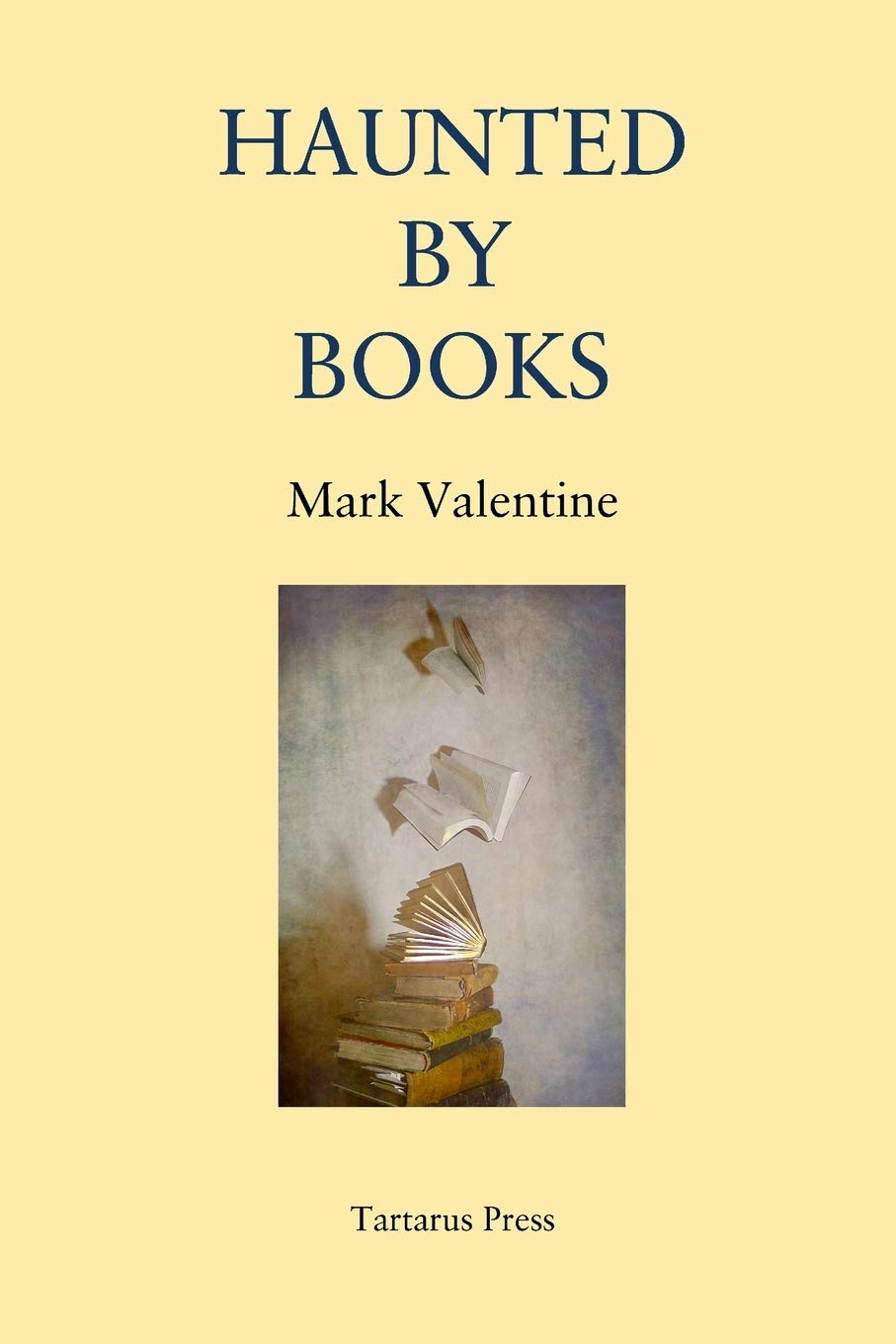
A taste for old, forlorn things: Haunted by Books by Mark Valentine

I read Mark Valentine's 2015 non-fiction collection Haunted by Books over the weekend. By the time I closed the ebook, I had reserved 59 of the mentioned book  titles from the Cleveland Public Library's online catalogue. That is the best testament I can give to the power of Valentine's perspicacity and enthusiasm as a writer and critic.


Most of the books and writers discussed in this collection of articles are new to me. Most have roots (physical or intellectual) in the aesthetic and esoteric world of 1890s UK bohemian books and publishing. Valentine recalls and beautifully memorializes the fallen, the forgotten, the overlooked. Many authors he extols were simply also-rans in the remorseless world of capitalist publishing; others were never-rans. Some ended as suicides, exhausted by the poverty and sheer hard work of trying to live by one's pen.


The excerpts below will suggested the strengths of this collection better than my words.


Jay

17 September 2017


***


Introduction

....if you look long enough and often enough at many shelves of books, some wonderfully unexpected finds are likely to come your way. But is that all that is in play? Do book collectors develop a mysterious extra sense? Or do some books call to them, as AE suggested? It may never make the headlines, but I suggest there is at moments a strange and subtle sorcery in the art and craft of book collecting.


Studies of Sad Beauty: Robert Aickman, Philip Steegman & Arthington Worsley

....In writing of W.H. Mallock’s book The New Republic — or Culture, Faith, and Philosophy in an English Country House (1877), a favourite of his from school-days, Aickman said it was ‘much more than the clever satire on a group of famous men that it appears to be’ because ‘behind the follies and light caricatures which are the ostensible subject-matter, one feels, though in the most delicate way, the tragedy, futility, and sad beauty of man’s aspirations, especially at their highest.’


In virtually every character study Aickman gives us in his memoir, these qualities are present. There is, in these brief examples, the ‘sad beauty’ of writing books (whether on Monism or a visit to India); the futility of ‘picking up’ a medal or marrying the marketer of a tomato cure; the tragedy that, after all such activities, all lives are only ‘solved’ by dying. Most notable, though, is that phrase ‘in the most delicate way’. Aickman also said of Mallock’s book that it had ‘a subtle and unique poetry, underlying but ever glimmering through’. And he famously said that the ghost story at its best was ‘akin to poetry’. We may see from these remarks that to Aickman ‘poetry’ was a term of high praise, and meant something elusive and luminous. So in The Attempted Rescue he does not choose to tell us all he can about the people he knew — of how Philip died, for example, or of how he might earlier have died, had it not been for two strange twists of fate. He seeks a poetic brevity. As in his stories, we have to find our way, if we can, to the unsaid and unseen — for he prefers reticence, allusiveness, and mystery.


A Dandysme of the Soul: Michael Arlen

....The strikingly-entitled Hell! Said the Duchess (1934) was closer to Arlen’s usual territory and did indeed achieve more success. Arlen catches some of the contemporary turmoil of the 1930s, with the unemployment marches, Fascist and Communist demonstrations, social upheaval and a ponderous, stagnant National Government. But this forms the background to a bizarre thriller about a series of ‘Jane the Ripper’ murders perpetrated by a young, unknown feminine killer on working class men. The beautiful Duchess of Dove is suspected, but Scotland Yard cannot bring themselves to believe that an aristocrat could be responsible, especially in view of the sexual nature of the crimes. As agitation to arrest the irreproachable Duchess increases, a private detective begins to find discrepancies in the case against her. In a strong and rather daring

climax to the novel, we learn that the Duchess’s semblance is seized and misused at intervals by an evil spirit of sin incarnate whose real form is closer to that of the serpent or dark slime. There are echoes of Jekyll and Hyde or Arthur Machen’s The Great God Pan.


Inner Bohemia: The Mystical Fiction of Mary Butts

....Armed with Madness , in my view [Mary Butts'] most fully-achieved work, gathers a group of impoverished bohemians in a house hidden in a hollow of the Dorset coast, like Salterns. Some of them, staying in a neighbouring farm, have fished out an agate cup from a spring, and they speculate that it might have attributes of the Grail. The talisman divides and challenges them, some treating it with reverence, others with disrespect. Their shifting relationships also become tense. Mary Butts believed, or was prepared to believe, that sometimes events and emblems in this world are a mirror of far greater movements in higher dimensions, and that is the sense we gain from this book. The actions of her characters are on one level to be seen as the fractious, creative, unconventional, wayward deeds of a group of slightly spoiled people, but there is more here, for it may be that they are aspects of the ageless, amoral deities: what she identified in her journals as ‘the beautiful interesting potencies that acknowledged no human values,’ known and understood most by the Greeks.

(n.b. Shades of Simon Raven! - JR)


With Whisperings and Mumblings: Walter de la Mare’s ‘Seaton’s Aunt’

....[Forrest Reid] concludes by ranking ‘Seaton’s Aunt’ very highly, with The Turn of the Screw and a few of Poe’s tales, and notes that this is because of ‘the very absence from it of a visible ghost’, for ‘It is not the ghost but the person who sees the ghost that matters’: the writer who can convey to us convincingly the deterioration of a mind succumbing to invisible presences will succeed far more, and at a higher level, than he who bodies forth the ghastly being itself, no matter how tactfully done. This is a lesson which could usefully be studied by all who write in this field.

....It is a characteristic mark of de la Mare’s craft, in his poetry and his anthologies and his stories, to provide finely deployed, delicately expressed, timeless and dreamlike images which work old, old spells in the reader’s mind. It is to our rarer, inner senses that de la Mare’s writing appeals, and that is why it is so hard to fix to his highest stories any one simple meaning in the outside world.


The Stranger Who Opens the Door: The Novels of Claude Houghton

....It was their duty to harness this power, but without losing their essential humanity—he had no time for the idea that such visionaries were superior beings; they were still fully human, and vulnerable. It’s important to note that Houghton's philosophy did not draw him towards any of the noxious political movements of the 1930s, proclaiming the advent of the Overman. His sight seems to have been fixed well beyond the politics of the day. And in his books, where a figure has achieved higher (mystical) powers, it is a matter for humility and care, for these are elusive and potentially perilous: ‘The soul in each of us is like a seed in that only in silence, in darkness, and in secrecy can it begin its ascent towards perfection.’


Goodbye, Mr Fothergill: James Hilton’s Knight Without Armour

....An Englishman abroad is plunged into a maelstrom in a foreign country where anarchy and chaos are in play. He is kept prisoner, assimilates himself to the new society he finds, has to make his escape, falls in love with a woman of the country, but finds it is a love that cannot survive beyond the boundaries of her world. Of course, the differences are more striking than these similarities. Undoubtedly it was the mystical element and the more exotic setting in Lost Horizon that won the hearts of readers. Yet one can see how in a certain sense Knight Without Armour is a precursor, a preparation and exploration of what was to come. It may not be stretching things too far, also, to see some qualities in the Russian book in common with Hilton’s other remembered classic, Goodbye, Mr Chips. Both books centre on an unassuming hero, apparently towards the twilight of unremarkable lives, who both in fact have strong and moving stories to tell.


‘A Demon in Reverse’: Cosnahan’s Magical Influences

....Algernon Blackwood (1869-1951) was foremost a writer of supernatural fiction and stories of wonder in nature who had, by the time of Lowry’s story, earned a reputation simply as ‘the Ghost Man’, from his yarns told to BBC audiences. His books are suffused with lyrical evocations of pantheistic awe. He was for a while in the 1890s, a member, with Yeats, Arthur Machen, Florence Farr and others, of the Hermetic Order of the Golden Dawn. His work continued to draw upon the order’s teachings and rituals, in veiled form, for some years afterwards.


Under This Strange Grey Sky: The Fantasies of Vernon Knowles

....His second book of short stories, Here and Otherwhere , followed swiftly at the end of 1926. It has a dedicatory note to a friend in Australia, John Jeffreys, ‘as an earnest of my love’, trying to lure him to

England, where (he says) happiness might be found, if only one looks for it ‘by the cunning method of glancing from out of the corner of one’s eye’. This jocular note does, however, hint at a sense in many of his stories that what we seek for should not be too directly addressed, for fear it will disappear—a superstition that we again may feel has its origin in a childhood so full of wonder, and wonder so suddenly lost, that the author will never quite trust any semblance of it ever again.


....In two other stories, ‘The Painter of Trees’ and ‘The Road to Tolbrisa’, Knowles conveys with economy the power and otherness of trees, somewhat from the same angle as some of Algernon Blackwood’s stories, though without that author’s pantheistic ardour or (it must be said) diffuseness of expression.


Perhaps the most successful accomplishment in the book is the four tales in ‘A Set of Chinese Boxes’, which may suffer from its title. The story is nothing to do with orientalia, and the title only indicates that the tales fit one inside the other (like a Russian doll). The central conceit is of a close friend of the author who is dying in part because he has lost the will to live: his doctor urges the author to think of some scheme to stimulate this lost verve. The narrator brings four strangers to the patient’s room, each with a highly curious and improbable encounter to tell, illustrating the strangeness and eccentricity of our existence. The cure works: the patient is baffled, intrigued, uncertain about what he is hearing from visitors who tell him in all studied seriousness these incredible things. He recovers: the secret is revealed; he has been hoaxed; the strangers were actors coached by the author to tell convincingly stories he invented. His friend’s laughter is evidence of his health restored. This play upon the treachery of tales told belongs in the same tradition as the tall tales in Arthur Machen’s The Three Impostors, or the paradoxes—true but in an oblique, unexpected way—of Chesterton in The Club of Queer Trades and others.


....Certain recurring themes, familiar in the literature—searching for wonder from within a humdrum world, the separation of selves, the sinister twists that come from wishes—suggest to us an author who has a vision to express that he has not quite fully made his own.


The Writer in the Railway Carriage: H.A. Manhood

....It was A.E. Coppard who noted that the short story should not be seen as a cut-down version of the novel: it was a different (and older) form with its origins in the folk tale and fairy tale, the fireside yarn, the pub anecdote. These sources influence our expectations: we look for evidence of the universal in the local, of the general lot in the particular fate. At the same time, we also seek to hear of the exception: the curious, the strange, the untoward; because they are an inevitable part of our existence too and perhaps what gives it spice.


....Cape saw and tried to convey this dual achievement too: the publisher advised readers that he ‘pleases the connoisseur who likes something out-of-the-way and well composed’: yet also ‘the general public which demands to hear a tale intriguingly told’.


....He went on, however, to stress, with some diffidence, that the incidental inspiration for a tale then needed significant work before it was fit for a story of his: ‘As a rule the shape is co n ceived quickly, flowing naturally and inevitably, as a day, our human day, may be said to flow, to be shaped between dawn and dusk; a large comparison perhaps, but then the matter of a story, spaced over many days in the writing, is a large matter for the writer at the time, however trivial the result may seem to a reader without patience or imagination.’


....If there is a theory of life in his stories, it is a rough-and-ready one, that relishes most its irony, the way things often work out differently to our plans, all in spite of our intentions. But there is no sense of any hidden order, nor any mover of fates, however implacable and inscrutable (as, for example, in the stories of T.F. Powys). If there are any lessons to be drawn (although Manhood’s work does not insist upon them), then they are purely about human conduct, and do not exemplify any particular moral framework. They are the shrewd observations one might expect from the way he led his own life: that it is unwise to poke our noses into others’ affairs, even if we think we are intent on doing good; that help and hindrance may still come from where we least expect it; that people can be both cruel and tender, or (as his own title had it) fierce and gentle. Gods, ghosts, spirits, devils are mostly (though not entirely) absent: at any rate, they are not active intruders. Far more of good and evil is worked by humankind, Manhood’s stories tell us. But perhaps most of all what they suggest is that there is material for a good story, rightly observed—and properly told, by a master craftsman—in the lives of almost anyone.


And I’d Be The King of China: The Strange Life of Charles Welsh Mason

....There was a long tradition in British India of young army officers taking ‘shooting leave’ to go on convenient private expeditions incognito in unmapped Central Asia, often returning with valuable intelligence. If caught, they could of course be disowned.


....Looking back on his scheme to seize power in China, in his Confessions , Mason was rueful but unrepentant, and convinced he still had some special destiny: ‘I am supposed to have had many “adventures” of a romantic sort,’ he wrote, ‘but in my own mind the only adventure of my life has been the obstinacy with which I have adhered to an insane resolution of my youth. Not only did it expose me to a cruel and instant punishment, but the chains of its aftermath have clanked at my heels in every step I have taken during the subsequent thirty odd years. Through the hardships, sufferings, struggles and defiances of all those years in many lands that resolution has been my guiding star; and it remains so still when I am now an old man, apparently a bit of damaged goods on the edge of the scrap-heap, but in my own secret and dour heart still the same young man, and still believing that I have another life before me in which I shall yet achieve the preposterous ambitions which haunted me....


Masks in Flanders: Major Morris’ Lost Classic

....W.F. Morris’s books have a distinctive quality: he was not content to write just a mystery, just a spy thriller (though he was very deft at both of those forms, as Ambler had attested), but he put into his books also understated humour, observant realism, thoughtfulness, a cast of well-bodied characters. Morris understands perfectly well his duties as a story-teller, and he holds and compels the reader: and he refuses also, because of this, to put up great high signals of solemnity and portent about his book, though that does not mean we should not take it seriously as good literature.


Offerings to Mercury

....the fascination of finding out how books were received when they first came out: and wondering what you would have bought for your bookshelves then.


Viper in the Temple: The Novels of L.H. Myers

....As the sequence [The Near and the Far] is by far Myers’ most major work, it is probably important to say what it is not. It does not comprise a set of ‘historical novels’ with the main purpose of exploring events and characters of the Moghul period. Nor is it an occult thriller drawing on the theosophists’ fascination with the mystic East. It is not an allegory of British imperialism in India. But what it is, most of all, is a novel of ideas. Myers wanted to choose a setting sufficiently remote so that his readers would not be distracted by any social preconceptions. He also wanted characters who could be more contemplative and concerned with spiritual realities than is common in modern Europe. And it is clear he also wanted a world where dramas of power, ritual, love, corruption and faith could be played out on a magnificent scale. ‘It was my object to create a world that I liked better than the existing one,’ he wrote to L.P. Hartley in 1929 and, to another friend, he said the work ‘does assert a dignity in the human mind that is truly there.’ But readers need not fear that the books will be overly dry or theoretical. Although Myers never visited India, and the incidental detail in the work is drawn from books, he does succeed in evoking a vivid, living world which the reader trusts; the characters, landscape, palaces and temples are far from being an abstract allegorical framework.


Lost Radiance: The Fiction of Lewis Grassic Gibbon

....he perfected a way of writing that captured the rhythm and current of Scots speech without relying on the condescending literary convention of showing dialect phonetically, and full of apostrophes. It was a remarkable fusion of lucid English prose with the authentic voice of his homeland. The success of this experiment was well-recognised by his compatriots. Fellow-writer Neil Gunn noted that you could hear the very earth speak in his prose, and critic Ivor Brown claimed, ‘It was the voice of Scotland’s past, almost of all antiquity . . .’


The narrative of the novel, too, won acclaim. Mitchell was writing now of what he really knew, the land and the people of his upbringing. The character of the socially and spiritually awakened young woman, Chris Guthrie, is unforgettable, and her progress through the three novels that comprise A Scots Quair, has spoken intensely to many readers. Sunset Song was quickly recognised as a distinctive and significant work by literary professionals, but just as important for the author must have been the many warm and grateful letters he received from ordinary readers. It remains the best-loved of his books. Though not an outright fantasy as such, the celebration of a closeness to the land and a sense of the ancient powers latent within it has echoes of the work of earlier pantheists such as Algernon Blackwood, though without his overt occultism.


Jerusalem in England: A Note on the Work of L. Furze Morrish

....Perhaps one of the more curious elements of what is indeed a very curious book [Bridge Over Dark Gods] is its adherence to the legend of ‘the English Jerusalem’, the belief that Joseph of Arimathea brought the young Jesus to Britain for a period, and returned, after the Passion to seed the new faith in that far island. His sanctuary was said to be at Glastonbury, where the legend of the holy thorn that grew where he planted his staff in Wearyall Hill, is still prevalent. The Somerset town, with its strange high tor, has been the focus of considerable spiritual activity in a revival now over a century old, and in the 1930s it was described as ‘the English Jerusalem’. The legend is immortalised, of course, in the William Blake poem beginning ‘And did those feet, in ancient time/Walk upon England’s mountains green?’, put to stirring music by Hubert Parry, and sung on patriotic occasions.


....The type of fiction exemplified by Bridge Over Dark Gods is not often highly regarded by commentators on, or readers of, fantastic literature.


....Books such as Bridge Over Dark Gods and its peers help to illumine recurring motifs in spiritual history that are often held, in varying degrees and forms, by many thoughtful people. They merit sympathetic, if not unreserved, reading, and will repay this with their qualities of originality, ardour and strangeness, seldom found in more conventional or commercial work.


‘I Walk Through the World’: The Writings of Geoffrey Pollett

....I found a copy of Song for Sixpence with a press cutting about his death. It reported that he took his own life by gas (like the mercurial composer Peter Warlock) aged twenty-nine in May 1937 ‘in his poorly furnished room in Long Acre, W.C.’ because he was at ‘the end of his financial tether’. The report says he left a poem to a ‘mystery girl’ and quotes the last verse. A friend, the artist Milton Lucas, said she had paid a visit to the poet on the day of his death. There is a picture of the poet striding along in jacket and tie and bags. Given the strong character and friendly disposition that comes across so engagingly in his book, this seems a tragic ending.


Mr Shakespeare’s Gunpowder Plot

....For some people, thirty-seven has never been enough, and there has grown up a whole side-study of ‘Shakespeare Apocrypha’. As well as some plays where there are genuine causes for debate, because of the conventions (or lack of them) of authorship in the sixteenth and early seventeenth century stage, there have also been numerous hoaxes, forgeries and examples of wishful thinking. The earliest major survey of all the unaccepted candidates for the canon then known was by C.F. Tucker Brooke in 1908 ( The Shakespeare Apocrypha ). One internet checklist identifies over forty examples now.


....in the apocrypha, people are trying to show that Shakespeare wrote rather more than is currently acknowledged.


....the complete extent of the canon has never been universally agreed at any time since Shakespeare’s death, and fresh admissions even now cannot be ruled out.


The Fifth of November, or, The Gunpowder Plot, by ‘William Shakspeare’ (sic) is a five act play, 100pp in text, portraying two interlocking groups—King James I and his courtiers, and Robert Catesby and the conspirators.


They stride across the stage in fine set-pieces, sharpening their wits and their swords. It opens on Westminster Bridge, with Catesby and Percy regarding Parliament and envisioning its fate—‘This night, my Percy, we will light a blaze/To shame the torch of Phoebus—’ and continues in the cellars of the Palace with some dark repartee with Guy Fawkes, who is readying the fuses. The second act introduces the King, and shows the betrayal and discovery of the Plot. In the third act, the conspirators are shown in escape and flight, and in the fourth act they do battle with their pursuers. The final act shows their capture, imprisonment, and the verdicts of the King. In this most masculine of plots, love interest is contrived through the fears and bravery of wives or lovers.


An anonymous introductory note tells us the play was ‘supposed to have been written by Shakspeare during the short period between his retirement into the country and his death, in 1616, and about ten years after the discovery of the Gunpowder Plot’.


The James I of The Fifth of November is depicted as vain, over-familiar with his favourites, foolish in adversity, unintelligent in strategy and without magnanimity in victory. No such play could have been performed during the King’s reign, nor was it likely to have been written.


....The author was in fact George Ambrose Rhodes, and it is believed that he owned up to it not longer after the play appeared.


The MS in a Red Box

....The mystery manuscript was a great historical romance in the tradition of Stevenson and Scott, about the seventeenth century struggle between the proud and independent people of the Isle of Axholme in Lincolnshire and the Dutch drainage lords who had come to change their world forever, and drive them from their lands. It was a gripping, twisting and turning, swashbuckling, yet also thoughtful and sometimes eerie book, with the isolated marshlands of Axholme so strongly evoked that the reader almost felt they had lived there themselves.


....there are weird visions and curses, and the sense of an inexorable working-out of fate.


....The Isle of Axholme was, until the Dutch drainage in the seventeenth century which the book depicts, a real inland island, surrounded by three rivers at their widest span, and enterable only by ferry. Even within the land that the rivers coiled around, much of the terrain was inhospitable marshland, whose narrow and uncertain tracks only natives knew thoroughly. Islonians, as they were called, would even use stilts to get around the murky, water-logged wastelands. Axholme was, in fact, a series of islands: one long ridge in the middle, bearing four villages upon it, some outlying outcrops with smaller settlements, and a few ferry cottages by the river crossings. The dominance of the rivers is well documented in a local history book, G. Dunston ’ s The Rivers of Axholme (c.1909).


Axholme was also the scene of a mysterious conflagration in the Dark Ages, recorded by a monkish chronicler, which denuded it of vegetation, burned trees down to their roots and even scorched stone and rocks. It is thought that this must have been caused by a fireball.


....Might the author have been Allan Fea (1860-1956)? So far as I am aware, this theory has not been put forward before now. A historian of the seventeenth century, he was fully versed in the period of the book. His study of the Sedgemoor rebellion led by the Duke of Monmouth, which Lane had published the year before, has many parallels: an armed uprising against the authority of the King, set in a marshland domain with its own traditions and pride. And Fea was already a John Lane author. A historian and antiquary, he might not want to be associated with a work of fiction, a romance. So he could have either sent the book to Lane anonymously, in the red box, just as Lane recounted: or collaborated with him on an elaborate hoax.


The Mysteries of the Pomegranate: Sax Rohmer’s The Orchard of Tears

....A counterpoint to [The Orchard of Tears' hero Paul] Mario comes from his bluffer, kindlier college friend, Captain Donald Courtier (whose name perhaps suggests one of Michael Arlen’s dashing modern cavaliers). Flamby’s father saved his life in the trenches, and he has appointed himself her unofficial guardian. He also acts as a calming influence on Mario, warning him of false friends and bringing a lightness to Mario’s otherwise fervent, fevered visionary life. When Mario is expatiating upon the mystic resonance of certain names (‘the phrase “cherry blossom in Japan” bears me upon a magical carpet to a certain street in Yokohama and there unveils to me all the secrets of Japanese mysticism’), Courtier wryly deflates the bombast: ‘I quite see your point . . . I have never ceased to regret that I was not born in Ashby-de-la-Zouch. The possession of such a euphonious birthplace would have coloured all my life’.


....Does The Orchard of Tears therefore merit very much attention nearly a hundred years later? I suggest that it does, because Rohmer uses the book to explore and propound his own beliefs, and these are interesting both for what they tell us about him, and for their reflection of a certain trend of thought in his time. They would not have been novel to a segment of his readership, versed in Theosophy or the early New Age, but Rohmer ev i dently thought his more general readership would find his ideas startling, and takes pains to justify them through his characters. In his The Romance of Sorcery (1914), he had already outlined on the opening page the framework that later informed his novel:


Today is notable for a curious change in Western thought, or properly, in a phase of Western thought, more appreciable by churchmen, theosophists, and other students of the Unseen than by the laymen. I refer to a growing discontent with, and a falling away from, revealed religion. It is an age of groping; and whereas one who stumbles onwards in the mist nearly always strays from the broad highway into the bypaths that lead to the mere, some may strike a fair and narrow road and emerge upon the mountain top....


....The first hint of the spiritual ambitions in the book comes in Chapter X, when Mario is wandering in the heaths near his purchased mansion. Rohmer’s prose rises almost to the heights of Arthur Machen’s in his description of an occult terrain. There is just a shade less poetry and incantatory sorcery than in the Welsh master, but he is certainly writing at a higher pitch than is usual in his thrillers. He even includes a Machenesque swipe at Puritans, the dour Roundheads who, ‘with their pitiless creed, had failed to destroy the fragrant sanctity’ of a little village church in the valley, a sanctity ‘which lingered in these foot-worn aisles like the memory of incense’. But Mario’s wandering culminates in a vision of a stark spiritual terror:


In the emotional vision of Paul, horror rode the tempest. Man, discarding the emblem of the Cross, and prostrating himself at the feet of strange idols, now was chained to a planet deserted by God, doomed and left to the mercy of monstrous earth spirits revitalised by homage and made potent again. . . . Fear touched him, because the Divine face was turned from man. Awe wrapped him about, because the Word had failed to redeem, and a new message must be given. The Prince of Darkness became a real figure—and seemed to be very near him. ( The Orchard of Tears, 1918.)


....Rohmer summaries its contentions: ‘the systems of Hermes, Krishna, Confucius, Moses, Orpheus and Christ were based upon a common primeval truth. . . . All of them had taught that man is re-incarnated, and because Western thought had been diverted from the truth and the fallacies of Heaven, Hell and Purgatory substituted for simple Rebirth, Western thought had become chaotic’. Rohmer is here following the Theosophical teaching of the universal religion, and Theosophy was already over forty years old, with a worldwide following of thousands: its ideas had permeated more widely still. But his plot depends upon the reader believing that the ideas of reincarnation and the universal religion would be received by the contemporary public as remarkable revelations, provoking scandal, opposition and hot debate: and this Rohmer never really succeeds in demonstrating.


....Rohmer is struggling hard to explain profound esoteric thinking as clearly as he can, but the result may have left many of his readers, hoping for a jaunty thriller with an exciting occult seasoning, somewhat bemused and perplexed. He was not the only author of occult romances to come up against this difficulty: Algernon Blackwood and Charles Williams, for example, also resorted to capitalised concepts to try to convey spiritual truths, but with no greater success. When all three use poetic metaphor instead, their work catches light, and the reader is given glimpses of far vistas, secret domains, living nature and the signs and symbols that lay all around us.


....like Holmes’ case of the Giant Rat of  Sumatra, it is a story for which the world is not yet prepared. Mario had told Courtier that ‘there are . . . wonderful things at Thessaly’s house’, hinting that there will be further revelations derived from the ancient and mystic trove that the wealthy collector has assembled: and Rohmer unveils some of the idols that Thessaly has loaned to Mario to keep in his studio. Prominent among them are the goddesses of love and desire: Kali, Venus Urania, Ashtaroth, daughter of Sin, ‘a wonderfully preserved ivory figure, half woman and half fish, of Derceto of Ascalon’, and ‘the tainted Isis whose lascivious rites were celebrated in Pompeii’. Here the author is hinting at the erotic complications that will eventually destroy Mario’s vision. His wife, neglected by Mario because of the intensity of his work, has taken a lover, a bohemian artist; Mario himself has a suppressed, sublimated love for Flamby, in unconscious rivalry with Captain Courtier, his closest friend. Rohmer intertwines these relationships with deft skill, showing how their deceptions and frustrations must undo the higher task Mario has set himself. The book ends with the conclusive abnegation of his vision, at least in this life.


Possible Masterpieces: The Novels of J.C. Snaith

....Like M.P. Shiel and Frederick Rolfe, Baron Corvo, who also both did not go to a university, Snaith’s work was streaked through with an idiosyncratic personal vision and an extravagance in language and plot.


The Ultimate Oddness: A Book of Whimsies

....The volume has the air of a youthful jeu d’esprit . Connoisseurs of dedications will enjoy its tongue-in-cheek address to various respectable persons: ‘To the middle-aged of heart we dedicate this book—to all thoroughly dependable persons—to thin persons—to all persons in any way fitted for legal or parliamentary activity—to the Lord Mayor—to the Episcopate—and to all vergers—upon whose souls may God have mercy.’


....Though the tone is facetious, their credo is quite clear and consistent and is not remote, in its way, from that of Arthur Machen, seeing romance and the inexplicable in the world before us, in the purlieus of Stoke Newington, for example, or the high road of Holborn. These younger authors assert that what we call whimsy ‘depends on a recognition of the ultimate oddness of all phenomena’.


....The word ‘whimsy’ has drawn to itself connotations of the fey but originally it was more robust than that, and could be used to describe most peculiar and original ideas.


Secret Names: The Hermetic Fiction of Peter Vansittart

....He sees history as most often formed by muddle, chance, fickleness, fraud, failure of understanding. His perspective is mostly pessimistic yet leavened by a fascination with the sheer sprawling denseness of life and by a delicate handling of that last refuge, irony.


‘Or Opaline Algol’: A Lost Edwardian Poet

....we may never know who wrote all these rather swooning Swinburnean lines in the brittle beige paper wrappers. That seems a loss, but it must be a fate the poet foresaw when they refrained from putting their name or even a pseudonym to the pamphlet. There is a pessimism about human vanities in most of the verses, and several times the poet, perhaps in their own person and not as a posed character, speaks of a doom upon their destiny. They must, however, have hoped the verses themselves would find appreciative readers....


A Small Place of Worship: The Last of the Johnsonians

....When the housing estate where I grew up had been built, a part of the land had been left as a park or rather, in the parlance of the times, a recreation ground. We called it The Field. It was surrounded on all sides by houses: one of these sides was our road, and our house backed onto it, divided by a hedge, through which, when small, I could crawl, using a hollow that closed after me as I passed through. My bedroom window looked out upon The Field. Opposite, at the far end of my view, was a large house guarded by a pine tree and a fir which, darkly etched against the sunset, often seemed to me solemn and mysterious.


....I began to cycle out to the villages lying beyond where I lived, in the segment of the county to the south and west: it was rarer for me to go north or east, as that would mean a long ride through the town at the start, and I wanted to be quickly out in less-used roads and among trees and fields. It was not easy at first to find out where I should go: I would choose a village and simply see what was there, often finding it unremarkable, and wishing it was more mysterious, like the country I read about in books. After a while, however, I began to go to places guided by pieces of information I had found, which had some suggestion of promise.


....I was always hoping, when I went on these lonely forays, to encounter some hint of the eerie, such as I had read about in the ghost stories I was already enjoying. I could not honestly say I found anything precisely of that kind here, except that I was certainly conscious of the presence of sadness, and a sadness that did not seem wholly due to the dull weather or the desolate little spot. I wanted quite soon both to go away, for the sadness seemed to bear down upon me, and to stay, for I wanted to know if anything else would reach out to me.


....the peculiar teachings of John Johnson, a Cheshire preacher. His most important belief was that faith may only be received as an act of grace from God, and cannot be earned or cultivated. There was perhaps an implication—and this was what must have scandalised contemporaries—that people were therefore free to go their own way, in the knowledge that none of the usual pious duties would make any difference. Certainly, Johnson seems to have been an original thinker in many other respects, often questioning conventional views. He asked the awkward, and unanswerable, question, of whether there would have been any need for redemption if man had never sinned. He was unconvinced by the doctrine of the trinity.


....There is something of a tradition of hatters and radical nonconformity, and indeed one source for the phrase ‘mad as a hatter’ derives it from Roger Crabbe, a seventeenth-century prophet and hatter, the author of The English Hermite, or Wonder of the Age (1655), an autobiography, and Dragons Downfall, or The Great Idol Digged Up (1657).


What Became of Dr Ludovicus: Ernest Dowson & Arthur Moore’s Lost Shocker

....Their first collaboration [The Passion of Dr Ludovicus], enticing-sounding to the connoisseur of the curious and fantastical in literature, seems to have disappeared. There have been rumours of the manuscript: but no part of it has ever been produced, or published. We do, however, have Dowson’s description of it in letters to his collaborator, Moore: and there is enough in these to give us a very good idea of what we have lost. The Passion of Dr Ludovicus , which they began while at Oxford, was, it seems, meant to be a ‘shocker’, as the Victorians called them, an exciting and outré tale with macabre and bizarre elements. The plot, as Dowson discusses it, seems quite Stevensonian: we are in a similar realm to his Strange Case of Dr Jekyll & Mr Hyde (1886), a great success just three years before they worked on their book. It seems surprising that the authors could not find a willing publisher for it, despite several attempts. After all, this was the period of Wilde’s The Picture of Dorian Gray (1890), Arthur Machen’s The Great God Pan (1894), M.P. Shiel’s Prince Zaleski (1895), and other strange and extravagant romances.


....The two collaborators composed their joint books by each writing alternate chapters in a shared notebook which passed between them, usually by post.


Wraiths: Some Lost Poets of the 1890

....there is perhaps a borderland even beyond these strange and beautiful books, and even more keenly evocative of their dying era. This pallid margin is haunted by the poets whose poems are lost utterly, or seem to be. We know that they wrote, we have descriptions of their work, we know a little of their life, but nothing whatever, or nearly nothing, has survived of their art. There are just chance references to them, buried in obscure letters or memoirs, and we are left to imagine what their work might have been. To have written poems that no longer exist, that never knew even the embrace of a volume’s vellum boards or the delicate caress of paper wrappers: in that ultimate obscurity, that aery evanescence, is there not something even more fin-de-siècle, more fleeting and fugacious yet, than the slim volume? That is, to be the author of a volume so slim as not even to exist.


The Piccadilly Goat

....G.F. Monkshood, author of a volume of decadent verse, Nightshades , privately printed in Paris (1899) and a later book of aphorisms, The Cynic’s Posy (1904), wrote a vignette for The Unicorn around this time which celebrated The Piccadilly Goat as a ‘pale-cloaked, cloven-hoofed lord’, fork-bearded and opaline-eyed, and suggested he might be a reincarnated magus observing sardonically the vanities of mortals.


Reviews of Unwritten Books

....For a few moments, when I chanced upon such words, I found myself imagining an alternative world where Father Rolfe was known, not for his works of devotion, not for his fine church, nor for his near-sainted qualities, but as the carver of quaint intaglios of prose, his coinages adopted by admirers for knowing exchange, perhaps in cloister or common room, with a sly look in the eye, as if of the code-words for the initiates of a secret order. If I should be found one day murmuring to myself ‘diaphotic,’ ‘maleficial’, ‘sufflavian’, ‘evitate’ and ‘pompadouring’ you will know that I have been admitted to this arcane cult.


***