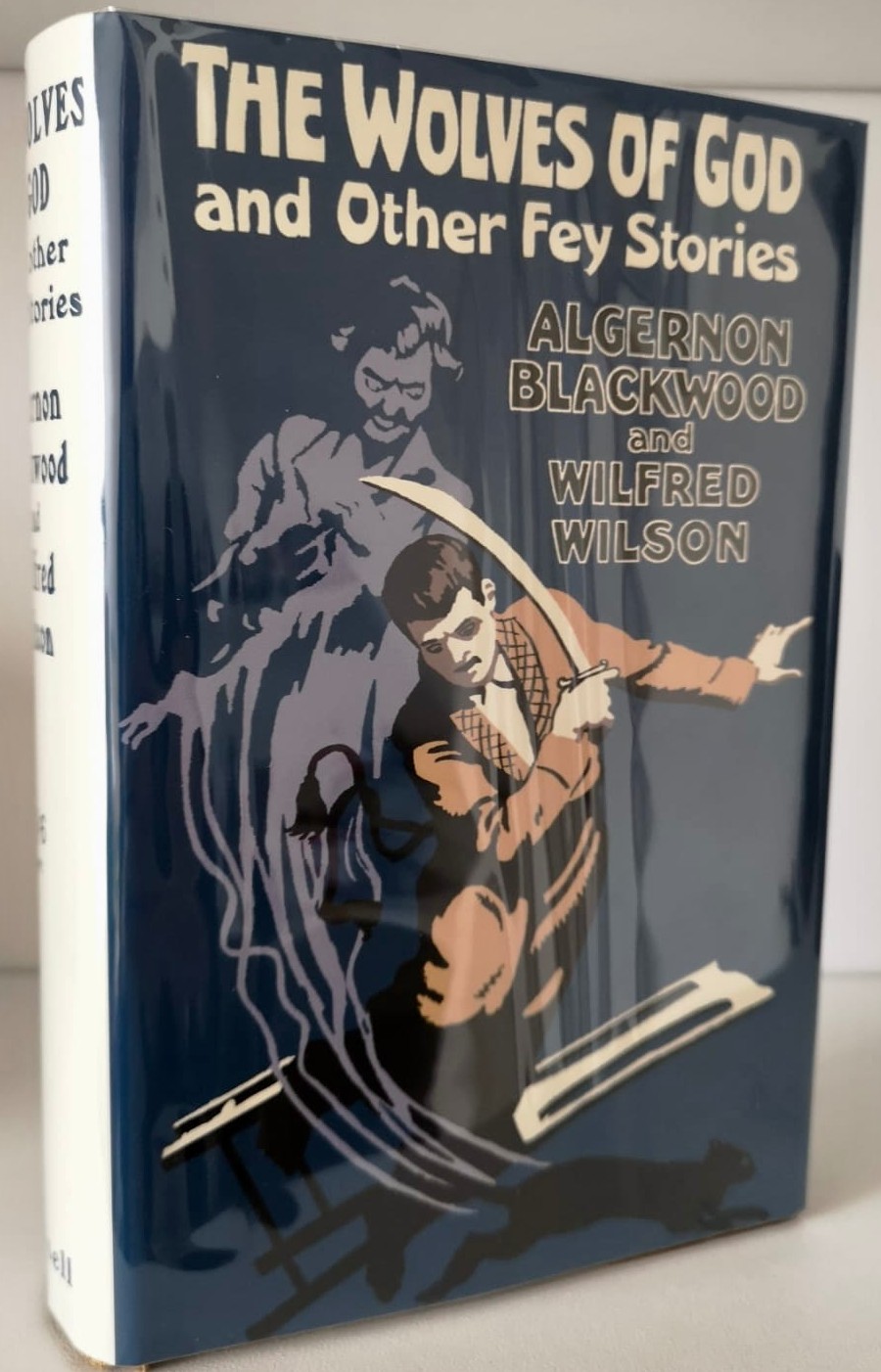
Readers who are unfamiliar with Wolves of God and Other Fey Stories may prefer to read these notes only after reading the stories.
* * *
"Hark!" cried Sandy's shrill voice. "Did you hear that? That wasn't wind, I'll swear." He sat up, looking for all the world like a dog pricking its ears to something no one else could hear.
"The sea coming over the dunes," said Rossiter. "There'll be an awful tide to-night and a terrible sea off the Swarf. Moon at the full, too." He cocked his head sideways to listen. The roaring was tremendous, waves and wind combining with a result that almost shook the ground. Rain hit the glass with incessant volleys like duck shot.
It was then that Jim spoke, having said no word for a long time.
"It's good there's no trees," he mentioned quietly. "I'm glad of that."
"There'd be fearful damage, wouldn't there?" remarked Sandy.
"They might fall on the house too."
But it was the tone Jim used that made Rossiter turn stiffly in his chair, looking first at the speaker, then at his brother. Tom caught both glances and saw the hard keen glitter in the eyes. This kind of talk, he decided, had got to stop, yet how to stop it he hardly knew, for his were not subtle methods, and rudeness to his guests ran too strong against the island customs. He refilled the glasses, thinking in his blunt fashion how best to achieve his object, when Sandy helped the situation without knowing it.
"That's my first," he observed, and all burst out laughing. For Sandy's tenth glass was equally his "first," and he absorbed his liquor like a sponge, yet showed no effects of it until the moment when he would suddenly collapse and sink helpless to the ground. The glass in question, however, was only his third, the final moment still far away.
"Three in one and one in three," said Rossiter, amid the general laughter, while Sandy, grave as a judge, half emptied it at a single gulp. Good- natured, obtuse as a cart-horse, the tropics, it seemed, had first worn out his nerves, then removed them entirely from his body. "That's Malay theology, I guess," finished Rossiter. And the laugh broke out again. Whereupon,
setting his glass down, Sandy offered his usual explanation that the hot lands had thinned his blood, that he felt the cold in these "arctic islands," and that alcohol was a necessity of life with him. Tom, grateful for the unexpected help, encouraged him to talk, and Sandy, accustomed to neglect as a rule, responded readily. Having saved the situation, however, he now unwittingly led it back into the danger zone.
"A night for tales, eh?" he remarked, as the wind came howling with a burst of strangest noises against the house. "Down there in the States," he went on, "they'd say the evil spirits were out. They're a superstitious crowd, the natives. I remember once — —" And he told a tale, half foolish, half interesting, of a mysterious track he had seen when following buffalo in the jungle. It ran close to the spoor of a wounded buffalo for miles, a track unlike that of any known animal, and the natives, though unable to name it, regarded it with awe. It was a good sign, a kill was certain. They said it was a spirit track.
"You got your buffalo?" asked Tom.
"Found him two miles away, lying dead. The mysterious spoor came to an end close beside the carcass. It didn't continue."
"And that reminds me — —" began old Rossiter, ignoring Tom's attempt to introduce another subject. He told them of the haunted island at Eagle River, and a tale of the man who would not stay buried on another island off the coast. From that he went on to describe the strange man-beast that hides in the deep forests of Labrador, manifesting but rarely, and dangerous to men who stray too far from camp, men with a passion for wild life over- strong in their blood — the great mythical Wendigo. And while he talked, Tom noticed that Sandy used each pause as a good moment for a drink, but that Jim's glass still remained untouched.
The atmosphere of incredible things, thus, grew in the little room, much as it gathers among the shadows round a forest camp-fire when men who have seen strange places of the world give tongue about them, knowing they will not be laughed at — an atmosphere, once established, it is vain to fight against. The ingrained superstition that hides in every mother's son comes up at such times to breathe. It came up now. Sandy, closer by several glasses to the moment, Tom saw, when he would be suddenly drunk, gave birth again, a tale this time of a Scottish planter who had brutally dismissed a native servant for no other reason than that he disliked him. The man disappeared completely, but the villagers hinted that he would — soon indeed that he had — come back, though "not quite as he went."
"The Wolves of God"
* * *
Blackwood biograprapher Mike Ashley sums up the 1921 collection Wolves of God and Other Fey Stories by Algernon Blackwood:
[....] The Wolves of God was published in April 1921. Although it did not receive rapturous reviews, the critics were generally in favour, commenting on the cleverness and ingenuity of the authors. There would be two more substantial collections of new stories from Blackwood, but Wolves is his last significant volume. The stories lack the power of his great works, but they are competent, professional pieces that show the mature mastery of a true storyteller, able to look back over a lifetime of experience and uncover the magic and mystery in every aspect of life.
* * *
The Wolves of God
(Orkneys)
"The Wolves of God" is an ambitious story about fate (or justice). Jim Peace returns to the family farm in the Orkneys, desperate for "the clean smells of open country" after decades of a career in Canadian tall timber.
Those thirty years in the woods, it seemed, oppressed his mind; the forests, the countless multitudes of trees, had wearied him. His nerves, perhaps, had suffered finally. Snow, frost and sun, stars, and the wind had been his companions during the long days and endless nights in his lonely Post, but chiefly — trees. Trees, trees, trees! On the whole, he had preferred them in stormy weather, though, in another way, their rigid hosts, 'mid the deep silence of still days, had been equally oppressive. In the clear sunlight of a windless day they assumed a waiting, listening, watching aspect that had something spectral in it....
Speaking personally, this is the type of story that first attracted me to Blackwood: the claustrophobic reaction to nature, depicted often as a veil obscuring one's antagonist or nemesis.
* * *
Chinese Magic
(London)
There is much that can be said against the story "Chinese Magic." On second reading, however, what seems like overreliance on coincidence is actually an effort to create an atmosphere of thickening inevitability. Like "The Wolves of God," it describes one man's return home from a foreign country, returning in this instance to London. It's a small world when first love and Sinophilia make their presence known. Arthur Morrison or R. Austin Freeman would have refolded the plot into backward-spinning murder mystery, which is one of the best arguments I know for Blackwood's superiority to other plotters.
* * *
Running Wolf
(Canada)
[....] Some hundred years before, the tribe that lived in the territory beyond the lake began their annual medicine-making ceremonies on the big rocky bluff at the northern end; but no medicine could be made. The spirits, declared the chief medicine man, would not answer. They were offended. An investigation followed. It was discovered that a young brave had recently killed a wolf, a thing strictly forbidden, since the wolf was the totem animal of the tribe. To make matters worse, the name of the guilty man was Running Wolf. The offence being unpardonable, the man was cursed and driven from the tribe:
"Go out. Wander alone among the woods, and if we see you we slay you. Your bones shall be scattered in the forest, and your spirit shall not enter the Happy Hunting Grounds till one of another race shall find and bury them."
"Which meant," explained Morton laconically, his only comment on the story, "probably for ever."
Superiority in plotting is also displayed in "Running Wolf." Malcolm Hyde, hotel clerk on a fishing holiday, solves the mystery of an unlucky spot on a lake "stiff with fish." Hyde's skill at solving the mystery comes from his patience and his quick grasp of clues that chased previous anglers away after a few days. "Running Wolf" is rich in detail and economically told.
* * *
First Hate
(Canada)
"There's first love. There's first hate, too."
If "Chinese Magic" creates a meaningful atmosphere for coincidence to play its part in the lives of two friends, then "First Hate" spectacularly deepens the lesson. Blackwood skilfully employs inevitability. When Ericssen ultimately tells two old friends the outcome of his first hate, classical unities are nearly all observed.
"I've felt dislike, but never hatred like that," Baynes mentioned. "I came across it in a book once, though. The writer did not mention the instinctive fear of the human animal for its natural enemy, or anything of that sort. He thought it was a continuance of a bitter feud begun in an earlier existence. He called it memory."
"Possibly," said Ericssen briefly. "My mind is not speculative. But I'm glad you spoke of fear. I left that out. The truth is, I feared the fellow, too, in a way; and had we ever met face to face in some wild country without witnesses I should have felt justified in drawing on him at sight, and he would have felt the same. Murder? If you like. I should call it self-defence. Anyhow, the fellow polluted the room for me. He spoilt the enjoyment of that dinner we had ordered months before in China."
* * *
The Tarn of Sacrifice
(Yorkshire)
On a walking tour in Yorkshire, at the meeting of Roman road, standing stone, tarn, and crag, a veteran of the Somme has a vision of... Well, he is made whole again, reconquers his love of life.
"The Tarn of Sacrifice" is also the story of past lives, of what today we would call a timeslip.
"I am glad that you have come at last," she said in a clear, strong voice that yet was soft and even tender. "We have been expecting you."
"You have been expecting me!" he repeated, astonished beyond words, yet finding the language natural, right and true. A stream of sweet feeling invaded him, his heart beat faster, he felt happy and at home in some extraordinary way he could not understand yet did not question.
Past and present meet and are recast in equipoise. Blackwood even grants the reader a slingshot epilogue, several years into the characters' common future. It is a poignant story of real emotional power.
* * *
The Valley of the Beasts
(Canada)
"The Valley of the Beasts" is an excellent evocation of what Blackwood came to love in the northern wilderness. The self-forgetting essential to literature aspiring to the Sublime is beautifully portrayed. The worst kind of hunter and man, Grimwood:
He was a slow-witted, heavy man, full-blooded, unobservant; a fact had to hurt him through his comfort, through his pleasure, before he noticed it....
Blackwood artfully and succinctly demonstrates the dawning of a mood of almost pagan agape.
* * *
The Call
(Sussex)
"You know, Dick," he went on in a low, half-reverent tone. "I don't want to marry. I never can."
Dick's heart stirred within him. "Mary," he said, understandingly.
The other nodded, as though the memories were still too much for him. "I'm still miserably lonely for her," he said. "Can't help it simply. I feel utterly lost without her. Her memory to me is everything." He looked deep into his pal's eyes. "I'm married to that," he added very firmly.
They pulled their cigarettes a moment in silence. They belonged to the male type that conceals emotion behind schoolboy language.
As it begins, "The Call" might be a setup for a Wodehouse love triangle comedy, perhaps "Tried in the Furnace." But Blackwood, here at his most lugubrious, has real fits of melancholy to explore in a couple of men "the wrong side of forty."
* * *
Egyptian Sorcery
(London)
"I'm a hell of a wreck," he said, as Morris came, beaming, to the bedside. "Have I been ill long? It's frightfully decent of you to come, old man."
But Morris, staggered at this greeting, stopped abruptly, half turning to the nurse for guidance. He seemed unable to find words. Sanfield was extremely annoyed; he showed his feeling. "I'm not balmy, you old ass!" he shouted. "I'm all right again, though very weak. But I wanted to ask you—oh, I remember now—I wanted to ask you about my—er—Deltas."
"My poor dear Maggie," stammered Morris, fumbling with his voice. "Don't worry about your few shares, darling. Deltas are all right—it's you we——"
"Why, the devil, do you call me Maggie?" snapped the other viciously. "And 'darling'!" He felt furious, exasperated. "Have you gone balmy, or have I? What in the world are you two up to?" His fury tired him. He lay back upon his pillows, fuming. Morris took a chair beside the bed; he put a hand gently on his wasted arm.
"My darling girl," he said, in what was intended to be a soothing voice, though it stirred the sick man again to fury beyond expression, "you must really keep quiet for a bit. You've had a very severe operation"—his voice shook a little—"but, thank God, you've pulled through and are now on the way to recovery. You are my sister Maggie. It will all come back to you when you're rested——"
"Maggie, indeed!" interrupted the other, trying to sit up again, but too weak to compass it. "Your sister! You bally idiot! Don't you know me? I wish to God the nurse wouldn't 'dear' me in that senseless way. And you, with your atrocious 'darling,' I'm not your precious sister Maggie. I'm—I'm George San——"
"Egyptian Sorcery" is mostly comedy and very little sorcery. Taking place in London, it depicts what today people would call an out of body experience; the term "astral projection" smacks too much of Madame Blavatsky or Shirley MacLaine.
* * *
The Decoy
(Kent)
"The Decoy" is an excellent example of Jack Sullivan's statement:
Blackwood could write effective indoor horror tales as well. Indeed, his haunted-house stories are as nasty and claustrophobic as his nature tales are lyrical and expansive. [The Penguin Encyclopedia of Horror and the Supernatural].
A husband, his younger wife, and her younger lover spend the right in an isolated country house to qualify for an inheritance. Atmosphere, an airless interior intensity, and raw nerves lay the trio open to something in the house that convinces each new inheritor to commit suicide.
[....] "There's a figure, remember," she said hurriedly, turning to gain her husband's attention, as when she touched wood at home. "A figure is seen; that's part of the story. The figure of a man." She gave a tiny shiver of pleasurable, half-imagined alarm as she took his arm.
"I hope we shall see it," he mentioned prosaically.
"I hope we shan't," she replied with emphasis. "It's only seen before—something happens." Her husband said nothing, while Mortimer remarked facetiously that it would be a pity if they had their trouble for nothing. "Something can hardly happen to all three of us," he said lightly, as they entered a large room where the paper-hangers had conveniently left a rough table of bare planks. Mrs. Burley, busy with her own thoughts, began to unpack the sandwiches and wine. Her husband strolled over to the window. He seemed restless.
"So this," his deep voice startled her, "is where one of us"—he looked round him—"is to——"
"John!" She stopped him sharply, with impatience. "Several times already I've begged you." Her voice rang rather shrill and querulous in the empty room, a new note in it. She was beginning to feel the atmosphere of the place, perhaps. On the sunny lawn it had not touched her, but now, with the fall of night, she was aware of it, as shadow called to shadow and the kingdom of darkness gathered power. Like a great whispering gallery, the whole house listened.
"Upon my word, Nancy," he said with contrition, as he came and sat down beside her, "I quite forgot again. Only I cannot take it seriously. It's so utterly unthinkable to me that a man——"
"But why evoke the idea at all?" she insisted in a lowered voice, that snapped despite its faintness. "Men, after all, don't do such things for nothing."
"We don't know everything in the universe, do we?" Mortimer put in, trying clumsily to support her. "All I know just now is that I'm famished and this veal and ham pie is delicious." He was very busy with his knife and fork. His foot rested lightly on her own beneath the table; he could not keep his eyes off her face; he was continually passing new edibles to her.
"No," agreed John Burley, "not everything. You're right there."
She kicked the younger man gently, flashing a warning with her eyes as well, while her husband, emptying his glass, his head thrown back, looked straight at them over the rim, apparently seeing nothing....
* * *
The Empty Sleeve
(London)
Like the M. R. James story "The Uncommon Prayer Book," Blackwood's "The Empty Sleeve" tells us about collectors nearly thwarted by a sneaky Jew: the Gilmer brothers, fussy bachelors, nearly lose their prized Guarnerius to Mr. Hyman. Hyman makes several runs at the violin he covets. Only later do the brothers find Hyman was out of the country at the time.
"The Empty Sleeve" is a minor tale of bilocation, and it never recovers from the use of Jew-hating clichés.
* * *
Wireless Confusion
(UK)
The phenomenon made one more appearance — the last — before its character, its field of action rather, altered. He was reading a book when the print became now large, now small; it blurred, grew remote and tiny, then so huge that a single word, a letter even, filled the whole page. He felt as if someone were playing optical tricks with the mechanism of his eyes, trying first one, then another focus.
More curious still, the meaning of the words themselves became uncertain; he did not understand them any more; the sentences lost their meaning, as though he read a strange language, or a language little known. The flash came then — someone was using his eyes — someone else was looking through them.
* * *
I did not read all the stories in Wolves of God and Other Fey Stories. In fact, I probably should have skipped more than four of the fifteen short stories and novellas. Most of the stories in the collection are post-war, and one doesn't have to read between the lines in Mike Ashley's biography of Blackwood to realize the tensions that drove the stories of 1907-1912 evaporated by 1921.
Still, Wolves of God and Other Fey Stories contains many descriptive passages of real aesthetic power, even in the more modest entries.
The power of place, both interior and exterior, seems best expressed in "The Wolves of God," "The Tarn of Sacrifice," "The Valley of the Beasts," and "The Decoy."
Jay
16 August 2022