Subscribe to my Substack

Showing posts with label cosmicism. Show all posts

Thursday, October 13, 2022

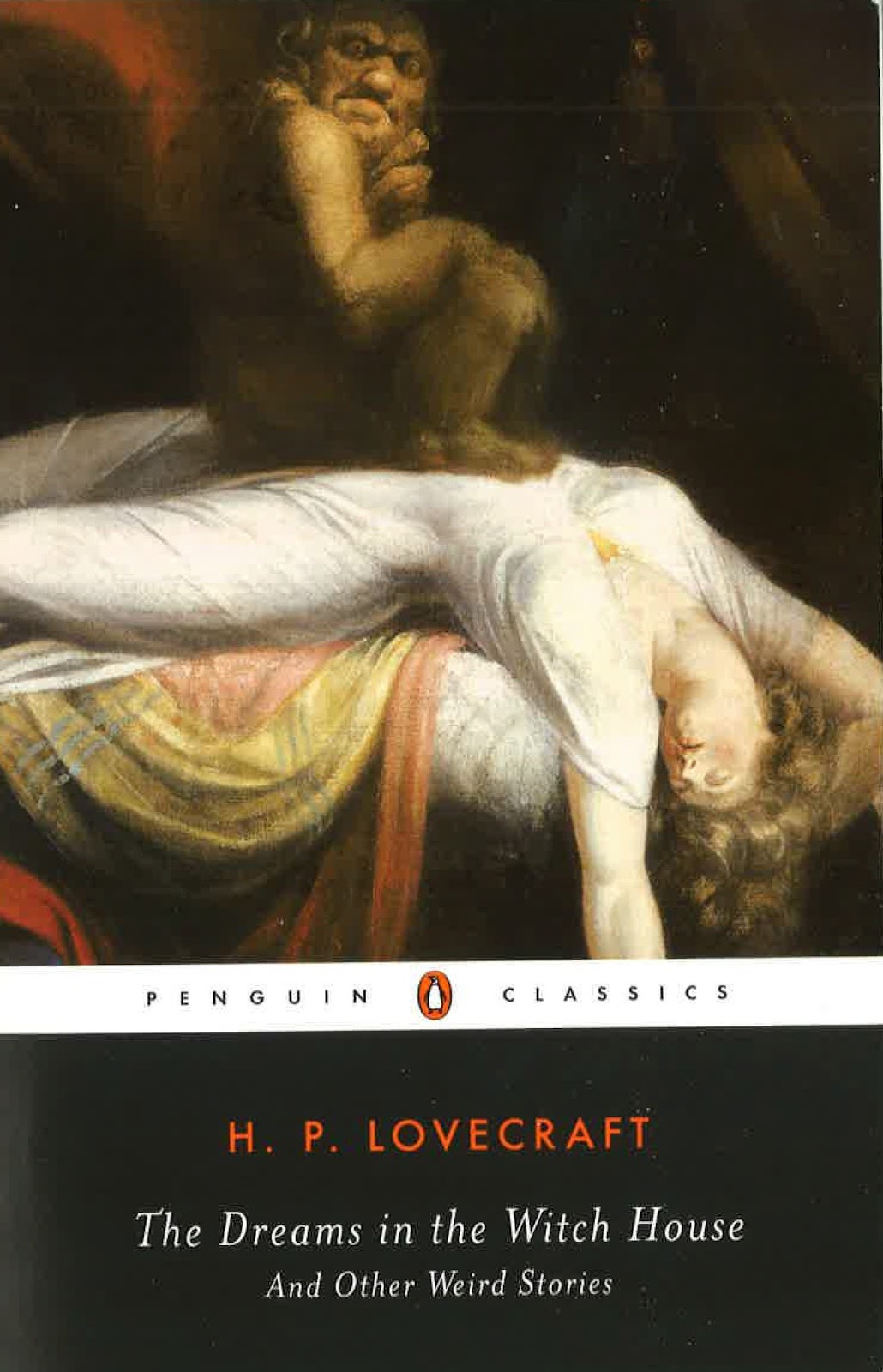
"The Dreams in the Witch House" (1932) by H. P. Lovecraft

Readers unfamiliar with "The Dreams in the Witch House" may prefer to read these notes only after reading the story.


*   *   *


[....] Gilman could not have told what he expected to find there, but he knew he wanted to be in the building where some circumstance had more or less suddenly given a mediocre old woman of the seventeenth century an insight into mathematical depths perhaps beyond the utmost modern delvings of Planck, Heisenberg, Einstein, and de Sitter.


*   *   *
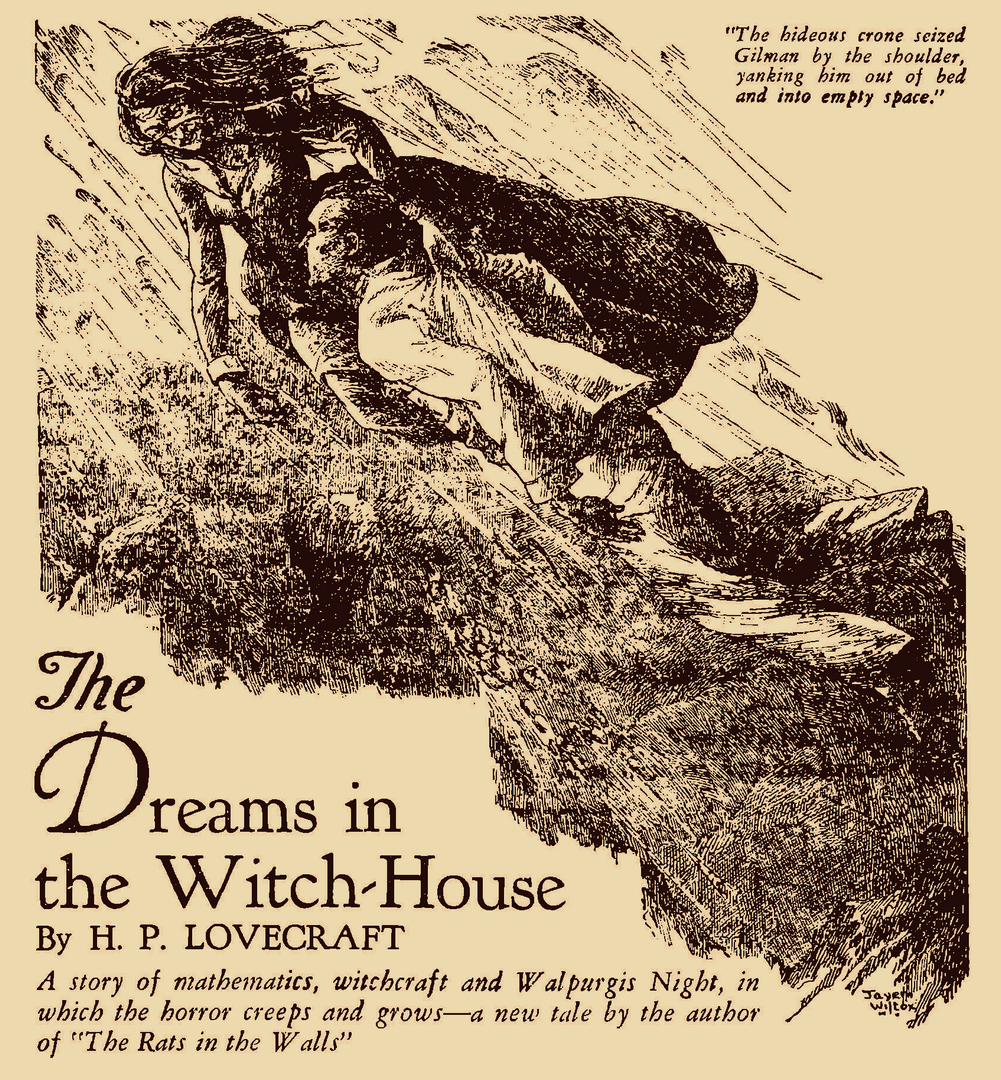


"The Dreams in the Witch House" (1932) still has the power to shock. Lovecraft clearly wasn't interested in letting his protagonist off the hook. There is no fleeing in terror out of town or collapsing into easeful insanity. Walter Gilman is the man who, four years after "The Call of Cthulhu" (1928), succeeded in the "piecing together of dissociated knowledge".  For his trouble he got the worst April of his life, and never saw May.


Before Walter Gilman arrived in Arkham, no renter in the rooming house reputed to be the former bolt-hole of 17th century witch and escaped fugitive Keziah Mason ever lived there by choice. But to Gilman the house looked like fertile ground for his research on points of interpenetration between witch's craft and Non-Euclidean calculus and quantum physics. 


"Possibly," comments the tale's omniscient narrative voice, "Gilman ought not to have studied so hard."


*   *   *


Slingshot


"The Dreams in the Witch House" had me thinking about M. R. James' 1904 story "The Ash Tree." Though there is little correspondence in plot action, its outline about a witch's familiar carrying out her vicious errands is apposite.


And both tales end with a final narrative slingshot as the last buried secrets of their witches are brought to light. Too late, alas, for either story's protagonist.


James:


[....] The lantern must have broken at the bottom, and the light in it caught upon dry leaves and rubbish that lay there for in a few minutes a dense smoke began to come up, and then flame; and, to be short, the tree was in a blaze.

     The bystanders made a ring at some yards' distance, and Sir William and the Bishop sent men to get what weapons and tools they could; for, clearly, whatever might be using the tree as its lair would be forced out by the fire.

     So it was. First, at the fork, they saw a round body covered with fire--the size of a man's head--appear very suddenly, then seem to collapse and fall back. This, five or six times; then a similar ball leapt into the air and fell on the grass, where after a moment it lay still. The Bishop went as near as he dared to it, and saw--what but the remains of an enormous spider, veinous and seared! And, as the fire burned lower down, more terrible bodies like this began to break out from the trunk, and it was seen that these were covered with greyish hair.

     All that day the ash burned, and until it fell to pieces the men stood about it, and from time to time killed the brutes as they darted out. At last there was a long interval when none appeared, and they cautiously closed in and examined the roots of the tree.

     'They found,' says the Bishop of Kilmore, 'below it a rounded hollow place in the earth, wherein were two or three bodies of these creatures that had plainly been smothered by the smoke; and, what is to me more curious, at the side of this den, against the wall, was crouching the anatomy or skeleton of a human being, with the skin dried upon the bones, having some remains of black hair, which was pronounced by those that examined it to be undoubtedly the body of a woman, and clearly dead for a period of fifty years.'


Lovecraft:


     In March, 1931 a gale wrecked the roof and great chimney of the vacant Witch House, so that a chaos of crumbling bricks, blackened, moss-grown shingles,and rotting planks and timbers crashed down into the loft and broke through the floor beneath. The whole attic story was choked with debris from above, but no one took the trouble to touch the mess before the inevitable razing of the decrepit structure. That ultimate step came in the following December, and it was when Gilman's old room was cleared out by reluctant, apprehensive workmen that the gossip began.

     Among the rubbish which had crashed through the ancient slanting ceiling were several things which made the workmen pause and call in the police. Later the police in turn called in the coroner and several professors from the university. There were bones—badly crushed and splintered, but clearly recognisable as human—whose manifestly modern date conflicted puzzlingly with the remote period at which their only possible lurking-place, the low, slant-floored loft overhead, had supposedly been sealed from all human access. The coroner's physician decided that some belonged to a small child, while certain others—found mixed with the shreds of rotten brownish cloth—belonged to a rather undersized, bent female of advanced years. Careful sifting of debris also disclosed many tiny bones of rats caught in the collapse, as well as older rat-bones gnawed by small fangs in a fashion now and then highly productive of controversy and reflection.     

    Other objects found included the mingled fragments of many books and papers, together with a yellowish dust left from the total disintegration of still older books and papers. All, without exception, appeared to deal with black magic in its most advanced and horrible forms; and the evidently recent date of certain items is still a mystery as unsolved as that of the modern human bones. An even greater mystery is the absolute homogeneity of the crabbed, archaic writing found on a wide range of papers whose conditions and watermarks suggest age differences of at least 150 to 200 years. To some, though, the greatest mystery of all is the variety of utterly inexplicable objects—objects whose shapes, materials, types of workmanship, and purposes baffle all conjecture—found scattered amidst the wreckage in evidently diverse states of injury. One of these things—which excited several Miskatonic professors profoundly—is a badly damaged monstrosity plainly resembling the strange image which Gilman gave to the college museum, save that it is larger, wrought of some peculiar bluish stone instead of metal, and possessed of a singularly angled pedestal with undecipherable hieroglyphics.     

    Archaeologists and anthropologists are still trying to explain the bizarre designs chased on a crushed bowl of light metal whose inner side bore ominous brownish stains when found. Foreigners and credulous grandmothers are equally garrulous about the modern nickel crucifix with broken chain mixed in the rubbish and shiveringly identified by Joe Mazurewicz as that which he had given poor Gilman many years before. Some believe this crucifix was dragged up to the sealed loft by rats, while others think it must have been on the floor in some corner of Gilman's old room all the time. Still others, including Joe himself, have theories too wild and fantastic for sober credence.     

    When the slanting wall of Gilman's room was torn out, the once sealed triangular space between that partition and the house's north wall was found to contain much less structural debris, even in proportion to its size, than the room itself; though it had a ghastly layer of older materials which paralysed the wreckers with horror. In brief, the floor was a veritable ossuary of the bones of small children—some fairly modern, but others extending back in infinite gradations to some period so remote that crumbling was almost complete. On this deep bony layer rested a knife of great size, obvious antiquity, and grotesque, ornate, and exotic design—above which the debris was piled.    

    In the midst of this debris, wedged between a fallen plank and a cluster of cemented bricks from the ruined chimney, was an object destined to cause more bafflement, veiled fright, and openly superstitious talk in Arkham than anything else discovered in the haunted and accursed building. This object was the partly crushed skeleton of a huge, diseased rat, whose abnormalities of form are still a topic of debate and source of singular reticence among the members of Miskatonic's department of comparative anatomy. Very little concerning this skeleton has leaked out, but the workmen who found it whisper in shocked tones about the long, brownish hairs with which it was associated. 

    The bones of the tiny paws, it is rumoured, imply prehensile characteristics more typical of a diminutive monkey than of a rat; while the small skull with its savage yellow fangs is of the utmost anomalousness, appearing from certain angles like a miniature, monstrously degraded parody of a human skull. The workmen crossed themselves in fright when they came upon this blasphemy, but later burned candles of gratitude in St. Stanislaus' Church because of the shrill, ghostly tittering they felt they would never hear again.


Both Sir Matthew Fell and Walter Gilman died without realizing how near they lived to the earthly remains of Mrs. Mothersole and Keziah Mason.


*   *   *



Vastation


"The Dreams in the Witch House '' suggests that every interior and exterior in Arkham, Massachusetts is of liminal character.


[....] Sometimes [Walter Gilman] would take walks through shadowy tangles of unpaved musty-smelling lanes where eldritch brown houses of unknown age leaned and tottered and leered mockingly through narrow, small-paned windows. Here he knew strange things had happened once, and there was a faint suggestion behind the surface that everything of that monstrous past might not—at least in the darkest, narrowest, and most intricately crooked alleys—have utterly perished. He also rowed out twice to the ill-regarded island in the river, and made a sketch of the singular angles described by the moss-grown rows of grey standing stones whose origin was so obscure and immemorial.


[....] Old Keziah, he reflected, might have had excellent reasons for living in a room with peculiar angles; for was it not through certain angles that she claimed to have gone outside the boundaries of the world of space we know? His interest gradually veered away from the unplumbed voids beyond the slanting surfaces, since it now appeared that the purpose of those surfaces concerned the side he was already on.


The Witch House itself was a true borderland: inside and outside, near and far, visible and occult. When each side of the border interpenetrated (what Arthur Machen termed a "perichoresis") it spelled death for Walter Gilman.


     It would be barbarous to do more than suggest what had killed Gilman. There had been virtually a tunnel through his body—something had eaten his heart out....


Lovecraft's tonal ostranenie regarding the fates of his protagonists is hard-boiled. But for all that, the reader feels the poignancy involved in the deaths of characters like the Nahum Gardner family, Charles Dexter Ward, and Walter Gilman. 


With the fates of his human characters, Lovecraft permits the reader to push beyond abstractions of "cosmic horror" and come to an "understanding of the malice of the world itself" in the words of John Clute. Clute terms this act of understanding vastation, the moment when protagonists  "find out too much about the world; more specifically, they find out, in a sense, that the world means its malice…." 


*   *   *


Jay

12 October 2022


Saturday, July 16, 2022

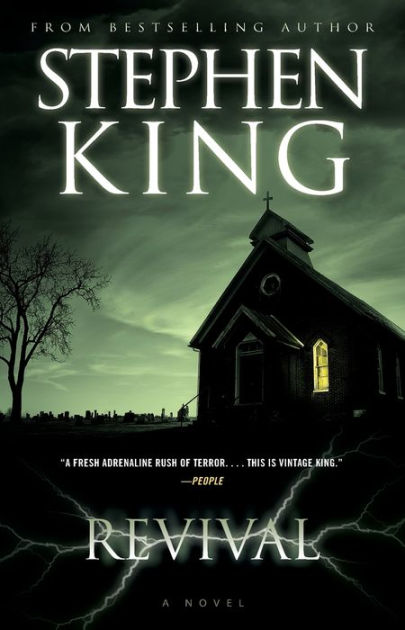
Revival (2014) by Stephen King

Readers unfamiliar with Revival may prefer to read the below only after reading the novel


     And after a pause, he added: 'I believe that there is a perichoresis, an interpenetration. It is possible, indeed, that we three are now sitting among desolate rocks, by bitter streams.

     '. . . And with what companions?'


"N" by Arthur Machen


When writers the caliber of Ramsey Campbell and Elizabeth Hand praise a piece of fiction, it's best not to delay. Catching up to Revival (2014), Stephen King's powerful novel of addiction, family calamity, and cosmic horror, only took me eight years. 


It's hard to keep up with Stephen King. The compelling novels demand attention. Their settings and characters appear in our dreams if they are too long neglected. Even weaker, prolix books consume energy; I came to terms with not finishing Duma Key, but the resolve to give up only came at the halfway mark.


Generally, I avoid contemporary novels. The banal rigamarole of beginnings is enervating. Happily, King solves this in Revival by using the first-person. Jamie Morton is a kid from a big working class family in Harlow, Maine. Jamie has been through life's ringer, and his shorthand style is excellent medicine for an easily distracted reader.


All the horrors, and there are many in Revival, have been suffered before Jamie starts page one. We know he survives, and wants to keep on living. 


     My life these days is far from happy, but the antidepressants have put a floor under me. Suicide isn't on my radar. And given what may come after death, I want to live as long as possible. There's something else, too. I feel—rightly or wrongly—that I have a lot to atone for. Because of that, I'm still trying to be a do-right daddy....


Revival is carefully equipoisal between sf-horror and supernatural-horror. 


As a child, Jamie Morton idolizes Harlow's new Methodist minister, the electricity-obsessed Rev. Charles Jacobs. Throughout the novel, their lives keep intersecting. After the death of his wife and young son in a spectacularly gruesome car accident (which King magnificently distances and makes strange), Jacobs publicly rejects Christianity and his ministerial calling. Jamie Morton becomes a successful rock musician and, after a motorcycle accident, an addict.


When they meet again, it is at the 1992 state fair in Tulsa, Oklahoma. Under the name Dan Jacobs, Jamie's former hero is offering "PORTRAITS IN LIGHTNING." His stage show is popular, but Jamie detects a whiff of the uncanny in its effects. But strung-out on heroin, the most uncanny effect turns out to be Jacobs curing him of his addiction and chronic pain.


     I looked at the chair, but didn't sit on it. "You were going to give me a little hit first."

     "So I was." He produced the brown bottle, considered it, then handed it to me. "Since we can hope this will be your last, why don't you do the honors?"

     He didn't have to ask twice. I took two heaping snorts, and would have doubled down if he hadn't snatched the small bottle away. Nevertheless, a window on a tropic beach opened in my head. A mellow breeze wafted in, and I suddenly no longer cared about what might become of my brainwaves. I sat down in the chair.

     He opened one of several wall cabinets and brought out a pair of battered, taped-up headphones with crisscrosses of metal mesh over the earpads. He plugged them into the amp-like device and held them out to me.

     "If I hear 'In-A-Gadda-Da-Vida,' I'm taillights," I said.

     He smiled and said nothing.

     I put the headphones on. The mesh was cool against my ears. "Have you tried this on anyone?" I asked. "Will it hurt?"

     "It won't hurt," he said, not answering the first question at all. As if to contradict this, he gave me a mouthguard of the type basketball players sometimes wear, then smiled at my expression.

     "Just a precaution. Pop it on in."

     I popped it on in.

     From his pocket he took a white plastic box no bigger than a doorbell. "I think you'll—" But then he pressed a button on the little box, and I lost the rest.      


     There was no blackout, no sense of time passing, no discontinuity at all. Just a click, very loud, as if Jacobs had snapped his fingers beside my ears, although he was standing at least five feet away. Yet all at once he was bending over me instead of standing beside the thing that wasn't a Marshall amp. The little white control box was nowhere to be seen, and my brain had gone wrong. It was stuck.

     "Something," I said. "Something, something, something. Happened. Happened. Something happened. Something happened, happened, something happened. Happened. Something."

     "Stop that. You're all right." But he didn't sound sure. He sounded scared.

     The headphones were gone. I tried to get up and shot one hand into the air instead, like a second-grader who knows the right answer and is dying to give it.

     "Something. Something. Something. Happened. Happened, happened. Something happened."

     He slapped me, and hard. I jerked backward and would have fallen over if the chair hadn't been placed almost directly against the metal side of his workshop.

     I lowered my hand, stopped repeating, and just looked at him.

     "What's your name?"

     I'll say it's something happened, I thought. First name Something, last name Happened.

     But I didn't. "Jamie Morton."

     "Middle name?"

     "Edward."

     "My name?"

     "Charles Jacobs. Charles Daniel Jacobs."

     He produced the little bottle of heroin and gave it to me. I looked at it, then handed it back. "I'm good for now. You just gave me some."

     "Did I?" He showed me his wristwatch. We had arrived at midmorning. It was now quarter past two in the afternoon.

     "That's impossible."

     He looked interested. "Why's that?"

     "Because no time passed. Except . . . I guess it did. Didn't it?"

     "Yes. We spoke at great length."

     "What did we talk about?"

     "Your father. Your brothers. Your mother's passing. And Claire's."


After the 1992 state fair, Jamie is clean, sober, and fully employed with a recording studio. Charles Jacobs becomes arena-filling faith healer C. D. Jacobs. Jamie's conclusion: "You're self-teaching, aren't you? All your customers are actually guinea pigs. They just don't know it. I was a guinea pig."


Most of the healings are spectacularly successful. But as Jamie tracks the healed, he finds a minority that have gone wrong.


     "I don't know if it was God working through him or not," Hicks told me over coffee in his office. "My wife does, and that's fine, but I don't care. I'm pain-free and walking two miles a day. In another two months I expect to be cleared to play tennis, as long as it's doubles, where I only have to run a few steps. Those are the things I care about. If he did for you what you say he did, you'll know what I mean."

     I did, but I also knew more.

     That Robert Rivard was enjoying his cure in a mental institution, sipping glucose via IV rather than Cokes with his friends.

     That Patricia Farmingdale, cured of peripheral neuropathy in Cheyenne, Wyoming, had poured salt into her eyes in an apparent effort to blind herself. She had no memory of doing it, let alone why.

     That Stefan Drew of Salt Lake City had gone on walking binges after being cured of a supposed brain tumor. These walks, some of them fifteen-mile marathons, did not occur during blackouts; the urge just came on him, he said, and he had to go.

     That Veronica Freemont of Anaheim had suffered what she called "interruptions of vision." One had resulted in a low-speed collision with another driver. She tested negative for drugs and alcohol, but turned in her license just the same, afraid it would happen again.

     That in San Diego, Emil Klein's miracle cure of a neck injury was followed by a periodic compulsion to go out into his backyard and eat dirt.

     And there was Blake Gilmore of Las Vegas, who claimed C. Danny Jacobs had cured him of lymphoma during the late summer of 2008. A month later he lost his job as a blackjack dealer when he began to spew profanity at the customers—stuff like "Take a hit, take a fucking hit, you chickenshit asshole." When he began shouting similar things at his three kids, his wife threw him out. He moved to a no-tell motel north of Fashion Show Drive. Two weeks later he was found dead on the bathroom floor with a bottle of Krazy Glue in one hand. He had used it to plug his nostrils and seal his mouth shut. His wasn't the only obit coupled to Jacobs that Bree had found with her search engine, but it was the only one we felt sure was connected.


Such anecdotes, and older lore, are the materials King assembles to create Revival's cosmicist, indifferentist horror.  Revival's picture of human life out-Ligotti's Ligotti. But unlike Ligotti, or Mark Samuels, King brackets his story of macabre revel culminating in apocalyptic vastation with an everyday world of individual physical carnage: addiction, painful disability, and cancer. Those whom "C. D. Jacobs" successfully heals are put in tow to an incomprehensible reality that will, ultimately, spare no one. As John Clute sums it up: "we are soon told that the inherent aspect of the world is malice...."


Revival (a title with many and often contradictory cutting edges) is a focused and compelling novel. Don't lose sight of it among other King titles.


Jay

15 July 2022


Sunday, June 26, 2022

"The Thing from Outside" (1923) by George Allan England

Readers unfamiliar with "The Thing from Outside" may prefer to read these notes only after reading the story.


     Presently darkness folded down. The men smoked, thankful that tobacco still held out. Vivian lay in a bunk that Jandron had piled with spruce-boughs for her, and seemed to sleep. The Professor fretted like a child, over the blisters his paddle had made upon his hands. Marr laughed, now and then; though what he might be laughing at was not apparent. Suddenly he broke out: "After all, what should It want of us?"

     "Our brains, of course," the Professor answered, sharply.

     "That lets Jandron out," the journalist mocked.

     "But," added the Professor, "I can't imagine a Thing callously destroying human beings. And yet—"

     He stopped short, with surging memories of his dead wife. "What was it," Jandron asked, "that destroyed all those people in Valladolid, Spain, that time so many of 'em died in a few minutes after having been touched by an invisible Something that left a slight red mark on each? The newspapers were full of it."

     "Piffle!" yawned Marr.

     "I tell you," insisted Jandron, "there are forms of life as superior to us as we are to ants. We can't see 'em. No ant ever saw a man. And did any ant ever form the least conception of a man? These Things have left thousands of traces, all over the world. If I had my reference-books—"

     "Tell that to the marines!"

     "Charles Fort, the greatest authority in the world on unexplained phenomena," persisted Jandron, "gives innumerable cases of happenings that science can't explain, in his Book of the Damned. He claims this earth was once a No-Man's Land where all kinds of Things explored and colonized and fought for possession. And he says that now everybody's warned off, except the Owners. I happen to remember a few sentences of his: 'In the past, inhabitants of a host of worlds have dropped here, hopped here, wafted, sailed, flown, motored, walked here; have come singly, have come in enormous numbers; have visited for hunting, trading, mining. They have been unable to stay here, have made colonies here, have been lost here.' "

     "Poor fish, to believe that!" mocked the journalist, while the Professor blinked and rubbed his bulging forehead.

     "I do believe it!" insisted Jandron. "The world is covered with relics of dead civilizations, that have mysteriously vanished, leaving nothing but their temples and monuments."

     "Rubbish!"

     "How about Easter Island? How about all the gigantic works there and in a thousand other places—Peru, Yucatan and so on—which certainly no primitive race ever built?"

     "That's thousands of years ago," said Marr, "and I'm sleepy. For heaven's sake, can it!"

     "Oh, all right. But how explain things, then!"

     "What the devil could one of those Things want of our brains?" suddenly put in the Professor. "After all, what?"

     "Well, what do we want of lower forms of life? Sometimes food. Again, some product or other. Or just information. Maybe It is just experimenting with us, the way we poke an ant-hill. There's always this to remember, that the human brain-tissue is the most highly organized form of matter in this world."

     "Yes," admitted the Professor, "but what—?"

     "It might want brain-tissue for food, for experimental purposes, for lubricant—how do I know?"


*   *   *


"The Thing from Outside" (1923) by George Allan England looks back to certain works by Algernon Blackwood, particularly "The Willows" and "The Wendigo." It also anticipates some later genre tropes of cosmic horror. These elements are all bunched-up with Gernsback-scale melodrama. Still, "The Thing from Outside" keeps struggling to overcome, and keeps introducing unexpected and uncanny moments of real power.


            The three men smoked. The two women huddled close to each other. Fireglow picked their faces from the gloom of night among the dwarf firs. A splashing murmur told of the Albany River's haste to escape from the wilderness, and reach the Bay.

     "I don't see what there was in a mere circular print on a rock-ledge to make our guides desert," said Professor Thorburn. His voice was as dry as his whole personality. "Most extraordinary!"

     "They knew what it was, all right," answered Jandron, geologist of the party. "So do I." He rubbed his cropped mustache. His eyes glinted grayly. "I've seen prints like that, before. That was on the Labrador. And I've seen things happen, where they were."

     "Something surely happened to our guides, before they'd got a mile into the bush," put in the Professor's wife; while Vivian, her sister, gazed into the fire that revealed her as a beauty, not to be spoiled even by a tam and a rough-knit sweater. "Men don't shoot wildly, and scream like that, unless—"


*   *   *


Five individuals in the Canadian north are abandoned by their guides and have to fight their way by river and portage to the nearest railhead, weeks away. As they do so, strange circular footprints appear: something is stalking them.


As the protagonists travel, it also becomes clear the thing from outside is intentionally or unintentionally disorienting them. One character thinks they are fighting their way upstream; another knows they are headed downstream. One thinks the sun has vanished; another, that it is still summer. One man wakes one morning covered in snow and fears he has been asleep for a month.


Time dilation, slingshot narrative jumps, and predicaments demanding negative capability or equipoise of characters, used often in later horror fiction,  are all anticipated in "The Thing from Outside."


*   *   *


….And silence fell upon the little night-encampment in the wilds; a silence that was ominous. 

        Pale, cold stars watched down from spaces infinitely far beyond man's trivial world.


Jay

26 June 2022