Subscribe to my Substack

Thursday, February 15, 2018

Alone in the dark at last: Such Stuff As Screams Are Made Of by Robert Bloch (1976)


Such Stuff As Screams Are Made Of

by Robert Bloch

Del Rey 1979


Introduction (Such Stuff As Screams Are Made Of) • (1979) • essay by Gahan Wilson


…. The thing about Bloch's stories is, literally, their knack of haunting the reader. They have a core happening which stays, rather like a fable or a story from the Brothers Grimm. I suspect this is what has made his stories so much in demand for adaptations. When you leave the theater after seeing a Blochian horror, it tags along behind and follows you on the empty sidewalks all the way home. When you turn off your television set, that Blochian climax continues to phosphoresce in your head. The crazy old lady in Psycho put a lot of small motels out of business because she wouldn't leave the people who saw it, and I think you'll encounter the same kind of lingering effect with at least one of the stories gathered here, depending on which one grabs your particular insecurity.


Maybe it'll be the silver skeleton tinkling somewhere in the darkness on your bedroom floor, or could be it'll be the horrible headsman lurking in your closet, or perhaps it'll be the snaky lady prowling out there on the lawn or the fire escape. It's hard to tell.


The Tunnel of Love • (1948) • short story 


But if that was Dolores out there in the water, then what . . .


Marco turned his head, ever so slowly. For the first time he glanced down at the seat beside him, at what lay cradled in his arms.


The Unspeakable Betrothal • (1949) • short story


Bloch has a merry time ringing the changes on "The Whisperer in Darkness."  His heroine Avis cannot wait to go.


No matter how often Doctor Clegg pursed his lips and hinted about calling in a "specialist," she wasn't afraid. Of course Avis knew he really wanted her to see a psychiatrist. The doddering fool was filled with glib patter about "retreat from reality" and "escape mechanisms."


But he didn't understand about the dreams. She wouldn't tell him, either. He'd never know the richness, the fullness, the sense of completion that came from experiencing contact with other worlds.


Avis knew that now. The voices and shapes that came in the window were from other worlds. As a naive child she had invited them by her very unsophistication. Now, striving consciously to return to the childlike attitude, she again admitted them.


They were from other worlds; worlds of wonder and splendor. Now they could meet only on the plane of dreams, but someday, someday soon, she would bridge the gap.


They whispered about her body. Something about the trip, making the "change." It couldn't be explained in their words. But she trusted them, and after all, a physical change was of slight importance contrasted with the opportunity.


The Girl from Mars • (1950) • short story 


A carnie owner's comeuppance.


"Sure. And my Girl from Mars skipped. So the way I figure it, why don't you come along with the show? You can have the same setup, sixty a week and chow, travel around and see the country. Nobody to tell you what to do or when to do it, see? Your own boss. Free. Get it—free?"


He wanted it to sound good. Sort of subtle, about being free. Even if she was a whack, she had enough sense to bust out and probably knew she'd have to keep moving. Not that he'd let her tie up with the show, that was all con, but he wanted her to go for the deal. Then he could start.


"But that is not what you speak. Hungry—"


Ah, to hell with it! You don't waste your breath on a screwball. And here in the dark she wasn't a screwball. She was a disheroo, a tall blonde, hot, better than Mitzie, damn Mitzie anyhow, she was here and he could feel her, feel the warmth just busting out of her—


The Head Hunter • (1950) • short story


They came—pallid, noble faces molded in sadness or rage; three thousand death-masks, and the end not yet! And with them came a message.


"You, Otto Krantz, are our Master! You are the most powerful man in the Reich. Not Hitler, not Goebbels, not Himmler or the others. You, Otto Krantz, hold the real power of life and death!"


At first, Krantz was afraid of such thoughts. But every day came a dozen new reminders, a dozen new faces to review in darkness, to remember, to relish.


To relish? But of course, it was a pleasure now. To be quiet. To dress in black. To wear a mask. To hide the secret thoughts and then come home to revel alone with three thousand memories!


The Weird Tailor • (1950) • novelette


All those weird colors in "The Colour Out of Space"? You can have a suit made like that.  And there's a poverty-stricken abusive jerk of a tailor who will make it for you wholesale.


Lucy Comes to Stay • (1952) • short story


She held the secret up. It glittered under the light, like the scissors, only this was a nice glittering. A golden glittering.


"A whole pint!" I gasped. "Where did you get it?"


"From the cupboard downstairs, naturally. You knew George still keeps the stuff around. I slipped it into your purse, just in case."


I had the shakes, but I got that bottle open in ten seconds. One of my fingernails broke, and then the stuff was burning and warming and softening—


"Pig!" said Lucy.


"You know I had to have it," I whispered. "That's why you brought it."


The Pin • (1953) • short story


Reapers are hired by accident and coincidence. But forever.  


I Do Not Love Thee, Doctor Fell • (1955) • short story


"Who are you?" Dr. Fell asked the question softly. "That's really what's bothering you, isn't it? Who are you? You can answer that question if you want to, you know. So try. Try. Who are you?"


It was the wrong question. Bromely felt it, and he froze. Somewhere, deep inside, words formed an answer. But he couldn't find the words. He couldn't find that spot, inside him, where the words came from.


For the rest of the hour he just lay there on the couch.


Luck Is No Lady • (1957) • short story


A dizzying, whirligig fantasy with a simple moral: You can't win.


"….If I could only learn the secret of what attracts Fortune, I'd ask for nothing else. Perhaps it's just a matter of real belief, or of worship. Fortune is a goddess and goddesses demand adoration. Being female, she requires constancy. Could it be that the so-called fortunate ones are merely those who have learned this secret and swear fealty to Fortune in return for her favors?"


"I dunno," Frankie mumbled. "Me, I'd go all-out for any dame who'd change my luck."


He picked up his glass, swallowed, then turned. But the old Professor guy had stumbled out. The bartender came up, shaking his head. "Funny how it hits them all of a sudden," he said.


"Yeah," Frankie answered. "But what gets me is why a guy like him hangs around this joint."


"I dunno about that," the bartender said. "We get some pretty classy trade, on account of the game in back."


The Cure • (1957) • short story


Thieves fall out.  A "one joke story," but what a joke!


The Screaming People • (1959) • novelette


A sweeping and ambitious noir tale about madness, control, and the treacheries to which medical science is bent.  Bloch is never better than in a story like this, brilliantly portraying shards of consciousness attempting to regroup themselves into a rational semblance of personality. Surpasses Aldritch's film Kiss Me Deadly.


Even now—even here in the womb, where nothing could harm me—I still didn't care to dwell on what happened. Actually, it all came to me via second-hand report, because when Wagram came I slipped down into the merciful oblivion of concussion-induced coma. And there I stayed for the next ten days, while Wagram accompanied me to the nearest town, supervised the work of the doctor who put the casts on me, represented me in the police investigation which followed, and finally—after two surgeons flew out from L.A., examined my head injuries, and pronounced my condition hopeless and my brain-damage so extensive as to render the case inoperable—chartered a private plane and flew me back to his own clinic here. Then he operated; Dr. Carl Wagram, who learned his neurosurgery in war-torn Munich. He put the plates into my skull and my head healed and he grafted the skin and hair grew and there was even a touch of cosmetological miracle involved. By the time my casts were off, my physical recovery was assured.


This left me with but one problem.


Amnesia.


Complete and total amnesia.


Oh, I could comprehend consciousness, and I could even speak after a fashion. But I was unable to remember a single solitary moment of my life before that crash. Existence, for me, began with a scream of pain out there on the desert.


The Big Kick • (1959) • short story


If you hate Beatniks – and who doesn't? – this is the story for you! Brilliant and as always with Bloch, the style is seemingly effordless.


"But don't you ever worry about the future?" Judy asked.


"This is the future, dig?" Mitch answered. "The whole thing's a circle, with us in the middle having kicks. Now take like squares, what have they got? The study-and-work-hard pitch, the get-a-steady-job thing, real draggy. And then it's marry-and-settle-down and buy-on-easy-terms and take-care-of-the-wife-and-kids. So you end up at fifty, doing the coronary bit."


"Awright awready," Judy said. "You aren't going to marry me, and I'm not queer for that wife-and-mother scene myself. But a girl has to think about things, you know? And I don't have any money, you don't have a job—"


"So get with it." Mitch shrugged. "You want some loot, find a live one."


"You mean some fat old character with a wife and six kids? I should sneak in and out of motels with him for peanuts?" Judy was scornful. "Look, Pops, I don't need it. I've been getting passes from such jerkies for years. All I'd catch is a bad dose of trouble."


"Figures," Mitch agreed. "But why sweat? You don't even have to bother looking. Just relax and enjoy it. Let it come to you. Like Kenny here."


He jabbed his thumb in the direction of a tall, thin man who stood leaning against the hall doorway, squinting at the smoky room through his horn rims.


"A real creepnik, that one," Mitch said. "Used to be an assistant prof up at the U., but he doesn't have to bust a truss making a living. He's loaded. Phil tells me he popped for three jugs tonight, just to get in. Likes to make the scene, you know? And he's got eyes for you."


The Masterpiece • (1960) • short story


A minor key anecdotal traveler's tale.


Talent • (1960) • short story


Like "The Screaming People," this story is a masterpiece.  The emotional, mental, and physical transformations of its protagonist, Andrew Benson, would fit comfortably into the surrealist fiction spaces of Ramsey Campbell.


…. If his foster-parents were a bit strict, he made no complaints. If they punished him because they suspected he sometimes slipped out of his room at night, he made no complaint or denials. If they seemed apprehensive lest he be disobeying their set injunctions not to attend the movies, he offered no overt defiance.


The only known clash between Andrew Benson and his family came about as a result of their flat refusal to allow a television set in their home. Whether or not they were concerned about the possible encouragement of Andrew's mimicry or whether they had merely developed an allergy to Lawrence Welk and his ilk is difficult to determine. Nevertheless, they balked at the acquisition of a TV set. Andrew begged and pleaded, pointed out that he "needed" television as an aid to a future dramatic career. His argument had some justification, for in his senior year, Andrew had indeed been "scouted" by the famous Pasadena Playhouse, and there was even some talk of a future professional career without the necessity of formal training.


But the Bensons were adamant on the television question; as far as we can determine, they remained adamant right up to the day of their death.


The Final Performance • (1960) • short story


A motel on a lonely stretch of California highway.  A writer with an car breakdown. A maid who will do anything to get to the coast.  And the motel owner? Just take a look at his scrapbooks before it's too late.


Life in Our Time • (1966) • short story


Utterly and infernally hilarious.  A fogey of a college professor takes interest in his younger wife when it is time to stock a time capsule destined for the cornerstone of the new humanities building.


"Everything preserved will be a clue to our social attitudes. Not what we pretend to admire, but what the majority actually believes in and enjoys. And that's where you come in, my dear. You're the majority."


Jill began to dig it, then. "You mean like TV and records?"


"Exactly. What's that album you like so well? The one with the four hermaphrodites on the liner?"


"Who?"


"Excuse me—it's purportedly a singing group, isn't it?"


"Oh, you're talking about the Poodles!" Jill went and got the album, which was called The Poodles Bark Again. The sound really turned her on, but she always thought Harry hated it. And now he was coming on smiles.


"Great," he said. "This definitely goes in."


"But—"


"Don't worry, I'll buy you another." He took the album and put it on his desk. "Now, you mentioned something about television. What's your favorite program?"


When she saw he was really serious she began telling him about Anywhere, U.S.A. What it was, it was about life in a small town, just an ordinary suburblike, but the people were great. There was this one couple with the two kids, sort of an average family, you might say, only he was kind of playing around with a divorcĂ©e who ran a discothetique or whatever they call them, and she was getting the hots for a psychiatrist—he wasn't really her psychiatrist, he was analyzing one of the kids, the one who had set fire to the high school gymnasium, not the girl—she was afraid she'd been caught because of that affair she was having with the vice-principal who was really a Commie agent only she didn't know it yet and her real boyfriend, the one who had the brain operation, had a thing about his mother, so—


It got kind of complicated, but Harry kept asking her to tell him more and pretty soon he was nodding. "Wonderful—we'll have to see if we can get kinescopes on a week's episodes."


Underground • (1967) • short story


A characterization so real, the audience thinks it is true.  And takes action accordingly.


A Case of the Stubborns • (1976) • short story


Bloch says he had to wait thirty years to find a story to match the first line.  It's magic: Americana folk horror in the Manly Wade Wellman vein.


Just then Ma come back out. "We're fresh out of lemonade," she said. "All's I could find was a jug. I know your feeling about such things, Reverend, but—"


"Praise the Lord!" The Reverend snatched the jug out of her hand, hefted it up, and took a mighty swallow.


"You're a good woman," he told Ma. "And I'm much beholden to you." Then he started down the path for the road, moving fast.


"Here, now!" Ma called after him. "What you aim to do about Grandpa?"


"Have no fear," the Reverend said. "We must put our trust now in the power of prayer."


He disappeared down the road, stirring dust.


"Danged if he didn't take the jug!" Grandpa mumbled. "You ask me, the onny power he trusts is in that corn-likker."


Ma give him a look. Then she bust out crying and run into the house.


"Now, what got into her?" Grandpa said.


"Never you mind," I told him. "Susie, you stay here and whisk those flies off Grandpa. I got things to attend to."


And I did.


The Head • (1976) • short story


A small-bore end of the world story.


What You See Is What You Get • (1977) • short story


Long before "The Sundog," instamatic cameras were showing things no human eye needed to see.


Nina • (1977) • short story


The old woman hesitated. "You will not be offended if I speak?"


"Of course not."


Mama's voice sank to a murmur. "It concerns the one outside."


"Nina?"


"That is not her name, but no matter." Mama shook her head. "For two days she has waited there. I see you with her now when you return. And I see you with her before—"


"That's none of your business!" Nolan reddened. "Besides, it's all over now."


"Does she believe that?" Mama's gaze was grave. "You must tell her to go."


"I've tried. But the girl comes from the mountains, she doesn't speak English—"


"I know." Mama nodded. "She is one of the snake-people."


Nolan stared at her. "They worship snakes up there?"


"No, not worship."


"Then what do you mean?"


"These people—they are snakes."


Nolan scowled. "What is this?"


"The truth, señor. This one you call Nina—this girl—is not a girl. She is of the ancient race from the high peaks, where the great serpents dwell. Your workers here, even Moises, know only the jungle, but I come from the great valley beneath the mountains, and as a child I learned to fear those who lurk above. We do not go there, but sometimes the snake-people come to us. In the spring when they awaken, they shed their skins, and for a time they are fresh and clean before the scales grow again. It is then that they come, to mate with men."


Author's Afterword (Such Stuff as Screams Are Made Of) • (1979) • essay by Robert Bloch


…. I still believe a writer must do more than try—his job is to succeed in saying what he means. Obscurantism is for politicians.


In discussing my stories I strive for equal clarity. The material in this collection falls into two genres: supernatural fantasy and the conte cruel. But there's a common element—horror, or psychological suspense, if you prefer the term. And that's about all the explanation that seems necessary.

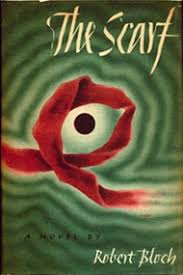

Diary of a Mad Man: The Scarf by Robert Bloch (1947, 1966)


Pity the monsters!
Pity the monsters!
Perhaps, one always took the wrong side –
Ah, to have known, to have loved
too many David and Judiths!
My heart bleeds for the monster.
I have seen the Gorgon.
The erotic terror....

"Florence" by Robert Lowell


Robert Bloch's novels and stories about the mentally unhinged and marginalized offer vivid humor, exalted wordplay, and bitter heartbreak for readers.

I'll place my bet now without hesitation: The Scarf by Robert Bloch is not only superior to Psycho, it is equal to The Talented Mr. Ripley and The Killer Inside Me.

That's a bold statement. But The Scarf is a bold, desolating, sleekly economical novel. Its characters are perfectly observed. Sentiment has no place in these pages. Self-pity is employed only to highlight the cloud castles of a pathologically unreliable narrator. Bloch's moral strength is that he invariably pities and seeks to understand his monsters; their sane friends, lovers, and antagonists appear as threats and warning alerts of bad weather to come.

Daniel Morley has been on the bum for ten years when we meet him.  He tells us about launching himself as a writer, but intercuts those chapters with excerpts from what he calls his "Black Notebook," in which his past is reviewed.

Bloch's handling of this material has the power of primary tragedy:


....Memories, like the time you were five years old and wet the bed, and your mother laughed at you. She made fun of you in front of the whole family while you ate Sunday dinner. You couldn't stand the snickering, and the way she described what you'd done. You ran from the table and vomited everything up. Only you couldn't vomit up one thing—the sudden hate, curling away in the pit of your stomach.

Your own mother! You wondered what she meant when she whined and whispered to you because you happened to pass the bathroom when your sister Geraldine was in the tub.

"What did you look at her for?" she asked. "Only nasty little boys look at little girls."

Then, memories of the day she caught you, behind the woodpile back of the house, playing Doctor—what the psychologists sweetly call "exploratory sex play"—with a little neighbor girl of your own age, which was nine. Your mother saw you, said you were filthy, ridiculed you, made your father switch you good and hard. She sold you thoroughly on the idea that sex was vile and shameful. You were a vile, filthy boy. You took it, dumbly, the way kids must, and that night at dinner she brought it up again, rubbing it in.

Later, hours later, you tossed on your bed, unable to sleep, because she'd tied your hands to the bedposts as punishment—to keep you, in her words, from polluting yourself—and because you didn't know exactly what she meant by vile and filthy. What was filthy? That meant dirty, didn't it? But the little girl had been clean and so had you.

Finally, overcome with thirst, you had slipped the bonds of ripped red flannel holding your wrists and had sneaked down the hall to the bathroom to get a drink of water. It was hot summer—you remember hearing the locusts singing and smelling the wild honeysuckle. Your parents' door was open and as you passed you saw and heard what they were doing, their nakedness and the panting. You remember that you fled back to your room, slipped back into the flannel bonds.

You remember the numb turmoil of your feelings; you didn't think; your conscious mind refused the whole thing. But then, she had called you filthy and she was filthy too!

You hated your mother from then on, although you didn't know then that it was hate. You had rejected her completely and she, sensing she'd lost a victory, sensing your coldness and loathing, took it out on you in constant and bitter nagging....


Morley keeps meeting women, and as with many writers he turns them into characters in stories.  When the stories are done, he moves on.  With the help of his maroon scarf.


.... You wonder why it is they can all enjoy themselves and you aren't having any fun.

Or are you thinking: yes, these are people, a pretty ordinary crowd of people at that. They pay taxes, they vote, they make the laws, they choose the popular songs and the books and the pictures, they tell us all how to live and how to work and what to think and worship. Yes, and if they were on your jury, your life would be in their hands.

Is that the way you figure it? Do you wish, as you watch them dancing, that you could walk right up to the bandstand and take out a sub-machine gun and let 'em have it, just mow 'em down; the whole cruel, greedy, moronic, dirty lot of them?

Maybe I'm wrong.

Maybe most people don't have those thoughts, those feelings, those desires.

Maybe it's just people like me.

Maybe they'd be afraid of me if they knew what went on inside. I must never let them find out. Write it all down, but don't tell anybody.

But I'd like to tell them. I'd like to let them know how I feel. How it feels. The whole works. I'd like to give them all a little personal demonstration.


Dan falls in with the New York cocktail literati.  His first novel is a big success, and his second is sold to the movies.  A woman named Constance puts him in her crosshairs.

"Constance is a nympholept."

"You mean, oversexed?"

"More than that. Nympholepsy is much more than a mere physical condition; a glandular maladjustment may, however, be a contributory cause. In the old days they called the condition 'nymphomania.' It's probably a better term. Because a woman so afflicted is a maniac."

I put out my cigarette. My mouth was too dry.

"Insatiable sexual appetite is a terrible thing, Dan." Somehow Ruppert didn't sound like a college boy any more. "It rarely appears in its pure form, however. Often it is accompanied by delusions, hallucinations. You've surely heard the old legends about the incubus: the carnal night demon who visits women in their dreams. Witches had such delusions—and nuns, too. And it's easy to spot a psychotic when the disorder is characterized by fantasies. When there are no fantasies, it's difficult. Very difficult." He shook his head.

"When a young girl has a so-called 'nervous breakdown' in school, her fellow-pupils and instructors, her own father, are likely to shrug it off. There's no babbling of dreams and visions, no delusions of persecution, disorders of perception, no outward hysteria. The hysteria is all inside.

"When the young girl visits a psychoanalyst for treatment and develops a violent fixation on him, the world calls it love. They don't hear the panting confessions, the moans, the sobs, the threats of suicide.

"The analyst doesn't tell them, either, if he knows that the threats are genuine. If he feels that perhaps, in time, he can cure the disorder. Particularly, if he has the misfortune to fall in love with her. Actually it was pity; believe me in that, Dan, although I pity her no longer....


Dr. Ruppert, a friend from cocktail land, is one of Bloch's sophisticated psychiatrists, clever and modern, smart and observant.

"But there's one thing I'm curious about, Dan. With all your perception of the feminine mind, why do you hate women?"

I didn't have any answers ready for that one.

He leaned closer. "You don't happen to be a homosexual, do you?"

Guys get hit for saying things like that, but somehow he asked the question honestly, the way a doctor would. "No. Quite the contrary."

"But you do hate women."

"How do you figure that?"

"I don't figure. It's there, in the book. More than detachment, cynicism, objectivity—I can sense pure hatred in your descriptions and the attitudes behind them. Actually, you don't describe. You dissect. Sadistically."

"Wait a minute, now, I'm not Jack the Ripper."

"Are you sure?"

Once again he had me off balance.

"Are you positive that you aren't writing as a sort of safety valve, to keep you from taking more direct action?"

"Are you positive you aren't trying to psychoanalyze me?"

Ruppert sat back and shrugged. "Maybe so. I think you'd make a very interesting patient, Dan."


In the end, Daniel Morley cannot ask for help because he spends every waking minute try to keep all the plates in the air: maintaining the appearance of sanity leaves no room for anything else.  Like James Ellroy's protagonist in Killer on the Road, killing and moving on is normality.


Jay

15 February

Monday, February 12, 2018

The stench of something atrociously wrong: A few reading notes on the collection The Red Brain: Great Tales of the Cthulhu Mythos


I'm not sure what motivated the publishers to produce such an uneven "great tales" collection. Most of the early stories are surely sub-canonical.The more recent stories are, to be kind, earnest attempts to aestheticize self-indulgence.

The chief pleasure of the book was reading for the first time Ramey Campbell's "The Pattern" and Brian McNaughton's "Meryphillia." The other stories only distract, and are best skipped tout court.

My reading notes are below.

_________________
THE RED BRAIN: GREAT TALES OF THE CTHULHU MYTHOS
Edited by S. T. Joshi

FALCO OSSIFRACUS: BY MR. GOODGUILE Edith Miniter (1921)
Anyone who thought putting this item between covers was useful, or whimsical, should rethink their career.

THE RED BRAIN
Donald Wandrei (1927)
D. Wandrei had some spectacular ideas for stories and novels. "The Red Brain" has conceptually the entropic sublimity found in Stapledon and Arthur C. Clarke. But Wandrei does not have the artistic chops to match the scope of his vision. His tale of a colloquium of alien superbrains discussing ways to defeat a universe-smothering dust cloud sounds like a Justice League committee meeting.

THE BEAST OF AVEROIGNE
Clark Ashton Smith (1933)
This oft-anthologized tale about a comet-borne beastie sucking spinal marrow in Medieval France excels when the writer gets out of his own way. But imitating a bygone style of writing is more trap than harness, and the rhetorical anachronisms and infelicities loudly clank.

THE WILL OF CLAUDE ASHUR
C. Hall Thompson (1947)
Hopelessly wet "good brother" versus "evil brother" in gothic manse.

THE PATTERN
Ramsey Campbell (1976)
No false notes. No false emotions. No laziness. No reliance on jargon. It takes reading Wandrei, Smith, and Thompson to really appreciate the incredible strengths Campbell brings to the genre. Most horror writing is gormless self-indulgence, particularly among pseudo-Lovecraft epigones.  Campbell's artistry and idiom are here under complete control.

THE SECT OF THE IDIOT
Thomas Ligotti (1988)
Beneath the squamous style, Ligotti gives us content impossible to further parody: "Let me write, while I still am able, that the transformation has not limited itself. I now find it difficult to continue this manuscript with either hand. These twitching tentacles are not suited for writing in a human manner, and I am losing the will to push my pen across this page."

MERYPHILLIA
Brian McNaughton (1990)
An exceptionally smart and well-organized fantasy of love, loss, and self-acceptance among ghouls in a Ruritanian dream land. On a level of attainment with Duane Pesice's story "Ghoul Picnic" in its intensity.

THE PEDDLER’S TALE; OR, ISOBEL’S REVENGE
CaitlĂ­n R. Kiernan (2013)
More ghoulishness in the lala land of phantasy. The story strikes some sharp emotional notes. While the tale-within-a-tale method makes the narrative more abstracted than it could be, the payoff at the end more than justifies the artistic choice.

INTEGRITY
Jonathan Thomas (2015)
To do well that which should not be done at all: trying to braid together hardboiled Continental Opery with ghoulish demonic corporate horror. A boring and protra ted aesthetic abortion

PICKMAN’S LAZARUS
W. H. Pugmire
I have never read Pugmire before. I think the editor here did him a disservice by including a weak story in a canonical anthology. "Pickman's Lazarus" is fan fiction, and the predictable ending flops miserably. Anyone wanting a tale of true horror about artists and their paintings should read "Cain" by Amelia B. Edwards.

THE CRIMSON FOG
Mark Samuels
An ambitious story, but in the end it cannot break free of self-imposed limitations. A retread of Conrad's Heart of Darkness. Its soldier narrator once - God help us - took a creative writing class and is conversant with Lovecraft and Machen. Punctuated with classy strokes like this:  "I drew my sidearm from its holster, pressed the business end of the pistol to his temple, and squeezed the trigger before he could finish the sentence. The sharp recoil as it discharged reminded me of the last time I’d jerked off."

MISANTHROPE
Ray Garton
I'm surprised Garton would be up for inclusion in a collection edited by a man who referred to him as sub-Laymon in Unutterable Horror. But no matter. There is the usual job for the Gartonesque protagonist: helming the cash register at an adult bookshop built over a Yog-Sothothic portal. Adding social relevance, Garton gives us some Alex Jones brand politics:
"“My father was a very religious man who maintained two religious identities—his Christian identity for appearances, and his real religious identity which he shared only with his fellow worshippers. They worship an ancient Ammonite god called Moloch. But one name is never enough for a god, so he has many. You’d be surprised how many people at that level of business and power—entire families going back many generations—are members of this cult. Not just in this country, but in Europe, the Middle East, all over the world. But in absolute secrecy, of course."

Jay
12 February 2018

No time for geometry lessons: Strange Eons by Robert Bloch (1979)

Bloch can hit the heights:

....Logic blossoms in the light of day, but when the night comes it withers quickly at a shadow’s touch. Then the darker flowers bloom and writhe, pouring forth the perfume of fear.


But in the end it's another US fashion model stripped naked for sacrifice:

....She struggled, but their grip was firm and their hands stripped away her clothing until she stood naked in the circle of torchlight.

The Black Man lifted his arms.

“Behold the bride!” he chanted.

And from behind her the voices rose in response. “Behold the bride!”

Then, somewhere in the darkness, a drum sounded. Sounded and boomed as the stars blazed down and Mike was dead and she was shivering with shame and cold but they held her fast as the Black Man beckoned, turning to lead the way.

Now they were forcing her forward, dragging her up the slope of Rano Roraku past rows of toppled statuary—the great stone heads with pegged bases, guardians of the crater above. Kay fought and twisted, but could not free herself. They half-carried her toward the rim as the carven faces loomed on every side—strange faces with upturned noses, scornful lips, and no eyes. What was it that even stones were not meant to see?

The drums thundered and the voices chanted, and past the crater ahead she could see the jagged outlines of the Poire promontory beyond, looming through a veil of mist.

Was it mist or miasma? Now the odor welled forth, nauseating and overpowering, a sea-stench swirling over her bare body, enveloping it in a reek of corruption, which suffused her senses. Behind her the drums boomed, the torch-bearers echoed their endless litany.

“Behold the bride!”

Kay reeled and stumbled, dazed by the mingled waves of sound and stench. Frantically she closed her eyes, striving to shut out sight and sensation, but the echo of the chanting remained. Behold the bride.

And another echo now—the voice of the Sanderson-shape as it had whispered to her on the plane. Someone had to be chosen . . . you were ideal, he said . . . risk . . . not dealing with a Lavinia . . .

Lavinia?

Suddenly she remembered the name and its source. Lovecraft’s story, The Dunwich Horror. The half-witted albino girl, Lavinia—who became the bride of Yot-Sothoth.

Kay opened her eyes, and as she did so, the foggy curtain ahead began to part.

Something was moving in the mist.

It rose—huge, black, oozing and bubbling forth from the great volcanic crater where it had watched and waited—its squamous shape silhouetted against the stars as it wriggled up and out, flowing toward her.

A single glimpse caused her to scream so loudly that she did not hear the drums, the chanting, or even the sound of the approaching planes overhead.

They flung her forward.

Then the writhing appendages extended to embrace her, and she knew no more.

____

Saturday, February 10, 2018

My Fritz Leiber Itinerary


My Fritz Leiber Itinerary


______________________________


The Dealings of Daniel Kesserich: A Study of the Mass-Insanity at

Smithville  (1936, 1997).

Clearly a tyro effort, originally written in 1936. Leiber handles the novella length with confidence. Braiding of horror and science fiction would recur throughout the writer's long career.


A Bit Of The Dark World (1962)

A superb story of cosmic horror. Leiber's depiction of uncanny events and atmosphere in Santa Monica Mountains is the equal of Machen and Blackwood. The slow accumulation of small incidents, sensations, anecdotes, and perceptions creates "a subtle attitude of awed listening, as if for the beating of black wings or the scratching of outside shapes and entities on the known universe's utmost rim." A masterpiece.


Our Lady of Darkness (1976)

The utopia of friendship limned on the canvas of a city, San Francisco. This is an astonishing and perfect novel, written by an author who finds and portrays the joyous interconnections of comradely and smart humans with each other. It is also a psychogeographic portrait of Frisco itself, particularly Corona Heights and its secrets. I cannot think of a stronger work suggesting the unnamable lurking under urban surfaces, unless it is the Machen of "The Red Hand" and "A Fragment if Life." The Jamesian is also invoked, but with the knowing breadth of Baudelaire. Megapolisomancy, the novel's black book, recalls arrogance and presumption of the flanuers, but also Walter Benjamin's Arcades Project. The novel ends with wisdom desperately earned: "Everything's very chancy."


Kreativity for Kats (1961)

Klever Kats tolerate humans. A perfect gem of presumed feline nomenclature.


Spacetime for Springers (1958)

Gummitch, checkmated.


Dreams of Albert Morland (1945)

"Beyond the Wall of Sleep" corrected, reimagined and given the essential soupçon of real life: the meat-and-potatoes of broke men, rooming houses, and everydayness.


Coming Attraction (1950)

Nothing attractive about this patriarchal post-atomic misogynistic hell-scape. Margaret Atwood, did you think you invented it?


Nice Girl with 5 Husbands (1951)

An expert time-slip story in which our narrator shifts from a 1950 of atomic paranoia to a 2050 socialist paradise of free love and free intellect.


Gonna Roll the Bones (1967)

Leiber was a writer's writer, and there is no better example than this story. Pure authorial confidence jumps the gap between start and finish: vocabulary, rhetorical exuberance, and gusto do the rest.

The Ship Sails At Midnight (1951)

Four nerdy intellectuals and artists fall into the orbit of a beautiful blond waitress. A Shakespearean "The Big Bang Theory," where drollery shifts to tragedy.


Poor Superman (1951)

Imagine a state where easily duped political leaders are under the sway of a think tank of public intellectuals. Imagine the intellects are actually just clever opportunists. Who but a superman could dream of upsetting such an apple barrel?


The Night He Cried (1953)

A jocular demolition of the brutishly misogynistic Cold War typist Mickey Spillane, tormented by an unsympathetic but inquisitive seven-tentacled researcher.


Smoke Ghost (1941)

"Have you ever thought what a ghost of our times would look like, Miss Millick? Just picture it. A smoky composite face with the hungry anxiety of the unemployed, the neurotic restlessness of the person without purpose, the jerky tension of the high-pressure metropolitan worker, the uneasy resentment of the striker, the callous opportunism of the scab, the aggressive whine of the panhandler, the inhibited terror of the bombed civilian, and a thousand other twisted emotional patterns."


The Power of the Puppets (1942)

Droll epitome of a weird tale, ready-made for an Amicus portmanteau. A detective plumbs the secret of a ventriloquist's startling artistic success.


The Hill and the Hole (1942)

Rural, Machenesque, perfectly proportioned.


The Eeriest Ruined Dawn World (1976)

Perhaps "At the Mountains of Madness," but told by alien explorers about their visit to a planet where only the consequences of unbridled urges and accomplishments remain.


Do You Know Dave Wenzel? (1974)
A truly disturbing tale about a young husband coming to grips with the collapse of his early artistic ambitions. It ripples into a crisis for his wife, as well, as the family is menaced by an unseen "old school friend."

A Visitor from Back East (1961)
A brutal depiction of the way some men discard some women, and a very cold comeuppance.

Dark Wings (1976)
Leiber's stories about women confronting the revelation of their secret selves raises him far above most writers of his generation. His responsiveness and solidarity are beautifully articulate.  "Dark Wings" is his finest story, free of all the trappings of genre "horror." The young women are perfectly and sympathetically delineated, as Leiber has them recount some true horrors of everyday life before the sublime finale.

Little Old Miss Macbeth (1958)
A giddy little post-apocalyptic fantasia, something Beckett would appreciate.

The Glove (1975)
San Francisco apartment building life exquisitely outlined: the impact on aquaintances on the same floor when a rape occurs.

The Black Gondolier (1964)
Oil wasn't discovered by man. It was waiting for us, and has its own plans. The black gondolier is its avatar.


Catch That Zeppelin! (1975)
A compelling alternative history of the 20th century, where unprecedented scientific advances, prompted by the military defeat and occupation of Germany in World War One, means the Second Wold War never happened.

Belsen Express (1975)
A perfect tale about a a present-day U.S. suburban commuter more than a little obsessed with the psychological landscape of Nazi Germany. Eventually the gestures of fellow commuters assume a sinister character.

The Girl with the Hungry Eyes (1949)
We don't drink up advertising images. They drink us.

Midnight by the Morphy Watch (1974)
The utopia of chess ajoins the asylum where so many of its masters sleep.

Alice and the Allergy (1946)
Leiber's strength and pioneering influence was in moving the old themes into a new century. "Alice and the Allergy" portrays the undying and cursed violence of a dead rapist and strangler in ways far removed from the sublimated frenzies of a Bram Stoker.

Mariana (1960)
How many "glitches in the matrix" can one woman endure?

Mr. Bauer and the Atom (1946)
Major mind-over-matter miseries of a man convinced he is an atomic bomb.

Diary in the Snow (1947)
We think of Leiber as an urban writer exploring travails of men and women in their offices, homes, and barrooms. "Diary of the Snow" is the opposite. Two writers in an isolated and snow-bound cabin in the far north of the Great Plains
experience a series uncanny events.

Conjure Wife (1943)
The campus novels and young marriage novels of middle class angst and frustration have nothing on Conjure Wife. And he does it all in under 200 pages.
I read Conjure Wife last, but anyone just starting on Leiber should read it first.


Jay

10 February 2018


Thursday, February 8, 2018

The Color Out of Time by Michael Shea (1984)

The Color Out of Time by Michael Shea (1984).

A modest novel-length pendant to Lovecraft's supreme "The Colour Out of Space" (1927).

All the sins of Lovecraft pastiche by Lovecraft's epigones are on display. An alien  force that in "The Colour Out of Space" was completely indifferent to mankind and earth becomes for Shea an occasion for good versus evil combat. Can plucky humans thwart the alien menace?

Some human monsters have walk-on roles, as they did in J.G. Ballard's early apocalypse novels. Other horrific anatomic consequences foreshadow the rural body-horror of Stephen King's Dreamcatcher.

Reading this novel may sound like a chore. But Shea played a large role in the literature of Lovecraftismo in the post-1970 period. It is of historical interest for completists to check it off their lists.

Jay
8 February 2018