Subscribe to my Substack

Showing posts with label Oliver Onions. Show all posts

Sunday, June 12, 2022

"The Rope in the Rafters" (1935) by Oliver Onions

Readers unfamiliar with "The Rope in the Rafters" may prefer to read these notes only after reading the story.


….it was by the coldness and the overpowering smell that he followed. After a moment or two these became less strong, but in the corridor the scent was still breast-high. Along the passage he followed in the direction of the stairs that led to the mansard, up the stairs into the space beneath the roof. He followed in cold blood, not into bat-haunted shadows now, but in pallid dusty daylight that showed up every detail of every post and beam. He came to where the floorboards ended and the drop to the stage below could be seen. Then the odour left him as cleanly as if it had fallen in one dense body over the edge, and he stood looking stupidly at the rope that dangled from the beam overhead.

     Stupidly yet with eyes suddenly cleared, for he remembered now how that rope had been the first thing to greet him on his arrival at the house. With workmen about its presence had not struck him as sinister then, but now it beckoned to him like some dreadful lure. 'Your life?' the gently-swaying, sinuous thing seemed to whisper. 'It cannot be that you value life? When you remember yourself as you were twenty years ago? Have you forgotten? The Past was the Best, the Present is Worse, the Worst is to Come! Twenty years ago you lived every minute, because you know how few the minutes might be. If anything should happen at least a whole man would get it in head or stomach or groin. The feel of your body was like wine to you, you made friends of a sudden. Where are your friends now? Can you find one, where before every man had a wave of the hand for you, though you never saw him again? The best of them are dead. They would be glad to be dead if they could see today what they died for. It would at least be decent that all should be dead before men began to think of carnage again. But they are subtly at work, even those who saw it—security, rights, the glorious past, our immortal story, the heritage our fathers died for, our glory still to be. And what of the multitude who will believe anything if only the lie is big and noisy enough? Who cling to their leaders who prepared the evil, and saw the evil through, and made a worse evil to follow it, and are even now tired and helpless before an evil by the side of which the other would be good? Have you seen it once and want to see it again? Do you want to live, James? In this world as it is? The Past was the Best, the Present is Worse, the Worst is to Come. Look at me, James, and ask yourself if you want to live'. All this, and a thousand times more, the rope seemed to be saying to James Hopley as it hung there, gently swaying from the beam overhead.

     And suddenly James Hopley covered his face with his hands. Blasted and blackened as he was, he did want to live. And he was afraid of that waving, beckoning thing. He turned and ran. He ran from some inner vision of what would happen to him unless he packed his bags and left that château at once. He ran to the door of his own room and put his hand on the knob, but even then he drew it back again with a cry. The door had been opened at the same moment from inside.

     'Monsieur!' he heard Marsac's voice, hard and shaken.


In "The Rope in the Rafters" (1935) by Oliver Onions protagonist James Hopley takes up residence in a friend's chateau in France where there are ongoing renovations. Hopley is isolated by choice from his friends and his country: he has not returned since the end of the war, where he lost an eye and most of his face in battle; he was also buried alive for seven days during trench fighting.


Hopley soon concludes his room in the chateau is haunted. Instead of being frightened, he is thrilled at the prospect. He has been, in a way, a ghost himself in his own life since his biblical seven days underground. 


As he tentatively explores the haunting's outlines, Hopley also interacts with a few of the locals. The caretakers, an old couple named Marsac, react to Hopley's appearance as though he has become an uncanny disruption in their own lives. A young contractor on a ladder almost falls to his death when he catches sight of Hopley. 


....must every place affect everybody in precisely the same way and degree? Was there nothing in what a man brought to it? It was no light experience that James Hopley was bringing to this château of his friend's. A smell at which anybody else would simply have opened a window was for him charged with dreadful memories. Coldness to him was not a mere momentary discomfort but the coldness of all mortality, disturbed breathing the suffering of a human frame that could bear no more. Was it then to be wondered at that after that first night he was ready to appropriate to himself anything unusual there might be about that château, its past, its present, or anything else it might have in store? He continued his walk under the alders of the swollen river, sometimes wondering whether the air was really as insalubrious as the curé has said, but always returning to his thought . . . that if a man brought more to a place than he found there he already knew a good deal more about it than anybody else could tell him.


The local curé initially offers to take Hopley in as a guest, but grows more aloof the longer Hopley stays in the chateau, and the more he presses for historical information about the site.


      But he did not find the curé communicative. No place like that was without its hundred legends, some with a basis of truth, others the merest gossip, he said. Three houses had stood on those foundations before the present one. One story was that the wounded were brought to this château after the battle of Arcques. There were rumours concerning it during the Terror. Later, if vulgar report was to be believed, it had a history of smuggling. Its skeletons were best left in its cupboards. And that was about as much as the curé would commit himself to. Again he recommended his own vicarage. He accepted a glass of wine, but declined to stop and share James's midday meal, and James accompanied him as far as the rusty gates.

     He found it interesting that the battle of Arcques had been fought in the neighbourhood. He did not know what weather that battle had taken place in, but a battle can be an earthy affair, with much trampled grass, and they who take part in it are exceedingly likely to sweat. But James could not believe that a battle fought nearly three hundred years ago had very much to do with himself. Had nothing happened in this country of France since then? The Terror was not exactly yesterday either. As for smuggling . . . well, these people ought to know best, but he gave a shrug. The incident had made far too deep an impression on him to be dismissed like that.


"The Rope in the Rafters" is written in third-person, but Onions provides narrative counterpoint with excerpts from Hopley's stream of consciousness diary entries. Here the sour stink and shape of a body on the other bed in his room is intermixed with his memories of the trench cave-in. This alternating point of view slowly thickens the emotional pitch of the story. The effect is terrifying, which with Onions is often only another word for sublime.


Oliver Ones was one of the finest twentieth century writers of supernatural stories.  His fictional marshalling of what James Machin in Weird Fiction in Britain 1880–1939 (2018) termed his "weirder valences" is still not fully appreciated, or explored.


"The Rope in the Rafters" is a fine late novella, perfectly observed and delineated. For readers new to Oliver Onions, it is an excellent place to start.


Jay

11 June 2022

Sunday, June 20, 2021

[Review] The Ghost Stories of Oliver Onions and the case for "Tragic Casements"

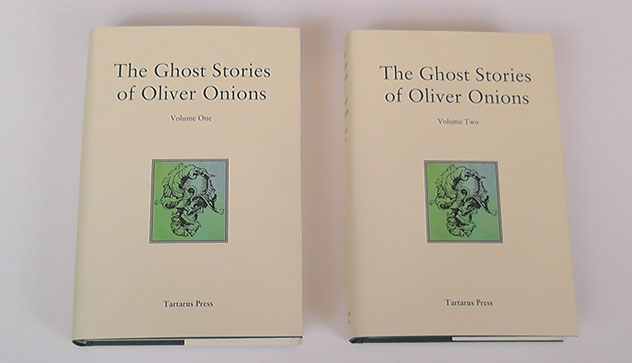
Tartarus Press has just released a new two-volume edition of their The Ghost Stories of Oliver Onions


I have written previously about Onions here.


The new edition features the first publication of the novella "Gambier." No date is provided for the story, but in her introduction editor Rosalie Parker says it is an early work. 


Parker goes on to say that "Gambier" will "be of interest to enthusiasts of Folk Horror." It certainly has elements that Folk Horror has gone back to claim: an isolated rural setting; old ways that are peculiarly maintained.


"Gambier" is the first person narrative of a new-minted country doctor, John Wilson. It begins:


Few, even, of my friends, have looked on me as a man whose nerves are lightly set a-start; and for this, I fancy, I have to thank a certain heaviness and immobility of countenance, together with a bigness of frame, not generally associated with high-strung natures. And, indeed, my training as a doctor of medicine has ridded of all terrors for me such things as deathbeds, wounds, and the like, regarded by most folks as dreadful. Nevertheless, I confess here that this big, bragging body of mine holds a spirit sometimes bold (I hope), but sometimes timorous as a child's. And in particular, I have always been extremely sensitive to that kind of Spirit of a Place, be it gay or gloomy, which has its commonest manifestation in the desire folks have to cast themselves from heights, as if an imp within them urged them to their end.

     The most remarkable instance of this sensitiveness that I can remember happened to me in the year 1778. I am able to give the month, from the fact that I was at the time hastening, fresh from college, to take up my first practice, that of my friend James Rewell, who had lately died; and it would be the first or second week in September. As the incident is all of a piece with my story, I will begin at that point.


Wilson finds that the village of Wastley is ruled by Father Gambier, and that the area was untouched by the Reformation and Cromwell's rule. 


"Gambier" presents the struggle between Wilson and a few local allies against Gambier's personal dictatorship. It is a no-quarter-given battle between the two men: a battle of wits and brute force with plenty of shocking and bloody violence. I have only read Onions' supernatural fiction, and "Gambier" has an eloquently ferocious tone that the reader of stories like "The Beckoning Fair One" and "The Cigarette Case" will be completely unprepared for.


*     *     *


In her introduction to the new edition, Rosalie Parker writes:


Selecting the stories for this volume has been a positive joy. We have been able to adopt a policy of inclusivity wherever possible, but, in order to maintain the quality of the collection, four stories which might have been included have been omitted. These are 'The Master of the House', a mystery novella included in the original Collected Ghost Stories of 1935, 'Two Trifles' ('The Mortal' and 'The Ether Hogs') and the recently rediscovered 'Tragic Casements'.


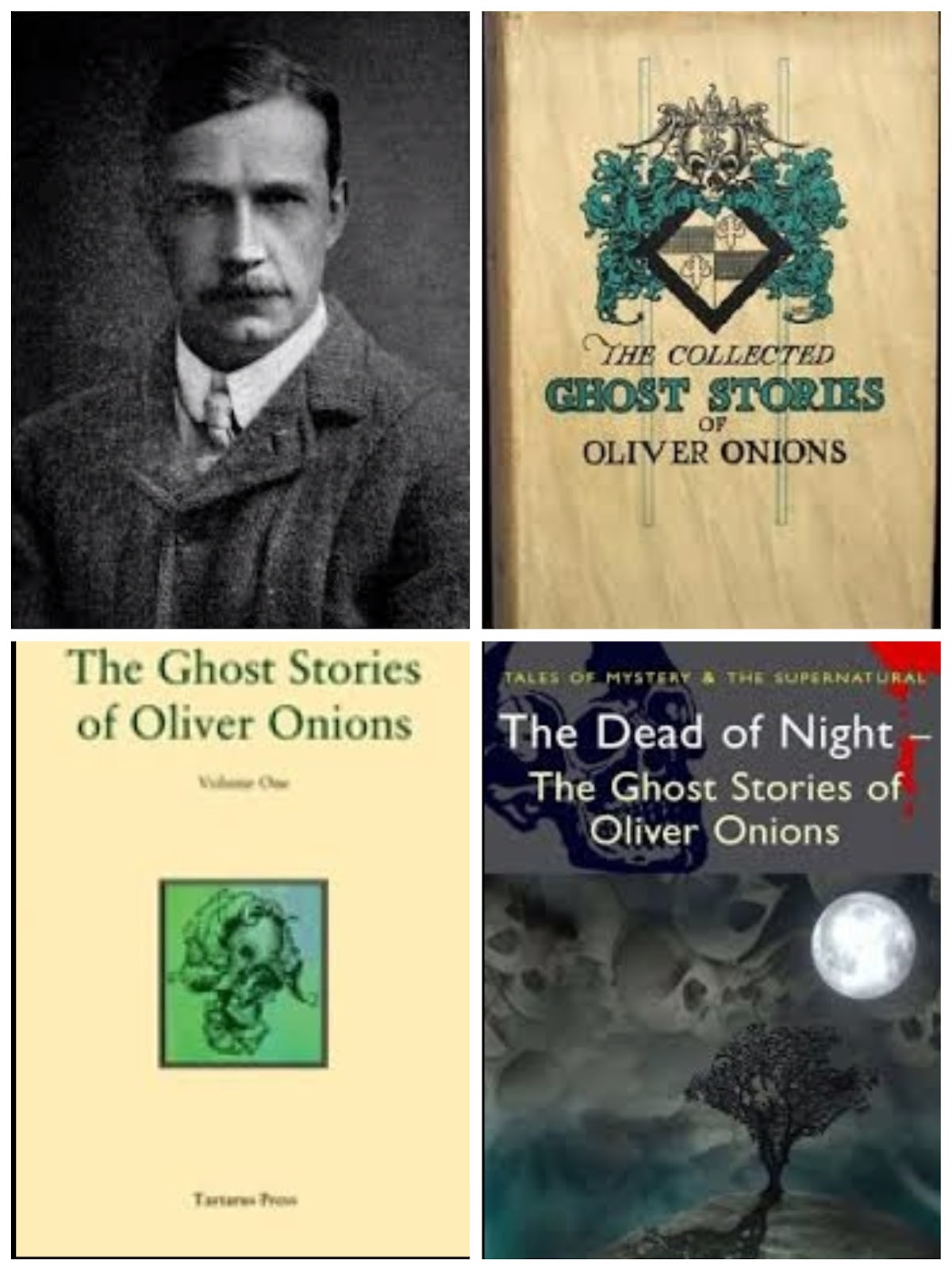
(The missing stories are available in The Dead of Night: The Ghost Stories of Oliver Onions [Wordsworth, 2010].)


The omission of "Tragic Casements" is a serious mistake. While the story does not have the scope or aesthetic authority of earlier Onions tales, it is an accomplished story of supernatural horror, well-organized and finely executed. On these strengths, and as a rarity, it deserves inclusion in any Onions collection that hopes to present the scope  of the author's career. (Especially when the collection has two volumes of space to work with.)


Jay

20 June 2021


Friday, October 18, 2019

Celebrating Oliver Onions (1873–1961)


Oliver Onions has a reputation as a bloodless, psychologizing aesthete of pristine refinement. The sense seems to be that if you prefer the cooless and distancing of Henry James, Onions is for you. If you want danger, melodrama, and horrorpilation, look elsewhere.

This sentiment, whose cues in the horror community kept me steering clear of Onions for the last four decades, is at best inaccurate. More fool me.

Onions is a meticulous craftsman who takes infinite pains. His stories are spacious enough to let readers breathe, to become acquainted with characters and the lay of the land. There is real external horror here, not just the dripping accumulation of menacing atmosphere via pastel prose.

A few notes and excerpts from stories read so far. (I am not done reading Onions).

Credo
....What the writer has in practice to investigate is the varying 'densities' of the ghostliness that is revealed when this surface of life, accepted for everyday purposes as stable, is jarred, and for the time of an experience does not recover its equilibrium.
....somewhere between the ultra-violet and the infra-red of the ghostly spectrum.

The Beckoning Fair One • (1911)
There are echoes of Poe's great essay-tale "The Imp of the Perverse" here, as the protagonist struggles against himself and an annihilating supernatural force in his new flat. Onions gives us plenty of the economy of everyday life of a writer living hand-to-mouth.  Each step along the path to self-annihilation is accompanied by new heights of self-deception:
....He was in truth only now beginning to work. He was preparing such a work . . . such a work . . . such a Mistress was a-making in the gestation of his Art . . . let him but get this period of probation and poignant waiting over and men should see . . .

Phantas • (1910)
A story of nautical timeslip, brief and of great poignancy.

Rooum • (1910)
A body-horror story of supernatural assault.
The narrator and Mr. Rooum are civil engineers visiting a construction project.  The narrator has a degree; Rooum does not, but he has a sixth sense about the business, and is also a talented water dowser.
….for all the lateness of the hour, I wasn't sleepy; so from my own bag I took a book, set the candle on the end of the mantel, and began to read. Mark you, I don't say I was much better informed for the reading I did, for I was watching the Vs on the wallpaper mostly – that, and wondering what was wrong with the man in the other bed who had fallen down at a touch in the subway. He was already asleep.

Now I don't know whether I can make the next clear to you. I'm quite certain he was sound asleep, so that it wasn't just the fact that he spoke. Even that is a little unpleasant, I always think, any sort of sleep-talking; but it's a very queer sort of sensation when a man actually answers a question that's put to him, knowing nothing what­ever about it in the morning. Perhaps I ought not to have put that question; having put it, I did the next best thing afterwards, as you'll see in a moment . . . but let me tell you.

He'd been asleep perhaps an hour, and I woolgathering about the wallpaper, when suddenly, in a far more clear and loud voice than he ever used when awake, he said: 'What the devil is it prevents me seeing him, then?'

That startled me, rather, for the second time that evening; and I really think I had spoken before I had fully realised what was happening.

'From seeing whom?' I said, sitting up in bed.

'Whom? . . . You're not attending. The fellow I'm telling you about, who runs after me,' he answered – answered perfectly plainly.

I could see his head there on the pillow, black and white, and his eyes were closed. He made a slight movement with his arm, but that did not wake him. Then it came to me, with a sort of start, what was happening. I slipped half out of bed. Would he – would he? – answer another question? . . . I risked it, breathlessly:

'Have you any idea who he is?'

Well, that too he answered.

'Who he is? The Runner? . . . Don't be silly. Who else should it be?'

With every nerve in me tingling, I tried again.

'What happens, then, when he catches you?'

This time, I really don't know whether his words were an answer or not; they were these:

'To hear him catching you up . . . and then padding away ahead again! All right, all right . . . but I guess it's weakening him a bit, too . . . '

Benlian • (1911)
One of Robert Chambers' artist studio nightmares meets "Nadelman's God" by T.E.D. Klein.

The Ascending Dream • (1924)
A story composed entirely of history-punctuated slingshot endings

The Honey in the Wall • (1924)
Must-read for lovers of E.F. Benson, with a soupcon of L.P. Hartley. The declining fortunes of a once-wealthy family, now reduced to selling-off patrimony.

The Rosewood Door • (1929)
Antiquarian time-slip melodrama accumulates into a tragedy of real scope. A novella with the scale of a novel, akin to the best Gerald Kersh historical fiction.

"John Gladwin Says ..." • (1928)
A masterclass in narrative distancing and afterlife fantasy.
...nameboards of ancient wood with finials sticking up at the ends like prick-ears, John Gladwin says. As for the church – well, there it was, what remained of it, that wrecked and ivied hum­mock in the middle of the field. The gap into the field had no gate. John Gladwin imagines he must have stopped his engine, for this pink and silver bowl in the hills was filled with an immense quiet. He got out of the car. Picking his way among the tombstones he pushed through coarse grass to the ruin.

Hic Jacet • (1911)
A man believes he is writing the biography of his dead friend, a penniless artist graced with genius. But the writer, who gave up literature for bestselling detective fiction, comes face-to-face with ramifications of a different order entirely. 

The Master of the House • (1929)
The Peckover siblings versus black magic and lycanthropy. For real. Recalls Sapper, Wheatley, or Blackwood. Boarded windows, secret passages, sealed rooms. 

Tragic Casements 
A very accomplished supernatural horror story.
....From some­where inside the house there had come the squeaking scrape of wood on stone and a creaking as of wicker under a weight. The muffled jingling vibration that followed it resembled nothing so much as the dropping of a tray laden with crockery, and snatching a candle from the table, Eustace Corydon had disappeared by the uncurtained doorway.

Matt Cowan at Horror Delve has his own pertinent notes on Onions here.

I've excerpted a passage on Onions from James Machin's great recent book Weird Fiction in Britain 1880–1939 here.

Jay
18 October 2018


Tuesday, October 8, 2019

James Machin on Oliver Onions

'this vague we know not what' 

Vernon Lee


....Another author of weird fiction associated with the Edwardian period is Oliver Onions (1873–1961), an erstwhile illustrator who began writing for the periodicals in the 1890s, publishing his first novel in 1900 (Kemp et al. 2002b, 301). His most well-known story, 'The Beckoning Fair One', is an example of the clear influence of Henry James on his writing, effective as it is in its own right. This, and several other of Onions' stories, is concerned with an artist struggling with the creation of their art, expressed through a supernaturally inflected narrative. Even though Onions was clearly drawn to psychic phenomena and ghost lore—explicitly referencing the Society for Psychical Research in 'Benlian' (1911) for example (Onions 1911, 177)—his oeuvre evades being subsumed within the ghost story genre proper, a fact not lost on contemporary critics:


The stories are by no means all to be dismissed as 'ghost' stories. They deal rather with various forms of supernaturalism which man does not profess, or is unable, to account for. (Athenaeum 1911, 274)


A good example of this weirder valence of his writing is the 1910 story 'Rooum', which concerns an invisible presence stalking the titular character, an itinerant construction engineer. Onions blends the traditional trope of supernatural persecution (a nineteenth-century example being Sheridan Le Fanu's 'The Familiar' (1872)) with contemporary scientific theory. In his attempts at explaining his strange affliction, Rooum speaks vaguely of 'osmosis' and 'molecules', which the narrator, although demonstrating greater scientific education, struggles to parse (Onions 1910, 1118). Typically, Onions never offers a definite explanation in terms of any specific supernatural agency (there is no ghost, as such), and never closes the door on the possibility that what is being described is a purely psychological affliction. Despite its brevity, Onions' execution of the narrative is compellingly suggestive: is Rooum's crisis over his identity, and the alleged threat to it, based on his own ethnicity (he is described by the narrator as mixed race and 'very dark' (1115))? Or is it connected with the liminal spaces of construction, and (again) the metropolitan suburbs in which the story is set (the 'eruption of red-brick houses' (1117))?


As I have discussed, this latter trope was a particular Edwardian hobby horse, but despite this, Onions' work refuses to conform neatly to retroactive periodization. Reviewing Widdershins—the collection that included

'Rooum'—the Saturday Review objects to Onions' alleged preoccupation with 'decay', leading them to place him with the 'decadent class of writers who, tired of the beautiful, seek only sensations and find them in the

study of all that is repulsive' (Saturday Review 1911, 214). The reviewer repeatedly criticizes Onions for 'taking the ugly theme of madness for so many of the stories', a preoccupation the reviewer again associates with decadence, 'the flowers of evil', and Charles Baudelaire (214–15). This reading of Widdershins as a series of investigations into degenerate psychological maladies sidelines any supernatural element to the work. For instance, 'The Beckoning Fair One' is described as 'a pitiless record of the various stages traversed by a man on his way from perfect sanity to the lunatic asylum,' though 'disguised as a ghost story' (the reviewer here echoing Max Nordau).


Indeed, this fin-de-siècle atmosphere is readily evident throughout the collection: the bohemian studio milieu of 'Hic Jacet' (1911) for instance, or the Classical Paganism of 'Io' (1911). In this latter story, which the

Saturday Review concedes to be a 'wonderfully clever piece of writing' (215), a woman is transported from her humdrum middle-class existence into a Bacchic frenzy; whether this is through actual invocation of a divine

agency or insanity is unresolved. The English Review said of the story that it was 'a masterly and beautiful conjunction of clerkly life and Dionysiac ecstasy', a description that could also apply to several of Machen's works, including 'A Fragment of Life' (English Review 1911, 755). Here again there is a through line between torrid fin-de-siècle paganism and what Carey identifies as the Pan-worship provoked by the quotidian suburbs:

the quiet external lives of their inhabitants, a stability interrupted, destabilized, and enriched by the resurgence of the romantic imagination.


Although it is certainly possible, as I have demonstrated, to identify various tropes and tendencies in Edwardian weird fiction, it is of course impossible to neatly distinguish fiction written after 1900 from that written before it. Onions in 1911, for example, was clearly being written about as an (unwelcome) outlier from the Yellow Nineties. In Chap. 4, I will discuss in detail the weird fiction of John Buchan, specifically in this context. Having acknowledged the possibility of an Edwardian weird fiction, therefore, I will once again subsume it within the more capacious ambit of the long nineteenth century.


___________________________________


James Machin

Weird Fiction in Britain 1880–1939

2018: Palgrave Macmillan