Subscribe to my Substack

Wednesday, June 19, 2019

Shadows over Frisco: Stories by Michael Shea


Shea's Bay Area Cthulhu stories have several strengths: mastery of language, scene-building, and high skill with prose.  Most neo-Cthulhu stories coming out today never rise above the level of fan fiction, but Shea is a stylist first, and the braiding of his Bay Area world with that of the Old Ones is at a very high aesthetic level.  No occult detectives, no scholars seeking after the outre, no armed vigilantes or private dicks, just working people and people too old to work who find a fierce desire within themselves to defend their community when the shadows gather.


Notes and excerpts below.


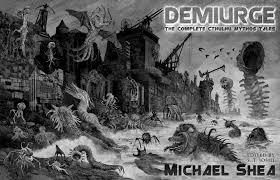
DEMIURGE: The Complete Cthulhu Mythos Tales of Michael Shea

Edited by S. T. Joshi

2017 Dark Regions Press


INTRODUCTION

....Michael Shea was anything but a pastichist; even when he was writing in novels or tales that avowedly imitated the work of others, his own dynamic originality kept bursting through—and the result is a series of works that, while drawing inspiration from prior texts, are infused with the distinctive vision of their creator.

....he quickly decided that he needed to draw upon his own Californian roots to generate tales that truly evoked the realistic topography—human, social, cultural, historical—of Lovecraft's best narratives.

....Shea, eschewing simple-minded moral condemnation, finds in these exiles from polite society a brooding determination to persevere in the face of poverty, crime and social condemnation that is strangely ennobling.

....Shea sensed that the cosmic and the human were not mutually exclusive. In such scintillating tales as "Copping Squid," "Dagoniad," and "Tsathoggua" he slyly leads the reader to the perception of unthinkable cosmic terror by means of characters whose all-too-human flaws make them the reader's eyes and ears as the awesome revelation slowly dawns.

....Shea both drew inspiration from H. P. Lovecraft and also transmuted Lovecraft's conceptions into his own by the alchemy of his imagination.

....he evolved into a genuine disciple whose vibrant originality and sensitivity Lovecraft would have recognized and admired.


FAT FACE

"Fat Face" bakes in the heat of Los Angeles dawns and dusks, of urban neighborhoods of coffee shops and old hotels, of superseded side streets of once pleasant residences left behind long ago. Its characters have fallen off the bottom rung of class society, and live an atomized lumpen existence, self-sedating and kidding themselves they have a future or any life plans worth thinking about. Bukowski has nothing on Shea with this milieu.

    ....She dreamed of a city like Hollywood, but the city's walls and pavements were half alive, and they could feel premonitions of something that was drawing near them. All the walls and streets of the city waited in a cold-sweat fear under a blackly overcast sky. She herself, Patti grasped, was the heart and mind of the city. She lay in its midst, and its vast, cold fear was hers. She lay, and somehow she knew the things that were drawing near her giant body. She knew their provenance in huge, blind voids where stood walls older than the present face of Earth; she knew their long cunning toll to reach her own cringing frontiers. Giant worms they were, or jellyfish, or merely huge clots of boiling substance. They entered her deserted streets, gliding convergingly. She lay like carrion that lives and knows the maggots' assault on it. She lay in her central citadel, herself the morsel they sped toward, piping their lust from foul, corrosive jaws.


NEMO ME IMPUNE LACESSIT

This is an astonishing and masterful story.  It far exceeds Bloch's Poe ventriloquism, and employs it beautifully in a tale of revenge worthy of a Montresor scion. Our narrator carries out an ingenious act of revenge against his former wife and her retinue, with the help of a shoggoth, from "roses" from Yuggoth, some "hounds" and various other tarantulaic and boiling entities ready to partake of  a bounteous May Eve.


THE PRESENTATION

A shadow over Frisco (and shadows are plentiful in Shea's Frisco) in the form of a new tech company wows the bohemian milieu. The avatar of Cthulhu comes in form of a business "master of the world" named Chip Shugrue; he has deep pockets and a generous checkbook. Shea gives us a big social canvas of characters, for each of whom Chip's money (and his portal project) become end-all and be-all.

    The presentation itself is the devil's own Ted Talk.

    ....And that was when, as one, they felt the sudden presence of the Entrepreneur, the Holder of this Account into whose bottomless wealth they'd just disgorged their holdings. The Holder of the Account hung just below them in the black gulf.

    They felt him as an immense subjacent gravitational mass. They felt the tug of a leviathan hanging just under the keel of their collective consciousness.

    And his sudden presence gave them all a wonderful moment of childhood. It was that Daddy feeling—that the grand, glorious, but frighteningly vast muchness and suchness of the world was mediated for your little self. That Daddy's greater, loving mass hovered between you and the immensity, a loving canopy of concern, a big ally in the bigness of it all....


THE POOL

Daryl is a social dropout working as a laborer on a crew digging holes for swimming pools in Marin County.

    ....What had these glacial horrors to do with him? It was as if, with ghostly fanfare, the Beyond had delivered its message to the wrong man on the wrong world.


THE RECRUITER

Chester is an old widower approaching the end.  He lives in a transient hotel in Frisco, a recurring location for Shea and artfully evoked. Chester gets a life-saving cash windfall, then learns what he must do to earn the pay.

    ....Galvanized, he sits up to swing his legs off the bed—and discovers a terror that dwarfs what he's already feeling: his body has not stirred. Violently, he again exerts his will … and his frame lies untouched by it, calm as sleep.


THE BATTERY

A non-Bay Area story, rare for this collection.  "The Battery: takes place on an isolated strip of coast in South Florida. One of Shea's great subjects is people confronting the unspeakable and reaching out in solidarity for allies.  His heroes are rarely intellectuals or scholarly, but in this story a couple are.

    ....Do you two realize that we have occupied our post of vigilance, wherever in the world it took us, for more than thirty years? And generations before us have done likewise, but to us it has been given to discharge our trust and confront the apocalypse. And at the same time it has been given us, near the end of our watch, which is the end of our lives, to find our successors, and to meet at last our dearest friends."


COPPING SQUID

It is easy to understand why "Copping Squid" has gained a reputation as one of Shea's best stories.  Like many of the best, it is a San Francisco Bay-area story, and takes us into the hills east of Richmond. What Shea's protagonist finds there, and what he comes away with, may not be beyond human ken, but they are things beyond reason.

    ....And the knell of that voice awoke winds in the night, and the winds buffeted Ricky as though he hung in the night sky within the eye, and Ricky knew. He knew this being into whose view he'd come! Knew this monster was the king of a vast migration of titans across the eons of the countless Space-Times! Over the gale-swept universe they moved, these Great Old Ones. Across the cracked continents they trawled, they plundered! Worlds were the pastures that they grazed, and the broken bodies of whole races were the pavement that they trod!


DAGONIAD

"dagoniad" details the opening guns in the battle to defnd the bay area from the Old One in the Bay. The heroes are the owne4r of a hole-in-the-wall bookstore and a young prostitute: both are women. It's a graphic and rousing story.

    "You know what we should do? We should defy him."

    "Dagon." Dee said it dully, not quite asking.

    "Dagon. Look at this thing! What good could meekness do us against its master? I say fuck him! What right does he have to our world? To our lives?"


TSATHOGGUA

"Tsathoggua" is the culminating Bay Area story.  It sees the founding of the "fellowship of the ring" of individuals who have survived previous encounters with Old Ones and their minions, have had enough, and are ready to join together to draw a line.  These are not elite and learned academics, nor students, or "seekers after the outre." They are seasoned working class people living a precarious economic existence in San Francisco, but who view it as their town.


MOMMA DURTT

A man makes his own god by accumulating illegally dumped toxic waste in an abandoned mineshaft near Richmond, California.  Shea is a master dramatizing each character through suggestive initial bits of plot before the main course. He has the skill and the confidence to switch through multiple characters, giving his short stories and novellas the breadth and scope of novel.

    ...."You gotta meet my Auntie some day," Alex said, scanning that view. "She's like half Miwok or something. Anyway she told me this mountain Chip's mine is in was like a Spirit Place—like where you go to fast and have visions? Go to like, face your demons and stuff."

    "Spirits! Rad. I wish there was something cool like that about it. That would be something, but I think what these guys are doing up here is just plain old creepy and criminal."

    "Yeah, but we don't really know that, not for sure. Anyway, we're definitely good and late now. Maybe he's just gonna fire us. When Chip said get back on time, he put a lot into it."


Jay

19 June 2019


C:\Users\john.rothermel\AppData\Local\Microsoft\Windows\INetCache\Content.MSO\66FC06DD.tmp

Friday, June 14, 2019

7 Short Stories by Michael Shea: Reading notes


That Frog!

This story is executed with the elan of an S.J. Perelman. The jocose understatement, the unreliability of the narrator, and all the hidden ghastliness of the joke, are unchallengeable. Our perfectly sane and reasonable protagonist never sees the punch line: he is the monster. And a very thorough one; like the narrator of "The Horla," who forgot to get his servants out of the house before he burned it to the ground.


Grunt-12 Test Drive

A tale of time travel, car salesmanship, and sibling rivalry paced to outstrip the Keystone Kops.


Fill It With Regular

Kaleidoscopic and masterful alien invasion story with an Emmerich-scale scope and cast.  Superior to Kevin J. Anderstons 2000 novel Ill Wind.

    ....Gasoline and some municipal supplies of natural gas were thought to be its initial vector, at least in California and others of the heaviest-hit states. The mechanisms of its continuing diffusion were no mystery. The fungus's omniperipheral advance, by mycelial branching, was incredibly rapid in itself, of course, through any food matrix. But with the combustion of that matrix, the mycelium it contained underwent a fusion and a heat-triggered concentration of genetic material, and resolved itself into a gust of exceedingly small and numerous spores. Hence the roadways were only the first of many zones that those first vectors had seeded, since most of a tail pipe's tillage went aloft to haunt the troposphere. There was the real scope of this thing, and it made Ken shiver slightly, imagining that global microsnow, that sooty seed like a gauze-fine, wide-flung shroud settling right now — softly, softly — down upon them all. What could anybody do but drive out to business as usual through this awesome newness that had been laid upon the world?


Delivery

A reproductive rights dystopia told in the language of dream fever, giving us the tip of a poisoned alp that rides just below the surface.

    ....The doctor's fingers were wedged in the os now, gripping the hair plug. Briefly, Lupe's womb seemed to recoil, to be at tug-of-war with him, and then it surrendered with a peristaltic shudder, and the slick mass of their second-born was uprooted — the crooked black legs, bunched like bananas below the bristly abdominal bulb, plucked free. The doctor carried it to the troopers' cart.

    One of them opened the glass box's trap, and the doctor eased it through. It poured off his cupped palms and scuttled around its bright, warm crib, pedipalps caressing the glass, so brisk and fully expert in its life's first moments.


For Every Tatter in Its Mortal Dress

An atypical and abstract fantasy along the lines of Borges or Kafka, in which one stranger's self-imposed suffering inflicts itself on another.


The Growlimb

A man makes his own god and calls it forth in Northern California wine country. A faultless tale, unerringly executed.

    .....All living things were dangerous miracles. Each tree brimmed with majesty as it wore the light, and the wind moved through it, but anything that lived could blow up in your face. And if you did win your own immortality, then you must live it in the web of these mortal lives, and you must endure all of their deaths, death after death after death. And if the beauty of it all – fields farms trees skies suns stars – was almost unendurable now, must not immortality itself kill you if you did attain it? Kill you with all that excruciating beauty?


Momma Durtt

A man makes his own god by accumulating illegally dumped toxic waste in an abandoned mineshaft near Richmond, California.  Shea is a master dramatizing each character through suggestive initial bits of activity before the main course. He has the skill and the confidence to switch through multiple characters, giving his short stories and novellas the breadth and heft of novel.

    ...."You gotta meet my Auntie some day," Alex said, scanning that view. "She's like half Miwok or something. Anyway she told me this mountain Chip's mine is in was like a Spirit Place—like where you go to fast and have visions? Go to like, face your demons and stuff."

    "Spirits! Rad. I wish there was something cool like that about it. That would be something, but I think what these guys are doing up here is just plain old creepy and criminal."

    "Yeah, but we don't really know that, not for sure. Anyway, we're definitely good and late now. Maybe he's just gonna fire us. When Chip said get back on time, he put a lot into it."


Jay

14 June 2019


Wednesday, June 12, 2019

Michael Shea: An initial encounter with the short fiction

1987: Arkham House


POLYPHEMUS
Was Shea considered New Wave?  Perhaps he came later. My ignorance of science fiction is almost complete, but "Polyphemus" strikes me as a compelling example of Hard SF flowing not from math or engineering, but from the biological sciences.  It is a skilled work of world-building, as well, where th society's back-story must be inferred by careful ready and is not handled with an info-dump. It is also a first-rate problem-solving adventure/frontier story.

THE ANGEL OF DEATH
Here is a perfectly and aesthetically satisfyingly fiction. Shea's style, his own but on a par in craft and authority with Flaubert and Conrad, is deployed in a masterful depiction of the meeting between an an alien conducting a field study and a Son of Sam-type serial killer. Pacing and scene-building are carefully executed, the protagonists modstly rounded.

UNCLE TUGGS
An uproarious piece of supernatural revenge slapstick, recounting one of those days when nothing goes right and we wonder whose side the gods are really on.  Here they are on the side of the wronged, though the laborer through whom they act probably has a different opinion now.

THE PEARLS OF THE VAMPIRE QUEEN
Swords and sorcery told deftly with gusto.
    ....She knelt beside him, and her face was taut, refined by a tension of icy love, made younger before our eyes by her passionate anticipation. She lowered her face—worshipfully, kissing—to the muscled juncture of his neck and shoulder. And then there was a crisp, liquid sound of horrible distinctness, her hands clutched his shoulders, and the King's body rose and convulsed upon the stone with the raw, coiling power of a speared eel.

THE HORROR ON THE #33
Shea is at his best when he conveys the economic dead-end choices thrust upon the marginalized who have fallen off the bottom rung of the ladder. It doesn't take much else to illuminate the horror of such a trap.
    ....A person without experience of the wino perspective could easily miss the peculiar dismalness of Knavle's position. He and his caste inhabit the waste corners of the world and have therefore the least power to hide of any class of men. Only a man who possesses things has any power to rearrange his life, to avoid or defend; as for the resolutely destitute, they are already clinging to crannies and last possibilities. There are only so many places to sleep for free, or to get a morning's work distributing supermarket advertisers, and to these places Knavle had to go.

THE EXTRA
"The Extra" is a slangy, impressionistic story of an atomized market future where individual barbarians combat corporate barbarians in the context of going to work.  Each is looking out for number one; there previous little gentility and even smaller space for sentiment.

THE AUTOPSY
Doctor Winters, our pathologist, carries a fellow traveler in his body: the cancer that will kill him.  Joe Allen, a footloose laborer killed in a mine explosion, hosts a different kind of traveler in his body. Shea makes of this conflict a masterpiece of speculative horror, a tale whose canonical status has been acknowledged for several decades now. Shea's surgical brevity in handling such a rich situation is admirable.
    ....the doctor had glimpses of the racial history that underlay the aliens' predatory present. Glimpses of a dispassionate, inquiring breed so advanced in the analysis of its own mental fabric that, through scientific commitment and genetic self-sculpting, it had come to embody its own model of perfected consciousness. It had grown streamlined to permit its entry of other beings and its direct acquisition of their experiential worlds. All strictest scholarship at first, until their matured in the disembodied scholars their long-germinal and now blazing, jealous hatred for all 'lesser' minds rooted and clothed in the soil and sunlight of solid particular worlds. The parasite spoke of the 'cerebral music,' the 'symphonies of agonised paradox' that were its invasion's chief plunder. The doctor felt the truth behind this grandiloquence: the parasite's actual harvest from the systematic violation of encoffined personalities was the experience of a barren supremacy of means over lives more primitive, perhaps, but vastly wealthier in the vividness and passionate concern with which life for them was imbued.


Jay
12 June 2019


Sunday, June 9, 2019

Some Weird Stories of Robert W. Chambers


Complete Weird Tales of Robert W. Chambers is a useful ebook to have, but like many other oceanic bodies it is a place where one can easily get lost. (Most of his work is also free online here).

Chambers wrote entertaining weird and strange stories for several decades. His later tales, invariably humdrum, are brightened with humor employed at the expense of his more sniffy protagonists.

The later stories, including the sublime "The Maker of Moons," have typically not received the hosannas delivered to two early masterpieces, "The Repairer of Reputations," and "The Yellow Sign." The praise is richly deserved for these tales, which are virtually unequaled in their concentrated power and originality.

Below are notes and excerpts on stories read this week:

The Repairer of Reputations (1895)
The early stories of Chambers, like those of Machen, are glutted to satiety with contradictions rife of their period, the rosy-fingered dawn of Washington's imperial ascendancy.
    Our narrator seems to model himself, at least in his grasping arrogance, on Theodore Roosevelt. (Anyone who has not read Richard Hofstadter on T.R. should stop avoiding the pleasure). Otherwise, our narrator Mr. Castaigne might just as well be another psychotic Bonaparte manque.
    Was Chambers the first to write about the mind-shattering effects of a book? (He certainly would not be the last; his pastichists may never outnumber Lovecraft's, but like readers of The King in Yellow they are multiplying).
    .....During my convalescence I had bought and read for the first time, The King in Yellow . I remember after finishing the first act that it occurred to me that I had better stop. I started up and flung the book into the fireplace; the volume struck the barred grate and fell open on the hearth in the firelight. If I had not caught a glimpse of the opening words in the second act I should never have finished it, but as I stooped to pick it up, my eyes became riveted to the open page, and with a cry of terror, or perhaps it was of joy so poignant that I suffered in every nerve, I snatched the thing out of the coals and crept shaking to my bedroom, where I read it and reread it, and wept and laughed and trembled with a horror which at times assails me yet.

The Mask • (1895)
Readers who enjoy tales of weird travails of artists and their connoisseurs have long prized tales like "Strange Event in the Life of Schalken the Painter" and "The Abominable History of the Man with Copper Fingers."
     "The Mask" gives is a briefer view, but no less telling for that. (Do writers still have friends who paint and sculpt, and do they still visit their studios for slices of life? Or is an appetite for the moveable feast defunct? Who today realizes Pickman would have smelled of linseed oil and turps, and had a cadmium cough?)
    ..... "What you tell me of seeing Boris bending over you while you lay ill, and feeling his touch on your face, and hearing his voice, of course troubles me. This that you describe must have happened a fortnight after he died. I say to myself that you were dreaming, that it was part of your delirium, but the explanation does not satisfy me, nor would it you."

In the Court of the Dragon (1895)
....I was worn out by three nights of physical suffering and mental trouble: the last had been the worst, and it was an exhausted body, and a mind benumbed and yet acutely sensitive, which I had brought to my favourite church for healing. For I had been reading The King in Yellow.
    "The sun ariseth; they gather themselves together and lay them down in their dens." Monseigneur C—— delivered his text in a calm voice, glancing quietly over the congregation. My eyes turned, I knew not why, toward the lower end of the church. The organist was coming from behind his pipes, and passing along the gallery on his way out, I saw him disappear by a small door that leads to some stairs which descend directly to the street. He was a slender man, and his face was as white as his coat was black. "Good riddance!" I thought, "with your wicked music! I hope your assistant will play the closing voluntary."
    With a feeling of relief — with a deep, calm feeling of relief, I turned back to the mild face in the pulpit and settled myself to listen. Here, at last, was the ease of mind I longed for.
    "My children," said the preacher, "one truth the human soul finds hardest of all to learn: that it has nothing to fear. It can never be made to see that nothing can really harm it."
    "Curious doctrine!" I thought, "for a Catholic priest. Let us see how he will reconcile that with the Fathers."

The Yellow Sign (1895)
.....I did not know whether it was something in the turpentine or a defect in the canvas, but the more I scrubbed the more that gangrene seemed to spread. I worked like a beaver to get it out, and yet the disease appeared to creep from limb to limb of the study before me. Alarmed, I strove to arrest it, but now the colour on the breast changed and the whole figure seemed to absorb the infection as a sponge soaks up water. Vigorously I plied palette-knife, turpentine, and scraper, thinking all the time what a séance I should hold with Duval who had sold me the canvas; but soon I noticed that it was not the canvas which was defective nor yet the colours of Edward. "It must be the turpentine," I thought angrily, "or else my eyes have become so blurred and confused by the afternoon light that I can't see straight." I called Tessie, the model. She came and leaned over my chair blowing rings of smoke into the air.
    "What have you been doing to it?" she exclaimed
    "Nothing," I growled, "it must be this turpentine!"
    "What a horrible colour it is now," she continued. "Do you think my flesh resembles green cheese?"
    "No, I don't," I said angrily; "did you ever know me to paint like that before?"
    "No, indeed!"
    "Well, then!"
    "It must be the turpentine, or something," she admitted....

The Demoiselle d'Ys (1895)
"The moor is wild and desolate. It is easy to enter, but sometimes they who enter never leave it. There are no peasants' huts here."
    A beautifully observed story set in the Breton moorland.

The Prophets' Paradise  (1895)
A sequence of adequate prose poems.

The Maker of Moons (1896)
A brilliantly executed and powerful fantasy about the interpenetration of worlds, ours and a weird China, one of whose wizards comes to live in and alter our reality. For a time. This story sends its echoes forward to works like Machen's "N." and King's "Crouch End."
    ....We never were able to find either her dwelling place or the glade and the fountain again. The only thing that remains to her of her former life is the gold serpent in the Metropolitan Museum and her golden globe, the symbol of the Kuen–Yuin; but the latter no longer changes color.

A Pleasant Evening (1896)
More atelier life.
  "....They say she is idle and vain and pleasure-loving; they say she is hare-brained and reckless. The little sculptor on the ground floor, who was buying rolls from old Cabane, spoke to me to-night for the first time, although we have always bowed to each other. He said she was very good and very beautiful. He has only seen her once, and does not know her name. I thanked him; — I don't know why I thanked him so warmly. Cabane said, 'Into this cursed Street of the Four Winds, the four winds blow all things evil.' The sculptor looked confused, but when he went out with his rolls, he said to me, 'I am sure, Monsieur, that she is as good as she is beautiful.'"

The Purple Emperor (1897)
An American expat tells the story of jealousy and murder in a small town in Brittany. A very wryly observed tale.

Pompe Funèbre • (1897)
....When anything that is dying — sick and close to death — falls upon the face of the earth, something moves in the blue above, floating like a moat; then another, then others. These specks that grow out of the fathomless azure vault are jewelled flies. They come to wait for Death.
    The sexton also arranges rendezvous with Death, but never waits; Death must arrive the first....

The Messenger • (1897)
Not an antiquarian, but a spectral archeology story, again told by an American in Brittany. He is wed to a local woman with famous antecedents.
    "....There was one in the last century, here in St. Gildas. He cast a white shadow in the sun. He wrote in the Breton language. Chronicles, too, I believe. I never saw them. His name was the same as that of the old chronicler, and of the other priest, Jacques Sorgue. Some said he was a lineal descendant of the traitor. Of course the first Black Priest was bad enough for anything. But if he did have a child, it need not have been the ancestor of the last Jacques Sorgue. They say this one was a holy man. They say he was so good he was not allowed to die, but was caught up to heaven one day," added Lys, with believing eyes.
    I smiled.
    "But he disappeared," persisted Lys.
    "I'm afraid his journey was in another direction," I said jestingly, and thoughtlessly told her the story of the morning. I had utterly forgotten the masked man at her window, but before I finished I remembered him fast enough, and realized what I had done as I saw her face whiten.
    "Lys," I urged tenderly, "that was only some clumsy clown's trick. You said so yourself. You are not superstitious, my dear?"
    Her eyes were on mine. She slowly drew the little gold cross from her bosom and kissed it. But her lips trembled as they pressed the symbol of faith.

The White Shadow (1897)
....And so Sweetheart took her first step across that threshold of mystery, the Temple of Idols. And of the gilded idols within the temple, one shall turn to living flesh at the sound of a voice. And lo! where a child had entered, a woman returned with the key to the Temple of Gilded Idols.

Passeur (1897)
....Around the room the furniture stood ranged — a chair or two of yellow pine, a table, the easel, and in one corner the broad curtained bed; and behind each lay shadows, menacing shadows that never moved.
    A little pale flame started up from the
smoking log on the andirons; the room sang with the sudden hiss of escaping wood gases. After a little the back of the log caught fire; jets of blue flared up here and there with mellow sounds like the lighting of gas-burners in a row, and in a moment a thin sheet of yellow flame wrapped the whole charred log.
    Then the shadows moved; not the shadows behind the furniture — they never moved — but other shadows, thin, gray, confusing, that came and spread their slim patterns all around him, and trembled and trembled.
    
The Key to Grief (1897)
....He often thought of the camp now; of Bates, his blanket mate; of Dyce, whose wrist he had broken with a blow; of Tully, whose brother he had shot. He even seemed to hear the shot, the sudden report among the hemlocks; again he saw the haze of smoke, he caught a glimpse of a tall form falling through the bushes.
    He remembered every minute incident of the trial: Bates's hand laid on his shoulder; Tully, red-bearded and wild-eyed, demanding his death; while Dyce spat and spat and smoked and kicked at the blackened log-ends projecting from the fire. He remembered, too, the verdict, and Tully's terrible laugh; and the new jute rope that they stripped off the market-sealed gum packs.

In Search of the Unknown (1904)
Braiding short stories together into a novel probably vanished from popular fiction after the Second World war (with the exception of the science fiction genre). When there was a huge market for short stories, some authors could make masterpieces and earn a second paycheck. Oppenheim's book The Terrible Hobby of Sir Joseph Londe, Bart. Is a masterpiece of this kind.
    In Search of the Unknown links together a series of adventures featuring a man from the Zoological Gardens of Bronx Park, New York. He goes after specimens of birds, lizards, and other fauna thought extinct or merely unknown to science.
    Each adventure gives him a new young woman to woo, though they always choose a more suitable rival.
    ....Across the half-moon of beach towered another cliff, and, behind this, I saw a column of smoke rising in the still air. It certainly came from Halyard's chimney, although the opposite cliff prevented me from seeing the house itself.
    I rested a moment to refill my pipe, then resumed rifle and pack, and cautiously started to skirt the cliffs. I had descended half-way towards the beech, and was examining the cliff opposite, when something on the very top of the rock arrested my attention—a man darkly outlined against the sky. The next moment, however, I knew it could not be a man, for the object suddenly glided over the face of the cliff and slid down the sheer, smooth lace like a lizard. Before I could get a square look at it, the thing crawled into the surf—or, at least, it seemed to—but the whole episode occurred so suddenly, so unexpectedly, that I was not sure I had seen anything at all.

The Sign of Venus  (1903)
....A curious little chill passed over Hetherford.
    "I said it again and again — I don't know why. I remember the ring glittered; I remember it grew brighter and brighter. And then — and then! I found myself upstairs in the dark, groping over the dresser for the matches."
    Again that faint chill touched Hetherford.
    "I was stupefied for a moment,"she said tremulously; "then I suspected what I had done, and it frightened me. And when I lighted the candle, and saw it was truly my own room —and when I caught sight of my own face in the mirror —terror seized me; it was like a glimpse of something taken unawares. For, do you know that although in the glass I saw my own face, the face was not looking back at me."She dropped her head, crushing the ring in both hands. "The reflected face was far lovelier than mine; and it was mine, I think, yet it was not looking at me, and it moved when I did not move. I wonder —I wonder—"
    
The Case of Mr. Helmer • (1904)
....She sat beside him with never a word or sigh or whisper of breathing; and dream after dream swept him, like burning winds. Then sleep immersed him so that he lay senseless, sightless eyes still fixed on her. Hour after hour — and the white glare died out, fading to a glimmer. In densest darkness, he stirred, awoke, his mind quite clear, and spoke her name in a low voice.
    "Yes, I am here," she answered gently.
     "Is it death?" he asked, closing his eyes.
     "Yes. Look at me, Philip."

The Bridal Pair (1902)
...."Three years ago to-day," he repeated; "the anniversary has given me courage to speak to you. Surely you will not take offense; we have traveled so far together! — from the end of the world to the end of it, and back again, here — to this place of all places in the world! And now to find you here on this day of all days — here within a step of our first meeting place — three years ago to-day! And all the world we have traveled over since never speaking, yet ever passing on paths parallel — paths which for thousands of miles ran almost within arm's distance —"

Out of the Depths (1904)
A story of deep emotion and great poignancy.
    ...."I remember perfectly well how we met. Do you? You had just come back to town from Bar Harbor, and I saw you stroll in and seat yourself in that corner, and, because I was sitting next you, you asked if you might include me in your order — do you remember?"
    "Yes, I remember."
    "And I told you I was a new member here, and you pointed our the portraits of all those dead governors of the club, and told me what good fellows they had been. I found our later that you yourself were a governor of the club."

Police!!! • (1915)
Another collection of tales about lost tribes, cryptids, and Fortean creatures, along the lines of In Search of the Unknown.

The Third Eye (1915)
An expedition hunting three-eyed people of the Everglades.

The Immortal  (1915)
Naturalists search the Everglades for a tribe of transparent women.

The Ladies of the Lake • (1915)
Two zoologists lead a group of influential suffragists on a tour of Alaskan lakes named after them. They discover that
Lake Gladys Doolittle Batt is vrtually bottomless, and home to a species of very large fish. An amusing and light-hearted story.

One Over (1915)
....Professor Jane Bottomly was wished on us out of a pleasant April sky. She fell like a meteoric mass of molten metal upon the Bronx Park Zoölogical Society splashing her excoriating personality over everybody until everybody writhed.
     I had not yet seen the lady. I did not care to. Sooner or later I'd be obliged to meet her but I was not impatient.
     Now the Field Expeditionary Force of the Bronx Park Zoölogical Society is, perhaps, the most important arm of the service. Professor Bottomly had just been appointed official head of all field work. Why? Nobody knew. It is true that she had written several combination nature and love romances. In these popular volumes trees, flowers, butterflies, birds, animals, dialect, sobs, and sun-bonnets were stirred up together into a saccharine mess eagerly gulped down by a provincial reading public, which immediately protruded its tongue for more.
    The news of her impending arrival among us was an awful blow to everybody at the Bronx. Professor Farrago fainted in the arms of his pretty stenographer; Professor Cornelius Lezard of the Batrachian Department ran around his desk all day long in narrowing circles and was discovered on his stomach still feebly squirming like an expiring top; Dr. Hans Fooss, our beloved Professor of Pachydermatology sat for hours weeping into his noodle soup. As for me, I was both furious and frightened, for, within the hearing of several people, Professor Bottomly had remarked in a very clear voice to her new assistant, Dr. Daisy Delmour, that she intended to get rid of me for the good of the Bronx because of my reputation for indiscreet gallantry among the feminine employees of the Bronx Society....

Un Peu d'Amour (1915)
....Over me crept a horrible certainty that something living was moving under us through the depths of the earth — something that, as it progressed, was heaping up the surface of the world above its unseen and burrowing course — something dreadful, enormous, sinister, and alive!
    "Look out!" screamed Blythe; and at the same instant the crumbling summit of the ridge opened under our feet and a fissure hundreds of yards long yawned ahead of us.
    And along it, shining slimily in the moonlight, a vast, viscous, ringed surface was moving, retracting, undulating, elongating, writhing, squirming, shuddering.
    "It's a worm!" shrieked Blythe.

The Eggs of the Silver Moon (1915)
A humorous tall tale about rival entomologists at the Bronx Zoological Park.


Jay
9 June 2019