Readers who are unfamiliar with the work discussed may prefer to read these notes only after reading the story.
❖
The title A Night on the Borders of the Black Forest (1873) by Amelia B. Edwards may sound like a medieval folk tale. But it is a fiction for the modern world of fast travel and instant communication: steam and the telegraph. What happens when those advantages can no longer be relied upon, in foreign places where men are made savages by the law of value?
* * *
"A Night on the Borders of the Black Forest" (1871)
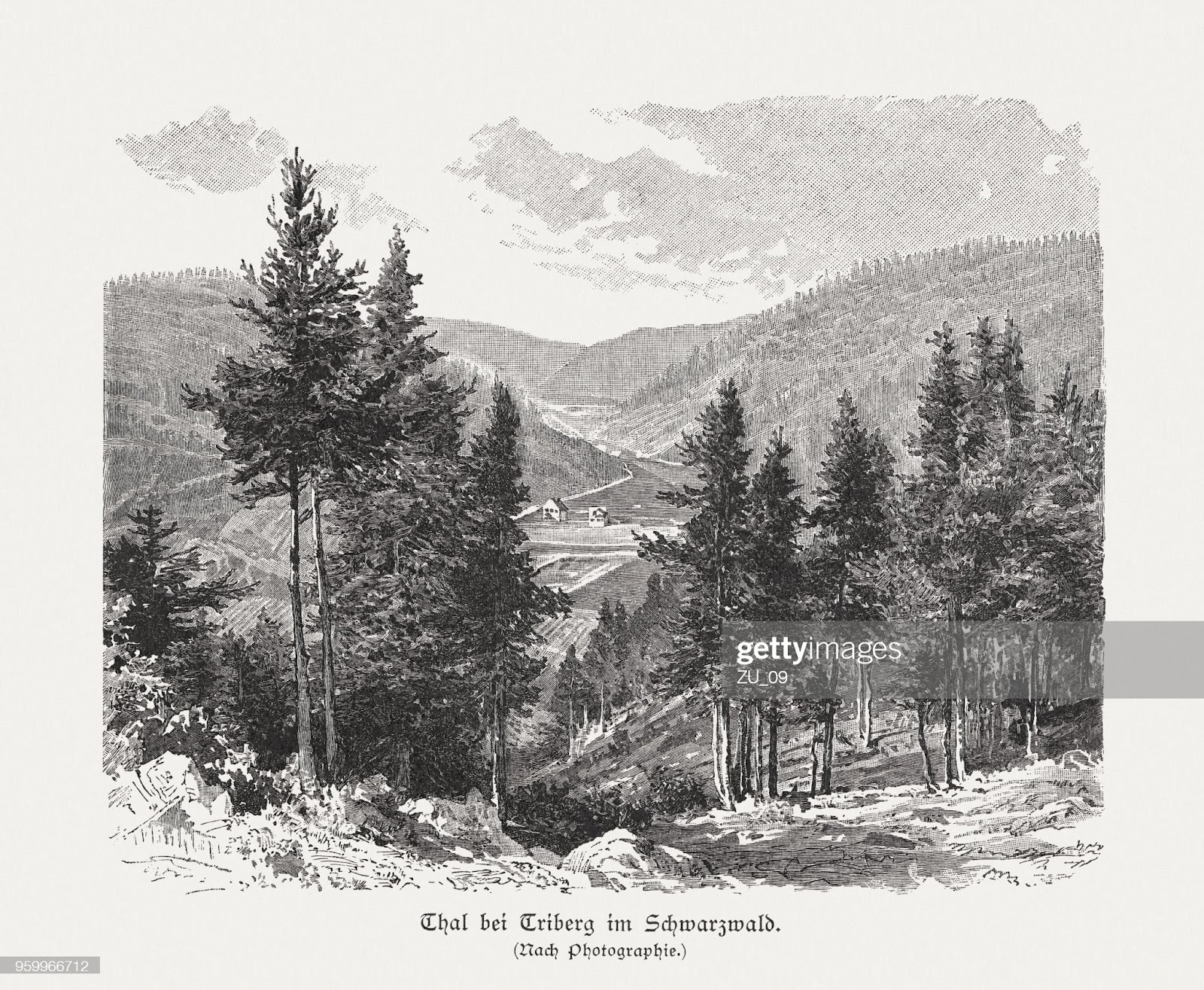
Like so many of Edwards' best strange stories, "A Night on the Borders of the Black Forest" begins with a young Englishman, Chandos Hamilton, walking in an unfamiliar part of Europe, the kingdom of Würtemberg. He strikes up a friendship with a fellow walker, Gustav Bergheim. The late afternoon is hot, and the next town, hosting a fair, has no rooms for the night. Our two protagonists pay a man for a ride when he is ready to leave for home.
....the driver lit his pipe and let his tired horses choose their own pace; the stars came out one by one overhead; and the road, leaving the dead level of the plain, wound upwards through a district that became more hilly with every mile.
Then I also fell asleep—I cannot tell for how long—to be waked by-and-by by the stopping of the charrette, and the voice of the driver, saying:—
"This is the nearest point to which I can take these Herren. Will they be pleased to alight?"
I sat up and rubbed my eyes. It was bright starlight. Bergheim was already leaning out, and opening the door. Our fellow-travellers were still sound asleep. We were in the midst of a wild, hilly country, black with bristling pine-woods; and had drawn up at an elevated point where four roads meet.
"Which of these are we to take?" asked Bergheim, as he pulled out his purse and counted the stipulated number of florins into the palm of the driver.
The man pointed with his whip in a direction at right angles to the road by which he was himself driving.
"And how far shall we have to walk?"
"To Rotheskirche?"
"Yes—to Rotheskirche."
He grunted doubtfully. "Ugh!" he said, "I can't be certain to a mile or so. It may be twelve or fourteen."
"A good road?"
"Yes—a good road; but hilly. These Herren have only to keep straight forward. They cannot miss the way."
And so he drives off, and leaves us standing in the road. The moon is now rising behind a slope of dark trees—the air is chill—an owl close by utters its tremulous, melancholy cry. Place and hour considered, the prospect of twelve or fourteen miles of a strange road, in a strange country, is anything but exhilarating. We push on, however, briskly; and Bergheim, whose good spirits are invincible, whistles and chatters, and laughs away as gaily as if we were just starting on a brilliant May morning.
"I wonder if you were ever tired in your life!" I exclaim by and by, half peevishly.
"Tired!" he echoes. "Why, I am as tired at this moment as a dog; and would gladly lie down by the roadside, curl myself up under a tree, and sleep till morning. I wonder, by the way, what o'clock it is."
I pulled out my fusee-box, struck a light, and looked at my watch. It was only ten o'clock.
"We have been walking," said Bergheim, "about half an hour, and I don't believe we have done two miles in the time. Well, it can't go on uphill like this all the way!"
"Impossible," I replied. "Rotheskirche is on the level of the river. We must sooner or later begin descending towards the valley of the Neckar."
"I wish it might be sooner, then," laughed my companion, "for I had done a good twenty miles to-day before you overtook me."
"Well, perhaps we may come upon some place half way. If so, I vote that we put up for the night, and leave Rotheskirche till the morning."
"Ay, that would be capital!" said he. "If it wasn't that I am as hungry as a wolf, I wouldn't say no to the hut of a charcoal-burner to-night."
And now, plodding on more and more silently as our fatigue increased, we found the pine-forests gradually drawing nearer, till by and by they enclosed us on every side, and our road lay through the midst of them. Here in the wood, all was dark—all was silent—not a breath stirred. The moon was rising fast; but the shadows of the pines lay long and dense upon the road, with only a sharp silvery patch breaking through here and there. By and by we came upon a broad space of clearing, dotted over with stacks of brushwood and great symmetrical piles of barked trunks. Then followed another tract of close forest. Then our road suddenly emerged into the full moonlight, and sometimes descending abruptly, sometimes keeping at a dead level for half a mile together, continued to skirt the forest on the left.
"I see a group of buildings down yonder," said Bergheim, pointing to a spot deep in the shadow of the hillside.
I could see nothing resembling buildings, but he stuck to his opinion.
"That they are buildings," he said, "I am positive. More I cannot tell by this uncertain light. It may be a mere cluster of cottages, or it may be a farmhouse, with stacks and sheds close by. I think it is the latter."
Animated by this hope, we now pushed on more rapidly. For some minutes our road carried us out of sight of the spot; but when we next saw it, a long, low, white-fronted house and some other smaller buildings were distinctly visible.
"A mountain farmstead, by all the gods of Olympus!" exclaimed Bergheim, joyously. "This is good fortune! And they are not gone to bed yet, either."
"How do you know that?" I asked.
"Because I saw a light."
"But suppose they do not wish to take us in?" I suggested.
"Suppose an impossibility! Who ever heard of inhospitality among our Black Forest folk?"
"Black Forest!" I repeated. "Do you call this the Black Forest?"
"Undoubtedly. All these wooded hills south of Heidelberg and the Odenwald are outlying spurs and patches of the old legendary Schwarzwald—now dwindling year by year. Hark! the dogs have found us out already!"
As he spoke, a dog barked loudly in the direction of the farm; and then another, and another. Bergheim answered them with a shout. Suddenly a bright light flashed across the darkness—flitted vaguely for a moment to and fro, and then came steadily towards us; resolving itself presently into a lanthorn carried by a man.
We hurried eagerly to meet him—at all, square-built, heavy-browed peasant, about forty years of age.
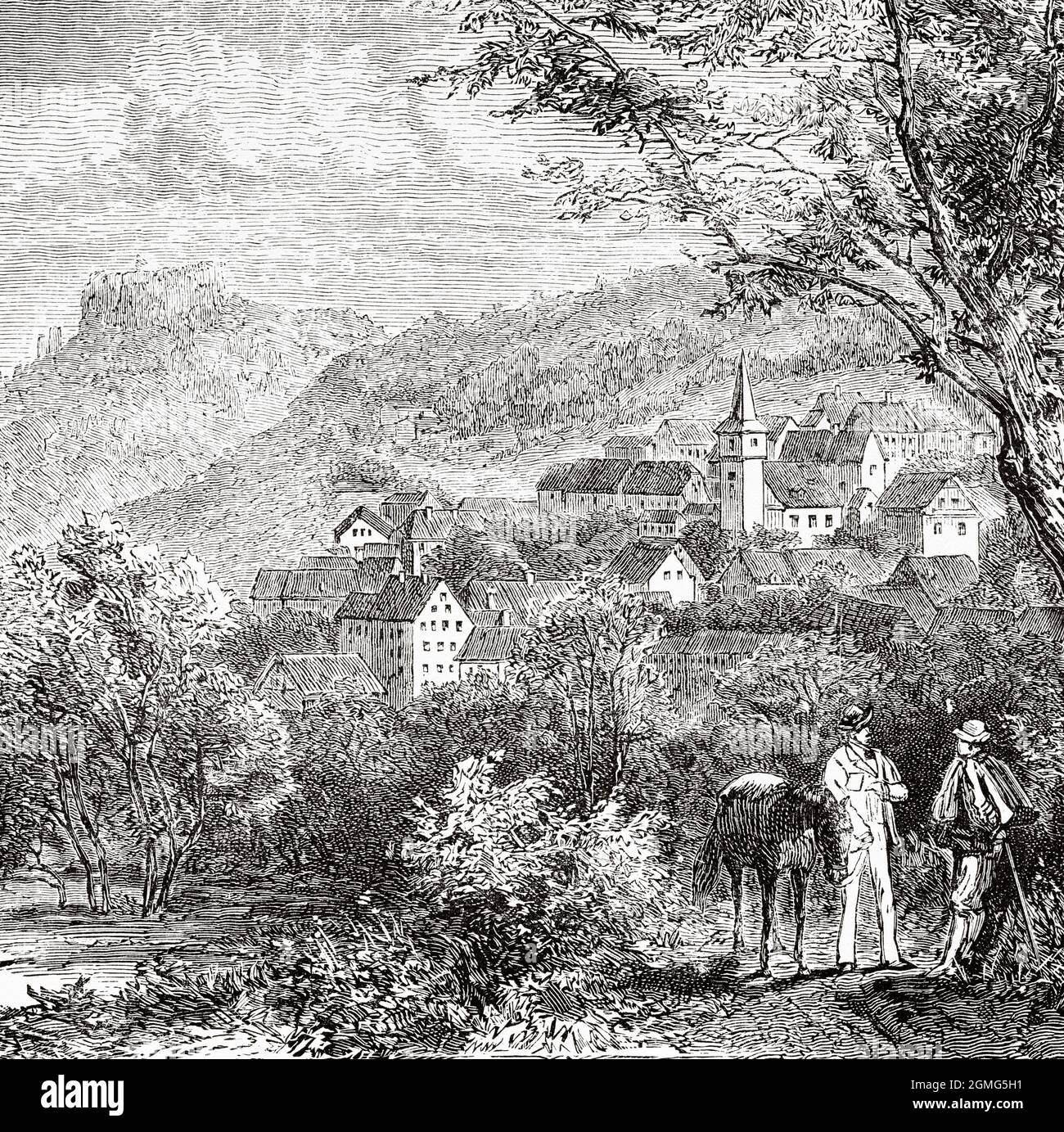
Although location and situation are completely different, Chandos Hamilton and Gustav Bergheim climbing down from a carriage at night at a crossroads cannot help but recall to me Jonathan Harker at Borgo Pass in the early chapters of Dracula.
Edwards excels herself in limning the walk along the lonely road in moonlight, pine-forest encroaching. It is a beautifully executed piece of menace. Until this point in the story, we have - like the protagonists - been enjoying the sights. Now the mood has changed: fatigue, darkness, physical narrowing of the horizon, and an isolated farm house replace earlier splendors of the open road and a flat horizon in daylight.
If the moonlit road was not sufficiently unnerving, the farmhouse certainly is.
Their host is offended when Gustav Bergheim complains about the taste of the house wine.
The landlord took up the bottle and held it between his eyes and the lamp.
"Bad as it is," he said, "you've drunk half of it."
"Not I—only one glass, thanks be to Bacchus! There stands the other. Let us have a Schoppen of your best beer—and I hope it will be better than your best wine."
The landlord looked from Bergheim to the glass—from the glass to the bottle. He seemed to be measuring with his eye how much had really been drunk. Then he went to the inner door; called to Friedrich to bring a Schoppen of the Bairisch, and went away, shutting the door after him. From the sound of his footsteps, it seemed to us as if he also was gone upstairs, but into some more distant part of the house. Presently the younger brother reappeared with the beer, placed it before us in silence, and went away as before.
"The most forbidding, disagreeable, uncivil pair I ever saw in my life!" said I.
"They're not fascinating, I admit," said Bergheim, leaning back in his chair with the air of a man whose appetite is somewhat appeased. "I don't know which is the worst—their wine or their manners."
And then he yawned tremendously, and pushed out his plate, which I heaped afresh with ham and eggs. When he had swallowed a few mouthfuls, he leaned his head upon his hand, and declared he was too tired to eat more.
"And yet," he added, "I am still hungry."
"Nonsense!" I said; "eat enough now you are about it. How is the beer?"
He took a pull at the Schoppen.
"Capital," he said. "Now I can go on again."
The next instant he was nodding over his plate.
"I am ashamed to be so stupid," he said, rousing himself presently; "but I am overpowered with fatigue. Let us have the coffee; it will wake me up a bit."
But he had no sooner said this than his chin dropped on his breast, and he was sound asleep.
I did not call for the coffee immediately. I let him sleep, and went on quietly with my supper. Just as I had done, however, the brothers came back together, Friedrich bringing the coffee—two large cups on a tray. The elder, standing by the table, looked down at Bergheim with his unfriendly frown.
"Your friend is tired," he said.
"Yes, he has walked far to-day—much farther than I have."
"Humph! you will be glad to go to bed."
"Indeed we shall. Are our rooms ready?"
"Yes."
I took one of the cups, and put the other beside Bergheim's plate.
"Here, Bergheim," I said, "wake up; the coffee is waiting."
But he slept on, and never heard me.
I then lifted my own cup to my lips—paused—set it down untasted. It had an odd, pungent smell that I did not like.
"What is the matter with it?" I said, "it does not smell like pure coffee."
The brothers exchanged a rapid glance.
"It is the Kirschenwasser," said Karl. "We always put it in our black coffee."
I tasted it, but the flavour of the coffee was quite drowned in that of the coarse, fiery spirit.
"Do you not like it?" asked the younger brother.
"It is very strong," I said.
"But it is very good," replied he; "real Black Forest Kirsch—the best thing in the world, if one is tired after a journey. Drink it off, mein Herr; it is of no use to sip it. It will make you sleep."
This was the longest speech either of them had yet made.
"Thanks," I said, pulling out my cigar-case, "but this stuff is too powerful to be drunk at a draught. I shall make it last out a cigar or two."
"And your friend?"
"He is better without the Kirsch, and may sleep till I am ready to go to bed."
Again they looked at each other.
"You need not sit up," I said impatiently; for it annoyed me, somehow, to have them standing there, one at each side of the table, alternately looking at me and at each other. "I will call the Mädchen to show us to our rooms when we are ready."
"Good," said the elder brother, after a moment's hesitation. "Come, Friedrich."
Friedrich turned at once to follow him, and they both left the room.
I listened. I heard them for awhile moving to and fro in the inner kitchen; then the sound of their double footsteps going up the stairs; then the murmur of their voices somewhere above, yet not exactly overhead; then silence.
I felt more comfortable, now that they were fairly gone, and not likely to return. I breathed more freely. I had disliked the brothers from the first. I had felt uneasy from the moment I crossed their threshold. Nothing, I told myself, should induce me at any time, or under any circumstances, to put up under their roof again.
Pondering thus, I smoked on, and took another sip of the coffee. It was not so hot now, and some of the strength of the spirit had gone off; but under the flavour of the Kirschenwasser I could (or fancied I could) detect another flavour, pungent and bitter—a flavour, in short, just corresponding to the smell that I had at first noticed.
This startled me. I scarcely knew why, but it did startle me, and somewhat unpleasantly. At the same instant I observed that Bergheim, in the heaviness and helplessness of sleep, had swayed over on one side, and was hanging very uncomfortably across one arm of his chair.
"Come, come," I said, "wake up, Herr fellow-traveller. This sort of dozing will do you no good. Wake up, and come to bed."
And with this I took him by the arm, and tried to rouse him. Then for the first time I observed that his face was deadly white—that his teeth were fast clenched—that his breathing was unnatural and laboured.
I sprang to my feet. I dragged him into an upright posture; I tore open his neckcloth; I was on the point of rushing to the door to call for help, when a suspicion—one of those terrible suspicions which are suspicion and conviction in one—flashed suddenly upon me.
The rejected glass of wine was still standing on the table. I smelt it—tasted it. My dread was confirmed. It had the same pungent odour, the same bitter flavour as the coffee.
In a moment I measured all the horror of my position; alone—unarmed—my unconscious fellow-traveller drugged and helpless on my hands—the murderers overhead, biding their time—the silence and darkness of night—the unfrequented road—the solitary house—the improbability of help from without—the imminence of the danger from within.... I saw it all! What could I do? Was there any way, any chance, any hope?
I turned cold and dizzy. I leaned against the table for support. Was I also drugged, and was my turn coming? I looked round for water, but there was none upon the table. I did not dare to touch the beer, lest it also should be doctored.
At that instant I heard a faint sound outside, like the creaking of a stair. My presence of mind had not as yet for a moment deserted me, and now my strength came back at the approach of danger. I cast a rapid glance round the room. There was the blunderbuss over the chimney-piece—there were the two hatchets in the corner. I moved a chair loudly, and hummed some snatches of songs.
They should know that I was awake—this might at least keep them off a little longer. The scraps of songs covered the sound of my footsteps as I stole across the room and secured the hatchets. One of these I laid before me on the table; the other I hid among the wood in the wood-basket beside the hearth-singing, as it were to myself; all the time.
Then I listened breathlessly.
All was silent.
Then I clinked my tea-spoon in my cup—feigned a long yawn—under cover of the yawn took down the blunderbuss from its hook—and listened again.
Hamilton deduces that he and Bergheim have entered a L'Auberge rouge. Quickly and in silence he starts improvising locks for the interior doors. As Bergheim sleeps, he prepares for the showdown.
So far my work had been noiseless, but now the time was come when it could be so no longer. The house-door must be secured at all costs; and I knew beforehand that I could not move those heavy fastenings unheard. Nor did I. The key, despite all my efforts, grated loudly in the lock, and the bolt resisted the rusty staples. I got it in, however, and the next moment heard rapid footsteps overhead.
I knew now that the crisis was coming, and from this moment prepared for open resistance.
Regardless of noise, I dragged out first one heavy oaken settle, and then the other—placed them against the inner door—piled them with chairs, stools, firewood, every heavy thing I could lay hands upon—raked the slumbering embers, and threw more wood upon the hearth, so as to bar that avenue, if any attempt was made by way of the chimney—and hastily ransacked every drawer in the dresser, in the hope of finding something in the shape of ammunition.
Meanwhile, the brothers had taken alarm, and having tried the inner door, had now gone round to the front, where I heard them try first the house-door and then the windows.
"Open! open, I say!" shouted the elder—(I knew him by his voice). "What is the matter within?"
"The matter is that I choose to spend the night in this room," I shouted in reply.
"It is a public room—you have no right to shut the doors!" he said, with a thundering blow upon the lock.
"Right or no right," I answered, "I shoot dead the first man who forces his way in!"
There was a momentary silence, and I heard them muttering together outside.
I had by this time found, at the back of one of the drawers, a handful of small shot screwed up in a bit of newspaper, and a battered old powder-flask containing about three charges of powder. Little as it was, it helped to give me confidence.
Then the parleying began afresh.
"Once more, accursed Englishman will you open the door?"
"No."
A torrent of savage oaths—then a pause.
"Force us to break it open, and it will be the worse for you!"
"Try."
All this time I had been wrenching out the hooks from the dresser, and the nails, wherever I could find any, from the walls. Already I had enough to reload the blunderbuss three times, with my three charges of powder. If only Bergheim were himself now!...
I still heard the murmuring of the brothers' voices outside—then the sound of their retreating footsteps—then an outburst of barking and yelping at the back, which showed they had let loose the dogs. Then all was silent.
Where were they gone? How would they begin the attack? In what way would it all end? I glanced at my watch. It was just twenty minutes past one. In two hours and at half, or three hours, it would be dawn. Three hours! Great Heavens! what an eternity!
I looked round to see if there was anything I could still do for defence; but it seemed to me that I had already done what little it was possible to do with the material at hand. I could only wait.
All at once I heard their footsteps in the house again. They were going rapidly to and fro overhead; then up and down the stairs; then overhead again; and presently I heard a couple of bolts shot, and apparently a heavy wooden bar put up, on the other side of the inner kitchen-door which I had just been at so much pains to barricade. This done, they seemed to go away. A distant door banged heavily; and again there was silence.
Five minutes, ten minutes, went by. Bergheim still slept heavily; but his breathing, I fancied, was less stertorous, and his countenance less rigid, than when I first discovered his condition. I had no water with which to bathe his head; but I rubbed his forehead and the palms of his hands with beer, and did what I could to keep his body upright.
Then I heard the enemy coming back to the front, slowly, and with heavy footfalls. They paused for a moment at the front door, seemed to set something down, and then retreated quickly. After an interval of about three minutes, they returned in the same way; stopped at the same place; and hurried off as before. This they did several times in succession. Listening with suspended breath and my ear against the keyhole, I distinctly heard them deposit some kind of burden each time—evidently a weighty burden, from the way in which they carried it; and yet, strange to say, one that, despite its weight, made scarcely any noise in the setting down.
Just at this moment, when all my senses were concentrated in the one act of listening, Bergheim stirred for the first time, and began muttering.
"The man!" he said, in a low, suppressed tone. "The man under the hearth!"
I flew to him at the first sound of his voice. He was recovering. Heaven be thanked, he was recovering! In a few minutes we should be two—two against two—right and might on our side—both ready for the defence of our lives!
"One man under the hearth," he went on, in the same unnatural tone. "Four men at the bottom of the pond—all murdered—foully murdered!"
I had scarcely heeded his first words; but now, as their sense broke upon me, that great rush of exultation and thankfulness was suddenly arrested. My heart stood still; I trembled; I turned cold with horror.
I think this is a fine example of a "well-managed crescendo."
Simultaneously, Hamilton and Bergheim have realized they are in a very bad place, in every sense. Hamilton has concluded this from an accumulation of clues in the behaviour of their hosts. Drugged and unconscious, Bergheim has seen behind the facade of everyday waking reality to the nightside of the farmhouse and its surroundings.
* * *

Following Bergheim's waking announcement, "A Night on the Borders of the Black Forest" leaps ahead with plenty of fire and gunsmoke. Edwards does not stint, and the final resolution is both aesthetically and emotionally correct.
* * *
In his The Guide to Supernatural Fiction (1983), E. F. Bleiler describes the story this way:
....A pair of Wandervogel, an Englishman and a German, put up at a hostelry, which is really a murder inn. The innkeeper drugs one of them. His clairvoyant visions of previous murders warn the other traveller of their perilous situation.
Bleiler misstates the action: Hamilton has already deduced their peril and is defending himself and the unconscious Bergheim arms-in-hand when the German awakes. Bergheim's announcement gives the moment of crisis and battle an uncanny confirmation, which we have been expecting since the crossroads.
* * *

Speaking for myself, Amelia B. Edwards and her works have always been stuck together with those of Mary E. Braddon, Charlotte Riddell, and Rhoda Broughton in an undifferentiated mass of tame supernaturalism in my mind: something outside the tradition of LeFanu, James, and the Bensons. Clearly, my error. Edwards always conveys excitement and anticipation in telling us stories of travellers in foreign lands who take wrong turns, get distracted, are waylaid, or just get a strange feeling they cannot ignore. Setting, and what Jack Sullivan in Elegant Nightmares calls a "thickening air of inevitability," are articulated with skill in Edwards' stories, whether supernatural, non supernatural, or a mix of both, as we see in "A Night on the Borders of the Black Forest."
Jay
10 June 2022