Subscribe to my Substack

Saturday, April 21, 2018

Great Plains Carnage: The Midnight Line by Lee Child (2017).

Here is the political context for Lee Child's 2017 thriller The Midnight Line:

....Opioid overdoses have reached crisis proportions nationwide, in urban centers and even more so in rural areas. Over 28,000 people died from these drugs in 2014, reported the Centers for Disease Control and Prevention, more than double the total from a decade earlier. Many who become addicted to doctor-prescribed pain killers such as Oxycontin or Demerol then turn to heroin or synthetic opioid drugs such as fentanyl, which is 50 times more powerful than heroin. Heroin-related overdoses have nearly quadrupled over the past decade, and last year outnumbered gun deaths.

In 2015 more than 12,000 people died of overdoses in just 10 states — Maine, New Hampshire, Vermont, Rhode Island, Connecticut, Pennsylvania, Maryland, North Carolina, Kentucky and Ohio — according to the Wall Street Journal. Fentanyl-related deaths across those states soared 128 percent from the previous year to nearly 4,000. Nationwide it rose to 9,580 last year.

In Huntington, West Virginia, with a population of 49,000, local health officials say some 12,000 people are hooked on heroin or another opioid. In a state devastated by the layoff of tens of thousands of coal miners, drug overdose deaths are the highest in the nation.

Pharmaceutical companies promoting opioid pain killer drugs as well as small-scale illicit drug labs producing fentanyl and other synthetic narcotics are reaping big profits while addicted workers pay, in growing numbers with their lives.

The spread of these drugs is tied to the fact that eight years into an official economic "recovery," millions of workers face declining median family income and lack of decent-paying full-time jobs. Today more than 11 percent of men between the ages of 25 and 54 are not part of the workforce, compared to less than 4 percent in the 1950s....

From:


The Midnight Line finds Jack Reacher wandering around the Great Plains. Lee Child seems to find his best stories here among the banal and modest criminal elements, as well as the banal and modest good people. His 2015 thriller Make Me is probably the best example.

The Midnight Line is about illegal trade in opioids along the I-90 corridor in South Dakota and rural Wyoming. The dramatic spine of the story is Reacher's hunt for the owner of the West Point class ring (Class of 2005.) He buys in it a pawnshop and starts his detective work. 

Along the way he meets Rapid City, SD police detective Gloria Nakamura. She is one of Child's proficient, Hawksian women, and she and her department are hunting a local crook with the grandiose name of Arthur Scorpio. 

Reacher also meets private investigator and retired FBI agent Terry Brammal. Brammal is snooping briefly on Scorpio, but then heads West, as does Reacher after an "interview" with the crook at his lair of evil, a local laundromat.

….Reacher sat down in the lawn chair next to Scorpio's. He stretched out and got comfortable and stared straight ahead at an inert Maytag. Scorpio was silent beside him. They looked like two old men at a ball game. The sentries stayed on the floor, breathing, but not easily.

Reacher took the West Point ring from his pocket. He balanced it on his palm. He said, "I need to know who you got this from."

"I never saw that before," Scorpio said. "I run a laundromat."

"What have you got in your pockets?"

"Why?"

"You need to take it all out. I'm going to put you in the tumble dryer. Keys or coins might damage the mechanism."

Scorpio glanced at a tumble dryer.

Couldn't help himself.

He said, "I wouldn't fit."

"You would," Reacher said.

"I never saw that ring before."

"You sold it to Jimmy Rat."

"Never heard of him."

"Where I set the temperature dial is up to you. We'll start on delicates. Then we'll turn it up. Someone told me it goes all the way to where it can kill a bedbug."

Scorpio said nothing.

"I understand," Reacher said. "You're Mr. Rapid City. You're the man. You got a bunch of networks running. Which is your problem. Maybe they're all interconnected. In which case, one question might lead to another. The whole thing might unravel. You can't afford for that to happen. Hence the stone wall. I get it. Perfectly understandable. Except you need to remember two very important things. Firstly, I don't care. I'm not a cop. I don't have another question. And secondly, I'll put you in the tumble dryer. So you're between a rock and a hard place here. You need to get creative. You ever read a book?"

"Sure."

"What kind?"

"About the moon landings."

"That's called non-fiction. There's another kind, called fiction. You make stuff up, perhaps to illuminate a greater central truth. In your case, maybe you could tell me a story about a poor homeless man, maybe from out of town, who came in to launder his clothes, except he had no money, nothing at all except a ring, which you reluctantly traded for a couple of hot-wash cycles and a couple of dryer loads, plus enough left over for a square meal and a bed for the night. All out of the kindness of your generous heart. Detective Nakamura couldn't argue with that. It would be a fine story."

"I would have to admit selling the ring to Jimmy Rat."

"Which was perfectly legal. You run a laundromat. You carry quarters to the bank. You don't know what to do with a ring. Fortunately a guy passing by on his motorcycle offered to buy it from you. Not your fault he turned out to be a bad guy. You're not your brother's keeper."

"You think that's a good enough story?"

"I think it's a fine story," Reacher said again. "Just as long as you happen to remember the out-of-towner's name."

"Out of state," Scorpio said. "That's exactly what happened. More or less. Some broke guy came in from Wyoming. I helped him out."

"When?"

"Six weeks ago, maybe."

"From where in Wyoming?"

"I believe a small town called Mule Crossing."

"What was his name?"

"I believe it was Seymour Porterfield. I believe he told me people call him Sy."


The utter poignancy of what Reacher finds in Mule Crossing, WY, and the wrongs he sets out to understand and put right, make for an ambitious tale. 

Child never lets us lose our geographical and narrative bearings.

Jay
21 April 2018


Wednesday, April 18, 2018

Shapes of larceny: Pale Gray for Guilt by John D. MacDonald (1968).

….I walked around to where Puss still sat on the sawhorse. She looked up at me.

With a small frown she said, "My heart bled for you the way you went reeling around in shock, McGee. You really took it hard. Your dear old buddy has gone to the big marina in the sky. The hard way. Came to get your bilge pump! God's sake, Travis!"

I sat on my heels and squinted up at her. Dark red hair and disapproval, outlined against a blue December sky.

"Win a few, lose a few, honey," I said.

"What are you?" she asked.

I stood up and put my hands on her upper arms, near the shoulders and plucked her up off the saw horse and held her. Maybe I was smiling at her. I wouldn't know. What I was saying seemed to come from a strange direction, as if I were standing several feet behind myself. I said some nonsense about smelling these things out, about sensing the quickest way to open people up, and so you do it, because if you don't, then maybe you miss one little piece of something you should know, and then you go join the long long line of the dead ones, because you were careless.

"And," I heard myself say, "Tush killed himself but not with that damned engine block. He killed himself with something he said, or something he did, and he didn't know he was killing himself. Maybe he didn't listen very good, or catch on soon enough. I listen very good. I catch on. And when I add up this tab and name the price, I'm going to look at some nice gray skin, honey. Gray and pale, oily and guilty as hell, and some eyes shifting around looking for some way out of it. But every damned door will be nailed shut."

I came out of it and realized she was making little hiccupy sobs and looking down and to the side, and her cheeks were wet, and she was saying, "Please, please."

I released her and turned on my heel and walked away from her. I went a little way up the road. I leaned against the trunk of an Australian pine and emptied my lungs a few times. A jay yammered at me. There were tree toads in a swamp somewhere nearby. Puss came walking very slowly up the road. She came over to me and with a quick, shy smile leaned her face into my neck and chest.

"Sorry" she whispered.

"For nothing?"

She exhaled. "I don't know. I asked you what you were. Maybe I found out, sort of."

"Whatever it is, I don't let it show, Puss. Ten more minutes and I would have been kindly Trav forevermore."

She pushed herself a few inches away and looked up at me. "Just smile with your eyes like kindly ol' McGee, dear, to kind of erase that other ... that other look."

"Was it that bad?"

"They could bottle it and use it to poison pit vipers."
❖

Pale Gray for Guilt by John D. MacDonald
(1968).

I finished John D. MacDonald's 1979 novel The Green Ripper last week. I did not care for it; MacDonald gave his hero a moral get-out-of-jail-free card for every vigilante action he took, then allowed Travis McGee to feel all sad and weighed-down by the terrible things he knew he was justified in doing.  

Ten years previous to The Green Ripper, Pale Gray for Guilt has McGee trying to figure out the death not of a paramour, but of old school chum Tush Bannon. Tush got himself athwart desperate movers and shakers in a big land speculation deal, the most sacrosanct of all deals or activities to be found in Florida.

MacDonald and McGee loathe consequences of the world they live in. Cars, consumerism, road construction, death by dollars. When a sheriff is aghast at antics of local hippie dropouts, McGee
admits: "....I can't lay too big a knock on them, you know. In another sense I'm a dropout. I don't pay for my tickets. I jump over the turnstile."

A lot of ethical turnstile-jumpers emerge as McGee stirs up trouble around Tush's killing. A desperate and over-extended real estate small fry named Preston LaFrance is either on the verge of a million dollar deal or destitution. Gary Santo is definitely a big wheeler-dealer when it comes to land speculation, but his vulnerability is that he is too big to risk any hint of failing. Sheriff's Deputy Freddy Hazzard, marginal to the economic villains, is a typical thug cop who likes wielding a black leather sap. When folks give him trouble, he just gives them a tunk on the skull and they go to sleep.

As McGee uncovers the rogues responsible for Tush's death, he works with his comrade-in-arms Meyer to sting them the perpetrators, using proceeds to fund a life and future for Tush's wife and children.

Pale Gray for Guilt is richly satisfying. Much superior to The Green Ripper: plenty of fat targets for McGee's brand of salvage, and a bloody-bones denouement with plenty of tunking all round.

Jay
18 April 2018


Tuesday, April 17, 2018

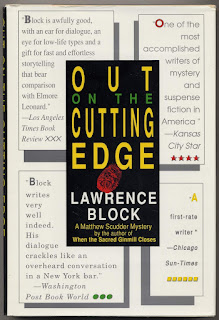
It would break your heart if you let it: Out on the Cutting Edge by Lawrence Block (1989).


"....Used to be addicted to science fiction and read shelves of it, but now when she read at all it was mostly English murder mysteries, the country house with the body in the library and butlers who had or hadn't done it. "I don't really give a damn who did it," she said. "I just like to slip into a world where everybody's polite and well-spoken and even the violence is neat and almost gentle. And everything works out in the end."


"Like life itself."


"Especially on West Fifty-first Street."


I talked a little about the search for Paula Hoeldtke and about my work in general. I said it wasn't much like her genteel English mysteries. The people weren't that polite, and everything wasn't always resolved at the end. Sometimes it wasn't even clear where the end was.


"I like it because I get to use some of my skills, though I might be hard put to tell you exactly what they are. I like to dig and pick at things until you begin to see some sort of pattern in the clutter."


"You get to be a righter of wrongs. A slayer of dragons."


"Most of the wrongs never get righted. And it's hard to get close enough to the dragons to slay them."


"Because they breathe fire?"


"Because they're the ones in the castles," I said. "With moats around them, and the drawbridge raised."


Out on the Cutting Edge by Lawrence Block (1989).


Have you ever read a novel so good you were scared to read another by the same author?

It has happened to me, but only a few times. Earthly Powers by Anthony Burgess was one. The Stand by Stephen King was another. It was never simply a question of craftsmanship. It came down to emotional involvement with the characters and the story that the writer built with their unerring craftsmanship.

I've read a dozen Lawrence Block novels, mostly his breezier output: Tanner (a kind of quirky spy), Rhodenbarr (a clever thief continually thwarted by bigger villains against whom he must turn the tables), and Keller (because if Block had to write about a man in midlife crisis, it would have to be a hit man).

Why no Matthew Scudder novels? For one thing, I dislike most U.S. private eye novels written in the last four decades. They are typically dark, cynical, and too easy on themselves; writers are usually too indulgent to their detective. And the mystery itself, the puzzle, is usually weak and camouflaged with nonsense, winning praise for "depth" from a Charlie Rose or a Terry Gross. (Plus, descriptions on Scudder back covers make the tales sound unremittingly grim.)

[N.B, My favorite detective novels are Unnatural Death by Dorothy L. Sayers and Three Act Tragedy by Agatha Christie. On a different day I might say Red Harvest by Hammett or 32 Cadillacs by Joe Gores.]

I read two of Block's wonderful collections this week: The Liar's Bible and The Liar's Companion. They comprise old columns from Writer's Digest. (I used to read that magazine as a teen in the early 1980s because I wanted to write fiction.) In several columns from the late 80s he used the composition of Out On the Cutting Edge as an example. The plot sounded intriguing, so I started my Matthew Scudder itinerary there.

Out On the Cutting Edge gives the reader two different types of mystery tale. Solving the disappearance of Paula Hoeldtke is the urban U.S. private dick mystery. Investigating the death of Eddie Dunphy is the classic English country house story, transplanted to a rent-controlled apartment building in Scudder's NYC neighborhood.

Paula Hoeldtke, a theater graduate from Muncie, Indiana, has vanished after three years in New York. Scudder is hired by her father two months after disappearance. The precious few leads are ice cold. Scudder meets her landlady and people she worked with as a waitress. He also interviews theatrical artists who hired her for bit parts and have no memory of her. (In these scenes we are given a look at the way the AIDS epidemic decimated New York's culture industry in the 1980s.)

Scudder eventually solves the Paula Hoeldtke case by persistently handing out wallet-sized photos of her until he finds a few people who react to her image. The people he meets are not nice, but they are compelling. Credit the compulsive gumshoe work ethic by Scudder.

The death of Eddie Dunphy is a different and more personal matter. Scudder has a personal stake in Eddie, a younger fellow member of AA. Eddie has been clean a year, and is coming to a crossroads: either going deeper into sobriety and owning up to past actions, or turning away out of fear of consequences.

Then Eddie dies. Magnificently, Block gives us a death which could be murder, suicide, or accident. This uncertainty eats away at Scudder. He keeps talking to people in Eddie's building. He reflects on conversations they had after meetings. Eddie has had a hard life, and Scudder burns to prove the young man died sober.

The two cases, the two styles of detective story, run parallel. Scudder learns of Paula's fate on the same day he solves the mystery of Eddie's death. Like the parallel editing in a film by Griffith, Scorsese, or P.T. Anderson, the narrative advances and resolutions come in huge crescendoing emotional waves delivered in seemingly modest prose of such a power as to make the reader weep.

As a Marxist, I was also struck by the third crime explored by Out On the Cutting Edge. The backdrop for Paula's disappearance and Eddie's death is the crime perpetrated against the people of New York City by a capitalism whose contradictions are turning murderous.

Everywhere Scudder goes, streets are filled with people driven to beggary. In Eddie's building, empty apartments are not rerented because owners want to wait and sell them as expensive co-ops.

As one character points out, every conversation between people in NYC, no matter where it begins, ends up as a conversation about real estate.

As the novel progresses, Scudder puts himself at moral hazard, but friends keep allowing him time for perspective and a saving patience, as well as the confidence to keep going his own way.

I could go on at length about the crucial and beautifully articulated characters Scudder meets while pursuing each case. I can tell you that they are the stuff of great art: they suggest the deep social reality Block pursues and carefully conveys.

You will, if you go ahead and read the book, be thankful I spoiled as little if its perfection as I did.


Jay

17 April 2018


Saturday, April 14, 2018

It was all the same jungle: The Specialists by Lawrence Block (1969)

....You know what we did? We got too fucking cute with this one. A nice easy touch and we had to go and make it complicated."


The Specialists by Lawrence Block (1969)

Funny how in early novels we trace a trait, trope, or concern which will blossom later later in Block's career. A character's hobby or habit.

The Specialists was a Gold Metal paperback. It was supposed to be the first in a series, but so far it's the only volume. Block has a funny afterword in my ebook edition where he goes in to all this.

All we readers need to know is that The Specialists is a short, sharp caper with professional Special Forces soldiers (officers and other ranks) home from Southeast Asia and turning the tables on the mob-owned Commercial Bank of New Cornwall, New Jersey.

The team is brought together by their old colonel, Roger Elliott Cross. Cross left two legs in Laos, he he's the strategic mastermind.

....And he had always liked it. It was hell, as Sherman had said, but at the same time it was a football game for adults, with the sweet harsh joy of contact and the sense of being utterly alive that exists only in the midst of death.


Each member of the team is sharply drawn, a stereotype infused with Blockian gusto.

Captain Howard Simmons, rare stamp broker and family man in Detroit, is African-American. He delights in home ownership, his lawn, and thwarting red-liners.

While on the job, he hides a getaway vehicle in an empty suburban house  in Bergen County and strikes a blow against Jim Crow:

....Across the street a woman stood in the doorway staring. Simmons looked at her for a moment in puzzlement before he got the message. He smothered a laugh, then walked quickly across the lawn. He had to give the FOR SALE sign a couple of kicks to loosen it. He pulled it from the ground, carried it around back, and left it with the trash.


When he came back, the woman was gone. On the phone already, he decided. But not to call the police. Right now she'd be calling her husband, and then the neighbors, and after that she'd be on the phone to her friendly neighborhood realtor. With any luck at all, half the houses on the block would be offered for sale within the next two days.


And of course the people in them would sell them to Negroes. They wouldn't think twice, since a Negro had already bought one of the houses.


Simmons got into the Dodge. He connected the jumper wire and the engine caught immediately.


He started to laugh.


Edward Manso is a Las Vegas gambler. A gambler who knows when to walk away.

Frank Dehn sells encyclopedias and loafs on the golf course.

Ben Murdock works one blue collar job after another, transient and full of an appetite for the kind of fun only the Colonel can offer.

Louis Giordano runs a travel agency in Phoenix. His assignment on the current mission was to seduce and and subtly interrogate bank teller Patricia Novak about the layout. He does his job of seduction a little too well.

The main enemy in all this is Albert Platt of Tenafly, New Jersey. He runs Bergen County and two banks for the syndicate. He's a beast to women and his own lower ranks. He's not the sharpest knife in the drawer, but he is an impulsive and violent antagonist with organization and resources on his side.

Colonel Cross and his specialists are not vigilantes or avenging angels. Platt's grotesque treatment of women brings him to their notice, but the team is not out to do anything but stomp Platt and give themselves a little vacation from the doldrums of civilian life. And a little extra income.

There are reverses, and at one point the team's survival is in the balance.

But Block gives us a lovely teasing beachside ending:

"I wonder where they all are, what they're doing."


"The colonel's reading something. His Bible or some military history. Helen's probably baking. The others? Howard was going to spend a couple of days in New York. There were some stamp auctions he wanted to go to. Frank is on the road somewhere, I don't know where. Ben's probably in the drunk tank of some jail or other. He generally goes on a bender afterwards and drinks up all his money."


"How can anybody drink up fifty thousand dollars?"


"Ben would try, but he doesn't have to. If he took all his cash he'd get himself in all kinds of trouble. He generally takes a thousand or two. He keeps five hundred bucks for getaway money and blows the rest. What he doesn't take, the colonel invests for him. Ben must be worth, oh, a quarter of a million."


"You would never guess it."


"He doesn't act it. He doesn't even think about it, which is why he manages to stay out of trouble. You see, that's the whole thing, you have to create a life for yourself that you feel comfortable in. Like we could spend absolutely all our time traveling and living it up, but then life would just be something in between the jobs, and it's harder to live that way. Same with Ben. When he runs out of dough, he'll get a job somewhere. And live like a bum until the colonel gives him a call."


"And Eddie? He's in Europe?"


He nodded. "Monte Carlo, I think. He wants to stay away from the stateside gambling areas, at least for the time being. He's clean as far as the police are concerned, but he figures it might be good to let the gambling types have some time today forget about Platt and his wife. You want to go in for a minute before we go back to the cabin?"


"I don't think so."


"I'll just take a dip, then. It seems to be doing my leg some good."


Jay
14 April 2018

Thursday, April 12, 2018

The gang plays detective: The Seventh by Richard Stark (1966)

….Somebody had taken one of the crossed swords from the wall and jammed it through her chest and through the padded headboard of the bed and into the plasterboard of the wall. She was stuck there like a scarecrow put away for the winter.

The guy who did it had a hell of an arm. Either that, or he'd brought a sledge along to hammer it the rest of the way after the first thrust.


The Seventh by Richard Stark (1966)


I've read the first seven Parker heist thrillers by Westlake/Stark, and the final eight. The Seventh is my favorite, and I'm in awe of its energy and drive. In this novel the author has pulled himself out of a tight corner: one of the string of bad guys doing the robbery does not have to be Parker's main enemy. The potboiling arbitrariness of coincidence can be allowed to provide a worthy nemesis.

In The Seventh, Parker and six other guys are hiding-out various places in a largish (perhaps midwestern) town after robbing a local college stadium on the day of the big game. One night Parker steps out of his apartment for ten minutes to get beer and cigarettes, and finds when he returns that the woman he was shacking up with has been murdered with an ornamental rapier.

To add injury to insult, whoever done it took the boodle from the stadium job, which the gang entrusted to Parker until they had a chance to split it seven ways and leave town.

Parker brings the gang back together. He convinces them that working together they can get their money back.

....Negli was sitting in the room's one chair, a foam-rubber and wrought-iron affair. He was as dapper as ever, dressed to the nines, busy unwrapping one of his long cigars. He said, 'You know better than this, Parker. It isn't time for us to contact each other. What if you brought the law here?'

'I didn't bring the law.'

Negli shrugged. 'Still,' he said, 'this had better be worth it.'

Parker studied him sourly. Negli had the little man's courage, the knowledge he could get away with things a bigger man would be called on in a minute. It gave him a nasty disposition, and made Parker itch to tromp him.

Feccio was the other half of the team, the apologizer.

'Parker knows what he's doing,' he said. 'If he's here, he's got a good reason.'

'Good enough,' Parker said. 'I was hijacked. The money's gone.'

Feccio just stared. Negli looked up from his cigar, and paused, and said, 'Stole it from you, Parker?' He said it like he didn't believe it.

Parker went over and picked him up and threw him into the corner. When Negli rolled over with his hand going inside his coat, Parker put his right hand in his topcoat pocket.

Feccio said, 'Cut it! Bob, don't you move!'

Negli stayed where he was, half up from the floor, right hand still inside the coat.

Feccio said, 'Parker, you know Bob's way. He didn't mean it like it sounded.'

Parker said, 'Let Negli talk.'

Negli said, 'I believe you, Parker. You had the dough and you let somebody glom it from you. I believe it.'

Feccio walked over in front of Negli and said, 'Cut it out, Bob, or I'll take care of you myself.'

'The hell, Arnie. What does he want, a medal? We put a lot of work in and he comes around and says he lost the money, somebody took it from him.'

'Let's listen to him, what do you say?'

Negli got to his feet, and brushed himself off. 'I'll listen to anybody,' he said.

Feccio turned to Parker. 'We start all over,' he said. 'You just tell the story and we'll listen.'

Parker told them the story. Feccio listened and Negli stood around trying to look insulting. Parker had control of himself now, and he ignored Negli. The little bastard wasn't worth the sweat.

When he was done, Feccio said, 'I like the outsider. Somebody wanted your girl dead and he found the cash by accident.'

Negli said, 'I haven't said word one to anybody outside the group about what we were doing. Neither has Arnie. What about you, talking to the girl? Or Dan and his bimbo?'

Parker shook his head. 'Neither one of us told our women anything to worry about.'

'Yours knew you had all that cash, didn't she?'

'She never left the apartment from the time I brought the suitcases in. She wasn't out of my sight for three days, not until I went out last night.'

Feccio said, 'All right, never mind that now. What do you want from us, that's the question.'

'If we work together, we can get our cash back.'

Feccio nodded. 'If we work together,' he said, 'and if we're lucky. And if the law doesn't get him first.'

'They'll be looking for me,' Parker said. 'They won't think about anybody else when I'm so handy.'

Negli said, 'That makes you a liability, doesn't it, Parker?'

Before Parker could say anything, Feccio said, 'Bob, keep your mouth shut. We don't have time to put up with you now.'

Parker said, 'Do you know where any of the others are holed up?'

'I know where Shelly is,' Feccio said. 'I think he knows where to find Clinger and Rudd.'

Negli said, 'What we ought to do, Arnie, we ought to clear out of here. That dough's gone.'

Parker said, 'Maybe not.'

Negli shook his head. 'You're a dreamer. If I had that cash, I'd be a thousand miles from here by now.'

'You're a pro. You wouldn't have hung around last night to ambush me.'

Feccio said, 'This is wasting time. Bob and I'll go talk to Shelly. You want us all to meet someplace?'

'At Dan's. I'll get there as soon as I can.'

'Fine.'

Parker went to the door, then looked back at Negli. 'You don't have to waste time with the rest of us,' he said. 'You want to take off, go ahead. We'll find something to do with your cut.'

Negli made a crooked grin around his cigar. 'Forget it, Parker,' he said. 'I own a seventh of that pie. As long as there's one chance left at it, I'll stick around.'

Parker said, 'That's what I thought.'


What makes The Seventh so unusual is the seeming randomness of the mystery the gang has to solve. They dig in to the murdered woman's past male associates. Parker, in a tight little scene, gets the notes from the police detective on the case.

Part Three of the novel gives Westlake/Stark the chance to break out of of the professional heister milieu and go into the mind of a character we'd typically find in a Robert Bloch novel from the 1950s. He's a homicidal nut, though he'd be the last person to realize it.

His inadvertent actions and ego let him advance where professionals would never tread.  At one point, Westlake/Stark hauls back on his narrative to send us this sling-shot about the guy: "....having made the mistake that would kill him."

We have to keep going after a line like that.

The other members of Parker's crew are beautifully realized. Each is given their minute to shine. I came away particularly fond of Little Bob and Arnie Feccio, a double act, and poor Abe Clinger:

....Abe Clinger was a businessman, not a crook. It was his nature to be a businessman, and only the force of circumstances had him temporarily playing the part of a crook, a temporary condition that had lasted now about twelve years.

Television was to blame. Television was a blot and a rotten thing, ruining the eyes of young America, an insidious monster in living rooms all across the nation, showing sex and sadism, people smoking and holding glasses full of beer, destroying the livelihood of honest businessmen trying to make an honest dollar even with the minimum wage going all the time up up up and taxes getting worse every year. Even with government intervention and payments for workmen's compensation and social security and all the rest of it, it might have been barely possible to keep an honest man's head above water, except for the rotten box, television.

Abe Clinger had owned a movie theater. But a movie, theater, the real thing, with a kiddie matinee on Saturday with twelve cartoons and a Western and a chapter, and beautiful dinnerware given away to the ladies on Wednesday evening, and always a double feature plus cartoon plus newsreel plus coming attractions, changed twice a week on Wednesday and Sunday. A nice friendly neighborhood theater that was like an institution almost, like the branch of the public library or the post office substation, a part of the neighborhood.

Until television.

Then, to make matters worse, when he burned the theater down for the insurance he did several things wrong and he got caught. His wife of twenty-six years, when she learned he'd borrowed to the hilt on his life insurance and was also letting it lapse because he was going to jail, divorced him. His two sons looked at him with disgust and reproach, said, 'Pop', in long-suffering voices, and went away to change their names.

But in jail he met a couple of people who made a new life possible for him, and when he got out on parole after spending the minimum time behind bars he was pretty sure he would never be bankrupt again. There was always work in the armed robbery line for a man who looked like a businessman or a bookkeeper or a general manager or whatever in the office type the job might require. Carrying guns always made him nervous nevertheless, and he was yet to fire one of them, but he understood it was necessary in this trade, like being a Democrat in his previous occupation. Still, the new line of work had its advantages, like no employees and no overhead and no long hours, and his blonde was a hell of an improvement over the former Mrs Clinger, and generally speaking he had no complaints....


You can tell Westlake/Stark enjoys having a large cast to narrate. In part three of any Parker novel we nearly always break away from following Parker. In part three of The Seventh we follow the killer, but we also follow the other six heisters as they go about their detective work to find the guy who took their money.

Not all will make it to their seventh of the one hundred thirty-four thousand dollars.


As one detective on the robbery case exclaims to another: "This one's a lulu!"


Jay
12 April 2018