Subscribe to my Substack

Showing posts with label John D. MacDonald. Show all posts

Monday, December 6, 2021

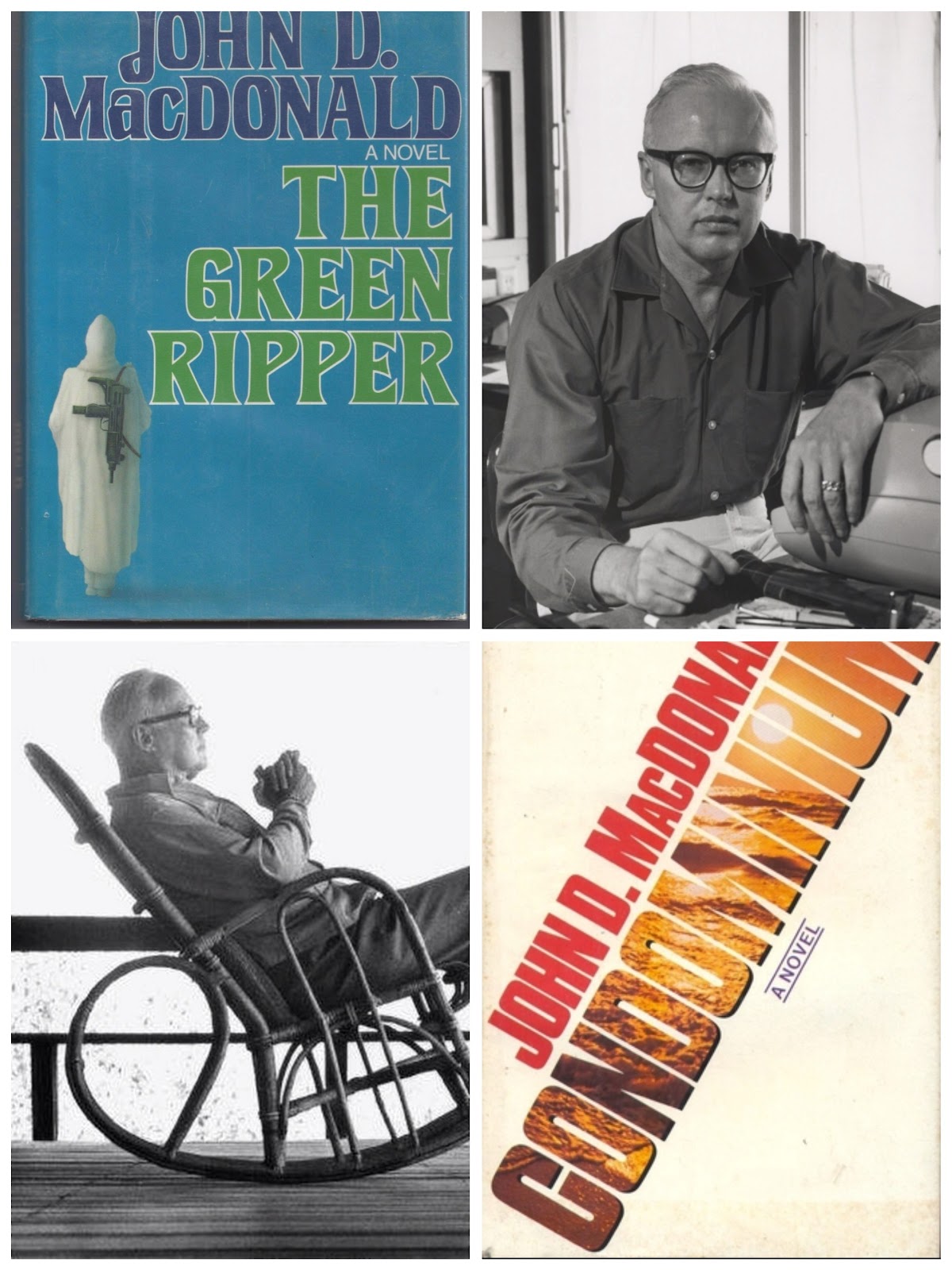
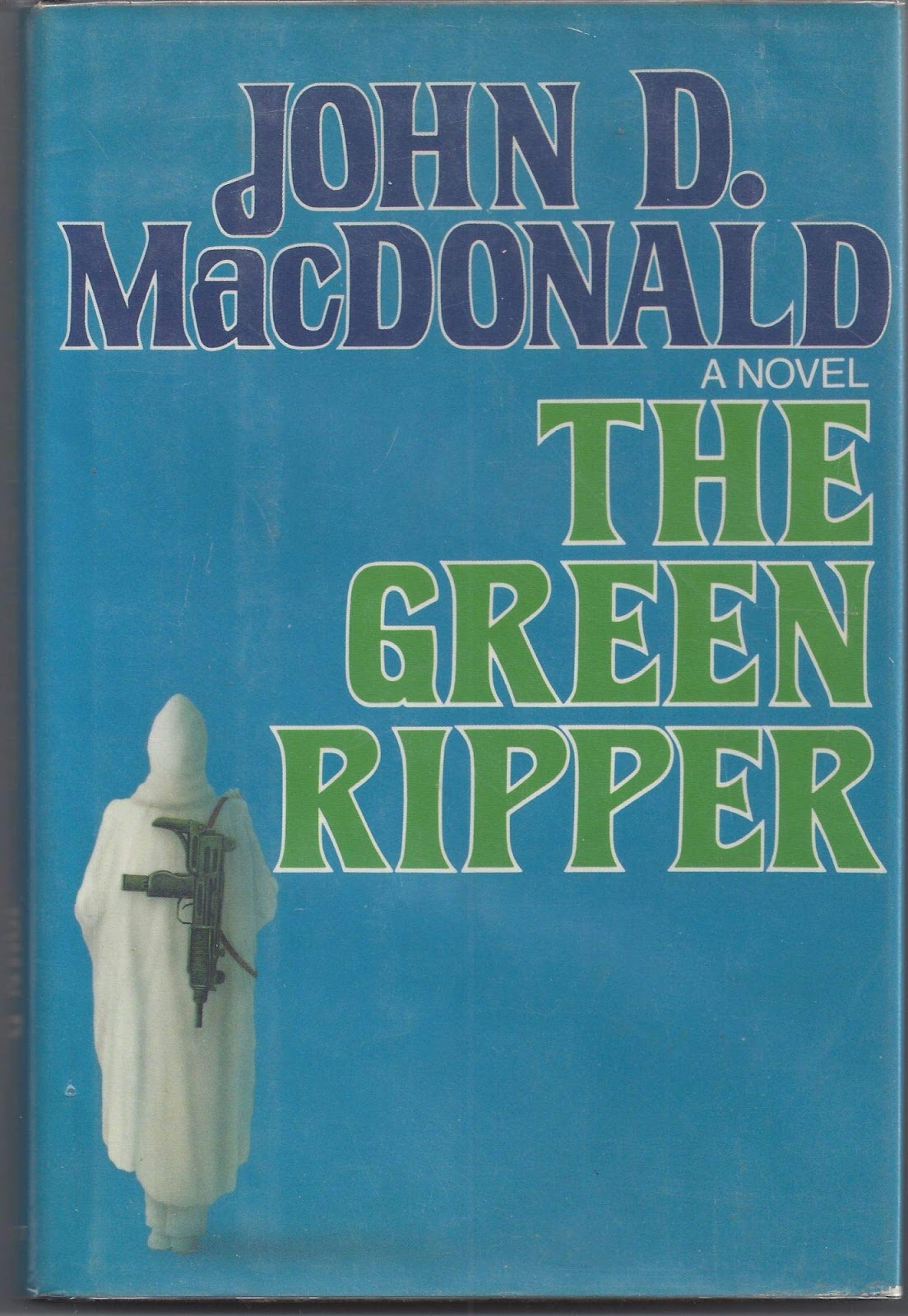
Bright patterns of nonsense: The Green Ripper by John D. MacDonald (1979).


The Green Ripper by John D. MacDonald (1979).


1979 was a big year for John D. MacDonald. My local drug store shelves groaned with Travis McGee paperbacks. His 1977 epic Condominium was shown as a syndicated miniseries. And I almost bought a paperback of The Green Ripper. The cover art intrigued me. But the first few pages, read at Struble's Drug Store on a rainy Friday night, left my 13 year old self unmoved.


I did not read my first MacDonald novel until winter 1994, a dark and fretful personal time. I read the first McGee novel, The Deep Blue Goodbye, and then Condominium, which I loved


And this week I finally got to grips with The Green Ripper.


I'm sure this is not a typical McGee adventure. The Deep Blue Goodbye was strictly small-bore, local, and tightly observed. I'd have to read a few more to assure myself The Green Ripper is aberrant, and I'm not sure I will.


The novel begins with McGee and his friend Meyer mulling over the horrible state of the world (for members of the U.S. petty bourgeoisie like themselves) on a dark and stormy December night:


"How much time have we got?"


"If nobody pushes the wrong button or puts a bomb under the wrong castle, I would give us five more years at worst, twelve at best. What is triggering it is the crisis of reduced expectations. All over the world people are suddenly coming to realize that their children and grandchildren are going to have it worse than they did, that the trend line is down. So they want to blame somebody. They want to hoot and holler in the streets and burn something down."


"Whose side are you on?"


"I'm one of the scufflers. Cut and paste. Fix the world with paper clips and rubber bands."


The cry of the panicked middle classes is also heard very clearly in Meyer's line "....there are too many mouths to feed."


MacDonald and his vigilante hero like to have their cake and eat it, too.


In Chapter One, we get McGee pondering the precarious state of the planet. He then makes love to Gretel, the love of his life. And then he gets a chance for some portentous humbuggery:


In Chapter One, we get McGee pondering the precarious state of the planet. He then makes love to Gretel, the love of his life. And then he gets a chance for some portentous humbuggery:


....So the gusty winds of a Friday night in December came circling through the marina, grinding and tilting all the play boats and work boats around us, creaking the hulls against the fenders, clanking fittings against masts. While in the big bed in the master stateroom her narrowed eyes glinted in faint reflected light, my hands found the well-known slopes and lifts and hollows of her warmth and agility. We played the games of delay and anticipation, of teasing and waiting, until we went past the boundaries of willed restraint and came in a mounting rush that seemed to seek an even greater closeness than the paired loins could provide. And then subsided, with the outdoor wind making breathing sounds against the superstructure of the old barge-type houseboat, and the faint swing and dip of the hull seeming to echo, in a slower pace, the lovemaking just ended. With neither of us knowing or guessing that it was the very last night. With neither of us able to endure that knowledge had we been told.


As with any great vigilante revenge potboiler, love's young dream is short-lived. Someone slips Gretel a Georgi Markov stinger, and McGee sets off to find the killers.


Leading him to the rural training camp of The Church of the Apocrypha. MacDonald presents them as a Jonestown-type cult, but bent on terrorism and having received training in Cuba, Lebanon, et cetera.


Jay

14 April 2018


Wednesday, April 18, 2018

Shapes of larceny: Pale Gray for Guilt by John D. MacDonald (1968).

….I walked around to where Puss still sat on the sawhorse. She looked up at me.

With a small frown she said, "My heart bled for you the way you went reeling around in shock, McGee. You really took it hard. Your dear old buddy has gone to the big marina in the sky. The hard way. Came to get your bilge pump! God's sake, Travis!"

I sat on my heels and squinted up at her. Dark red hair and disapproval, outlined against a blue December sky.

"Win a few, lose a few, honey," I said.

"What are you?" she asked.

I stood up and put my hands on her upper arms, near the shoulders and plucked her up off the saw horse and held her. Maybe I was smiling at her. I wouldn't know. What I was saying seemed to come from a strange direction, as if I were standing several feet behind myself. I said some nonsense about smelling these things out, about sensing the quickest way to open people up, and so you do it, because if you don't, then maybe you miss one little piece of something you should know, and then you go join the long long line of the dead ones, because you were careless.

"And," I heard myself say, "Tush killed himself but not with that damned engine block. He killed himself with something he said, or something he did, and he didn't know he was killing himself. Maybe he didn't listen very good, or catch on soon enough. I listen very good. I catch on. And when I add up this tab and name the price, I'm going to look at some nice gray skin, honey. Gray and pale, oily and guilty as hell, and some eyes shifting around looking for some way out of it. But every damned door will be nailed shut."

I came out of it and realized she was making little hiccupy sobs and looking down and to the side, and her cheeks were wet, and she was saying, "Please, please."

I released her and turned on my heel and walked away from her. I went a little way up the road. I leaned against the trunk of an Australian pine and emptied my lungs a few times. A jay yammered at me. There were tree toads in a swamp somewhere nearby. Puss came walking very slowly up the road. She came over to me and with a quick, shy smile leaned her face into my neck and chest.

"Sorry" she whispered.

"For nothing?"

She exhaled. "I don't know. I asked you what you were. Maybe I found out, sort of."

"Whatever it is, I don't let it show, Puss. Ten more minutes and I would have been kindly Trav forevermore."

She pushed herself a few inches away and looked up at me. "Just smile with your eyes like kindly ol' McGee, dear, to kind of erase that other ... that other look."

"Was it that bad?"

"They could bottle it and use it to poison pit vipers."

Pale Gray for Guilt by John D. MacDonald
(1968).

I finished John D. MacDonald's 1979 novel The Green Ripper last week. I did not care for it; MacDonald gave his hero a moral get-out-of-jail-free card for every vigilante action he took, then allowed Travis McGee to feel all sad and weighed-down by the terrible things he knew he was justified in doing.  

Ten years previous to The Green Ripper, Pale Gray for Guilt has McGee trying to figure out the death not of a paramour, but of old school chum Tush Bannon. Tush got himself athwart desperate movers and shakers in a big land speculation deal, the most sacrosanct of all deals or activities to be found in Florida.

MacDonald and McGee loathe consequences of the world they live in. Cars, consumerism, road construction, death by dollars. When a sheriff is aghast at antics of local hippie dropouts, McGee
admits: "....I can't lay too big a knock on them, you know. In another sense I'm a dropout. I don't pay for my tickets. I jump over the turnstile."

A lot of ethical turnstile-jumpers emerge as McGee stirs up trouble around Tush's killing. A desperate and over-extended real estate small fry named Preston LaFrance is either on the verge of a million dollar deal or destitution. Gary Santo is definitely a big wheeler-dealer when it comes to land speculation, but his vulnerability is that he is too big to risk any hint of failing. Sheriff's Deputy Freddy Hazzard, marginal to the economic villains, is a typical thug cop who likes wielding a black leather sap. When folks give him trouble, he just gives them a tunk on the skull and they go to sleep.

As McGee uncovers the rogues responsible for Tush's death, he works with his comrade-in-arms Meyer to sting them the perpetrators, using proceeds to fund a life and future for Tush's wife and children.

Pale Gray for Guilt is richly satisfying. Much superior to The Green Ripper: plenty of fat targets for McGee's brand of salvage, and a bloody-bones denouement with plenty of tunking all round.

Jay
18 April 2018