Subscribe to my Substack

Monday, April 5, 2021

"Warren Clark couldn’t have picked a better day to kill himself."

No one starts a novel like Robert Bloch:


"Warren Clark couldn't have picked a better day to kill himself."


[The Cunning by Robert Bloch (1979)]


....He'd been fifty-six when they moved into Eden, two years before. That wasn't so old. For some people, yes; the poor devils who lose their jobs and find they're unemployable, living in the twilight zone between forty-five and the coming of social security benefits, with nowhere to go. But he didn't need a job. Voluntary retirement, assured income, and only fifty-eight last month. Didn't look it, either, not when he took off his glasses.

     Appearances don't matter. Fit Napoleon with a pair of horn-rims and he'd look like a dentist.

     Warren frowned. At fifty-eight he'd lived longer than Napoleon. Longer than Lincoln, Shakespeare or Columbus. And what had he to show for it? He'd achieved nothing except his longevity. And the sea tortoise lives for two-hundred years.

     Soon the problems would begin. The little brown liver-spots on the backs of the hands. Out, damned spot. Cover it with something you get at the drugstore when you go there to buy the stuff that holds your dentures in place. Stay with it, let your sideburns grow so that you look like an elderly raccoon, a mandrill, an aging orangutan. The world is full of long-haired old men—grandfathers trying to look like grandmothers.

     Dye your hair, buy a toupee, have your face lifted. But you aren't fooling anyone. One sure way to know you're over the hill: when the insurance salesmen stop calling.

     When you're young, so few of your contemporaries die that death is only a rumor, at worst an accident occurring in the distance. But as you grow older, death grows too, until it's omnipresent, omnipotent. Death becomes a fact of life.

     And how do you fight it? Youth has so many allies—parents, brothers and sisters, relatives and friends, teachers, employers. But as time goes on, you lose them one by one until you face the big fight, the big crises, utterly alone.

     The perils of age. Prostatic pain gnawing your genitals. Glaucoma blotting out the light. Arthritis paralyzing the once skillful hands, hobbling the nimble feet; cardiac cripplings; the stroke that turns animal to vegetable, artificially irrigated. Senility contracts the world—to an apartment, then a single room, finally to a hospital bed.

     Of course, at fifty-eight, that was all in the future. But did it have to be? This slow crawl into oblivion? The weary, wracking journey to still one more country from which no traveler returns?

     Not when there was a better trip.

     Warren couldn't remember when he'd first begun to think about it. Last week, last month, last year? It seemed to have come in bits and pieces. First, the thought of going; then the reasons why he might like to go. Finally, planning how to travel. There were so many ways available, particularly to a first-class citizen.

     You could travel fast, with the sleek, streamlined speed of a high-powered bullet. You could travel slow, lying in the tub and watching the thin red threads of life unravel from your wrists. You could travel on a variety of fuels—alcohol was one, and narcotics offered a fashionable trip.

     Warren had found his way and now he was committed. No more planning. No fussing with passports, no tickets to buy, no itinerary to plan. His desk was clear, his will was made. And the only thing he had to do now was get through the next few hours.

     He wondered how he'd say goodbye to Sylvia when the time came. Or if he would even bother. How do you say goodbye to a mask?

     Warren turned away, glancing at the clock on the nightstand. Somewhere in the recesses behind the clock-face (it was a mask too, a mask of Time with the real processes controlling movement hidden away) a mechanical crisis arose. A sprocket caught, a lever was depressed.

     The alarm rang. And its sound caught another sprocket, depressed another lever, so that Warren Clark's body rose mechanically to begin the last day of his life.


Jay

5 April 2021


Saturday, April 3, 2021

Horror in Three Men in a Boat by Jerome K. Jerome

It's amazing how thin the border is between humor and horror. 


Jerome K. Jerome certainly realized it, using a humorous prism to skew our readerly expectations of how to treat horrible (or terrible) events.


In Three Men in a Boat Jerome uses poignancy to dwell in a maudlin way over the floating corpse of the ruined woman. But when he gets to banjo and bagpipe practice, it's all murder and the pipes of madness.


....I knew a young fellow once, who was studying to play the bagpipes, and you would be surprised at the amount of opposition he had to contend with. Why, not even from the members of his own family did he receive what you could call active encouragement. His father was dead against the business from the beginning, and spoke quite unfeelingly on the subject.


My friend used to get up early in the morning to practise, but he had to give that plan up, because of his sister. She was somewhat religiously inclined, and she said it seemed such an awful thing to begin the day like that.


So he sat up at night instead, and played after the family had gone to bed, but that did not do, as it got the house such a bad name. People, going home late, would stop outside to listen, and then put it about all over the town, the next morning, that a fearful murder had been committed at Mr. Jefferson's the night before; and would describe how they had heard the victim's shrieks and the brutal oaths and curses of the murderer, followed by the prayer for mercy, and the last dying gurgle of the corpse.


So they let him practise in the day-time, in the back-kitchen with all the doors shut; but his more successful passages could generally be heard in the sitting-room, in spite of these precautions, and would affect his mother almost to tears.


She said it put her in mind of her poor father (he had been swallowed by a shark, poor man, while bathing off the coast of New Guinea—where the connection came in, she could not explain).


Then they knocked up a little place for him at the bottom of the garden, about quarter of a mile from the house, and made him take the machine down there when he wanted to work it; and sometimes a visitor would come to the house who knew nothing of the matter, and they would forget to tell him all about it, and caution him, and he would go out for a stroll round the garden and suddenly get within earshot of those bagpipes, without being prepared for it, or knowing what it was. If he were a man of strong mind, it only gave him fits; but a person of mere average intellect it usually sent mad....


Jay

3 December 2019


Four stories from Alfred Hitchcock anthologies


Alfred Hitchcock: 16 Skeletons from My Closet (1963)


16 Skeletons does not have the historical breadth of other Hitchcock anthologies.


Still, "...said Jack the Ripper," reminiscent of "The Waxworks" by A.M. Burrage, is worth the cover price.


...said Jack the Ripper

by Robert Arthur (1957)


A wax museum filled with murderers and their victims is a bad place for a condemned man to hide after escaping death row on the night he is supposed to go to the electric chair. And the wax museum proprietor, Pop, seems a little "funny."


"Keep your eyes open, Pop," the police inspector called back as he headed for the door. "Blow that whistle I gave you if you hear anything. We'll come running. Morgan's around some place."


"I will, Inspector," Pop Dillon answered, staying carefully in front of the seated figure in the electric chair - a figure with a black cloth over its face, with a metal plate clamped to its skull, with straps holding its wrists and ankles in place.


As the door closed, the figure in the electric chair stirred. Burke Morgan lifted the false bands that seemed to bind his arms and legs. He pushed back the metal bowl on his head and lifted the black cloth from his face. He winced as his stiffened shoulder protested.


"Seemed like they were here an hour," he said. "Good thing they were in a hurry, my shoulder was getting pretty bad. But, you see, they never gave me a second look."


"Oh, it was very smart," Pop agreed. "But now what can you do? If you go out even in a police uniform, they'll recognize you; there are so many of them."


"I don't think so. But anyhow I'm going to stay here for a couple of hours until they move to another part of the park. If anyone comes back, we'll work the same trick. I'm going to take it easy right here in this chair, and you can sit there, in your old rocker. We'll wait together, Pop."


❖


Alfred Hitchcock: Stories They Wouldn't Let Me Do on TV (1960)


Stories They Wouldn't Let Me Do on TV is filled with canonical masterpieces by Edward Lucas White, Jerome K. Jerome, M. R. James, Saki, and Robert Hichens. There were still several I had not read before, however.


Being a Murderer Myself by Arthur Williams


A droll tale narrated by a too-clever killer beset by attentions of tiresomely attentive women. Some might envy such a predicament; the narrator finds in it only pragmatic fodder for his chicken farm.


....She did not notice, however, that I was not enthusiastic at the prospect of helping her. Actually, I was highly displeased. After she had jilted me, I had worked her out of my system, at the same time making extensive improvements on my poultry farm. I had made the whole farm self-supporting, and with labor-saving devices and processes was able to run the whole place singlehanded, for I liked fowls and preferred to do all the work among them myself.

     But with Susan there it would have been difficult to continue in the same satisfying way. I knew I would have to entertain her, which meant that I would have had to shelve some of the less important, yet essential work. My routine would probably have got interfered with, and the three thousand chickens, which were at the most awkward age, might have caught cold or contracted some other ailment they are susceptible to.


❖


A Woman Seldom Found by William Sansom


....Softly she spoke the return of his love. Nothing would ever go amiss, nothing would ever come between them. And very gently she drew back the bedclothes for him.

     But suddenly, at the moment when at last he lay beside her, when his lips were almost upon hers - he hesitated.

     Something was wrong. A flaw could be sensed. He listened, felt - and then saw that the fault was his. Shaded, soft-shaded lights by the bed - but he had been so careless as to leave on the bright electric chandelier in the centre of the ceiling. He remembered the switch was by the door. For a fraction, then, he hesitated. She raised her eyelids - saw his glance at the chandelier, understood.


Samson, L.P. Hartley, and Robert Aickman cry out in one voice: Never visit Venice!


❖


The Perfectionist by Margaret St. Clair


Aunts and nephews: a relationship that usually ends in tears.


Our narrator moves in with his Aunt Muriel, who loves sketching but has a hard time with active subjects. A drawing of goldfish is aided by Muriel freezing the fishbowl. Her beloved dog finally sits still after he is poisoned and taxidermied.


....The day was muggy and overcast, and I didn't feel like doing much, anyhow. I disbudded peonies for a while and clipped off seed pods; then I decided to give the Oriental cherries a light going-over with the pruning shears. It ought to have been done earlier. When I'd finished, I went into the shed for some linseed oil and bordeaux to mix a poultice for their wounds.

     Reaching for the can of bordeaux, an unfamiliar gleam in the comer behind it caught my eyes. It was a can of arsenate of lead. The label bore the usual skull and crossbones. I opened the can. About a quarter of an inch of the poison was gone.

     It might have been in the shed before, of course; I wasn't sure it hadn't been. I held on to that idea: I wasn't sure.

     I don't know what I did the rest of the day. I must have pottered around in the garden, trying not to think, until dinner time. Aunt Muriel came to the window once and asked me if I didn't want any lunch, and I said I wasn't hungry.


❖


Jay

15 May 2020


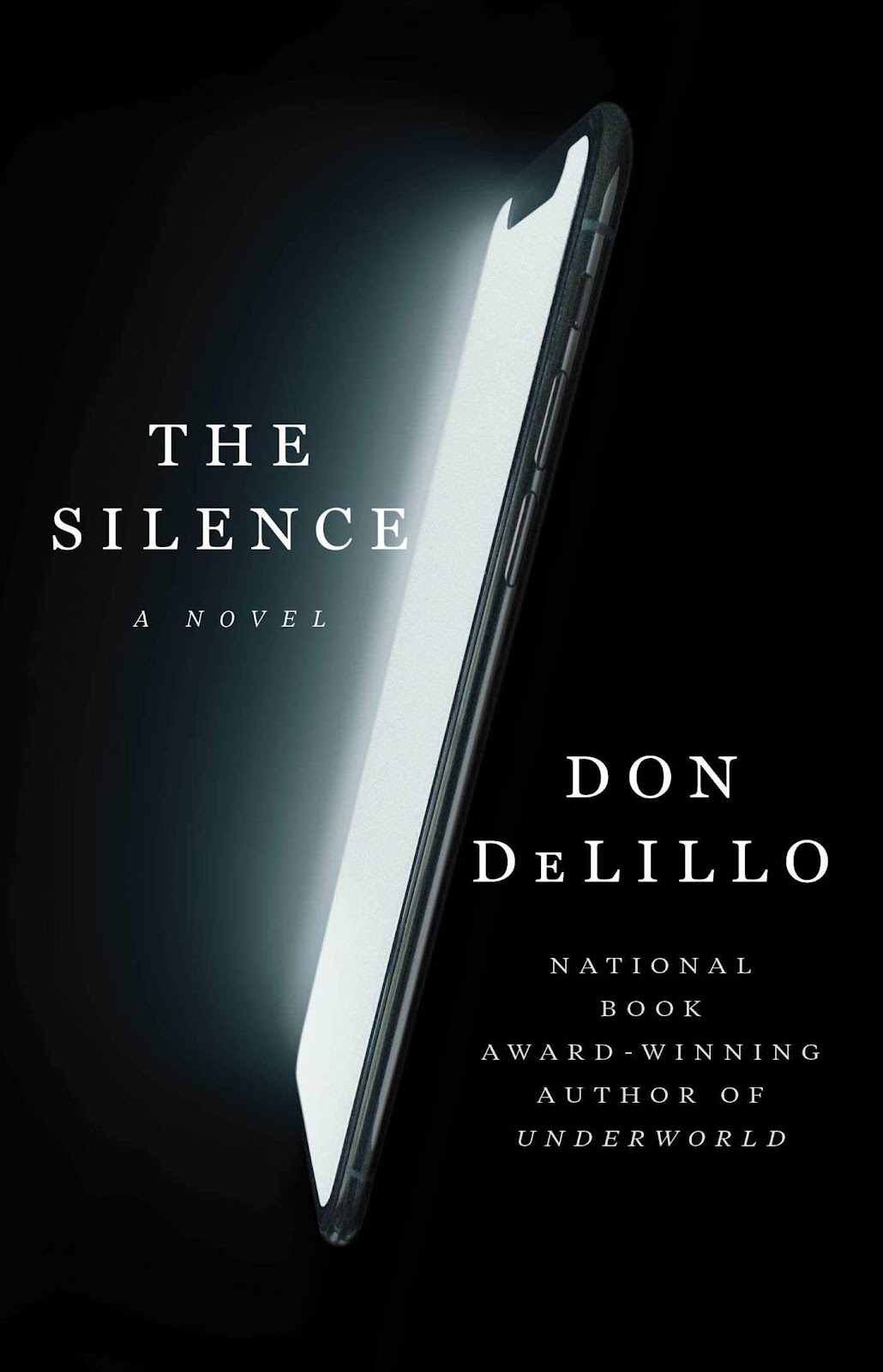
On The Silence by by Don DeLillo (Scribner, 2020)

....As long as the pillars of capitalist society seemed unshakable, say up to the first world war, the so-called avant-garde danced with the fetishes of their inner life. Some writers, it is true, saw the approach of the inevitable catastrophe (Ibsen, Tolstoy, Thomas Mann, etc.). The gaudy carnival, often with a ghastly tone from tragic incidental music, went on uninterrupted. The philosophy of Simmel and Bergson and much of the literature of the time show exactly where things were heading.

     Many a good writer and keen thinker saw through the intoxication of carnival to the fact that the fetishized ego had lost its essence. But they went no further than to sketch tragic or tragi-comic perspectives behind the garish whirl. The fetishized bases of life seemed so beyond question that they escaped study, let alone criticism. If there were doubts, they were like the doubt of the Hindu who questioned the accepted doctrine that the world rests on a huge elephant; he asked modestly on what the elephant rested; and when told it rested on a huge tortoise, he went his way contented. Mind was so formed by fetish thinking that when the first world war and the subsequent series of crises called the very possibility of human existence into question, giving a new tinge to every idea, and when the carnival of isolated individualism gave way to its Ash Wednesday, there was still virtually no change in the way that philosophical questions were asked....


- Lukacs, "Existentialism" (1949)


❖


❖


The Silence by by Don DeLillo

(Scribner, 2020)


Is every Don DeLillo novel like this? 


By "like this" I mean like observing a performance of "No Exit" in the world of the film Cloverfield.


The five middle class Manhattanites DeLillo draws together are ciphers unmoored from the consequences of the germinating global disaster. DeLillo suggests people have been remade by technology: blank slates with a thin patina of social media screen time substituting for consciousness. (And never mind an Unconscious). 


One of the characters, a high school physics teacher, begins reciting quotes of Einstein in a German accent.  I assume DeLillo is thus suggesting that social media technology has superseded atomic energy as a threat to life on earth.


Middle class intellectuals seem to share and enjoy this kind of insight, assuming the technology that reshaped their habits of work has also remade the world for everyone else.


The world of The Silence is Superbowl Sunday 2022. Three characters are in an apartment preparing for dinner party guests and an evening of enjoying the game. A second couple is flying from Paris to NYC to attend that dinner party.


DeLillo's characters freeze-up as soon as the power fails. Those in the apartment take no action, apparently resigned to regurgitate abstractions as pantomime of agency in face of a crisis.


Diane Lucas decides to say something, although she has no idea what might come spouting out.


     "Staring into space. Losing track of time. Going to bed. Getting out of bed. Months and years and decades of teaching. Students tend to listen. All those different backgrounds. The faces dark, light, medium. What is happening in the public squares across Europe, the places where I've walked and looked and listened? I feel so simpleminded. A college professor who quit too soon. A would-be inspiration to my students, one of whom sits next to me here and now. The end-of-the-world movie. People stranded in a room. But we're not stranded. We can leave anytime. I try to imagine the vast sense of confusion out there. My husband does not want to describe what he has seen but I am guessing bedlam in the streets and why am I so reluctant to get up and walk to the window and simply look? But didn't this have to happen? Isn't that what some of us are thinking? We were headed in this direction. No more wonder, no more curiosity. Totally impaired orientation. Too much of everything from too narrow a source code. And am I saying all this because it's way past midnight and I haven't slept and have barely eaten and the people here with me are barely listening to what I'm saying? Tell me I'm wrong, someone, but of course no one speaks. I want to resume teaching and return to my classroom and speak to my students about the principles of physics. The physics of this, the physics of that. The physics of time. Absolute time. Time's arrow. Time and space. Before I shut up I will quote a stray line from Finnegans Wake, a book I've been reading on and off, here and there, for what seems like forever. The line has stayed secure in the proper mind slot, the word preserve. Ere the sockson locked at the dure. Just one more thing to say. To myself this time. Shut up, Diane."


*     *     *


The last hundred years have given us many "machine stops" stories. Few have been as airless and underpowered as The Silence. It's moral, for only moralizing could be the goal of such a slight tale, is that technology has wrecked the human race - or at least its privileged petty-bourgeois heights. 


Compared to Devolution by Max Brooks (Del Rey, 2020), The Silence is small-beer defeatism and self-pity. 


Jay

3 April 2021


Baudelaire [from Gaunt's Aesthetic Adventure]


From Gaunt's Aesthetic Adventure:


....He avoided that to which the romantic Bohemian was prone the chic pittoresque that smart picturesqueness which in Gautier somewhat regrettably expressed itself by a flaming red waistcoat. A stickler for conventions he carried politeness to the verge of affectation, choosing his words with great care and avoiding volubility and gesture like the most phlegmatic of Britons though the satanic epigrams which fell from his lips were not British in the least.

In Edgar Poe he found an inspiring morbidity, a morbidity kindred to that which had lurked in France after its ordeal, but adapted to the purposes of literature. A creature of tragedy and a slave of the bottle he had made poetry out of delirium tremens, and induced strange dreams from which he had evolved masterpieces.

Roderick Usher, in Poe's weird story, the Fall of the House of Usher, had shown a perverted connoisseurship in books, scents and liquors which reflected the author's sense of values to be discovered in what was not normal and 'natural. And this was balanced, it seemed to Baudelaire, by a cool and calculating appreciation of artistic values like his own. Thus to attain a refinement of sensation by taking a hard way through the bog and quicksand of life presented itself to him almost as a duty. In this way the artist could signify the exacting nature of his own code and plunge into what people called evil from austere motives and with a singleminded devotion to his art. Had not Delacroix perceived the splendour of misery? Was not his painting a great and pitiful hymn rising from scenes of ferocious carnage and barbarism? The voyage of aesthetic discovery could be pressed further, towards stranger ends. What was gross and vile as well as what was savage and barbarous might be made to yield its quota of beauty: and any means were justified in achieving that result. There was even a sort of religious exaltation in choosing the necessary martyrdom of vice, a saintly courage in exploring sin, a religious belief implicit in the defiance of religious rule.

These strange notions revolved behind the noble forehead of Charles Baudelaire, and though he was the younger of the two, he exercised a great influence on Gautier. The latter was not so intense, so introvert, but he acquired, through their friendship, some of Baudelaire's refinement as Baudelaire acquired some of his audacity. Together they crystallized the exclusive position of the artist and his separation from the middle class world. Gautier, the man of slogans, put it in a phrase "l'art pour l'art" or, as it may be written in English, Art for Art's Sake....


THE AESTHETIC ADVENTURE
by William Gaunt
(1945).
_________


Friday, April 2, 2021

On "The Picture" by Rosalie Parker

"The Picture" by Rosalie Parker

Supernatural Tales 15 

Summer 2009


❖


"The Picture" by Rosalie Parker is told deftly and finishes too soon.


It is a haunted picture story. Or perhaps a possessed picture (pencil sketch) story?


....In it, a dark-haired, curiously androgynous figure, half-draped in a voluminous white garment, gazed adoringly, imploringly, in profile at some unseen entity above. His slender, long-fingered hands (Sadie decided it was a he, despite the shoulder length hair) were clasped together over his chest. She thought it was mid-Victorian, probably Continental, possibly French, and of a very high standard of draughtsmanship.


Protagonist Sadie spends her life scouring junk shops and flea markets for items of at best marginal value, pieces that might be mistaken for treasures by internet auction bettors.


Not all online responses are constructive, however.


....She found that she had three messages asking questions about items; two of them concerned the picture. The first was more of an essay than a question.

     From carazon

       You say that he is in adoration of an unseen loved one but are you quite sure this is a romantic picture? I'd say we have here a religious subject, one of the saints, or Judas, perhaps, repenting. Anyway a very fine picture but not for me. I'd rather keep religious emotionalism out of my home! And anyway, he's a bit creepy. No restraint at all!

     The second was downright peculiar.

     From fallen angel

       This is a warning. You are meddling with something you do not understand. The picture must be returned from whence it came, otherwise you will be held responsible. It should not be displayed. HEED THIS WARNING OR SUFFER THE CONSEQUENCES.

     Sadie let out a little laugh. She had learnt that there were many strange people populating the internet. There were no bids on the picture yet but some of her other items were doing very well, in particular a silver gilt, enamelled matchbox cover by David Anderson of Norway that she had found at a car boot sale and which was currently yielding £110. 


Once purchased by Sadie, the picture seems to power a turnaround in 

business. Several valuable pieces are discovered, and then a Fabergé egg. However, once the picture is sold and shipped, the good fortune slips away.


At Christie's:


The valuer took his lens away from his eye and looked curiously at Sadie. 

       'You do know what this is?' he asked.

       'Yes, I think so,' said Sadie. 'My grandmother left it to me, but I need some cash so I thought I would sell it.'

       'Well, it's Fabergé, obviously, but perhaps you don't know that its one of a group of three ornaments called, colloquially, The Holy Trinity. There are two more, one in the Hermitage in St Petersburg and the other in a private collection in Russia. This one has been missing for about eighty-five years – it was brought out of Russia by a White Russian family who emigrated to London after the Revolution of 1917. It disappeared from their house in mysterious circumstances in 1923. This is the main piece, the central ornament, designed to be flanked by the other two. If this was an ordinary piece of Faberge then I'd say it was worth around £4,000, but as its from The Holy Trinity, it is literally priceless.'

       Sadie could hardly keep a lid on her excitement. He looked at her over his spectacles and continued.

       'However, I think we'd have to ask some serious questions about its provenance. Where did your grandmother, for instance, get it from? It was probably stolen from the Pretovskis, so can we really say that it belongs to you? We'd have to weigh up these matters very carefully before proceeding with any sale.'

       Sadie grabbed the ornament and bolted.


The man who purchased the picture from her has his own complaint to make.


David Swinton returned the picture.

       He emailed to ask for his money back and wrote that, although he loved it, and had hung it in his bedroom, some odd things had been happening to him since he bought it. He had had two days of good luck – he had been given a longed for promotion, a premium bond had come up, some medical test results turned out to be negative - but then, things had begun to go wrong. 

       His wife had taken against the picture, claiming that it was mawkish and unsettling, and had made him take it down. The promotion turned out to be a poisoned chalice, he was expected to work unreasonably long hours and his new boss was a Gorgon.

       The doctor had called him in for some more tests, and the premium bond money was soon eaten up in paying off a couple of loans his wife had taken out without telling him. What's more, every time he looked at the picture he seemed to see something different, and he had become tormented by not knowing what it was the subject was contemplating with such ecstasy. 

       He was sorry, and could only apologise, but he really couldn't live with it any more.


All of which builds to a swift and poignant climax. 


Sadie is not presented as any more immoral than other side-gig parasites hunting for their niche; she is not lying to her bidders, just facilitating their own habits of self-deception. Ultimately the picture and the story it tells brings this home to her, sharp like teeth closing on meat.


Jay

2 April 2021


❖


Thursday, April 1, 2021

Slingshot openings in Amelia B. Edwards?

This is a terrible admission to make, but until this week I confused the Amelia B. Edwards stories "The Phantom Coach" (1864) and "The Four-Fifteen Express" (1866). 


Listening to an audio version of "The Phantom Coach" (1864) this week, the mist of confusion cleared.


The Phantom Coach


The Four-Fifteen Express


Rereading both stories again this morning, I was struck by Edwards' handling of the opening of each tale. 


Clute and Langford have an article about slingshot endings here:


A term initially used by Kim Stanley Robinson when attempting to describe the typical ending of a Gene Wolfe tale. The Book of the New Sun (1980-1983 4vols), There Are Doors (1988) and Exodus from the Long Sun (1996) all close as their protagonists begin to move towards a goal which has been anticipated from the beginning. But they move out of frame, out of the end of the book, and the story closes as though before its proper ending. As Robert Frost said in a letter of 1 November 1927 (in Selected Letters of Robert Frost [coll 1964, p344]): "My poems ... are all set up to trip the reader head foremost into the boundless." The effect is similar to the device in classical rhetoric known as enthymeme, where an argument is begun but not ended; the term also describes a syllogism that is left incomplete, with the conclusion to be supplied by the reader. Though unexpecting readers might feel that the consequent affect is one of frustrating truncation, a discomfort at not being told what should be told for proper closure, a true slingshot ending should persuade them that a choice of conclusions has indeed been indicated – and that their task (or joy) is to plunge head foremost towards a finish they will be glad to sanction….


The endings Edwards provides in "The Phantom Coach" and "The Four-Fifteen Express" do not contain much of the majesty or sublimity Clute and Langford describe. But the start of both stories offer modest but electric telescoping motion I could term "slingshot openings."


"The Phantom Coach"


THE CIRCUMSTANCES I AM about to relate to you have truth to recommend them. They happened to myself, and my recollection of them is as vivid as if they had taken place only yesterday. Twenty years, however, have gone by since that night. During those twenty years I have told the story to but one other person. I tell it now with a reluctance which I find it difficult to overcome. All I entreat, meanwhile, is that you will abstain from forcing your own conclusions upon me. I want nothing explained away. I desire no arguments. My mind on this subject is quite made up, and, having the testimony of my own senses to rely upon, I prefer to abide by it.

      Well! It was just twenty years ago, and within a day or two of the end of the grouse season. I had been out all day with my gun, and had had no sport to speak of. The wind was due east; the month, December; the place, a bleak wide moor in the far north of England. And I had lost my way. It was not a pleasant place in which to lose one’s way, with the first feathery flakes of a coming snowstorm just fluttering down upon the heather, and the leaden evening closing in all around. I shaded my eyes with my hand, and stared anxiously into the gathering darkness, where the purple moorland melted into a range of low hills, some ten or twelve miles distant. Not the faintest smoke-wreath, not the tiniest cultivated patch, or fence, or sheep-track, met my eyes in any direction. There was nothing for it but to walk on, and take my chance of finding what shelter I could, by the way. So I shouldered my gun again, and pushed wearily forward; for I had been on foot since an hour after daybreak, and had eaten nothing since breakfast....


From there the narrator commences a full report of being lost, then found, in a snow-storm.


❖


"The Four-Fifteen Express"


THE EVENTS WHICH I am about to relate took place between nine and ten years ago. Sebastopol had fallen in the early spring; the peace of Paris had been concluded since March; our commercial relations with the Russian empire were but recently renewed; and I, returning home after my first northward journey since the war, was well pleased with the prospect of spending the month of December under the hospitable and thoroughly English roof of my excellent friend, Jonathan Jelf, Esquire, of Dumbleton Manor, Clayborough, East Anglia. Travelling in the interests of the well-known firm in which it is my lot to be a junior partner, I had been called upon to visit not only the capitals of Russia and Poland, but had found it also necessary to pass some weeks among the trading ports of the Baltic; whence it came that the year was already far spent before I again set foot on English soil, and that instead of shooting pheasants with him, as I had hoped, in October, I came to be my friend’s guest during the more genial Christmas-tide....


❖


I touched on this kind of opening with several other examples here.


❖


The above story quotes are taken from The Phantom Coach: Collected Ghost Stories (1999, Ash-Tree Press).


Jay

1 April 2021