Subscribe to my Substack

Tuesday, August 6, 2019

Toni Morrison 1931-2019

Harold Bloom on Toni Morrison


The Chelsea House collections of critical writings about Toni Morrison's work now span half a dozen volumes, all introduced by Harold Bloom.  With art I seek out guidance from Robert Hughes; with literary fiction, I go to Bloom.


Toni Morrison, in a speculative essay on literary canon-making, proposes the difficult critical quest of uncovering the hidden obsession with African-Americans that has haunted the American novel throughout its history. Her principal example is to sketch a reading of Moby-Dick in which Ahab's manic obsessiveness with the whiteness of the whale becomes a synecdoche for white America's compulsive relation to the African-American aspects of its culture, past and present. Morrison's reading is in the mode of D.H. Lawrence's Studies in Classic American Literature, where what Lawrence saw as the doom of the white race is prefigured in Ahab's compulsiveness. I am of many minds about Morrison's critical project, if only because it would give yet another dimension to the unhappy procedure of uncovering just how much of white America cannot be exorcised from African-American fiction. Morrison's five early novels, culminating in Beloved, are possible candidates for entering an American canon founded upon what I insist would be aesthetic criteria alone, if we still retain any such criteria after our current age of politicized response to narrative, dramas, and poems has passed.

Morrison, like any potentially strong novelist, battles against being subsumed by the traditions of narrative fiction. As a leader of African-American literary culture, Morrison is particularly intense in resisting critical characterizations that she believes misrepresent her own loyalties, her social and political fealties to the complex cause of her people. If one is a student of literary influence as such, and I am, then one's own allegiances as a critic are aesthetic, as I insist mine are. One is aware that the aesthetic has been a mask for those who would deny vital differences in gender, race, social class, and yet it need not be an instrument for the prolongation of exploiting forces. The aesthetic stance, as taught by Ruskin, Pater, and Wilde, enhances a reader's apprehension of perception and sensation. Such a mode of knowing literature seems to me inescapable, despite times like our own, in which societal and historical resentments, all with their own validity, tend to crowd out aesthetic considerations. Yet, as an artist, Morrison has few affinities with Zora Neale Hurston or Ralph Ellison, or with other masters of African-American fiction. Her curious resemblance to certain aspects of D.H. Lawrence does not ensue from the actual influence of Lawrence, but comes out of the two dominant precursors who have shaped her narrative sensibility, William Faulkner and Virginia Woolf. Faulkner and Woolf have little in common, but if you mixed them potently enough you might get Lawrence, or Toni Morrison.

Lest this seem a remote matter to a passionate reader of Morrison, I would observe mildly that one function of literary study is to help us make choices, because choice is inescapable, this late in Western cultural history. I do not believe that Morrison writes fiction of a kind I am not yet competent to read and judge, because I attend to her work with pleasure and enlightenment, amply rewarded by the perception and sensation that her art generates.

Reading Alice Walker or Ishmael Reed, I cannot trust my own aesthetic reactions, and decide that their mode of writing must be left to critics more responsive than myself. But then I reflect that every reader must choose for herself or himself. Does one read and reread the novels of Alice Walker, or of Toni Morrison? I reread Morrison because her imagination, whatever her social purposes, transcends ideology and polemics, and enters again into the literary space occupied only by fantasy and romance of authentic aesthetic dignity. Extraliterary purposes, however valid or momentous they may be for a time, ebb away, and we are left with story, characters, and style, that is to say, with literature or the lack of literature. Morrison's early novels leave us with literature, and not with a manifesto for social change, however necessary and admirable such change would be in our America.

Morrison herself has made very clear that she prefers to be contextualized in African-American literature, or in an American literature that ceases to repress the African-American presence. I am neither a feminist nor an African-American critic, nor am I a Marxist, a deconstructor, a Lacanian, a New Historicist, a semiotician. And yet I scarcely would agree with several of the contributors to this volume, who would maintain that my theories of literary influence simply reduce to yet another logocentric, capitalistic, white male symbolic system that has no validity or relevance for reading and understanding the work of an African-American feminist andbMarxist novelist. Literary texts emerge from other literary texts, and they do not choose their forerunners. They are as overdetermined aesthetically as their human makers are overdetermined erotically. It is a great sorrow that we cannot choose whom we are free to love, and it is almost an equal sorrow that the gifted cannot choose their gift, or even the bestowers of their gift.

We are free to choose our ideologies, but eros and art, however intertwined they are with cultural politics, cannot be reduced to cultural politics alone.

As an African-American woman, Toni Morrison has developed a powerful stance that intervenes forcefully in the cultural politics of her time and place, the United States as it stumbles beyond the year 2000 of the Common Era.

As a novelist, a rhetorical tale-teller, Toni Morrison was found by Virginia Woolf and William Faulkner, two quite incompatible artists, except perhaps for the effect that James Joyce had upon both of them. Morrison's marvelous sense of female character and its fate in male contexts is an extraordinary modification of Woolfian sensibility, and yet the aura of Woolf always lingers on in Morrison's prose, even as Joyce's presence can be felt so strongly in Woolf's Mrs. Dalloway and in Faulkner's The Sound and the Fury. Faulkner's mode of narration is exquisitely modulated by Morrison, but the accent of Faulkner always can be heard in Morrison's narrators, even as Joseph Conrad's authorial stance never quite left Faulkner. Consider the plangent closing passages of The Bluest Eye, Sula, and Song of Solomon:

....And now when I see her searching the garbage—for what? The thing we assassinated? I talk about how I did not plant the seeds too deeply, how it was the fault of the earth, the land, of our town. I even think now that the land of the entire country was hostile to marigolds that year. This soil is bad for certain kinds of flowers. Certain seeds it will not nurture, certain fruit it will not bear, and when the land kills of its own volition, we acquiesce and say the victim had no right to live. We are wrong, of course, but it doesn't matter. It's too late. At least on the edge of my town, it's much, much, much too late.

—The Bluest Eye


Shadrack and Nel moved in opposite directions, each thinking separate thoughts about the past. The distance between them increased as they both remembered gone things.


Suddenly Nel stopped. Her eye twitched and burned a little.


"Sula?" she whispered, gazing at the tops of trees. "Sula?"


Leaves stirred; mud shifted; there was the smell of overripe green things. A soft ball of fur broke and scattered like dandelion

spores in the breeze.


"All that time, all that time, I thought I was missing Jude." And the loss pressed down on her chest and came up into her throat.


"We was girls together," she said as though explaining something.


"O Lord, Sula," she cried, "girl, girl, girlgirlgirl."


It was a fine cry—loud and long—but it had no bottom and it had no top, just circles and circles of sorrow.

— Sula


Milkman stopped waving and narrowed his eyes. He could just make out Guitar's head and shoulders in the dark. "You want my life?" Milkman was not shouting now. "You need it? Here."


Without wiping away the tears, taking a deep breath, or even bending his knees—he leaped. As fleet and bright as a lodestar he wheeled toward Guitar and it did not matter which one of them would give up his ghost in the killing arms of his brother. For now he knew what Shalimar knew: If you surrendered to the air, you could ride it.

— Song of Solomon


Even decontextualized, without the narratives that they culminate, these conclusions retain considerable lyrical and dramatic vitality. If I stumbled upon them anywhere, I would know them for Morrison's fictional prose, and I do not hear any voices in them except for Morrison's passionate and caring cry of the human, her own particular eloquence. And yet part of appreciating Morrison's command here of sensation and perception involves attending to the genealogy of her art. It is not a question of allusion or of echoing but of style, stance, tone, prose rhythm, and mimetic mode, and these do stem from an amalgam of Faulkner and Woolf, the father and mother of Morrison's art, as it were. Woolf and Faulkner are poets of loss, who search past and present for the negative epiphanies of vanished moments, possibilities, radiances, hopes. The narrative voice in Morrison turns always upon the negative magic of the romancer. Her perfect sentence is: "If you surrendered to the air, you could ride it." That is her epitome, but it would serve also for the most Morrisonian beings in Faulkner: Darl Bundren in As I Lay Dying and Lena Grove in Light in August. And it would illuminate also the perfect heroine of Woolf, Clarissa Dalloway, whose sensibility hovers at making that surrender in the air that Septimus Smith made, only to discover that he could not ride it. The pure madness of integrities of being that cannot sustain or bear dreadful social structures is as much Morrison's center (and not just in The Bluest Eye) as it is Woolf's and, with a difference, Faulkner's. The most authentic power in Morrison's work is the romance writer's sense that "it's much, much, much too late," that one's cry of grief and loss "had no bottom and it had no top, just circles and circles of sorrow." In some sense, all of Morrison's protagonists leap wheeling towards the death struggle, with the fine abandon of Faulkner's doom-eager men and women. Toni Morrison, in her time and place, answering to the travail of her people, speaks to the needs of an era, but her art comes out of a literary tradition not altogether at one with her cultural politics.


Jay

6 August 2019


Thursday, August 1, 2019

Reviewing: The Seven Days of Cain by Ramsey Campbell (2010)

The Same Man

In 1981 I started reading Ramsey Campbell's short stories. I only took the plunge and read one of his novels once: Ancient Images, in the summer of 1993.

All credit for reawakening my desire to read Ramsey Campbell (after a hiatus of twenty years) goes to Matt Cowan and his Horror Delve blog. Horror Delve is the only place I have found online for serious discussion of classic international and contemporary supernatural fiction. There is no jargon or clickbait to Matt's posts; they show him to be a patient, curious, and thoughtful genre connoisseur.

In the last two years I have read nine of Campbell's twenty-first century novels with excitement and deep pleasure.


Pact of the Fathers (2001)
✔The Darkest Part of the Woods (2002)
✔The Overnight (2004)
Secret Stories (2005)
✔The Grin of the Dark (2007)
Thieving Fear (2008)
✔Creatures of the Pool (2009)
✔The Seven Days of Cain (2010)
✔The Kind Folk (2012)
✔The Last Revelation of Gla'aki (2013)
✔Think Yourself Lucky (2014)
✔Thirteen Days by Sunset Beach (2015)
The Searching Dead (2016)
Born to the Dark (2017)
The Way of the Worm (2018)


This experience has shown me just how many recurring themes drive Campbell's artistic project. Plots of many of these novels turn on questions of descent, parenting, and family obligation. Characters in crisis discover, when mounting contradictions peel away a thin crust of hard-won normality, that familiar people, landscapes, memories, and even language sabotage action, cohesion, and sanity. Bosses and neighbors change from punchlines for everyday absurdity to venal menaces, though not nearly as looming as the cops.

Many characters find that artistic ambitions or intellectual obsessions of their youth, long assumed painlessly buried, have uncanny ways of returning.

Local mages from ages past (Thackeray Lane, John Strong, Roland Franklyn) have sown the region with their demoniacal dragon's teeth.

The Seven Days of Cain (2010) turns on questions of identity. Against a liminal landscape (urban, coastal), Andrew Bentley's career, marriage, and place in society begins to disintegrate. Colleagues, clients, and spouse start appearing as daydreams of solipsistic ideation. (We readers know Andrew's antagonists have an independent interior life: Campbell craftily demonstrates that Andrew cannot be living in a "matrix.")

The solution to this existential contradiction may also be the solution to a series of gruesome murders, fires, and seemingly random accidents.

In the end, solutions to supernatural and criminal enigmas may leave Andrew a sadder and wiser man, but also a man whom the uncanny has marked for its own.


Jay
1 August 2019


Saturday, July 27, 2019

Reading Gateways to Abomination by Matthew M. Bartlett (2014)


by Matthew M. Bartlett (2014)

Welcome to a rebarbative rural Western Massachusetts. It is shot-through with monstrous facts and uncanny contexts of real aesthetic power and the moral voice of a sleep-deprived, keening Jeremiah.

Gateways to Abomination by Matthew M. Bartlett makes Mark Samuels' tales of a universe succumbing to entropy in slush piles of UHF static look like reports of hijinks at the vicar's tea party.

The collection contains over thirty stories. Some are brief slices of life, a few are more rounded. The entire collection can be read in a day, if not a single sitting. But I do not recommend such intense exposure. Like Ramsey Campbell, Matthew M. Bartlett not only depicts situations where perceptions are warped and lethally inaccurate, he attempts to impose those sensations on the reader through his fun-house strategies delineating setting, characters, events, and durations.

By far my favorite story, for its ability to subvert itself and keep upping the horror ante, is "when I was a boy – a broadcast."

It begins by posing as a reminisce of rural youth:

When I was a boy in Leeds, I had a friend named Christopher Dempsey who lived out on Cemetery Hollow Road. He had a younger brother named Alex and a backyard that emptied out into an expanse of woods that hid most of our boyhood exploits, which for a time were no less innocent than catching and eating frogs....

But menacing facts and events accumulate in the story's second and third paragraph:


....Christopher and Alex each seemed to be clothed in dirt. It smudged their faces at the corners of their mouths and settled into the cracked skin at their elbows and knees. Their toes were so encased in filth they were never once kicked out of King's Grocery for being shoeless; a glance at their filthy feet fooled most into thinking the boys had donned dense and dirty slippers.
    Their mother, though not as obviously caked and clotted with filth as her boys, seemed to be filthy with secrets. She was thick-hipped and black-haired and wore huge glasses and colorful faded sashes tied at her waist. She favored dark denim pantsuits and she smoked up hand-rolled cigarettes one after the other. She was ugly and beautiful and fat and curved and she did not wear lipstick neatly like Mother wore lipstick. She spent hours behind the closed door of her room listening to monotonous and eerie orchestral music. She read strange books. She was quiet and sullen and cursed at her boys and humiliated and hated them. She took to me instantly, foisting her boys off upon me on many a hot afternoon and staring strangely after me as we fled into the woods....


But "when I was a boy – a broadcast" is not simply a memory of the benighted Dempsey family. The narrator peels back and displays something more than lumpen crudity; this is a family, particularly a mother, diagnosed as a social disease:


....I turned to leave and She beckoned me from the doorway. She was wearing a ratty pink robe that hung open obscenely. Its browned sash curled like a snake at her feet. I seem to remember--though it cannot be--that a newly lit cigarette jutted from between her disturbingly large big toe and its curled neighbor, sending a seductive tendril of smoke up past the webbed blue veins of her thighs, past the sweaty cramped horizons of her belly, past the glitter stuck in clumps between her ample, dangling breasts, past her eyes, one of which twitched, past her hair, which was greasy and brown and frayed. I turned again to run and fainted dead away....


It quickly follows, however, that the social disease has conquered more than the Dempsey family. The narrator begins to get a sense of the rest of the iceberg:


....I cannot describe what was happening to me when I woke. It was my dream come true and my nightmare. Her face pushed into me everywhere. She pulled from me pleasures I'd never imagined and pulled and bit at my skin angrily until I shrieked and pulled away in pain and shame. Cigarettes lay broken and smoking in ashtrays all over the room. There must have been scores of them, providing ample light to see the faces watching us from all the corners of the room. I thought I saw Guy grappling with my father over scraps of raw meat. I remember a clock whose face was an obscene caricature of a black man, another whose hands were crudely rendered pricks. I remember a dog rolling on a milk-soaked carpet, its belly a mass of grotesque breasts. She saw me looking frantically about the room and covered my eyes with her hand, which smelled of sex and nicotine
     There was music playing, I remember, and there were whispers and bursts of jeering laughter. I think at one point a dog lapped at the bottom of my foot. I endured a cigarette burn whose ghost still haunts my eyebrow. I remember the sounds of someone vomiting. But mostly there was her, from every angle and in deep in every fold. Our bodies roiled and boiled and pushed into each other unspeakably. I was terrified of her, and terrified that it would end. I was sure I would die, for there were long stretches of time when her flesh filled my throat and seemed to be on the verge of somehow invading my very lungs. I wanted to die, and I wanted to go on forever....


At this point "when i was a boy – a broadcast" is about two pages from its pulverizing climax. I won't spoil it by describing it here, but the narrator both descends to and supercedes his community's depravities and crapulence.

Gateways to Abomination is not a reassuring book. It does not try to make the reader comfortable, even at the end. Bartlett's goal - a goal achieved - is to curdle readerly confidence in our own senses, our judgment, and in our apprehension of the world outside stories.

Jay
27 July 2019


Friday, July 26, 2019

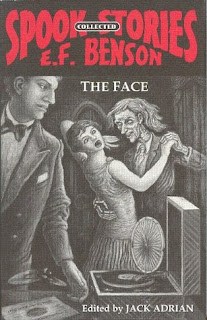
Not my idea of a peaceful night: "The Face" by E.F. Benson


July 24 was the 152nd anniversary of E.F. Benson's birth.

On Facebook that day Ramsey Campbell singled-out Benson's "The Face" for particular praise.

A praiseworthy story of incredible uncanny power it is. If one were looking for a "missing link" between M.R. James and Robert Aickman, "The Face" would be an outstanding candidate. It's "gone in the night" climax will also strike a chord with Campbell readers.

Excerpt:


....The gallery was crowded when she got there; there were friends among the sightseers, and the inspection of the pictures was diversified by cheerful conversation. There were two or three fine Raeburns, a couple of Sir Joshuas, but the gems, so she gathered, were three Vandycks that hung in a small room by themselves. Presently she strolled in there, looking at her catalogue. The first of them, she saw, was a portrait of Sir Roger Wyburn. Still chatting to her friend she raised her eye and saw it….

Her heart hammered in her throat, and then seemed to stand still altogether. A qualm, as of some mental sickness of the soul overcame her, for there in front of her was he who would soon come for her. There was the reddish hair, the projecting ears, the greedy eyes set close together, and the mouth smiling on one side, and on the other gathered up into the sneering menace that she knew so well. It might have been her own nightmare rather than a living model which had sat to the painter for that face.

"Ah, what a portrait, and what a brute!" said her companion. "Look, Hester, isn't that marvellous?"

She recovered herself with an effort. To give way to this ever-mastering dread would have been to allow nightmare to invade her waking life, and there, for sure, madness lay. She forced herself to look at it again, but there were the steady and eager eyes regarding her; she could almost fancy the mouth began to move. All round her the crowd bustled and chattered, but to her own sense she was alone there with Roger Wyburn.

And yet, so she reasoned with herself, this picture of him—for it was he and no other—should have reassured her. Roger Wyburn, to have been painted by Vandyck, must have been dead near on two hundred years; how could he be a menace to her? Had she seen that portrait by some chance as a child; had it made some dreadful impression on her, since overscored by other memories, but still alive in the mysterious subconsciousness, which flows eternally, like some dark underground river, beneath the surface of human life? Psychologists taught that these early impressions fester or poison the mind like some hidden abscess. That might account for this dread of one, nameless no longer, who waited for her.

That night down at Rye there came again to her the prefatory dream, followed by the nightmare, and clinging to her husband as the terror began to subside, she told him what she had resolved to keep to herself. Just to tell it brought a measure of comfort, for it was so outrageously fantastic, and his robust common sense upheld her. But when on their return to London there was a recurrence of these visions, he made short work of her demur and took her straight to her doctor.

"Tell him all, darling," he said. "Unless you promise to do that, I will. I can't have you worried like this. It's all nonsense, you know, and doctors are wonderful people for curing nonsense."

She turned to him.

"Dick, you're frightened," she said quietly.

He laughed.

"I'm nothing of the kind," he said, "but I don't like being awakened by your screaming. Not my idea of a peaceful night. Here we are."


"The Face" by E.F. Benson


Jay

26 July 2019


[Walter Pater]


From Gaunt's Aesthetic Adventure:


....At this stage he appeared to suffer almost from an excess of Christianity. He was considered 'a tremendous Ritualist'. He never ate meat in Lent and every night he murmured a Latin prayer. Anxiety was expressed lest Ritualism should lead this young Thomas a Kempis to Rome. The fact was far different. By the time he went up to Oxford, with an Exhibition from King's School in 1858, he had already lost all religious faith. A reading of the doctrines of Christian Socialism as expounded by Maurice and Kingsley which have brought others to belief caused him to doubt. He seemed now to take a malicious delight in shocking his devout friends and in saying sneering and disturbing things out of character. 'Be boy-like boys', said Pater in a parting monitorial address at the school, looking fixedly at Dombrain Pater who had rejoiced in being the most unboy-like of boys. 'Mephistophelian sneers', said the puzzled Rainier McQueen of his attacks on the Bible in the manner of Voltaire. It was horrifying to him to think that one of their holy 'triumvirate' could suggest: 'What fun it would be to be ordained and not to believe a single word of what you are saying.' Nothing could be more disconcerting than this demure devilment. It was not as if Pater had revealed serious doubts which could be wrestled with in communion with staunch friends such wrestlings might in themselves be called a religious exercise and perfectly proper. No, it was as if a demon had quite suddenly asserted itself in his mind. 'An enemy', said this demon, in Pater's own voice, 'to all Gothic darkness' and 'full of a better taste.' McQueen was horrified, heartbroken. 'Please desist from that kind of talk', he implored. To which Pater with quiet savagery replied, 'When I was at Canterbury I was a contemptible hypocrite'. His heresy was 'the cause of a rupture which could have come to pass by nothing else'.

Religious experience, shades of religious belief, were then the main preoccupation of Oxford. There were various religious sets like so many political parties the High Church set who wore their hair plastered very sleekly and close to the head, and went in for incense at seven shillings and sixpence a pound, the puritan Anglicans who liked the interior of St. Mary's because it was bare, the Broad Churchmen, prominent among whom were the Rev. Mark Pattison and Benjamin Jowett, the Regius Professor of Greek, who with five collaborators in the Essays and Reviews of 1860 had earned the title of the 'Seven Against Jesus'. Occasionally and to the sound of tears and sobs, someone would go over to Rome, with the effect of a wilful child who, reaching too far for a flower, had tumbled over a cliff.

And about none of these things did the new Pater, the Mr. Hyde Pater, now care in the least. He was indifferent. As to the painful case of one who had gone over to Rome he remarked dispassionately: 'In fact, as far as mere comfort of mind is concerned, I consider conscientious Roman catholics quite enviable'. As for himself he even went to the length of giving away or selling all his religious books, including a copy of The Christian Year. Robert McQueen wrote to his brother: 'Pater must be in a very bad state. What particular religion does he profess to belong to?' No one knew, though it seemed that philosophy had replaced religion in his mind from the fact that his favourite reading was Heraclitus, Pythagoras and Plato, the Germans Schelling and Hegel, and the story was told that he sat up all night reflecting on the absolute.

He profited or at least was affected by certain contemporary influences. He attended Mathew Arnold's lectures on Poetry. He was impressed by his attacks on the Philistine, his crusade for 'sweetness and light', his cosmopolitan attitude to letters. He read the books of John Ruskin. The decorative fluent prose of Modern Painters, the insistence on art as the supreme business of life, the reiteration of great names, Titian, Angelico and Tintoretto, with as much reverence as if they were Prophets of the Old Testament, all this undoubtedly turned him to the thought if not to the actual study of art.

So too must those authors whom he cared for enough to translate. He translated Plato and Aristotle. He read passages of Goethe and from him he derived a serene, a meditative approach to the classical perfection of Greece. He imitated Goethe in destroying his own early poems because of their Christian sentiment. By 1860 he was regularly translating a page from Flaubert whose great first book Madame Bovary had appeared three years before. The deliberate choice of words, the detachment from the bourgeois world, in which Flaubert is so much akin to his contemporary Baudelaire could not fail to strike the translator. His view of art, his sense of style, was built on this study of ancient Greeks, modern Germans and modern French.

Gradually Pater became more inscrutable. It was about this time (1860) that he grew that moustache which completed the mask-like nature of his expressionless features. He was a 'Caliban of letters', was very sensitive about his looks, had been heard to say, 'I would give ten years of my life to be handsome*. Meetings were held among his friends to discuss 'the External Improvement of Pater'. Various suggestions were made. It was agreed that a moustache was the thing if anyone dared try to persuade him. To their surprise Pater took kindly to the idea and shortly there burgeoned on his upper lip that formidable luxuriance which provided him with a distinct character not his own.

This sensitiveness about his own appearance helped to make him interested in ideal beauty. He could not bear ugly people. His friends were good-looking. He admired his brother Willie Pater, a tall, handsome guardsman type, with Dundreary whiskers and a fascination for women, because of his physical well being and comeliness. Walter Horatio had been known to speak of a boy at school who was uglier even than he in terms of the most utter contempt and with unrelenting sarcasm.

Perhaps through diffidence, a sense of his unattractiveness, or through a naturally sluggish habit he was no lover. Apart from a mild, a vague, a passing warmth for a cousin he was able to dispense with the tender passion and even his friendships were restrained and tepid. He abstained from love as he had abstained from cricket the better to enjoy contemplation. Any kind of violence became alien to the rhythm of his life and it was almost a sign of his avoidance of the spectacular, of energetic outward display and vulgar excess that he took only Second Class Honours in the Final Classical Schools in 1862. His visits to Heidelberg (to see his sisters who had gone to live there) were, however, supposed to have given him a special equipment in philosophy: he was reputed to have special knowledge of the systems of Schelling and Hegel. Because of this or some perception ofan inner and latent merit concealed by his reserve, his abstention from being brilliant, he was fortunate enough to be elected Fellow of Brasenose in 1864.

It is interesting that he should have tried to persist in his diabolical plan of becoming ordained. His friends 6pposed him (as Rainier McQueen said) for his own sake. Dombrain, the most bigoted of the young triumvirate, shut Pater completely out of mind. McQueen, more sensitive and affectionate but equally religious, sorrowfully 'spoke with him for the last time in this world'. He found it difficult to reconcile the 'ascetic and saintly boy' of his earlier acquaintance with this cold stranger. He wondered 'what the real Pater was'. But a clergyman, surely he must not be. 'If you make the attempt I shall do all I can to prevent it/ said his former master the Rev. J. B. Kearney. 'And I shall do so, too/ said McQueen. Both wrote to the Bishop of London imploring him in the best interests of their infidel friend to prevent his taking orders. The veto was upheld.

Aunty Betty was deeply grieved but he showed only a passing annoyance and instead settled quietly down to being a writer, in his academic haven.

His mental isolation was singularly complete. He presented to the world an imposing array of negatives. He was no administrator his attitude to undergraduate manliness being expressed in the remark that they were 'like young tigers at play'. He was no scholar, in the Oxford sense, and got rather quickly at sea in construing Virgil's Georgics. He had neither the capacity nor the energy for research and he had extremely few points of contact with his colleagues or with contemporary life at all. He conceived himself as a 'crystal man', a man of taste, that is to say with a mind adorned by 'the reminiscence of a forgotten culture', but entirely himself, unaffected by the age in which he lived, and cherishing his isolation from it.

His was an inward existence. He was content with the most frugal and monkish of surroundings and equipment. His rooms at Brasenose were small, simple, austere. The little chintz curtains, the stained floorboards that bordered the matting and the Turkey carpet, the few line engravings after Michelangelo, Correggio and Ingres, in themselves a frugal choice from among the riches of art, spoke of plain and very threadbare living. A bust of Hercules, somewhat out of place in these prim quarters, bore witness to an entirely abstract approval of the force its owner did not possess. 'Hercules, Discobolus, Samson/ apostrophized an admirer, 'these be thy gods, O Pater/ The only touch of adornment was the bowl of dried rose leaves which stood on the table. Even his books were few. A few small shelves held some battered paper-backed and cheap editions. When Pater wanted to read he went to the Bodleian or else borrowed a book from a friend. The adjoining bedroom, which lay along a narrow passage approached by a low Gothic doorway, was only a few feet wide and was in fact so cramped that the head of the bed had to rest, without legs, on a projection in the wall.

In his sitting-room he would settle down in the morning to wring a few reluctant, anxiously weighed words from his pen. The table would be covered with small lozenges of white paper each bearing a phrase or a word, with here and there a blue lozenge, this representing a key point. Such were his 'notes'. There is something in this neat and precise plan that reminds us of Pater's Dutch ancestry.

Having cast off religion and being without interest either in scholarship or in practical affairs Pater began to concentrate on the subject of Art. That he was much impressed by Swinburne is certain, though he knew him only slightly. It may have been partly through him that he imbibed the doctrine of Art for Art's Sake in the emphatic form which the French writers had given it. He became one of a circle of young poets and painters whose watchword it was. There was John Payne, the poet who had set forth Gautier's doctrine of aesthetic perfection in an essay on The Poets of the Neo-Romantic School in France: Arthur O'Shaughnessy of the British Museum, and the painters J. T. Nettleship and Simeon Solomon, in whose studios they often met. There is no question but that an essay on Leonardo which Swinburne wrote in 1864 inspired the style and a celebrated passage of Pater's own later essay on the artist. Here is Swinburne:

Of Leonardo the samples are choice and few: full of that indefinable grace and grave mystery which belongs to his slightest and wildest work. Fair strange faces of women full of dim doubt and faint scorn, touched by the shadows of an obscure fate; eager and weary as it seems at once, pale and fervent with patience and passion, allure and perplex the thoughts and eyes of men.

The presence that rose thus so strangely beside the waters is expressive of what in the ways of a thousand years men had come to desire. Hers is the head upon which all 'the ends of the world are come' and the eyelids are a little weary. It is a beauty wrought out from within upon the flesh, the deposit, a little cell by cell, of strange thoughts and fantastic reveries and exquisite passions.

It was a very vague and dreamy conception of ideal beauty, yet with its own tension and quiet ruthlessness. One pursued beauty as Johann Joachim Winckelmann had pursued it with 'a feverish nursing of the one motive of his life'. In that Prussian archaeologist a 'religious profession was only one incident of a culture' in which the moral instinct like the religious or political was merged in the artistic. And great pains had gone into the fashioning of the sentences which set forth this superlative aim. The reserved and cautious man thought it necessary to weigh every word, to restrain the violent and importunate epithet so prone to appear, to bring into the 'passion' which so much coloured the theme that sort of frugality manifest in his own surroundings.

This spartan care for form was something new in English literature. English writers wrote to say something, to serve a moral end; but the series of essays contributed by Pater to the Fortnightly Review and published in 1873 as 'The Renaissance: Studies in Art and Poetry' served no such end and seemed to many people very insubstantial in consequence. They seemed to Mrs. Mark Pattison an 'air-plant independent of the ordinary sources of nourishment a sentimental revolution having no relation to the conditions of the actual 'world'. They were not, as the writings of Ruskin were, an incentive to production, a call to contemporaries to emulate the past. They took no account of the kind of society in which art flourished. They established an attitude, of one attempting to put in words certain tenuous sensations, representing the 'sharp apex of the present moment between two hypothetical eternities'. Pater's writings were concerned with great artists, though the author knew nothing of visual art and as technical criticism his account of their work has little value. Pater sought, following Goethe, for the relation in which a work of art stood to the inner nature of the person contemplating it. To obtain flrom art as many pulsations as possible, 'to burn always with this hard gem-like flame', was 'success in life'.

In this egoistic vision of ideal beauty there lurked a poison the same poison as in the poems of Baudelaire, from the study of whom Pater may have imbibed it direct. It was the sense that something vaguely evil was to be found at the very centre of beauty, an evil not to be avoided but to be embraced and enjoyed (intellectually and imaginatively) by the writer. An excitement was given to the quest 'for the perfection of the gods by the idea that it held some corrupt and diabolic secret. There is a curious passage in Pater's early study of Aesthetic Poetry (omitted from the final version of the Appreciations) in which he was writing of William Morris, and grafted on to the poetry of Pre-Raphaelitism a sentiment of his own, with little relation to the subject. 'The colouring is intricate and delirious as of "scarlet lilies". The influence of summer is like a poison in the blood', he wrote. He envisaged' a strange complex of conditions where as in some medicated air, exotic flowers of sentiment expand, among people of a remote and unaccustomed beauty, somnambulistic, frail, andro- gynous, the light almost shining through them'. Here is the spirit of the Fleurs du Mai, the sentiment of decay. In later essays, in the Imaginary Portraits, Pater elaborated in various ways the idea of some horror or demoniac element haunting peaceful lives and pleasant places, itself concealed beneath some outward fairness of aspect.

Jowett scented danger, The sturdy little Broad Churchman with immense forehead, the cherubic face and the barrel-bodied great-coat, was a practical man and as such he had little patience with gush about beauty, which was no concern of a scholar and a gentleman. Anyone going in 'for poetry and all that nonsense' aroused his irritation. But here was something more. He could not put a finger on it 'quite but there was a pernicious feeling in it. Undergraduates might get hold of the wrong idea and be led astray by this over-heated, artificial style of thing. The classics should be approached as a straightforward exercise in knowledge and not as a romantic excuse for self-indulgence. He was frankly alarmed at 'the mental and moral attitude' with which Pater was credited, none the less because he had once said to Pater, 'You have a mind that will attain eminence'. He tried by every means to keep him away from Swinburne, on whom he thought Pater would be a most dangerous influence. Seeing that Algernon openly professed to be 'dangerous', and that he and Pater had visited the same source for their inspiration, this seems rather ironical.

Pater went imperturbably on. It was one of his characteristics not to care in the least what was said or thought of him. "To burn always with this hard gem-like flame is success in life'. It is to be assumed that this illumination burnt in his mind as he bent his head with every mark of the reverence he did not feel in prayers in the college chapel which he so punctiliously attended; or as he waved a hand to a friend when limping along the High Street with a famous gesture, indeterminate, yet indicating in a delicate way that, while he was sensitively and even gratefully aware of the friend's presence, on this occasion he begged that it should be, without the exchange of words, understood, that it was quite impossible for him to pause, even for a moment, for the exchange of mundane courtesies. Life became, increasingly, a system of aestKetics. 'But why should we be good, Mr. Pater?' an undergraduate is supposed to have asked.

'Because it is so beautiful/ was the reply. Religion, like virtue, was an aesthetic subdivision. He liked to visit St. Alban's, in Holborn, the polychrome creation of the Gothic revivalist, William Butterfield, which was particularly 'High'; and also the principal Roman Catholic chapels, to admire the flowers, arum, jonquil and narcissus, banked before the altar, the clouds of incense, the splendid robes, the elaborate .ceremonies.' On the other hand the 'starveling ceremonies of the Low Church are not worth witnessing'.

'It does not matter what is said provided it is said beautifully.'

A languor of manner seemed the necessary accompaniment of this continued and exalted preoccupation with Beauty. In the withdrawal from the stirring and the bustling contacts of the ordinary world, it was desirable to explain that the sensations still retained their acuteness/ that they might even be exhausted by their own refinement. Thus Pater, walking one summer evening in Christ Church meadow with a friend, remarked to him, 'Certain flowers affect my imagination so that I cannot smell them with pleasure. The white jonquil, the gardenia and the syringa actually give me pain. I am partial to the meadow-sweet but on an evening like this there is too much of it. It is the fault of nature in England that she runs too much to excess/ There are few who suffer to any extent from the smell of meadowsweet. This is not to say that Pater was not altogether serious. At the same time the attitude appeared uncommonly close to a pose; and the 'flute-like modulations of voice' which he adopted had to some listeners the sound of affectation.

For Oxford it was an entirely new style of behaviour. The remnants of its eighteenth-century tradition, bluff and jovial, mighty eaters and drinkers, had no nonsense of this sort about them, nor had the typical men of the nineteenth century, grave, earnest, wrapped up in questions of religion. Pater opposed to the materialism of the one and the spirituality of the other a new form of self-indulgence.

....he met with opposition. Jowett took good care that he was not given the disciplinary office of Proctor (worth some 300 a year) and others beside Jowett were heartily contemptuous. Once at a dinner party in the Bradmore Road he began to discourse 'with spring flower sickliness' on the beauty of the Reserved Sacrament in the Roman Church. 'As though', snorted the Rev. Mandell Creighton, ofMerton (who was present), 'he was describing a house in which lay a dead friend/ A sturdy Protestant made a sarcastic remark and a closure had to be applied to the heated discussion which followed. There was a lack of understanding in Oxford which made Pater dislike the place.

His pupils were more impressionable than his fellow dons. Some of them sat at his feet in adoration, but his enemies were careful to point out that these worshippers were not usually very good in their examinations. The burning of the hard gem-like flame did not ensure success in the Final Schools and one young man, it is recorded, who excelled in aesthetic ecstasy 'got only a Fourth'....


_______
THE AESTHETIC ADVENTURE
by William Gaunt
(1945).


Jay

26 July 2019

Wednesday, July 24, 2019

Another death in Venice: The Quest for Corvo (1934) by A.J.A. Symons


The Quest for Corvo (1934)
A.J.A. Symons
(Valancourt eClassics)

With a century's retrospect, Rolfe was an unappreciated artist who never found a place for himself in life where his craft could be rewarded. But damn, it must have been a misery to know him. Unfit for adulthood or providing for himself, he imposed on acquaintances, then rained down calumny on them when they got sick of his resentments and paranoia. You can't help some people.

The book does signify the triumph of Symons after over a decade of patient scholarship.

....It was a deeper satisfaction still to know that every one of the works which had been left and lost in obscurity when Frederick William Serafino Austin Lewis Mary Rolfe died suddenly and alone at Venice had been collected together by sympathetic hands, and that, alone of living men, I had read every line of every one. Nothing was left to be discovered; the Quest was ended. Hail, strange tormented spirit, in whatever hell or heaven has been allotted for your everlasting rest!