Subscribe to my Substack

Showing posts with label Richard Dalby. Show all posts

Friday, March 31, 2023

Three stories by Mary Webb (1881-1927)

Readers unfamiliar with the fiction of Mary Webb may prefer to read these notes only after reading the stories. 

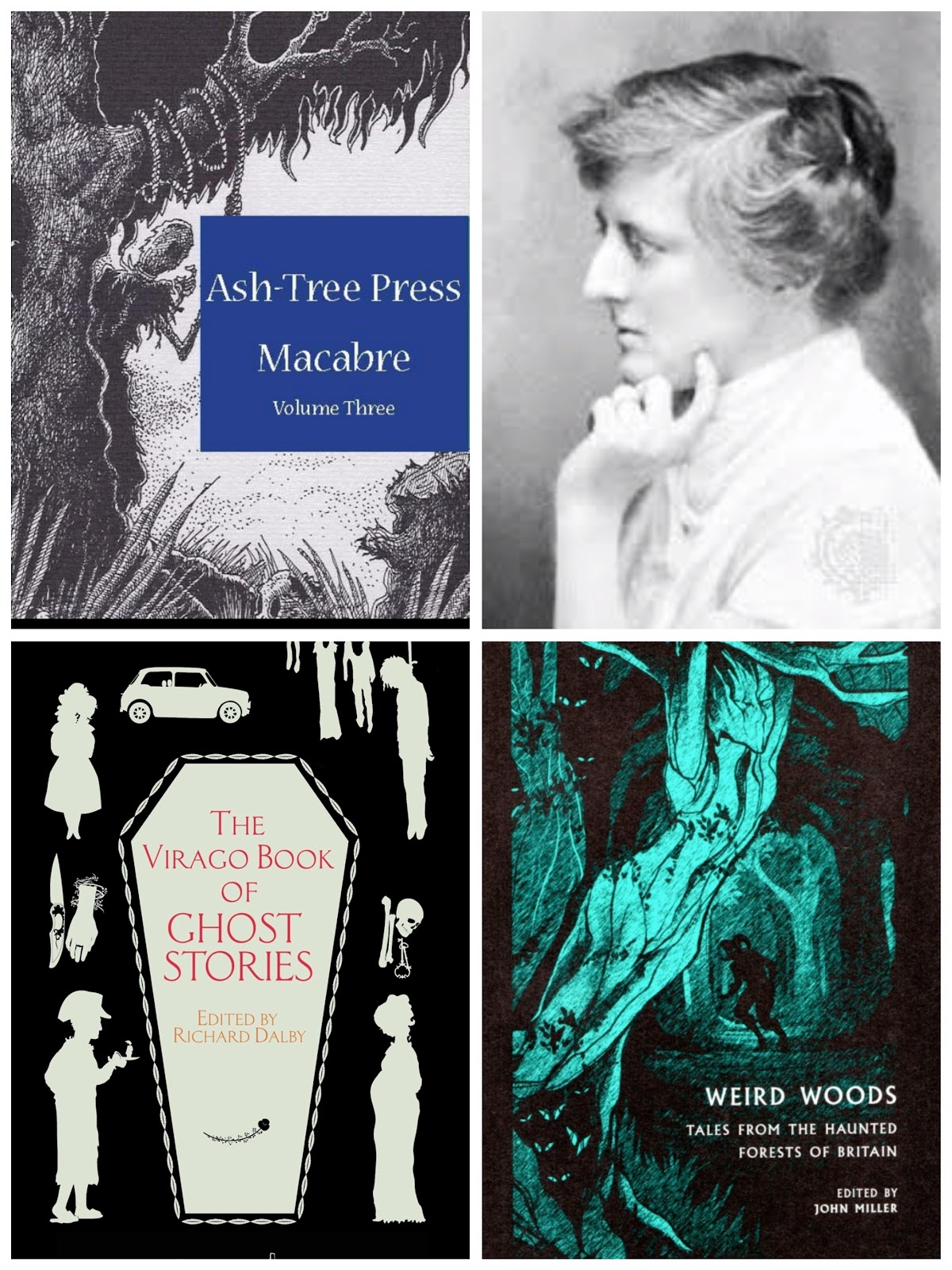
"The Name-Tree" (1921) [from Weird Woods: Tales from the Haunted Forests of Britain] is a story from an arch age of sublimated emotions and succulent subtexts.

[....] that brooding place—that place where mists lingered and melodies sounded, and man wrestled with the spirit of earth.

Laura, living in genteel poverty with her father on their ancestral property Cherry Orchard, is beset by attentions of a newcomer to the area, magnate and landowner Julius Winter. Cherry Orchard is to be sold, and Winter makes it clear to her that he will accept either possession of the property or Laura herself. "Your love should be given to a man. Such passion as yours should bear fruit."

The worldly man obsesses over the unworldly woman.

[....] He had not thought passion of just that quality existed in the modern world. Certainly the women he had known had not possessed it. This woman had it, and she wasted it on a place. He watched her, standing slim and gauche in her old brown dress, her soul tormented by love for something vague and mysterious, something he could not touch or name, that seemed to lie beneath the earthly beauty that she saw, like a dreaming god. Desire surged over him—the poignant longing that jonquils bring, the longing to touch the silken petals, to gather the brittle, faintly-scented stalks.

Winter's ultimatum: "I'll come for your answer this day next week, Laura. If it's no, you and your father will go at once."

The fruit of Laura's name-tree, a Morello, does ripen, and she makes her decision.

"The Name-Tree" is a story the contemporary reader might find too distanced in tone. Still, struggles over class privilege and exploitation predominate; new-money Julius slips easily into an older patriarchal role, adding emotional piquancy to questions of buying and selling, rites and rights.

[....] The trees brooded over them like jewelled birds in some ancient tapestry. They filled him with an ache of longing. He wanted to possess them, as a god might. He would possess them in her.

Laura, in contrast, is "as fond of the nettles as of the cowslips." The value for her of ancient family property lies in continuity, not title. "I'd as lief think of selling myself" as selling Cherry Orchard, she assures herself. 

And that is exactly what Winter will demand.  

*   *   *

"Mr. Tallent's Ghost" (1926) [The Virago Book of Ghost Stories] is a droll tale of haunting, similar in tone to E. F. Benson's more tongue-in-cheek work. 

The narrator, a solicitor, meets Mr. Tallent on a rainy day during a mountain vacation. Fighting boredom, he agrees to listen to one of the man's unpublished pieces of fiction. Agonies of miserable boredom ensue. Years later, after Tallent's death, the narrator must carry out his final wish:  spend the estate's small fortune arranging publication of a boxful of the amateur author's horrible stories. A dozen of Tallent's financially hopeless relatives dispute this use of the estate. A legal free-for-all ensues, and all parties delaying publication are haunted at night by the author himself, reciting his manuscripts out loud. Webb excels here in the multiple peripeteias of a dispute that seems capable of rivaling Jarndyce v Jarndyce, until non-spectral reality provides its own punchline. 

*   *   *

"The Sword" (1934) [in The Ash-Tree Press Annual Macabre 2003: Ghosts at 'The Cornhill' 1931-1939] is a poignant short story about "loving honor more" than happiness and romantic contentment. Its macabre subtext is carefully husbanded. Richard Gledd is prone to staring off in the distance, "his homeless eyes [looking] across the gaiety into the dark night beyond." Comrades in arms during the Great War noted his "sense of the deep, icy integrity which lay in his soul like a sheathed sword and made him as absolute, omnipotent, terrible, and beautiful as a god."

He rejects all appropriate marriage prospects. 

His friends said of him that he was the man who perpetually enquired for the goods that were not in the shop, not anywhere in the world…. Not one of the flower-soft, bird-voiced, gazelle-eyed girls he met could call him home.

Webb returns to home, homeless, and homing several times in "The Sword." When Gledd finally meets the woman he has sought, the reader at first assumes she too is a homeless, unattached soul. 

The final scene is quickly executed. The unbending authority of Gledd's aroused disapproval calls up a preternatural manifestation keen as any drawn blade.

*   *   *

Mary Webb was a successful author in her lifetime. Women's social predicaments were at the forefront in her bestsellers, as they are in two stories discussed above. Both Laura in "The Name-Tree" and Eucharis in "The Sword" face marriage as an ultimatum. Laura bests her suitor, thwarting him for the first time. Eucharis is not so lucky: giving up her "second-best life" for the answered prayers of marriage turns out to be a mistake, around which others precipitate. 

[....] as his look settled upon her there was in it the same icy, fiery dreadfulness that had been in it once when he court-martialled a man for robbing the wounded. Steely, unpitying, his eyes forced hers to look at him. No word was spoken….

As a contrast, "Mr. Tallent's Ghost" is filled with no such gravitas. I wrote above that it recalled E. F. Benson's lighter stories. But more than that, it brings to mind Saki's unrest-cure stories, wherein hard-working middle class people are pulled backward through a thorny hedgerow of topsy-turvy at the hands of Clovis. Only by a hair's breadth is Tallent's executor permitted a happy ending.

Mary Webb seeds these stories with quotidian miseries. But as each story unfolds, the everyday is amalgamated and complicated by something still stranger. Whether melodrama, farce, or tragedy, the strangeness itself lingers when everyday unhappiness is temporarily dispelled.

Jay

31 March 2023


Monday, December 20, 2021

5 stories from Shivers for Christmas (2014)

Shivers for Christmas 

Edited by Richard Dalby

(Michael O'Mara Books, 2014)


We now have the luxury of Christmas horror anthologies from the British Library and Valancourt Books. Before plenitude we had to rely on instant remainders and hope the editors had a sense of mercy and perspicacity. 


Shivers for Christmas was a useful collection to own. Dalby gives us the classics and includes rarities; Dickens is mercifully absent.


Some thoughts on stories I have read the last few nights at bedtime:


The Discovery of the Treasure Isles by Amelia B. Edwards (1864)


A merchant captain learns about untold riches while visiting a ship of the damned. Throwing away his career and the lives of his crew, he eventually finds an island and a ruined city of riches.


....The rest of my story may be told very briefly. After running before the wind for eleven days and nights, in a northeasterly direction, I was picked up by a Plymouth merchantman, about forty-five miles west of Marignana. The captain and crew treated me with kindness, but evidently looked upon me as a harmless madman. No one believed my story. When I described the islands, they laughed; when I opened my store of jewels, they shook their heads, and gravely assured me that they were only lumps of spar and sandstone; when I described the condition of my ship, and related the misfortunes of my crew, they told me the schooner Mary-Jane had been lost at sea twenty years ago, with every hand on board. Unfortunately, I found that I had left my mate's narrative behind me in the cavern, or perhaps my story would have found more credit. When I swore that to me it seemed less than six months since I had put off in the small boat with Joshua Dunn, and was capsized among the breakers, they brought the ship's log to prove that instead of its being the 25th of December A.D. 1760, when I came back to the beach, and saw the Mary-Jane lying high and dry between the rocks, it must have been nearer the 25th of December, 1780, the twentieth Christmas, namely, of the glorious and happy reign of our most gracious sovereign, King George the Third.

     Was this true? I know not. Everyone says so but I cannot bring myself to believe that twenty years could have passed over my head like one long summer day. Yet the world is strangely changed, and I with it, and the mystery is still unexplained as ever to my bewildered brain....


* * *


The Dead Sexton by Joseph Sheridan Le Fanu (1871)


Le Fanu was incapable of writing an uninteresting story, even when mummy-wrapped in a Dr. Hesselius narrative apparatus.


In "The Dead Sexton" the titular character has died by misadventure. A well-spoken stranger comes to town and asks for a look at the body, then remains lurking.


     "What the—what are ye afraid on? Gi' me the lantern—it is all one: I will."

     And cautiously, little by little, he opened the door; and, holding the lantern over his head in the narrow slit, he peeped in—frowning and pale—with one eye, as if he expected something to fly in his face. He closed the door without speaking, and locked it again.

     "As safe as a thief in a mill," he whispered with a nod to his companion. And at that moment a harsh laugh overhead broke the silence startlingly, and set all the poultry in the yard gabbling.

     "Thar he be!" said Tom, clutching the landlord's arm—"in the winda—see!"

     The window of the cedar-room, up? two pair of stairs, was open; and in the shadow a darker outline was visible of a man, with his elbows on the window-stone, looking down upon them.

     "Look at his eyes—like two live coals!" gasped Tom.

     The landlord could not see all this so sharply, being confused, and not so long-sighted as Tom.

     "Time, sir," called Tony Turnbull, turning cold as he thought he saw a pair of eyes shining down redly at him—"time for honest folk to be in their beds, and asleep!"

     "As sound as your sexton!" said the jeering voice from above.


* * *


Wolverden Tower by Grant Allen (1896)


....Each carried a flower laid loosely in her bosom. Yolande's was an orchid with long, floating streamers, in colour and shape recalling some Southern lizard; dark purple spots dappled its lip and petals. Hedda's was a flower of a sort Maisie had never before seen—the stem spotted like a viper's skin, green flecked with russet-brown, and uncanny to look upon; on either side, great twisted spirals of red-and-blue blossoms, each curled after the fashion of a scorpion's tail, very strange and lurid. Something weird and witch-like about flowers and dresses rather attracted Maisie; they affected her with the half-repellent fascination of a snake for a bird; she felt such blossoms were fit for incantations and sorceries....


I have read "Wolverden Tower" several times, and hope to read it again. There are few pieces of popular fiction as capable of stirring the sublime sense of being "on the heights." Maisie's willing seduction while attending theatrical tableau at a holiday house party is weirdly charming, and Grant Allen beguiles the reader as effectively as he does his heroine.


The portrayal of friendship between women is very well done.


* * *


The Picture Puzzle by Edward Lucas White (1909)


One of White's reliably wrenching stories, this time set in a homely middle class milieu. A husband and wife find solace and distraction in jigsaw puzzles in the aftermath of the kidnapping of their four year old daughter, who was never returned.


One day the wife feels compelled to purchase a crudely made two-sided puzzle from a street vendor. Assembled, she says it shows the daughter taken in hand by a bearded man. The husband sees only a blank field of pink. 


When he assembles the verso:


....The picture showed an old red-brick house, with brown blinds, all open. The top of the front steps was included in the lower right hand corner, most of the front door above them, all of one window on its level, and the side of another. Above appeared all of one of the second floor windows, and parts of those to right and left of it. The other windows were closed, but the sash of the middle one was raised and from it leaned a little girl, a child with frowzy hair, a dirty face and wearing a blue and white check frock. The child was a perfect likeness of our lost Amy, supposing she had been starved and neglected. I was so affected that I was afraid I should faint. 

     I was positively husky when I asked: 'Don't you see that?' 

     'I see Nile green,' she maintained.


White does an excellent job here with grief and what today we would call "coping mechanisms."


* * *


Tarnhelm by Hugh Walpole (1929)


"I only know that as one grows older one calls things coincidence more and more seldom."


A compelling queer tale in every sense. Same-sex love and devotion are counterposed to malevolently sorcerous molestation. The first-person point of view is well-handled.


Whatever the ultimate fate of novels Walpole took seriously and sweated-over, the strange stories he left reward repeated readings.


* * *


Jay

20 December 2021