Subscribe to my Substack

Showing posts with label C.S. Forester. Show all posts

Friday, April 6, 2018

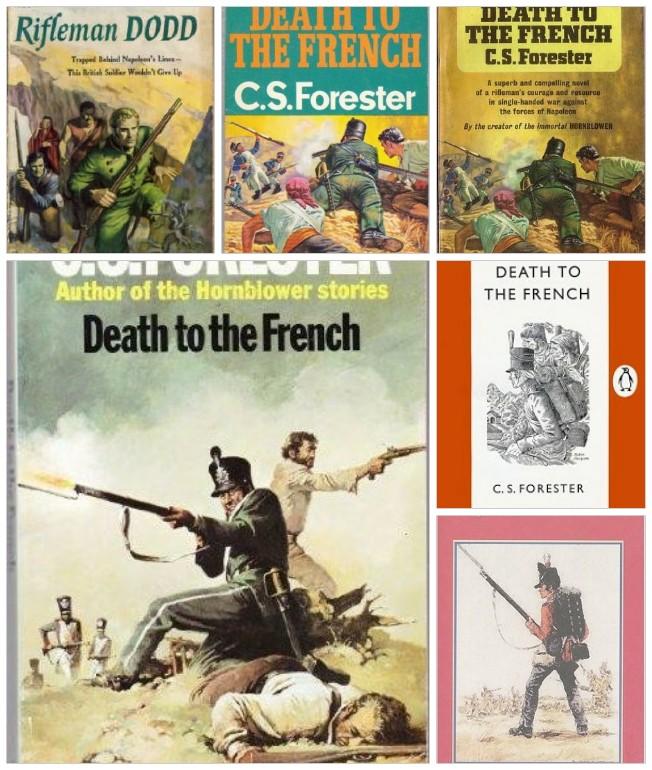
Death to the French by C.S. Forester (1932) reviewed.


RIFLEMAN MATTHEW DODD was already aware that he was cut off, although at the moment he was too occupied in saving his life to consider the consequences. He had been making his way back through the olive groves to his picket when he had heard strange voices ahead and had glimpsed strange uniforms. Bent double, and sweating under his pack, he had scurried through the undergrowth in the valley trying to make his way round the enemies who had interposed across his line of retreat. Half an hour of violent exertion had, he thought, brought him clear, when at that very moment a shout told him that he was observed by some other detachment. A musket rang out not far away from him and a bullet smacked into a tree-trunk a dozen yards away. He turned and ran again, uphill this time, in a direction which he knew took him away from his friends but which alone, as far as his skirmisher's instinct told him, was still not barred by the French advance guard. There were more shouts behind him and a crashing among the undergrowth which told him that he was closely pursued by a dozen men. He dashed along up the steep slope, his pack leaping on his back, and his ammunition pouches pounding on his ribs. Soon he emerged from the olive grove on to an open, heather-covered hillside. There was nothing for it but to continue his flight without the protection of the friendly trees—either that, at least, or to turn back and surrender, and Dodd was not of the type which surrenders too easily….


C.S. Forester wrote three classics of irregular warfare prior to embarking on his Hornblower
roman fleuve. Brown on Resolution (1929) is a masterpiece the "man alone" thriller genre and
of the psychological novel. The African Queen (1935) shows the transformations of
consciousness wrought by war, where situations and individuals become their own
opposites.


Forester's crowning achievement in the "man-alone" genre is Death to the French (1932).  The
tale takes place during the Peninsular War.  A rifleman, cut off from his unit during a
rearguard action, is cut off for half a year in a scorched-earth no-man's-land prepared by
Wellington to destroy the French Army and their allies.


Dodd falls in with a troupe of irregular local guerillas, who are able to land arbitrary blows
against the enemy episodically.


The strength of the novel is not that Dodd turns the tide of war or any other such potboiler
nonsense.  As with Brown on Resolution and The African Queen, it is small engagements that
tell on the characters we come to root for.


This is a favorite of mine:


....IN the wet morning the usual three military problems of offence and defence and supply presented themselves. They shared the last of their bread with the stunted man—there was no knowing how he had been maintaining himself before they met him; badly enough presumably—and tried to discuss the next move. Bernardino, in fact, was so disgruntled by recent events that he presumed to press plans upon Dodd. He wanted to go back to the village, taking the stunted man with them as a fresh recruit, and resume the harassing of the battalion there. To Bernardino it was obviously the thing to do. On the hill there was food and there were friends and an enemy to attack. Here in the wood there seemed nothing. When Dodd said "See Santarem" and persisted in saying it he grew exasperated. He knew nothing of strategy; he could not grasp the possibly supreme importance of the bridging materials at Santarem.


The stunted man contributed little to the discussion. If he had ever had any initiative—and there was no means of telling—it had all evaporated with the death of his father.


He wanted to kill Frenchmen, but he seemed willing enough to do it under the direction of others. He said nothing when Dodd said "See Santarem" in a tone of finality and rose and hitched his rifle on his shoulder and set off towards the far corner of the wood, although Bernardino stamped his feet with annoyance. Bernardino followed Dodd, sulkily, in the end, and the stunted man came too, without a word. There was small satisfaction to be gained from the distant view of the land front of Santarem. The little town was walled on this side, with gates, which would make it supremely difficult to achieve an unobserved entrance. Bernardino fidgeted with irritation while Dodd looked this way, and that way, and tried to ask the stunted man questions.


In the end coincidence brought about a dramatic change in Dodd's plans, and delighted Bernardino's heart. Across the half or three-quarters of a mile of flat land which lay between them and the town they suddenly saw signs of some important move outside the gate on the upstream end of the town. They saw a little column of troops march out. After them came a waggon—at that distance they could make out no details, but Dodd was sure it was a waggon and not a gun. There came another waggon, and another, and another, and another. Waggon followed waggon until Dodd was sure that he was not observing a minor military move—the transfer of a convoy, or something of that order. It became pressingly important to his mind to discover what this was. "Go to road. See," said Dodd. He turned and hurried back into the wood, with Bernardino delightedly following him, for that must be the direction they must follow to return to the village. They hurried through the wood at the best speed possible to them when they had to be on guard at every step lest some French patrol should be prowling near at hand. Even in the heart of the forest they could hear the sound of the waggon train on the pave—a low rumble rising a note or two in the scale whenever a waggon crossed over a culvert or a bridge. At last they reached a point in the wood whence they could look down on the high road, and Dodd threw himself on his face and edged forward to peer round a trunk of a tree. The others crouched near, and ever the rain poured down on them. The head of the column, with the vanguard of troops, had already passed, but what followed was far more interesting. Dodd had been right when he had suspected the French of bridge construction. The first vehicles were odd-shaped things, each composed of two artillery caissons linked together. On these were piled pontoons, huge, clumsy boats nested into each other, four or five together. Their number was great—section after section lumbered by. Dodd took note of the animals drawing them along—wretched, underfed horses with their ribs starting through their coats; it was a wonder that they could drag themselves along, to say nothing of the loads behind them.


The French soldiers driving them displayed little care as to their condition, flogging the poor brutes along as they slipped and stumbled over the cobbles. Dodd readily decided that a few weeks more of this underfed life would leave the French army with no transport animals at all. To the pontoon-laden caissons succeeded, at length, service waggons and country carts heaped with all the miscellaneous accessories of military bridges; there were four carts laden with rope and quite thirty laden with timber.


But before the last caisson had gone by Dodd had resolved to do what he could to interfere with the march of the bridging train. No one knew better than he, who had served in so many convoy guards, how helpless is a long train of waggons strung out along the road. And he knew, too, that to kill one of the enemy's horses was quite as helpful as killing one of the enemy's men. He looked round at his two followers.


"Caballos," he said, "Caballos," and pushed his rifle forward.


They took aim beside him, and the three shots rang out almost together. One horse in a team of six fell in its traces; another, plunging and kicking on three legs, made evident the fact that the fourth was broken. Instantly Dodd leaped to his feet and dashed back among the trees, with the others at his heels, to where he could reload undisturbed.


"Horses," said Dodd again, as he rammed the bullet home.


The others nodded. They could understand this method of warfare. Dodd pelted through the wood parallel with the road for a short space before changing direction to the edge again. There was confusion in the convoy. The waggon at whose team they had fired was stationary and helpless, and everything behind it was pulling up. Drivers were seeking their weapons, men were shouting, horses were plunging—there was all the confusion of a sudden surprise attack. The escort parties at the head and rear of the column were each of them half a mile away or more; the three were safe for some time from any counter-attack, for the drivers had, as was only to be expected, an exaggerated idea of the force attacking them, and were hampered by the necessity of looking after their teams. A young officer came galloping up the road to the place of the jam. For the moment Dodd pointed his rifle at him, but he refrained from pulling the trigger when he guessed what order the officer was going to give. He glowered round at his companions to enforce on them the same self-restraint. At the officer's order the waggon behind the one which was stationary pulled out of the line and began to go up past the point of stoppage; the rest of the long line made preparations to follow. Just when the overtaking waggon was diagonally across the road Dodd fired again, and next second the jam was complete; two helpless waggons completely blocked the narrow paved road.


Drivers raved and horses kicked while Dodd reloaded with all the speed five years of practice could give. A third volley brought down more horses still and perfected the work.


After that for several hectic minutes each of the three loaded and fired at will, bringing down a horse here and a horse there, until Dodd made his companions cease fire. He had to shake them by the shoulders to compel their attention, so excited had they grown. Some of the drivers had found their muskets and were blazing back at random into the wood; bullets were rapping sharply on trees here and there, but that was not the reason for Dodd's cessation of fire. There was a body of troops hurrying back from the head of the column; another hurrying up from the tail. They were still some distance off when Dodd ran away, intent on living to fight another day. As they ran breathlessly through the wood, Dodd found himself regretting that he had not thirty men with him instead of two; there would be a fine game open to them then in the attack on this long, vulnerable column. Three was too small a force altogether. When the escort reached the point in the road whence the firing had come they halted for a moment at a loss, for there was no firing now. In the end they plunged into the wood, but only for a short distance. They could find no trace of the enemy, and as they plunged about in the undergrowth the officers were uneasily conscious that meanwhile they were leaving the line of waggons unguarded—an uneasiness which was greatly accentuated immediately afterwards by the sound of firing from high up towards the head of the column. It was a lively day for the convoy escort as well as for the drivers. The escort spent their time running up and down a couple of miles of road in hopeless dashes after an enemy which fled at their earliest approach and yet was always ready to reappear elsewhere and resume their harassing attacks. If the three hundred men of the escort had been strung along the road trying to guard every point they would have been just as useless—one man to every ten yards.


Meanwhile the drivers were engaged in cutting out injured horses, in replacing them with animals from the few teams which could spare them, and getting the waggons along somehow.


In the end, the situation was relieved by the arrival of reinforcements. A battalion—the fourth of the Forty Sixth—was called out of its billets in a village some distance up the road, and another came up from Santarem, which the convoy had just left. Then they were able to post guards in sufficient strength along the dangerous length of road, and even to spare men to manhandle teamless waggons out of the way. Yet all this took time; by the end of the day the waggon train had progressed exactly three miles.


Dodd, crouching with his two companions at the far end of the wood, whither they had been driven by the new arrivals, could feel pleased with his day's work, despite the fact that they were all three of them so exhausted that they could hardly stand. He had regained his old ascendancy too.


Bernardino was enormously amused by what they had done; despite his fatigue he still broke into little chuckles at the recollection of the exasperated waggon drivers and the jams and confusion of the train and the harassed running about of the escort. It had taken a thousand men in the end to guard those waggons against three enemies.


It is to be feared that Dodd enjoyed undue credit on this account—both Bernardino and the stunted man believed (and the difficulties of language prevented a clearing up of the situation) that this attack on the convoy had been planned from the first, and that the dangerous visit to inspect Santarem, which they had condemned so bitterly earlier, was a necessary part of the scheme. It sent up Dodd's stock with a bound. Several times Bernardino told Dodd, who did not understand what he said, and the stunted man, who did not appear specially interested, all about what they had done that day. Even Bernardino's excitement died away in time, and allowed him to meditate upon the matter which was now occupying all Dodd's attention—the matter of their hunger and the absence of means to satisfy it. Bernardino's ebullition of spirits changed to peevishness, when suddenly the stunted man rose and walked away through the darkness under the trees. Bernardino was actually too tired and hungry to ask where he was going. Dodd pulled in his belt and tried to reconcile himself to an evening without supper and the prospect of a morrow without breakfast. He had actually sunk into a fitful doze when they heard the stunted man, seeking them, call to them in a guarded tone. They replied, and he appeared, a shadowy shape, through the trees. He pressed something wet and faintly warm into Dodd's hands, and presumably made a similar present to Bernardino.


"What is this?" asked Bernardino.


"Horse," said the stunted man, who was a man of few words.


For once one of Dodd's subordinates had been cleverer than he—Dodd had forgotten all about the dozen dead horses along the edge of the main road, but the stunted man had remembered them, and had found his way to one. Not merely that, but he had used his wits well when he had reached his objective. Even in the dark and in the imminent danger of being surprised by a stray enemy he had remembered that it would be far too dangerous to light a fire for cooking with so many of the enemy near, and he had realized that a lump of muscle hacked from a starving horse might well defy their teeth were it uncooked. So he had ripped open the horse's belly and had plunged into its still warm entrails in search of its liver, from which he had cut the generous portions which they were now considering.


Dodd had eaten horse before—no soldier could serve five campaigns in the Peninsula, where small armies are beaten and large armies starve, without doing so—but always before it had at least made a pretence at being cooked. But he had never been as hungry before as he was now, and it was too dark to see what he was eating and, anyway, he had led the life of a savage for two months. He took a tentative nibble at his lump, and followed it with another, and yet another.


Before very long he had made a good meal in the darkness and so had the others. And the fact that they had all been living lives of hard physical exertion in the fresh air for so long blessed them with digestions which could even master uncooked cart horse.


After that they all slept well and deeply until Dodd woke and roused his companions—he had the knack of being able to wake at any hour he decided upon before going to sleep.


Wednesday, April 4, 2018

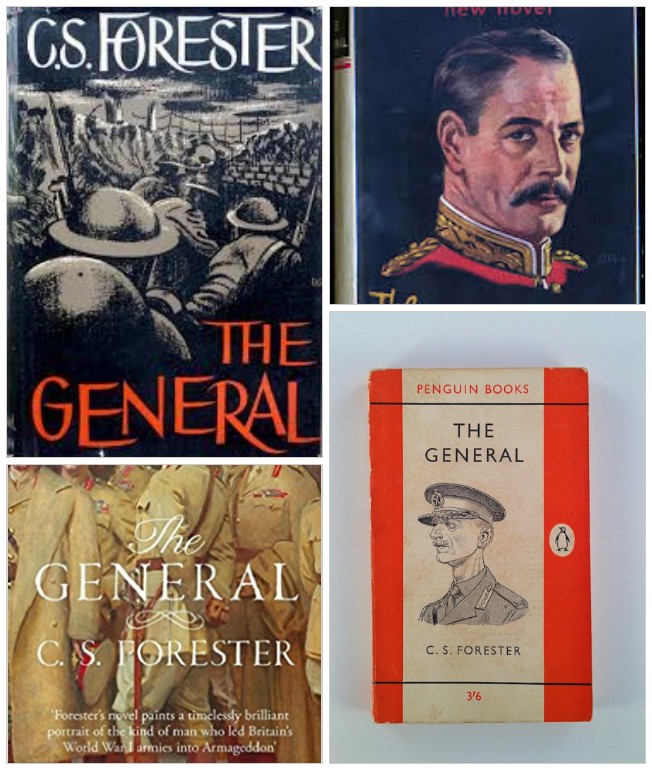
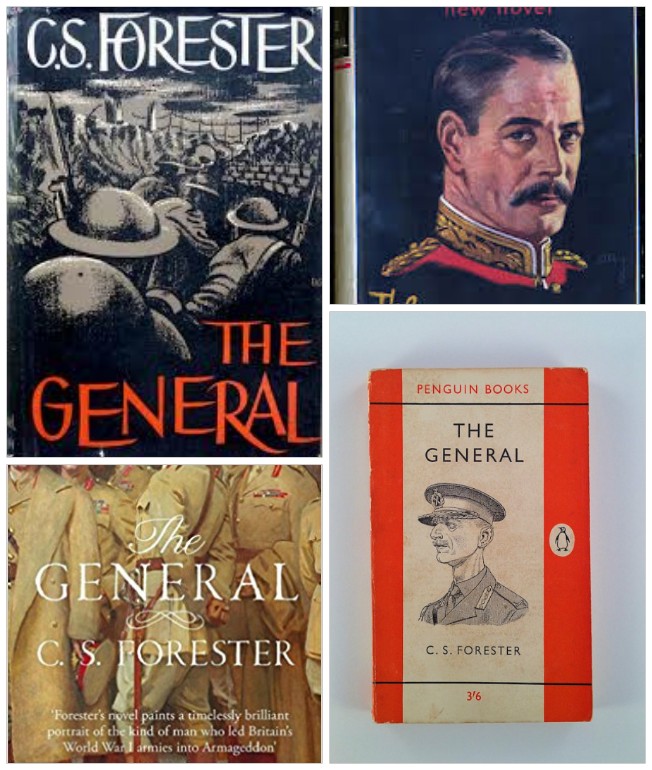
A great Great War novel: The General by C.S. Forester (1936)


The General (1936) by C.S. Forester is a thrilling book about a subject misunderstood and dismissed in the period of Blackadder Goes Forth and the fiction of Michael Morpurgo.  The subject? Army staff work and the pulling together of diverse and often conflicting elements into that tool of tools for the bourgeoisie: an army.


Forester's General, Bertie Curzon, begins by getting blooded in the Boer War, rises in the cavalry, and rises even more quickly   when the Great War begins. The fact that Curzon and his type could not organize victory is seen by Forester not as a result of their stupidity or hide-bound reactionary conservatism.  They are simply men educated in a superseded tradition, struggling to adapt in new circumstances.


Forester explains it nicely here:


….In some ways it was like the debate of a group of savages as to how to extract a screw from a piece of wood. Accustomed only to nails, they had made one effort to pull out the screw by main force, and now that it had failed they were devising methods of applying more force still, of obtaining more efficient pincers, of using levers and fulcrums so that more men could bring their strength to bear. They could hardly be blamed for not guessing that by rotating the screw it would come out after the exertion of far less effort; it would be a notion so different from anything they had ever encountered that they would laugh at the man who suggested it.


My favorite part of the book, showing General Curzon at his best (or worst) deals with his "firing" of a gossipy brother-in-law from his staff, and the outrage this creates among his titled in-laws.


.... That same day a report went into the War Office saying that Major-General Curzon much regretted being under the necessity of informing the Director-General of Staff Personnel that Lieutenant Horatio Winter-Willoughby had been found unsuitable for work on the Staff, and of requesting that he be ordered to return to his unit. There was a wail of despair from Horatio when the news reached him – a wail expressed in indignant letters to London, which brought down the Duchess of Bude and Lady Constance Winter-Willoughby, simply seething with indignation.


The Duchess was angry largely because this upstart son-in-law of hers was betraying the family which had condescended to admit him into its circle. What was the good of having a general in the family if he did not find places on the staff for the nephews? And the suggestion that a Winter-Willoughby was not up to his work was perfectly preposterous – more preposterous still, because the Duchess could never imagine that it mattered a rap which man did which work as long as she had a finger in the pie. There was the question of the succession of the title too. If Horatio was sent back into the Guards as a result of this ridiculous notion of Curzon's it was possible that he might be killed – not likely, of course, because Winter-Willoughbys were not killed, but possible – and that would make the continued existence of the title almost precarious.


'So you see,' said the Duchess, putting down her teacup, 'you simply can't go on with this wicked idea. You must write to the War Office at once – or it would be better to telephone to them perhaps – and tell them that you have made a mistake and you want Horatio to stay here with you.'


Curzon would have found it difficult to have answered politely if he had cast about for words with which to tell his mother-in-law that he was not going to do what she said. But as it was he did not stop to try to be polite. He was not going to have the efficiency of his Division interfered with by anyone not in authority, least of all a woman.


'I'm not going to do anything of the sort,' he said briefly.


'Bertie!' said the Duchess, scandalized.


'No,' said Curzon. 'This isn't the first time I've had to find fault with Horatio. I'm sorry, he's no good, but I can't have him on my Staff. I hope he will find regimental duty more – more congenial.'


'Do you mean,' said the Duchess, 'that you're not going to do what I ask – what the Family ask you to do?'


'I'm not going to keep him as my A.D.C.,' said Curzon sturdily.


'I think,' said Lady Constance, 'that is perfectly horrible of you.'


Lady Constance happened to be more moved by anxiety for her son than by Curzon's blasphemous denial of the family.


'I'm sorry,' said Curzon, 'but I can't help it. I have the Division to think about.'


'Division fiddlesticks,' said the Duchess, which made Curzon exceedingly angry. Lady Constance saw the look in his eye, and did her best to soothe him.


'Perhaps Horatio was a little indiscreet,' she said, 'but he's only young. I think he will have learned his lesson after this. Don't you think you might give him another chance?'


Lady Constance made play with all her beauty and all her elegance as she spoke. Curzon would certainly have wavered if it had not been the concern of the Division. He was suddenly able to visualize with appalling clarity Horatio, lazy, casual, and unpunctual, confronted suddenly with a crisis like any one of the fifty which had occurred during the eleven days at Ypres. If the existence of the Division should at any time depend on Horatio, which was perfectly possible, the Division would cease to exist. It was unthinkable that Horatio should continue in a position of potential responsibility.


'No,' said Curzon. 'I can't have him.'


Lady Constance and the Duchess looked at each other and with one accord they turned to Emily, who had been sitting mute beside the tea things.


'Emily,' said Lady Constance. 'Can't you persuade him?'


'Horatio is your first cousin,' said the Duchess. 'He's a future Duke of Bude.'


Emily looked in distress, first at her mother and her aunt, and then at her husband in his khaki and red tabs beside the fire. Anyone – even a woman only three weeks married to him – could see by his stiff attitude that the matter was very near to his heart, that his mind was made up, and that his temper was growing short. In the last two months the family had declined in importance in her eyes; it was her husband who mattered. Yet it was frightening that they should be debating a matter on which Horatio's very life might depend – it was that thought which distressed her more than the need to oppose her mother.


'Don't ask me,' she said. 'I can't interfere with the Division. I don't think you ought to ask me.'


The Duchess snapped her handbag shut with a vicious click and rose to her feet.


'It appears to me,' she said, 'as if we were unwelcome even in my daughter's house.'


She rose superbly to her feet, carrying Lady Constance along with her by sheer force of personality.


'I can see no profit,' she went on, 'in continuing this subject. Perhaps, Bertie, you will be good enough to send and have my car brought round?'


Curzon tugged at the bell-rope and gave the order to the parlourmaid; it is just possible that the Duchess had not expected to be taken quite so readily at her word. At any rate, Lady Constance made a last appeal.


'I don't want to have to part in anger like this,' she said. 'Can't something be arranged, Emily – Bertie?'


'Something will doubtless be arranged,' said the Duchess, with a venomous glance at her daughter and son-in-law. 'Please do not be too distressed, Constance.'


Curzon and Emily walked out to the door with them, but the Duchess so far forgot her good manners as to climb into the car without saying good-bye. Enough had happened that afternoon to make her angry; that a Winter-Willoughby should be denied something apparently desirable, and that a Duchess of Bude should be forced to plead with an upstart little General and then be refused was a state of affairs calculated to make her perfectly furious.


The sequel followed promptly, materializing in the arrival of the Duke the next day, preceded by a telegram. Curzon talked with him alone, at his special request, Emily withdrawing after receiving his fatherly greetings. They sat one each side of the fire and pulled at their cigars in silence for several minutes until the Duke began on the inevitable subject.


'You've made my wife a bit annoyed over this business of young Horatio, Curzon, you know,' said the Duke. 'As a matter of fact I've never seen her so angry before in my life.'


The tone of the Duke's voice suggested that he had frequently seen her fairly angry.


'I'm sorry,' said Curzon.


'Trouble is, with women,' went on the Duke, 'they never know when to stop. And they don't draw any distinctions between a man's private life and his official one – they don't render unto Caesar the things that are Caesar's, you know. My wife's determined to put the screw on you somehow or other – you know what women are like. You can guess what she made me do last night – first shot in the campaign, so to speak?'


'No,' said Curzon.


'She made me sit down there and then, with dinner half an hour late already, and write an order to Coutts'. Dash it all, you can guess what that was about, can't you?'


'I suppose so,' said Curzon.


'It was to countermand my previous order to pay one-seventy a month into your account. Women never know what's good form, and what isn't.'


Curzon said nothing. The prospect of losing the Duke's two thousand a year was disturbing; it would mean altering the whole scale of his domestic arrangements, but it did absolutely nothing towards making him incline again in the direction of retaining Horatio's services.


'I suppose,' said the Duke nervously, 'there isn't any chance of your changing your mind about Horatio?'


'Not the least,' snapped Curzon. 'And I don't think we had better discuss the subject.'


'Quite right,' said the Duke. 'I was sure you would say that. Dam' good thing you didn't kick me out of the house the minute I said what I did. Of course, I wrote another order to Coutts' this morning, saying that they were to continue paying that one-seventy. But I'd rather you didn't let the Duchess know all the same.'


'Thank you,' said Curzon.


'Now,' said the Duke, with enormous relief, 'is there any way out of this mess? Can you think of any job Horatio could do?'


'He might make a good regimental officer,' said Curzon. Most of the regimental officers he had known had not been much more distinguished for capacity than Horatio. The Duke nodded.


'I suppose so,' he said. 'There aren't many brains in us Winters, when all is said and done. Fact is, I don't think we'd be very important people if the first Winter hadn't married William of Orange's lady friend. But it's not much good telling the Duchess that. I've got to do something about it.'


The Duke looked quite pathetic.


'There are some staff positions,' said Curzon, 'where he couldn't do much harm.'


Curzon was quite incapable of expressing that awkward truth any less awkwardly.


'M'm,' said the Duke. 'And none of them in your gift, I suppose?'


'No.'


'It's awkward,' said the Duke. 'But I'll have to see what I can do up in town. I suppose you know that I'll be in office again soon?'


'No,' said Curzon. Despite the revelations of the last few weeks he was still abysmally ignorant of the behind-the-scenes moves in politics.


'Yes,' said the Duke. 'I don't think it matters if I tell you. The Radicals won't be able to keep us out much longer. Then I may be able to do a bit more for Horatio and satisfy the Duchess. There's a good many points I want your advice about, too. What's this man Mackenzie like? Any good?'


'First rate,' said Curzon without hesitation. Had not Mackenzie been instrumental in promoting him to Major-General, in giving him the Ninety-first Division, and in supplying that Division with material far beyond its quota? Quite apart from that, it would have needed a very serious deficiency indeed to induce Curzon not to give the simple loyalty which he in turn expected from his subordinates….


Tuesday, April 3, 2018

England expects: The African Queen by C.S. Forester (1935).


C.S. Forester's 1935 novel The African Queen is not John Huston's film The African Queen.  No drumhead marriage, no torpedo-death for the Kaiser's Königin Luise.


What the novel does have is Forester constantly upsetting our preconceptions about his characters and their predicament, and doing it magnificently.  As with Brown on Resolution (1929), Death to the French (1932), and The General (1936), we are constantly blind-sided by the complications and challenges the characters face and must overcome. The recurring theme in all these novels is the thwarting of plans, replanning, and then the thwarting of the newer plan.


As with Forester's Hornblower novels, where there are no great final fleet battles, and where Horatio even misses Trafalgar, it is the daily struggles of people working together against long odds that breeds suspense.


My favorite examples in The African Queen are of lovers Charlie and Rose succumbing to recurring bouts of malaria and becoming lost in the horizonless deltas of a river.


Another is Allnutt and Rose performing miracles on the Queen's twisted shaft and broken propeller blade:


"What was all that clattering just before we stopped?" asked Rose.

"We still got to find that out, old girl," said Allnutt. There was a cautious sympathy in his voice. He feared the very worst, and he knew what it would mean in disappointment to Rose. He had already looked up the side of the ravine, and found a small comfort in the fact that it was just accessible. If the _African Queen_ was so much disabled as he feared, they would have to climb up there and wander in the forest until the Germans found them - or until they starved to death. It said much for his new-found manliness that he kept out of his voice the doubts that he felt.

"How are we going to do that, dear?" asked Rose. Allnutt looked at the steep bank against which they were lying, and at the gentle eddy alongside.

"I'll 'ave to go underneath an' look," said he. "There ain't no other wye, not 'ere."

The bank was steep-to. There was four feet of water on the shore side of the boat, six feet on the river side, as Allnutt measured it with the boat hook.

" 'Ere goes," said Allnutt, pulling off his singlet and his trousers. They were wet through already, but it runs counter to a man's instincts to immerse himself in water with his clothes on.

"You stay 'andy wiv that rope, case there's a funny current darn at the bottom."

Rose, looking anxiously over the side, saw his naked body disappear under the bottom of the boat. His feet stayed in view and kicked reassuringly. Then they grew more agitated as Allnutt thrust himself out from under again. He stood on the rocky bottom beside the boat, the water streaming from his hair.

"Did you see anything, dear?" asked Rose, hovering anxiously over him.

"Yerss," answered Allnutt. He said no more until he had climbed back into the boat; he wanted time to compose himself. Rose sat beside him and waited. She put out her dry hand and clasped his wet one.

"Shaft's bent to blazes. Like a corkscrew," said Allnutt, dully. "An' there's a blade gone off the prop."

Rose could only guess at the magnitude of the disaster from the tone he used, and she underestimated it.

"We'll have to mend it, then," she said.

"Mend it?" said Allnutt. He laughed bitterly. Already in imagination he and Rose were wandering through the forest, sick and starving. Rose was silent before the savage despondency of his tone.

"Must 'a' just 'it a rock with the tip of the prop," went on Allnutt, more to himself than her. "There ain't nothink to notice on the deadwood. Christ only knows 'ow the shaft 'eld on while we was getting in 'ere. Like a bloody corkscrew."

"Never mind, dear," said Rose. The use of the words "Christ" and "bloody" seemed so oddly natural here, up against primitive facts, that she hardly noticed them, any more than she noticed Charlie's nakedness. "Let's get something dry, and have some dinner, and then we can talk about it."

She could not have given better advice. The simple acts of hanging things to dry, and getting out greasy tins from the boxes of stores, went far to soothe Allnutt's jangled nerves. Later, with a meal inside him, and strong tea making a hideous mixture in his stomach with bully beef, he felt better still. Rose returned them to the vital issue.

"What shall we have to do before we go on?" she asked. "I'll tell you what we could do," said Allnutt, "if we 'ad a workshop, an' a landin' slip, an' if the parcel post was to call 'ere. We could pull this old tub out on the slip and take the shaft down. Then we might be able to forge it straight agine. I dunno if we could, though, 'cause I ain't no blacksmith. Then we could write to the makers an' get a new prop. They might 'ave one in stock, 'cause this boat ain't over twenty years old. While we was waitin' we might clean 'er bottom an' paint 'er. Then we could put in the shaft an' the new prop, an' launch 'er, an' go on as if nothink 'ad 'appened. But we 'aven't got nothink at all, an' so we can't."

Thoughts of the forest were still thronging in Allnutt's mind.

It was Rose's complete ignorance of all things mechanical which kept them from lapsing into despair. Despite Allnutt's depression, she was filled with a sublime confidence in his ability; after all, she had never yet found him wanting in his trade. In her mind the problem of getting a disabled steamboat to go again was quite parallel with, say, the difficulties she would meet if she were suddenly called upon to run a strange household whose womenfolk were down with sickness. She would have to get to know where things were, and deal with strange tradesmen, and accustom herself to new likes and dislikes on the part of the men. But she would tackle the job in complete confidence, just as she would any other household problem that might present itself. She might have to employ makeshifts which she hated; so might Allnutt. In her own limited sphere she did not know the word "impossible." She could not conceive of a man finding anything impossible in his, as long as he was not bothered, and given plenty to eat.

"Can't you get the shaft off without pulling the boat on shore?" she asked.

"M'm. I dunno. I might," said Allnutt. "Means goin' under water an' gettin' the prop off. _Could_ do it, p'raps."

"Well, if you had the shaft up on shore you could straighten it."

"You got a hope," said Allnut. "Ain't got no hearth, ain't got no anvil, ain't got no coal, ain't got nothink, an' I ain't no blacksmith, like I said."

Rose raked back in her memory for what she had seen of blacksmith's work in Africa.

"I saw a Masai native working once. He used charcoal. On a big hollow stone. He had a boy to fan the charcoal."

"Yerss, I seen that, too, but I'd use bellers myself," said Allnutt. "Make 'em, easy enough."

"Well, if you think that would be better -" said Rose. "'Ow d'you mike charcoal?" asked Allnutt. For the life of him, he could not help entering into this discussion, although it still seemed to him to be purely academic - "all moonshine" as he phrased it to himself.

"Charcoal?" said Rose vaguely. "You set fire to great beehives of stuff - wood, of course, how silly I am - and after it's burnt there's charcoal inside. I've seen them do it somewhere."

"We might try it," said Allnutt. "There's 'eaps an' 'eaps of driftwood up on the bank."

"Well, then -" said Rose, plunging more eagerly into the discussion.

It was not easy to convince Allnutt. All his shop training had given him a profound prejudice against inexact work, experimental work, hit-or-miss work. He had been spoiled by an education with exact tools and adequate appliances; in the days of his apprenticeship, mechanical engineering had progressed far from the time when Stephenson thought it a matter of self-congratulation that the Rocket's pistons fitted her cylinders with only half an inch to spare.

Yet all the same, flattered by Rose's sublime confidence in him, and moved by the urgency of the situation, he gradually came round until he was half-disposed to try his hand on the shaft. Then suddenly he shied away from the idea again. Like a fool, he had been forgetting the difficulty which made the whole scheme pointless.

"No," he said. "It ain't no go, Rosie, old girl. I was forgetting that prop. It ain't no go wiv a blade gone."

"It got us along a bit just now," said Rose.

"Yerss," said Allnutt, "but -"

He sighed with the difficulty of talking mechanics to an unmechanical person.

"There's a torque," he said. "It ain't balanced -"

Any mechanic would have understood his drift at once. If a three-bladed propeller loses a blade, there are two blades left on one-third of its circumference, and nothing on the other two-thirds. All the resistance to its rotation under water is consequently concentrated upon one small section of the shaft, and a smooth revolution would be rendered impossible. It would be bad enough for the engine, and what the effect would be on a shaft fresh from the hands of an amateur blacksmith could be better imagined than described. If it did not break it would soon be again like the corkscrew of Allnutt's vivid simile. He did his best to explain this to Rose.

"Well, you'll have to make another blade," said Rose. "There's lots of iron and stuff you can use."

"An' tie it on, I serppose?" said Allnutt. He could not help smiling when his irony missed its mark altogether.

"Yes," said Rose. "If you think that will do. But couldn't you stick it on, somehow? _Weld_ it. That's the right word, isn't it? Weld it on."

"Coo, lumme," said Allnutt. "You are a one, Rosie. Reely you are."

Allnutt's imagination trifled with the idea of forging a propeller blade out of scrap iron, and hand-welding it into position, and affixing this botched propeller to a botched shaft, and then expecting the old _African Queen_ to go. He laughed at the idea, laughed and laughed, so that Rose had to laugh with him. Allnutt found it so amusing that for the moment he forgot the seriousness of their position. Directly afterwards they found themselves in each other's arms - how, neither of them could remember - and they kissed as two people might be expected to kiss on the second day of their honeymoon. They loved each other dearly, and cares dropped away from them for a space. Yet all the same, while Rose held Allnutt in her arms, she reverted to the old subject.

"Why did you laugh like that when I spoke about welding?" she asked in all seriousness. "Wasn't it the right word after all? You know what I mean, dear, even if it's not, don't you?"

"Crikey," said Allnutt. "Well, look here -"

There was no denying Rose; and Allnutt especially was not of the type to deny her. Moreover, Allnutt's mercurial spirits could hardly help rising under the influence of Rose's persistent optimism. The disaster they had experienced would have cast him into unfathomable despair if she had not been with him - despair, perhaps, which might have resulted in his not raising a finger to help himself. As it was, the discussion ended eventually, as was quite inevitable, in Allnutt's saying that "he would see what he could do," just as some other uxorious husband in civilization might see what could be done about buying a new drawing-room suite. And from that first yielding grew the hard week's work into which they plunged.

The first ray of hope came at the very beginning, when Allnutt, after much toil under water, with bursting lungs, managed to get the propeller off and out of the water. The missing blade had not broken off quite short. It had left a very considerable stump, two inches or so. In consequence it appeared more possible to bolt or fasten on a new blade - the propeller, of course, was of bronze, and as the new blade would have to be of iron there could be no question of welding or brazing. Allnutt put the propeller aside and devoted himself next to getting the shaft free; if he could not repair that it was useless to work on the propeller.

It was extraordinary what a prolonged business it was to free the shaft. Partly this was because it called for two pairs of hands, one pair inside the boat and one pair underneath the boat, and Rose had to be instructed in the use of spanners, and a very comprehensive code of signals had to be arranged so that Allnutt, crouching in the water underneath the boat, could communicate his wishes to her.

The need for all these signals was only discovered by trial and error, and there were maddening moments before they were fully workable.

The shaft was kinked in two places, close above and close below the bracket which held it steady, two feet from where it emerged from the glands, just above the propeller. There was no sliding it out through these bearings in either direction, as Allnutt discovered after a couple of trials. In consequence Allnutt had to work with spanner and screwdriver under water, taking the whole bracket to pieces, and, seeing that he had never set eyes on it in his life, and had to find out all about it by touch, it was not surprising that it took a long time. He would stand in the water beside the boat, his screwdriver in his hand and his spanner in his belt, taking deep breaths, and then he would plunge under, feel hastily for the bracket, and work on it for a few fleeting seconds before his breath gave out and he had to come out again.

The _African Queen_ was moored in moderately still water in the eddy below the rock, but only a yard or two away there was a racing seven-knot current tearing downstream, and occasionally some whim of the water expressed itself in a fierce underwater swirl, which swung the launch about and usually turned Allnutt upside down, holding on like grim death in case the eddy should take him out into the main current from which there would be no escape alive. It was in one of these swirls that Allnutt dropped a screw, which was naturally irreplaceable and must be recovered - it took a good deal of groping among the rocks beneath the boat before he found it again.

Before he had finished Allnutt developed a surprising capacity for holding his breath, and as a result of his prolonged immersions and exposures, his skin peeled off in flakes all over him. It was an important moment for Rose when at last, bending over the shaft in the bottom of the boat, she saw it slide out through the glands, and Allnutt emerged wet and dripping beside the boat with it in his hands.

Allnutt shook his head over the kinks and bends now revealed in the light of day - the terminal one was nearly half a right angle - but the two of them set themselves doggedly to the business of forging the thing straight again.

The sight of those kinks brought relief to Allnutt's mind in one respect. The fact that the metal had bent instead of breaking revealed that its temper was such that it might not suffer much from his amateur blacksmith's work - Allnutt was very well aware that what he knew about tempering was extraordinarily little. He comforted himself philosophically by telling himself that after all he was not dealing with a tool steel, and that obviously the shaft had a good deal of reserve strength, and that if he did not use extravagantly high temperatures and if he annealed the thing cautiously, he might not do too much harm.

There was not the slightest chance of their using very high temperatures, as they quickly discovered. Their attempts at making charcoal were complete and utter failures. When trying to reconstruct from memory what they had seen done, they soon discovered that they had seen with eyes unseeing. All they had to show in return for several piles of wood were heaps of white ashes and a few bits of what only a kindly person could have called charcoal. In desperation Allnutt resolved to try if he could not obtain a great enough heat with a wood fire and bellows. He made the bellows neatly enough with a couple of slabs of wood and an inch or two of piping and a pair of black, elbow-length gloves which Rose had carried in her tin box for ten years of Central Africa without wearing. When they found at last a good shape for their hearth of piled rocks Allnutt was relieved to discover that by energetic working of the bellows they could heat up that unwieldy shaft until he could actually alter its shape with his light hand hammer. They scorched themselves pretty well all over while using the flaring, inconsistent fuel, but all the same, the metal became soft enough to work in a manner of speaking, and Allnutt was becoming reconciled to makeshifts by now.

Nevertheless, under the urging of the bellows, at which Rose worked feverishly on her knees with scorched face, the open hearth consumed wood at an incredible rate. It was not long before they had gathered in every scrap of driftwood accessible in the ravine, and the work was as yet hardly begun. They had to climb the steep face of the ravine into the forest, and gather wood there. The heat was sweltering, they were bitten by insects of all sorts, they wore themselves out and their clothes into rags hacking paths through the undergrowth. No one on earth could have climbed down that cliff face with a load of wood; they had to drag the bundles to the verge and push them over the edge, and some fell direct into the river, and one or two caught on inaccessible ledges and were lost just as thoroughly although they were in sight, but they managed to profit by about half the wood they collected in the forest.

Curiously enough, they were as happy as children during these days of hectic work. Hard regular labour suited both of them, and as soon as Allnutt had become infected by Rose's passion to complete the job, they had a common interest all day long. And every day there was the blessed satisfaction of knocking off work in the late afternoon, and revelling in the feeling of comradely friendliness which drew them close together until passion was aroused and hand went out to hand and lip met lip. Rose had never known such happiness before, nor perhaps had Allnutt either. They could laugh and joke together; Rose had never laughed nor joked like that in the whole thirty-three years of her existence. Her father had taken shopkeeping as seriously as he (and her brother) had taken religion. She had never realized before that friendliness and merriment could exist along with a serious purpose in life, any more than she had realized that there was pleasure in the intercourse of the sexes. There was something intensely satisfying in their companionship.

Little by little that propeller shaft was straightened. Patient heating and patient hammering did their work. The major bends disappeared, and Allnutt turned his attention to the minor ones. He had to use a taut string now to judge the straightness of the shaft, and he had to make himself a gauge of wire for testing the diameter, so nearly true was it, and there came a blessed morning when even his exacting mind was satisfied, and he pronounced the shaft as good as he could make it. He could lay it aside now, and turn his attention to the far more difficult matter of the propeller blade.

In the end Allnutt made that new blade out of half a spare boiler tube. The operations on the shaft had taught him a good deal of the practical side of smith's work, and his experience with the propeller blade practically completed his education. Under the urging of necessity, and with the stimulus given him by Rose's confiding faith in his ability, Allnutt devised all sorts of ways of dealing with that boiler tube; it might almost be said that he reinvented some of his processes. He welded one end into a solid plate, and he worked upon it and beat it and shaped it until it gradually began to assume an appearance reminiscent of the other two blades which were his models.

The ravine rang with the sound of his hammer. Rose was his diligent assistant. She tended the fire, and worked the bellows, and, her hands shielded with rags, held the nominally cool end of the tube under Allnutt's instructions. Her nostrils were filled with the smell of scorching cloth, and she burned her fingers over and over again and nearly every single garment she and Allnutt possessed between them was burned and torn until they gave up the hopeless pursuit after decency, and she somehow enjoyed every minute of it.

There was intense interest in watching how the new blade took shape; there were exciting discussions as to how this difficulty or that was to be evaded. Allnutt found it all to his taste; there was gratification in the primitive pleasure of making things with his own hands.

"If my old dad," said Allnutt once, "had put me to blacksmithing when I was a kid, I don't think I should never have come to Africa. Coo! I might still -"

Allnutt lost himself in a pictured fantasy of a London working-class shopping district on a Saturday night, redolent with fried fish shops, garish with lights, and all a-bustle with people. He experienced a little qualm of homesickness before he came back to real life again, to the ravine with its pale red rocks, and the singing river, and the dazzling light, and the _African Queen_ rocking in the eddy down below, and Rose beside him.

"But then I shouldn't never have met you, Rosie, old girl," he went on. He fingered the embryo propeller blade. "Nor done all this. It's worth it. Every time it is, honest."

Allnutt would not have exchanged Rose for all the fried fish shops in the world.

Later the propeller blade began to demand accurate measurement, so like had it grown to its fellows. Allnutt had to invent gauges of intricate shape to make sure that the curvature and contour of the old blades were accurately reproduced, and before this part of the work was quite completed he turned his attention to the other end and set to work to forge a socket to fit over the broken stump, and to drilling holes by which it might be made comparatively safe. The moment actually came at last when the completed blade was slipped on over the stump, and Rose was given a practical demonstration of riveting - Allnutt made the rivets out of stumps of nails, and Rose had a trying time as "holder-on"; neither spanner nor pincers were really effective tongs.

The new blade was in position now, an exact match of its fellows, and to casual inspection seemingly secure, but Allnutt was not yet satisfied. He could appreciate the leverage exerted upon a propeller blade in swift rotation, and the strain that would come under the base - upon his makeshift joint. At the risk of slightly reducing the propeller's efficiency he joined all three blades together with a series of triangles of wire strained taut. That would help to distribute the strain around the whole propeller.

"That ought to do now," said Allnutt. "Let's 'ope it does."

Putting the propeller shaft back into position, and settling it into its brackets, and putting on the propeller again, called for a fresh spell of subaqueous activity on the part of Allnutt.

"Coo, blimy," said Allnutt, emerging dripping at the side of the _African Queen_. "I oughter been a diver, not a blinkin' blacksmith. Let's 'ave that other spanner, Rosie, an' I'll 'ave another go."

Allnutt was very dear to her now, and she thought his remarks extraordinarily witty.

When shaft and propeller were in position, there was very little chance of testing the work. Once they left the bank they would have to go down the next cataract, willy-nilly. Allnutt got up steam in the boiler, and sent the propeller ahead for a few revolutions, until the mooring ropes strained taut, and then he went astern for a few revolutions more. It was good enough proof that shaft and propeller would turn, but it proved nothing else. It did not prove that the propeller would stand up to a full strain, nor that the shaft would not buckle under the impulse of a head of steam. They would have to find that out amid the rapids and cataracts, with certain death as their portion if Allnutt's work should fail them.

The night before, they had both of them visualized this situation, and they had neither of them ventured to discuss it. They had lain in each other's arms. Rose's eyes had been wet, and Allnutt's embrace had been urgent and possessive, each of them consumed with fear of losing the other. And this morning they tacitly acknowledged their danger, still without mentioning it. Steam was up, a full cargo of wood was on board, they were all ready for departure, Allnutt looked about him for the last time, at their rock-built hearth, and his rock-built anvil, and the heap of ashes that marked the site of one of their charcoal burning experiments. He turned to Rose, who was standing stiff and dry-eyed beside the tiller. She could not speak; she could only nod to him. Without a word he cast off the moorings, and held the _African Queen_ steady in the eddy with the boat hook, while Rose scanned the surface of the river.

"Right!" said Rose, and her voice cracked as she said it. The sound of it hardly reached Allnutt's ears above the noise of the river and the hiss of steam. Allnutt pushed with the boat hook, and as the bows came out into the current he gingerly opened the throttle.

"Goodbye, darling," said Allnutt, bent over the engine.

"Goodbye, darling," said Rose at the tiller.

Neither of them heard the other, and neither was meant to; there was a high courage in them both....