Subscribe to my Substack

Showing posts with label Alan Dean Foster. Show all posts

Sunday, June 12, 2022

"Some Notes Concerning a Green Box" by Alan Dean Foster

Sirs: I did not know what to do with these notes until a friend of mine suggested that I send them along to you, assuming, I suppose, that you might find them of some interest. They form an exceedingly odd story, one with which I am now not so sure I wish to be connected. I report them here as they occurred....


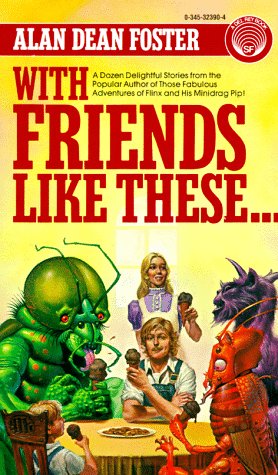
"Some Notes Concerning a Green Box" was published in The Arkham Collector, Summer 1971. In his notes on the story in With Friends Like These (1977), Alan Dean Foster says the story began as a joke, product of his first looking into Lovecraft.


It's testament to Foster that, initially exposed to Lovecraft, he would write a glib and jokey send-up of what had become clichés by 1970. 


The story is presented as a letter. The narrator details his investigation of the disappearance of two anthropologists. They were last known to be sailing south of Easter Island. Fragments from a log book indicate they were searching for something, following Captain Cook's old charts, "almost directly down the center of the subsurface mountain mass known as the Easter Island Cordillera."


Our narrator also discovers that one of their collaborators, a Chilean academic, was conducting some esoteric rituals on the mainland at the same time. Survivors of that event:


....were found in the mountains the night after the quake, shivering and frightened. They were given food and clothing by the government rescue team and permitted to return to their families, except for one oldster who adamantly maintained in spite of the most determined expostulations that the professor was responsible for the quake. According to this patriarch, the professor had been performing some incomprehensible ritual with burning herbs and an odd little idol when the tremors had begun. At this point the old man's testimony lapses into insane drivel, as when he claims that the mountain across the valley from them got upon gigantic stone feet and stepped on the professor, killing most of the party with him.


"A mountain walked" indeed!


From there, "Some Notes Concerning a Green Box" splutters along on in-jokes until it ends. 


Foster reports he sent the narrative as a letter to Derleth, who offered to publish it as a work of fiction. Clearly, Derleth had his net out for young writers, and caught not just Ramsey Campbell and Brian Lumley.


Jay

12 June 2022


Tuesday, December 7, 2021

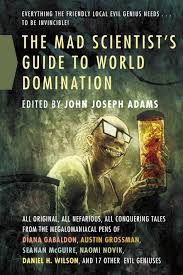
Four stories from The Mad Scientist's Guide to World Domination: Original Short Fiction for the Modern Evil Genius (2013) Edited by John Joseph Adam


The Mad Scientist's Guide to World Domination: Original Short Fiction for the Modern Evil Genius (2013)

Edited by John Joseph Adam 


* * *


"Mofongo Knows" by Grady Hendrix recalls some of Kim Newman's early stories: "Famous Monsters" (1988), "The Original Dr Shade" (1990), and "The Pierce Arrow Stalled, And... " (1995). It's an elegant exercise in poignant belatedness, coolly clocking the afterlives of adventurers.


      It's been thirty years without a whiff of Theresa Savage, yet here's her smell again like a golden oldie.    "We need to talk," she says, standing outside Mofongo's cage with three men in dark suits.

    "Let me guess," Mofongo says, sitting up. He is excited to have some new playmates, especially ones who wear suits. None of his visitors ever wear suits, and he hasn't seen a human being in forty hours. He can mentally dampen his hunger and thirst but his boredom knows no bounds. He points to them in order. "CIA, FBI, NSA."

    "CIA, FBI, and Animal Control," the youngest suit man says to him.

    "I am not an animal," Mofongo says.

    "You're not exactly human, either," the man says.

    Mofongo's nostrils flare.

    "What is this, Theresa?" he asks. "Why did you come back?"

    "Dad's dead," she says.

    "What?"

    "He's dead," she repeats.

    "Who did it?"

    "A bottle of Southern Comfort and a handful of Vicodin," she says. "Day before yesterday."

    "Wrong," Mofongo says. "One of his enemies, returned for revenge."

    "Mo, I appreciate that you're upset but this isn't part of you guys' soap opera. He killed himself."

    "No," Mofongo says, and he feels fear because he really does not know who did it. Old allies can turn into new enemies, old friends can become new foes. Men of Adventure are no stranger to psychosis. "One of his enemies is here. I may also be in danger. You must free me so I can defend myself."

    "I can't let you come to the funeral," she says, ignoring him. "People will want to know why a talking ape is there and you're kind of hard to explain."

    "I don't want to go to his funeral," Mofongo snarls. "I want to defend myself!"

    "I'm sorry," Theresa says. "I really am. On the plus side, we're getting you out of here."

    "Yes, free to defend myself. Free to destroy my enemies."

    "There's a Primate Refuge outside Austin," the Animal Control man says. "They've agreed to take you. You'll fit right in. That chimpanzee who did all those Geico ads is there."

    "Chimpanzees? Chimpanzees! Masturbating, shit-flinging, pants-wearing attention whores! I am Mofongo: Gorilla of the Mind. I am a threat to mankind! I'm on the UN watch list!"

    "You've been off that list for twenty-six years," the CIA agent says. "No one remembers you anymore."

    "If men do not still feel fear," Mofongo snarls, "why do they send the CIA? Why the FBI?"

    The FBI agent shrugs. "I just wanted to see a talking gorilla," he says.


* * *

"Blood & Stardust" by Laird Barron


     "Mary," he says. "You double-checked the array, I presume?" He scarcely acknowledges my answer; his mind is already three jumps ahead, and besides, my loyalty is unquestioned. "One of my specimens expired last night— but all is not lost. My revivification project awaits!"

    "Remember not to talk on the phone during the storm," I say. "I just saw an account of a woman who was fried doing dishes. Ball lightning exploded from the sink and set her on fire. It traveled through the pipes."

    Dr. Kob stares at me, his beady eyes narrowed. He rubs his temples as if experiencing a migraine. "You're watching the talk shows again. You know how I frown upon that, my dear. Less daydreaming, more physical exertion. Remind me to have Pelt assign you additional duties. Idle hands and all that."

    "Sure, gimme a pitchfork and I'll swamp out the stables."

    "Never mention pitchforks again!"

    "Or torches."

    "Out! Before I lose patience for your belligerence. And tomorrow, take the rod into our lovely village for quality-assurance testing. I've altered the design. It possesses more jolt than ever."

    "As you command," I say sweetly. After he wanders off, I chew my cup and swallow it piece by piece. It kind of frightens me that my Pavlovian dread of the Doctor has ebbed, replaced by an abiding irritation. This is very dangerous. He's a middle-aged megalomaniacal child— an L'enfant Terrible. We know what rotten children do with their toys, right?

    He gave me a puppy, once. I loved her, and often imagined how she had crept into the caves of my ancestors to escape the cold and the dark. I accidentally broke the puppy's neck. It's probably a good thing he didn't hand me the little brother I always wanted.


Lab assistant Mary turns the tables on her employer, then finds a circus to join. Barron is at his ease with the material, calm and in control, far away from Universal Studios clichés. The tone is slangy, first-person, and assured.


Readers curious about subtle handling of sex and gender roles will appreciate the human sympathies the story portrays.


* * *


"Rural Singularity" by Alan Dean Foster is a droll story about a smalltown reporter following-up on a two-headed chicken story. He meets the farmer and the farmer's precocious daughter, Suzie.


     She showed him the antigravity projector the size of a cell phone, just like the one in her pocket that had kept the miniature solar system hovering above her palm. She showed him the homunculus Santa and elves that she only animated at Christmas. Showed him the robot cat that kept the barn free of rats and mice, and the extractor that drew water from the seemingly desiccated air, and the candy maker that spun elaborate gourmet treats out of plain sugar and simple flavorings. She showed him the small thermonuclear device.

     "But I can't get enough radium or tritium out of the old watches dad buys for me a flea markets so I'm gonna try and build my own centrifuges to concentrate enough U-235 to ninety percent from the ore in the hills around here." She eyed her father. "For my next birthday dad promised me enough lead to make some shielding."

     Gilcrease looked at his host. Parker shrugged. "It's harmless, I'm sure. Another one of her toys."

     "Yeah," Gilcrease mumbled. "Harmless." He was eyeing the girl not just out of curiosity now, but warily. "Suzie, some of these things, some of your toys— aren't you afraid they might be a little bit dangerous?"


* * *

"Ancient Equations" by L. A. Banks


Ernest Lassiter, engineering genius with access to the "Akashic records," gets ready to work a spell to save the world:


[....]There was nothing wrong with his mind and he was no extremist, no matter what the psychiatrists had said. He did not have a breakdown. Thinking differently than the zombified public did not mean he'd gone around the bend. He'd had an awakening on the job, is all . . . one that brought him clarity!


It's the usual mishmash of self-righteous social-misfit moralizing:


[....]The Bildebergers and the Illuminati still ran the entire fucking world. They were the devil, and they got regular people to buy into being blind consumers, suckered them into debt, poisoned them for profit, made them so unhappy with their lives, their looks, their bodies, their families that they had to spend money— somehow, somewhere in the food chain of greed— to make themselves feel better.

     Somebody needed to do something. Somebody really smart could fuck up their decadent Roman orgy party forever....


It's remarkable that a story by a professional writer,  selected for a professional anthology, cannot do more than spin its wheels for nineteen pages.


Jay

7 December 2021


Sunday, August 13, 2017

Alan Dean Foster and John Carpenter's The Thing: celebtating 35 years of the 1982 novelization


In the period 1981-1983 I read more novels by Alan Dean Foster than any other writer.

I read:

Splinter of the Mind's Eye
Star Trek Log 1-?
The Black Hole
Alien
The Thing
Outland


I can still remember practically verbatim the first few paragraphs of his novelization of John Carpenter's The Thing (1982):

The worst desert on Earth never gets hot. It boasts no towering sand dunes like the Sahara, no miles and miles of barren gravel as does the Gobi. The winds that torment this empty land make those that sweep over the Rub al Khali seem like spring breezes.

There are no venomous snakes or lizards here because there is nothing for them to poison. A bachelor wolf couldn't make a living on the slopes of its Vinson Massif. Even the insects shun the place. The birds who eke out a precarious life along its shores prefer to swim rather than fly, seeking sustenance from the sea rather than a hostile land. Here live seals that feed on other seals, microscopic krill that support the world's largest mammals. Yet it takes acres to support a single bug.

A mountain named Erebus stands cloaked in permanent ice, but burns with the fires of hell. Elsewhere the land itself lies crushed beneath the solid ice up to three miles thick. In this frozen waste, this gutted skeleton of a continent unlike any other, only one creature stands a chance of surviving through the winters. His name is Man, and like the diving spider he's forced to carry his sustenance on his back.

Sometimes Man imports other things to Antarctica along with his heat and food and shelter that would not have an immediate impact on an impartial observer. Some are benign, such as the desire to study and learn, which drives him down to this empty wasteland in the first place. Others can be more personal and dangerous. Paranoia, fear of open places, extreme loneliness; all can hitch free and unwelcome rides in the minds of the most stable of scientists and technicians.

Usually these feelings stay hidden, locked away behind the need to concentrate on surviving hundred-mile-an-hour winds and eighty-below-zero temperatures.

It takes an extraordinary set of circumstances to transform paranoia into a necessary instrument for survival.

When the wind blows hard across the surface of Antarctica, the universe is reduced to simpler elements. Sky, land, horizon all cease to exist. Differences die as the world melts into blustery, homogeneous cream....


At which point a helicopter and a dog enter the narrative and we are off to the races.

I found this P.R. fluttering in my paperback. Old-fashioned and charming:

ALAN DEAN FOSTER, a Scorpio, was born in California where he completed his schooling. After serving a hitch in the U.S. Army, he worked as a copywriter in a public relations-advertising firm. Since then he has taught Motion Picture History and Writing at Los Angeles City College, as well as Literature at U.C.L.A.

A prolific writer, Foster has written very successful novelizations of Alien, Dark Star, The Black Hole, Outland and Clash of the Titans. He has also had ten novels published including the five Humanx Commonwealth volumes, Midworld, Cachalot, Icerigger, Mission to Moulokin and his most recent one, Spellsinger.

A red belt in Tang Soo Do (a form of Korean Karate), Foster's hobbies are backpacking, body surfing and basketball. He and his wife recently deserted the Pacific Coast to live in the Arizona desert.


Sounds like a pretty nice life.

Macready and Childs don't end up so nicely situated:

.... [Macready] leaned against the handmade bar and lit a cigar from the pub's undamaged stock. His hands were heavily wrapped. No gloves were lying conveniently about, but there'd been plenty of insulated tape in the ruins of the infirmary. What was left of his hands benefited from the bandaging anyway. He puffed on the cigar and poured a double, no soda please, into a glass that was only slightly chipped.

Something grabbed him by the shoulder and spun him around. He was too exhausted to scream.

A face stared back into his own: Childs. White-and-black blotches mottled the exposed skin and icicles decorated the mechanic's woolly beard.

"Did . . . did you kill it? I heard an explosion." Childs's mouth wasn't working too well. His lips were cracked and stained with dried blood. A weak gust of wind caused the powerful frame to stagger. Lack of food and exposure to the elements had severely depleted the mechanic's strength.

"I think so," Macready told him

"What do you mean, 'you think so'?" Childs stumbled backward a few steps.

They eyed each other suspiciously, the voices guarded. Macready was suddenly alert.

"Yeah, I got it." He gestured with a mummified finger at the mechanic's face. "Pretty mean frostbite."

Childs kept his distance and exhibited a puffy, pale hand.

"It'll turn again soon enough. Then I guess I'll be losing the whole thing." He kicked out first his right foot, then the left. The movements were feeble, shaky. "Think my toes are already gone."

Macready had salvaged one of the card tables and set it up nearby. Carrying bottle and glass he limped over and sat down in the single chair. The back was cracked but the legs were still intact.

A chess set rested on the table, its power wire hanging loosely over the side. By some miracle the box of pieces that had been buried beneath it had survived the cataclysm. Several piles of cards lay nearby. Macready was in the process of combining them to form a single, complete deck.

The two men continued to eye each other warily. "So you're the only one who made it," said Childs.

Macready was setting up the chessboard. Tiny magnets held each piece to the metal board despite the steady wind.

"Not the only one, it looks like."

Childs found a couple of blankets and gratefully wrapped them around his upper body. "The fire's got the temperature way up all over camp. Won't last long, though." He nodded toward the pub's missing wall.

"Neither will we."

"Maybe we should try and fix one of the radios. Try and get some help."

"Maybe we shouldn't."

"Then we'll never make it," the mechanic said calmly.

Macready puffed on the cigar until the tip glowed red, then reached down into the bundle of supplies he'd gathered. From the middle of the pile he pulled a small, cylindrical metal shape.

"Lookee what I found. This one works." He carefully put the blowtorch on the table next to him.

"Maybe we shouldn't make it," he added speculatively.

Childs eyed the blowtorch. "If you're worried about anything, let's take that blood test of yours."

"If we've got any surprises for each other," the pilot replied, "we wouldn't be in any condition to do anything about it. Any testing can wait." He paused, then ask cheerfully, "You don't play chess?"

Childs studied the pilot, then hunted through the wreckage outside the pub. He returned carrying a second chair in reasonably good condition and placed it across the table from Macready.

"I guess I'll be learning."

The pilot grinned and handed the mechanic the bottle. Childs leaned back and drained half of what was left. When he put the bottle down he was smiling.

Around them the persistent fires smoldered on, riding a sea of frozen water. Bright embers levitated by the wind rose lazily into the night sky The ghostly ribbon of the southern aurora pirouetted overhead, masking many of the stars that had come out in the wake of the storm.

Macready nudged a pawn two squares forward


And that's how Foster ends it. Magnificent.


Jay
13 August 2017