Subscribe to my Substack

Tuesday, August 24, 2021

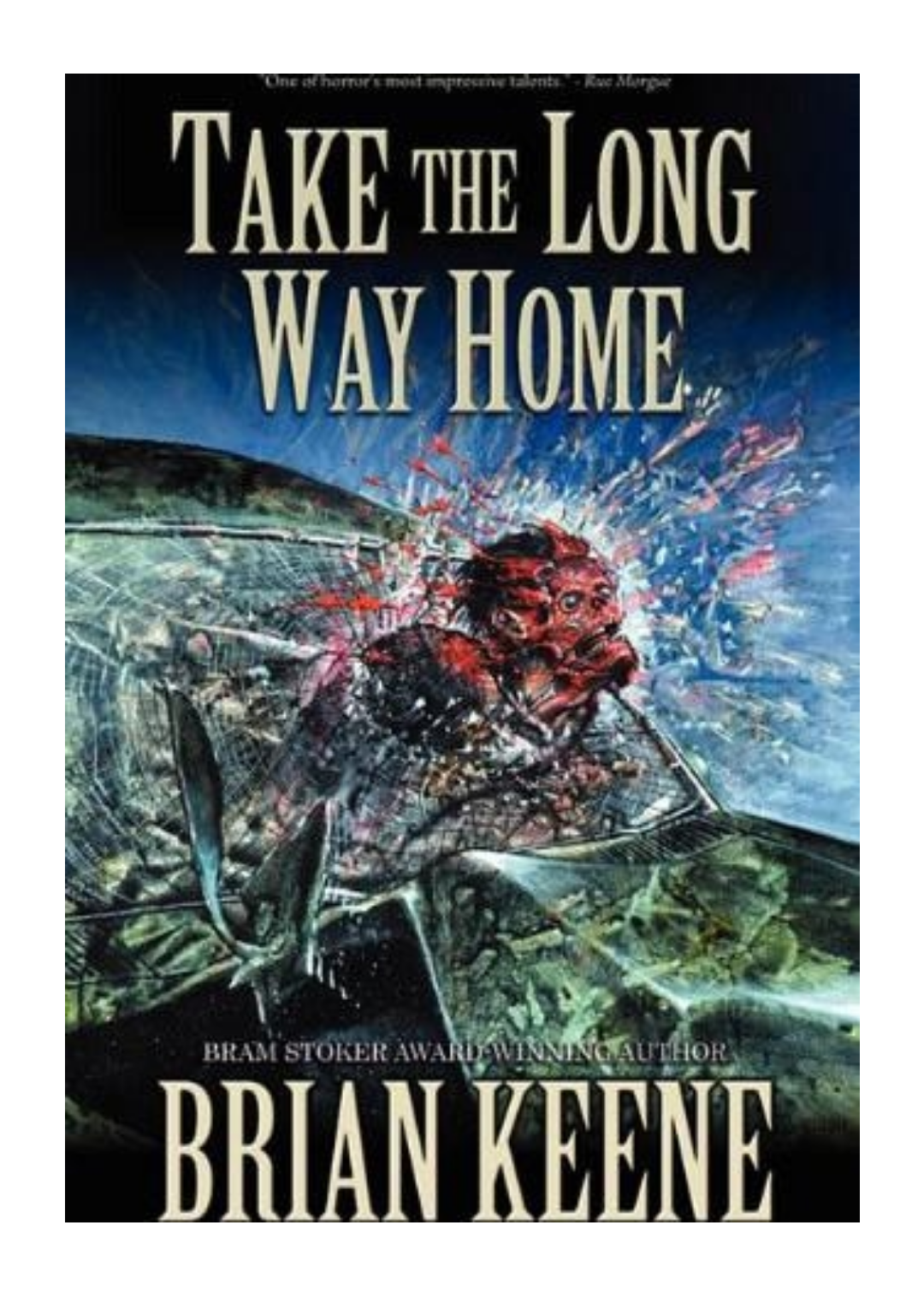
It’s a prelude: "Take the Long Way Home" by Brian Keene (Deadite Press, 2006)

....They were looting the Wal-Mart as I walked past. Surprisingly, the whole thing seemed pretty civil. Locals, people I knew and faces I recognized, filed out of the store carrying everything from food to televisions. They pushed shopping carts filled to overflowing with goods. There was no fighting or shoving. It was eerily calm. Neighbors greeted each other, and helped each other load up their cars and trucks. I heard laughter, saw lovers holding hands, children smiling. The scene was polite and friendly, almost festive. A carnival atmosphere where all that was missing was a Ferris wheel and a few cotton candy vendors. Maybe a trained elephant doing tricks for the kids, as well.


Take the Long Way Home by Brian Keene (Deadite Press, 2006)


In the afterword to this novella, author Brian Keene puts his bona fides on the table:


I was raised by two Irish-American Protestant parents, attended a Methodist church, and was even the president of the church youth group at one point, if you can dig that. My grandparents were Presbyterians, my extended family hardcore Southern Baptists, and I once dated a preacher's daughter. My point is; I was surrounded by religion, specifically Christianity, all through my childhood and teenage years. Readers have commented that my fiction seems to be primarily based on the Christian mythos—well, that's why. 

    Readers have also said that they see a deep schism; that I often depict God as the ultimate bad guy, and I think that's also a fair assumption. I trace that to adulthood. As a young man, I traveled the world and was exposed to many other religions and alternative ways of thinking. I came to realize that what I was brought up to believe wasn't the whole truth, the big picture, and that there were millions of other people whose ideas and faiths were just as valid and deep and personal.

    I've gone through phases: occultism, powwow, paganism, Buddhism, atheism, and finally, agnosticism. At forty-three, I'm no longer sure what I believe, and that bothers me more and more each day. I believe in an afterlife, but I'm not sure that it's Heaven. I believe that there's something more to this world, to this universe, something behind the veil, but I'm not sure that it's God. 

    Sometimes, it seems like the more I learn, the less I know.


"Take the Long Way Home" is not satire or black comedy or send-up. Keene presents The Rapture as a real event: a trumpet blast is heard around the world, then millions immediately vanish. Good people and not-so-good people remain and must contend. Mistakes, errors in judgment, violence, and carnage ensue. 


Keene lets the reader infer the widescreen epic character of the catastrophe, but carefully only follows his own trio of protagonists, on foot, as they walk their daily commuter route home from suburban Baltimore to small-town southern Pennsylvania. 


In the Maryland portions of the story, maddened crowds wreak havoc, pertetrate mob violence, and inflict vigilante death. Keene does not push a gloating we're-the-real-monsters line indulged in by many contemporary visceral horror writers. He suggests it, certainly, but is careful to counterpoint such moments with expressions of longing, ambivalence, regret, and existential dysphoria sparked by the crisis.


Late at night, narrator Steve Leiberman finally gets a ride from a minister who is driving to Harrisburg. As the physical agonies of hours of walking, escaping, evading, and facing a variety of mortal perils abates, Steve observes:


     "We'll survive," I said. "We'll pick up the pieces, dust ourselves off and move on. We always do. Look at everything the human race has been through. We always bounce back."

    He shook his head. "Not this time. The next seven years will quite literally be hell on earth. War. Famine. Earthquakes. Disease. Total chaos."

    "Don't we have that now?"

    "No, Steve. This is just the beginning. We have those things now, but they pale in comparison to what's coming. This will be a tough time for the tribulation saints."

    I gasped.

    "What's wrong?" he asked.

    "I—something you said just made me think. I heard something similar earlier today."

    "How so?"

    I told him about all that had transpired. Even with the disappearances, I didn't expect him to believe me when I got to Gabriel and the skinheads turning into salt. But when I'd finished, he simply nodded his head.

    "You've been chosen."

    I snorted, trying to keep the sarcasm out of my voice. "Chosen for what?"

    "Don't scoff. A dynamic new leader is about to arise. People will see him as a great man. He will fix everything, stop the lawlessness and chaos and usher in an era of peace."

    "But you said it would be Hell on earth. Wars and famine and all that."

    "It's a false peace, and he's anything but a great man. The Bible calls this man Antichrist. He's a descendent of those who destroyed the temple in Jerusalem in 70 A.D. But who he really is, is Satan. The Antichrist will enjoy worldwide popularity. People will love him like no other world leader they've ever known."

    "Who is he?"

    "I don't know. He has yet to reveal himself. But I'm sure he's already active. We've probably watched him in action for years, and loved him without knowing his true identity. Soon, most likely within a few weeks, he will set up a new one-world government in response to today's events. He'll even bring peace to Israel with the signing of a seven-year agreement."

    "Never happen," I said. "There will never be peace in Israel, especially now. And what does this have to do with me anyway? You said I was chosen."

    "The signing of the agreement kicks off a seven-year period called the tribulation, and those who receive Jesus as their Lord and Savior after the Rapture are called tribulation saints. Many of them will be Jews, just like you. Revelation talks about the 144,000 Jewish witnesses. These witnesses, the tribulation saints, will be protected supernaturally from the horrors to come. Much like you were today, with your guardian. What did you say his name was?"

    "Gabriel," I whispered. He'd mentioned something about the 144,000 as well, when Al the skinhead held me at knifepoint.

    "Gabriel the Protector. You do know Gabriel was an angel of the Lord?"

    "No," I said. "But I do now."


Brian Keene is clearly passionate about exploring the end of the world in his fiction. "Take the Long Way Home" is a powerful story, curious and alive to the contradictions at war in its world. As in the only other Keene book I have read, The Conqueror Worms (Leisure, 2006), there is nothing of the "relentlessly trashy" method S. T. Joshi condemns in his piece on the author in 21st-Century Horror: Weird Fiction at the Turn of the Millennium (Sarnath Press, 2018).


Like Keene, I am passionate about end-of-the-world literature, past and present. "Take the Long Way Home" is smaller in scope than works like King's "The Mist" or Koontz's The Taking, but it is no less serious for all that.


Jay

24 August 2021


Monday, August 23, 2021

On: Sleeping with the Lights On: The Unsettling Story of Horror by Darryl Jones (OUP, 2018)

"….uncanny tales play on a creeping awareness that reality is unstable. As we have seen, horror often arises out of a blurring or transgressing of clear category distinctions. The uncanny tends to arise out of a sense of uncertainty as to whether we are encountering or experiencing something which is alive or dead, organic or inert, material or supernatural. It is the statue that moves, the portrait whose eyes follow you around the room, the doll that comes to life, the mirror that reflects back a different room, or a different face, the door that suddenly will not open, or that opens of its own accord, or that rattles as if being violently shaken from the outside when you know there's no one there. It is the window that looks out onto an unexpectedly strange vista, or onto nothing at all."


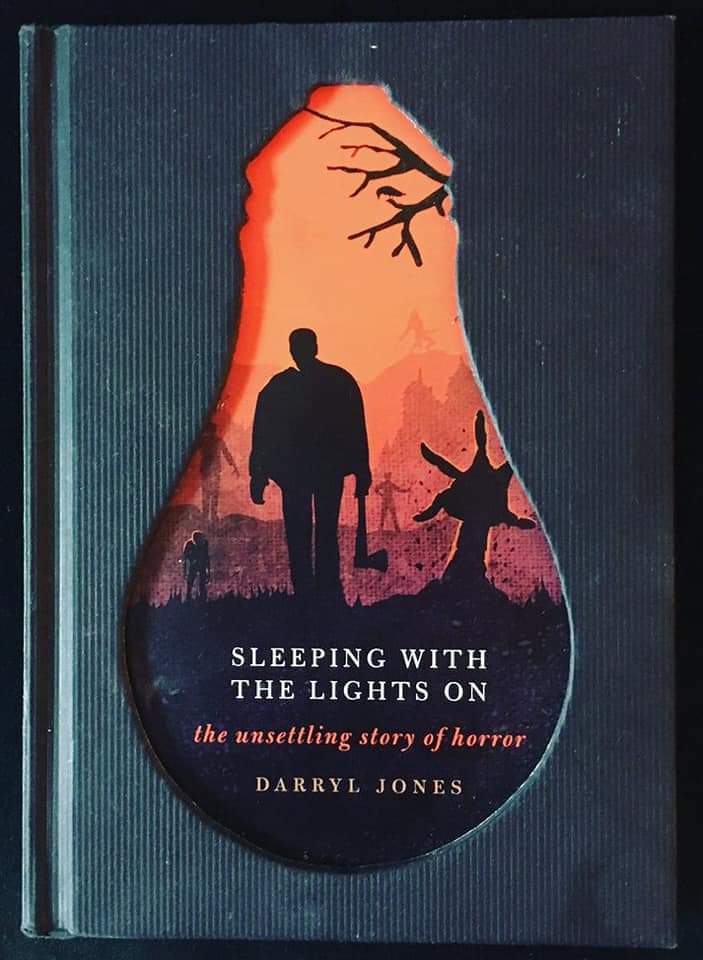
Sleeping with the Lights On: The Unsettling Story of Horror by Darryl Jones (OUP, 2018) is a useful, competent historical survey of the horror mode.


For most of the very brief book, Jones addresses the market-driven historical vicissitudes of horror film and TV work. As a teacher he's probably learned that students are willing to discuss "True Detective" or "Buffy," but  not Melmoth the Wanderer or "Laura Silver Bell." (Sorry to be wearing my Sneering S.T. Joshi hat today.)


I was surprised that the most recognized and influential contemporary stylists of horror prose today get little mention.  Stephen King is discussed, as are Victor LaValle and Michelle Paver, but not Dennis Etchison, Ramsey Campbell, or Reggie Oliver. Perhaps that's just me, though. Jones is clearly aiming at a short, popular outline, employing sexy tops like "body horror" and "torture porn." His discussions of these topics are sober and thoughtful, and do point readers at the best examples.


Some excerpts I posted on Facebook during my time reading the book:


....Horripilation can be a pleasurable experience. In Jane Austen's quasi-Gothic Northanger Abbey, Henry Tilney reads Ann Radcliffe: 'The Mysteries of Udolpho, when I had once begun it, I could not lay down again;—I remember finishing it in two days—my hair standing on end the whole time.' Horror audiences laugh as often as they scream, or laugh and scream at the same time.


The pleasures of genre are, in fact, often akin to those of ritual. They are based on repetition, on the acting out of predetermined roles, on the precise fulfilment of expectations. Horror audiences are often highly knowledgeable, with an acute intuitive knowledge of the codes and conventions of the genre. They often know exactly what to expect, and this explains the enduring popularity of many of the most generically formulaic kinds of horror, from Radcliffe's Gothic novels to slasher movies. Nobody went to see Friday the 13th, part 8, or Saw 6, expecting a whole new cinematic experience from the one they got when they went to see Friday the 13th, part 7, or Saw 5. Sometimes, this genre-familiarity can indeed lend a ritualistic or even a participatory experience to the work or art, as we go self-consciously through the conventions of the genre while experiencing it, or even start to take part in the work ourselves (like the audience for The Rocky Horror Picture Show). The great success of the Scream franchise (1996–2011), for example, is to a large extent predicated on its audience's genre expertise. We have been here before….


....who actually believes in vampires?'

     Though unquestionably revenants, 'folkloric' vampires such as Arnold Paole and his ilk tend to be peasants or rural villagers, intensely localized in their effects. In appearance, they are often described as ruddy faced, as though bloated with blood. How did we get from these frankly unsexy undead yokels to the characteristic vampire of modern popular culture—suave, aristocratic, cultivated, pale, and desirable?

     This vampire is a distinctive product of the literary culture of Romanticism. As the critic Mario Praz identified as long ago as 1933, there is a recurring strain of 'Dark Romanticism' which is fascinated by the allure of supernatural and demonic creatures (Lamia, Geraldine, and other serpent-women, Life-in-Death, La Belle Dame Sans Merci) and by human transgressors and overreachers standing apart from the common concerns of humanity (Faust, Frankenstein, Napoleon). In April 1819, the New Monthly Magazine published a tale entitled The Vampyre, whose protagonist, the charismatic and seductive Lord Ruthven, returns to London from his European Grand Tour, having died in Greece and arisen as a vampire. Published anonymously, the work was assumed to be by Lord Byron (Goethe thought it among his best work), though it was in fact written by the Edinburgh physician Dr John Polidori. Polidori was present at the evening of supernatural tales told at the Villa Diodati on the shores of Lake Geneva in 1816 which was the genesis of Mary Shelley's Frankenstein. Told as they have been from a variety of different and differing sources, the events of this evening are difficult to reconstruct with certainty, but it seems likely that Polidori based The Vampyre on the supernatural tale which Byron himself told that night (a fragment of which was subsequently published), and drew heavily on the scandalous public persona of Byron himself for Lord Ruthven.

     With Romantic writers such as Byron and Polidori, the vampire became, importantly, both sexualized and aristocratic, a demon lover, running riot across the poetry, fiction, and theatre of the nineteenth century right up to the publication of the single most important text in the history of horror, Bram Stoker's Dracula, in 1897. At the same time, Karl Marx habitually deployed the vampire as a metaphor for the 'bloodsucking' economic exploitation of capitalism (one wonders what he would have made of the Twilight phenomenon, capitalism red in fang and claw?). Marx was much given to Gothic metaphors, and when casting around in Capital (1867) for an exemplar of 'The Voracious Appetite for Surplus Labour', settles on 'a Wallachian Boyar…in the Danubian Principalities' (was he thinking of Vlad the Impaler?). A couple of pages earlier, Marx offers his celebrated account of bloodsucking capitalism:


     [The] capitalist…is only capital personified. His soul is the soul of capital. But capital has one sole driving force, the drive to valorize itself, to create surplus-value, to make its constant part, the means of production, absorb the greatest possible amount of surplus labour. Capital is dead labour which, vampire-like, lives only by sucking living labour, and lives the more, the more labour it sucks.


     The class polarities of vampirism have been reversed. Marx's vampiric 'Wallachian Boyar' exploits the labour of the very people (the Eastern European poor) who were traditionally prone to vampirism.


It is difficult to think of a body of mythology or folklore that does not contain narratives of lycanthropy or other forms of beast transformation, and contemporary popular culture is suffused with such narratives. These may originally have emerged from widespread beliefs in types of metempsychosis, the transmigration of souls from one bodily form to another, and might be said to reflect the unity of humanity and nature in a polytheistic order, or even a sense of innate pantheism, in which all living things are divine spirits. Ovid's Metamorphoses is in essence an enormous catalogue of such narratives.

     Beast transformations of this kind are rarer in monotheistic mythology and theology, much of which emerged from the necessities of harsh desert survival, and thus stresses an essential separation of humanity and nature, which is a force which needs to be mastered and controlled, governed by a series of laws and interdicts, from the Abominations of Leviticus (many of which are dietary) to the Ten Commandments (which emerge out of a period of national survival in the wilderness). One of the few such narratives in the Bible is that of the Babylonian King Nebuchadnezzar, 'deposed from his kingly throne' for his pride and reduced to a life of feral madness: 'And he was driven from the sons of men, and his heart was made like the beasts, and his dwelling was with the wild asses; they fed him with grass like oxen, and his body was wet with the dew of heaven' (Daniel 5:20–1). (This is the subject of a famous painting by William Blake, and it has been suggested that Blake drew for this on an illustration of a cannibalistic werewolf by Lucas Cranach; see Figure 5.)


Sometimes lycanthropy is, as Pliny maintained, a straightforward curse, a misfortune brought upon an innocent through sheer bad luck, or as a result of a family history over which they have no control. This remains a significant impetus for modern cinematic lycanthropy, in Werewolf of London (1935), The Wolf Man (1941), The Curse of the Werewolf (1961), or An American Werewolf in London (1981). Modern beast transformations have also found a powerful explanatory narrative in Darwinism, a major source of anxiety ever since the publication of The Origin of Species in 1859, as we shall see in Chapter 5. The Strange Case of Dr Jekyll and Mr Hyde (1886) and The Island of Doctor Moreau (1896) are both explicitly post-Darwinian narratives of beast transformation, and all subsequent tales of lycanthropy are in their different ways necessarily informed by the implication of natural selection that there is no existential division between man and beast.

     In many cases, as with Lycaon himself, lycanthropy is both a punishment and a metaphor for savagery. In serving up human flesh (the flesh of a baby; the flesh of his own child) to Zeus, Lycaon violates numerous taboos against blasphemy, unclean eating, familial ties, and the obligations of a host. He transforms into a wolf as an externalization of his own inhumanity. This is very much the interpretation for lycanthropy which the Reverend Sabine Baring-Gould offered in his influential 1865 treatise, The Book of Were-Wolves.

     Baring-Gould was a kind of super-Victorian, an Anglican clergyman who was also an astoundingly prolific man of letters—a novelist, an antiquary (he wrote A Book of Dartmoor, one of Arthur Conan Doyle's sources for The Hound of the Baskervilles), a folklorist, a hymnist ('Onward Christian Soldiers'), and much else besides. Baring-Gould's interest in lycanthropy dates, he maintains, from a walking tour in a remote part of Brittany, where he is warned against setting out after dark, for fear of the loup-garou, 'a fiend, a worse than fiend, a man-fiend—a worse than man-fiend, a man-wolf-fiend'.

     For Baring-Gould, lycanthropy is a moral category. As well as Lycaon himself, Baring-Gould identifies as lycanthropes a number of moral monsters—notorious serial killers and cannibals such as Elizabeth Báthory and Gilles de Rais. He also associates the Berserkers with lycanthropy. These were terrifyingly savage Scandinavian warriors, apparently impervious to pain and injury, who dressed in the skins of beasts for battle: 'The berserkir were said to work themselves into a state of frenzy, in which a demoniacal power came over them, impelling them to acts from which their sober senses would have recoiled…and as they rushed into conflict they yelped as dogs or howled as wolves.' Berserker (or 'Bersicker') is the name Bram Stoker chose for the giant wolf that escapes from London Zoo at the Count's bidding in Dracula. Dracula commands wolves ('Listen to them—the children of the night. What music they make!'), and is himself a lycanthrope, referred to by the locals as '"Ordog"—Satan, "pokol"—hell, "stregoica"—witch, "vrolok" and "vlkoslak"—both of which mean the same thing, one being Slovak and the other Servian [sic] for something that is either werewolf or vampire'. When the Count disembarks the ship he has commandeered, on English soil, he does so in the guise of 'an immense dog', or wolf.

     In part because of its association with cannibalism, lycanthropy is also a directly political category, a means of subhumanizing aliens and Others by rendering them as bestial. As we have seen, the further we get from the polis, from metropolitan centres of population and civilization—to Colchis, Castle Dracula, the Yorkshire Moors, the Asiatic steppes, Prospero's island, the Island of Doctor Moreau—the closer we get to monstrosity and savagery, as though we are travelling back in time. For Herodotus, the lycanthropic Neuri and their neighbours, the Anthropophagi, lived in remote Eastern Europe and Central Asia. For Pliny, beast-men lived in unexplored Africa:

     Then come regions which are purely imaginary: towards the west are the Nigroi, whose king is said to have only one eye, in his forehead; the Wild-beast-eaters [Agriophagi], who live chiefly on the flesh of panthers and lions; the Eatalls [Pamphagi], who devour everything; the Man-eaters [Anthropophagi], whose diet is human flesh; the Dog-milkers [Cymanolgi], who have dogs' heads; the Arbatitae, who have four legs and rove about like wild animals.

     You will notice that Pliny's primary method of taxonomy here is dietary; beast-men are monstrous because they violate food taboos.

     Baring-Gould also recognized that lycanthropy was a psychological as well as a moral and geopolitical category. Lycanthropes, he speculated, 'may still prowl in Abyssinian forests, range still over Asiatic steppes, and be found howling dismally in some padded room of a Hanwell or a Bedlam.' The 'zoophagous' R. N. Renfield in Dracula was one such lunatic. Another was a patient of Sigmund Freud, Sergei Pankejeff, known as the Wolf Man. Pankejeff suffered from a variety of physical and psychological conditions, and under analysis recounted to Freud a particularly terrifying childhood dream of white wolves sitting in the walnut tree outside his bedroom. Freud interprets this as a displaced rendition of a traumatic episode in which the infant Pankejeff, sleeping in a cot in his parents' bedroom, witnesses a 'Primal Scene', an act of 'coitus a tergo, more ferrarum' ('sex from behind, like the animals'), allowing him simultaneously to see both parents' genitals, and to interpret his mother's vagina as lack, a castrated bleeding wound. Pankejeff grew into a 'savage' child; for the Wolf Man, Freud concludes, 'the sexual aim could only be cannibalism—devouring'.

     The anxious relationship between humanity and wolves is also a recurring trope in folklore, and particularly in the European fairy tale, in which the Big Bad Wolf is a recurring figure. The tale of 'Little Red Riding Hood' is especially ripe for interpretation and adaptation. One of the most widely circulated folktales, 'Little Red Riding Hood' has direct analogues and antecedents that can be traced back to medieval Europe, and was collected by both Charles Perrault and the Grimm brothers. The tale, with its pubescent heroine and her grandmother, its red cloak, and its rapacious antagonist, is ripe with psychoanalytic suggestion. For the Freudian theorist Bruno Bettelheim in his influential study of fairy tales, The Uses of Enchantment, the wolf is 'the male seducer', who 'represents all the asocial, animalistic tendencies within ourselves'. The devouring wolf-grandmother ('What big teeth you have!') who lives in a cottage in the woods has clear links to the cannibalistic witch of the related tale of 'Hansel and Gretel' (also collected by the Grimms). In her feminist study of fairy tales, From the Beast to the Blonde, Marina Warner draws together the wolf, the grandmother, and the adolescent girl, as figures linked by their liminality:

     The wolf is kin to the forest-dwelling witch, or crone; he offers us a male counterpart, a werewolf, who swallows up grandmother and then granddaughter. In the witch-hunting fantasies of early modern Europe they are the kind of beings associated with marginal knowledge, who possess pagan secrets and are in turn possessed by them.


Science and Horror

     In 1995, the year before his death, the distinguished astronomer and science writer Carl Sagan published a book entitled The Demon-Haunted World. Subtitled Science as a Candle in the Dark, the book had its origins in a course Sagan taught at Cornell University, 'Critical thinking in scientific and non-scientific contexts'. The Demon-Haunted World is an analysis of the follies, but also the temptations, of occult thinking and pseudoscience, which offer misleading or simplistic, if sometimes emotionally satisfying, answers to complex questions. Sagan was no philistine—he was the most polymathically humanistic of public intellectuals, with a real understanding of the power of myth, the importance of religion, the necessity of art. But he was acutely aware of the cultural and intellectual deficit that results from scientific ignorance. Without some understanding of and sympathy for science, intellectual citizenship was under threat, and with that the very possibility of educating a responsible electorate.

     In part, Sagan realized, scientific illiteracy arose out of a climate of distrust. This was understandable:


     Our technology has produced thalidomide, CFCs, Agent Orange, nerve gas, pollution of air and water, species extinctions, and industries so powerful they can ruin the climate of our planet. Roughly half the scientists on Earth work at least part-time for the military….There's a reason people are nervous about science.


     This fear and distrust of science and scientists is a major component of modern horror. In part, this is an aspect of horror's suspicion towards authority, in this case the overwhelming claims made for science as the only explanatory model, the only approach to existence worth taking seriously, the only method that matters. As we saw in Chapter 4, scientific genius is often understood in horror as a dangerous species of madness. Victor Frankenstein is only the most famous of a large group of unethical experimentalists in bloodstained laboratory coats, scalpel or serum in hand, or else of bloodless, abstract theoreticians who would, like Edward Teller, destroy the world in order to satisfy their intellectual curiosity. Fiat experimentum in corpore vili ('Let the experiment be performed on a worthless corpse'). The attitude expressed in this Latin proverb informs much of the anxiety horror has about science, the fear people have of being treated as corpora vilia, expendable experimental subjects.

     This kind of anti-scientific popular culture is a fundamentally modern affair, and in essence dates from the climate of scientific materialism which followed in the wake of the publication of The Origin of Species in 1859. The term 'scientific materialism' was coined in 1872 by the Irish physicist John Tyndall; T. H. Huxley, Charles Darwin's colleague, preferred the term 'scientific naturalism', which he understood as antithetical to 'supernaturalism'. Tyndall and Huxley were at the centre of a group of Victorian scientists who challenged the cultural and intellectual authority of the Church of England, one important battle in a broader Victorian 'crisis of faith'. Famously, Huxley debated evolution with Bishop Samuel Wilberforce in the Oxford University Natural History Museum on 30 June 1860, a debate which history, at least, judged Huxley to have won by knockout when he answered Wilberforce's snide question 'was it through his grandfather or grandmother that he claimed descent from a monkey?' with the answer that 'He was not ashamed to have a monkey for an ancestor; but he would be ashamed to be connected with a man who used great gifts to obscure the truth.' Huxley recognized that evolution's dethroning of humanity from the pinnacle of creation was psychologically and existentially shocking, causing 'the awakening of a sudden and profound mistrust of time-honoured theories and strongly-rooted prejudices regarding [humanity's] own position in nature'.

     Huxley taught evolutionary biology to H. G. Wells in what is now Imperial College in London. Wells acknowledged that his intellectual debt to Huxley was immeasurable, and it can be seen very clearly in his own Darwinist horror, The Island of Doctor Moreau, in which a crazed vivisector attempts to demonstrate the relationship between man and beast by transforming a variety of animals into human beings. These concerns about the status and place of humanity raised by scientific materialism in general and Darwinism in particular are anxieties with which horror continues to wrestle, because culture at large does. 'Mad science'—scientific progress completely severed from any ethical concerns—is a recurring trope in horror, and can be understood as giving form to genuine concerns about unchecked technological progress and its potential for dehumanization....


[Body Horror]

     Such cinematic transformations are inevitably technology-driven, and entered a decisively modern phase in the early 1980s, as advances in visual effects and make-up, pioneered by the likes of Rick Baker, Rob Bottin, Tom Savini, and Stan Winston, meant that monstrous transformations could be shown onscreen for the first time in ways that often comprehensively exceeded the power of the audience's imaginations. In An American Werewolf in London, Baker's transformation of David Naughton into a wolf, with elongation of limbs and face, cracking of spine, and agonizing screams, is one of the defining moments of modern horror cinema. In Bottin's effects for John Carpenter's The Thing, the human body is given a nightmarish plasticity, seemingly able to recombine in any form, as a severed head sprouts spider's legs, Arachne-like, or a huge, fanged gash opens up in a torso, like the very mother of all vaginae dentatae. This was the world of 1980s 'body horror', which radically figured, disfigured, and refigured the human body, focusing on it relentlessly as a site of pain, and anxiety and disgust, but also of transformation and transcendence, often with highly sophisticated philosophical and intellectual underpinnings. Body horror of this kind is particularly associated with the work of the Canadian auteur David Cronenberg and the British writer and film-maker Clive Barker.

     Consistently across a very distinguished body (corpus) of work, from early low-budget films such as Shivers (1975) and Rabid (1978), to 1980s classics like Scanners (1981), Videodrome (1983), or The Fly (1986), and beyond the millennium (including his 2014 novel, Consumed), Cronenberg has given artistic form to his sense of the human body as a corporation, composed of parts which have their own identities and individuality, which they seek to assert, in what is a radical literalizing of mind–body dualism. As a university literature graduate, Cronenberg is also an articulate theorist of his own work:


     I don't think the flesh is necessarily treacherous, evil, bad. It is cantankerous, and it is independent. The idea of independence is the key. It really is like colonialism…I think to myself: 'That's what it is: the independence of the body, relative to the mind, and the difficulty of the mind accepting what that revolution might entail.'


     Cronenberg's use of the rhetoric of decolonization here, and his insistence on the relationship between the corporation and the corporeal, suggests a political reading of his work, underlined by his tendency to invent imaginatively named shadowy scientific/commercial organizations (Spectacular Optics, ConSec, the Raglan Institute for Psychoplasmics) which seek to distort and exploit the body for commercial gain. From rapacious capitalism to the AIDS crisis to the 'beauty myth' and its discontents, body horror became an effective means of engaging with and representing the grotesque elements of contemporary lived reality in the 1980s.

     The politics of the body are even more to the fore in the work of Clive Barker. Another humanities graduate (English and Philosophy), Barker is, like Cronenberg, a ready theorist of his own work, which he has discussed across numerous, often very candid interviews. Barker, to begin with, is no believer in what was defined in the Introduction as the aesthetics of terror, arising out of implication, restraint, or uncanny uncertainty. There is no fear of the unknown here, and certainly no sense that the reader's or viewer's own imagination should be allowed to conjure the greatest horrors:


     The kind of horror which is all suggestion and undertow, and 'it's what you don't see that horrifies you' kind of stuff—that doesn't do a thing for me.…I like imagining horrors in detail. I like to be able to give the reader everything I can imagine on a subject.…Horror fiction is about confrontation.


     Barker's aesthetic radicalism—his uncompromisingly confident representational style—is matched by a commensurate political radicalism. His best work, the stories collected in the Books of Blood, are tales of riotous fleshly mutability, often with an avowedly feminist and/or an openly gay politics. In 'Jacqueline Ess: Her Will and Testament', for example, a bored and frustrated housewife discovers that she has the power to mould flesh, and turns her sexist doctor into a woman:


     She willed his manly chest into making breasts of itself and it began to swell most fetchingly, until the skin burst and his sternum flew apart. His pelvis, teased to breaking point, fractured at its centre…It was from between his legs all the noise was coming; the splashing of his blood; the thud of his bowel on the carpet.


     Deliberately extreme and often brilliant, Barker's work is a classic example of horror at its most divisive, self-consciously setting out to shock and alienate large sections of the population, while establishing a devoted cult following. As Barker himself maintained:


     I like to think there's some kind of 'celebration of perversity' in the Books of Blood. That's a response, simply, to normality. What I cannot bear is 'normality'. What I'm trying to upset is not something hugely repressive—but something banal, that is, the lives most people lead.


Jay

23 August 2021

Sunday, August 22, 2021

Black Easter by James Blish (1968)

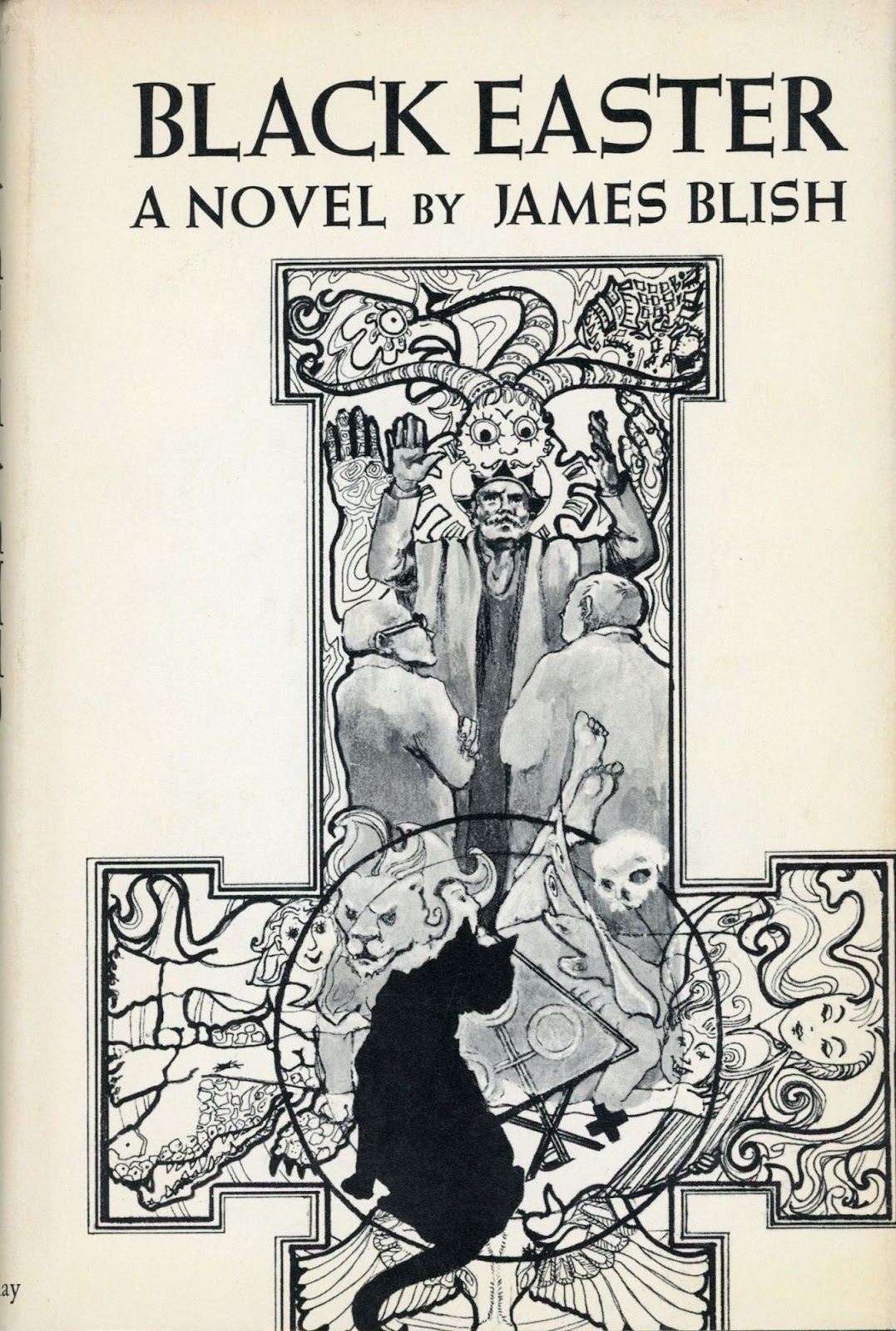
Black Easter by James Blish (1968) (available here and here) is a compelling novella of demons, warring black and white magicians, and the end of the world. It should be acknowledged today as a contemporary equal to works like Là-bas (1891) and The Phoenix and the Mirror (1969).


This is the second time I have read Black Easter. Its brevity, scope, and implications are achieved with a prose style of eloquent simplicity. I am tempted to say that in the hands of Dennis Wheatley, whom I have often celebrated, this would be a six hundred page thriller. Blish, a lifelong reader, writer, and critic of  SF and fantasy, has pared all that away. 


The scene I will now quote sums up the conflicting and coinciding interests of armaments maker Baines, black magician Theron Ware, and Roman Catholic white magician Father Domenico nicely:


Of the other three people in the office with Ware – for Ware had said there was no way to prevent Father Domenico from attending – none looked as pleased as Baines felt, but after all he was the only man who counted here, the only one to whose emotions Ware need pay any more than marginal attention. 'And much faster than you had anticipated, too. I'm very well satisfied, and also I'm now quite ready to discuss my major commission with you, Dr Ware, if the planets and so on don't make this a poor time to talk about it.'

     'The planetary influences exert almost no effect upon simple discussion,' Ware said, 'only on specific preparations – and of course on the experiment itself. And I'm quite rested and ready to listen. In fact, I'm in an acute state of curiosity. Please charge right in and tell me about it.'

     'I would like to let all the major demons out of Hell for one night, turn them loose in the world with no orders and no restrictions – except of course that they go back by dawn or some other sensible time – and see just what it is they would do if they were left on their own hooks like that.'

     'Insanity!' Father Domenico cried out, crossing himself. 'Now surely the man is possessed already!'

     'For once, I'm inclined to agree with you, Father,' Ware said, 'though with some reservations about the possession question. For all we can know now, it's entirely in character. Tell me this, Dr Baines, what do you hope to accomplish through an experiment on so colossal a scale?'

     'Experiment!' Father Domenico said, his face as white as the dead.

     'If you can do no more than echo, Father, I think we'd all prefer that you kept silent – at least until we find out what it is we're talking about.'

     'I will say what I need to say, when I think it is needful,' Father Domenico said angrily. This thing that you're minimizing by calling it an 'experiment' might well end in the dawn of Armageddon!'

     'Then you should welcome it, not fear it, since you're convinced your side must win,' Ware said. 'But actually there's no such risk. The results may well be rather Apocalyptic, but Armageddon requires the prior appearance of the Antichrist, and I assure you I am not he … nor do I see anybody else in the world who might qualify. Now, again, Dr Baines, what do you hope to accomplish through this?'

     'Nothing through it,' Baines, now totally caught up in the vision, said dreamily. 'Only the thing itself – for its aesthetic interest alone. A work of art, if you like. A gigantic action painting, with the world for a canvas –'

     'And human blood for pigments,' Father Domenico ground out.

     Ware held up his hand, palm towards the monk. 'I had thought,' he said to Baines, 'that this was the art you practised already, and in effect sold the resulting canvasses, too.'

     The sales kept me able to continue practising it,' Baines said, but he was beginning to find the metaphor awkward, his though it had originally been. 'Look at it this way for a moment, Dr Ware. Very roughly, there are only two general kinds of men who go into the munitions business – those without consciences, who see the business as an avenue to a great fortune, eventually to be used for something else, like Jack here – and of course there's a subclass of those, people who do have consciences but can't resist the money anyhow, or the knowledge, rather like Dr Hess.'

     Both men stirred, but apparently both decided not to dispute their portraits.

     'The second kind is made up of people like me – people who actually take pleasure in the controlled production of chaos and destruction. Not sadists primarily, except in the sense that every dedicated artist is something of a sadist, willing to countenance a little or a lot of suffering – not only his own, but other people's – for the sake of the end product.'

     'A familiar type, to be sure,' Ware said with a lopsided grin. 'I think it was the saintly Robert Frost who said that a painting by Whistler was worth any number of old ladies.'

     'Engineers are like this too,' Baines said, warming rapidly to his demonstration; he had been thinking about almost nothing else since the conjuration he had attended. 'There's a breed I know much better than I do artists, and I can tell you that most of them wouldn't build a thing if it weren't for the kick they get out of the preliminary demolitions involved. A common thief with a gun in his hand isn't half as dangerous as an engineer with a stick of dynamite.

     'But in my case, just as in the case of the engineer, the key word is 'controlled' – and, in the munitions business, it's rapidly becoming an obsolete word, thanks to nuclear weapons.'

     He went on quickly to sketch his dissatisfactions, very much as they had first come to a head in Rome while Governor Rogan was being sent for. 'So now you can see what appeals to me about the commission I propose. It won't be a series of mass obliterations under nobody's control, but a whole set of individual actions, each in itself on a comparatively small scale – and each one, I'm sure, interesting in itself because of all the different varieties of ingenuity and surprise to be involved. And it won't be total because it will also be self-limiting to some small period of time, presumably twelve hours or less.'

     Father Domenico leaned forward earnestly. 'Surely,' he said to Ware, 'even you can see that no human being, no matter how sinful and self-indulgent, could have elaborated anything so monstrous without the direct intervention of Hell!'

     'On the contrary,' Ware said, 'Dr Baines is quite right, most dedicated secularists think exactly as he does – only on a somewhat smallerscale. For your further comfort, Father, I am somewhat privy to the affairs of Hell, and I investigate all my major clients thoroughly. I can tell you that Dr Baines is not possessed. But all the same there are still a few mysteries here. Dr Baines, I still think you may be resorting to too big a brush for the intended canvas, and might get the effects you want entirely without my help. For example, why won't the forthcoming Sino-Russian War be enough for you?'

     Baines swallowed hard. 'So that's really going to happen?'

     'It's written down to happen. It still might not, but I wouldn't bet against it. Very likely it won't be a major nuclear war – three fusion bombs, one Chinese, two Soviet, plus about twenty fission explosions, and then about a year of conventional land war. No other powers are at all likely to become involved. You know this, Dr Baines, and I should think it would please you. After all, it's almost exactly the way your firm has been trying to pre-set it.'

     'You're full of consolations today,' Father Domenico muttered.

     'Well, in fact, I am damn pleased to hear it,' Baines said. 'It isn't often that you plan something that big and have it come off almost as planned. But no, Dr Ware, it won't be enough for me, because it's still too general and difficult to follow – or will be. I'm having a little trouble with my tenses. For one thing, it won't be sufficiently attributable to me – many people have been working to bring that war about. This experiment will be on my initiative alone.'

     'Not an insuperable objection,' Ware said. 'A good many Renaissance artists didn't object to collaborators – even journeymen.'

     'Well, the spirit of the times has changed, if you want an abstract answer. The real answer is that I do object. Furthermore, Dr Ware, I want to choose my own medium. War doesn't satisfy me any more. It's too sloppy, too subject to accident. It excuses too much.'

     '?' Ware said with an eyebrow.

     'I mean that in time of war, especially in Asia, people expect the worst and try to ride with the punches, no matter how terrible they are, In peacetime, on the other hand, even a small misfortune comes as a total surprise. People complain, "Why did this have to happen to me?" – as though they'd never heard of Job.'

     'Rewriting Job is the humanist's favourite pastime,' Ware agreed. 'And his favourite political platform too. So in fact, Dr Baines, you do want to afflict people, just where they're most sensitive to being afflicted, and just when they least expect it, right or wrong. Do I understand you correctly?'

     Baines had the sinking feeling that he had explained too much, but there was no help for that now; and, in any event, Ware was hardly himself a saint.

     'You do,' he said shortly.

     Thank you. That clears the air enormously. One more question. How do you propose to pay for all this?'

     Father Domenico surged to his feet with a strangled gasp of horror, like the death throes of an asthmatic.

     'You – you mean to do this!'

     'Hush. I haven't said so. Dr Baines, the question?'

     'I know I couldn't pay for it in cash,' Baines said. 'But I've got other assets. This experiment – if it works – is going to satisfy something for me that Consolidated Warfare Service hasn't satisfied in years, and probably never will again except marginally. I'm willing to make over most of my CWS stock to you. Not all of it, but – well – just short of being a controlling interest. You ought to be able to do a lot with that.'

     'It's hardly enough, considering the risks involved,' Ware said slowly. 'On the other hand, I've no particular desire to bankrupt you –'

     'Dr Ware,' Father Domenico said in an iron voice. 'Am I to conclude that you are going to undertake this fearful insanity?'

     'I haven't said so,' Ware replied mildly. 'If I do, I shall certainly need your help –'

     'Never. Never!'

     'And everybody else's. It isn't really the money that attracts me, primarily. But without the money I should never be able to undertake an experiment like this in the first place, and I'm certain the opportunity will never come up again. If the whole thing doesn't blow up in my face, there'd be an enormous amount to learn from a trial like this.'

     'I think that's right,' Hess's voice said. Baines looked towards him in surprise, but Hess seemed quite serious. 'I'd be greatly interested in it myself.'

     'You'll learn nothing,' Father Domenico said, 'but the shortest of all shortcuts to. Hell, probably in the body!'

     'A negative Assumption?' Ware said, raising both eyebrows this time. 'But now you're tempting my pride, Father. There've been only two previous ones in Western history – Johannes Faustus and Don Juan Tenorio. And neither one was properly safeguarded or otherwise prepared. Well, now certainly I must undertake so great a work – provided that Dr Baines is satisfied that he'll get what he'll be paying for.'

     'Of course I'm satisfied,' Baines said, quivering with joy.

     'Not so fast. You've asked me to let all the major demons out of Hell. I can't even begin to do that. I can call up only those with whom I have pacts, and their subordinates. No matter what you have read in Romantic novels and plays, the three superior spirits cannot be invoked at all, and never sign pacts, those being SATHANAS, BEELZEBUTH and SATANACHA. Under each of these are two ministers, with one of the six of which it is possible to make pacts – one per magician, that is. I control LUCIFUGE ROFOCALE, and he me. Under him in turn, I have pacts with some eighty-nine other spirits, not all of which would be of any use to us here – VAS SAGO, for instance, who has a mild nature and no powers except in crystallomancy, or PHOENIX, a poet and teacher. With the utmost in careful preparations, we might involve as many as fifty of the rest, certainly no more. Frankly, I think that will prove to be more than enough.'

     'I'll cheerfully take your word for it,' Baines said promptly. 'You're the expert. Will you take it on?'

     'Yes.'

     Father Domenico, who was still standing, swung away towards the door, but Ware's hand shot out towards him above the desk as if to grasp the monk by the nape of the neck. 'Hold!' the magician said. 'Your commission is not discharged, Father Domenico, as you know very well in your heart. You must observe this sending. Even more important, you have already said yourself that it is going to be difficult to keep under control. To that end I demand your unstinting advice in the preparation, your presence in the conjurations, and, should they be needed, your utmost offices in helping me and my other Tanists to abort it. This you cannot refuse – it is all in your mission by stipulation, and in the Covenant by implication. I do not force you to it. I do but remind you of your positive duty to your Lord.'

     That … is … true …' Father Domenico said in a sick whisper. His face as grey as an untinted new blotter, he groped for the chair and sat down again.

     'Nobly faced. I'll have to instruct everyone here, but I'll start with you, in deference to your obvious distress –'

     'One question,' Father Domenico said. 'Once you've instructed us all, you'll be out of touch with us for perhaps as much as a month to come. I demand the time to visit my colleagues, and perhaps call together a convocation of all white magicians –'

     'To prevent me?' Ware said between his teeth. 'You can demand no such thing. The Convenant forbids the slightest interference.'

     'I'm all too horribly aware of that. No, not to interfere, but to stand by, in case of disaster. It would be too late to call for them once you knew you were losing control.'

     'Hmm . . probably a wise precaution, and one I couldn't justly prevent. Very well. Just be sure you're back when the time comes. About the day, what would you suggest? May Eve is an obvious choice, and we may well need that much time in preparation.'

     'It's too good a time for any sort of control,' Father Domenico said grimly. 'I definitely do not recommend piling a real Walpurgis Night on top of the formal one. It would be wiser to choose an unfavourable night, the more unfavourable the better.'

     'Excellent good sense,' Ware said. 'Very well, then. Inform your friends. The experiment is hereby scheduled for Easter.'

     With a scream, Father Domenico bolted from the room. Had Baines not been taught all his life long that such a thing was impossible in a man of God, Baines would have identified it without a second thought as a scream of hatred.


Blish has done a magnificent job in Black Easter, thickening and complicating material driven down into cliché since the 1890s.


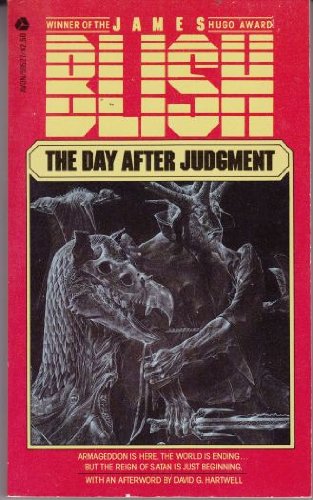
Reading Black Easter's sequel The Day After Judgment (1971) a few days ago, I realized I must have previously read at least halfway through the book, as I knew the transvection scene nearly word for word. Memory is a very tricky opponent when it wants to be: for nearly twenty years, I recalled very clearly that the transvection scene was in Black Easter


Blish biographer David Ketterer, in his useful essay "Imprisoned in a Tesseract: Black Easter and The Day After Judgement' by James Blish" [ The Missouri Review vol. 7 no. 2 (1984). p. 254.]  gives the scene short shrift:


....the episode where Ware flies a broomstick is more ridiculous than sublime.

     But it is surely not without point that this "transvection" (p. 163) experience is notable for being the first exterior scene and for being Blish's wildest flight of invention in the diptych. This correlation is, of course, indicative of the containment/flight opposition (and the transcendence of same) which is so dominant in Blish's work. 


Ketterer seems deaf to the scene's power and aesthetic authority.


The chapter takes place halfway through The Day After Judgment. Black magician Theron Ware tries to figure out how to travel from his Italian estate to Death Valley in the U.S., where the city of Dis has suddenly appeared (thanks entirely to his handiwork in Black Easter).


….the war was not yet over, and Ware might indeed find some way to make himself useful; Baines had been right about that, too. But in what way remained unclear. 

     Very probably, he would have to go to Dis to find out. It was a terrifying thought, but Ware could see no way around it. That was where the centre of power was now, where the war would henceforth be directed; and there, if Baines actually succeeded in reaching the SAC in Denver, Ware conceivably might succeed in arranging some sort of a detente. Certainly he would be of no use squatting here in ruined Italy, with all the superior spirits half a world away. 

     But how to get there? He did not have Baines's power to commandeer an aircraft, and though he was fully as wealthy as the industrialist – in fact most of the money had once been Baines's – it seemed wholly unlikely that any airline was selling tickets these days. A sea and overland journey would be too slow. 

     Would it be possible to compel ASTAROTH to provide him with some kind of an apport? This too was a terrifying thought. To the best of Ware's knowledge; the last magician to have ridden astride a devil had been Gerbert, back in the tenth century. He had resorted to it only to save his life from a predecessor of the Inquisition, whose attention he had amply earned; and, moreover, had lived through the ordeal to become Pope Sylvester II. 

     Gerbert had been a great man, and though Ware rather doubted that he had been any better a magician than Ware was, he did not feel prepared to try that conclusion just now. In any event, the process was probably unnecessarily drastic; transvection might serve the purpose just as well, or better. Though he had never been to a sabbat, he knew the theory and the particulars well enough. Included in the steel cabinets which held his magical pharmacopoeia were all the ingredients necessary for the flying ointment, and the compounding of it required no special time or ritual. As for piloting and navigation, that was to be sure a little alarming to anticipate, but if thousands upon thousands of ignorant old women had been able to fly a cleft stick, a distaff, a besom or even a shovel upon the first try, then so could Theron Ware. 

     First, however, he drew from the cabinet a flat slab of synthetic ruby, about the size and shape of an opened match folder; and from his cabinet of instruments, a burin. Upon the ruby, on the day of Mars, which is Tuesday, and in the hour of Mars, which is 0600. 1300, 2000 or 0300 on hat day, he would engrave the following seal and characters: 
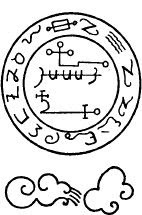


     This he would henceforth carry in his right shirt pocket, like a reliquary. Though he would accept no help from ASTAROTH if he could possibly avoid it, it would be well since he was going to be travelling in that fiend's domains, to be wearing his colours. As a purist, it bothered him a little that the ruby was synthetic, but his disturbance, he knew, was only an aesthetic one. ASTAROTH was a solar spirit, and the ancients, all the way through Albertus Magnus, had believed that rubies were engendered in the Earth by the influence of the Sun – but since they were not in fact formed that way, the persistence of the ruby in the ritual was only another example of one of the primary processes of magic, superstiiion, the gradual supremacy of the sign over the thing, so that so far as efficacy was concerned it did not matter a bit whether the ruby was synthetic or natural. Nature, too, obstinately refused to form rubies the size and shape of opened match folders. 

     For a magician, Ware reflected, there were indeed distinct advantages in being able to practise ten centuries after Gerbert had ridden upon his demon eagle. 


     Transvection, too, has its hazards, Ware discovered. He crossed the Atlantic without incident in well under three hours – indeed, he suspected that in some aspect beyond the reach of his senses, the flight was taking place only partially in real time – and it began to look as though he would easily reach his goal before dawn. The candle affixed by its own tallow to the bundle of twigs and rushes before him (for only the foolhardy fly a broomstick with the brush trailing, no matter what is shown to the contrary in conventional Halloween cartoons) burned as steadily as though he were not in motion at all, casting a brilliant light ahead along his path; any ships at sea that might have seen him might have taken him to be an unusually brilliant meteor. As he approached the eastern United States, he wondered how he would show up on radar; the dropping of the bomb two days ago suggested that there might still be a number of functioning radomes there. In quieter times, he though, he might perhaps have touched off another flying saucer scare. Or was he visible at all? He discovered that he did not know, but he began to doubt it; the seaboard was hidden in an immense pall of smoke. 

     But once over land, he slowed himself down and lost altitude in order to get his bearings, and within what seemed to him, to be only a very few minutes, he was grounded head over heels by the sound of a church bell forlornly calling what faithful might remain to midnight Mass. He remembered belatedly, when he got his wind back, that in some parts of Germany during the seventeenth-century flowering of the popular Goetic cults, it had been the custom to toll church bells all night long as a protection against witches who might be passing overhead on the way to the Brocken; but the memory did him no good now – the besom had gone lifeless. 

     He had fallen in a rather mountainous, heavily timbered area, quite like the Harz Mountain section of Germany, but which he guessed to be somewhere in western Pennsylvania. Though it was now late April, which was doubtless warm in Positano, the night here was decidedly cold, especially for a thin man clad in nothing more than a light smear of unguent. He was instantly and violently all ashiver, for the sound of the bell had destroyed the protective as well as the transvective power of the flying ointment. He hastily undid the bundle of clothes, which was tied to the broomstick, but there were not going to be enough of them; after all, he had assembled them with Death Valley in mind. Also, he was beginning to feel drowzy and dizzy, and his pulse was blurred and banging with tachycardia. Among other things, the flying ointment contained both mandragora and belladonna, and now that the magic was gone out of it, these were exerting their inevitable side effects. He would have to wash the stuff off the minute he could find a stream, cold or no cold. 

     And not only because it was drugging him. Still other ingredients of the ointment were rather specifically organic in nature, and these gave it a characteristic smell which the heat of his body would gradually ripen. The chances were all too good that there would be some people in this country of the Amish – and not all of them old ones – who would know what that odour meant. Until he had had some kind of a bath, it would be dangerous even to ask for help. 

     Before dressing, he wiped off as much of it as he could with the towel in which the clothing had been tied. This he buried, together with the taper and the brush from the besom; and after making sure that the ruby talisman was still safely in his pocket, he set out, using the denuded broomstick as a staff. 

     The night-black, hilly, forested countryside would have made difficult going even for an experienced walker. Ware's life, on the other hand, had been nearly inactive except intellectually, and he was on the very near side of his fiftieth birthday. To his advantage, on the other hand, stood the fact that he had always been small and wiry, and the combination of a slightly hyperthyroid metabolism and an ascetic calling – he did not even smoke – had kept him that way, so that he made fair progress; and an equally lifelong love of descriptive astronomy, plus the necessity of astrology to his art, helped to keep him going in the right direction, whenever he could see a few stars through the smoke. 

     Just before dawn, he stumbled upon a small, rocky-bedded stream, and through the gloom heard the sound of a nearby waterfall. He moved against the current and shortly found this to be a spillway of a small log dam. Promptly he stripped and bathed under it, pronouncing in a whisper as he did so all three of the accompanying prayers from the rite of lustration as prescribed for the preparatory triduum in the Grimorium Verum – though the water was neither warm nor exorcized, it was obviously pure, and that would have to do. 

     The ablution was every bit as cold as he had expected it to be, and even colder was the process of air-drying himself; but he endured it stoically, for he had to get rid of what remained of the ointment, and moreover he knew that to put on damp clothes would be almost as dangerous. While he waited, his teeth chattering, faint traces of light began to appear through the trees from the east. 

     In answer, massive grey rectangular shapes began to sketch themselves against the darkness downstream, and before long he was able to see that to the west – which was the way the stream was momentarily running – the aisle it cut through the trees opened out on to a substantial farm. As if in confirmation of help to come, a cock crowed in the distance, a traditionl ending for a night of magic. 

     But as the dawn continued to brighten, he saw that there would be no help for him here. Under the angle of the roof of the large barn nearest to him a circular diagram had been painted, like a formalized flower with an eye in it. 

     As Jack Ginsberg had taken the pains to find out long before he and his boss had even met the magician, Ware had been born and raised in the States and was still a citizen. As his name showed, his background was Methodist, but nevertheless he knew a hex sign when he saw one. And it gave him an idea. 

     He was not a witch, and he certainly had had no intention of laying a curse on this prosperous-looking farm ten seconds ago, but the opportunity to gather new data should not be missed. 

     Reaching into his shin pocket, he turned the ruby around so that the seal and characters on it faced outward. In a low voice, he said, THOMATOS. BENESSER, FLEANTER.' 

     Under proper circumstances these words of the Comte de Gabalis encompassed the operator with thirty-three several Intelligences, but since the circumstances were not proper, Ware was not surprised when nothing happened. For one thing, his lustration had been imperfect; for another, he was using the wrong talisman – the infernal spirits of the ceremony were not devils but salamanders or fire elements. Nevertheless he now added: 'LITAN, ISER, OSNAS.' 

     A morning breeze sprang up, and a leaflike whispering ran around him, which might or might not have been the voices of many beings, individually saying, 'NANTHER, NANTHERR NANTHER, NANTHER …' Touching the talisman, Ware said. 'GITAU, HURANDOS, RIDAS, TALIMOL.' and then, pointing to the barn, 'UUSUR, ITAR.' 

     The result should have been a highly localized but destructive earthquake, but there was not even a minor tremor, though he was pretty sure that he really heard the responsive voices of the fire spirits. The spell simply would not work under the eye of the hex sign – one more piece of evidence that the powers of evil were still under some kind of restraint. That was good to know, but in a way, too, Ware was quite disappointed; for had he gotten his earthquake, the further words SOUTRAM, UBARSINENS would have compelled the intelligences to carry him across the rest of his journey. He uttered them anyhow, but without result. 

     Neither in the Comte de Gabalis or its very late successor. The Black Pullet, did this ritual offer any word of dismissal, but nevertheless for safety's sake he now added; 'RABIAM.' Had this worked, he would have found himself carried home again, where at least he could have started over again with more ointment and another broomstick; but it did not. There was no recourse now but to seek out the farmhouse and try to persuade the farmer to give him something to eat and drive him to the nearest railhead. It was too bad that the man could not be told that he had just been protected by Ware from a demonic onslaught but unfortunately the Amish did not believe that there was any such thing as white magic – and in the ultimate analysis they were quite right not to do so, whatever delusions about the point might be harboured by Father Domenico and his fellows. 

     Ware identified the farmhouse proper without any trouble. It looked every bit as clean, fat and prosperous as the rest, but it was suspiciously quiet; by this hour, everyone should be up and beginning the day's chores. He approached with caution, alert for guns or dogs, but the silence continued. 

     The caution had been needless. Inside, the place was an outright slaughterhouse, resembling nothing so much as the last act of Webster's The White Devil. Ware inspected it with clinical fascination. The family had been a large one – the parents, one grandparent, four daughters, three sons and the inevitable dog – and at some time during the preceding night they had suddenly fallen upon each other with teeth nails, pokers, a buggy whip, a bicycle chain, a cleaver, a pig knife and the butt end of a smoothbore musket, old enough to have been a relic of the Boer War. It was an obvious case of simultaneous mass possession, probably worked through the women, as these things almost always were. Doubtless they would infinitely have preferred a simple localized earthquake, but from an attack like this no conceivable peasant hex sign could have protected them. 

     Probably nothing could have, for as it had turned out, in their simple traditional religiosity they had chosen the wrong side. Like most of humankind, they had been bom victims; even a beginning study of the Problem of Evil would have suggested to them that their God had never played fair with them, as indeed He had caused to be written out in Job for all to read; and their primitive backwoods demonology had never honestly admitted that there really were two sides to the Great Game, let alone allowing them any inkling of who the players were. 

     While he considered what to do next he prowled around the kitchen and the woodshed, where the larder was, trying not to Slip or step on anybody. There were only two eggs – today's had obviously not been harvested – but he found smoked, streaky rashers of bacon, a day-old loaf of bread just ripe for cutting, nearly a pound of country butter and a stone jug of cold milk. All in all it was a good deal more than he could eat, but he built a fire in the old wood-burning stove, cooked the eggs and the bacon, and did his best to put it all down. After all he had no idea when he would meet his next meal. He had already decided that he was not yet desperate enough to risk calling for an apport, but instead would keep walking generally westward until he met an opportunity to steal a car. (He would find none on the farm; the Amish still restricted themselves to horses.) 

     As he came out of the farmhouse into the bright morning, a sandwich in both hip pockets, he heard from the undestroyed barn a demanding lowing of cattle. Sorry, friends, he though; nobody's going to milk you this morning. 


Jay

22 August 2021