Subscribe to my Substack

Thursday, August 6, 2020

Coming events cast their shadows before them: Come Into My Parlour by Dennis Wheatley (1946).


....Sir Pellinore had popped a dose of veronal into Gregory's last drink, so he slept until nearly midday. On waking he felt pretty heady but he remembered perfectly clearly all that had taken place the night before. For a little he lay in bed torturing himself with thoughts of what might be happening to Erika; but, after a bit, he realised that he was acting like a fool, as unnerving speculations about her could do neither her nor him any good, and that his best hope of defeating Grauber lay in regarding the problem of her rescue as coldly and logically as if it was no personal concern of his at all.

After a bath he felt slightly better; then, downstairs, he had a Pim and three cocktails with Sir Pellinore, which made him feel more his own man.

When they had lunched Sir Pellinore provided the best possible antidote to his guest's depression. Upstairs in his library he had a fine collection of maps, both historical and modern, and he produced a great pile, all showing either Lake Constance or the ancient Kingdom of Wurttemberg, in which Schloss Niederfels lay. Work, and work connected with the hazardous journey he was soon about to undertake, was the very thing Gregory needed to occupy his mind. He spent most of the rest of the day concentrating on memorising the names of German villages, the by-roads that connected them and the situation of wooded areas which would give good cover if required.

On the Monday morning Sir Pellinore introduced both Gregory and Stefan to a clever-looking little man wearing thick-lensed spectacles. He had at one time been a dentist but, owing to the war, had gravitated to certain highly specialised duties connected with sabotage operations. From a little box he produced some small squares of hardish, jelly-like substance each of which had a little lump in its middle. The lump was the cyanide of potassium and its coating so composed that, with a little pressure, it would stick to the side of a back tooth and, once stuck, would need a really hard thrust of the tongue to dislodge.

"If you—er—get into trouble," he explained gently, "you simply rip it off with your tongue and bite through its centre. The result is very swift and, I believe, affects the user only by a sudden contraction, as though he were about to give a violent sneeze.

"You will see," he went on, "that they are of two colours. The green ones are dummies for you to practise with; the red ones are the real thing. Both kinds can be kept permanently in the mouth for a considerable time without any likelihood of their dissolving and becoming dangerous. But, if necessary, I advise that you should replace a used one by a new one after a fortnight. Now, I'd like to look at your mouths to decide the most suitable places for you to wear them."

Having asked on which side of their mouths they chewed by preference, he made a very careful examination of their teeth, and affixed two of the dummies. Then, wishing them good luck, he departed....


Come Into My Parlour by Dennis Wheatley (1946).

We are in Ashenden country here: Switzerland and Russia.

Come Into My Parlour is one of the more focused Sallust novels. There are nice atmospheric touches: Gregory and Stefan jaunting between Russian and German lines in a stolen vehicle during a blizzard as they travel from Leningrad to Moscow; nighttime criscrossings of the Bodensee; hide and seek in a castle suitable for a Dornford Yates thriller.

I wish Wheatley were a better writer. Imagine his vigor, inventiveness and scope combined with pen of a Maugham, a Waugh, or a Fleming. The arcs of his plots are usually sound in 1940s terms. His love of high living with fine food and spirits is always welcome. But as the sentences themselves go by, it feels like a long ride on highway rumble strips.

Wheatley's Sallust thrillers would have benefitted from parallel action in alternating chapters. In Come Into My Parlour we get huge chunks Erika being lured to Lake Constance so that she can be kidnapped as bait to lure Sallust; then a chunk of Gregory and Stefan in Russia, interviewing Voroshilov and evading Grauber. Today's thriller writers would weave the simultaneous events together by cross-cutting and employing shorter chapters.

Politically, Wheatley being Wheatley, we get the usual stuff about how decent a gent Admiral Canaris was and how Mussolini was just fine until he started getting too tightly bound-up with Hitler in '39. It's a solid example of petty bourgeois anti-communist opinion, and of the double-entry moral bookkeeping made famous by the middle class left and right.

Canaris and Himmler's plan to lure Sallust into Germany is ingenious, and I will leave it to the reader to savor. Canaris's appearance brought back the enjoyable 1970s World War Two thrillers of Jack Higgins.

The S.S. villain Grauber leaves a lot to be desired. Wheatley describes him first as a "mincing pervert," then as an implacable and physically dangerous opponent, then as a coward. The one thing Grauber is never graced with by his creator is the idea to just shoot Sallust when he has him in hand. Like Dr. Evil dealing with Austin Powers, everything is deferred and deflected to give Sallust a lifeline.

From the above paragraphs it sounds like I disliked Come Into My Parlour, that I am picking it apart with gripes. In fact I enjoyed the novel, an absurd and impossible fantasy filled with good food, good drink, good friends, good scenery, and a good fight.


Jay
29 April 2018

Tuesday, August 4, 2020

The solace of our declining years: The Return of Bulldog Drummond by H.C. McNeile

The Return of Bulldog Drummond (1932) is the strongest novel in the series thus far.

It begins with a heavy fog on Dartmoor, an escaped convict, and a young man in a doomed flight to save his own life. It ends in wit and humor in sparkling sunshine after the thwarting of an ingenious caper. A group of charlatans, con men, and grifters is fought to a standstill by Drummond and his "black gang."

In this novel our vigilantes rely on wit, intelligence, and expert advice from knowledgeable friends to come out on top. And until the end it is a question whether they will or not. In several chapters Drummond himself makes the biggest mistakes and miscalculations.


This adds to the freshness, as does the handling of omniscient point of view.

The first three chapters are set on Dartmoor and in the secret-passage-rich old dark Glensham House. They are superbly moody chapters, and they feature escaped convict, ghost, and brutal murder. After that the caper motif predominates and the mood brightens.

Happily Drummond's wife is visiting the U.S. for the duration of the novel. Even when Irma Peterson shows up for a few pages, we know we are safe from the frustrating  absurdities of another kidnapping plot, which doomed The Female of The Species to my black list.

Jay

3/25/17


_______


From Chapter 2:

….Glensham House was a large, rambling old place.
It stood on low ground surrounded by trees, about half-way between the main road and the deadly Grimstone Mire. For generations it had belonged to the Glensham family, but increasing taxation and death dues had so impoverished the present owner that he had been compelled to let.
Legends about the place abounded, and though some of them were undoubtedly founded on fact, many were merely local superstitions. For the house was an eerie one, set in eerie surroundings: the sort of place round which stories would be likely to grow—especially in the West Country.
But whatever the truth of some of the modern yarns—strange lights seen without human agency, footsteps when there was no one there to make them—certain of the older legends were historically true. The house was honeycombed with secret passages, and there was documentary proof that it had sheltered many of the Royalists during the Civil War with Cromwell.
For the last two years it had been empty, the tenants having left abruptly because, so they said, of the servant troubles. An old woman who lived in a cottage not far away had aired the place and kept it more or less clean, but there was a dark and unlived-in atmosphere about the house as it loomed up that made the man who was feeling his way cautiously forward along the edge of the drive shiver involuntarily and hesitate.
He was cold and hungry: for eight hours, like a phantom, he had been dodging other phantoms through the fog. Once he had butted straight into a woman, and she, after one glance at his clothes, had fled screaming. He had let her go: anyway there would not have been much good in attempting to follow her in that thick blanket of mist.
And in some ways he was glad she had seen him.
Already he was regretting bitterly the sudden impulse that had made him bolt, and she would most certainly say she had seen him, which would localise the hunt. In fact, only a certain pride and the knowledge that he was hopelessly lost prevented him from going back to the prison and giving himself up.
Sheer chance had guided his footsteps to Glensham House. He knew the dangers of the moor in a fog: he knew that the risk he ran of being caught by a patrol of warders was a lesser evil far than a false step into tone of those treacherous green bogs, from which there was no return. But he also knew that the main road was more dangerous than a side track, and when he had accidentally blundered off the smooth surface on to gravel he had followed the new direction blindly. Food and sleep were what he wanted: then perhaps he would feel more capable of carrying on. Perhaps he might even do the swine yet, and make a clear get away. Other clothes, of course—but that would have to wait. It was food first and foremost.
And now he stood peering at the house in front of him. He could see no trace of a light: not a sound broke the silence save the melancholy drip, drip from the sodden branches above his head.
And once again did Morris, the Sydenham murderer, shiver uncontrollably.
Like most men of low mentality, anything at all out of the ordinary frightened him. And having been born in a town, and lived all his life in crowds, the deadly stillness of this gloomy house almost terrified him. But hunger was stronger than fear: where there was a house there was generally food, and to break into a place like this was child's play to him.
He took a few steps forward until he reached the wall: then he began to circle slowly round the house in the hope of finding a window unlatched.
To save himself trouble had always been his motto, and in case there should be anyone about it would minimise the risk of making a noise. But ten minutes later he was back at his starting point without having found one open. He had passed three doors, all bolted, and he had definitely decided in his own mind that the place was empty.
And now the question arose as to what to do.
If it was empty there would probably be no food: at the same time it was shelter—shelter from this foul fog. He would be able to sleep: and, he might find something to eat. Perhaps the owners were only away for the night, in which case he might even get some other clothes. Anyway it was worthwhile trying, and a couple of minutes later there came a sharp click, followed by the sound of a window being gently raised.
Inside the room he paused again and listened: not a sound. Once a board cracked loudly outside the door, and he waited tensely. But there was no repetition, and after a while he relaxed.
"Empty," he muttered to himself. "I guess we'll do a bit of exploring, my lad."
He turned and softly shut and rebolted the window. Then he crept cautiously towards the door. There was a carpet on the floor, but except for that it struck him the room was very sparsely furnished. And hopes of food drooped again, only to be resurrected as he tiptoed into the hall.
For close beside him in the darkness a clock was ticking. Another thing struck him also: the temperature in the hall seemed appreciably warmer than in the room he had just left.
He paused irresolutely: he was beginning to doubt after all if the house was empty. And then the clock began to strike. He counted the chimes—eight: why, if there were people in the house, were they all upstairs or in bed so early?
The darkness was absolute, and if he had had any matches he would have chanced it and struck one. But matches are not supplied to His Majesty's convicts, and so he could only grope forward blindly and trust to luck that he would not kick anything over.
He wanted, if he could, to locate the kitchen, as being the most likely place to find food. And so, guessing it would be at the back of the house, he tried to move in a straight line directly away from the room by which he had entered. And he had taken about ten paces when his foot struck something. All too late he knew what it was—one of those rickety little tables which are specially designed to upset on the slightest provocation.
He felt it going, and his hand shot out to try to save it, with the result that he gave it the coup de grace. It fell with a crash, and a thing that sounded as if it must be a brass bowl went with it.
In the silence the noise was appalling, and the convict, with the sweat pouring off his forehead, stood motionless. He'd find out now sure enough if the house was empty or not. Was that somebody moving upstairs, or was it his imagination?
He waited for what seemed an eternity: no further sound came. And at length his heart ceased to race, and with a sigh of relief he wiped his forehead with the back of his hand. Safe, so far.
Once more he went cautiously ahead, and a few moments later he bumped into a door. He tried the handle: it was unlocked, and he opened it. And at once he knew that he had struck lucky, for there came to his nostrils the unmistakable smell of food. Another thing, too—and this time there was no doubt at all about it—the room he was now in was much warmer. He groped his way forward, until his hands encountered a table—a solid, substantial table. Very gently he moved them over the surface. What was that? A cup and saucer, a loaf of bread, and last but not least a candle. And if there was a candle there might be matches.
He went on feeling with his fingers: a knife, a plate with meat on it, and—but that seemed too good to be true—a bottle with a screw stopper: a bottle of a shape he had only seen in his dreams for years: a bottle of beer. And then, when he had almost decided to begin to eat, he touched a box of matches.
For a while he hesitated: was it safe? There was still no sound from outside, and he decided to risk it: he wanted to gloat over that wonderful bottle. The next moment the candle illuminated the repast in front of him, and like a famished wolf the convict fell on it.
He tore the bread in hunks from the loaf, beautiful white bread the taste of which he had almost forgotten. He crammed his mouth with beef— beef cut in thin slices. And finally he washed it down will great gulps of beer.
At last the immediate pangs were appeased, and he began to think things over. The room he was in was apparently the servants' hall, and since the meal had obviously not been prepared for him, there must be someone in the house. Then why had nothing happened when he upset the table in the hall?
After a while a possible solution dawned on him. The owners of the house were clearly away, and had left the house in charge of a caretaker, who had gone out and been unable to get back owing to the fog.
The point was, would he or she return that night? And even as he cogitated over it, his throat turned dry and he froze into a rigid block of terror. A mirror was hanging on the wall in front of him, and in it he could see the reflection of the door behind his chair. And it was slowly opening.
He watched it with distended eyes, unable to move or speak: what was coming in? And nothing came: as silently as it had opened, it closed: almost he might have imagined the whole thing.
But he knew he hadn't imagined it: he knew that the door had opened and shut. Who had done it? Who had peered in and seen him sitting there? He had heard no sound: he had seen nothing. But that silent watcher had seen him!
At last he forced himself to get up from his chair and turn round. The movement caused the candle to flicker, and the distorted shadows danced fantastically on the walls and ceiling. The only sound in the room was his heavy breathing as be stared fearfully at the door. Who was on the other side?
He took a step forward: another. And then with a sudden run he darted at it and flung it open. The passage was empty: there was no one there.
He rubbed his eyes dazedly: then, going back into the room, he got the candle, and holding it above his head once again examined the passage. No sign of anyone: no sound. The door which led into the hall was shut: so were two others that he could see. And suddenly a thought occurred to him that drove him back into the room almost frantic with fear: supposing there had never been anyone there, supposing it had been a ghost that had stood in the passage?
Almost gibbering with terror, he shut the door again and fumbled wildly for the key. It was not there: if there was one at all, it was on the other side of the door. But not for a thousand pounds would Morris, brutal murderer though he might have been, have opened it again. All the horrors of the unknown were clutching at his heart: he would have positively welcomed the tramp of heavy boots in the hall, and the sight of a warder with a gun.
Keeping the table between him and the door, he crouched on the floor, staring with fascinated eyes at the handle. Was it going to turn again or not?
And after a while imagination began to play him tricks: he thought it was moving, and he bit his hand to prevent himself crying out. And then it didn't: nothing happened.
Suddenly he straightened up: for the moment the ghost was forgotten. A sound had come from above his head—the unmistakable sound of a footstep. It was repeated, and he stood there staring upwards, listening intently. No ghost about that, be reflected: somebody was in the room above him, and by the heaviness of the tread it sounded like a man.
He leaned forward to blow out the candle: then he paused, torn between two conflicting fears. If he left it burning it might be seen, but if he blew it out the room would be in darkness. And darkness with the thing outside in the passage was impossible to contemplate: if the door was going to open again he felt he must see it. And even as he hesitated there came a strange, half—strangled cry from overhead followed by a heavy bump that shook the ceiling.
He began to tremble violently: things were happening in this house that he could not understand. Give him a squalid slum, the lowest of boozing dens with murder in the air, and he was as good a man as anyone. But this was something he had never met before, and it was making him sweat cold. That noise upstairs—it wasn't normal: and now there were other sounds, for all the world like the flounderings of some huge fish on the floor above. Gradually they died away, and once again silence settled on the house.
After a while, as the silence continued, he grew a little calmer: he must decide what he was going to do. On one thing he was absolutely determined: clothes or no clothes, nothing would induce him to go upstairs. And the only point was whether he should go through the window now and out into the foggy night, or whether he dared to wait a few more hours. He opened the shutters, and found the point was settled for him: there were bars outside, and so that means of exit was cut out. And the bare idea of going through the hall until daylight came was out of the question.
He sat down once more in the chair by the table, and tilted up the bottle of beer to see if by chance a drop remained. Then he spied a cupboard in the corner, and crossing the room he looked inside. And there, to his joyful amazement, he found five more. He greedily seized one, and turned back towards the table to get the glass.
And the next moment the bottle fell from his nerveless fingers on the carpet. For the door had opened again.
He stared at it, making hoarse little croaking noises in his throat. He was in such a position that he could not see into the passage. All he knew was that was open wide enough to admit a human being, or whatever it was that was outside.
And now it was opening wider still, and he cowered back with his arm over his eyes. In another second he felt he would yell: his reason would give.
And then suddenly the tension snapped. He heard a voice speaking, and it was a woman's voice, though curiously deep and solemn.
"My poor man, do not be frightened. I am here to help you."


From Chapter 2
....Glensham House was a large, rambling old place.
It stood on low ground surrounded by trees, about half-way between the main road and the deadly Grimstone Mire. For generations it had belonged to the Glensham family, but increasing taxation and death dues had so impoverished the present owner that he had been compelled to let.
Legends about the place abounded, and though some of them were undoubtedly founded on fact, many were merely local superstitions. For the house was an eerie one, set in eerie surroundings: the sort of place round which stories would be likely to grow—especially in the West Country.
But whatever the truth of some of the modern yarns—strange lights seen without human agency, footsteps when there was no one there to make them—certain of the older legends were historically true. The house was honeycombed with secret passages, and there was documentary proof that it had sheltered many of the Royalists during the Civil War with Cromwell.
For the last two years it had been empty, the tenants having left abruptly because, so they said, of the servant troubles. An old woman who lived in a cottage not far away had aired the place and kept it more or less clean, but there was a dark and unlived-in atmosphere about the house as it loomed up that made the man who was feeling his way cautiously forward along the edge of the drive shiver involuntarily and hesitate.
He was cold and hungry: for eight hours, like a phantom, he had been dodging other phantoms through the fog. Once he had butted straight into a woman, and she, after one glance at his clothes, had fled screaming. He had let her go: anyway there would not have been much good in attempting to follow her in that thick blanket of mist.
And in some ways he was glad she had seen him.
Already he was regretting bitterly the sudden impulse that had made him bolt, and she would most certainly say she had seen him, which would localise the hunt. In fact, only a certain pride and the knowledge that he was hopelessly lost prevented him from going back to the prison and giving himself up.
Sheer chance had guided his footsteps to Glensham House. He knew the dangers of the moor in a fog: he knew that the risk he ran of being caught by a patrol of warders was a lesser evil far than a false step into tone of those treacherous green bogs, from which there was no return. But he also knew that the main road was more dangerous than a side track, and when he had accidentally blundered off the smooth surface on to gravel he had followed the new direction blindly. Food and sleep were what he wanted: then perhaps he would feel more capable of carrying on. Perhaps he might even do the swine yet, and make a clear get away. Other clothes, of course—but that would have to wait. It was food first and foremost.
And now he stood peering at the house in front of him. He could see no trace of a light: not a sound broke the silence save the melancholy drip, drip from the sodden branches above his head.
And once again did Morris, the Sydenham murderer, shiver uncontrollably.
Like most men of low mentality, anything at all out of the ordinary frightened him. And having been born in a town, and lived all his life in crowds, the deadly stillness of this gloomy house almost terrified him. But hunger was stronger than fear: where there was a house there was generally food, and to break into a place like this was child's play to him.
He took a few steps forward until he reached the wall: then he began to circle slowly round the house in the hope of finding a window unlatched.
To save himself trouble had always been his motto, and in case there should be anyone about it would minimise the risk of making a noise. But ten minutes later he was back at his starting point without having found one open. He had passed three doors, all bolted, and he had definitely decided in his own mind that the place was empty.
And now the question arose as to what to do.
If it was empty there would probably be no food: at the same time it was shelter—shelter from this foul fog. He would be able to sleep: and, he might find something to eat. Perhaps the owners were only away for the night, in which case he might even get some other clothes. Anyway it was worthwhile trying, and a couple of minutes later there came a sharp click, followed by the sound of a window being gently raised.
Inside the room he paused again and listened: not a sound. Once a board cracked loudly outside the door, and he waited tensely. But there was no repetition, and after a while he relaxed.
"Empty," he muttered to himself. "I guess we'll do a bit of exploring, my lad."
He turned and softly shut and rebolted the window. Then he crept cautiously towards the door. There was a carpet on the floor, but except for that it struck him the room was very sparsely furnished. And hopes of food drooped again, only to be resurrected as he tiptoed into the hall.
For close beside him in the darkness a clock was ticking. Another thing struck him also: the temperature in the hall seemed appreciably warmer than in the room he had just left.
He paused irresolutely: he was beginning to doubt after all if the house was empty. And then the clock began to strike. He counted the chimes—eight: why, if there were people in the house, were they all upstairs or in bed so early?
The darkness was absolute, and if he had had any matches he would have chanced it and struck one. But matches are not supplied to His Majesty's convicts, and so he could only grope forward blindly and trust to luck that he would not kick anything over.
He wanted, if he could, to locate the kitchen, as being the most likely place to find food. And so, guessing it would be at the back of the house, he tried to move in a straight line directly away from the room by which he had entered. And he had taken about ten paces when his foot struck something. All too late he knew what it was—one of those rickety little tables which are specially designed to upset on the slightest provocation.
He felt it going, and his hand shot out to try to save it, with the result that he gave it the coup de grace. It fell with a crash, and a thing that sounded as if it must be a brass bowl went with it.
In the silence the noise was appalling, and the convict, with the sweat pouring off his forehead, stood motionless. He'd find out now sure enough if the house was empty or not. Was that somebody moving upstairs, or was it his imagination?
He waited for what seemed an eternity: no further sound came. And at length his heart ceased to race, and with a sigh of relief he wiped his forehead with the back of his hand. Safe, so far.
Once more he went cautiously ahead, and a few moments later he bumped into a door. He tried the handle: it was unlocked, and he opened it. And at once he knew that he had struck lucky, for there came to his nostrils the unmistakable smell of food. Another thing, too—and this time there was no doubt at all about it—the room he was now in was much warmer. He groped his way forward, until his hands encountered a table—a solid, substantial table. Very gently he moved them over the surface. What was that? A cup and saucer, a loaf of bread, and last but not least a candle. And if there was a candle there might be matches.
He went on feeling with his fingers: a knife, a plate with meat on it, and—but that seemed too good to be true—a bottle with a screw stopper: a bottle of a shape he had only seen in his dreams for years: a bottle of beer. And then, when he had almost decided to begin to eat, he touched a box of matches.
For a while he hesitated: was it safe? There was still no sound from outside, and he decided to risk it: he wanted to gloat over that wonderful bottle. The next moment the candle illuminated the repast in front of him, and like a famished wolf the convict fell on it.
He tore the bread in hunks from the loaf, beautiful white bread the taste of which he had almost forgotten. He crammed his mouth with beef— beef cut in thin slices. And finally he washed it down will great gulps of beer.
At last the immediate pangs were appeased, and he began to think things over. The room he was in was apparently the servants' hall, and since the meal had obviously not been prepared for him, there must be someone in the house. Then why had nothing happened when he upset the table in the hall?
After a while a possible solution dawned on him. The owners of the house were clearly away, and had left the house in charge of a caretaker, who had gone out and been unable to get back owing to the fog.
The point was, would he or she return that night? And even as he cogitated over it, his throat turned dry and he froze into a rigid block of terror. A mirror was hanging on the wall in front of him, and in it he could see the reflection of the door behind his chair. And it was slowly opening.
He watched it with distended eyes, unable to move or speak: what was coming in? And nothing came: as silently as it had opened, it closed: almost he might have imagined the whole thing.
But he knew he hadn't imagined it: he knew that the door had opened and shut. Who had done it? Who had peered in and seen him sitting there? He had heard no sound: he had seen nothing. But that silent watcher had seen him!
At last he forced himself to get up from his chair and turn round. The movement caused the candle to flicker, and the distorted shadows danced fantastically on the walls and ceiling. The only sound in the room was his heavy breathing as be stared fearfully at the door. Who was on the other side?
He took a step forward: another. And then with a sudden run he darted at it and flung it open. The passage was empty: there was no one there.
He rubbed his eyes dazedly: then, going back into the room, he got the candle, and holding it above his head once again examined the passage. No sign of anyone: no sound. The door which led into the hall was shut: so were two others that he could see. And suddenly a thought occurred to him th

From Chapter 3
....it was not until they reached the main road that he spoke again.
"There's no doubt about it, boys," he said, "that that little bunch of beauties is pretty high up in the handicap. It's a pleasure to have met them. There's a calm nerve about their doings which beats the band. It's gorgeous. And having shown us the damned old ghost, the subtle way Hardcastle got round the Inspector was a delight. The actual suggestion to say nothing about it came much better from the police than from anyone else."
"I gathered from your face you were a bit sceptical about the spectre," said Darrell.
"Sceptical!" laughed Drummond. "I should say. For a moment I admit I was taken in: the thing was staged so well. And I'd been going on the assumption that there was only one female in the house. But then I went back to our one basic idea—that Morris was speaking the truth. And that being so, the Inspector's profound statement that a ghost can't carry a suit of clothes on its arm assumes a rather different complexion from what the worthy warrior intended. That was the woman whom Morris saw, and who gave him the clothes. And having done her little piece at the top of the stairs, she backed into 'honey's' room, who then bolted the door and let out an ear-splitter. Meanwhile, the ghost vanishes through some secret panel, and that's that."
"Probably you're right, old boy," said Jerningham. "But for the life of me I can't see their object in doing it."
"That's what I was trying to get at, Ted, all the time we were in the hall. And I think it's this way. Their original plan miscarried owing to our being there, and so they had to amend it. They knew the police would arrive shortly, and that from then on there would always be at least one constable in the house. They knew also that we should mention the woman, which would cause awkward questions. So the first thing they do is to send the Comtessa along after us—I saw the marks of footsteps leaving that panel in the hall—partially to find out what we were going to say, and partially to sustain the bluff that she had been in Plymouth. Now, since that cry we heard was almost certainly Morris in Grimstone Mire, the sweet thing must have known of his death before she saw us. And, incidentally, I wonder if he fell or was pushed: his death was a godsend to them. However, to continue— back we go with the lady, who is suitably greeted by dear Dad, once more registering her absence in Plymouth. Then what about the other woman? If 'honey' was in Plymouth, what about the female Morris said he saw? Where was she? Or was it a complete invention? Great idea—stage her as a ghost; and, as I said before, they staged her damned well."
"Do you really think—we ought to let them get away with it?" said Darrell.
"How can we prevent it, old boy? If Morris wasn't dead, I'd agree with you: he may have been a swine, but we couldn't have let the poor blighter swing without making an effort to save him. But now he's dead, what's the use of worrying? Put it how you will, the only thing we can say is that we believed his story. Who cares? We should merely be regarded as gullible mugs. No, our line is to pretend that we are in complete agreement with the theory put forward by the Inspector, and once the inquest is over set to work from the other end. I'm inclined to think that if there are any survivors left at all of the firm of Marton, Peters and Newall, we might be able to get on to something."
"I'm just wondering," said Jerningham, "if by chance that is one Dick Newall with whom I've played a lot of golf. As far as I remember, he is a legal bird of sorts."
"The rum thing, to my mind, is what they're doing down here at all," said Darrell, as they turned in at the gate of Merridale Hall.
"The solution of that little problem, old lad," cried Drummond, "may possibly prove to be the solace of our declining years. But don't forget that the one essential thing is to make that bunch believe that they've fooled us. We've got to do a bit in the acting line ourselves. For, unless I'm much mistaken, the situation is this at the moment. They know they've bluffed the Inspector: they're not certain about us. And it therefore behoves us to allay their maidenly fears. Even as the trout must we swallow their little effort. And that is going to entail a certain discretion at the inquest: I should loathe to get it in the neck for perjury."

From Chapter 9
....Gloomily he ordered himself some more port. What a ghastly fiasco the whole thing had turned out! He felt bored stiff, and though he tried to assure himself that he was acting as a worthy and God-fearing citizen in unmasking such villainy, his boredom only increased. There was no sport in it. No humour of any sort whatever. He was simply doing a common or garden spying job for a nasty-looking specimen of humanity who wanted the notoriety without incurring the risk.

From Chapter 9
..... "Peruvian Eagles are a big oil concern. Up to a few days ago they were regarded in the City as being one of the finest investments—a little speculative, of course—obtainable. Then rumours began to circulate that all was not too well with the child. At first it was nothing more than that; then suddenly it began to come out that Sir Edward Greatorex, a man you may have heard of, and who holds far more than fifty per cent. of the shares, was selling them as fast as he could. That started the rot."

From Chapter 11
....carrying out a real crime under the cover of the same crime on the film.


The Return of Bulldog Drummond
http://freeread.com.au/@rglibrary/Sapper/BD07-TheReturnOfBulldogDrummond.html

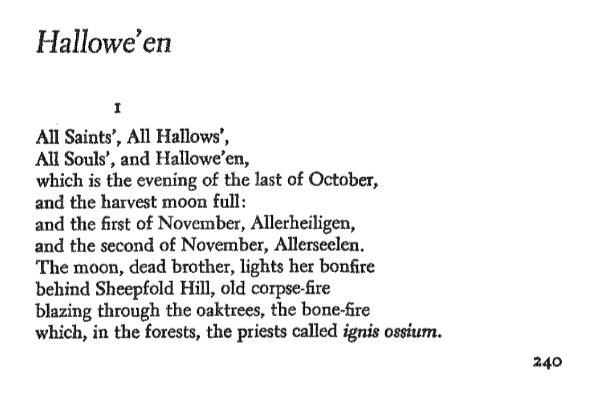
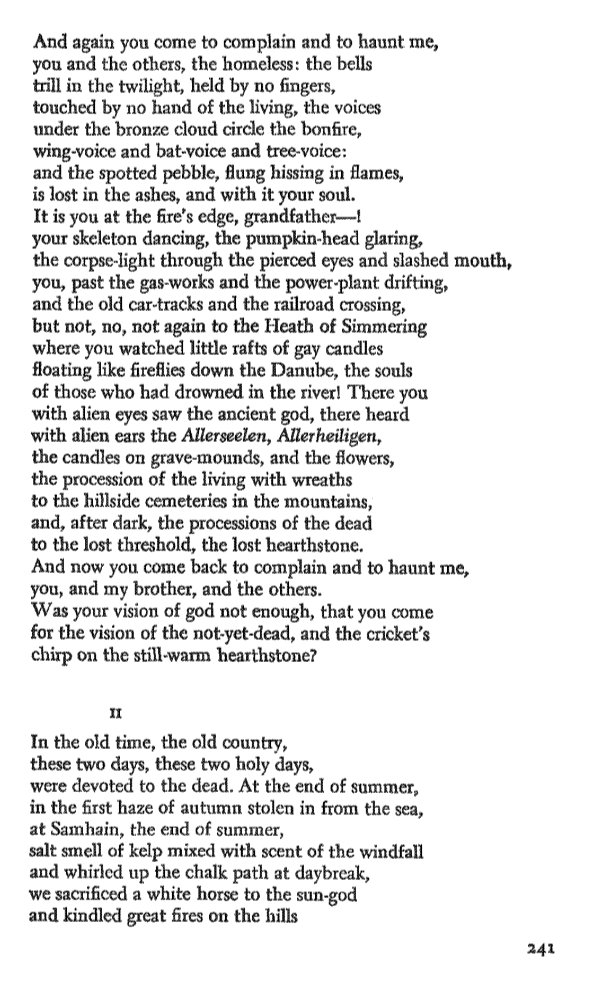
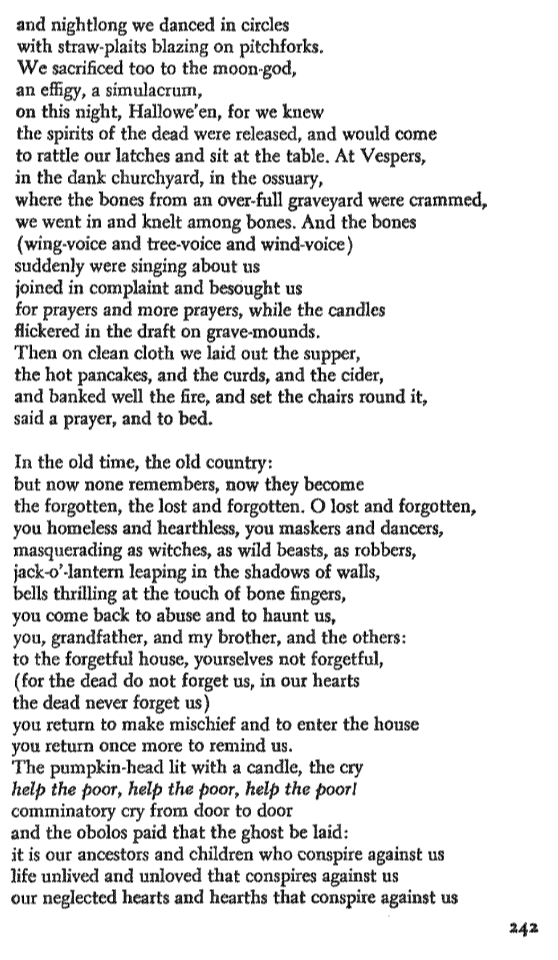
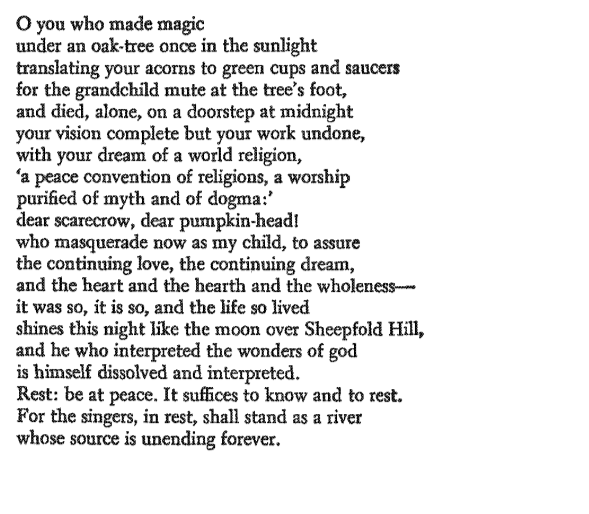
Hallowe'en by Conrad Aiken


From Skylight One (1949)


* * *


https://drive.google.com/file/d/1dcG7cQkFKbYUMNQ7EEKgf2RfyKj26hSa/view?usp=drivesdk


Sunday, August 2, 2020

The lonesome death of Charlie Rhodes: Salem's Lot by Stephen King

A favorite scene from Stephen King's 1975 novel Salem's Lot: the demise of smalltown Maine school bus driver Charlie Rhodes.


   In the Lot the dark held hard.

    At ten minutes to twelve, Charlie Rhodes was awakened by a long, steady honking. He came awake in his bed and sat bolt upright.

    His bus!

    And on the heels of that:

    The little bastards! The children had tried things like this before. He knew them, the miserable little sneaks. They had let the air out of his tires with matchsticks once. He hadn’t seen who did it, but he had a damned good idea. He had gone to that damned wet-ass principal and reported Mike Philbrook and Audie James. He had known it was them-who had to see?

    Are you sure it was them, Rhodes?

    I told you, didn’t I?

    And there was nothing that fucking Mollycoddle could do; he had to suspend them. Then the bastard had called him to the office a week later.

    Rhodes, we suspended Andy Garvey today.

    Yeah? Not surprised. What was he up to?

    Bob Thomas caught him letting the air out of his bus tires. And he had given Charlie Rhodes a long, cold, measuring look.

    Well, so what if it had been Garvey instead of Philbrook and James? They all hung around together, they were all creeps, they all deserved to have their nuts in the grinder.

    Now, from outside, the maddening sound of his horn, running down the battery, really laying on it:

    WHONK, WHONNK, WHOONNNNNNNNK -

    ‘You sons of whores,’ he whispered, and slid out of bed. He dragged his pants on without using the light. The light would scare the little scumbags away, and he didn’t want that.

    Another time, someone had left a cow pie on his driver’s seat, and he had a pretty good idea of who had done that, too. You could read it in their eyes. He had learned that standing guard at the repple depple in the war. He had taken care of the cow-pie business in his own way. Kicked the little son of a whore off the bus three days’ running, four miles from home. The kid finally came to him crying.

    I ain’t done nothin’, Mr Rhodes. Why you keep kickin’ me off.?

    You call puttin’ a cow flop on my seat nothin’?

    No, that wasn’t me. Honest to God it wasn’t.

    Well, you had to hand it to them. They could lie to their own mothers with a clear and smiling face, and they probably did it, too. He had kicked the kid off two more nights and then he had confessed, by the Jesus. Charlie kicked him off once more-one to grow on, you might say-and then Dave Felsen down at the motor pool told him he better cool it for a while.

    WHONNNNNNNNNNNNNNNNK-

    He grabbed his shirt and then got the old tennis racket standing in the corner. By Christ, he was going to whip some ass tonight!

    He went out the back door and around the house to where he kept the big yellow bus parked. He felt tough and coldly competent. This was infiltration, just like the Army.

    He paused behind the oleander bush and looked at the bus. Yes, he could see them, a whole bunch of them, darker shapes behind the night-darkened glass. He felt the old red rage, the hate of them like hot ice, and his grip on the tennis racket tightened until it trembled in his hand like a tuning fork. They had busted out-six, seven, eight-eight windows on his bus!

    He slipped behind it and then crept up the long yellow side to the passenger door. It was folded open. He tensed, and suddenly sprang up the steps.

    ‘All right! Stay where you are! Kid, lay off that goddamn horn or I’ll-’

    The kid sitting in the driver’s seat with both hands plastered on the horn ring turned to him and smiled crazily. Charlie felt a sickening drop in his gut. It was Richie Boddin. He was white-just as white as a sheet-except for the black chips of coal that were his eyes, and his lips, which were ruby red.

    And his teeth -

    Charlie Rhodes looked down the aisle.

    Was that Mike Philbrook? Audie James? God Almighty, the Griffen boys were down there! Hal and Jack, sitting near the back with hay in their hair. But they don’t ride on my bus! Mary Kate Greigson and Brent Tenney, sitting side by side. She was in a nightgown, he in blue jeans and a flannel shirt that was on backward and inside out, as if he had forgotten how to dress himself.

    And Danny Glick. But-oh, Christ-he was dead; dead for weeks!

    ‘You,’ he said through numb lips. ‘You kids-’

    The tennis racket slid from his hand. There was a wheeze and a thump as Richie Boddin, still smiling that crazy smile, worked the chrome lever that shut the folding door. They were getting out of their seats now, all of them.

    ‘No,’ he said, trying to smile. ‘You kids… you don’t understand. It’s me. It’s Charlie Rhodes. You… you…’ He grinned at them without meaning, shook his head, held out his hands to show them they were just ole Charlie Rhodes’s hands, blameless, and backed up until his back was jammed against the wide tinted glass of the windshield.

    ‘Don’t,’ he whispered.

    They came on, grinning. ‘Please don’t.’

    And fell on him.


Jay

28 September 2017


The Screaming Skull by F. Marion Crawford

#HBD F. Marion Crawford 🎂 🍾
Birthdate: 2 August 1854

....That's a good fire, isn't it? When driftwood gets started at last there's nothing like it, I think. Yes, we get lots of it, for I'm sorry to say there are still a great many wrecks about here. It's a lonely coast, and you may have all the wood you want for the trouble of bringing it in. Trehearn and I borrow a cart now and then, and load it between here and the Spit. I hate a coal fire when I can get wood of any sort. A log is company, even if it's only a piece of a deck-beam or timber sawn off, and the salt in it makes pretty sparks. See how they fly, like Japanese hand-fireworks! Upon my word, with an old friend and a good fire and a pipe, one forgets all about that thing upstairs, especially now that the wind has moderated. It's only a lull, though, and it will blow a gale before morning....

THE SCREAMING SKULL 
BY
F. MARION CRAWFORD

https://www.gutenberg.org/files/40386/40386-h/40386-h.htm#Page_41


Saturday, August 1, 2020

"A Vignette" by Montague Rhodes James

....To be sure, it is difficult, in anything like a grove, to be quite certain that nobody is making a screen out of a tree trunk and keeping it between you and him as he moves round it and you walk on. All I can say is that if such an one was there he was no neighbour or acquaintance of mine, and there was some indication about him of being cloaked or hooded. But I think I may have moved at a rather quicker pace than before, and have been particular about shutting the gate.

....it undoubtedly has had some formidable power of clinging through many years to my imagination. I feel that even now I should be circumspect in passing that Plantation gate; and every now and again the query haunts me: Are there here and there sequestered places which some curious creatures still frequent, whom once on a time anybody could see and speak to as they went about on their daily occasions, whereas now only at rare intervals in a series of years does one cross their paths and become aware of them; and perhaps that is just as well for the peace of mind of simple people.

"A Vignette" by Montague Rhodes James

https://www.thin-ghost.org/items/show/163