….Each time I saw him, I gained a momentary glimpse of a roaring blackness that wore his face like a mask.
"Notes of a Mad Copyist"
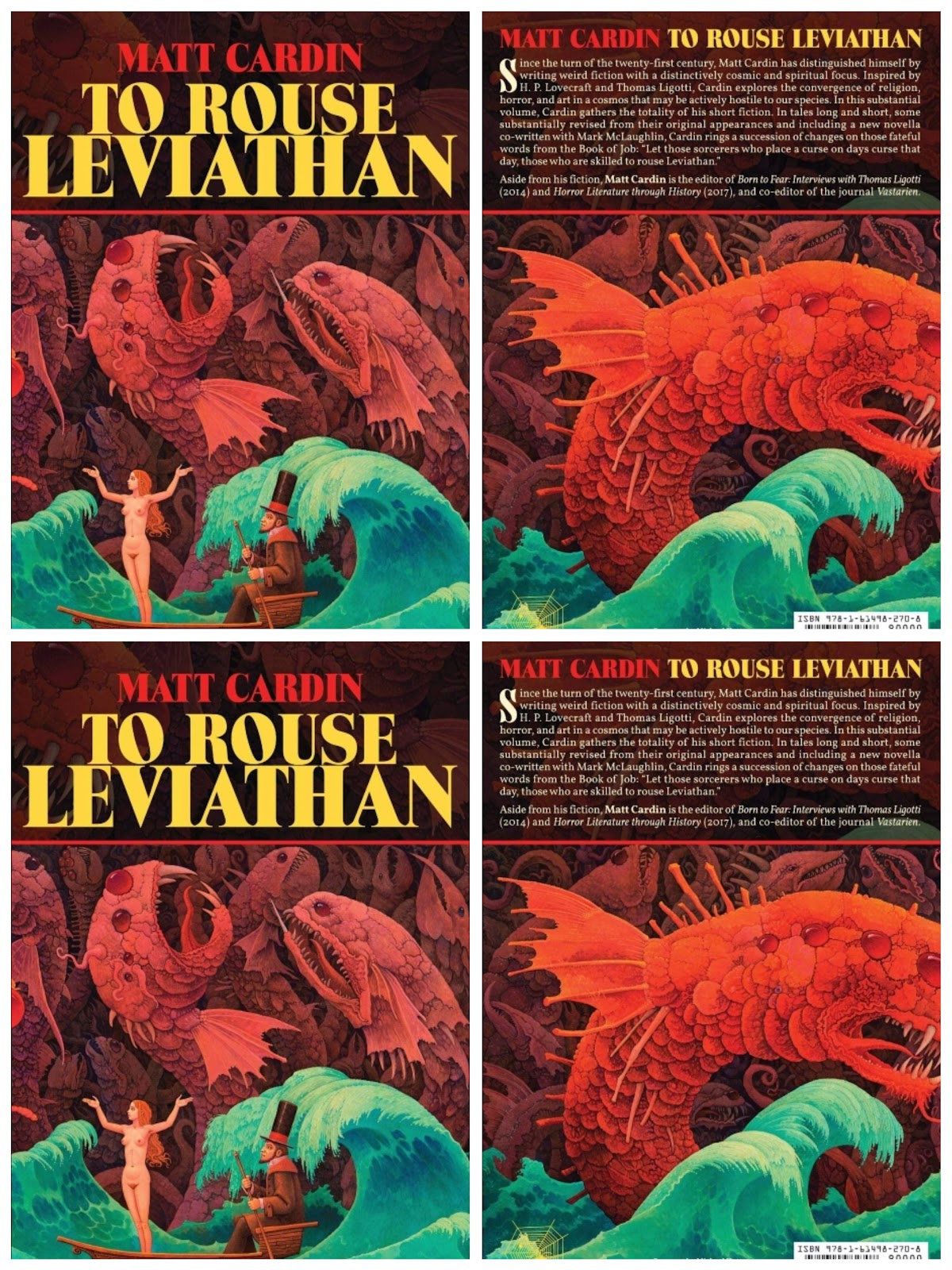
To Rouse Leviathan by Matt Cardin
[2019, Hippocampus Press]
Pastiche and emulation occur in every genre. In horror it is often the province of the adolescent tyro and the amateur. Who wouldn't want to create a new Jamesian ghost story, or make a new Conan Doyle-soaked adventure?
Matt Cardin strikes me on first reading to be deeply inspired and fed by the work of Thomas Ligotti. His prose is clear and his theological preoccupations are refreshing. Some tales strike the reader as perfunctory, but the further one goes in the book, the more ambitious and more interesting the tales become.
❖
An Abhorrence to All Flesh (1999)
This tale begins with elements that made me afraid it was just another sub-Ligotti pastiche: a man discovers he has just spooned a clot of maggots down his throat from a bowl of leftovers; later, the skin on his hands feels strange. (Oh, brother.)
But at that point, in a dinner party scene, Cardin sets his hook:
....I knew of Fillmore, of course. It was a nonentity of a little town situated just thirty miles east of Terence. But how had I never heard of the Temple of Jehovah—a cult so geographically near and tantalizingly bizarre?
"Who was the mysterious Middle Eastern man, the one who spoke to your grandfather?" This unexpected question came unexpectedly from Mr. Snyder, who was listening to everything from the recesses of his great chair and watching us all with bloodshot eyes. I suspected his wine was going right to his head. He couldn't have had more than a couple of glasses, but I would have bet money he was more thoroughly inebriated than he had been in many a year.
"I'm not sure of that," Barbara said, smiling at him. "Grandfather never even mentioned his name. He was a member of some old church, an ancient Christian group located in Jerusalem. Or was it somewhere in Egypt?" She frowned slightly as her mind worked to dredge up the long-buried memory. "I really don't know. Isn't that odd?" She turned to Jim, but he shrugged and offered no help.
"Actually, the fabled theological interloper was from Cairo. Old Cairo. He was a member of an ancient sub-cult within the Coptic church that believed itself to be the inheritor of the one true Christian faith." It took me a moment to realize these words were issuing from the mouth of my friend Darby. I stared at him dumbly, thunderstruck, but my own amazement must have been minuscule next to Barbara's.
"How do you know that?" she gasped. Darby offered her another charmer of a smile, and a look of comprehension crossed her face. "Your uncle?"
"Yes, my dear. My uncle's acquaintance extended not only to your grandfather, but to his Egyptian friend as well. In fact, my uncle was even present for the famous conversation that eventually proved to be the genesis of your church."
Barbara's eyes were all but glowing with excitement, but I simply couldn't keep out of the conversation at that point.
❖
Notes of a Mad Copyist (1999)
A flaccid and lackluster attempt at personifying spiritual collapse and nihilism. A monk copying scripture discovers his hand is writing something else.
....I could not say precisely what this new thing was, but it was certainly not the Word of God. Nowhere in the Deposit of Faith, either oral or written, could one find teachings of such a horrific and subversive cast. I read through the pages with a sense of mounting wonder and terror as I began to gain a powerful impression of imminent doom from certain words that appeared repeatedly in a patterned regularity whose scheme I could not divine. They spoke of "darkness" and "disorder," "dispersion" and "depletion," and of "the great deep, the watery waste of oblivion" that "laps hungrily at the shore of creation." The world as I knew it—the world of life, light, and order, where God, man, and nature stood in fixed and unalterable relation to each other—was framed by those words into a loathsome perspective of weariness, worthlessness, and wasted effort.
❖
The Basement Theater (2000)
Beautifully written short story, but it smacks most of a five finger exercise for a creative writing class.
....I have in my mind's eye a vision of the playwright emerging at last from his concealment behind the wood-and-cardboard flat to stoop down and gaze firsthand upon my interpretation of the role he has written for me. Whether I shall get a glimpse of his face is unclear, but even if I do, this much is certain: the only thing that I will ever truly know is my own ignorance.
❖
If It Had Eyes (2002)
A brief, willfully acroamatic poem in prose.
...Has the fog ever really known itself? Has it been able to pierce the wall of its own gloom, to glimpse its own hidden heart? No, it has not. The fog, I now know, is blind. The horror of my current entombment is the horror the fog has always inhabited within the space of its own awareness. It knows nothing of the people and the things, the cities and the civilizations, that it embraces, that it has always embraced, since before human memory. It is completely blind, and equally so to its own self as to the world it enwraps in ancient sheets of funereal white in a perpetual cycle of nocturnal death and sunlit rebirth.
❖
Judas of the Infinite (2002)
A rhetorical exercise attempting to capture the contradictions of nihilism via ipseity.
....I finally had to admit the truth of my deepest fear: that I was the harbinger of a doom worse than Hell. This void inside me could not be Satan, because it was more ancient than even that ancient serpent. I had become host to a faceless face behind all worlds, a nothing at the center of everything, a chaos from which the cosmos has been snatched for a brief instant. I realized that I was beyond salvation or damnation. I saw beyond them both, beyond Heaven and Hell, beyond all opposites and created things into a realm of absolute negation. And this meant that even God could not save me, because the Void was older and bigger than he was.
❖
Teeth (2002)
A more robust story than those preceding it, dramatizing the protagonist's intellectual collapse and misanthropic renunciation after exploring a student's notebook. Well executed, but strangely uninvolving, as was the case with the preceding stories.
.... Of all the things I might or might not have expected to find, an elaborate sacred drawing was surely among the last. And yet that was exactly what I found. Rendered in the same blue ink that Marco had used to record his thoughts and quotes was an incredibly intricate visual pattern composed of abstract shapes, shadings, and forms. Its design was dense and complex, but what made it truly striking was its lushness and vividness, which made it seem three-dimensional. At the same time, it was reminiscent of a Zen painting with its distinct dependence on space and absence to contextualize and comment on form and presence. Most amazingly, its elements were arranged according to some alternative philosophy of design that flouted and exploded common artistic principles of harmony, emphasis, opposition, and so on. Each line led the eye to one or more angles that refracted attention like a prism dividing light. Each shape held its position and significance in relation to a hundred different elements, each of which was in turn embedded in its own peculiar nest of visual meanings and unstated implications. The overall effect was of a bold, bristling infinity.
In a word, I was dazzled. I knew the creation of mandalas to serve as objects of sacred contemplation had been developed into an exquisite art form in religious traditions both Eastern and Western, but the one I was seeing now was even more breathtaking than the ones I had encountered in my studies of Buddhism, Hinduism, and medieval Christianity. I had not known that in addition to his other prodigious gifts, Marco was an artist of genius. But there was no mistaking it. The mandala had been rendered by his pen, in his notebook.
I went to raise my head so that I could rave to him about the wonderfulness of the drawing and my awe at his secret talent. But then, with a sudden, startling sense of the impossible, I found that I could not do it. My neck was locked in place and my eyes were magnetized to the center of the picture. I blinked, or rather tried to, and found that I was likewise prevented from doing that. I was still aware of the room, still aware of the floor and bed beneath me and the walls around me, and of Marco seated across from me. But I could only attend to them with my peripheral vision. It was as if an invisible anchor had been hurled out from the page and lodged in my eyeballs, fastening them to the image and throwing me into an increasingly panicked state of immobility. I simply could not look away from the mandala, which filled my vision and began to horrify me with what I now perceived as its obscene infinitude.
And then it started moving. Right before my disbelieving eyes, the shapes began to stir on the page with a creeping motion like the slow boiling of liquids in an alchemist's laboratory. Every hidden implication and mini-universe of meaning in the individual elements took on countless additional connotations as the whole structure shuddered to life. The picture's three-dimensional appearance became literal as the page's center dropped away into a recess of infinite depth. I no longer sat in a room beholding a picture; the picture had become the whole of my consciousness, and it encompassed me, and I stared through it into a chasm of measureless meaning whose very vastness was a horror.
Then, in an instant, all motion stopped. A dark spot no bigger than a pinhead formed at the mandala's center and began to grow, as if approaching from an impossible distance. Ringed layers of shape and form fell away as this darkness accelerated its all-consuming approach. It resolved and clarified, and now wicked barbs and slivers were visible in its fabric, needled in endless rows of concentric rings like ivory spikes planted in rotten flesh. They churned and fluttered and twitched with a spasmodic motion, and in the tiny corner of my mind that I could still claim as my own I realized I was staring into a nightmare abyss of endless teeth, a fanged and insatiable cosmic gullet that endlessly devoured, devoured, devoured all things in an eternal feast of annihilation.
All had been a prelude to this. My whole life, my very conception and progress through the stages of human existence, had been preordained to lead me to this dreadful moment. I felt the attention of a massive and malevolent intelligence turned upon me, and as I began to pitch forward into the pit, and as the first of trillions of teeth began to sink into my mind, I knew with absolute, horrified certainty that this nightmare abyss was also staring into me.
❖
The Stars Shine Without Me (2002)
Ligotti and William Browning Spencer territory: Work as a corporation as hellscape. Meh.
❖
Desert Places (2006)
A man is reunited with a former lover, and recounts his experiences since she chose another friend over him:
....With growing amazement at my own willingness to open up to her like this, I began to tell her of my life without her: of how only a few weeks after I had fled from her and Paul, I had become involved with an activist group devoted to fighting the destruction of the Brazilian rain forest. The story sounded alien and ridiculous to me as I related it, almost as if I were talking about another person. Prior to encountering that activist group I had been the farthest thing from a "joiner." Despite the lip service that my self-conscious spiritual hipness had led me to pay to ecological issues, I had never done a single thing to back that up in concrete action. Nor had I imagined how frighteningly simple such hypocrisy would be to change. A chance encounter in a new city with a man handing out pamphlets on a street corner, an impulsive trip to the address listed on the cover, and one short screening session later, and I found myself seated on a Boeing 757—I, who had never left the continental United States—headed for Brazil to join the protest. Even at the time, I knew that my impulsiveness was mostly driven by my escapist fantasy. I just wanted to flee my past and forget that my two best friends, who were also the two most spiritual people I had ever known, had betrayed me for each other.
The memory of this part enhanced the pain of telling the story to Lisa. It also made it all the more delicious. I began to revel in recalling minute details of sight and sound, taste and smell, image and emotion. I told her of my first impressions of South America when I got off the plane in São Paulo: of the stifling heat and humidity, the moist ripe smell of earth and jungle, and the way the horrendous humidity acted like a lens to focus the sunlight and roast one's flesh. I told her of the protest that fizzled after just a few days, the tiny band of friends I made, and the eventual disillusionment I felt when I realized that nothing we did made a difference for the rain forest, nor for my personal pain.
Lisa asked no questions while I talked. She appeared mesmerized by my account, and maybe it was her enraptured expression that lulled me so much that when I arrived at the part of my story I had never meant to tell—the part about the revelation or vision I received one night while sleeping in the open air under a mosquito net—I just kept going, as if my words had cast a spell over both of us.
The fact was, after living for several weeks with the constant assault of the jungle noises droning in my ears—all the unidentified swishings and scrapings and screechings—I stopped noticing them. The pungent smells of earth and bark likewise faded from my awareness, until I became as oblivious to them as I was to the stink of my own body in the tropical heat.
But on that single special night, three months into my stay, with no warning or prelude, the jungle suddenly became vivid again. I awoke from a deep sleep into a state of extreme disorientation. With a tinge of panic, I realized that I had utterly lost my bearings. Where was I? Why was I lying in a tent under a net with a cacophony of tropical night buzzing all around me? I lay there in mounting terror with the jungle saturating my senses until my ears actually began to tingle with all the secretive murmurings. My nose stung with the sweat of tree bark and jungle beasts. My tongue stiffened with the tang of mold and grass. My skin inhaled the moist rotten heat of hidden decay.
And I was sickened by the florid life all around me. For no cause that I could discern—and I tried long and hard afterward to divine a reason for it—I was suddenly horrified by the organic eruption that was the rain forest. The sole idea that I recalled from reading Sartre in college came to mind at once: de trop, "too much." The jungle was too much. It was too ripe, too juicy, too pungent, too sharp, too alive. That was the crux of the matter: it was the principle of life itself, bursting and blooming all around me, that was a horror.
After that, nothing could be the same. My acquaintances in the activist group, who liked to call themselves my friends but who in truth knew nothing about me, were shocked when I quit them without explanation and left the jungle to return to São Paulo. I flew back to the States and tried to reboot my life again, but this proved impossible when I discovered that the midnight vision from Brazil had accompanied me. Leaving the original scene of its onset merely brought the new perception home to inhere in the things that were more familiar to me, as I quickly understood when the oaks, elms, cedars, and walnut trees bristling from the Ozark hills began to inspire the same reaction as the rain forest. I couldn't stop thinking about the root systems of those trees, all twined and knotted like diseased fingers digging into the loamy earth. Nor could I stop thinking about the rodents and birds nesting in those trees, and the snakes and insects toiling in secrecy beneath the matted forest floors, and below even that, the worms and grubs tilling the soil, consigning the whole pungent mass of it back to a primal black organic mash.
❖
Blackbrain Dwarf (2010)
A nice bit of domestic ghoulishness.
....He sat at the kitchen table while Linda poured some sort of whole-grain, prepackaged breakfast substance into a plastic bowl. "What's wrong, honey?" she asked, setting the bowl before him and taking a seat at the opposite chair.
"Nothing," he said. A single spoonful told him the cereal was stale and the milk had tipped over into the pungent no-man's-land between liquid and solid. But he sucked on the mushy mass anyway, savoring it with a grimace, and found he couldn't tell whether the staleness and sourness resided in the food or on his tongue. And still the tingling buffer from the bathroom, like a buzzing wall of bees, remained interposed between him and the external world.
"You're not still worried about your meeting, are you?" Linda reached out and tousled his dark hair. "You've worked on it all week. If anything, you're overprepared. Don't worry. You'll do fine."
"Sure," he said. "Right. Like I said, nothing's wrong." She went to rinse the dishes while saying something about getting together with Steve for dinner that night. He ignored her chatter and watched her body closely from behind. She was wrapped in a blue terrycloth bathrobe, the fuzzy fabric pulled tight against her rump. The memory of her naked body arose unbidden from some black well of the past, from the mental ruins of another lifetime when he had actually craved the sight of her white skin and soft-rounded curves. Hot shadows rustled at the edges of his eyes and brain. His stomach lurched and squirted a jet of sourness up into his throat.
❖
Nightmares, Imported and Domestic (2006)
A strange story of doubling, and of the woes in a marriage, spreading out into horrific phenomenology. A very well-executed tale.
....What had happened was that Susan had asked Brian to unload a pickup bed full of potted flowers. He had backed the vehicle up to the front porch like the dutiful dream-husband he was, and had lowered the tailgate and climbed into the bed to unstack the dull plastic pots with their colorless floral occupants.
(Lafcadio, watching from a nonlocalized point some distance away while simultaneously identifying with his dream-self, had thought the grayish blooms most distasteful.)
It happened on the first jump. Brian realized it would be much easier to hop down than to squat and climb, so he steadied the pot in his hands and stepped off the edge of the tailgate, intending to drop lightly onto the balls of his feet. Susan's scream burst out with an impossible loudness and hung in the air with a ringing reverberation that could only happen in a dream. He hadn't noticed the hook projecting from the porch ceiling, right near the edge under which he had opened the tailgate. It was meant for hanging a plant on, obviously. Susan must have mounted it there without telling him. The gray-silver point extended an absurd length past the overhang, maybe three inches or more, and was located precisely at eye-level from his standing position in the pickup bed.
The curved end was vicious-looking, almost medieval. It caught him in the top rim of his right eye socket, and his weight did the rest. He fell forward, the point gouged into the bone of his skull, his legs left the tailgate, and then he was lodged there, hooked like a great flailing fish. The plastic pot hit the lawn without breaking, although potting soil sprayed everywhere, and the colorless bloom was crushed. His body went out of control then, legs kicking and spasming as if he were trying to pedal up Mount Everest, hands and fingers slapping and clawing at the smooth vinyl siding of the eave in a vain attempt to lift himself up. While all this went on, his throat opened up and spouted a veritably Pentecostal string of gibberish that seemed to have something to do with screaming for help.
Then Susan was grabbing his legs. She was grunting and lifting him up, heaving, thrusting, while her impossibly loud and long scream still hung in the air. At last she succeeded. The hook ripped free, dragging a few bone splinters with it, and he dropped to the truck, slammed into the open tailgate with the small of his back, and hit the lawn still writhing.
That was when the blood began to spurt from his eye in candy-red finger-paint gouts. The pain was a knot of acid searing its way inward from his eye to his brain. Susan was pawing at him in panic, weeping, asking him what to do. And in the midst of it all, rather absurdly, he vomited.
❖
The Devil and One Lump (2010)
An engaging story about an author who gets a visit from the devil. Cleverly articulated.
....He gave me a pointed look. "I'm here about your books." Then he waited for my response.
In my brilliance, I came up with, "What?"
"Let's not mince words, Evan." He assumed a shrewd expression. "Horror novels are one thing, but religious horror novels—or horrific religious novels, if you prefer—are quite another. The books you write have produced the unfortunate result of crossing certain wires, as it were, and thereby producing certain, shall we say, problematic effects amongst a wide swath of readers. The purpose of my visit this morning is to set you on a different course."
"You . . . I . . ." My eloquence continued to astound.
"The problem," he said, "is that you have taken the entire Christian cosmology and, more importantly, the characteristic emotional tenor of those who consider themselves Christians, and you have turned these on their head. You have created protagonists whose very search for salvation produces a backfire effect that damns them to a worse hell than they had ever imagined. You have speculated that the Bible contains a hidden subtext that runs between the actual printed lines and undermines the surface message at every turn. You have written of a narcissistic demiurge who is so enraptured by the beauty of his own creation that he represses the memory of his birth from a monstrous prior reality, so that when he is forcibly reawakened to this memory, he suffers a psychological breakdown that generates cataclysmic consequences both for himself and for the cosmos he created. In these ways and many others, you've launched a subversive assault on the deepest philosophical and theological foundations of the enemy camp."
He actually said "the enemy camp." Was he referring to God? To Christians? Did this fact, and also the smell and the voice and the Dante-esque shape that still sizzled on my retinas, indicate the man's true identity? Was this truly the type of story that I had stepped into? A "Devil in the morning" rehash?
As I wondered these things with my jaw hanging down, he concluded: "You might reasonably think that I would approve of your efforts. But you would be mistaken. God, to put it bluntly, does not need depth therapy. He can't handle it—precisely as you have intuited in your books. And I'm here to make sure that your future creative efforts are focused in a different and, shall we say, more fruitful direction."
Despite or because of my astonishment, my blood began to boil again. The guy was talking about my books. My books, those hated relics from the former life I had lost. And he was speaking as if I were somehow still responsible for them. The heat of my rising fury began to clear away some of the remaining fog in my brain, and I let this irate clarity shape my words.
"Even though this is all a dream, I'm still not going to sit here and listen to such accusations. Let's get this straight right now: I do not write those goddamned books, I wrote those goddamned books. And now it's hands off, once and for all. So don't you dare come here to my house and interrupt my coffee and sit in my chair and accuse me of . . . of whatever it is you're accusing me of. Because you're talking to an ex-author who doesn't give a damn about those books."
"Of all the delicious sins in this sinfully delicious universe," he said, "there's none more delicious or endearing than self-deception. Especially of the willful kind, which you're demonstrating with aplomb at the moment. Bravo, Evan!" He sized me up, smiled with that handsome mouth, and nodded. "Go ahead. Tell me what you want to tell me. Share the whole sad story of your private woe, which, as I strangely regret to inform you, really hasn't been all that private."
I felt as if I were coming unglued. Literally. My brain reeled and my heart wanted to hammer a hole in my sternum. "The . . . the books . . ." He nodded again with obvious approval, encouraging me to share and tell.
And just like that, the logjam in my mouth and heart and brain broke wide. "My books almost killed me! Do you think I wanted to become the king of mid-list horror? Hell, no! All I ever wanted was to spend my life writing about religion and beauty and truth and spirit and mystical awakening. That's what I loved since I was a kid! When those novels about God's psychosis and all that crap came flooding out instead, I was more horrified than any of my readers. I was absolutely mortified at the metaphysical sewage spewing from my pen."
❖
The God of Foulness (2002)
A journalist is assigned to cover an increasingly widespread cult worshipping and not treating their loathsome ailments.
....The media had dubbed them the "Sick Seekers" and given them enough coverage to lead some commentators to call them the story of the century. The Sick Seekers came from all walks of life and boasted all manner of physical and mental disorders, and their defining characteristic was that they viewed any kind of sickness as evidence of a special spiritual grace. At least, this was the best guess the commentators could come up with, since the Sick Seekers were notoriously close-mouthed to outsiders about the particulars of their beliefs and practices....
".....But Bobby," I said, "I don't understand them. Yes, I've studied up on them, but for the life of me I can't figure out why anybody would choose to live with terminal intestinal cancer, let alone celebrate it." I was thinking of a story I had watched just the night before on a weekly television news magazine. A man in Montana had refused to submit to having a large part of his colon removed, and had said things that indicated a link to the Sick and Saved movement. His wife had gone crying to the newspapers. "What am I supposed to do? How do I even find any of these people?"
❖
Chimeras & Grotesqueries (2010)
....I continued to read the scraps of newspaper that came my way, and I found they had come to sound unhinged in a manner formerly reserved for the tabloids, as their pages were now filled with tales of impossible occurrences. In a hastily published pamphlet that circulated by hand and word of mouth throughout the city's populace, and that was roundly denounced by religious and civil authorities, a putative and anonymous scholar who specialized in what he or she described as "an occult branch of philosophical theology" suggested that all these disruptions confirmed his or her thesis that "the godhead is insane, and the supernatural is its insanity."
Over time, the scale of the events grew greater, surpassing their former status as mere news of the bizarre to reach heights of grotesquery and hallucinatory horror that led otherwise sober commentators to speculate in all seriousness that something had come unraveled at the heart of things.
A woman entering a clothing shop on a busy avenue was killed when the plate glass window above the door suddenly came loose from its frame and fell upon her with unnatural force like a guillotine, hitting the crown of her skull broadwise and cleaving her head cleanly in half before exploding on the floor in a cascade of crystalline fragments. Her face thus remained untouched, and when she fell to the floor, her eyes remained open, rolling wildly in their sockets with an expression of panic while her lips worked silently. Compounding the astonishment and horror of onlookers were the half-dozen clumps of pulsating feathers that came spilling out of the woman's split cranium. These landed on the polished tile floor and whipped instantly into motion, unfurling to reveal themselves as enormous black birds that someone described as misshapen crows. They took flight and dashed madly about the interior of the store in a squawking hurricane of oily wings, crashing into light fixtures, knocking over clothing racks, and wounding a number of the store's patrons with slashes and gouges from jagged beaks and black talons, and then, as if possessed by a single, demonic mind, they shot through the open front door and out into the street. A dozen witnesses saw the screeching black shapes flap high into the air and then out of sight past the edge of a skyscraper.
In another part of the city, a young woman was attacked in her apartment by her four-year-old daughter. Two college students who lived in the adjacent unit came running in response to the screams and found the girl buried neck-deep inside her mother's torso, which was split open like a fish. She told the police later that she had been trying to "get back inside mama's belly." One of the students told a journalist that when he and his roommate arrived, the girl pulled her head out of the bloody vertical wound and turned to gaze at them with "black, burning eyes."
As I walked silently through the city streets and byways in my ever-widening and constantly evolving circuit, and as I sat propped against the wall of my alley in pursuit of my demiurgic work of monstrous creation, my thoughts kept circling round to the inner state of those who had witnessed and participated in such prodigies. Again and again, I returned to meditate on the sense of unreality that must have overtaken them. Dwelling upon this for endless hours, I would frequently experience an inner upwelling of giddiness, like the onset of cosmic vertigo, which would, if I happened to be standing at the time, oblige me to reach out to steady myself against a wall or lamppost. My eyesight would flicker and grow dim, as if my surroundings were lit only by the glow of a guttering candle, and I would hear the faint sound of a muted, hollow roar, like the shrieking of some vast metallic gate swinging open. If this came over me while I sat in my alley pursuing my calling, I would stare curiously at the little unfinished creature in my hands, and at the others strewn about the alley floor. And all the repressed knowledge of my nature, of my origin and reason for being, would tremble at the far edge of consciousness.
❖
Prometheus Possessed (2012)
A dystopian tale of the far future.
....Subject discovered inside the Temple by a Peace Enforcer making final sector sweep to verify full evacuation before building demolition. PE transmitted a request for assistance but was cut off from further communication by unknown interference. Additional PEs arrived to find subject emerging from Temple, walking backward. All reported cognitive, emotional, and multisensory perceptual anomalies accompanying subject's presence and movements. Apprehension of subject successfully accomplished, but arresting PEs suffered unspecified injuries. Cleanup Team dispatched for assistance. Sector sweep located original PE inside Temple suffering severe multiphase trauma. PE later expired at hospital.
❖
The New Pauline Corpus (2010)
A curious addition to the Lovecraft mythos via theology.
....Our antithesis, our dilemma in the form of a sacred riddle, is simply this: What has Christ to do with Cthulhu?
It comes with a corollary: What has Jerusalem to do with R'lyeh?
In these letters I intend to present you with the rudiments of a viable theological recalibration that will explore the avenues opened up by these shocking juxtapositions, and that, in doing so, will safeguard the possibility of our salvation, albeit in a much modified and, as I fear we shall be unable to keep from feeling it, far less agreeable form.
❖
A Cherished Place at the Center of His Plans (2019)
A confident weird atelier tale, reminiscent of the early work of Robert W. Chambers.
....Spread out in a fantastic array across the length and breadth of the basement was a collection of mysterious figures draped in sheets of white linen. The figures were obviously human or humanlike statues. The telltale outlines
of heads and arms were enough to make this plain. His astonishment was magnified when he looked at the gypsum walls on the right and left and saw that they, too, were hung with sheets, and that these sheets concealed what could only be paintings. A hundred or more of them lined the walls on either side. The whole space seemed to be held under a hush, like a church sanctuary.
"In here," Anthony said, shutting the stairwell door behind them, "I keep my most treasured collection. It is a room that I have devoted entirely to the power of art in all its forms. I believe art has the power to transform the world, to give us all a sense of widened perception and heightened consciousness. Don't you agree, Mr. Thornton?" His voice echoed with a dull reverberation against the cold concrete of the walls and floor. Without waiting for an answer, he led Thornton through the graveyard of shrouded forms. "I have hung your works in the back, where I put all my most recent purchases. Would you like to see?"
Thornton followed closely behind him. He was careful not to touch anything, for fear that he would disturb some deliberate arrangement whose logic he could not perceive. Pale shapes loomed on either side like mute guardians of some obscure secret. He fancied he could feel the pressure of restrained visionary power billowing outward from beneath the sheets, and he breathed a sigh of relief when he and his host left the shapes behind and came to the far wall.
Anthony turned to the right and pointed, and Thornton saw that they were facing an alcove in the corner where his paintings, the ones from last night's gallery encounter, had been hung. Unlike the others in the room, they were uncovered, and the familiar sight of his own work sparked a welcome sense of security. Their arrangement, however, was unusual, for Anthony had hung them next to each other in semi-interlocking fashion like the pieces of a puzzle, resulting in a kind of horizontal arc that resembled a letter "C."
Anthony waited a moment and then spoke. "I think you see what I'm needing, don't you?" He pointed to the empty space within the arc. "One piece is lacking. When it is finished and placed with the others, the series will be complete." He slipped his hands into his pockets and offered Thornton another of those lopsided grins. Thornton noticed that his voice was losing its mealy sound. Down here, surrounded by his secret, sheeted gallery, Anthony had begun to speak in an increasingly commanding baritone, rich and resonant.
"You must paint this final piece for me, Mr. Thornton," Anthony said. "Or at least, I hope you will. Despite appearances, I'm not an arrogant aristocrat who issues orders simply because I think I can buy people and manipulate them to my will. I'm seeking a true collaboration between the two of us, one in which the environment and financial backing that I can provide will enable you to create a masterpiece—the final painting in this important series."
He paused, and Thornton knew a response was required. He licked his lips before speaking. "Thank you for all this, Mr. Anthony, including the good words about my work. And my apologies, but I feel I need to remind you that I didn't paint those works deliberately as a series. I mean, look." He pointed to each painting in turn. "Time Enough for a Scream is over a year old. The next three I painted over the course of last winter. I only finished The Hatchlings recently. They're not a series, they're individual works. I created each one without thinking of the others. I wouldn't know where to start painting something to finish 'the series,' because there isn't any series to begin with."
"Strange, then," said Anthony, "that I knew how to line them up in chronological order. Wouldn't you say?" He waited for Thornton to see it, and when he did . . . by God, Anthony was right. Starting with the top point of the arc, the paintings were hung in the order of their creation. A moment earlier, when Thornton had pointed to each and recounted this order, he had not noticed that he was simply tracing the arc Anthony had created.
As he looked more closely, the artist began to recognize a distinct thematic consistency to the paintings' arrangement. For all the world, it was as if Anthony truly had found an implicit coherence that connected this recent string of work—an internal thematic logic that had been hidden from their very creator.
"Now, perhaps, you can see," Anthony said, smiling in a way that was not at all lopsided, "why and how I have come to be known as a nurturer of new talent."
Thornton smiled, nodded, blinked—and, in the nanosecond of darkness behind his closed lids, saw a cowled face staring at him with yellow glowing eyes.
Jay
5 April 2020