[Before World War One] Crowley and J.F.C. Fuller were embarked on publishing an occult journal, The Equinox. Thoughts of The Equinox, in Crowley's account, gave them visions of durability in the face of a coming smash of civilisation and "imminence of world catastrophe": "We saw the New Zealander sitting on the ruined arch of London Bridge quite clearly."
This was the once-famous New Zealander of the future who visited the remains of London and sketched the ruin of St. Paul's Cathedral. Thomas Macaulay had conjured him up in an 1840 review of von Ranke's History of the Popes, as an image of the power and endurance of the Roman Catholic Church: an organisation that "may still exist in undiminished vigour when some traveller from New Zealand shall, in the midst of a vast solitude, take his stand on a broken arch of London Bridge to sketch the ruins of St. Paul's".
Like Shelley's ruined statue of Ozymandias, this New Zealander was one of many such images of the sublime vastness of time and the waning fortunes of empires. In the 1770s the same Walpole who owned the Dee scrying stone had already conjured up a "curious traveller from Lima [who] will visit England and give a description of the ruins of St. Paul's." He also suggested a future researcher "from the banks of the Oronooko" might one day "revive knowledge of the English language and English gardening".
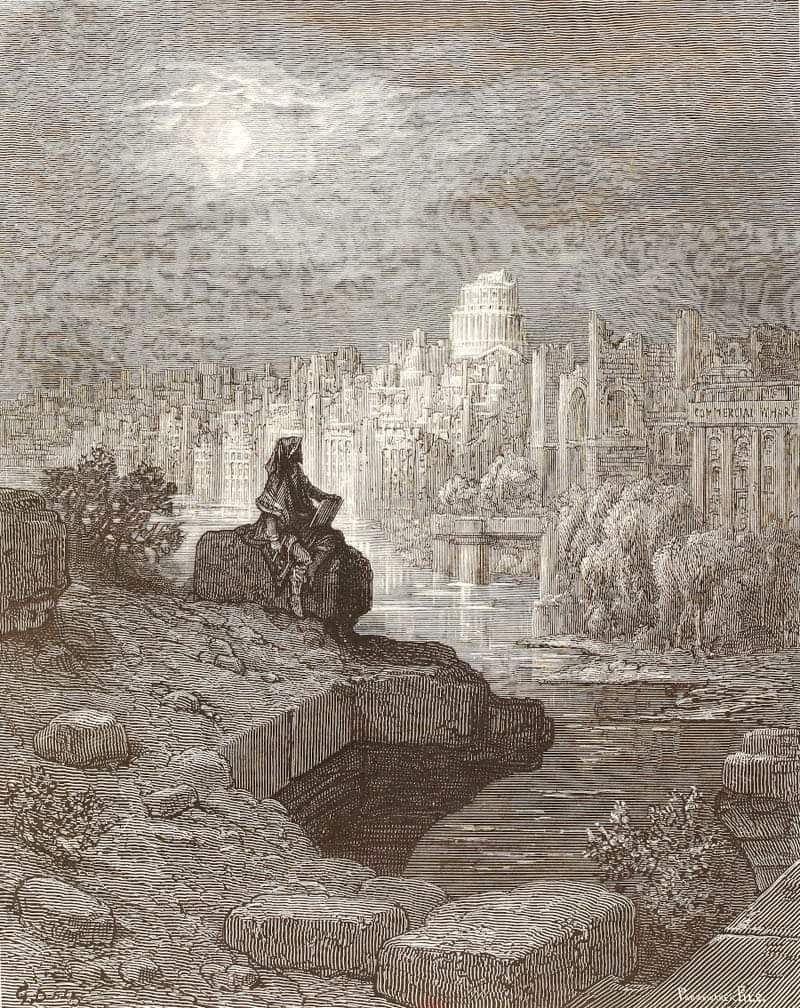
The New Zealander by Gustave Doré, 1872. Image: Public Domain
* * *
The capital of peripeteia
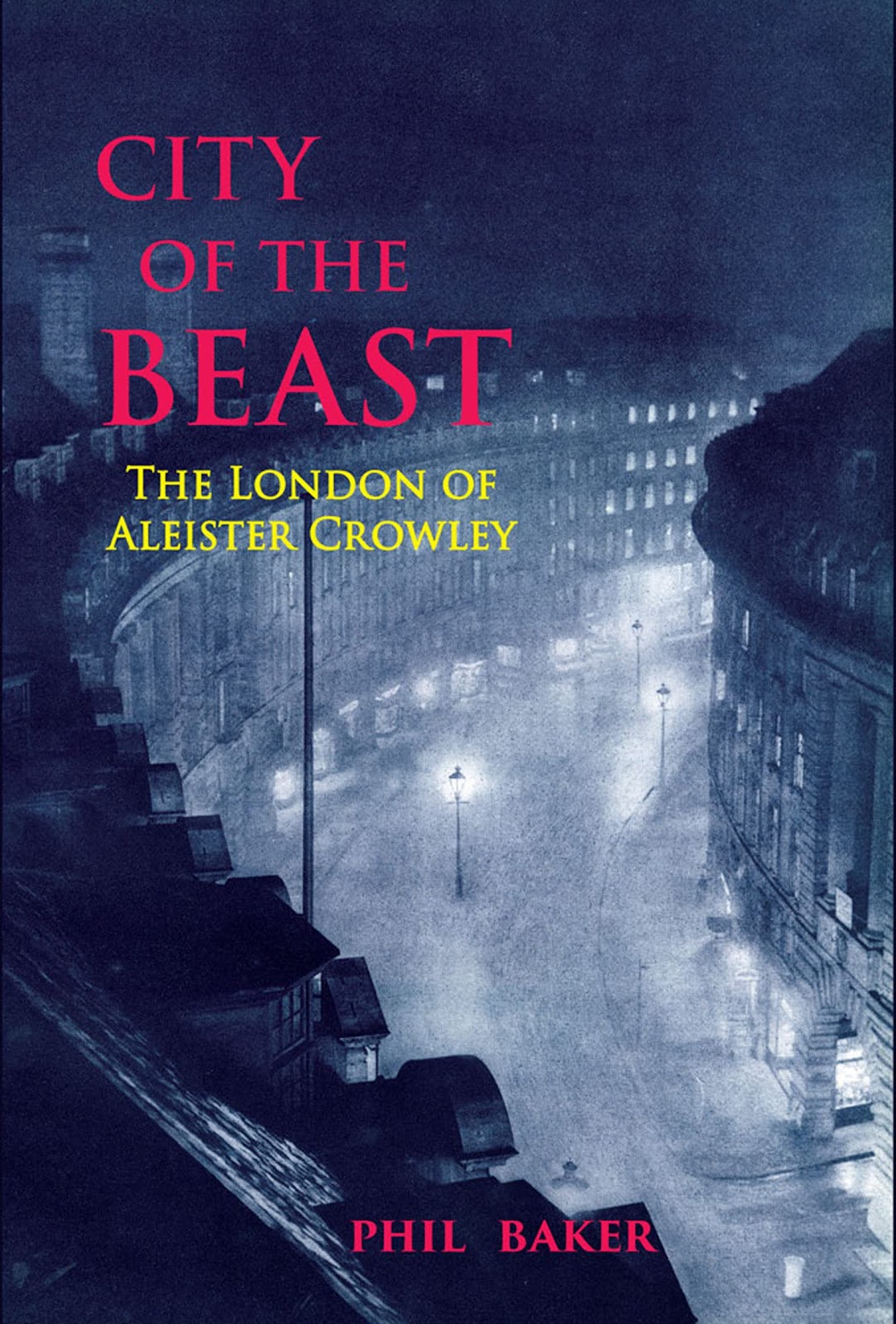
City of the Beast: The London of Aleister Crowley (2022) by Phil Baker is an entertaining and well-researched book. London's fleshpots, restaurants, bookstores, libraries, magistrate's court, and bankruptcy court all make up Crowley's world. City of the Beast tells us how a man of this world could function in the face of grinding poverty and drug addiction. (Like mountain climbing, a passion of Crowley's youth, being broke for thirty years in London took a lot of equipoise.)
The City of the Beast is also a book about walking out on hotel and restaurant bills and seducing and living with women obviously suffering from mental illnesses. We follow Crowley as he pursues casual seductions as well as an endless series of assignations with prostitutes. City of the Beast is an excellent answer to arguments that prostitution and mental illness are "empowering."
* * *
One collaborator recalls sighting Crowley in the 1930s "wandering about Piccadilly wearing the same suit of brown plus-fours with the silver buckles at the knees… An ageing, disillusioned magician, crossing from pavement to pavement like some antediluvian monster, lost in a world of superficial irrelevancies and transitory values."
* * *
Happily, the soap opera component of Crowley's public career as an occultist is not explored in detail. Baker is stalking Crowley's movements and life situations, not explicating his theology. We meet Waite and Mathers and Yeats where Crowley met them, close-up, with the frictions of the times and personalities nicely dramatized.
Baker also explores and weighs the stranger aspects of everyday life experienced by Crowley and his friends. This anecdote struck me as straight out of a story by Arthur Machen, and demonstrates the digressive richness of City of the Beast:
[....] Oscar Eckenstein is another dedicatee of Crowley's Confessions, the man "who trained me to follow the trail". Eckenstein (1859-1921) was a pioneering mountaineer and Crowley's mentor in climbing. He was also a Burton enthusiast – "Sir Richard Burton was my hero and Eckenstein his modern representative", writes Crowley – and he collected Burton books and documents, eventually donating them to the Royal Asiatic Society.
Formidably intelligent and equally fit, Eckenstein climbed around the world, but his strangest adventure took place while walking home to this family house in 29 Douglas Road, Canonbury, Islington.1 There was "an immense amount in his life mysterious and extraordinary beyond anything I have ever known" and one of the mysteries was a series of murderous attacks, lasting several years, which led him to believe his assailants must be mistaking him for someone else.
One night, after beating off an attack in Soho or Fitzrovia, he took an unfamiliar route to shake off anyone trailing him, but somewhere around the Caledonian Road he realised two men were following. Dodging into an alleyway behind some houses, he let himself into a back garden, hoping to explain himself to the householder and be let out by the front door on to a different street.
Inside the house was a beautiful woman in evening dress, who asked him to stay for supper. He noticed the quality of the pictures – some Monets, and some drawings or etchings by Whistler – and found a cold supper for two already laid out, with no servants visible. It was delightful, and as morning broke he left with the understanding that he would return that evening. Unfortunately he was delayed and didn't make it, but twenty-four hours later he was back at last, only to find the house dark, shut up, and "To Let". He knocked, but there was no answer. Returning with the letting agent, he found it was the right house, but emptied, with the wallpaper less faded where the bookcase and pictures had been. The agent assured him it had been vacant for three months, while the elderly owner was in France. Now obsessed, Eckenstein kept watch on the house. In a month or so two servants reappeared and told him that the owner would be back in the spring, but the woman he described made no sense to them. A while later he received an anonymous letter, which said in vague terms that there was no hope; it was impossible; but the memory would never fade. Eckenstein thought this must be from the woman.
And there the story ends. It is a dreamlike situation like something out of the Arabian Nights. As Crowley writes, it is
.... almost as universal as the 'flying dream'. It possesses the quality of the phantasmal… an adventure which in some form or other happens to a very large number of men.
He dreams of it regularly, he says. He uses a similar idea in his own short story 'The Dream Circean', and remembers related instances in the once-famous 1883 novel Called Back, by Hugh Conway, and in Robert Louis Stevenson tales including 'John Nicholson', 'The Sire de Malétroit's Door', and 'A Lodging for the Night', as well as Jekyll and Hyde, adding "There are similar ideas in oriental and classical literature."
This oriental aspect struck Proust in Venice, wandering in a maze of alleys:
Suddenly, at the end of one of these alleys… [a] vast and splendid campo of which, in this network of little streets, I should never have guessed the scale, or even found room for it, spread out before me surrounded by charming palaces silvery in the moonlight… it seemed to be deliberately concealed in a labyrinth of alleys, like those palaces in oriental tales whither mysterious agents convey by night a person who, brought back home before daybreak, can never find his way back to the magic dwelling which he ends by believing that he visited only in a dream.
The glimpse of a lost paradise is so archetypal we find variants of it in Coleridge's Kubla Khan, Keats's Lamia, De Quincey's story of his vanishing druggist on Oxford Street, and on into H.G. Wells's 'The Door in the Wall' (1907), Arthur Machen's 'N' (1935), and elsewhere....
* * *
Baker carefully plots what remains of the buildings and businesses visited by Crowley. Parts of London thrive and decline at different speeds: areas where young Crowley reveled, burning through his inheritance, are sometimes visited again later, when he was destitute.
City of the Beast also spells out Crowley's political opinions and actions: Jew-hate, anticommunism, and support for Berlin in both world wars. Crowley, writes Baker,
....had had some political hopes for Hitler and the cause of Thelema, and in May 1936 he met a man identified only as "Slippery Joe" in the Café Royal bar to have lunch and talk about "93 as base for Nazi New Order". Also in 1936 he asked his old First World War associate Viereck – now promoting National Socialism in America – to use any influence he might have with Hitler to bring The Book of the Law to his attention as a "philosophical basis for Nazi principles." Crowley was convinced he had influenced Hitler, probably through his German disciple Martha Küntzel. It is unlikely, but the correspondences are still remarkable. Küntzel saw Hitler and Thelema as one, and Crowley noted "astonishing" similarities between Hitler's thinking and The Book of the Law (also noticed by Gerald Yorke). Watching British propaganda, Crowley was impressed for what its makers would have seen as all the wrong reasons: "Saw show of cartoons lampooning Mein Kampf, with appropriate quotations. Taken in these selected doses, what a masterpiece! And how patent & profound a debt he owes to AL!"
* * *
Compared to Machen and Yeats, Crowley was a negligible literary figure. He created no lasting fiction or verse. He also failed at making his life a work of art on his own terms. Subjective idealism, believing "the material world existed only in the mind," never amounted to more than Tory nostrums and canting rationalizations.
* * *
City of the Beast demonstrates that London is an endlessly fascinating city. The book is enchanting.
Jay
2 September 2020