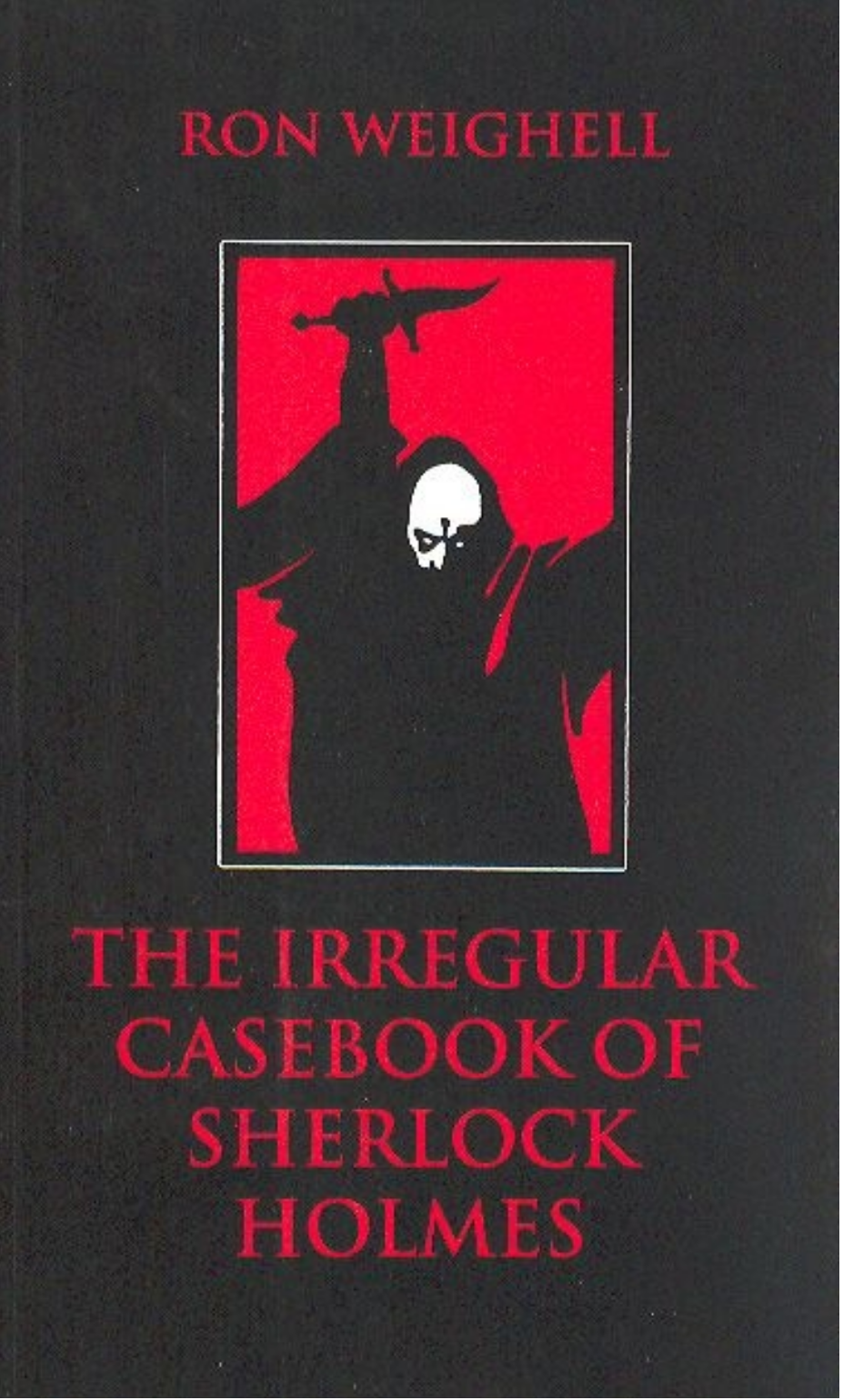
The Irregular Casebook of Sherlock Holmes by Ron Weighell (2000) is the first Weighell collection I have read. He is clearly a writer who takes great pains with his material, and creates a pleasing frisson at several points in these stories.
Sherlock Holmes pastiches, like those by epigones of Lovecraft and Robert E. Howard, always strike me as frustrating work made by frustrated readers and aimed at other frustrated readers. We're never going to get back the thrill of reading "The Red-Headed League" or Baskervilles for the first time; persisting like this is at best unhealthy. Conan Doyle lived, wrote, and triumphed; we are left with cross-referencing and footnotes.
One might make a case that The Irregular Casebook of Sherlock Holmes is such a series of cross-referencing notes.
"The Case of the Fiery Messengers" offers a team-up of Holmes and Watson with scholar M. R. James. Weighell's fan service here is copious and obliging.
In King's College Chapel:
Holmes rubbed his hands and chuckled. 'A circle on the ground plan that touches those two windows. Go on, doctor, go on.'
'Where are we? Yes—"Then fashion an arc by which ye shall be encrowned and bewailed." The last window on the north side has Christ crowned, and on the last south window, Christ mourned by the women. Absurdly simple, why didn't I think of it? Have you got that, Mr Holmes?'
'Yes—the arc thus formed cuts through the circle, forming an ellipse around the altar.'
"'Therebye enfolding ye most high"—altus, meaning high, an altar!—"within th vesica piscis." Now, "Blindfold and mocked, on ye arms of ye crosse." The third to last windows on each side show Christ blindfolded and Christ mocked. A cross, then, with the arms touching those two points. May I see?'
He peered over Holmes's shoulder.

'The Hieroglyphic Monad!' he exclaimed. 'It is Dee's own symbol.'
Holmes nodded. 'But our puzzle is not quite complete. Have you forgotten the reference to a circle whose centre is everywhere?'
'Wait, you are right. The symbol usually has a dot at the centre of the circle.'
'Then let us add one. And as it is described as "everywhere" we can take it that its position—before the steps leading up to the altar—is all important. It is surely to the flagstone at that spot that we must look.'
'Do we dig it up?' I asked.
'There is no need, Watson. Our man will do that for us, and return the stolen pages, if we only wait for him.'
At that moment, the sound of movement sent us swiftly into a side chapel, from which James peeked out.
'It is an undergraduate named Wimbush. An excellent young man, but somewhat talkative. If he sees us here, I fear it will be all over the University by nightfall.'
'Then,' whispered Holmes, 'we may turn the situation to our advantage. Stay out of sight—and hold my coat.'
Rolling up his sleeves, Holmes ruffled his hair and tied his handkerchief about his neck. By the time Wimbush drew near, the consulting detective had disappeared and, in his place, stood a rather truculent workman.
'Can I help you, sir?' I heard Wimbush ask in a frankly suspicious tone.
''Elp us?' rejoined Holmes. 'If yer've got a cold chisel or a lump 'ammer about yer.'
'I thought,' persisted the youth, 'that renovations were in abeyance at present.'
'Did yer! So did we till the word came to get back 'ere. We'll be workin' on the floor right up ter Christmas Eve.'
'Who gave you the order to resume work?' Wimbush asked.
It was an awkward moment, but Dr James saved the day by shouting from the shadows in an accent every bit as convincing as that of Holmes. 'Are you gunner stand there jawin' all day?'
'Keep yer 'air on,' Holmes called back. 'There's a young genelman 'ere wants ter 'elp us wi' the liftin'.'
'I'm sorry, gentlemen,' said Wimbush in quavering tones, 'but I am really rather busy—good day to you.'
Holmes chuckled as he pulled on his jacket. 'Well done, Dr James.'
'Well done to both of you,' I said, 'but would it not have been better just to hide?'
'No, Dr Watson,' replied James. 'I think Mr Holmes wants our talkative young friend to spread the word that workmen are examining the floor of the Chapel.'
'You anticipate me in every particular, doctor. The thief will not risk any accidental discoveries by workmen. This should force his hand. If we are lucky, tonight might well see the moment of confrontation.'
Holmes's plan was to mount a vigil in the Chapel. To this end we prepared, arming ourselves with dark lanterns, rugs, and walking sticks for weapons. Dr James was given a stout oak cudgel. Holmes had his cane weighted with lead, and I elected to settle any differences of opinion with the aid of a Penang Lawyer.
"The Shadow of the Wolf" offers apparent lycanthropy in a country house.
But in discussing Tibetan religious practices as they relate to the case, Holmes recounts some Himalayan anecdotes.
'This has been my worst hour, Watson. I fear that the faculties hymned in those sensationalised accounts of yours have not been in evidence here, and a man is dead because of it. I have allowed my mental processes to be dulled by a shadow out of the past.'
'The Hound, Holmes?'
'No Watson, the shadow falls from a greater distance than Dartmoor: Tibet, Watson, Tibet. I had not intended to mention it, but you deserve an explanation. Let us go back inside.
'As I may have mentioned, I had been in contact with Mycroft throughout the period of my disappearance, and was in fact engaged in work on his behalf, the nature of which I need not go into. It was required of me that I assemble men, animals, and supplies at Darjeeling for a journey into Tibet. My application for a permit was successful, and, to my surprise, it was accompanied by an invitation to speak to the Head Lama, who was representing the Dalai Lama himself.
'After a six hundred foot descent into the Teesta River Valley, we crossed the Teesta Bridge and covered the last sixty miles to the Tibetan border. Torrential rains, suffocating atmosphere, and leeches made the trip intolerable. Men and animals alike were running with spilled blood. Following a pony track through Yalimpong to Rangpo, I reached Sikkim. We entered a region of tropical forests, a riot of hibiscus, bougainvilleas, and orchids. A place not unlike Mrs Sturleson's conservatory in atmosphere. Climbing steeply through blazing rhododendrons we reached the Tibetan plateau and descended into the Chumbi valley.
'On the high plateau of central Tibet, we travelled through a region of blue skies and searching winds. The way divided at Gyantse, but I pressed on and, a hundred miles further, crossed the Tsangpo by a narrow bridge suspended on yaks' hair cables. Finally, having braved landslides and freezing nights, for the "long arm of Everest" was already reaching for us, we entered foggy Lhasa.
'I was taken to the Jokhang Temple for an audience with the Head Lama, Abbot of the Ten-gye-ling monastery, who was acting Regent during the Minority of the Dalai Lama. Among the carved red pillars and tapestries, he made an impressive figure in his burgundy red robes. I presented him with the traditional gift of a white Khata, or scarf, and spoke with him for some hours. As you recorded in The Sign of the Four, I had at that time some knowledge of the Southern form of Buddhism, but was very keen to learn of the Northern form.
'When eventually I asked why I had been summoned to Lhasa, I was taken deep into the temple and brought into the presence of the young God King himself.
'He was a small child, but with the dignity of bearing and the intensely focussed gaze of the adept. When I was introduced his face broke into a wide smile so typical of Tibetan people, and he brandished some well-worn documents. One was my monograph on footsteps, the others—and I hate to say it, Watson, for I fear it will do little for the size of your head—were copies of The Strand Magazine.
'It seemed that he had read, and been impressed by, your accounts of my cases. I suppose there is no reason why spiritual enlightenment should bring improved perception of literature. However, he talked of a creature the sherpas called Meto Khangmi, or Demon Mountain Man; and Yeti, or Rock Animal. The Dalai Lama would not use these names. He called the creature mi-teh, or man-animal. The belief in the existence of this being is total. One of the names of the Everest area itself is Mahalanggur-Himan, or snowy mountains of the great ape.
'Having read my monograph "Upon the Tracing of Footsteps", his Holiness was particularly impressed by my work on the use of plaster of Paris as a receiver of impresses. His hope was that I might further his knowledge of that shy creature. There is, it seems, a legend to the effect that the Compassionate Spirit from whom Tibetans descend was once incarnated as a monkey, and it was felt that there may be some responsibility to carry the word of Buddha to these strange mountain-dwellers. So it was that I was asked to ascend the highest mountain on earth and there confront a creature around which had grown an aura of terror and superstitious dread.
'An expedition was arranged, with experienced guides. I set up a base camp just below the glacier at over sixteen thousand feet, and began reconnaissance. At that height it is an alien and terrible world, Watson. The very rocks seemed reduced to the form of coral by the howling winds and bitter chill.
'After many days exploring the glacier, I had my first sighting of the creature. Far away on the ice fields just below the snow line something dark was moving, and it seemed to me that it was walking upright.
'I pressed on with the porters and two guides supplied by the Head Lama. On the snow fields just above the glacier I came upon footprints. The snow at that temperature was hard and crisp, with no crumbling at the edge, so I could identify the size of the foot as between twelve and fourteen inches long, and of a depth that suggested a weight of two hundred pounds or more. The effect of these prints on the porters was quite marked. They were fearful, and loath to go on.
'I completed the tricky task of taking Plaster of Paris moulds, one each of the right and left print made by the creature. The splayed toes were clearly those of a being who had never worn footwear of any kind, which at such temperatures effectively ruled out of the reckoning even the hardiest Sherpa.
An ancient Egyptian stele is stolen in London and seems to confirm "The Curse of Nectanebo." Weighell overloads his plate here, sending Holmes and Watson to Egypt for a long holding action before dashing back to London for the punchline.
"The Sect of the Salamander" gives us a previously unknown Venice chapter of Holmes and Watson. On the trail of The Cellini Perseus, Holmes settles a score with a fellow fencing student from his youth.
'The Cellini Perseus? Yes, I know that much about the great treasure. Rumours have persisted so long. So you are not surprised to see me. You are surprised, I think, to see that I am not surprised to see you. Always you forget Second Intention. The first move is never for the purposes it appears to be, but to enable the attacker to deceive the anticipated reaction. It was always my intention that you should come to La Serenissima, Master Holmes. Who else should I engage to solve so great a mystery but the World's greatest consulting detective?'
'You have murdered two human beings for that end?'
'Rosselino was not compliant, and could have named me. But the other, in London, was to present you with a locked room mystery you could not resist.'
'Could you not have engaged my services at a less terrible price?'
'You always were very dull, Master Holmes. I chose not to. I engaged you at no cost, anonymously, and can dispose of you now your work is done.'
'You will not have the assistance of your large friend. He is no more.'
'Ah, poor Toto. A small price for a great purpose. We, the Salamandra, are the true kings of the Serene Principality, just as Venice is the true capital of this unhappy new creation known as Italy. And Murano, Master Holmes, will once again be what it always was. The true seat of power in Venice. We Muranesi had our own laws and our own coin. We were a law unto ourselves. The Cellini will stand once more as a symbol of our sovereignty. It will become the focus of a new Sect of the Salamander.'
'The Perseus is somewhere you can never find it.'
'There are torture chambers under this building. All men are open to persuasion.'
'We would defend ourselves to the death,' I said. 'And, if taken alive, we would die with our lips sealed.'
'There is another solution, Master Holmes, if you have the courage. Let us see if you have improved as a swordsman. Win, and you have me, and go free without a fight. Lose, and you tell me the location of the Perseus.'
'Are you not afraid that I may have surpassed you?'
'A graduate of the Salon of the so-called Maître Alphonse Bencin? I do not think so. But I fear your friend might shoot me while I am not looking.'
'You have my word that I will not,' I said, angrily.
'Very well. A fencing lesson and a bloodletting will do you no harm!'
He sent a rack of blades skidding across the floor with his boot. 'Venetian blades of the finest quality. With your permission, I will keep faith with the weapon that served me so well in London. Rosellino's masterpiece. He will never make another. This is the way all disputes should be settled in Venice.'
I could not give a coherent account of what followed because it was conducted with such speed of reflex and economy of movement. If I can recreate that dazzling interplay of blades, it is because Sherlock Holmes gave me his own account of the fight, and it is from my notes that I have constructed the account.
One thing was immediately apparent even to my untrained eye. If I had ever thought that I had seen Holmes at full stretch, either in combat or practice, I never had. He had simply never met an opponent good enough to bring out the best in him.
In all conscience I must record that this one was more than his equal. It was always the contention of Sherlock Holmes that fencing could be likened to a conversation, with one fencer 'asking questions' with his blade that the other was forced to 'answer' with a parry, before asking his own 'question' with the riposte. Mentoni, according to Holmes, was not content just to speak with his blade; he told fables from the forgotten history of duelling, expounded complex doctrines, and hammered home painful truths, with his rapier. He evidently even told witty jokes with his blade, referring to the styles and favoured moves of the great masters of Fence. It was, alas, a momentous conversation in a language I could not understand.
What I saw was Holmes apparently managing to hold his own, under slow retreat, against a ceaseless stream of lightning-swift attacks. Evidently, when Holmes did manage a counter, he came up against effortless 'ceding' parries which made no attempt to resist the attack, but diverted it with gently yielding strokes, as water slides off a rock. It was like chasing an elegantly floating phantom.
'I found myself,' Holmes later admitted, 'admiring his work.'
As the progress of the fight took the two men close to the spot where I was standing, Mentoni stepped back out of range of Holmes's sword and executed the back-handed sweep of the blade with which he had slit the unfortunate's throat in London. But he aimed it at me! Whether this was an unthinking piece of treachery on his part, or an attempt to divert Holmes's attention I cannot say, but it did draw my friend's eye away from his opponent for a split second, and in that time Mentoni gathered up Holmes's blade with a circular action and disarmed him.
Holmes retreated to avoid the fatal lunge that had to follow, and fell over a footstool. Mentoni approached the fallen body with great deliberation, blade poised.
I was on my honour not to intervene, but Holmes had been placed in the situation by a trick, and I had no qualms about levelling the score.
"The Black Heaven" seems more modest than "The Curse of Nectanebo" and "The Sect of the Salamander." But any story that unites both Holmes brothers, Dr. Watson, and a recently widowed Arthur Machen working to thwart a cult hunting the Sixty Stone must redefine authorial ambition.
We were clearly so completely outnumbered that our few meagre bullets would not account for a tithe of them. In my years of foreign service I had, on more than one occasion, stood my ground in a square of men that all but broke under waves of assault, but held and lived to tell the tale. It is the simple truth that I was never more scared then than I was in the bloody hollow, surrounded by that crouching, hissing crowd.
We were preparing to sell our lives dear if we could, when the hosts stopped and looked back towards the eastern edge of the hollow. At first I thought dawn had come. Then I remembered the lamp knocked over in the house, and realised that the whole building must be ablaze, turning the skyline to flame.
It was not this, though, that had stopped the horde in their tracks. Silhouetted against the blaze were mounted men, armed with weapons that glittered cruelly in the light. I surmised that the police had arrived, supplemented by volunteers with horses and farm implements. The effect as they thundered down on the horde was remarkable. They seemed to glow, their weapons sparkling as swords and lances of silver. Like a receding tide, the dark host melted backwards and fled, pursued by the galloping figures.
This distraction enabled some of the cowled ones to escape over the edge of the hollow, while the braver few leapt at us. The ensuing scene was chaotic. Machen was wading in with all the pent up anger of a man who has been held under restraint, and has a score to settle. Even Mycroft felled one of them with what looked to me like a move from some mysterious Eastern art of self defence.
I overcame my adversary and held him at gunpoint. Holmes was locked in a struggle with the 'Lucifer', whose cowl had fallen off to reveal an incongruously well-groomed and respectable looking gentleman. He may have looked like a London bank manager, but he was busy trying to slit Holmes's throat with his ritual dagger. Machen, who had settled his own argument, raised a large and heavy looking object and brought it down on the 'Lucifer's' head.
Peace reigned in the hollow for a second. Then a man in a muddy brown raincoat, brow bloody and collar askew, appeared over the brim, gripping one of the cult by the arm. Uniformed police officers followed, each with a firm grip on a would-be escaper.
'Inspector Evans,' cried Holmes, scrambling to his feet, 'your timing is perfect.'
'Two got away, Mr Holmes, but we will have 'em.'
We set about untying the girl, who had been decked with a pungent garland. I found her to be physically unharmed, but in a deep state of shock. Evans addressed her as Mary, and she responded, so she had stood up well to her ordeal.
'Thank God you sent the horsemen on ahead,' I said to Evans. 'They saved our lives.'
Evans looked blankly at me.
'Horsemen? I had enough trouble scraping together the few officers you see. What do you think we are, the Welsh Hussars?'
'But there were men on horseback!' I expostulated.
Machen, who was looking like a man who had been in a fight, and enjoyed it, raised a hand to his lips.
'I saw them too, gentlemen, but Inspector Evans can tell you nothing of them. I understand now just what this thing is.'
He held cradled in his arms an elaborately fashioned box of iron.
The stories in The Irregular Casebook of Sherlock Holmes are clearly a labor of love. Weighell has a light and jocular touch, and if the stories rarely achieve heights found in the originals, there are exceptions.
Jay
13 April 2022