Subscribe to my Substack

Showing posts with label criticism. Show all posts

Monday, November 28, 2022

Edmund Wilson's 1943 essay "Thoughts on Being Bibliographed"

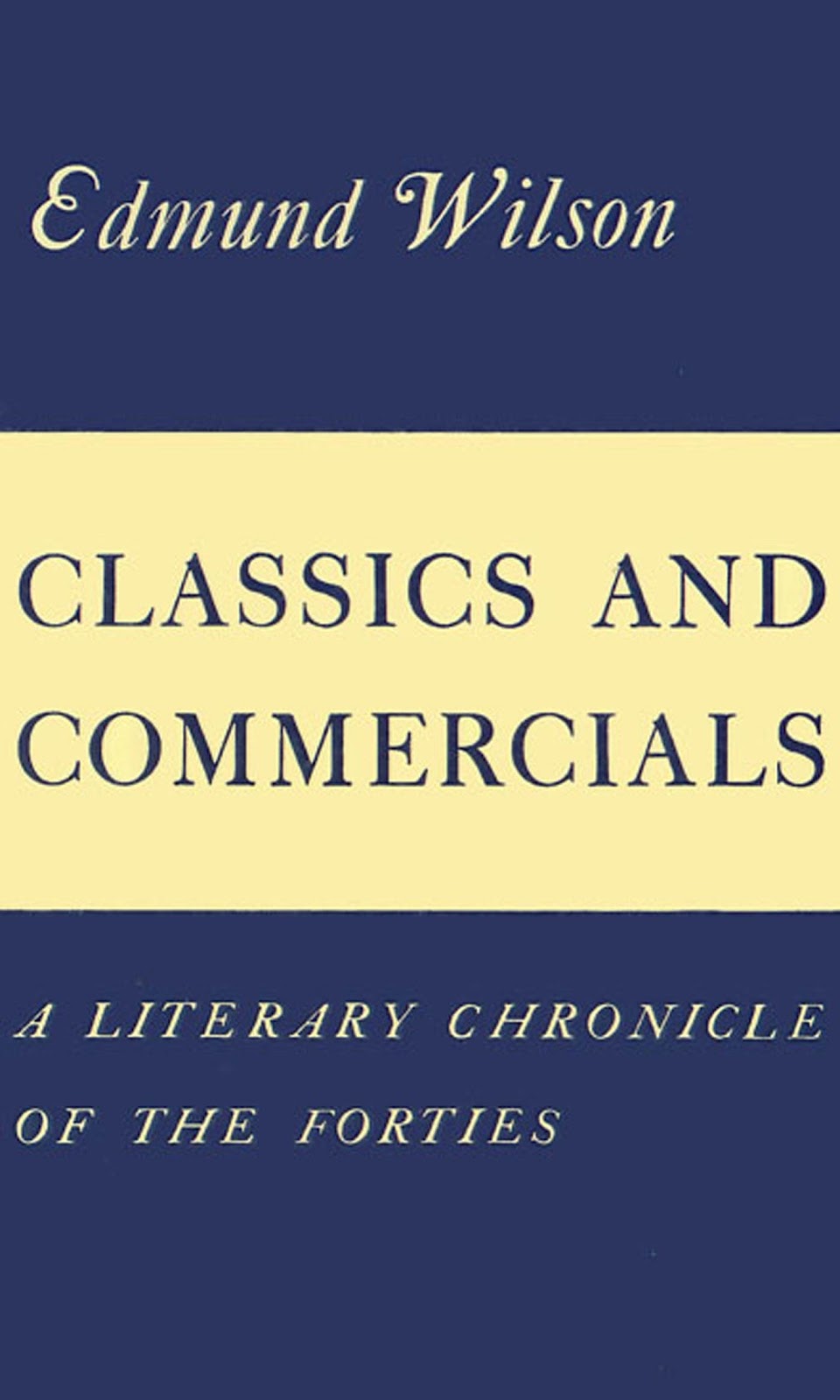
Wilson was the first writer who made the study of literature understandable to me as an activity. "Thoughts on Being Bibliographed" (in Classics and Commercials: A Literary Chronicle of the Forties) is his 1943 look back at a quarter century as a literary journalist engaged in that task. 


The paragraphs underlined below seem useful, reflecting Wilson's approach to the vicissitudes of literary business for U.S. petty-bourgeois intellectuals in the period 1919-1943.


I have omitted the paragraphs on Marxist politics, where Wilson is no more clear-headed than he ever was. Like Hook, Eastman, Burnham, and a million other valuable allies of independent working class militancy, he dropped his pseudo-radical socialism in August 1939 and never looked back.


*   *   *


[....] somniferously [soporific]


[....] a kind of fancy-dress party of frantic self-advertisement.


[....] when the problems of historical action seemed to have been removed in Europe to a less intellectual plane, they could only take sanctuary in learned research. The scholarship of Marxism in some cases shaded easily into the scholarship of the English Department; and the inquest on literary culture from the social-economic point of view was contracted to a simple ambition to get the whole thing under glass.


[....] nauseating puerilia [boyish, youthful ; immature, childish]


[....] I have made my living mainly by writing in periodicals. There is a serious profession of journalism, and it involves its own special problems. To write what you are interested in writing and to succeed in getting editors to pay for it, is a feat that may require pretty close calculation and a good deal of ingenuity. You have to learn to load solid matter into notices of ephemeral happenings; you have to develop a resourcefulness at pursuing a line of thought through pieces on miscellaneous and more or less fortuitous subjects; and you have to acquire a technique of slipping over on the routine of editors the deeper independent work which their over-anxious intentness on the fashions of the month or the week have conditioned them automatically to reject, as the machines that make motor parts automatically reject outsizes. 


[....] Poe in particular-though at the cost of an effort which was one of the pressures that shattered him -succeeded in selling almost all he wrote to the insipid periodicals of his day, studying the forms that were effective with the public, passing off his most anguished visions in the guise of mystery stories, and, be getting the editors, in some cases, to print pieces that had been published before but of which he had prepared new versions, scoring the triumph of thus making them pay him for the gratuitous labor of rewriting demanded by his artistic conscience. The masterpieces excreted like precious stones by the subterranean chemistry of his mind were sprinkled into a rapid stream of news letters and daily reviewing that was itself made to feed his interests and contribute to his higher aims.


[....] My own strategy – to make an anti-climax – has usually been, first to get books for review or reporting assignments to cover on subjects in which I happened to be interested; then, later, to use the scattered articles for writing general studies of these subjects; then, finally, to bring out a book in which groups of these essays were revised and combined.


[....] This method of working out in print one's treatment of something one is studying involves a certain amount of extra writing and consequently of energy wasted; but it does have the advantage of allowing one's ideas first to appear in a tentative form, so that they are exposed to correction and criticism. My non-critical and non-reportorial productions I have also to some extent smuggled in, and their forms may have been sometimes affected by the importunate consideration of the usefulness of detachable units of the right size for magazines.


[....] in the literary field, it does look as if the movements for which people have been fighting had, if not actually run their courses, at least completed certain phases of their development. Two of the tendencies that have stimulated most controversy, both vis-a-vis traditional methods and in conflict with one another: naturalism and symbolism-culminated and fused in the work of Joyce at the time that he wrote Ulysses. And there was also embodied in Ulysses an exploitation or a parallel exploration of the Freudian tendencies in psychology which had themselves had to fight for their lives and which could still seem sensational in fiction. The Waste Land came out the same year as Ulysses: 1922; and the result was one of those blood-heating crises that have been occurring periodically in literature since the first night of Hernani in 1830: howls of denunciation, defiant applause and defense, final vindication and triumph. But when the successor to Ulysses arrived, even more daring and equally great though it was, its reception was completely different; and the difference is significant and perhaps marks the drop of a trajectory in modern literature. Such occasions had never been deprived in the past either of evening clothes to hiss from the boxes or of young men to wear the red vest of Gautier; but the appearance of Finnegans Wake, instead of detonating a battle, was received with incurious calm. No exalted young journalists defended it; no old fogeys attacked it with fury. The reviewers spoke respectfully of Joyce while deprecating an aberration, and detoured around the book without giving it the smallest attention; and among the older writers who had been interested in Ulysses, now comfortably ensconced in their niches, a few read it, but most ignored. The only group of intellectuals that gave a serious hearing to this work turned out, by a curious reversal of the traditional situation, to be made up, precisely, of members of the profession which had become proverbial as the enemies of anything new. Finnegans Wake went straight from the hands of Joyce into the hands of the college professors, and is today not a literary issue but a subject of academic research. Nor is this, in my opinion, entirely due to the complex erudition of the book itself or to the abstruseness of some of its meanings: Finnegans Wake gives a scope to Joyce's lyric gift in a way that Ulysses did not, and it makes a new departure in the merging of the techniques of the novel and verse that ought to be of special interest to poets and fiction-writers both. The fate of Finnegans Wake is partly, I believe, the result of the process which I have mentioned above: the inevitable gravitation toward teaching jobs of able young literary men who can find no decent work outside them. In the twenties, Mr. Harry Levin, who has written so brilliantly on Joyce, would undoubtedly have been editing the Dial and going to bat for Ulysses in its pages: today he teaches English at Harvard, while an old-red-waistcoat-wearer like me who made a move to get the garment out of moth-balls at the time Finnegans Wake was published, is being treated to a quiet bibliography under the auspices of the Princeton Library, where, as I remember, in 1912, Ernest Dowson and Oscar Wilde were the latest sensational writers who had got in past the stained-glass windows.

[My emphasis]


[....] what, from the artistic point of view, have Kafka and his emulators done-though they reflect a different moral atmosphere-that had not already been done in the nightmares of Gogol and Melville and Poe?


*   *   *


Wilson is at pains above to note a change with long-range implications for the study of new literature: a shift from initial reception in popular journals and newspapers to college literature departments. The period after 1950 would speed this process exponentially. 


Jay

28 November 2022


Saturday, November 12, 2022

Reading notes: "The Sacred Grove" (2017) by John Clute

"Fantastika; or, The Sacred Grove" by John Clute in Fantastika Journal, April 2017


*   *   *


ludic: showing spontaneous and undirected playfulness


eruv: an area within which observant Jews can carry or push objects on the Sabbath, (which lasts from sunset on Friday to sunset on Saturday), without violating a Jewish law that prohibits carrying anything except within the home.


*   *   *


Part 1: A Problem


[....]  I proposed to use the term ​primarily to describe works written (very roughly) from the last decades of the eighteenth ​century onward: works that might be deemed therefore to have been written in a ​consciousness of their generic nature. I now use the term fantastika, in these two primary ​senses (plus a few others), in everything I write. I try to keep several loose conditions in ​mind.


Part Two: Practical/Poetical


1): Fantastika consists of that wide range of fictional works whose contents are understood ​to be fantastic.


​2): Fantastika is a child of Romanticism in Europe. It soon monstrously outgrew these ​swaddling clothes.


​​3) [....]  not until (roughly) the ​beginning of the nineteenth century that the subversive quasi-industrial creation by authors ​and publishers of oppositional genres began to create centripetal domains for various forms ​of the fantastic, forms inherently transgressive of standard understandings of how the West ​was won. For reasons beyond my scope here to anatomise concisely, these

incipient genres ​seemed from the first pragmatically prone to the breeding of interpellatory conversations, ​which is to say toolkits. A toolkit is a sharing of knowledge. 


[....]  The term fantastika designates a fictional work understood ​to be non-mimetic and which its creator understands is a toolkit (or megatext) to be shared.


​4) [....]  the nature of the sf gaze, which is a gaze driven ​by time.


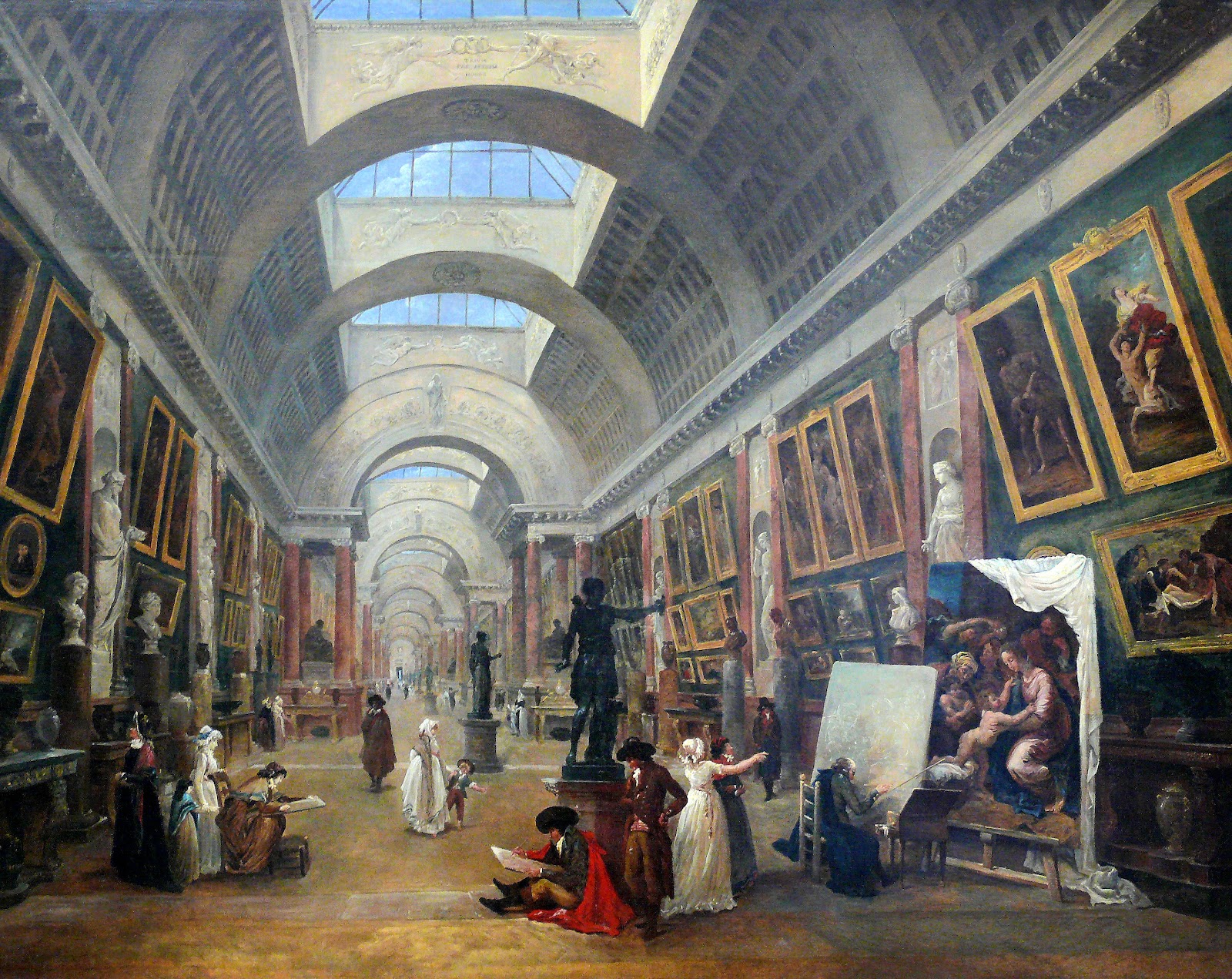
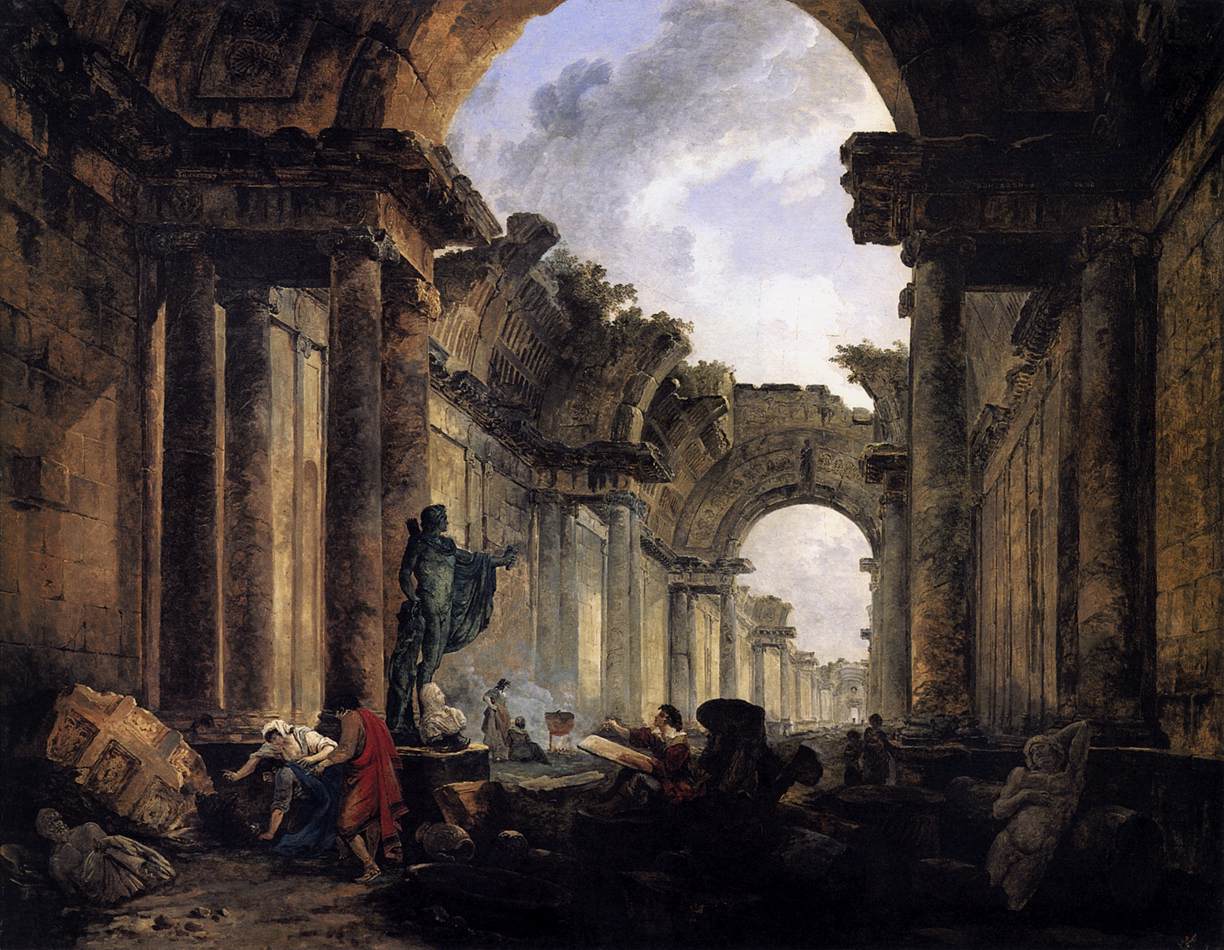
[....]  the landscape painter Robert Hubert had already ​created a diptych, Project for the Grande Galerie of the Louvre (1796) and Imaginary View of ​the Grande Galerie of the Louvre in Ruins (1796), which, for the first time in his huge oeuvre ​(and perhaps for the first time ever), can be taken to visualise a doubled world joined one to ​the other through a yet-unspoken temporal gap that cried out to be narrated.


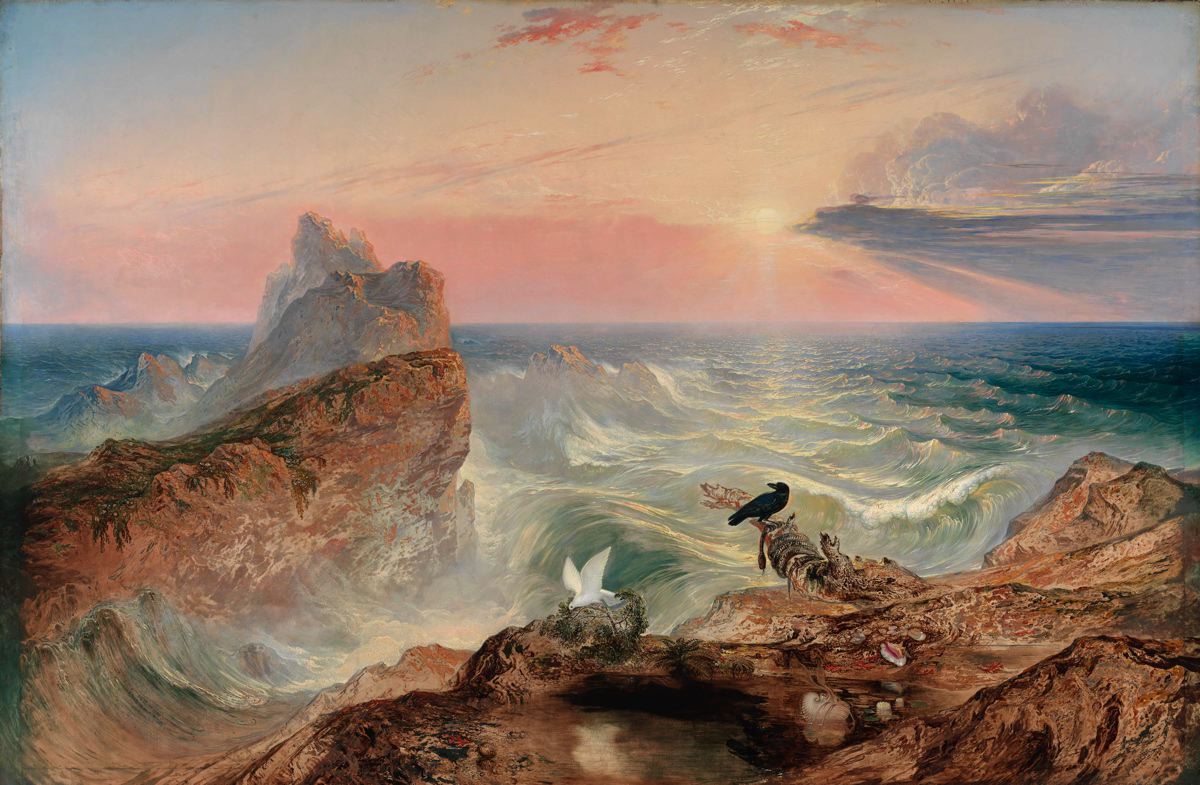
[....]  Similarly, John Martin's The Assuaging of ​the Waters (1840) or Solitude (1843) or The Plains of Heaven (1851-1853) may be the first ​works of art to hint at the curvature of the Earth.


The Assuaging of ​the Waters


Solitude


The Plains of Heaven


[....]  The term ​fantastika designates a fictional work through which the planet may be seen.


​5) [....]  the default understanding of a tale of fantastika is literal

not ​metaphorical; for metaphors in fantastika can mean what they say. Fantastika is a grammar ​of the literal; it is not a lesson imparted to the world from without. A story told literally is a ​story which believes what it sees, no matter how "marvelous" the vision may seem.


​6) [....]   if we take the Western World between 1800 and 2017 as its focus, then fantastika is ​transgressive against owners.


​7) [....]   the world is the fourth wall of fantastika. So when we say that a sf text can be ​defined as story set in an arguable world, we are saying that an sf text can be defined as a ​story that addresses the fourth wall. Any reading of any text of fantastika that dissevers text ​​from its worldly context throws out the bathwater and the baby. That to best understand any ​such text, we must recognise where it is. The author's engendering intentions, the context ​she wrote in and for whom, when he wrote and with what knowledge or premonition, the ​anthropocenic world that circumambiates each word: all should be taken into account. [My empasis - JR]


​8): Fantastika is ludic, which may be another way of saying it is literal....


[....]  inherent grammar – the ​engendering fire – of fantastika is not to be found in the thing done, or in strategic groupings ​of texts under various partial rubrics, but in the grammars of connection between texts


[....]  it ​lies in the beat that marks a tensing of the limbs of story, in the gap between the repose of ​the already told and the alarums of something new; it might be described as a manifestation ​of Pathosformel, a term Aby Warburg used to describe what he conceived of as the essence ​of any typology of an artistic form through time: which was the edge where it all changes. 


[....]  The heart of a matter is when it changes. ​Fantastika, which is time-bound, is the lord of the dance, which moves in time. The heart of ​fantastika is a changing of the guard between fixations.


*   *   *


Jay

12 November 2022


Friday, December 10, 2021

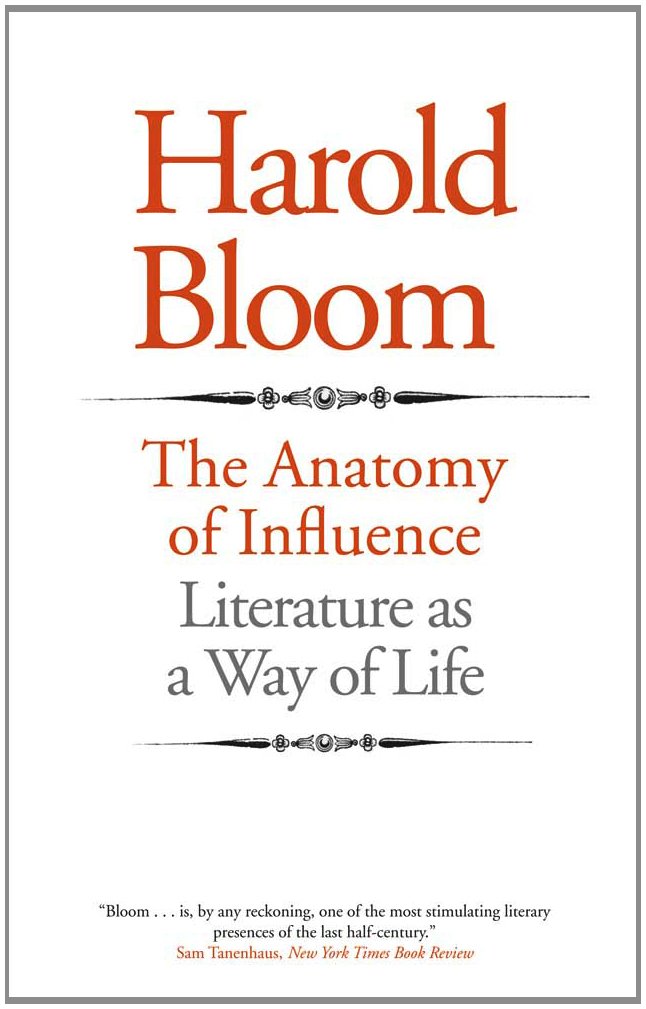
My reading notes on The Anatomy of Influence [i]

My Reading notes on The Anatomy of Influence: Literature as a Way of Life by Harold Bloom

(Yale, 2011)


PRAELUDIUM


[....]Literary criticism, as I learned from Walter Pater, ought to consist of acts of appreciation.


The Point of View for My Work as a Critic


LITERARY LOVE


[....]I was a graduate student writing a doctoral dissertation on Shelley before I began to realize that influence was the inevitable problem for me to solve if I could. Existing accounts of influence seemed to me mere source study, and I became puzzled that nearly every critic I encountered assumed idealistically that literary influence was a benign process.


[....]Literary criticism, as I attempt to practice it, is in the first place literary, which is to say personal and passionate. It is not philosophy, politics, or institutionalized religion. At its strongest—Johnson, Hazlitt, Charles Augustin Sainte-Beuve, and Paul Valéry, among others—it is a kind of wisdom literature, and so a meditation upon life. Yet any distinction between literature and life is misleading. Literature for me is not merely the best part of life; it is itself the form of life, which has no other form.


[....]It took me from 1953 until the summer of 1967 before my meditation clarified. It was then that I awoke in my state of metaphysical terror and after a dazed breakfast with my wife began to write the dithyramb that eventually became The Anxiety of Influence. It took about three days to complete, and it baffled me as I brooded. What was it? I could recognize that I had been thinking it a long time, not always consciously.


[....]the cultural present both derives from and reacts against anteriority.


[....]it is a last-ditch defense of poetry, and a cry against being subsumed by any ideology. Opponents accuse me of espousing an "aesthetic ideology," but I follow Kant in believing that the aesthetic demands deep subjectivity and is beyond the reach of ideology.


[....]Creative misreading....  The influence process always is at work in all the arts and sciences, as well as in the law, politics, popular culture, the media, and education.


[....]I acknowledged Shakespeare's Sonnet 87, "Farewell, thou art too dear for my possession," for giving me what have become critical keywords: misprision, swerving, and mistaking....  belatedness....


[....]Influence anxiety, in literature, need not be an affect in the writer who arrives late in a tradition. It always is an anxiety achieved in a literary work, whether or not its author ever felt it.


[....]Joyce's personal lack of such anxiety was, to me, not the issue. Ulysses and Finnegans Wake manifest considerable belatedness, more in relation to Shakespeare than to Dante. Influence anxiety exists between poems and not between persons. Temperament and circumstances determine whether a later poet feels anxiety at whatever level of consciousness. All that matters for interpretation is the revisionary relationship between poems, as manifested in tropes, images, diction, syntax, grammar, metric, poetic stance. 


[....]greatness ensues from giving inevitable expression to a fresh anxiety.


[....]Longinus, critical.... formulator of the sublime, said that "beautiful words are in very truth the peculiar light of thought." But what is the origin of that light in a poem, play, story, novel? It is outside the writer, and stems from a precursor, who can be a composite figure. In regard to the precursor, creative freedom can be evasion but not flight. There must be agon, a struggle for supremacy, or at least for holding off imaginative death.


[....]to see art as a contest for the foremost place.


[....]Norman Austin, commenting upon Sophocles in Arion (2006), observes that "ancient poetry was dominated by an agonistic spirit that has hardly ever seen its equal.


[....]Western culture remains essentially Greek, since the rival Hebrew component has vanished into Christianity, itself indebted to the Greek genius.


[....]In the wake of French theorists of culture like the historian Michel Foucault and the sociologist Pierre Bourdieu, the world of letters is most often portrayed as a Hobbesian realm of pure strategy and strife.


[....]Bourdieu's now fashionable account of literary relationships, with its emphasis on conflict and competition, has an affinity with my theory of influence and its emphasis on agon. But there are fundamental differences as well. I do not believe that literary relationships can be reduced to a naked quest for worldly power, though they may in some cases include such ambitions. The stakes in these struggles, for strong 


[....]For decades, I was informed that women and homosexual writers entered no contest but cooperated in a community of love. Frequently I was assured that black, Hispanic, and Asian literary artists too rose above mere competition. Agon was apparently a pathology confined to white heterosexual males. 


[....]In the wake of French theorists of culture like the historian Michel Foucault and the sociologist Pierre Bourdieu, the world of letters is most often portrayed as a Hobbesian realm of pure strategy and strife.


[....]I do not believe that literary relationships can be reduced to a naked quest for worldly power, though they may in some cases include such ambitions. The stakes in these struggles, for strong. poets, are always literary.


[....]A strong poet seeks not simply to vanquish the rival but to assert the integrity of his or her own writing self.


[....] I define influence simply as literary love, tempered by defense. The defenses vary from poet to poet. But the overwhelming presence of love is vital to understanding how great literature works.


[....] Milton's defense against Shakespeare is highly selective repression while Joyce's is total appropriation.


[....] Shakespeare a special case for the study of influence: his effects are too large to be coherently analyzed.


[....] We would have been here anyway, of course, but without Shakespeare we would not have seen ourselves as what we are.


[....]Shelley appears in several chapters as a strong influence on Yeats, Browning, and Stevens, and as a somewhat reluctant skeptic too. Whitman, who appears in many chapters, comes in at least two key guises. He is the poet of the American Sublime, but he is an important representative of the Skeptical Sublime, and as such he appears alongside Shelley, Leopardi, Pater, Stevens, and the more covert Lucretians John Dryden, Samuel Johnson, Milton, and Tennyson.


[....] The structure of literary influence is labyrinthine, not linear.


[....] how to transcend echoes and allusions, and to find the more crucial matter of the transmission of poetic stances and vision.


[....]My ways of writing about literary influence have been widely regarded as relying upon Freud's Oedipus complex. But that is just wrong, as I have explained before, to little avail. Freud's Hamlet complex is far closer, or even better, your Hamlet complex and mine. Hamlet's deepest struggles are with Shakespeare and with the Ghost, who was played by the dramatist.


[....]Magpie that he was, Shakespeare voids any distinction between tuition and provocation, and loots where he chooses. Whitman tends to limit his sources because his self-presentation demands that he become his own supreme authority.


[....]Influence, which figures everywhere in life, becomes intensified in poetry. It is the only true context for the strong poem because it is the element in which authentic poetry dwells.


[....]Influence stalks us all as influenza and we can suffer an anguish of contamination whether we are partakers of influence or victims of influenza. What remains free in us is the daimon. I am not a poet, but I can speak of the reader-in-the-reader and also as a daimon who deserves to be appeased. In our age of the screen—computer, television, movie—the new generations grow up seemingly bereft of their daimons. I fear that they will develop new versions of the daimonic, and that a visual culture will end imaginative literature.


[....]correct readings are not possible if a literary work is sublime enough. A correct reading merely would repeat the text, while asserting that it speaks for itself. It does not. The more powerful a literary artifice, the more it relies upon figurative language.


[....]To practice criticism, properly so-called, is to think poetically about poetic thinking.


[....]Imaginative literature is figurative or metaphoric. And in talking or writing about a poem or novel, we ourselves resort to figuration.


[....] I prefer the philosopher Søren Kierkegaard on anxiety to Freud, but Anna Freud mapped the mechanisms of defense, and my accounts of influence are indebted to her.


[....]Makari concludes by rightly judging psychoanalysis as the leading modern theory of the mind, citing its ideas of defense and inner conflict. Since I define influence here as literary love tempered by defense....

     Defense ( Abwehr ) is an agonistic concept in psychoanalysis, but it is a dialectical one as well and thus a splendid fit for any theories of influence. We fall in love, and for a time we have no defenses, but after a while we develop an arsenal of apotropaic gestures. We are animated by a drive that wants us to return to the ego's narcissistic investment in itself. So too with poets. Possessed by all the ambivalence of Eros, the new but potentially strong writer struggles to ward off any totalizing attachments.


* * *


Jay

9 December 2021


My reading notes on The Anatomy of Influence [ii]

The Anatomy of Influence: Literature as a Way of Life by Harold Bloom

(Yale, 2011)


* * *


SUBLIME STRANGENESS


[Pseudo-Longinus]


[....]The single treatise we have from the more properly named Pseudo-Longinus properly should be translated "On the Heights." But by now we are unable to do without On the Sublime, even though sublime as a word remains bad currency. So too is aesthetic, which Pater (after its popularization by Wilde) wanted to restore to its ancient Greek sense of "perceptive."


[....]To be a Longinian critic is to celebrate the sublime as the supreme aesthetic virtue and to associate it with a certain affective and cognitive response. A sublime poem transports and elevates, allowing the author's "nobility" of mind to enlarge its reader as well.


[....]First published in 1949, "The Affective Fallacy" launched a major assault on the then pervasive belief that the meaning and value of a literary work could be apprehended by "its results in the mind of its audience."


[....]In the long Age of Resentment, intense literary experience is merely "cultural capital," a means to power and glory within the parallel "economy" that Bourdieu labels the literary field. Literary love is a social strategy, more affectation than affect. But strong critics and strong readers know we cannot understand literature, great literature, if we deny authentic literary love to writers or readers. Sublime literature demands an emotional not an economic investment.


[....] I cheerfully affirm a passion for the difficult pleasures of the sublime, from Shakespeare, Milton, and Shelley on to Yeats, Stevens, and Crane.


[....] can be no living literary tradition without secular canonization, and judgments of literary value have no significance if not rendered explicit. Yet aesthetic evaluation has been viewed with suspicion by academic critics since at least the early part of the twentieth century. The New Critics deemed it too messy an undertaking for the professional scholar-critic.


[....] There can be no living literary tradition without secular canonization, and judgments of literary value have no significance if not rendered explicit. Yet aesthetic evaluation has been viewed with suspicion by academic critics since at least the early part of the twentieth century. The New Critics deemed it too messy an undertaking for the professional scholar-critic. Northrop Frye said that evaluation should be implicit, and that was one of the disagreements between us from 1967 on. But the New Cynicism's roots in the social sciences have produced a more clinical posture still. To speak of the art of literature is viewed as a breach of professional responsibility. Any literary academic who issues a judgment of aesthetic value—-better, worse than, equal to—risks being summarily dismissed as a rank amateur.


[....] Over time the strong poets settle these matters for themselves, and precursors remain alive in their progeny.


[....] the canon in time will select itself, you still can follow a critical impulse to hasten the process, as I did with the later Stevens, Ashbery, Ammons, and, more recently, Henri Cole.


[....] I keep urging the work of the reader's sublime: confront only the writers who are capable of giving you a sense of something ever more about to be.


[....]sublime literature transports and enlarges its readers.


[....]we experience something akin to authorship: "We come to believe we have created what we have only heard."


[....]Freud identified this aspect of the sublime in the uncanny, which returns from the flight of repression as "something familiar and old-established in the mind."


[....]Longinus's treatise exalts the sublime yet implies ambivalence as well: "what is wonderful always goes together with a sense of dismay."


[....]sublime is at once magnificent and fraught.


[....]greatness of the sublime object induces both delight and terror: "Infinity has a tendency to fill the mind with that sort of


[....]delightful horror, which is the most genuine effect, and truest test of the sublime."


[....]paradoxical coupling of pain and pleasure. For Shelley, the sublime is a "difficult pleasure," an overwhelming experience whereby we forsake simple pleasures for ones that are almost painful.


[....]Pater contributed to theories of the sublime in his pithy description of Romanticism as the adding of strangeness to beauty. "Strangeness" for me is the canonical quality, the mark of sublime literature.


[....]Strangeness is uncanniness: the estrangement of the homelike or commonplace.


[....]strangeness renders the deep relation between sublimity and influence palpable.


[....]In the case of the strong reader, strangeness often assumes a temporal guise.


[....]In his wonderful essay "Kafka and His Precursors," Jorge Luis Borges evokes the uncanny process by which the novelist and essayist Franz Kafka seems to have influenced the poet Robert Browning, his precursor by many decades. What is most strange in such Borgesian moments is not that the prior poet appears to have written the new poem. It is that the new poet appears to have written the prior poet's poem. Examples of this kind of chronological reordering, in which a strong poet appears miraculously to have preceded his or her precursors, abound in the pages that follow.


[....]But you cannot reformulate the sublime in the twentieth century, or now in the twenty-first, without wrestling Sigmund, whose Hebrew name, Solomon, suited him far better since he was not at all Wagnerian and very much a part of Hebraic wisdom, "Weisheit the rabbi" as Stevens hinted at naming him.


[....]Longinus, Kant, Burke, and Nietzsche are all Freud's heirs.


[....]For a strong writer, strangeness is the anxiety of influence.


[....]inescapable condition of sublime or high literature is agon


[....]Implicit in Longinus's famous celebration of the sublime—"Filled with delight and pride we believe we have created what we have heard"—is influence anxiety.


[....]transports us beyond ourselves, provoking the uncanny recognition that one is never fully the author of one's work or one's self.


[....]The element of strangeness in beauty has the contrary effect. It arises from contact with a different kind of consciousness from our own, different, yet not so remote that we cannot partly share it, as indeed, in such a connection, the mere word 'contact' implies. Strangeness, in fact, arouses wonder when we do not understand: aesthetic imagination when we do."


[....]As we go out to meet a larger consciousness, we metamorphose into a provisional acceptance that sets aside moral judgment, while wonder transmutes into a more imaginative understanding.


[Kant, Pater]


[....]Kant defined the sublime as that which defies representation. To which I would add that the turbulence of the sublime needs representation lest it overwhelm us.


[....]Pater's aesthetic, essentially also my own, is Lucretian through and through; it is deeply concerned with the effects of the work upon its reader: "What is this song or picture, this engaging personality presented in life or in a book, to me?


[....]Does it give me pleasure?


[....]what sort or degree of pleasure?


[....]is my nature modified by its presence, and under its influence?


[....]ancient Greek meaning of aesthetes, "one who perceives."


[....]Pater, self-quarried as he was out of the odes of John Keats, and out of his favorite Shakespearean play, the be-absolute-for-death Measure for Measure. He quotes Victor Hugo's "Men are all condemned to death with indefinite reprieves,"


[....]Of such wisdom, the poetic passion, the desire of beauty, the love of art for art's sake, has most. For art comes to you proposing frankly to give nothing but the highest quality to your moments as they pass, and simply for those moments' sake. ["Conclusion," The Renaissance: Studies in Art and Poetry (1868)]


[....]like most of Pater, this motto has been largely weakly misread from 1873 to the present. Anything misunderstood through four generations has its own sanction


[....]What Pater analyzes is the love of art for the sake only of quickening and enhancing consciousness.


[....]influence anxiety, an anxiety in expectation of being flooded


[....]a problem for critics as well


[....]for the critic as for the poet, representation may be the only defense


[....]coming to terms with the overwhelming flood of images and sensations that Pater called phantasmagoria.


[....]literature was not merely an object of study but a way of life.


[Samuel Johnson, Angus Fletcher]


[....]I regard Johnson as my critical forerunner, since my life's work from The Anxiety of Influence until now seems to me more Johnsonian than Freudian or Nietzschean, a following of the great critic in his quest to understand literary imitation.


[....]has the knack of making all four later and himself earlier, as though they were influenced by him.


[....]imaginative displacement

enters again with Pater and his Aesthetic school: Wilde and Yeats, Virginia Woolf and Wallace Stevens.


[....]I read [Angus Fletcher] and experience what I wish were my own thoughts coming back to me "with a certain alienated majesty," as Emerson put it. That is the critic's sublime or partial recognition.


[....]Appreciation subsequent to overt evaluation is vital.


[....]Read, reread, describe, evaluate, appreciate: that is the art of literary criticism for the present time.


[....]Longinian rather than philosophical, in the modes of either Plato or Aristotle.


* * *


THE INFLUENCE OF A MIND ON ITSELF


[Valérian investigation]


[....]Sadly, Borges idealized his account of literary influence by rejecting any idea of rivalry or competition in regard to precursors. Shelley once grandly remarked that all imaginative literature formed one comprehensive cyclic poem; Borges went further by amalgamating all writers into one, a Here Comes Everybody Shakespeare-Homer, James Joyce's composite before it became Borges's.


[....]Valéry, like the French Poe and Mallarmé, desires the power of his mind only over the mind itself, a Cartesian quest rather than a Shakespearean one. The central man in French literature is not Rabelais, Montaigne, or Molière, nor is he Racine, Victor Hugo, Balzac, Baudelaire, Flaubert, or Proust. He is Descartes, who occupies in France the place reserved in other nations for Shakespeare, Dante, Cervantes, Goethe, Tolstoy, or Emerson. Call it the place of the Founder. Literary influence in Britain, Italy, Spain, Germany, Russia, and the United States is not radically different from country to country. But because a philosopher was the Founder, they order these matters differently in France.


[....]Those who now prate about either separating literature and life or yoking them together become bureaucrats of the spirit, professors of Resentment and Cynicism. Valéry, supremely intelligent, ended his great poem about the marine cemetery with the monitory outcry that the wind was rising and one should try to live. "The influence of a mind on itself and of a work on its author" is central to Valéry's speculations upon literature.


[....]self-influence ought to concern us only in the strongest writers. The effect of Ulysses upon the Wake is a vital matter; the influence of earlier upon later Updike is of possible interest only to those who esteem him.


[....]Falstaff, Hamlet, Iago, and Cleopatra have an independent existence in our consciousness. Shakespeare's art of foregrounding character is such that we delight in transposing his men and women to other contexts, speculating as to how they might fare in other plays or alongside other characters. How can that be? Each of these fourfold is made up out of words and inhabits a fixed space. Yet the illusion of vitalism is nonetheless particularly strong in them, even though it goes against my deepest conviction to employ the word illusion. If Falstaff and Hamlet are illusive, then what are you and I?


[....]Valéry, so far as I know, never found the right time and place to "discuss the influence of a mind on itself and of a work on its author." This book is my time and place to do so. Self-influence is a Valérian concept, and The Anatomy of Influence is partly a Valérian investigation, an exploration of how certain strong writers, especially Shakespeare and Whitman, were possessed by and then possessed their precursors in turn.


[....] Valérian investigation.... Valéry, so far as I know, never found the right time and place to "discuss the influence of a mind on itself and of a work on its author." This book is my time and place to do so. Self-influence is a Valérian concept, and The Anatomy of Influence is partly a Valérian investigation, an exploration of how certain strong writers, especially Shakespeare and Whitman, were possessed by and then possessed their precursors in turn.


[....]To understand what makes poetry poetry and not something else one must locate the poem in relation to its precursors. These relations are the element in which true poetry dwells. And in rare instances they lead us back to the poet's own work.... 


[....]Kenneth Burke once said that a critic must ask what a writer intended to do for himself or herself by creating a specific work.... But I would amend Burke's law: the critic must ask not simply what the writer intended to accomplish as a person but what he or she intended to accomplish as a writer.


[....] I remain gripped by particular questions. Why has influence been my obsessive concern? How have my own reading experiences shaped my thinking? Why have some poets found me and not others? What is the end of a literary life?


[....]Literary criticism cannot reverse authentic declines in high culture, but it can bear witness. Growing old, I intensify my personal quest to gain more vitality from the literary text.


[....]All literary influence is labyrinthine. Belated authors wander the maze as if an exit could be found, until the strong among them realize that the windings of the labyrinth are all internal. No critic, however generously motivated, can help a deep reader escape from the labyrinth of influence. I have learned that my function is to help you get lost.


* * *


Jay

9 December 2021