Subscribe to my Substack

Showing posts with label Harold Bloom. Show all posts

Wednesday, August 24, 2022

Reading notes: Ozick on Harold Bloom

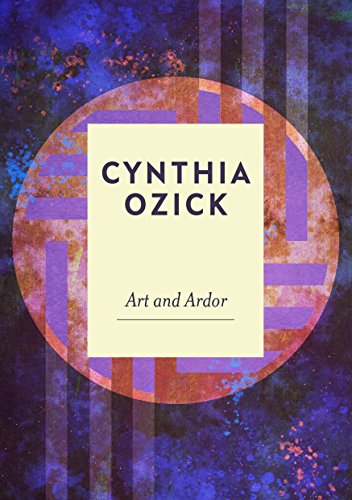
The below reading notes are taken from the first half of Ozick's essay "Literature as Idol: Harold Bloom" in her 1983 collection Art and Ardor.


The remainder of the essay redirects from Bloom's critical approach to a broader consideration of idolatry in Judaism. This was fascinating, but beyond my competence to understand.


[....] against a background of nineteenth-century impressionistic "appreciation," which included not only the words of the poem, but speculations about the "mood" of the poet, with appropriate allusions to the poet's life, and often enough an account of the state of mind or spirit of the reader while under the mood-influence of the poem. The New Criticism, puritan and stringent, aimed to throw out everything that was extravagant or extraneous, everything smacking of "sensibility" or susceptibility, every deviation….


[....] [Bloom's goal] revive the subjective style of impressionism, wherein the criticism of the text vies as a literary display with the text itself, and on a competitive level of virtuosity, even of "beauty."


[....] made connections well out of the provincial text itself


[....] fanatic homage to the real presence of palpable stanzas, lines, and phrases


[....] he conceived of poetry-reading as a kind of poetry-writing, or rewriting


[....] though he stuck to explication de texte in the old way, he made connections outside of the text in a new way—and, besides, he raised the subjectivist mode of vying with the original to a higher pitch

than ever before, while draining it of all self-indulgence.


[....] connections beyond "the poem itself" that he found were neither social nor psychobiographical.... they were theological


[....] Jewish Gnosticism strained through Freud, Nietzsche, Vico, and, of course, Gershom Scholem


[....] The real shock of Bloom was that he overturned what the academy had taken for granted for a good number of graduate-school generations: that if you analyze a poem closely enough, and with enough dogged attention to the inherent world of accessible allusion locked into every phrase, you will at length find out

what the poem truly means.


[....] draining it of all self-indulgence.


[....] "Few notions," Bloom observed, are more difficult to dispel than the "commonsensical" one that a poetic text is self-contained, that it has an ascertainable meaning or meanings without reference to other poetic texts. Something in nearly every reader wants to say: "Here is a poem and there is a meaning, and I am reasonably certain that the two can be brought together." Unfortunately, poems are not things but only words that refer to other words, and those words refer to still other words, and so on, into the deeply populated world of literary language. Any poem is an inter-poem, and any reading of a poem is an inter-reading. A poem is not writing, but rewriting , and though a strong poem is a fresh start, such a start is a starting-again.


[....] "Such a start is starting-again."


[....] He divides poets into "precursors" and "ephebes," or revisers; and he defines revision as purposeful misinterpretation, or "misprision."


[....] any poet born afterward is born into the condition of "belatedness," which he fights by wresting not the flame of the precursor, which cannot be taken, but the power to remake the flame. Invention is replaced by interpretation.


[....] that there is only interpretation, and that every interpretation answers an earlier interpretation, and then must yield to a later one.


[....] There are no interpretations but only misinterpretations, and so all criticism is prose poetry.


[....] interpretation is a process nearly analogous to a process in physics; to describe and summarize….


[....] how a poem comes into being out of its reading of an earlier poem, i.e., out of its own "swerving" from the influence of a powerful precursor-poem, Bloom names a "dialectic of revisionism"the drama of giants who once walked the earth, and turned "originality" into an acrobatic labor for those who came after.


[....] a contest for power, in which the competitors struggle for the possession of context; in which context is contest.


[....] contains the triad of re-seeing, re-esteeming, and re-aiming, which in Kabbalistic terms becomes the triad of contraction, breaking-of-the-vessels, and restitution, and in poetic terms the triad of limitation, substitution, and representation


[....] What Bloom means by "revisionism" is a breaking off with the precursor; a violation of what has been transmitted; a deliberate offense against the given, against the hallowed; an unhallowing of the old great gods; the usurpation of an inheritance by the inheritor himself; displacement. Above all, the theft of power.


*   *   *


Jay

24 August 2022


Friday, December 10, 2021

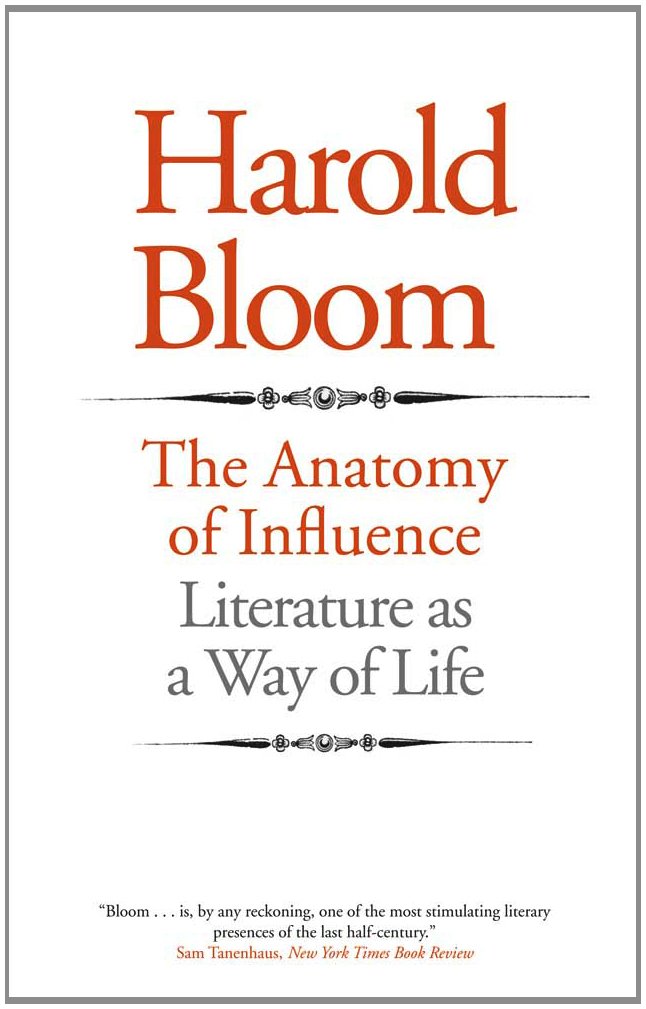
My reading notes on The Anatomy of Influence [i]

My Reading notes on The Anatomy of Influence: Literature as a Way of Life by Harold Bloom

(Yale, 2011)


PRAELUDIUM


[....]Literary criticism, as I learned from Walter Pater, ought to consist of acts of appreciation.


The Point of View for My Work as a Critic


LITERARY LOVE


[....]I was a graduate student writing a doctoral dissertation on Shelley before I began to realize that influence was the inevitable problem for me to solve if I could. Existing accounts of influence seemed to me mere source study, and I became puzzled that nearly every critic I encountered assumed idealistically that literary influence was a benign process.


[....]Literary criticism, as I attempt to practice it, is in the first place literary, which is to say personal and passionate. It is not philosophy, politics, or institutionalized religion. At its strongest—Johnson, Hazlitt, Charles Augustin Sainte-Beuve, and Paul Valéry, among others—it is a kind of wisdom literature, and so a meditation upon life. Yet any distinction between literature and life is misleading. Literature for me is not merely the best part of life; it is itself the form of life, which has no other form.


[....]It took me from 1953 until the summer of 1967 before my meditation clarified. It was then that I awoke in my state of metaphysical terror and after a dazed breakfast with my wife began to write the dithyramb that eventually became The Anxiety of Influence. It took about three days to complete, and it baffled me as I brooded. What was it? I could recognize that I had been thinking it a long time, not always consciously.


[....]the cultural present both derives from and reacts against anteriority.


[....]it is a last-ditch defense of poetry, and a cry against being subsumed by any ideology. Opponents accuse me of espousing an "aesthetic ideology," but I follow Kant in believing that the aesthetic demands deep subjectivity and is beyond the reach of ideology.


[....]Creative misreading....  The influence process always is at work in all the arts and sciences, as well as in the law, politics, popular culture, the media, and education.


[....]I acknowledged Shakespeare's Sonnet 87, "Farewell, thou art too dear for my possession," for giving me what have become critical keywords: misprision, swerving, and mistaking....  belatedness....


[....]Influence anxiety, in literature, need not be an affect in the writer who arrives late in a tradition. It always is an anxiety achieved in a literary work, whether or not its author ever felt it.


[....]Joyce's personal lack of such anxiety was, to me, not the issue. Ulysses and Finnegans Wake manifest considerable belatedness, more in relation to Shakespeare than to Dante. Influence anxiety exists between poems and not between persons. Temperament and circumstances determine whether a later poet feels anxiety at whatever level of consciousness. All that matters for interpretation is the revisionary relationship between poems, as manifested in tropes, images, diction, syntax, grammar, metric, poetic stance. 


[....]greatness ensues from giving inevitable expression to a fresh anxiety.


[....]Longinus, critical.... formulator of the sublime, said that "beautiful words are in very truth the peculiar light of thought." But what is the origin of that light in a poem, play, story, novel? It is outside the writer, and stems from a precursor, who can be a composite figure. In regard to the precursor, creative freedom can be evasion but not flight. There must be agon, a struggle for supremacy, or at least for holding off imaginative death.


[....]to see art as a contest for the foremost place.


[....]Norman Austin, commenting upon Sophocles in Arion (2006), observes that "ancient poetry was dominated by an agonistic spirit that has hardly ever seen its equal.


[....]Western culture remains essentially Greek, since the rival Hebrew component has vanished into Christianity, itself indebted to the Greek genius.


[....]In the wake of French theorists of culture like the historian Michel Foucault and the sociologist Pierre Bourdieu, the world of letters is most often portrayed as a Hobbesian realm of pure strategy and strife.


[....]Bourdieu's now fashionable account of literary relationships, with its emphasis on conflict and competition, has an affinity with my theory of influence and its emphasis on agon. But there are fundamental differences as well. I do not believe that literary relationships can be reduced to a naked quest for worldly power, though they may in some cases include such ambitions. The stakes in these struggles, for strong 


[....]For decades, I was informed that women and homosexual writers entered no contest but cooperated in a community of love. Frequently I was assured that black, Hispanic, and Asian literary artists too rose above mere competition. Agon was apparently a pathology confined to white heterosexual males. 


[....]In the wake of French theorists of culture like the historian Michel Foucault and the sociologist Pierre Bourdieu, the world of letters is most often portrayed as a Hobbesian realm of pure strategy and strife.


[....]I do not believe that literary relationships can be reduced to a naked quest for worldly power, though they may in some cases include such ambitions. The stakes in these struggles, for strong. poets, are always literary.


[....]A strong poet seeks not simply to vanquish the rival but to assert the integrity of his or her own writing self.


[....] I define influence simply as literary love, tempered by defense. The defenses vary from poet to poet. But the overwhelming presence of love is vital to understanding how great literature works.


[....] Milton's defense against Shakespeare is highly selective repression while Joyce's is total appropriation.


[....] Shakespeare a special case for the study of influence: his effects are too large to be coherently analyzed.


[....] We would have been here anyway, of course, but without Shakespeare we would not have seen ourselves as what we are.


[....]Shelley appears in several chapters as a strong influence on Yeats, Browning, and Stevens, and as a somewhat reluctant skeptic too. Whitman, who appears in many chapters, comes in at least two key guises. He is the poet of the American Sublime, but he is an important representative of the Skeptical Sublime, and as such he appears alongside Shelley, Leopardi, Pater, Stevens, and the more covert Lucretians John Dryden, Samuel Johnson, Milton, and Tennyson.


[....] The structure of literary influence is labyrinthine, not linear.


[....] how to transcend echoes and allusions, and to find the more crucial matter of the transmission of poetic stances and vision.


[....]My ways of writing about literary influence have been widely regarded as relying upon Freud's Oedipus complex. But that is just wrong, as I have explained before, to little avail. Freud's Hamlet complex is far closer, or even better, your Hamlet complex and mine. Hamlet's deepest struggles are with Shakespeare and with the Ghost, who was played by the dramatist.


[....]Magpie that he was, Shakespeare voids any distinction between tuition and provocation, and loots where he chooses. Whitman tends to limit his sources because his self-presentation demands that he become his own supreme authority.


[....]Influence, which figures everywhere in life, becomes intensified in poetry. It is the only true context for the strong poem because it is the element in which authentic poetry dwells.


[....]Influence stalks us all as influenza and we can suffer an anguish of contamination whether we are partakers of influence or victims of influenza. What remains free in us is the daimon. I am not a poet, but I can speak of the reader-in-the-reader and also as a daimon who deserves to be appeased. In our age of the screen—computer, television, movie—the new generations grow up seemingly bereft of their daimons. I fear that they will develop new versions of the daimonic, and that a visual culture will end imaginative literature.


[....]correct readings are not possible if a literary work is sublime enough. A correct reading merely would repeat the text, while asserting that it speaks for itself. It does not. The more powerful a literary artifice, the more it relies upon figurative language.


[....]To practice criticism, properly so-called, is to think poetically about poetic thinking.


[....]Imaginative literature is figurative or metaphoric. And in talking or writing about a poem or novel, we ourselves resort to figuration.


[....] I prefer the philosopher Søren Kierkegaard on anxiety to Freud, but Anna Freud mapped the mechanisms of defense, and my accounts of influence are indebted to her.


[....]Makari concludes by rightly judging psychoanalysis as the leading modern theory of the mind, citing its ideas of defense and inner conflict. Since I define influence here as literary love tempered by defense....

     Defense ( Abwehr ) is an agonistic concept in psychoanalysis, but it is a dialectical one as well and thus a splendid fit for any theories of influence. We fall in love, and for a time we have no defenses, but after a while we develop an arsenal of apotropaic gestures. We are animated by a drive that wants us to return to the ego's narcissistic investment in itself. So too with poets. Possessed by all the ambivalence of Eros, the new but potentially strong writer struggles to ward off any totalizing attachments.


* * *


Jay

9 December 2021


My reading notes on The Anatomy of Influence [ii]

The Anatomy of Influence: Literature as a Way of Life by Harold Bloom

(Yale, 2011)


* * *


SUBLIME STRANGENESS


[Pseudo-Longinus]


[....]The single treatise we have from the more properly named Pseudo-Longinus properly should be translated "On the Heights." But by now we are unable to do without On the Sublime, even though sublime as a word remains bad currency. So too is aesthetic, which Pater (after its popularization by Wilde) wanted to restore to its ancient Greek sense of "perceptive."


[....]To be a Longinian critic is to celebrate the sublime as the supreme aesthetic virtue and to associate it with a certain affective and cognitive response. A sublime poem transports and elevates, allowing the author's "nobility" of mind to enlarge its reader as well.


[....]First published in 1949, "The Affective Fallacy" launched a major assault on the then pervasive belief that the meaning and value of a literary work could be apprehended by "its results in the mind of its audience."


[....]In the long Age of Resentment, intense literary experience is merely "cultural capital," a means to power and glory within the parallel "economy" that Bourdieu labels the literary field. Literary love is a social strategy, more affectation than affect. But strong critics and strong readers know we cannot understand literature, great literature, if we deny authentic literary love to writers or readers. Sublime literature demands an emotional not an economic investment.


[....] I cheerfully affirm a passion for the difficult pleasures of the sublime, from Shakespeare, Milton, and Shelley on to Yeats, Stevens, and Crane.


[....] can be no living literary tradition without secular canonization, and judgments of literary value have no significance if not rendered explicit. Yet aesthetic evaluation has been viewed with suspicion by academic critics since at least the early part of the twentieth century. The New Critics deemed it too messy an undertaking for the professional scholar-critic.


[....] There can be no living literary tradition without secular canonization, and judgments of literary value have no significance if not rendered explicit. Yet aesthetic evaluation has been viewed with suspicion by academic critics since at least the early part of the twentieth century. The New Critics deemed it too messy an undertaking for the professional scholar-critic. Northrop Frye said that evaluation should be implicit, and that was one of the disagreements between us from 1967 on. But the New Cynicism's roots in the social sciences have produced a more clinical posture still. To speak of the art of literature is viewed as a breach of professional responsibility. Any literary academic who issues a judgment of aesthetic value—-better, worse than, equal to—risks being summarily dismissed as a rank amateur.


[....] Over time the strong poets settle these matters for themselves, and precursors remain alive in their progeny.


[....] the canon in time will select itself, you still can follow a critical impulse to hasten the process, as I did with the later Stevens, Ashbery, Ammons, and, more recently, Henri Cole.


[....] I keep urging the work of the reader's sublime: confront only the writers who are capable of giving you a sense of something ever more about to be.


[....]sublime literature transports and enlarges its readers.


[....]we experience something akin to authorship: "We come to believe we have created what we have only heard."


[....]Freud identified this aspect of the sublime in the uncanny, which returns from the flight of repression as "something familiar and old-established in the mind."


[....]Longinus's treatise exalts the sublime yet implies ambivalence as well: "what is wonderful always goes together with a sense of dismay."


[....]sublime is at once magnificent and fraught.


[....]greatness of the sublime object induces both delight and terror: "Infinity has a tendency to fill the mind with that sort of


[....]delightful horror, which is the most genuine effect, and truest test of the sublime."


[....]paradoxical coupling of pain and pleasure. For Shelley, the sublime is a "difficult pleasure," an overwhelming experience whereby we forsake simple pleasures for ones that are almost painful.


[....]Pater contributed to theories of the sublime in his pithy description of Romanticism as the adding of strangeness to beauty. "Strangeness" for me is the canonical quality, the mark of sublime literature.


[....]Strangeness is uncanniness: the estrangement of the homelike or commonplace.


[....]strangeness renders the deep relation between sublimity and influence palpable.


[....]In the case of the strong reader, strangeness often assumes a temporal guise.


[....]In his wonderful essay "Kafka and His Precursors," Jorge Luis Borges evokes the uncanny process by which the novelist and essayist Franz Kafka seems to have influenced the poet Robert Browning, his precursor by many decades. What is most strange in such Borgesian moments is not that the prior poet appears to have written the new poem. It is that the new poet appears to have written the prior poet's poem. Examples of this kind of chronological reordering, in which a strong poet appears miraculously to have preceded his or her precursors, abound in the pages that follow.


[....]But you cannot reformulate the sublime in the twentieth century, or now in the twenty-first, without wrestling Sigmund, whose Hebrew name, Solomon, suited him far better since he was not at all Wagnerian and very much a part of Hebraic wisdom, "Weisheit the rabbi" as Stevens hinted at naming him.


[....]Longinus, Kant, Burke, and Nietzsche are all Freud's heirs.


[....]For a strong writer, strangeness is the anxiety of influence.


[....]inescapable condition of sublime or high literature is agon


[....]Implicit in Longinus's famous celebration of the sublime—"Filled with delight and pride we believe we have created what we have heard"—is influence anxiety.


[....]transports us beyond ourselves, provoking the uncanny recognition that one is never fully the author of one's work or one's self.


[....]The element of strangeness in beauty has the contrary effect. It arises from contact with a different kind of consciousness from our own, different, yet not so remote that we cannot partly share it, as indeed, in such a connection, the mere word 'contact' implies. Strangeness, in fact, arouses wonder when we do not understand: aesthetic imagination when we do."


[....]As we go out to meet a larger consciousness, we metamorphose into a provisional acceptance that sets aside moral judgment, while wonder transmutes into a more imaginative understanding.


[Kant, Pater]


[....]Kant defined the sublime as that which defies representation. To which I would add that the turbulence of the sublime needs representation lest it overwhelm us.


[....]Pater's aesthetic, essentially also my own, is Lucretian through and through; it is deeply concerned with the effects of the work upon its reader: "What is this song or picture, this engaging personality presented in life or in a book, to me?


[....]Does it give me pleasure?


[....]what sort or degree of pleasure?


[....]is my nature modified by its presence, and under its influence?


[....]ancient Greek meaning of aesthetes, "one who perceives."


[....]Pater, self-quarried as he was out of the odes of John Keats, and out of his favorite Shakespearean play, the be-absolute-for-death Measure for Measure. He quotes Victor Hugo's "Men are all condemned to death with indefinite reprieves,"


[....]Of such wisdom, the poetic passion, the desire of beauty, the love of art for art's sake, has most. For art comes to you proposing frankly to give nothing but the highest quality to your moments as they pass, and simply for those moments' sake. ["Conclusion," The Renaissance: Studies in Art and Poetry (1868)]


[....]like most of Pater, this motto has been largely weakly misread from 1873 to the present. Anything misunderstood through four generations has its own sanction


[....]What Pater analyzes is the love of art for the sake only of quickening and enhancing consciousness.


[....]influence anxiety, an anxiety in expectation of being flooded


[....]a problem for critics as well


[....]for the critic as for the poet, representation may be the only defense


[....]coming to terms with the overwhelming flood of images and sensations that Pater called phantasmagoria.


[....]literature was not merely an object of study but a way of life.


[Samuel Johnson, Angus Fletcher]


[....]I regard Johnson as my critical forerunner, since my life's work from The Anxiety of Influence until now seems to me more Johnsonian than Freudian or Nietzschean, a following of the great critic in his quest to understand literary imitation.


[....]has the knack of making all four later and himself earlier, as though they were influenced by him.


[....]imaginative displacement

enters again with Pater and his Aesthetic school: Wilde and Yeats, Virginia Woolf and Wallace Stevens.


[....]I read [Angus Fletcher] and experience what I wish were my own thoughts coming back to me "with a certain alienated majesty," as Emerson put it. That is the critic's sublime or partial recognition.


[....]Appreciation subsequent to overt evaluation is vital.


[....]Read, reread, describe, evaluate, appreciate: that is the art of literary criticism for the present time.


[....]Longinian rather than philosophical, in the modes of either Plato or Aristotle.


* * *


THE INFLUENCE OF A MIND ON ITSELF


[Valérian investigation]


[....]Sadly, Borges idealized his account of literary influence by rejecting any idea of rivalry or competition in regard to precursors. Shelley once grandly remarked that all imaginative literature formed one comprehensive cyclic poem; Borges went further by amalgamating all writers into one, a Here Comes Everybody Shakespeare-Homer, James Joyce's composite before it became Borges's.


[....]Valéry, like the French Poe and Mallarmé, desires the power of his mind only over the mind itself, a Cartesian quest rather than a Shakespearean one. The central man in French literature is not Rabelais, Montaigne, or Molière, nor is he Racine, Victor Hugo, Balzac, Baudelaire, Flaubert, or Proust. He is Descartes, who occupies in France the place reserved in other nations for Shakespeare, Dante, Cervantes, Goethe, Tolstoy, or Emerson. Call it the place of the Founder. Literary influence in Britain, Italy, Spain, Germany, Russia, and the United States is not radically different from country to country. But because a philosopher was the Founder, they order these matters differently in France.


[....]Those who now prate about either separating literature and life or yoking them together become bureaucrats of the spirit, professors of Resentment and Cynicism. Valéry, supremely intelligent, ended his great poem about the marine cemetery with the monitory outcry that the wind was rising and one should try to live. "The influence of a mind on itself and of a work on its author" is central to Valéry's speculations upon literature.


[....]self-influence ought to concern us only in the strongest writers. The effect of Ulysses upon the Wake is a vital matter; the influence of earlier upon later Updike is of possible interest only to those who esteem him.


[....]Falstaff, Hamlet, Iago, and Cleopatra have an independent existence in our consciousness. Shakespeare's art of foregrounding character is such that we delight in transposing his men and women to other contexts, speculating as to how they might fare in other plays or alongside other characters. How can that be? Each of these fourfold is made up out of words and inhabits a fixed space. Yet the illusion of vitalism is nonetheless particularly strong in them, even though it goes against my deepest conviction to employ the word illusion. If Falstaff and Hamlet are illusive, then what are you and I?


[....]Valéry, so far as I know, never found the right time and place to "discuss the influence of a mind on itself and of a work on its author." This book is my time and place to do so. Self-influence is a Valérian concept, and The Anatomy of Influence is partly a Valérian investigation, an exploration of how certain strong writers, especially Shakespeare and Whitman, were possessed by and then possessed their precursors in turn.


[....] Valérian investigation.... Valéry, so far as I know, never found the right time and place to "discuss the influence of a mind on itself and of a work on its author." This book is my time and place to do so. Self-influence is a Valérian concept, and The Anatomy of Influence is partly a Valérian investigation, an exploration of how certain strong writers, especially Shakespeare and Whitman, were possessed by and then possessed their precursors in turn.


[....]To understand what makes poetry poetry and not something else one must locate the poem in relation to its precursors. These relations are the element in which true poetry dwells. And in rare instances they lead us back to the poet's own work.... 


[....]Kenneth Burke once said that a critic must ask what a writer intended to do for himself or herself by creating a specific work.... But I would amend Burke's law: the critic must ask not simply what the writer intended to accomplish as a person but what he or she intended to accomplish as a writer.


[....] I remain gripped by particular questions. Why has influence been my obsessive concern? How have my own reading experiences shaped my thinking? Why have some poets found me and not others? What is the end of a literary life?


[....]Literary criticism cannot reverse authentic declines in high culture, but it can bear witness. Growing old, I intensify my personal quest to gain more vitality from the literary text.


[....]All literary influence is labyrinthine. Belated authors wander the maze as if an exit could be found, until the strong among them realize that the windings of the labyrinth are all internal. No critic, however generously motivated, can help a deep reader escape from the labyrinth of influence. I have learned that my function is to help you get lost.


* * *


Jay

9 December 2021


My reading notes on The Anatomy of Influence [iii]

The Anatomy of Influence: Literature as a Way of Life by Harold Bloom

(Yale, 2011)


* * *


DR. JOHNSON AND CRITICAL INFLUENCE


[....]Shakespeare himself is change, and the bounds of existence are broken and reformed because it is through Shakespeare that we are reminded that the mind is a ceaseless activity.


[....]"He that peruses Shakespeare looks around alarmed, and starts to find himself alone." There is the epitome of Johnson on Shakespeare: here is the writer and his critic who make us tremble like a guilty thing surprised when we first encounter the most vivid immediacy that imaginative literature can afford us.


[....]Shakespeare confronts Johnson with an invaluable dilemma. In his own new way Johnson seems to me essentially a biographical critic. Johnsonian universals always are biographical, that is to say psychological, and that is the clue to his love and understanding of Shakespeare. For Johnson, Shakespeare is the absolute poet of human nature, and of our affections in particular.


[....]Walter Pater's subtle essay on Measure for Measure a century later.


[....]Universal is a key word for Johnson's comprehension of Shakespeare's importance, since "universals" imbue the Johnsonian mode of criticism, empirical but deeply learned, a parallel discipline to David Hume's philosophy.


[....]Of everything on Shakespeare I have read, the most helpful is Johnson's preface to his edition of Shakespeare's plays. Nothing else devoted to Shakespeare brings to the sublime of all works of literature a total human being whose cognitive and affective endowments rival the plays he lovingly confronts.


[....]Always a moralist above all, Johnson is too intelligent not to see the plays are not Christian, and their audience is presumed such only as a social convention.


[....]I agree that we owe everything to Shakespeare, even if to say so invites scorn from the usual rabblement: comma counters, "cultural" materialists, new and newer historicists, gender commissars, and all the other academic impostors, mock journalists, inchoate rhapsodes, and good spellers. Without Shakespeare what would we know? We no longer recognize what we mean by "nature," unless it be Shakespeare's work. To appeal from reason to nature simply is to invoke Shakespeare.


[....]Johnson had a nostalgia for the formalistic neoclassical rules of literature but discarded them whenever they did not fit Shakespeare, since Shakespeare alone gives copious sustenance to our "hunger of imagination."


[....]In the tradition of Longinus, he wants us to apprehend that Shakespeare is showing us much for the first time while making us feel we had truly known it all along but lacked awareness.


[....]Citing this passage or that from Johnson's preface to his Shakespeare edition is a hopeless way of getting at its power of insight. Underlying it throughout is Johnson's sense of perilous balance, of falling into Swiftian madness rather than imitating the supposedly Shakespearean "repose on the stability of truth." For Johnson this is the value of Shakespeare; but reflect upon that massive phrase, "the stability of truth." What can Johnson mean? Nothing, no one, is stable in Shakespeare or in our lives; Johnson knows this too well. It must change is the law of Shakespeare and of life; we have neither youth nor age but a dreaming on both.


[....]Hearing Wimsatt, I said once in a seminar that his Johnson seemed to be a kind of baroque Neoplatonist, and my teacher did not demur. That class was in the autumn of 1951; fifty-eight years later I reflect back on it and wonder whether Johnson's Shakespeare is not a Neoplatonic or Hermetic Demiurge, which is not a bad description of Prospero.

     The preface's Shakespeare is remarkably close to the Bard of Hazlitt and Coleridge, Lamb and Keats: the maker of a new reality in which—not altogether consciously—we find ourselves more truly and more strange. Shakespeare called out to the Romantic strain in Johnson, the mind through all its powers seeking to exorcize the vileness of melancholy and assert itself against a universe of death.


* * *


THE SKEPTICAL SUBLIME


ANXIETIES OF EPICUREAN INFLUENCE


[Pater, Yeats, Stevens, Merrill]


[....]Lucretian tradition is not less anxious than Protestant continuity.


[....] Milton could subsume all anteriority except for Shakespeare


[....]the hierophant of metamorphosis is an incessant magpie, sensibly appropriating what he finds useful.


[....] the Epicurean exalter of the swerve was a marvelous stimulus to a Skeptical Sublime.


[....] As a disciple of Walter Pater and his ephebe Oscar Wilde, I am an Epicurean literary critic, reliant upon sensations, perceptions, impressions


[....]To-day at least, in the peculiar clearness of one privileged hour, he seemed to have apprehended . . . an abiding-place. . . .


[....]Himself—his sensations and ideas—never fell again precisely into focus as on that day, yet he was the richer by its experience. . . . It gave him a definitely ascertained measure of his moral or intellectual need, of the demand his soul must make upon the powers, whatsoever they might be, which had brought him, as he was, into the world at all.


[clinamen]: swerve


[....]Certainly the strongest of Italian poets since Dante and Petrarch, Leopardi, like Wordsworth, is the inaugurator of modern poetry. Something that went from Homer and the Hebrew Bible on to Goethe and William Blake changed forever with Wordsworth and Leopardi. Two Romantic visionaries hardly could be more different than are Leopardi and Wordsworth in temperament, belief, and hope. And yet they share (with no knowledge of the other's existence) the fundamental patterns of the High Romantic crisis-poem, in which the poet saves himself from acedia if only to write the next poem, to make it possible.


[acedia /əˈsēdēə/ spiritual or mental sloth; apathy.]


[heterocosm] A separate or alternative world. noun


[....] Schopenhauer and of the early Wittgenstein in the Tractatus, in his observation that what the solipsist says is irony but what he means is right.


[....]Paterian imagination—"simplification through intensity"


[....]Despite its closing line, this should be called "The Second Birth" since it celebrates the Second Coming of the Egyptian sphinx and not of Christ.


[....]Ultimately Yeats's starting point had to be Shelley's rugged sonnet "Ozymandias"


[....] The Theban sphinx, Riddler and Strangler, overcome by Oedipus, had the head of a woman. Yeats, a late Pre-Raphaelite, followed Swinburne and Wilde in seeing the Oedipal female sphinx as the muse of sadomasochistic self-destruction. This was the sphinx of Yeats's Tragic Generation, his friends the poets of the 1890s: Ernest Dowson, Lionel Johnson, Arthur Symons, Victor Plarr.


[....] What if every two thousand and odd years something happens in the world to make one sacred, the other secular; one wise, the other foolish; one fair, the other foul; one divine, the other devilish?


[....] What if there is an arithmetic or geometry that can exactly measure the slope of a balance, the dip of a scale, and so date the coming of that something?


[gnosis]


[....] this shattering poem that more than triumphs over its own incoherence, and indeed exploits such sacred disorder. Why the Egyptian sphinx rather than the Greek? Because Yeats is thinking of Oedipus as he drafts what will become "The Second Coming," yet he strongly desires to exclude his "new divinity" from the poem.


[....] the fascination with what's difficult, endemic in Yeats's work.


[....] Pater's definition of Romanticism as "adding strangeness to beauty,"


[Aickman adds strangeness to banality.]


[....] I cannot think of another twentieth-century poem in any Western language that rivals "The Second Coming" in rhetorical power. Yeats's poem of violent annunciation is as fearfully relevant now as it was in January 1919, when it was composed.


[misprision]


[....] "The Second Coming" is a celebration of the rough beast, not a lamentation. Neither a Christian nor a humanist, Yeats was an apocalyptic pagan, who would have looked on and laughed in what he called "tragic joy."


[....] Politically, Yeats was refreshingly outrageous, and hardly asked to be held responsible for his outbursts. His essay On the Boiler (1939) is a wild absurdity in which "the drilled and docile masses," if they do not submit, are to be rolled over by "the skilful, riding their machines as did the feudal knights their armoured horses." That is Yeats twenty years after "The Second Coming," yet the spirit is the same.


[....] Meditating upon Yeats's reveries on Shelley and Blake crystallized for me the realization that the most fruitful poetic influence was a creative misreading or misprision.


[....] Per Amica Silentia Lunae, more than A Vision, is Yeats's Book of the Daimon. A beautiful, original twist is given by Yeats to daimonic lore. The poet's daimon, or opposing self, is also his muse, the unattainable [Maude Gonne] precisely call her Yeats's Genius, perpetually frustrating him into poetic greatness.


[....]Stationing "Byzantium" both as an aesthetic phenomenon of poetic images and as an emblem of an occult death-before-life gives Yeats an uncomfortable advantage over us, his readers. We simply cannot know where we are, and so we don't really know what the poet is talking about, and perhaps Yeats does not really know either. The rhetoric of "Byzantium" is pitched so high, its rhythms so wonderfully modulated, that we don't much care. With a poem so rich beyond measure, incoherence is no more a burden here than it need be in "The Second Coming."


[Willed phantasmagoria]


[....]"revisionary ratios"  A Map of Misreading


[synecdoche]


[tessera]


[....]metonymy/metaphor division of Roman Jakobson, I rewrought as kenosis/askesis


[....]hyperbole, but conceived as a daimonic assertion of individual genius.


[....] metalepsis, or the metonymy of a metonymy, which I called by the ancient Athenian word apophrades, the unlucky (dismal) days when the dead returned momentarily to repossess their former homes.


[apophradian]


[exegetical instruments]


[....] Once again, influence anxiety, as I have seen it, takes place between poems, and not between persons. Temperament and circumstances determine whether or not a later poet feels anxiety at whatever level of consciousness. All that matters for interpretation is the revisionary relationship between poems, as manifested in tropes, images, diction, syntax, grammar, metric, poetic stance.


[cathected: to invest with mental or emotional energy]


[....]Strong poets do not choose but are found by the imaginative register of blood kindred.


[....] anxiety of influence as an affect of the belated poet scarcely interests me. The impingements of one poem upon another is my concern...


* * *


CODA


[....] [Robert Penn] Warren remarked that my phrase "the anxiety of influence" was a metaphor for poetry itself, which is my starting point for this brief coda. Shakespeare's influence upon himself does not mark him as unique, and yet it mattered more than the combined effect of Marlowe, Ovid, Chaucer, and the English Bible.


[....]Only a few of the strongest—Robert Frost, Elizabeth Bishop, James Merrill—did not respond to [Whitman]. Wallace Stevens, T. S. Eliot, and Hart Crane belong to a particular tradition in which form is almost totally unaffected by Whitman, but the inward motions of stance, trope, and self-awareness increasingly reveal their sonship to the American Homer. Western poetry, perhaps unlike Eastern, is incurably agonistic.


[....]When I began to formulate the image of anxiety of influence, I relied from the start on Lucretius, whose clinamen, "swerve," became my model for the rhetorical relation between earlier and later poets. That is why so much of this book is devoted to Lucretian poets: Shelley, Leopardi, Whitman, Stevens, and others. One could have added Robert Frost, perhaps the most Lucretian of all our poets.


[....]There is no way out of the labyrinth of literary influence once you reach the point where it starts reading you more fully than you can encompass other imaginations. That labyrinth is life itself. I cannot finish this book because I hope to go on reading and seeking the blessing of more life.


Jay

10 December 2021