Subscribe to my Substack

Showing posts with label George Allan England. Show all posts

Sunday, June 26, 2022

"The Thing from Outside" (1923) by George Allan England

Readers unfamiliar with "The Thing from Outside" may prefer to read these notes only after reading the story.


     Presently darkness folded down. The men smoked, thankful that tobacco still held out. Vivian lay in a bunk that Jandron had piled with spruce-boughs for her, and seemed to sleep. The Professor fretted like a child, over the blisters his paddle had made upon his hands. Marr laughed, now and then; though what he might be laughing at was not apparent. Suddenly he broke out: "After all, what should It want of us?"

     "Our brains, of course," the Professor answered, sharply.

     "That lets Jandron out," the journalist mocked.

     "But," added the Professor, "I can't imagine a Thing callously destroying human beings. And yet—"

     He stopped short, with surging memories of his dead wife. "What was it," Jandron asked, "that destroyed all those people in Valladolid, Spain, that time so many of 'em died in a few minutes after having been touched by an invisible Something that left a slight red mark on each? The newspapers were full of it."

     "Piffle!" yawned Marr.

     "I tell you," insisted Jandron, "there are forms of life as superior to us as we are to ants. We can't see 'em. No ant ever saw a man. And did any ant ever form the least conception of a man? These Things have left thousands of traces, all over the world. If I had my reference-books—"

     "Tell that to the marines!"

     "Charles Fort, the greatest authority in the world on unexplained phenomena," persisted Jandron, "gives innumerable cases of happenings that science can't explain, in his Book of the Damned. He claims this earth was once a No-Man's Land where all kinds of Things explored and colonized and fought for possession. And he says that now everybody's warned off, except the Owners. I happen to remember a few sentences of his: 'In the past, inhabitants of a host of worlds have dropped here, hopped here, wafted, sailed, flown, motored, walked here; have come singly, have come in enormous numbers; have visited for hunting, trading, mining. They have been unable to stay here, have made colonies here, have been lost here.' "

     "Poor fish, to believe that!" mocked the journalist, while the Professor blinked and rubbed his bulging forehead.

     "I do believe it!" insisted Jandron. "The world is covered with relics of dead civilizations, that have mysteriously vanished, leaving nothing but their temples and monuments."

     "Rubbish!"

     "How about Easter Island? How about all the gigantic works there and in a thousand other places—Peru, Yucatan and so on—which certainly no primitive race ever built?"

     "That's thousands of years ago," said Marr, "and I'm sleepy. For heaven's sake, can it!"

     "Oh, all right. But how explain things, then!"

     "What the devil could one of those Things want of our brains?" suddenly put in the Professor. "After all, what?"

     "Well, what do we want of lower forms of life? Sometimes food. Again, some product or other. Or just information. Maybe It is just experimenting with us, the way we poke an ant-hill. There's always this to remember, that the human brain-tissue is the most highly organized form of matter in this world."

     "Yes," admitted the Professor, "but what—?"

     "It might want brain-tissue for food, for experimental purposes, for lubricant—how do I know?"


*   *   *


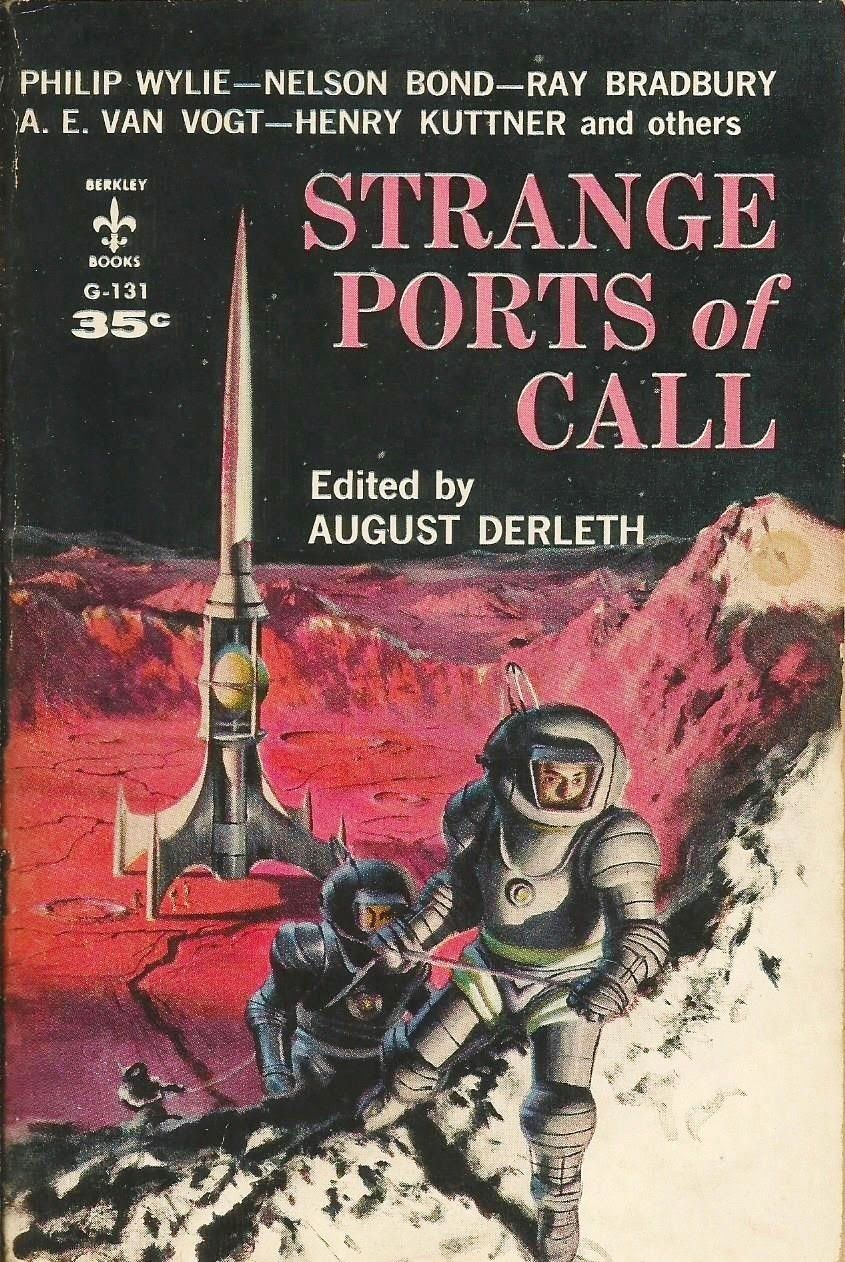
"The Thing from Outside" (1923) by George Allan England looks back to certain works by Algernon Blackwood, particularly "The Willows" and "The Wendigo." It also anticipates some later genre tropes of cosmic horror. These elements are all bunched-up with Gernsback-scale melodrama. Still, "The Thing from Outside" keeps struggling to overcome, and keeps introducing unexpected and uncanny moments of real power.


            The three men smoked. The two women huddled close to each other. Fireglow picked their faces from the gloom of night among the dwarf firs. A splashing murmur told of the Albany River's haste to escape from the wilderness, and reach the Bay.

     "I don't see what there was in a mere circular print on a rock-ledge to make our guides desert," said Professor Thorburn. His voice was as dry as his whole personality. "Most extraordinary!"

     "They knew what it was, all right," answered Jandron, geologist of the party. "So do I." He rubbed his cropped mustache. His eyes glinted grayly. "I've seen prints like that, before. That was on the Labrador. And I've seen things happen, where they were."

     "Something surely happened to our guides, before they'd got a mile into the bush," put in the Professor's wife; while Vivian, her sister, gazed into the fire that revealed her as a beauty, not to be spoiled even by a tam and a rough-knit sweater. "Men don't shoot wildly, and scream like that, unless—"


*   *   *


Five individuals in the Canadian north are abandoned by their guides and have to fight their way by river and portage to the nearest railhead, weeks away. As they do so, strange circular footprints appear: something is stalking them.


As the protagonists travel, it also becomes clear the thing from outside is intentionally or unintentionally disorienting them. One character thinks they are fighting their way upstream; another knows they are headed downstream. One thinks the sun has vanished; another, that it is still summer. One man wakes one morning covered in snow and fears he has been asleep for a month.


Time dilation, slingshot narrative jumps, and predicaments demanding negative capability or equipoise of characters, used often in later horror fiction,  are all anticipated in "The Thing from Outside."


*   *   *


….And silence fell upon the little night-encampment in the wilds; a silence that was ominous. 

        Pale, cold stars watched down from spaces infinitely far beyond man's trivial world.


Jay

26 June 2022      


Tuesday, April 27, 2021

“Can this be A.D. 2O16?” The Plunge (1916) by George Allan England

Though the month was June, and the stupendous aero-liner Imperatrice had only half an hour before demagnetized its electromagnetic disks and cleared from the Pacific Transport towers at Honolulu, the thin, cold atmosphere of more than two miles aloft nipped keenly....


"The Plunge" (1916) by George Allan England ends the anthology Steampunk Prime on a spectacular note. None of the dying-fall pathos of "The Last Days of Earth," or the space-going Tsushima of "An Interplanetary Rupture." 


"The Plunge" opens with a nighttime meet-cute between Jeanne Hargreaves and novelist Norford Hale on the Imperatrice. (A wag might say Imperatrice is an aero version of Titanic).


The world of Imperatrice and its passengers is a future Max Nordau would hate:


     "....Now that China and India and Thibet are weekend excursions, on tourist schedules, what can be left to wonder at or be romantic about?" He stifled a yawn, with difficulty. "Not one uncivilized or semi-civilized place in the whole world — even the very Esquimaux and Patagonians sophisticated and selling postcards — bah! In these days of motive power drawn from the sun or from polar currents streaming to it, these days of synthetic foods, etheric energies, and all-embracing mechanism, what part is left for the personal equation?

     "Civilization? Ugh! I detest it! I'd give a year of my life — five years — for a touch of the real, the raw, the primitive! Life has become as dull as men and women themselves. Are there any real women in the world to-day? "I've never met one. That's why I've never married — "

     He gestured outward with his hand, despairingly. She smiled with certain bitterness.

     "Real women?" The girl exclaimed. "Show me a real man first! Extinct! I've always thought so; but until tonight I've always been too polite to say so. Somehow, with you, politeness and subterfuge seem as stupidly unreal as all the rest of this super-civilization. I wonder, now — "


Never fear, though. "In shadowy silent distance grew the Iceberg too."


     A sudden flare of light, far outshining the moon, interrupted her speech. The brilliance flooded the whole sky, dazzled upon the spinning clouds below, and for a second glared with noonday radiance. Every minutest detail of the ship stood out in startling relief.

     A wailing, screeching note cleft the high air, grew swiftly louder as the light brightened, then ended in a thunderous crash that shook the liner from lookout to extremest rudder-plane.

     Then, instantly, the light glared below. The novelist, leaning over the rail as the staggered liner heeled sickeningly far to port, saw a swift streak of bluish flame — flame that roared, that coruscated — plunge like a rocket into the enveloping fleeciness of the clouds, and vanish.

       A DULL concussion shuddered through the Imperatrice, then two more in quick succession. Flames gushed, aft. Confused cries, shouts, and tumult rose on the night. Everywhere echoed that most terrible of all sounds; the shrieking of women. Came the trampling of feet running along the decks, which already — as the stupendous aerocraft slowed, drunkenly swaying — had begun to slant at a perilous angle....


Imperatrice does not sink like a stone, but does turn over in mid-air as fire spreads and machinery fails. Passengers who cannot figure out how to work their anti-gravity life belts fall into the Pacific with other liner debris.


     A gust of incandescent gases puffed from the liner's bow. The gigantic craft seemed to empty herself in a second. She staggered, rolled slowly over, and gathered momentum downward. In a vast and rushing spiral she plunged; roaring into white heat; shot swiftly off to the left, and — violently exploding — leaped into twisted wreckage.

     A stupendous concussion rolled its echoes over the sea as the shattered, glowing skeleton of metal surged into the waves.

     Up leaped a Vesuvius of steam, writhing in snowy belchings under the moonlight. Hissings of tortured waters drowned the seethes of the waves and the death-cries of the struggling wretches annihilated by the hulk.

     Then, for a moment, silence, while Norford — cradled upward on the breasts of the sea — dimly perceived a boiling, spuming writhe of brine that marked the liner's grave.

     A column of gaseous blue flame belched from the waves, writhed aloft and vanished.

     Impassive, the sea covered all. The Imperatrice was dead.


Author England spends little time on the technology of aero-liners. Like Kipling's treatment in two magnificent tales, "With the Night Mail" and "As Easy as A.B.C.," he simply presents it and keeps going.


Jeanne Hargreaves and Norford Hale are popular magazine fiction characters, dissatisfied with the modernity of their world and its complacency. George England gives them the privilege of facing death close up, which concentrates their minds wonderfully.


     Night wore on; and now the moon, dimming as the east began to glow, had dropped almost to the vague mists that pearled the horizon. The stars blanched and died; but, watching them, the man saw one star moving on the edge of the sea — a star that waxed, that mounted on the sky — a star that spoke of life.

     "Look,'' cried Norford, pointing. "A kinetogram was sent, after all! See there — rescue!"

     The girl, all disheveled, wet and shivering, raised her eyes to the swift-approaching searchlight of the aerocraft. For a moment she peered at it in silence; then she smiled.

     "Can this be A.D. 2O16?" She asked wonderingly. "Things like this happen only in books — books of the old days — "

     "Books of life!" Said Norford, with his arm about her. "Don't you see — this plunge has been a plunge back into life, real life, for us? Romney mine, a story like this can have only one ending! And was it you, Romney, was it you, who told me that Romance was dead?"

     She bowed her head, yearning against his breast. His arms made home for her.

     "I told you that," she faltered, "before I knew what a man could be — before either of us had drunk the wine of primitive emotion — before I owed you the life that's yours now, if you want it!"

     He slid the eagle ring from his finger.

     "Give me your left hand, Romney," he bade. "The air has made us one; the symbol of these wings shall always bind us!"

     Her answer was to kiss the ring that he had put upon her finger. Kisses and tears, together, sanctified it.

     "You would have died that I might live!" He whispered. "You are my woman, Romney girl!" He put her head back from his heart, turned up her face, and crushed her mouth to his. "Mine, mine!" Said he. "You are my woman now!"


Arguably a happier ending than drowning.


Jay

27 April 2021