Subscribe to my Substack

Sunday, August 21, 2022

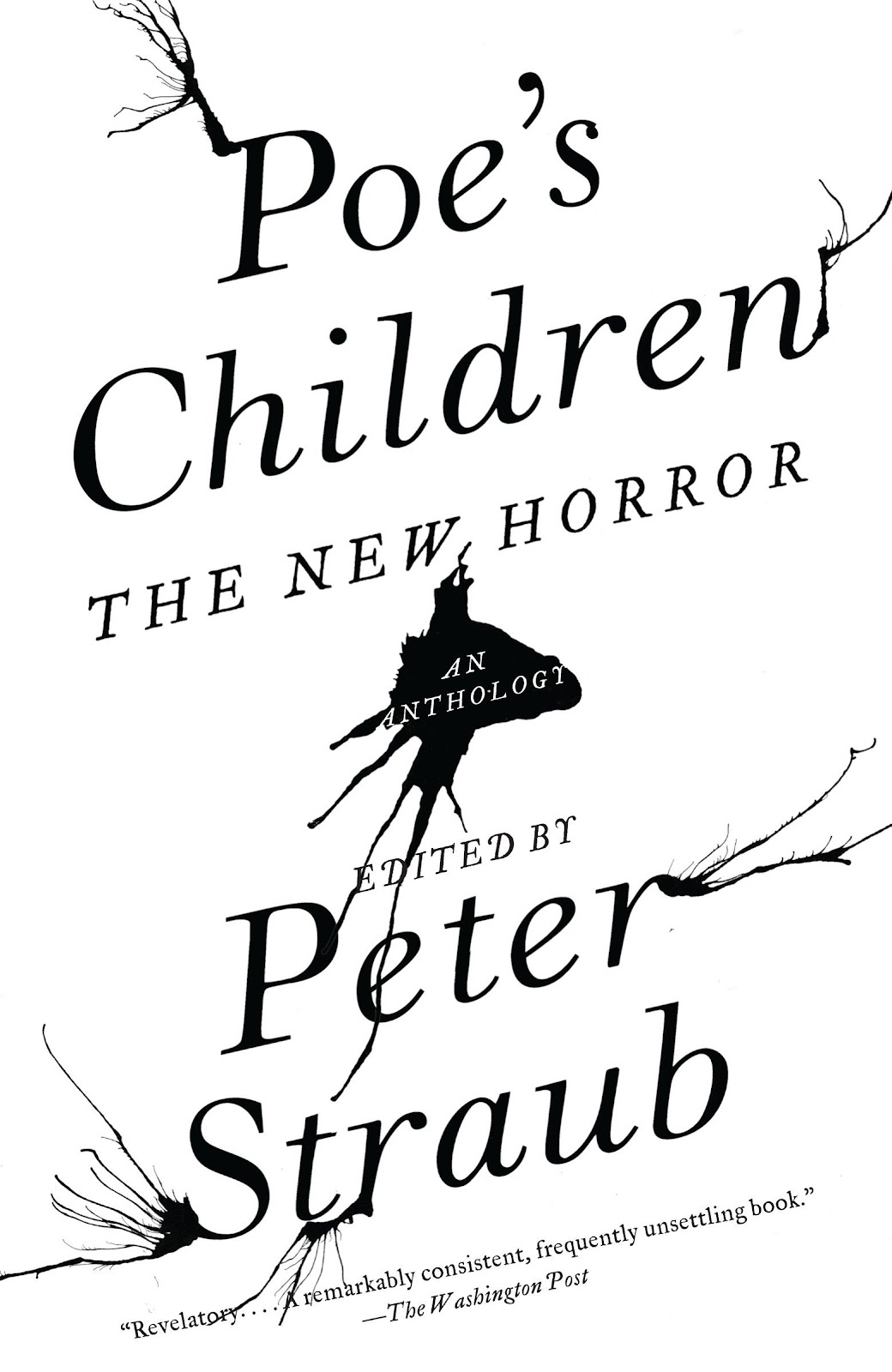
Not Poe, Not New, Not Horror: 15 stories from Poe's Children: The New Horror: An Anthology Edited by Peter Straub (2008)

Readers unfamiliar with Poe's Children may prefer to read these notes only after reading the anthology.


Poe's Children is a proper, well-mannered collection, safe to take to a cocktail party without risk of social embarrassment.  The subtitle "The New Horror" itself confirms this. The old stuff, crass and plebeian, mass market and midlist, could never be respectable. It needed to be erased, replaced with "the new," using the canned heat prose stylings redolent of writing workshops.


From Straub's introduction:


[....]"horror" as a category overflowed its banks during the late eighties and flooded the chain-stores' shelves with malevolent orphans, haunted brownstones and haunted farms and haunted subway cars, ancient curses, things in bandages, evil toddlers, zombies at play, Nazi vampires—" underwater lesbian Nazi vampire turtles," my now-deceased friend Michael McDowell joked....


Note the phrase "chain-stores." He means Walmart, flyover country, and deplorables. 


Of the stories in Poe's Children, I count perhaps one unsettling and macabre enough to recall the author of "The Black Cat" and "The Business Man." The rest have their strengths and weaknesses, some more than others. Few evoke horror, or make use of Horror's modes. Most are fantasies of a special type: insular, suburban, socially incurious, and satisfied to depict their middle class professional (meritocratic) milieus.


*   *   *


Black Dust (2001) by Graham Joyce

     "Black Dust" is a story about sons of miners in the rural UK. Naturally, there is a cave-in. But quicker than you can say Roddy McDowall, the dead father's spirit visits his son's friend to convey his farewells. Throat-lumpening.


October in the Chair (2002) by Neil Gaiman

     Gaiman pumps up the old Bradbury Wurlitzer© for some schmaltz about a runaway who befriends a boy ghost his age. The story-circle setting is cleverly done.


Leda (2002) by M. Rickert

     Ma'am, are you saying you were raped by a swan? 

     Yes. I think I could recognize him in a lineup.


"Leda" begins as a conceitedly self-congratulatory rape riff.  The conclusion, however, is convincing.


The Man on the Ceiling (2000) by Melanie Tem and Steve Rasnic Tem

    And the world also has in it: Werewolves, whose unclaimed rage transforms them into something not human but also not inhuman (modern psychiatry sometimes finds the bestial "alter" in the multiple personality). Vampires, whose unbridled need to experience leads them to suck other people dry and are still not satisfied. Zombies, the chronically insulated, people who will not feel anything because they will not feel pain. Ghosts.

     I write in order to understand these things. I write dark fantasy because it helps me see how to live in a world with monsters.


"The Man on the Ceiling" is an intrepid aesthetic folie à deux. Each hand-off is beautifully wrenched, the overall effect is energizing.


The Body (2004) by Brian Evenson

     "The Body" seems like the product of an assignment: interesting to put on paper, but no pleasure or satisfaction for the reader. The plot may be about a man with body dysphoria restrained in a rubber suit while two sadistic foot fetishists indulge in pretentious monologues. Evenson employs an abstract and obscure style in "The Body," but giving the reader no bearings does not increase our appreciation of the story's horror and mystery. I just kept counting how many pages I had left to go.


Plot Twist (2002) by David J. Schow

     Three characters are stranded in the desert. One is a kibbitzer with ideas about how they got there. The other two, a couple, try to keep their sense of humor. They find two backpacks on consecutive days: each has water and snacks for two. Their predicament ends with a plot twist and sudden death. Schow is a fine stylist, but "Plot Twist" never rises above uninvolving. Stories that don't solve their own mysteries need more misdirection than that.


The Bees (2003) Dan Chaon

     "The Bees" horrifies at a deep level, depicting a father whose worst fear is that things are going too good for him, his wife, and their little boy. "Something bad has been looking for him for a long time, he thinks, and now, at last, it is growing near." To think, I almost skipped this fine short story because it was written in the present-tense. 


Little Red's Tango (2002) by Peter Straub

     I almost wrote-off "Little Red's Tango" as #dnf. It tells, at interminable length (though with charming style), the story of an everyman Manhattanite, his good vibes, his zen composure, and his constructive influence on those whose paths he crosses. Horror? Not at all: not the old horror or the New Horror.


20th Century Ghost (2002) by Joe Hill

     My first time reading Hill. Joshi dismisses him as smarmy and using "fussy, self-conscious prose." I found "20th Century Ghost" well-structured and emotionally involving. Not horror, it is a rare and welcome addition to the subgenre of posthumous fantasy.


Louise's Ghost (2001) by Kelly Link

     "Louise's Ghost" is the most accomplished story in Poe's Children. Link begins the story with two protagonists named Louise, inseparable friends since childhood. Using present-tense and having two characters with the same first name strikes the reader as authorial willfulness. But persistence is rewarded. The humor and pathos are distanced and objective, but the effect is inarguably graceful.


Cleopatra Brimstone (2001) by Elizabeth Hand

     "Cleopatra Brimstone" is an impeccably written novella. Hand's style is briskly declarative, alive with the power and authority of competing vocabularies in divergent subcultures, in this case entomology and punk. Cleopatra herself, in several respects, transforms and shapes transformation in others. The momentum of her ambitions, however, is thwarted by her own short-cutting single mindedness and her social position as a woman. The tale could be generously termed "dark fantasy." There is little horror to it, and I doubt Poe would claim it as offspring.


The Sadness of Detail (1989) by Jonathan Carroll

     I have not read Carroll before, but "The Sadness of Detail" is a precise and brief story I hope is indicative. It takes place, for the most part, on a cold and wet November day in a warm and comfortable cafe. I would read the story again just to enjoy another visit to that cafe. The things Carroll's narrator discovers about her future, and the fates of her child and husband, only put the bow on it. The description of God as a thinning intelligence is terrifying. But perhaps the reporter on his condition, the man named Thursday, is wrong.


Notes on the Writing of Horror: A Story (1985) by Thomas Ligotti

    "Notes on the Writing of Horror: A Story" is incontestably a child of Poe. The jocular narrative mask, in a few pages, starts slipping, and the slippage reveals the multiform voices of madness beneath. 


In Praise of Folly (1992) by Thomas Tessier

     If a property is abandoned and overgrown, skip it. Thomas Tessier's protagonist Roland does the opposite. "In Praise of Folly" is a sharp story about life's wrong turns and fate's little tricks. And the whisper of an ax at dusk.


The Two Sams (2002) by Glen Hirshberg

     "The Two Sams" examines the horrific equipoise life demands of parents after they suffer miscarriages, but keep trying for a child. Such a topic demands, ultimately, an inconclusive resolution. Hirshberg provides the reader with one, but "The Two Sams" has crossed all the other lines previous to its end. It could be written-off as maudlin and special pleading, but given the author's taciturnity, I think that judgment would be wrong.


*   *   *


Jay

21 August 2022


Wednesday, August 17, 2022

The Year's Best Horror Stories 17 (1989)

Readers who are unfamiliar with the anthology The Year's Best Horror Stories 17 may prefer to read these notes only after reading the stories.


The Year's Best Horror Stories XVII  edited by Karl Edward Wagner (DAW 1989)


My notes on twelve of the anthology's twenty stories are below.


My previous posts about earlier volumes in the series can be found here


*   *   *


Fruiting Bodies by Brian Lumley 


"Fruiting Bodies" is one of Lumley's best stories. I previously wrote about it here.


*   *   *


Works of Art by Nina Kiriki Hoffman


"Works of Art" is minor but unsettling: a couple must return the wooden sculpture that has come to dominate their lives: the artist has to destroy it before he can release a new work. (It's all in the contract).


Then one partner  proposes a swap.


*   *   *


She's a Young Thing and Cannot Leave Her Mother by Harlan Ellison


Ellison begins the story this way:


     This morning I woke to the infinitely sweet, yet lonely sound of Clair de Lune coming to me through closed windows, upstairs in a high-ceilinged suite of this century-old hotel; in a land that is not my own. I lay in bed and at first thought I was still in the dream: it was so ethereal and melancholy. Then I heard Camilla stir, where she lay wrapped in blankets on the floor, and I knew the dream was past. The bed had been too soft for her, an old fluffy mattress with a gully down the middle. She had chosen to sleep beyond the foot of the bed....


Well, we think, this seems like a cultured and sophisticated chap. The, a little later:


[....] You just can't know why people do the things they do; and if you try to be a good guy, and go out of your way not to hurt anyone, then other people simply ought to let you be.

     For instance, and I don't mean this to be smutty, but it's just exactly what I'm talking about, a long time ago I was in Uppsala, Sweden. I was given some magazines full of naked men and women, by a student I met who attended the University there. One of them was full of photographs of a woman having sex with animals. When I first saw it, I was very upset. I'd never seen anything like that. The woman was pretty, and the pictures had been taken on a farm somewhere, I suppose in Sweden, because the bull she was with had ice all matted in his hair. And she was doing things with a pig.

     And I was so upset that I sought him out, the student who had given me the magazines, and I gave that one back to him, and I told him I couldn't understand how a woman could do such things. And he told me this young woman was very famous, that she was a simple farm girl, and that she truly loved animals, and didn't think there was anything awful about making the animals she loved happy. So I sat and studied that magazine, with that pretty young woman making love to the bull and the pig, and after a while I could see that she was really smiling, and the animals seemed to be content; and after a while longer it wasn't dirty to me any more. It was just as if she were petting a rabbit, or hugging a kitten.

     I didn't see the ugliness others saw. I came to understand that there is little enough affection in the world and, even if everyone finds it necessary to pass judgments that this is proper, and that is obscene, that this young woman, even if she was of what they call diminished capacity, even she was better than those who passed judgments, because she loved the animals, and she wasn't hurting anyone, and if that was how she chose to show her love, it was okay.


Let's see George Saunders top that!


Our narrator, who misses Atlantis, cannot interact with others. In his wanderings, he meets Camilla. At first, the circumspect first-person narration allows us to worry that Camilla is a dog; it turns out she is probably human. 


While the narrator's Atlantean heritage is left unexplored, Camilla's Scottish descent is given in horrifying depth.


*   *   *


The Resurrection Man by Ian Watson


"The Resurrection Man" is a bravura short story: droll, macabre, and over too soon. It depicts a perceived continuity between Burke and Hare and a present-day collector of outre items. The historical background is beautifully conveyed.


*   *   *


Call 666 by Dennis Etchison


Like Charles L. Gant, Dennis Etchison is not a writer to fool around with while we grapple with our own emotional problems. His protagonists have a terrible record as exemplars in such situations.


     The TV reporter was saying something about ritual mutilations of the homeless in the tunnels under Glendale and Atwater, when he noticed an item at the top of page four. A body had been found in a bedroom in another part of the city, the victim of an apparent burglary attempt. He did not recognize the person's name, nor was the scene of the crime anywhere near this neighborhood. Yet something about the story held his attention.

     It took him a minute to figure it out.

     Today, in the park, the voice on the other end of the line had said an address. Another number first, a code of some kind, then a street and house number.

     It was the address in the newspaper. The same. He was sure.


Moral: never answer a ringing pay phone in the park. It may be for you.


*   *   *


The Great God Pan by M. John Harrison


Don't let the title confuse you. This "The Great God Pan" is Harrison's own powerful work about a trio still struggling to cope with life twenty years after their own attempt to pierce the veil. 


The narrator acts as mediator between Lucas and Ann, each handicapped by mental issues that emerged after they experimented together with their "magus" Sprake.


      When I told Lucas, "Something's gone badly wrong here," he was silent. After a moment or two I prompted him. "Lucas?"

      I thought I heard him say:

      "For God's sake, put that down and leave me alone."

      "This line must be bad," I said. "You sound a long way off. Is there someone with you?"

      He was silent again—"Lucas? Can you hear me?"—and then he asked, "How is Ann? I mean, in herself?"

      "Not well," I said. "She's having some sort of attack. You don't know how relieved I am to talk to someone. Lucas, there are two completely hallucinatory figures in that passage outside her kitchen. What they're doing to one another is…look, they're a kind of dead white color, and they're smiling at her all the time. It's the most appalling thing—"

     He said, "Wait a minute. Do you mean that you can see them too?"

      "That's what I'm trying to say. The thing is that I don't know how to help her. Lucas?"

      The line had gone dead....


Sprake himself comes across as a more unwashed Crowley:


     For twenty years he had lived in the same single room above the Atlantis Bookshop. He was reluctant to take me there, I could see, though it was only next door, and I had been there before. At first he tried to pretend it would be difficult to get in. "The shop's closed," he said. "We'd have to use the other door." Then he admitted:

     "I can't go back there for an hour or two. I did something last night that means it may not be safe."

     He grinned.

     "You know the sort of thing I mean," he said.

     I couldn't get him to explain further. The cuts on his wrists made me remember how panicky Ann and Lucas had been when I last spoke to them. All at once I was determined to see inside the room.

     "If you don't want to go back there for a bit," I suggested, "we could always talk in the Museum."

     Researching in the manuscript collection one afternoon a year before, he had turned a page of Jean de Wavrin's Chroniques d'Angleterre—that oblique history no complete version of which is known—and come upon a miniature depicting in strange, unreal greens and blues the coronation procession of Richard Coeur de Lion. Part of it had moved; which part, he would never say. "Why, if it is a coronation," he had written almost plaintively to me at the time, "are these four men carrying a coffin? And who is walking there under the awning—with the bishops not with them?" After that he had avoided the building as much as possible, though he could always see its tall iron railings at the end of the street. He had begun, he told me, to doubt the authenticity of some of the items in the medieval collection. In fact, he was frightened of them.

     "It would be quieter there," I insisted.

     He didn't respond but sat hunched over the Church Times, staring into the street with his hands clamped violently together in front of him. I could see him thinking.

     "That fucking pile of shit!" he said eventually.

     He got to his feet.

     "Come on, then. It's probably cleared out by now, anyway."

     Rain dripped from the blue-and-gold front of the Atlantis. There was a faded notice, CLOSED FOR COMPLETE REFURBISHMENT. The window display had been taken down, but they had left a few books on a shelf for the look of things. I could make out, through the condensation on the plate glass, de Vries's classic Dictionary of Symbols & Imagery. When I pointed it out to Sprake, he only stared at me contemptuously. He fumbled with his key. Inside, the shop smelled of cut timber, new plaster, paint, but this gave way on the stairs to an odor of cooking. Sprake's bed-sitter, which was quite large and on the top floor, had uncurtained sash windows on opposing walls. Nevertheless, it didn't seem well lit.

     From one window you could see the sodden facades of Museum Street, bright green deposits on the ledges, stucco scrolls and garlands gray with pigeon dung; out of the other, part of the blackened clock tower of St. George's Bloomsbury, a reproduction of the tomb of Mausoleus lowering up against the racing clouds.

     "I once heard that clock strike twenty-one," said Sprake.

     "I can believe that," I said, though I didn't. "Do you think I could have some tea?"

     He was silent for a minute. Then he laughed.

     "I'm not going to help them," he said. "You know that. I wouldn't be allowed to. What you do in the Pleroma is irretrievable."


Harrison's "The Great God Pan" is magnificently cold and articulate, and I can see why Douglas Winter published it in his 1988 anthology Prime Evil. 


Harrison's "The Great God Pan" is also one of a number of horror stories and novels about adults contending with strange experiences they shared in their youth. [Ramsey Campbell's 1980 novel The Parasite is one example; another, which I recently finished, is Peter Straub's A Dark Matter (2010).]


*   *   *


Lost Bodies by Ian Watson


"Lost Bodies" is a strange story of thwarted desires and bourgeois boredom among 1980s London nouveau riche. The stultifying atmosphere of complacency is imbued with body revulsion, which I suppose allows editor Karl Edward Wagner to class the story as horror.


*   *   *


Snowman by Charles L. Grant


A recondite, pitch-perfect winter's tale, "Snowman" depicts a man spending another night on earth trying to solve the puzzle of his own social isolation and loneliness.


Many horror short stories  simply stop. Does the author suspect that if we are not happy with this state of affairs it is because we're unsophisticated? Grant is another order of writer entirely: his character, unable to unravel the complex mystery of his situation, resolves to keep going, clutching equipoise wrestled from reality. The reader is left in no doubt they have read a well-executed tale that explored something meaningful.


*   *   *


Nobody's Perfect by Thomas F. Monteleone


[....] Salazar allowed himself a small, anticipatory smile. He was not certain what excited him the most, what provided him with the most pleasure—the initial search for suitable prey, the stalking-time when one had been selected, or the final act of consummation? There was a grandness about it all which inspired him, drove him with a fervor that religious zealots would envy....


Here it is, reader beware: Monteleone is going to push your face right down into this cynical carpet-stain of a story. Like every other moralizing "splatterpunk," he'll have his cake and eat it, too: date rape, religious mania, Thalidomide deformity, handicapped people finding out they, and not their kidnapper, are one of the world's secret royals. It's every prurient horror cliché in one place. Moral: humans are the real monsters, and women crime victims can be monsters, too.


The ritual was so wonderful, and the meat always so utterly tasty…


[....] When he touched her dead flesh, he'd unwittingly switched on the radiant energy of her soul....


*   *   *


Bleeding Between the Lines by Wayne Allen Sallee


     "Why does so much of your recurring imagery involve elevated trains and subway tunnels?" 

     "I take the train to and from work; accomplishing much of my writing on the El. The train conjures so many images: the train of thought; pulling a train; the light at the end of the subway tunnel; downtown Chicago is called the Loop because the El tracks encircle it, snakes eating their tails, perhaps. The tracks can be a type of altar to worship on." I took a deep breath.


"Bleeding Between the Lines" is a story about being a horror writer, and how reshaping reality to make fiction knots-up so many things in life and art. Sallee's dialogue is the action driver: exposition, character, and plot backfill are all skilfully articulated. Unlike the stories by Monteleone and Hoffmann, there is no sense the reader is wasting their time..


*   *   *


Playing the Game by Ramsey Campbell


"Playing the Game" would serve as title for any number of Campbell stories. 


A young reporter decides to play at being an investigative newshawk, which sends him right back to the source of his childhood nightmares. 


     "There's a man down by the docks who claims he can cure illness without medicine. He's got everyone around him believing he can. They say he cures their aches and pains and saves them having to go to the doctor about their depressions. Sounds all right, doesn't it? But I happen to know," the ragged man said, lowering his voice still further until it was almost inaudible, "that he puts up his price once they need him. They have to go back to him, you see—it isn't a total cure. Maybe he doesn't mean it to be, or maybe it's all in their minds, until it wears off. Either way, you can see it's an addiction that costs them more than the doctor would."

     He was plucking unconsciously at his torn pockets. "I'll tell you something else—every single one of his neighbours believes he should be left alone because he's doing so much good. That can't be right, can it? People don't take to things like that so easily unless they're afraid not to. Why won't they use the short cut through the docks any longer, if they think there's nothing to be afraid of?"

     "You're suggesting that there is."

     "I've got to be careful what I say." He looked afraid of being overheard, even in the empty room. "I don't live far from him," he said eventually. "Not far enough. I haven't had any trouble with him personally, but my next-door neighbour has. I can't tell you her name, she doesn't even know I'm here. You mustn't try to find her. In fact, to make sure you don't, I'm not going to tell you my name either."

     Hill's interest was waning; his editor would never take a story with so few names. "Anyway," the man whispered, "she antagonised Mr. Matta, though she didn't mean to. She caught him up to no good in one of the old docks. So he said that if she was so fond of water, he'd make sure she got plenty. And the very next day her house started getting damp. She's had people in, but they can't find any reason for it, and it's just getting worse. Mold all over the walls—you wouldn't believe it unless you saw it for yourself. Only you'll have to take my word for it, I'm afraid."


*   *   *


Prince of Flowers by Elizabeth Hand


Unfailing sureness is the hallmark of Hand's fiction, no matter what length. "Prince of Flowers" is spectacularly effective, combining psychological inwardness with a cold style free of arrogance and editorializing. The setting is fascinating; her use of forgotten hallways and dusty corners to hide her sharp-toothed treasures is flawless.


     "Helen," he called softly. "It's Leo. You okay?"

     He knocked harder, called her name, finally pounded with both fists. Still nothing. He should leave; he should call the police. Better still, forget ever coming here. But he was here, now; the police would question him no matter what; the curator for Indo-Asian Studies would look at him askance. Leo bit his lip and tested the doorknob. Locked; but the wood gave way slightly as he leaned against it. He rattled the knob and braced himself to kick the door in.

     He didn't have to. In his hand the knob twisted and the door swung inward, so abruptly that he fell inside. The door banged shut behind him. He glanced across the room, looking for her; but all he saw was gray light, the gauzy shadows cast by gritty curtains. Then he breathed in, gagging, and pulled his sleeve to his mouth until he gasped through the cotton. He backed toward the door, slipping on something dank, like piles of wet clothing. He glanced at his feet and grunted in disgust.

     Roses. They were everywhere: heaps of rotting flowers, broken branches, leaves stripped from bushes, an entire small ficus tree tossed into the corner. He forgot Helen, turned to grab the doorknob and tripped on an uprooted azalea. He fell, clawing at the wall to balance himself. His palms splayed against the plaster and slid as though the surface was still wet. Then, staring upward he saw that it was wet. Water streamed from the ceiling, flowing down the wall to soak his shirt cuffs. Leo moaned. His knees buckled as he sank, arms flailing, into the mass of decaying blossoms. Their stench suffocated him; his eyes watered as he retched and tried to stagger back to his feet.

     Then he heard something, like a bell, or a telephone; then another faint sound, like an animal scratching overhead. Carefully he twisted to stare upward, trying not to betray himself by moving too fast. Something skittered across the ceiling, and Leo's stomach turned dizzily. What could be up there? A second blur dashed to join the first; golden eyes stared down at him, unblinking.


*   *   *


Jay

17 August 2022

Tuesday, August 16, 2022

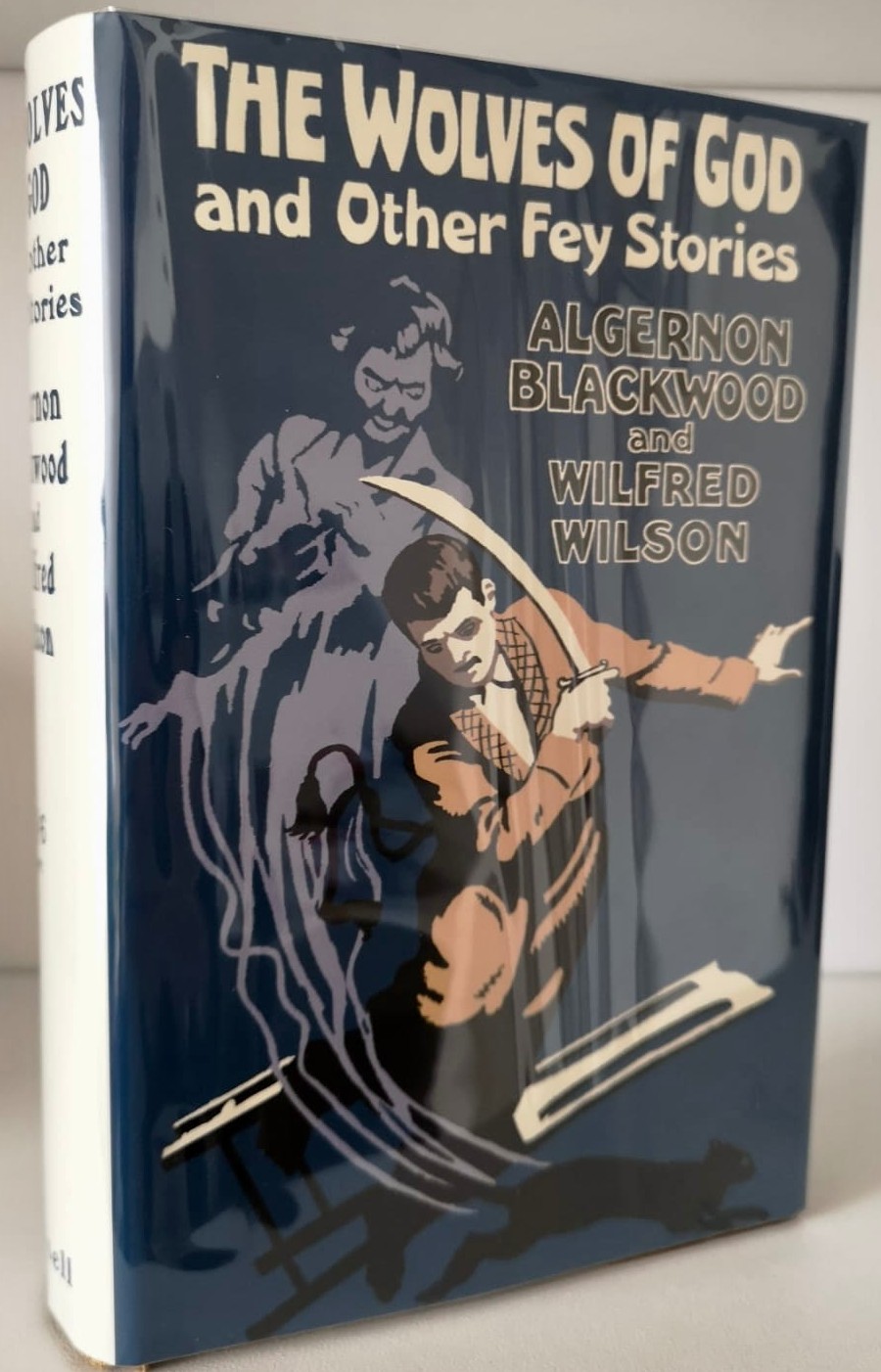
Algernon Blackwood 1921: Wolves of God and Other Fey Stories

Readers who are unfamiliar with Wolves of God and Other Fey Stories may prefer to read these notes only after reading the stories.


*   *   *


   "Hark!" cried Sandy's shrill voice. "Did you hear that? That wasn't wind, I'll swear." He sat up, looking for all the world like a dog pricking its ears to something no one else could hear.

     "The sea coming over the dunes," said Rossiter. "There'll be an awful tide to-night and a terrible sea off the Swarf. Moon at the full, too." He cocked his head sideways to listen. The roaring was tremendous, waves and wind combining with a result that almost shook the ground. Rain hit the glass with incessant volleys like duck shot.

      It was then that Jim spoke, having said no word for a long time.

     "It's good there's no trees," he mentioned quietly. "I'm glad of that." 

     "There'd be fearful damage, wouldn't there?" remarked Sandy. 

     "They might fall on the house too."

But it was the tone Jim used that made Rossiter turn stiffly in his chair, looking first at the speaker, then at his brother. Tom caught both glances and saw the hard keen glitter in the eyes. This kind of talk, he decided, had got to stop, yet how to stop it he hardly knew, for his were not subtle methods, and rudeness to his guests ran too strong against the island customs. He refilled the glasses, thinking in his blunt fashion how best to achieve his object, when Sandy helped the situation without knowing it.

     "That's my first," he observed, and all burst out laughing. For Sandy's tenth glass was equally his "first," and he absorbed his liquor like a sponge, yet showed no effects of it until the moment when he would suddenly collapse and sink helpless to the ground. The glass in question, however, was only his third, the final moment still far away.

     "Three in one and one in three," said Rossiter, amid the general laughter, while Sandy, grave as a judge, half emptied it at a single gulp. Good- natured, obtuse as a cart-horse, the tropics, it seemed, had first worn out his nerves, then removed them entirely from his body. "That's Malay theology, I guess," finished Rossiter. And the laugh broke out again. Whereupon,

setting his glass down, Sandy offered his usual explanation that the hot lands had thinned his blood, that he felt the cold in these "arctic islands," and that alcohol was a necessity of life with him. Tom, grateful for the unexpected help, encouraged him to talk, and Sandy, accustomed to neglect as a rule, responded readily. Having saved the situation, however, he now unwittingly led it back into the danger zone.

     "A night for tales, eh?" he remarked, as the wind came howling with a burst of strangest noises against the house.       "Down there in the States," he went on, "they'd say the evil spirits were out. They're a superstitious crowd, the natives. I remember once — —" And he told a tale, half foolish, half interesting, of a mysterious track he had seen when following buffalo in the jungle. It ran close to the spoor of a wounded buffalo for miles, a track unlike that of any known animal, and the natives, though unable to name it, regarded it with awe. It was a good sign, a kill was certain. They said it was a spirit track.

     "You got your buffalo?" asked Tom.

     "Found him two miles away, lying dead. The mysterious spoor came to an end close beside the carcass. It didn't continue."

     "And that reminds me — —" began old Rossiter, ignoring Tom's attempt to introduce another subject. He told them of the haunted island at Eagle River, and a tale of the man who would not stay buried on another island off the coast. From that he went on to describe the strange man-beast that hides in the deep forests of Labrador, manifesting but rarely, and dangerous to men who stray too far from camp, men with a passion for wild life over- strong in their blood — the great mythical Wendigo. And while he talked, Tom noticed that Sandy used each pause as a good moment for a drink, but that Jim's glass still remained untouched.

     The atmosphere of incredible things, thus, grew in the little room, much as it gathers among the shadows round a forest camp-fire when men who have seen strange places of the world give tongue about them, knowing they will not be laughed at — an atmosphere, once established, it is vain to fight against. The ingrained superstition that hides in every mother's son comes up at such times to breathe. It came up now. Sandy, closer by several glasses to the moment, Tom saw, when he would be suddenly drunk, gave birth again, a tale this time of a Scottish planter who had brutally dismissed a native servant for no other reason than that he disliked him. The man disappeared completely, but the villagers hinted that he would — soon indeed that he had — come back, though "not quite as he went."


"The Wolves of God"


*   *   *


Blackwood biograprapher Mike Ashley sums up the 1921 collection Wolves of God and Other Fey Stories by Algernon Blackwood:


[....] The Wolves of God was published in April 1921. Although it did not receive rapturous reviews, the critics were generally in favour, commenting on the cleverness and ingenuity of the authors. There would be two more substantial collections of new stories from Blackwood, but Wolves is his last significant volume. The stories lack the power of his great works, but they are competent, professional pieces that show the mature mastery of a true storyteller, able to look back over a lifetime of experience and uncover the magic and mystery in every aspect of life.


*   *   *


The Wolves of God 

(Orkneys)


"The Wolves of God" is an ambitious story about fate (or justice). Jim Peace returns to the family farm in the Orkneys, desperate for "the clean smells of open country" after decades of a career in Canadian tall timber. 


     Those thirty years in the woods, it seemed, oppressed his mind; the forests, the countless multitudes of trees, had wearied him. His nerves, perhaps, had suffered finally. Snow, frost and sun, stars, and the wind had been his companions during the long days and endless nights in his lonely Post, but chiefly — trees. Trees, trees, trees! On the whole, he had preferred them in stormy weather, though, in another way, their rigid hosts, 'mid the deep silence of still days, had been equally oppressive. In the clear sunlight of a windless day they assumed a waiting, listening, watching aspect that had something spectral in it....


Speaking personally, this is the type of story that first attracted me to Blackwood: the claustrophobic reaction to nature, depicted often as a veil obscuring one's antagonist or nemesis.


*   *   *


Chinese Magic

(London)


There is much that can be said against the story "Chinese Magic." On second reading, however, what seems like overreliance on coincidence is actually an effort to create an atmosphere of thickening inevitability. Like "The Wolves of God," it describes one man's return home from a foreign country, returning in this instance to London. It's a small world when first love and Sinophilia make their presence known. Arthur Morrison or R. Austin Freeman would have refolded the plot into backward-spinning murder mystery, which is one of the best arguments I know for Blackwood's superiority to other plotters.


*   *   *


Running Wolf

(Canada)


[....] Some hundred years before, the tribe that lived in the territory beyond the lake began their annual medicine-making ceremonies on the big rocky bluff at the northern end; but no medicine could be made. The spirits, declared the chief medicine man, would not answer. They were offended. An investigation followed. It was discovered that a young brave had recently killed a wolf, a thing strictly forbidden, since the wolf was the totem animal of the tribe. To make matters worse, the name of the guilty man was Running Wolf. The offence being unpardonable, the man was cursed and driven from the tribe:

     "Go out. Wander alone among the woods, and if we see you we slay you. Your bones shall be scattered in the forest, and your spirit shall not enter the Happy Hunting Grounds till one of another race shall find and bury them."

     "Which meant," explained Morton laconically, his only comment on the story, "probably for ever."


Superiority in plotting is also displayed in "Running Wolf." Malcolm Hyde, hotel clerk on a fishing holiday, solves the mystery of an unlucky spot on a lake "stiff with fish." Hyde's skill at solving the mystery comes from his patience and his quick grasp of clues that chased previous anglers away after a few days. "Running Wolf" is rich in detail and economically told.


*   *   *


First Hate

(Canada)


"There's first love. There's first hate, too."


If "Chinese Magic" creates a meaningful atmosphere for coincidence to play its part in the lives of two friends, then "First Hate" spectacularly deepens the lesson. Blackwood skilfully employs inevitability. When Ericssen ultimately tells two old friends the outcome of his first hate, classical unities are nearly all observed.


     "I've felt dislike, but never hatred like that," Baynes mentioned. "I came across it in a book once, though. The writer did not mention the instinctive fear of the human animal for its natural enemy, or anything of that sort. He thought it was a continuance of a bitter feud begun in an earlier existence. He called it memory."

     "Possibly," said Ericssen briefly. "My mind is not speculative. But I'm glad you spoke of fear. I left that out. The truth is, I feared the fellow, too, in a way; and had we ever met face to face in some wild country without witnesses I should have felt justified in drawing on him at sight, and he would have felt the same. Murder? If you like. I should call it self-defence. Anyhow, the fellow polluted the room for me. He spoilt the enjoyment of that dinner we had ordered months before in China."


*   *   *


The Tarn of Sacrifice

(Yorkshire)


On a walking tour in Yorkshire, at the meeting of Roman road, standing stone, tarn, and crag,  a veteran of the Somme has a vision of... Well, he is made whole again, reconquers his love of life. 


"The Tarn of Sacrifice" is also the story of past lives, of what today we would call a timeslip. 


     "I am glad that you have come at last," she said in a clear, strong voice that yet was soft and even tender. "We have been expecting you."

     "You have been expecting me!" he repeated, astonished beyond words, yet finding the language natural, right and true. A stream of sweet feeling invaded him, his heart beat faster, he felt happy and at home in some extraordinary way he could not understand yet did not question.


Past and present meet and are recast in equipoise. Blackwood even grants the reader a slingshot epilogue, several years into the characters' common future. It is a poignant story of real emotional power.


*   *   *


The Valley of the Beasts

(Canada)


"The Valley of the Beasts" is an excellent evocation of what Blackwood came to love in the northern wilderness. The self-forgetting essential to literature aspiring to the Sublime is beautifully portrayed. The worst kind of hunter and man, Grimwood:


He was a slow-witted, heavy man, full-blooded, unobservant; a fact had to hurt him through his comfort, through his pleasure, before he noticed it....


Blackwood artfully and succinctly demonstrates the dawning of a mood of almost pagan agape.


*   *   *


The Call

(Sussex)


    "You know, Dick," he went on in a low, half-reverent tone. "I don't want to marry. I never can."

     Dick's heart stirred within him. "Mary," he said, understandingly.

     The other nodded, as though the memories were still too much for him. "I'm still miserably lonely for her," he said. "Can't help it simply. I feel utterly lost without her. Her memory to me is everything." He looked deep into his pal's eyes. "I'm married to that," he added very firmly.

     They pulled their cigarettes a moment in silence. They belonged to the male type that conceals emotion behind schoolboy language.


As it begins, "The Call" might be a setup for a  Wodehouse love triangle comedy, perhaps "Tried in the Furnace." But Blackwood, here at his most lugubrious, has real fits of melancholy to explore in a couple of men "the wrong side of forty."


*   *   *


Egyptian Sorcery

(London)


     "I'm a hell of a wreck," he said, as Morris came, beaming, to the bedside. "Have I been ill long? It's frightfully decent of you to come, old man."

     But Morris, staggered at this greeting, stopped abruptly, half turning to the nurse for guidance. He seemed unable to find words. Sanfield was extremely annoyed; he showed his feeling. "I'm not balmy, you old ass!" he shouted. "I'm all right again, though very weak. But I wanted to ask you—oh, I remember now—I wanted to ask you about my—er—Deltas."

     "My poor dear Maggie," stammered Morris, fumbling with his voice. "Don't worry about your few shares, darling. Deltas are all right—it's you we——"

     "Why, the devil, do you call me Maggie?" snapped the other viciously. "And 'darling'!" He felt furious, exasperated. "Have you gone balmy, or have I? What in the world are you two up to?" His fury tired him. He lay back upon his pillows, fuming. Morris took a chair beside the bed; he put a hand gently on his wasted arm.

     "My darling girl," he said, in what was intended to be a soothing voice, though it stirred the sick man again to fury beyond expression, "you must really keep quiet for a bit. You've had a very severe operation"—his voice shook a little—"but, thank God, you've pulled through and are now on the way to recovery. You are my sister Maggie. It will all come back to you when you're rested——"

     "Maggie, indeed!" interrupted the other, trying to sit up again, but too weak to compass it. "Your sister! You bally idiot! Don't you know me? I wish to God the nurse wouldn't 'dear' me in that senseless way. And you, with your atrocious 'darling,' I'm not your precious sister Maggie. I'm—I'm George San——"


"Egyptian Sorcery" is mostly comedy and very little sorcery. Taking place in London, it depicts what today people would call an out of body experience; the term "astral projection" smacks too much of Madame Blavatsky or Shirley MacLaine.


*   *   *


The Decoy

(Kent)


"The Decoy" is an excellent example of Jack Sullivan's statement:


     Blackwood could write effective indoor horror tales as well. Indeed, his haunted-house stories are as nasty and claustrophobic as his nature tales are lyrical and expansive. [The Penguin Encyclopedia of Horror and the Supernatural].


A husband, his younger wife, and her younger lover spend the right in an isolated country house to qualify for an inheritance. Atmosphere, an airless interior intensity, and raw nerves lay the trio open to something in the house that convinces each new inheritor to commit suicide.


[....] "There's a figure, remember," she said hurriedly, turning to gain her husband's attention, as when she touched wood at home. "A figure is seen; that's part of the story. The figure of a man." She gave a tiny shiver of pleasurable, half-imagined alarm as she took his arm.

     "I hope we shall see it," he mentioned prosaically.

     "I hope we shan't," she replied with emphasis. "It's only seen before—something happens." Her husband said nothing, while Mortimer remarked facetiously that it would be a pity if they had their trouble for nothing. "Something can hardly happen to all three of us," he said lightly, as they entered a large room where the paper-hangers had conveniently left a rough table of bare planks. Mrs. Burley, busy with her own thoughts, began to unpack the sandwiches and wine. Her husband strolled over to the window. He seemed restless.

     "So this," his deep voice startled her, "is where one of us"—he looked round him—"is to——"

     "John!" She stopped him sharply, with impatience. "Several times already I've begged you." Her voice rang rather shrill and querulous in the empty room, a new note in it. She was beginning to feel the atmosphere of the place, perhaps. On the sunny lawn it had not touched her, but now, with the fall of night, she was aware of it, as shadow called to shadow and the kingdom of darkness gathered power. Like a great whispering gallery, the whole house listened.

     "Upon my word, Nancy," he said with contrition, as he came and sat down beside her, "I quite forgot again. Only I cannot take it seriously. It's so utterly unthinkable to me that a man——"

     "But why evoke the idea at all?" she insisted in a lowered voice, that snapped despite its faintness. "Men, after all, don't do such things for nothing."

     "We don't know everything in the universe, do we?" Mortimer put in, trying clumsily to support her. "All I know just now is that I'm famished and this veal and ham pie is delicious." He was very busy with his knife and fork. His foot rested lightly on her own beneath the table; he could not keep his eyes off her face; he was continually passing new edibles to her.

     "No," agreed John Burley, "not everything. You're right there."

     She kicked the younger man gently, flashing a warning with her eyes as well, while her husband, emptying his glass, his head thrown back, looked straight at them over the rim, apparently seeing nothing....


*   *   *


The Empty Sleeve

(London)


Like the M. R. James story "The Uncommon Prayer Book," Blackwood's "The Empty Sleeve" tells us about collectors nearly thwarted by a sneaky Jew: the Gilmer brothers, fussy bachelors, nearly lose their prized Guarnerius to Mr. Hyman. Hyman makes several runs at the violin he covets. Only later do the brothers find Hyman was out of the country at the time.


"The Empty Sleeve" is a minor tale of bilocation, and it never recovers from the use of Jew-hating clichés.


*   *   *


Wireless Confusion

(UK)


     The phenomenon made one more appearance — the last — before its character, its field of action rather, altered. He was reading a book when the print became now large, now small; it blurred, grew remote and tiny, then so huge that a single word, a letter even, filled the whole page. He felt as if someone were playing optical tricks with the mechanism of his eyes, trying first one, then another focus.

      More curious still, the meaning of the words themselves became uncertain; he did not understand them any more; the sentences lost their meaning, as though he read a strange language, or a language little known. The flash came then — someone was using his eyes — someone else was looking through them.


*   *   *


I did not read all the stories in Wolves of God and Other Fey Stories. In fact, I probably should have skipped more than four of the fifteen short stories and novellas. Most of the stories in the collection are post-war, and one doesn't have to read between the lines in Mike Ashley's biography of Blackwood to realize the tensions that drove the stories of 1907-1912 evaporated by 1921.


Still, Wolves of God and Other Fey Stories contains many descriptive passages of real aesthetic power, even in the more modest entries. 


The power of place, both interior and exterior, seems best expressed in "The Wolves of God," "The Tarn of Sacrifice," "The Valley of the Beasts," and "The Decoy."


Jay

16 August 2022