Subscribe to my Substack

Showing posts with label short stories. Show all posts

Tuesday, May 9, 2023

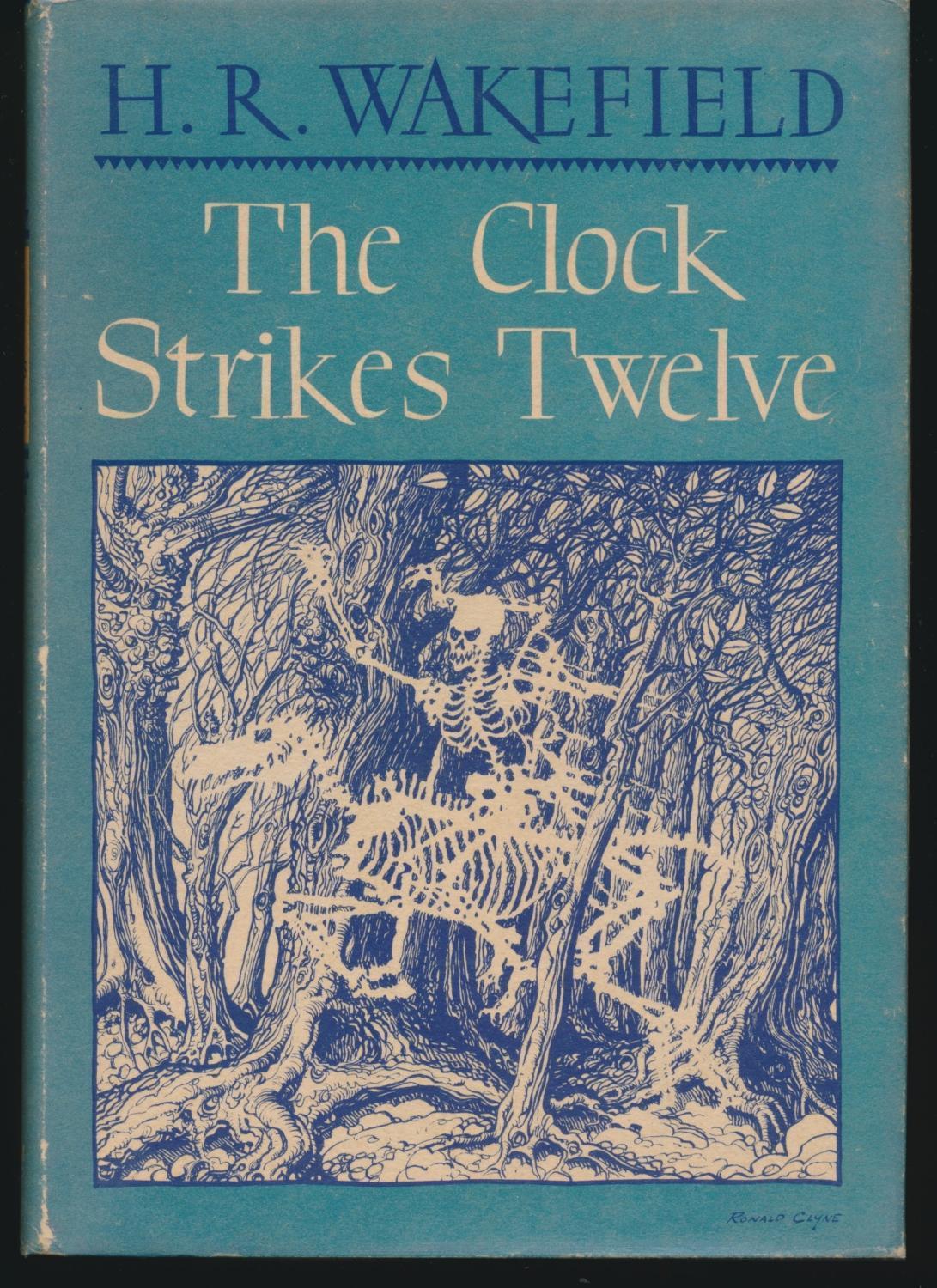
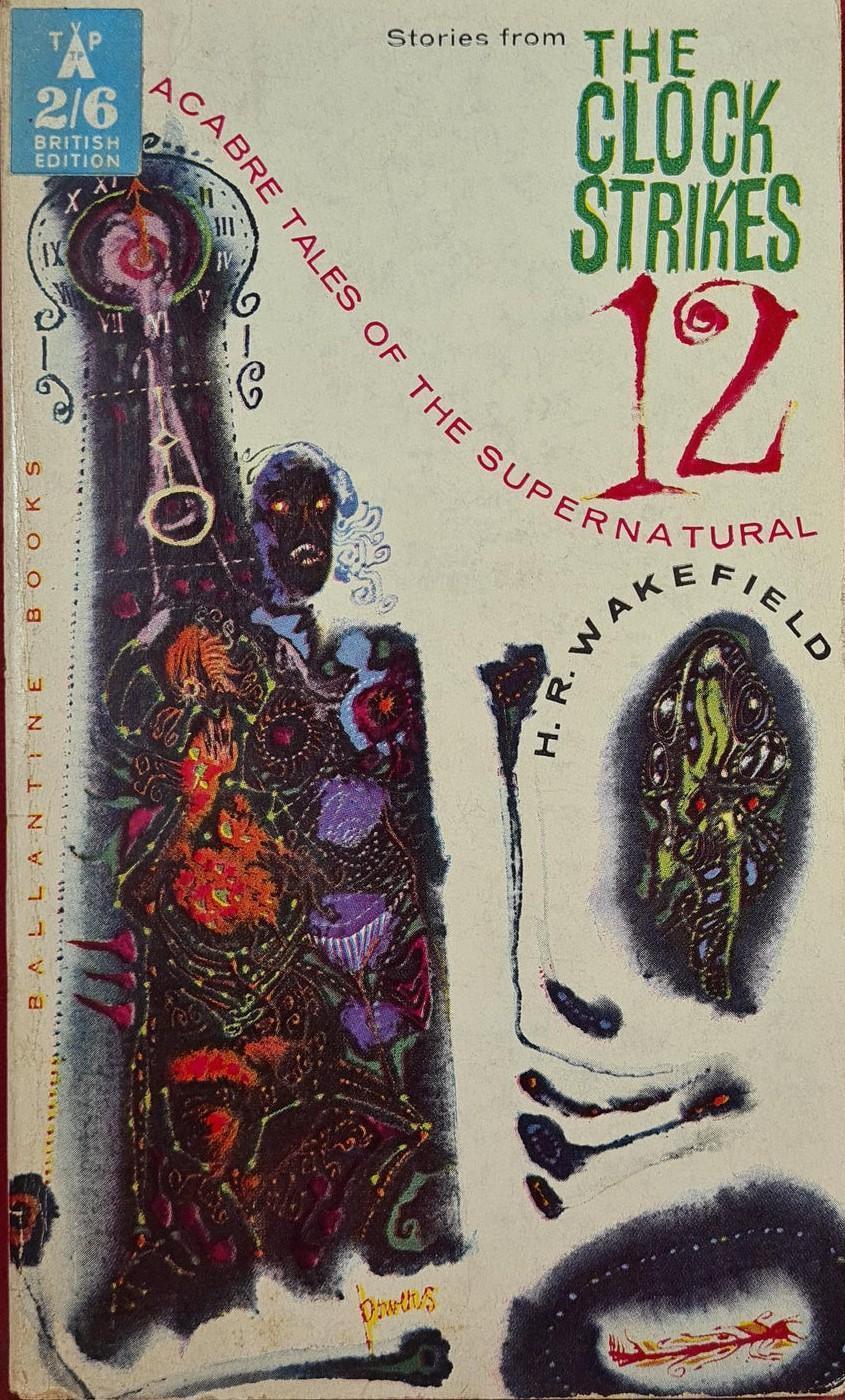
Personifications of malevolence: Seven stories from The Clock Strikes Twelve and Other Stories by H. R. Wakefield. (Ash-Tree Press, 1998)


Readers who are unfamiliar with the collection may prefer to read these notes only after reading the stories.
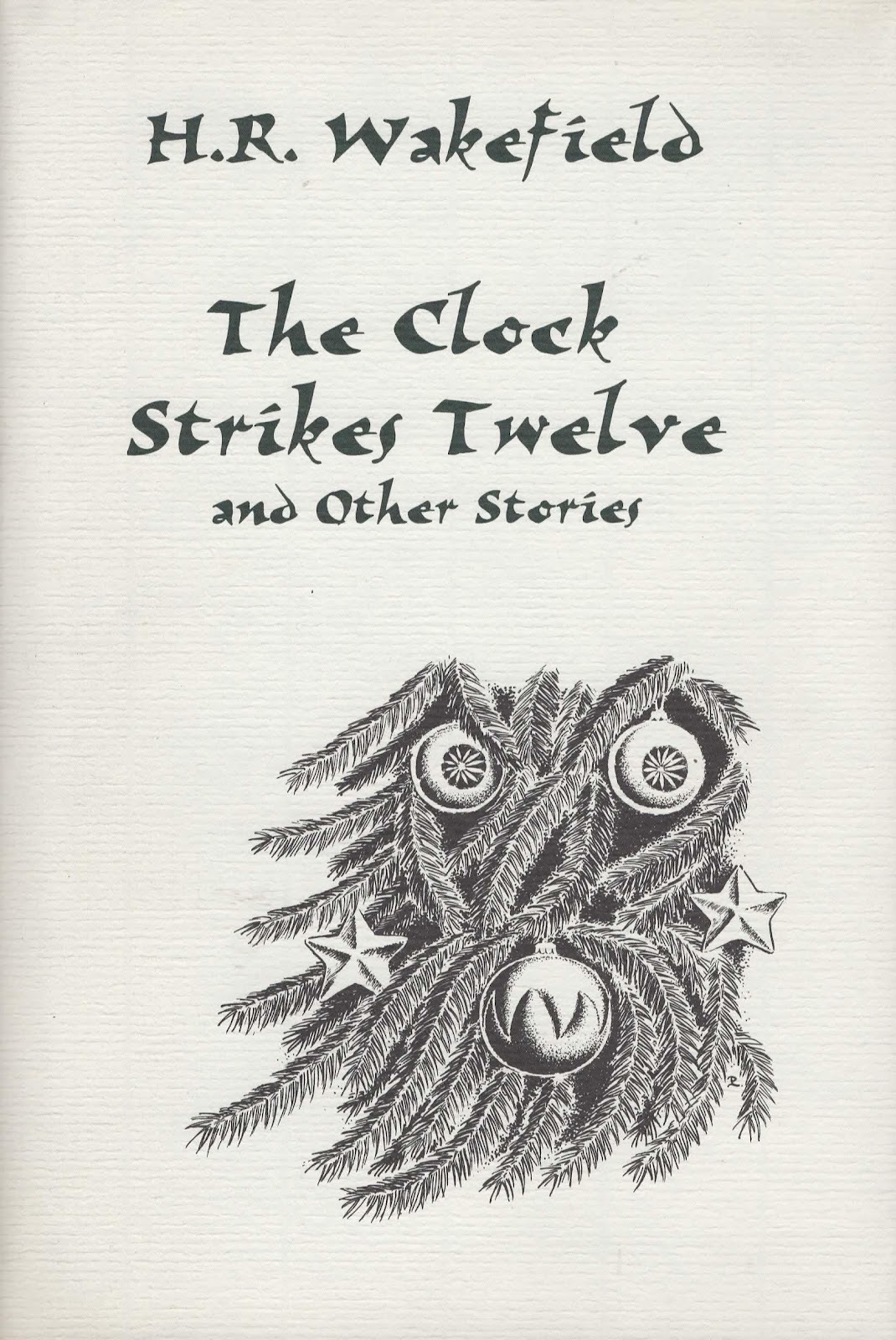


Two years ago I read most of the short stories in The Clock Strikes Twelve, and posted about them here. Last week, I returned to the collection.


Not Quite Cricket


  ' "There they are, both of 'em!" he yelled. "Sam's come to see the play, bloody face and all!"


"Not Quite Cricket" is a well-told rural horror story centered on the cricket rivalry of two men and their villages. But this is not a Hornung or Wodehouse cricket yard. Wakefield does a fine turn depicting sudden death in sport, pulling in peg legs, gypsies, and a village idiot with second sight. There is nothing light-hearted outside the framing prologue; this is life depicted as lived for mortal stakes.


A Fishing Story


An Irish fishing story, beautifully evoking a troubled landscape.


  A fish rose, head and tail, a little ahead of Tranion's fly. He reeled out, took in the slack, and dropped the fly in the widening swirl.

     It didn't rise again and Meynel's eyes wandered.     Tranion had flushed a small gaggle of geese, which gained flying height, made formation, and sailed seawards. A curlew wailed happily by. A brace of teal, wing to wing, swished towards them, saw them, changed direction, and were lost in a sunbeam. A small bird came to a rock, flicked his tail, and made a tiny, definite sound. A twite, perhaps, thought Meynel; I rather think so. What a long, lovely, desolate land this is, he thought, and hardly a man to be vile. But there was evidence of his existence in the footed stacks of peat where the turf had been neatly shaved down. Directly in front of him were two rough stone pillars, one on each side of the Glady, and nothing connecting them. 

     'Was that bridge destroyed in the Bad Times?' he asked. 

     The gillie stared at it for a moment. 

     'Well, it was not,' he said.       'That wasn't the way of it.' 

     'It just collapsed, did it?' 

     'Well, that's true, it did; that's how it was.' 

     'Just fell in?' 

     'Well, it fell in, it did.' He paused. 'But there was a man on it when it fell,' he added. 'It was rotten, you see.' 

     'All the bridges over the Glady are rotten,' said Meynel with feeling. 'A foot wide, no hand-rails, and full of gaps; horrible wobbly brutes. I hate the sight of them.' 

     'But,' said McBrain, 'those others are foine, stout bridges compared with the way this one was.' 

     'What happened to the chap who fell in? It must have shaken him up a bit.' 

     'It must have done that. There's no doubt about that at all.'

     'Could he swim?' 

     'He could not.' 

     'How did he get out, then?' 

     'Well, that man never got out.' 

     'He was drowned!' 

     'He must have been drowned surely.'

     'But you must know, McBrain! His body must have been found.' 

     'No, that man's body was never found.' 


I Recognised the Voice


"I Recognised the Voice" is one of the stranger stories in The Clock Strikes Twelve


Two men, Goran and Lefanu, spot each other at their club.


Goran had the very queer sensation that they had long been acquainted, as if they had met in some previous incarnation. An absurd idea, but how otherwise to explain this feeling for one with whom he had never exchanged a word, never seen before to his knowledge?


When they sit down over drinks, Lefanu reveals he is somewhat clairvoyant, having "learnt some odd things in Tibet, the air breathes magically there." Each man tries unpicking the tangled skein of their connection. This being a Wakefield story, adultery and murder play a part.


Red Feathers


Bloody hell, "Red Feathers" is a masterpiece of some kind: misanthropy first and last. But also a masterpiece of cold feet about shooting animals and about  having feet of clay about the prospect of  marriage to hell-whelped "steel-and-concrete harpies."


Happy Ending? 


Young student of behaviorism Jonathan Turtell rents a bed- sitting room at 84 H—— Street.


  As for the other denizens of Number 84, Jonathan had no concern with them; but he vaguely hoped the person next door didn't snore, for he could hear him moving about and the wall seemed rather thin.


Jonathan that very night begins having consecutive dreams related to that next door room. 


....there was, of course, always the possibility that the Universe was fundamentally irrational and that such phenomena were merely modes of its unreason; that Nature sometimes acted in such a way that man could not frame laws to interpret that action. This possibility was highly unpalatable


Wakefield is happiest grinning as he examines his characters like Petri dishes through the microscope. 


  Jonathan's régime was regular and austere. He had a light breakfast at an A.B.C. shop, worked from nine to one. Had a light lunch at an A.B.C. shop, worked from two to six. Had dinner at a Corner House. Usually went to a movie afterwards, for the reactions of the multitude were of huge psychological value. Walked back to 84 and went to bed.


The real mirth Wakefield conveys in relating facts of everyday life about his protagonists is only matched by his enjoyment of how they suffer his Savonarola-scale authorial chastisements.


Death of a Poacher 


"Death of a Poacher" would have made a memorable episode of "Rod Serling's Night Gallery." Zoologist Sir Willoughby Mantlet, Bart., has returned shattered in mind and body from Africa. A friend of his enlists our narrator for an informal diagnosis during a country house weekend hosted by the Bart.


Sir Willoughby might have scheduled his appointment in Samarra in Africa, but it becomes clear to his guests that he knows the final encounter is now at hand– and that it will be mortal.


He gives the narrator the picture:


  'I had not been long in this region before I had reason to believe it housed a secret. Briefly, there was a conviction amounting to certainty that some strange animal had there its habitat. This belief was held by the white population, though they were disinclined to discuss the matter with strangers. The Masai were elusive and enigmatic about it, as only savages can be....'


[....] To an ardent zoologist the possibility of being the first to discover an animal unknown to science was irresistible....


The usual country house rigamaroles ensue over several days, including rumors of poachers and sounds of distant gunfire.


  It was impossible to concentrate; somehow [Sir Willoughby's] psychic malaise communicated itself to me. It may sound fantastically exaggerated, but I felt in the presence of some thing of darkness. I would have done anything to help him, but what was almost incipient panic urged me to be away.


The final encounter is a showdown at night in open country on the estate.


....I think we both saw it at the same moment. It was huge and it was crouching over something stretched out beneath it on the margin of the stream. It looked up and its eyes were slanted, orange, and utterly evil.


"Death of a Poacher" is a belated story of colonial life coming home to roost. It does not attempt the heights of "Pollock and the Porroh Man" (1895) or "The Recrudescence of Imray" (1891), but it sharply demonstrates the knowledge that there is no UK "moat-defensive" (Clute) untouched by empire's consequences. 


From the Vasty Deep 


"From the Vasty Deep" is a pitch-perfect story of ambitious theme and scope. 


Rival leading men Alistair Brayton and Sir Rex Beaumont find themselves together on holiday at Algiers, a city of fine hotels amid streets filled with "septic beggars and precociously lewd small boys."


Brayton bribes a sand-diviner to predict Beaumont has a year to live, a "catty" move even in "that logically lawless profession."


Within a year Beaumont is dead, at the end of a world cruise meant to help him forget the seer's prophecy.


  Unluckily he went alone save for one companion, John Barleycorn. That boom comrade and he became inseparable. 'Why not,' he told himself, 'if I am doomed!' Of course he got no better. In fact he threw himself overboard on the last night before the ship reached Southampton, and though they searched for a while, they could not find his body. 


Brayton, who could not confess  his joke when Baumont was alive, certainly cannot admit it after the suicide for fear it will end his career.


  He could not get Rex out of his mind, especially as he began dreaming about him and what was worse, always the same dream. He was standing on a beach gazing out to sea over some rocks. The sea was breaking lightly over the rocks and he was looking for something he knew he did not want to see. He stared hard, watching the lift of each small wave. Presently he saw something white rise on a crest, surge forward, and disappear. There it was again, a bit nearer this time, and the next time and the next. And then whatever this was reached the rocks. He wanted to run away but he could not move. Then he saw it climb up on the rocks and come toward him and it was something like a naked man, only there was a difference. For instance where the face should have been, he presently could see, was the big ochre shell of a crab, and he could see the claws moving, and that was the worst of all....


The final pages of "From the Vasty Deep" are a tour de force depiction of Brayton's ordeals during rehearsals and the first night of his star turn in Macbeth:


The back parts of theatres during the throes of rehearsal of a big play like Macbeth are crowded, scurrying places; chaos to the uninitiated, but really that odd, motley section of humanity on the move about its business is a good example of organised division of labour. Brayton was, of course, quite at home in this come-and-go and could perfectly distinguish the wood from the trees, the combined effort from the atoms composing it.

  Yet one of these 'trees' began to worry him. Whether it was in a group of scene-shifters, or Scottish Noblemen, or the orchestra, or any grouped bodies contributing to the enterprise, an intruder was sometimes to be seen furtively lurking; very furtively, for the moment Brayton got him properly in his gaze, or rather just before he succeeded in doing so, he at once dissolved and disappeared, presently to reappear elsewhere. During one rehearsal he saw him for a second watching from the Royal Box. The curtains of the box were of light ochre silk and Brayton noticed a certain resemblance.

  Of course his colleagues noticed something was the matter with Billy Bennett and whispered and wondered, but they had to confess he had never acted better. He was word perfect and never more moving and intense; the tortured Thane and he seemed absolutely one in spirit indomitably defying all the legions of Earth and Hell and Heaven.

  For the first night he plugged himself with as much Scotch courage as he dared, and Dulcinea Delavere, the Lady Macbeth, turned up her nose when she accepted his bouquet and hoped for the best. It certainly was the best; he had never given such a terrific performance, in spite of, perhaps partly on account of, the fact that there was someone who had no business to be there, standing for a flash in the shadows behind the weird sisters, and then entering for a second with Duncan's retinue, and just visible out of the corner of his eye as he tried to seize the phantom dagger. But he was very near breaking-point in the banquet scene, for when he and his lady were surveying the assembled guests and the ghost of Banquo should have entered, it was not Banquo who came in, but someone Brayton had seen terribly often coming towards him across the rocks.

  'Which of you have done this?' he cried, and pretty well everyone in the audience felt a quick, damp fear break out on them at the way he spoke that mighty line. Dulcinea, who was watching his face as he spoke it, says she knows she will never forget it, but hopes very much she is wrong....


*   *   *


As part of returning to The Clock Strikes Twelve, I decided to sample a few critical opinions about H. Russell Wakefield. Assessments were mixed.


Mike Ashley summed him up briefly in Encyclopedia of Fantasy (1997):


....noted for his Ghost Stories, some of which rank alongside those of M R James, with whom he is sometimes compared. Although most of his stories are formulaic they are well crafted and frequently atmospheric, and often feature vengeful ghosts (see Vengeance). Wakefield was first inspired to write by an experience he had at a reputedly haunted house in 1917; this resulted in "The Red Lodge", in his first volume They Return at Evening (coll 1928).


Richard Bleiler in Horror Literature through History (2017):


....Wakefield recognized that hauntings did not necessarily need to involve medieval cathedrals and manuscripts or the English public schools; indeed, hauntings could occur in the twentieth century and did not need to involve the English upper classes. Wakefield thus occasionally made use of the traditional English country estate in such works as "The Red Lodge" (published in They Return at Evening), but his settings included golf courses ("The Seventeenth Hole at Duncaster" in They Return at Evening), and could involve even used cars and American gangsters ("Used Car," 1932)....


Jack Sullivan in The Penguin Encyclopedia of Horror and the Supernatural (1986):


.... taking James's emphasis on tautness and economy a few steps further, without the doting descriptions of old architecture and often without a denouement. The

cold efficiency of his endings—sometimes consisting of a swift, brutal line or two—can be deliciously shocking or simply puzzling. He was not as richly atmospheric or consistently satisfying as James, but his best work has a percussive power that is unique and memorable.


Jess Nevins, in Horror Fiction in the 20th Century Exploring Literature's Most Chilling Genre (2020), salutes Wakefield's competence, but goes on to quote Brian Stableford to the effect that Wakefield "took up where M.R. James left off in extending the core of the British tradition through the period between the wars."


Wakefield, part of a postwar levy of professional writers, had a wide curiosity about motivations of men and women from all classes. "Lucky's Grove" and  "The First Sheaf", two of his finest stories, are acutely non-Jamesian in point of view. Other specters are linked to domestic crime. In many ways, they share themes explored not by M. R. James but by E. F. Benson. Benson built his career as a fiction writer on comedies and melodramas of domestic malice and rural-urban feudal-bourgeois boundary clashes. 


The most acidic Wakefield critic today, S. T. Joshi, writes in Unutterable Horror: A History of Supernatural Fiction (2014):


[....] Lovecraft enjoyed several stories from his first two collections, but many of them are undistinguished, such as "The Red Lodge," a routine story of a house haunted as a result of murders committed in the past; "'He Cometh and He Passeth By,'" a shameless rip-off of M. R. James's "Casting the Runes" and clearly meant to portray the moral evil of Aleister Crowley; and "The Seventeenth Hole at Duncaster," in which a wood near a golf course apparently has evil properties, for no ascertainable reason.


[....] Some later tales reveal moments of interest.


[....] Some of Wakefield's later work does exhibit an engaging misanthropy (and, perhaps less appealingly, also misogyny), but overall his work is not nearly as meritorious as his small legion of ardent followers appear to believe.


To say that the horrors depicted in the sublime "The Seventeenth Hole at Duncaster" have no ascertainable motivation is willful critical blindness.


*   *   *


Jay

20 April 2023


Monday, May 1, 2023

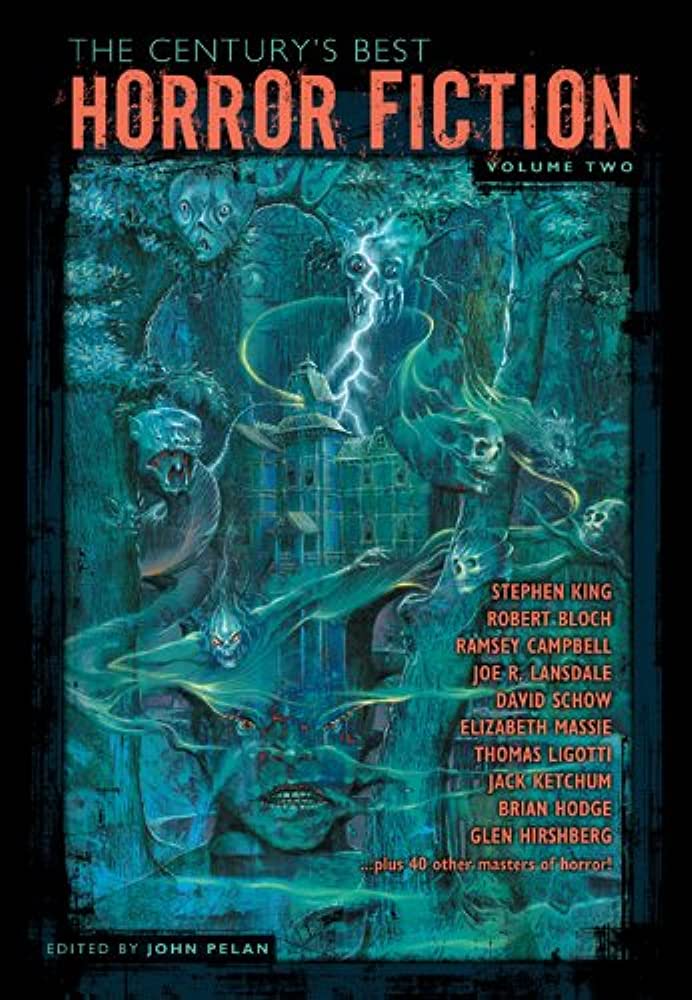
A midcentury modern style in U.S. horror fiction? Five stories from The Century's Best Horror Fiction 1951-2000 (2012) edited by John Pelan


Readers unfamiliar with the contents of The Century's Best Horror Fiction 1951-2000 may prefer to read these notes only after reading the story.


Ӂ


Where was everyone tonight?


"Lonely Road" (1956) by Richard Wilson is a moving and powerful short story of cosmic horror. It is slickly written in what I'll term "mid-century modern" style: the nimble, supremely competent, unembellished, realist-seeming prose of enchanters who graced the pages of magazines from The New Yorker to The Magazine of Fantasy and Science Fiction in the period 1945-1969. (In fact, "Lonely Road" appeared in the September 1956 issue of F&SF).


"Lonely Road" begins with motorist Clarence Spruance heading home. He has twelve hours ahead of him on a modern two-lane road. He stops to eat, but the diner is empty, so he makes himself a pot of coffee and a sandwich and pays. It's the same later that night at a gas station; he pumps it himself and leaves money in the office.


There are no other cars on the road that night. Nor anyone at a small town's all-night drug store. No response at a payphone when he calls the operator, or 411, or 611. No one at the motel where he stops, leaving cash in the guest book. In his room he "prayed on his knees for the. first time since childhood."


Next day, at a toll booth forty miles from home, normality seems to return. But in the next town there are no copies of the previous day's newspapers. And in all the people he observes, "hostility was general. Everyone was being distant with everyone

else."


Once home, Spruance and his wife compare notes. She had noticed something off the previous day while in the attic, visiting the stored possessions of their late son and only child.


  Bobby had been very good about his illness. He became a tropical fish enthusiast, spending hours, watching the gaily-colored creatures dart among the water plants and in and out of the pottery castle in the sand at the bottom of the big tank.

  Then one day Bobby had asked for another aquarium, exactly like the first, down to the last plant and the castle. They had bought it for him, of course, and set it beside the other near his bed. Bobby made adjustments in the slope of the sand, the angle of the castle and the spacing of the plants.

  His mother wanted to know about the twin aquarium but he wouldn't tell her anything except that it was an experiment. Later, when she'd left the room, closing the door at his request, he'd transferred the fish from the old tank to the new one.

  Bobby died not long after that. Later the fish died, too, and they'd emptied the two aquariums and put them in the attic.

  "That afternoon," Joan said, "I picked up one of the aquariums and was holding it in both hands. I'd forgotten how heavy it was.

  "Then I felt as if I was being moved. Not lifted or pushed, but moved in some positive way. The light flickered for an instant, then the feeling stopped. I was still holding the aquarium. I put it down. Everything seemed the same. Only it wasn't. There were three aquariums now."

  "Three?" her husband asked.

  "Yes." She looked at him as if he were far away. He waited for her to go on. "Then, this afternoon, I was here in the living room, dusting, wearing my yellow dust mitt. I had the feeling of being moved again. I went to the broom closet to put the dust mitt away-and it was there already."

  "Two dust mitts?"

  She laughed tensely. "Yes, two. So after I thought about it a while I went up to the attic. There was only one aquarium."

  Spruance got up and went to the window. The stars seemed close in the clear black sky.

  "You and everybody else went away; and then came back," he said. "But why not me?"

  Joan didn't reply. He turned quickly. She was still there, looking past him at the bright stars.

  "What are you thinking?" he asked.

  "Oh-nothing. Well ... actually I was thinking about the snail in the aquarium."

  "The snail?"

  "Yes. Remember how proud Bobby was when he'd transferred all the fish to the new tank? But then I told him he'd forgotten the snail. It was still in the old tank, hiding inside the castle."

  "I remember," he said. "Bobby sure was annoyed with that snail. But then he said: 'It was just an old experiment.' And, instead of putting the snail in the new tank too, he put all the fish back in the old tank."

  "Yes. He said he thought they liked it better there."

  For an instant he glimpsed that world some other where (with three aquariums now, and no yellow dust mitt), empty again, abandoned after the sterile experiment. He did not dare try to glimpse the experimenter....


With an almost audible wallop, Wilson has aesthetically jarred the two hemispheres of his tale: the lonely road and the parents' memories of their child's final hobby. The convergence, and the insight it generates, explode in the final abyssal insight.


Ӂ


Suburban sacrifice


"The Altar" (1953) by Robert Sheckley gives us a droll springtime Lovecraft festival story for the era and suburban milieu of The Man in the Gray Flannel Suit


Sprightly Mr. Slater of North Ambrose, New Jersey, on his way to the train one fine morning, meets a stranger.


  "Pardon me, sir," the man said. "Could you direct me to the Altar of Baz-Matain?"


All day Mr. Slater puzzles over the fact that such an altar might exist without him knowing about it. And he is a twenty-year resident of North Ambrose!


The next morning the stranger assures him he found the right location:


  "Right beside the Temple of Dark Mysteries of Isis," the stranger said. "Stupid of me. I should have asked for that in the first place. I knew it was here, but it never occurred to me—" 

  "The temple of what?" Mr. Slater asked.


Mr. Slater cannot find the organizations in the phone book, or by using directory assistance.


  Altar of Baz-Matain. Dark Mysteries of Isis. They sounded like cults. Could there be such places in his town? It seemed impossible. No one would rent to people like that.


His spouse Mrs. Slater assures him "no one's going to start any cults in this town. The Better Business Bureau wouldn't allow it. To say nothing of the Woman's Club, or the P.T.A."


A few days later Mr. Slater is glad to come across the stranger again, and enquires how his cult is prospering.


  "So-so," the man said, his hands clasped behind his back. "To tell you the truth, we're having a bit of trouble." 

  "Oh?" Mr. Slater asked. 

  "Yes," the dark man said, his face stern. "Old Atherhotep, the mayor, is threatening to revoke our license in North Ambrose. Says we aren't fulfilling our charter. But I ask you, how can we? What with the Dionysus-Africanus set across the street grabbing everyone likely, and the Papa Legba-Damballa combine two doors down, taking even the unlikely ones well, what can you do?" 

  "It doesn't sound too good," Mr. Slater agreed."

  "That's not all," the stranger said [....] 


  It was such a little town. Mr. Slater knew a good percentage of the inhabitants by their first names. How could something like this go on unnoticed?


The next day, at another chance meeting, the stranger complains about his group having insufficient members to face its tasks.


  "Could I come?" Mr. Slater asked, without hesitation. "I mean, if you're short-handed—" 

  "Well," Elor mused. "It's unprecedented." 

  "I'd really like to," Mr. Slater said, seeing a chance to get to the bottom of the mystery. 

  "I really don't think it's fair to you," Elor went on, his thin, dark face thoughtful. "Without preparation and all."


Mr. Slater, tired of everyone denying the existence of underground cults in his North Ambrose, feels he is close to proving it. "He would really have something to dump in the mayor's lap if this worked!"


That night Elor leads Mr. Slater to the event via many circuitous and back-doubled routes.


[....] as they approached familiar streets from unfamiliar directions, Mr. Slater became just a trifle confused. He knew where he was, of course, but the constant circling had thrown him off.


[....] How very strange, he thought. One can get lost in one's own town, even after living there almost twenty years.


[....] The buildings became stranger and stranger as they walked down the dim street. They were of all shapes and sizes, some new and glistening, others ancient and decayed. Mr. Slater couldn't imagine any section in North Ambrose like this. Was there a town within the town? Could there be a North Ambrose by night that the daytime inhabitants knew nothing of? A North Ambrose approached only by devious turns through familiar streets?


At last they reach the address, and head down to the meeting chamber.


  "Have you got it ?" a thin voice asked from beside the light.


Elor assents and assures his comrades: "And he was willing, too." 


   The white light was suspended over a stone altar, Mr. Slater realized. In a single reflex action he turned to run, but Elor's hand was tight on his arm.


Ӂ


I'm not sure why editor John Pelan would choose "Founding Father" (1957) by Clifford D. Simak for inclusion in The Century's Best Horror Fiction 1951-2000. Aside from the crossing back and forth between mean barrack settler reality on a newly colonized planet and a computer-aided ("dimemsino") solipsistic fantasy of friends, material fecundity, and bourgeois living, what horror is there? That a single immortal man might fail to educate and cultivate an embryonic settlement of humans far from earth?


Ӂ


Is "The House" (1960) by Fredric Brown posthumous fantasy? Self-satisfied solipsism?  In hundreds of short stories Brown was either perfectly timed over his target, or misfired for want of what used to be called the "objective correlative." The o. c.'s absence is certainly felt acutely in "The House."


Ӂ


"The Aquarium" (1962) by Carl Jacobi


English painter Emily Rhodes rents the house of the late conchologist Horatio Lear. In its library, Lear's massive aquarium remains, cloudy water concealing what?


Emily's companion Edith Halbin joins her. Their domestic bliss is short-lived. Emily is horrified by the contents of Lear's library. Edith takes up sleepwalking. Emily is troubled by a throbbing sound, "as if... well, as if a large hollow shell were placed against the ear and held there..."


Next door neighbor Lucius Bates is conversant with Horation Lear's theory and practice.


  [Miss Rhodes] became aware of a man on a stepladder on the adjoining property. It was Lucius Bates. She crossed over and bade him good morning.

  "But a wet, gloomy one," he said, resting his saw in the branch of the plane tree he had been trimming. "It seems one bad day follows another."

  They exchanged idle talk. "You still haven't got rid of that stone monstrosity, I see," he said.

  "Monstros ? Oh, you mean the aquarium! But why...?"

  Bates adjusted his oversized spectacles. "You have a rather nice library. That oversized tank is out of taste. I've often wondered why Horatio put it there in the first place." 

  "Presumably because it was close to his place of work." "Fiddlesticks! I should think a dry table would have been as good a place to keep his shell specimens on. But then, Horatio was a little touched."

  Miss Rhodes was going to mention Lear's queer papers and books when she thought better of it. Instead she said, "In what way— touched, I mean?"

  Bates smiled slightly. "Well, for one thing, his pet theory about a form of undersea life. He had some wild idea that somewhere in the unplumbed ocean depths there exists a highly developed kind of mollusk capable of emulating certain characteristics of those life forms it devours.

  "That was his original theory. In later years he apparently cloaked it with a pattern of demonology and what amounted to a modern adaptation of prehistoric superstition and folklore. He believed that these super undersea species are the incarnation of those Elder Gods who ruled the antediluvian deep and whose existence has been brought down to us in the dark myths and legends of a primitive past; that commanded by the great Cthulhu, they have lain dormant these eons in the sunken city of Flann, awaiting the time they would rise again to feed and rule. He believed further that this metempsychosis of the Elder Gods carried with it a latent incredible power and that if he could aid them to their destiny some of that power would be transmitted to him. Oh, Horatio really went all out in this mystic fol-de-rol. I even overheard him promise his brother, Edmund, all kinds of maledictions if he continued to ridicule his beliefs."


"The Aquarium" is not what I referred to above as "mid-century modern" horror. While Jacobi's style is carefully unadorned, the story (to be polite) still strikes the reader as a work designed to hit a targeted niche market. Despite its central symbolic apparatus of a tank of murky salt water and its claustrophobic interiors filled with somnambulism, auto-hypnosis, and unacknowledged lesbianism, it is far from the cosmopolitanism of writers like Shirley Jackson, Richard Matheson, Carson McCullers, the Bowles's, or Burroughs.


Still, Jacobi's studied climax does not stint in blood or thunder:


  "Edith!" she called. "Let me in."

  That same ringing silence answered her. Again she pounded on the door.

  "Edith! Why don't you answer?"

  Her unease gave way to alarm. She turned and ran down the corridor to the kitchen where a master key hung from a hook on the wall. A moment later, she had unlocked the library door and entered the room.

  At first glance, she thought the room was empty. Her eyes lowered to the floor and she advanced several steps. For a long moment she stood there, looking down. A dribble of saliva ran from a corner of her mouth. Then she turned very quietly and left the room.

  The rain, coming down harder, wrapped itself about her as she went out the door and down the outside steps to the street. She walked down Haney Lane to Brompton Road, heading south east toward Embankment. She moved into Basil Street and followed Basil into Walton, threading her way blindly through the night traffic, unaware of her surroundings, not knowing where she was or where she was going. She entered Pont Street and as she went on, she saw again in her mind's eye what she had seen in the library—the sight which would live forever in her memory—the body of Edith Halbin lying limp on the floor... a body that was all but unrecognizable because the head and face had been partially devoured! And the aquarium that no longer showed a milky grey solution, was now a sickening pink. And most hideous of all—the marks on the floor, the still wet red convolutions extending from the aquarium to the body of Edith Halbin and from there back to the tank again—marks that might have been made by some crawling thing, satiated and slobbered with blood.

  Miss Rhodes came into Cadogan Square. Here she suddenly stopped, threw back her head and screamed....


That dribble of saliva is certainly worthy of Sheckley or Wilson, if nothing else in "The Aquarium" comes close.


Ӂ


Jay

29 April 2023