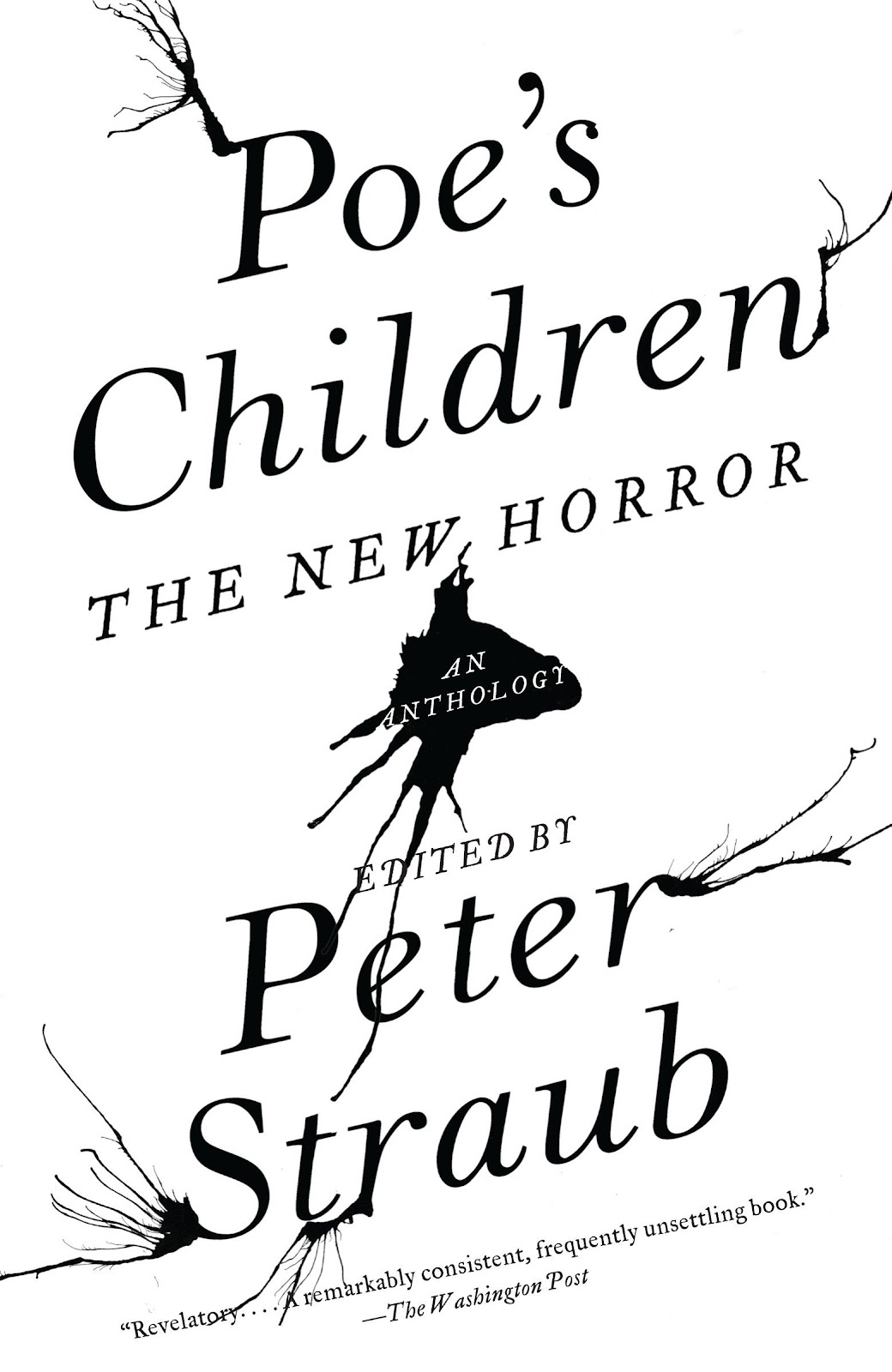
Readers unfamiliar with Poe's Children may prefer to read these notes only after reading the anthology.
Poe's Children is a proper, well-mannered collection, safe to take to a cocktail party without risk of social embarrassment. The subtitle "The New Horror" itself confirms this. The old stuff, crass and plebeian, mass market and midlist, could never be respectable. It needed to be erased, replaced with "the new," using the canned heat prose stylings redolent of writing workshops.
From Straub's introduction:
[....]"horror" as a category overflowed its banks during the late eighties and flooded the chain-stores' shelves with malevolent orphans, haunted brownstones and haunted farms and haunted subway cars, ancient curses, things in bandages, evil toddlers, zombies at play, Nazi vampires—" underwater lesbian Nazi vampire turtles," my now-deceased friend Michael McDowell joked....
Note the phrase "chain-stores." He means Walmart, flyover country, and deplorables.
Of the stories in Poe's Children, I count perhaps one unsettling and macabre enough to recall the author of "The Black Cat" and "The Business Man." The rest have their strengths and weaknesses, some more than others. Few evoke horror, or make use of Horror's modes. Most are fantasies of a special type: insular, suburban, socially incurious, and satisfied to depict their middle class professional (meritocratic) milieus.
* * *
Black Dust (2001) by Graham Joyce
"Black Dust" is a story about sons of miners in the rural UK. Naturally, there is a cave-in. But quicker than you can say Roddy McDowall, the dead father's spirit visits his son's friend to convey his farewells. Throat-lumpening.
October in the Chair (2002) by Neil Gaiman
Gaiman pumps up the old Bradbury Wurlitzer© for some schmaltz about a runaway who befriends a boy ghost his age. The story-circle setting is cleverly done.
Leda (2002) by M. Rickert
Ma'am, are you saying you were raped by a swan?
Yes. I think I could recognize him in a lineup.
"Leda" begins as a conceitedly self-congratulatory rape riff. The conclusion, however, is convincing.
The Man on the Ceiling (2000) by Melanie Tem and Steve Rasnic Tem
And the world also has in it: Werewolves, whose unclaimed rage transforms them into something not human but also not inhuman (modern psychiatry sometimes finds the bestial "alter" in the multiple personality). Vampires, whose unbridled need to experience leads them to suck other people dry and are still not satisfied. Zombies, the chronically insulated, people who will not feel anything because they will not feel pain. Ghosts.
I write in order to understand these things. I write dark fantasy because it helps me see how to live in a world with monsters.
"The Man on the Ceiling" is an intrepid aesthetic folie à deux. Each hand-off is beautifully wrenched, the overall effect is energizing.
The Body (2004) by Brian Evenson
"The Body" seems like the product of an assignment: interesting to put on paper, but no pleasure or satisfaction for the reader. The plot may be about a man with body dysphoria restrained in a rubber suit while two sadistic foot fetishists indulge in pretentious monologues. Evenson employs an abstract and obscure style in "The Body," but giving the reader no bearings does not increase our appreciation of the story's horror and mystery. I just kept counting how many pages I had left to go.
Plot Twist (2002) by David J. Schow
Three characters are stranded in the desert. One is a kibbitzer with ideas about how they got there. The other two, a couple, try to keep their sense of humor. They find two backpacks on consecutive days: each has water and snacks for two. Their predicament ends with a plot twist and sudden death. Schow is a fine stylist, but "Plot Twist" never rises above uninvolving. Stories that don't solve their own mysteries need more misdirection than that.
The Bees (2003) Dan Chaon
"The Bees" horrifies at a deep level, depicting a father whose worst fear is that things are going too good for him, his wife, and their little boy. "Something bad has been looking for him for a long time, he thinks, and now, at last, it is growing near." To think, I almost skipped this fine short story because it was written in the present-tense.
Little Red's Tango (2002) by Peter Straub
I almost wrote-off "Little Red's Tango" as #dnf. It tells, at interminable length (though with charming style), the story of an everyman Manhattanite, his good vibes, his zen composure, and his constructive influence on those whose paths he crosses. Horror? Not at all: not the old horror or the New Horror.
20th Century Ghost (2002) by Joe Hill
My first time reading Hill. Joshi dismisses him as smarmy and using "fussy, self-conscious prose." I found "20th Century Ghost" well-structured and emotionally involving. Not horror, it is a rare and welcome addition to the subgenre of posthumous fantasy.
Louise's Ghost (2001) by Kelly Link
"Louise's Ghost" is the most accomplished story in Poe's Children. Link begins the story with two protagonists named Louise, inseparable friends since childhood. Using present-tense and having two characters with the same first name strikes the reader as authorial willfulness. But persistence is rewarded. The humor and pathos are distanced and objective, but the effect is inarguably graceful.
Cleopatra Brimstone (2001) by Elizabeth Hand
"Cleopatra Brimstone" is an impeccably written novella. Hand's style is briskly declarative, alive with the power and authority of competing vocabularies in divergent subcultures, in this case entomology and punk. Cleopatra herself, in several respects, transforms and shapes transformation in others. The momentum of her ambitions, however, is thwarted by her own short-cutting single mindedness and her social position as a woman. The tale could be generously termed "dark fantasy." There is little horror to it, and I doubt Poe would claim it as offspring.
The Sadness of Detail (1989) by Jonathan Carroll
I have not read Carroll before, but "The Sadness of Detail" is a precise and brief story I hope is indicative. It takes place, for the most part, on a cold and wet November day in a warm and comfortable cafe. I would read the story again just to enjoy another visit to that cafe. The things Carroll's narrator discovers about her future, and the fates of her child and husband, only put the bow on it. The description of God as a thinning intelligence is terrifying. But perhaps the reporter on his condition, the man named Thursday, is wrong.
Notes on the Writing of Horror: A Story (1985) by Thomas Ligotti
"Notes on the Writing of Horror: A Story" is incontestably a child of Poe. The jocular narrative mask, in a few pages, starts slipping, and the slippage reveals the multiform voices of madness beneath.
In Praise of Folly (1992) by Thomas Tessier
If a property is abandoned and overgrown, skip it. Thomas Tessier's protagonist Roland does the opposite. "In Praise of Folly" is a sharp story about life's wrong turns and fate's little tricks. And the whisper of an ax at dusk.
The Two Sams (2002) by Glen Hirshberg
"The Two Sams" examines the horrific equipoise life demands of parents after they suffer miscarriages, but keep trying for a child. Such a topic demands, ultimately, an inconclusive resolution. Hirshberg provides the reader with one, but "The Two Sams" has crossed all the other lines previous to its end. It could be written-off as maudlin and special pleading, but given the author's taciturnity, I think that judgment would be wrong.
* * *
Jay
21 August 2022