Subscribe to my Substack

Sunday, May 19, 2019

Super-lice, cyclostomes, and obours: A Coven of Vampires by Brian Lumley (1998).


I've always enjoyed Lumley's novels and stories, provided they are not pastiches of Derleth pastiching Lovecraft.

The collection No Sharks in the Med and Other Stories was superb, in my judgment. The novel Demogorgon was a fast and rousing supernatural thriller; it brought to mind the Italian films that tried to cash-in on the popularity of The Exorcist and The Omen.

A Coven of Vampires is another entertaining book, filled with stories both weird and droll. (The superiority of the No Sharks in the Med collection resides solely in the fact that it is Cthulhu-free.)


*


[Quotations in italics.]

What Dark God? • (1975)
Like the vampires in "The Picnickers," the villains of this tale don't rely on the usual neck-biting.
     ....He had been a chalky-grey colour before; we all had, in the weak glow from the alternately brightening and dimming compartment ceiling light. Now he seemed to be flushed; pinkish waves of unnatural colour were suffusing his outré features and his red-slit mouth was fading into the deepening blush of his face. It almost looked as though…. My God! He did not have a mouth! With that unnatural reddening of his features the painted slit had vanished completely; his face was blank beneath the eyes and nose.

Back Row • (1988)
Police statement of a seasoned citizen about what happened at a matinee at the Odeon. A droll story about imagining what the teeenagers in the row behind you are getting up to in the dark, what with their fumblings, slurpings, and growlings.
     ....There was very little flesh on her face, just raw red. Breasts had gone, right down to steaming ribs. The belly was open, eviscerated, a laid back gash that opened right down to the spread thighs. There were no innards, no sexual parts left at all down there. If I hadn't seen her before, I couldn't even have said it was a girl at all.

The Strange Years • (1982)
....They appeared almost overnight, five times larger than their immediate progenitors and growing bigger with each successive hatching; and unlike the new octopus they didn't die; and their incubation period down to less than a week. The superlice. All Man's little body parasites, all of his tiny, personal vampires, growing in the space of a month to things as big as your fist. Leaping things, flying things, walking sideways things.

The Kiss of the Lamia • (1985)
This story is a complete fiasco: a sword-and-sandal potboiler shot-through with modern-day slang anachronism and pretentious back-projections of how people in the Near East talked to each other thousands of years ago.
    ....Bully boys out of Chlangi they were, desperadoes riding forth from that shunned city of yeggs and sharpers, on the lookout for quick profits in the narrow strip twixt Lohmi's peaks and the Desert of Sheb.

Recognition • (1981)
    ...."Prior to the fire which razed the main building to the ground in 1618, there had been a certain intercourse and intrigue of a similarly undiscovered nature between the nameless inhabitants, the de la Poers of Exham Priory near Anchester, and an obscure esoteric sect of monks dwelling in and around the semi-ruined Falstone Castle in Northumberland. Of the latter sect, they were wiped out utterly by Northern raiders—a clan believed to have been outraged by the 'heathen activities' of the monks—and the ruins of the castle were pulled to pieces, stone by stone. Indeed, it was so well destroyed that today only a handful of historians could even show you where it stood!...."

The Thief Immortal • (1990)
An interesting science fantasy about a German sign painter who robs individuals, then nations, then whole sentient species of their life-time, which he accumulates to prolong his own existence. Until the universe has a backfire.

Necros • (1986)
Another lounging sunny Mediterranean vacation ruined. Between Lumley, Ramsey Campbell, and Simon Raven alone there must be enough material for a monograph.

The Thing from the Blasted Heath (1971)
....Many and varied are the weird tales to come filtering out of that area, and fiction or superstition though they may or may not be the fact remains that men will not drink the water of that reservoir.

Uzzi • (1988)
Twice-told travellers tales about running into trouble in a foreign country have always been a thematic current within the genre. Lumley does a bloodily good job here with events in a small town in Germany once named Hexenstadt.

Haggopian (1973)
Romance a la cyclostome
    ...."You see, Mr Belton, I had developed—yes, an organ! An appendage, a snout-like thing had grown out of my stomach, with a tiny hole at its end like a second navel! Eventually, of course, I was obliged to see a doctor, and after he examined me and told me the worst I swore him—or rather, I paid him—to secrecy. The organ could not be removed, he said, it was part of me. It had its own blood vessels, a major artery and connections with my lungs and stomach. It was not malignant in the sense of a morbid tumour. Other than this he was unable to explain the snout-like thing away.

The Picnickers • (1991)
This is by Lumley's finest story. A masterpiece of folk-horror, it has been anthologized by canon-makers Charles L. Grant, Karl Edward Wagner, and Stephen Jones. Redolent of youth's lost time and place, it never ceases to excite me as reader, even after multiple re-readings.
    ....I turned the book over and looked at the pictures. They were woodcuts, going from top to bottom of the two pages in long, narrow panels two to a page. Four pictures in all, with accompanying legends printed underneath. The book was old, the ink faded and the pictures poorly impressed; the text, of course, was completely alien to me.
     The first picture showed a man, naked, with his arms raised to form a cross. He had what looked to be a thick rope coiled about his waist. His eyes were three-cornered, with radiating lines simulating a shining effect. The second picture showed the man with the rope uncoiled, dangling down loosely from his waist and looped around his feet. The end of the rope seemed frayed and there was some detail, but obscured by age and poor reproduction. I studied this picture carefully but was unable to understand it; the rope appeared to be fastened to the man's body just above his left hip. The third picture showed the man in an attitude of prayer, hands steepled before him, with the rope dangling as before, but crossing over at knee height into the fourth frame. There it coiled upward and was connected to the loosely clad body of a skeletally thin woman, whose flesh was mostly sloughed away to show the bones sticking through.
    Now, if I tell my reader that these pictures made little or no sense to me, I know that he will be at pains to understand my ignorance. Well, let me say that it was not ignorance but innocence. I was a boy. None of these things which I have described made any great impression on me at that time. They were all incidents—mainly unconnected in my mind, or only loosely connected—occurring during the days I spent at my uncle's house; and as such they were very small pieces in the much larger jigsaw of my world, which was far more occupied with beaches, rock pools, crabs and eels, bathing in the sea, the simple but satisfying meals my uncle prepared for us, etc. It is only in the years passed in between, and in certain dreams I have dreamed, that I have made the connections....

Zack Phalanx Is Vlad the Impaler • (1977)
Jokey and unhumorous tale about the pitfalls of location shooting on a Dracula movie in Eastern Europe. I suppose everyone in the field has to write one of these at some point.

The House of the Temple • (1980)
The aesthetic wash-outs of most of Lumley's short stories is displayed here perfectly. UK lore about worms (or wyrms?) and water creatures is used as another opportunity for sub-Derleth Lovecraft pastiche.
...."There have been a number down the centuries—the horror that dwelled in the mirror of Nitocris; the sucking, hunting thing that Count Magnus kept; the red, hairy slime used by Julian Scortz—familiars of the Great Old Ones, parasites that lived on Them as lice live on men. Or rather, on their life-force! This one has survived the ages, at least until now. It does not take the blood but the very essence of Its victim. It is a soul-eater...."


Jay
19 May 2019


Thursday, May 16, 2019

The devil's member: Warlock by Ray Garton (1989).


I recall Warlock fondly, having rented it on video in about 1995. The acting was confident and the effects were adequate for period and budget. And best of all, it was a genuinely arresting supernatural thriller.

Ray Garton's novelization is an outstanding example of the art, recalling skills shown back in the 1980s in tie-ins by Dennis Etchison and Alan Dean Foster.

This is not a bloodless book. Right away, in 1690s Puritan Massachusetts, we know our guide is Ray Garton and not Charles L. Grant:

....She'd set the table, but the plates and silverware were scattered on the floor where the warlock had thrown them. In their place lay Marian, sprawled face-down over the table, her clothing torn away, her smooth pale skin mottled with bruises. Her buttocks jutted upward, splashed with blood and . . . and something else . . . something milky . . .

The worst of it buckled Redferne's knees beneath him and pushed him to the very edge of unconsciousness. Marian's anus yawned open like a mouth, dribbling blood-streaked semen. She had been violated by something obscenely large, far too large to belong to an ordinary man.


The warlock has destroyed Puritan witch-smeller Giles Redferne's young wife. He is condemned to be burned alive on top of a crate filled with cats. But the devil sends a time-warping tornado to save the day, transporting warlock and Redferne three hundred years into the future.

In 1989 Los Angeles Redferne joins forces with Kassandra, a waitress/actress. Kassandra got in the warlock's way shortly after his arrival, and is now cursed to age about twenty years per day: a real motivation to unite with Redferne to stop their villain.

The warlock is not only equipped with Satan's member. He is also skilled in what used to be called The Black Arts. A boy tossing a football, a little girl at a petting zoo, and a woman pregnant with twins discover this the hard way.

The warlock, we discover, is working with a purpose: reassembling scattered and hidden pages of the ultimate evil book:

....Redferne stood, clearly shaken. "He's come for it. Blessings of heaven, 'tis the Grand Grimoire he's after."

"The Grand Grimwhat?"

"A spellbook. All witches keep grimoires. But one is indestructible. One is the Bible of black magic. The Grand Grimoire. Always, witches have lusted for it....

"Hidden within the Grand Grimoire is the name of God, Kassandra, the lost name of God."

"I don't wanna hear it, Redferne," she whispered as tears welled up in her eyes.

" 'Tis the name invoked during Creation. Witches charge that, should this name—this true name of God—be uttered back to front—"

"Please . . ."

"—should the name be uttered in reverse—"

"Please don't . . ."

"—then Creation will undo . . . 'twill reverse, Kassandra."

She faced him, crying. "It's gonna uncreate, huh? That what you're trying to tell me, here? The world's just gonna—"

"All worlds, Kassandra." He let that sink in. "All."

"Ooohh, son of a bitch," she groaned, scrubbing her face with her hands, "I especially didn't want to hear that last part. Do . . . do you believe that, Redferne?"

"I believe the book holds the name. And witches believe the name, spoken in reverse, will unravel life itself."

Warlock is a novel worth reading. I'm not a fan of Garton, but he gives us an outstanding supernatural chase thriller. The Mennonite scenes, my favorite from the film, are deftly and powerfully handled here.


Jay
16 May 2019


Tuesday, May 14, 2019

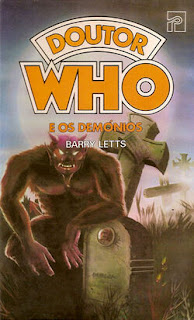
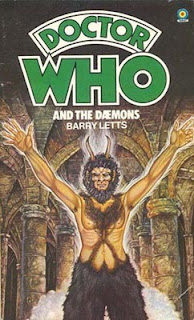
They couldn't be hoof marks: Doctor Who and the Daemons by Barry Letts (1975).


....'You beg so prettily, my dear. But you see, I am so near to attaining one of my greatest ambitions: power to control, to rule, an entire planet—this planet, Earth. Nothing and nobody can be allowed to stand in my way.'

'You're mad.. ' she breathed....


A barrow called the Devil's Hump  is being excavated in the picturesque village of Devil's End (which has a local pub called The Cloven Hoof.) The excavation will climax on live TV on May 1, as village Morris dancers and all the trimmings are rolled out for the holiday.

The local vicar, Mr. Magister, thinks concerns about supernatural and malevolent forces are absurd. Miss Hawthorne, local wise woman, suspects differently.

The Doctor Who TV episode "The Demons" was first aired in 1971. Co-scripter Barry Letts' novelization appeared in 1975.

To viewers and readers of my generation, this was the golden age of Doctor Who.  (No Moffat-Gatiss mind-screws back then.)

"The Demons," like the Fang Rock, Weng-Chiang, and Martian pyramid episodes,  checks many boxes in the weird "matter of Britain." "The Demons" includes: ancient barrows, 'white' witches, altered or unusual maypole traditions, Beltane, Quatermassian boffins, and archeological digs that reveal "we are all Martians." Well, not Martians per se, but the product of fiddling by alien Prometheans.

Notes of Nigel Kneale, Grant Allen, and Eleanor Scott are struck, as well as Dennis Wheatley.

The Doctor lays it all out here:


…..Sitting round the rickety old oak table in the little back room of 'The Cloven Hoof' Jo, Mike and Sergeant Benton were tucking into a traditional 'Ploughman's Lunch'—
large slabs of cheese, crusty new bread with farm butter and crunchy pickled onions; all washed down with pints of draught cider or strong ale. Miss Hawthorne had graciously accepted one small apple, stating it as her considered opinion that too much eating in the middle of the day led to sluggish vibrations in the afternoon.

'Do come and eat something, Doctor,' called Jo.

But the Doctor was too far away to think of food.

Surrounded by piles of books of every shape, size and age, he was hunting here and there through them, making notes and leaving slips of paper as book marks.

'Well, well, well! The Grimoire of Pope Honorius!' The Doctor had seized an ancient leatherbound volume with great excitement. 'A copy I never knew existed...'

'You have the pick of the finest collection of occult material in the country there, Doctor,' said Miss Hawthorne proudly, 'though why you wanted me to bring it, I can't think.'

'I hope that will become clear. Apart from anything else, I'm being pestered for an explanation. These books will help me to provide it.'

Miss Hawthorne looked puzzled. 'But Doctor, there is only one possible explanation: this is the supernatural at work.'

The Doctor looked up from his notes. 'Nonsense!' he said.

Benton thoughtfully chomped on a pickled onion.

'What about that thing that got me? That was real enough.'

The Doctor had returned to his books. 'There's nothing more real than a force-field, Sergeant,' he said, marking a large coloured picture of a goat, 'even a psionic force-field.'

Miss Hawthorne bristled. To have her cherished beliefs challenged! It was unthinkable. 'You're being deliberately obtuse, Doctor. We are dealing with the supernatural, I tell you. The Occult! Magic!'

The Doctor shook his head. 'Science,' he said.

'Magic!'

' Science, Miss Hawthorne.'

Mike Yates finished off his beer. 'Really,' he said, 'what does it matter? There's no point in getting all hot under the collar about words. The important thing is to find a way to stop it, whatever it is.'

'How can you stop it without knowing what it is?' said Jo indignantly, leaping to the Doctor's defence as usual.

'Well done, Jo,' said the Doctor, getting up, 'you're being logical at last.'

'Oh, am I? Thanks,' said Jo, doubtfully.

'We'll turn you into a scientist yet. Now then. If you've all finished perhaps we could clear a space.'

One end of the table was quickly cleared of the remains of the meal and the Doctor was able to spread out a number of books. 'Right,' he said, 'here we go,' and he opened the first book. 'Who's that?'

'It's an Egyptian god, isn't it?' said Jo.

'Top of the class. The God Khnum—one of their gods with horns.' He opened the next book. 'A Hindu Demon—with horns.' Another. And another. 'The Ancient Greek god Pan—with horns. A bust of Jupiter—with horns. A statue of Moses—yes, even he's got horns. The Minotaur—the bull-headed monster of Crete. Our old friend the Horned Beast—the Devil with the head of a goat...'

The Doctor went on opening book after book, until the table was filled with pictures of horned beings.

Miss Hawthorne was not impressed. 'You could go on all day and all night showing us pretty pictures,' she said tartly. 'It proves nothing. Horns have been a symbol of power ever since... Oh, ever since...'

'Even since man began,' agreed the Doctor. 'Look.' He showed them yet another picture—a photograph of a prehistoric cave-painting which seemed to show a group of witch doctors dancing, all with horns upon their brows.

'But has it ever struck you to ask yourself why?' the Doctor continued. 'Creatures like that have been seen over and again throughout the history of man, and man has over turned them into myths—into gods or devils.' He gestured towards the pictures. 'But they're neither. They are creatures from another world...'

Even Miss Hawthorne was silenced.

'You mean,' said Benton slowly, 'like the Axons, and the Nestenes—and the Cybermen?'

'Precisely,' said the Doctor, 'but far, far older and immeasurably more dangerous.'

'Charming,' murmured Mike Yates.

'Are you suggesting that these creatures came to Earth in spaceships?' said Miss Hawthorne, regaining her composure.

'I am,' he replied. 'They're Dæmons* from the planet Damos; and that's a long long way from Earth.'

'Sixty thousand light years,' put in Jo, wisely.

'That's right. The other side of the Milky Way; and they first came to Earth nearly one hundred thousand years ago...'

'But why? I mean, why should they want to?' asked Benton.

So the Doctor went on to tell them something of the history of these alien beings, the Dæmons, or Demons. He told of their evolution and the development of their culture over long aeons even before life began on Earth. When the first land creatures were crawling out of our oceans, the Dæmons already had a fully developed civilisation with a sophisticated science and technology. By the time man

* pronounced deemons.

appeared, the Dæmons had been space travellers for many centuries and had established a tradition of scientific exploration and experiment through-out the Galaxy. They arrived on Earth just in time to help homo sapiens kick out Neanderthal Man and they have been appearing on and off over since, merely observing most of the time but occasionally giving history a push in the right direction...

'There you are,' said Miss Hawthorne, triumphantly,

'that proves you're talking nonsense. This.. thing that Professor Horner loosed on the world is evil. You said so yourself. And now you tell us that they have been helping mankind for a thousand centuries!'

'Yes,' said Jo, 'and you say they're from another planet.

Then what's all this jazz about witchcraft and covens and all?'

'A very good point, Miss Grant,' put in Miss Hawthorne.

'But don't you see,' explained the Doctor, 'all the magical traditions are just the remnants of the Dæmons'

advanced science. And that's what the Master is using!'

'Mm...' Miss Hawthorne was unconvinced. 'And how do you know all this anyway?'

'Yes, Doctor,' said Mike, 'you didn't seem to know what was going on at first.'

'I learned it at school,' said the Doctor grumpily,

'chapter thirteen of the Galactic History. Unfortunately, I forgot it all.' He stood up and started to clear away the books.

'You must have gone to a very odd school—and you must have very peculiar memory,' said Miss Hawthorne.

'That, madam, is my misfortune; said the Doctor acidly, for she had touched on a sore point. 'In any case, it's all in these books of yours, if you know how to read them properly.'

'Then these creatures are linked with the Black Arts,'

she said. 'They are evil.'

'Amoral would be a better word, perhaps,' the Doctor replied 'They help Earth, but on their own terms. It's a scientific experiment to them. We're just a cageful of laboratory rats.'

'Then what's the Master up to?' asked Mike.

'He's established a link with the Dæmon from the barrow. What frightens me is the choice—domination by the Master or total destruction.'

Jo, who had been stacking the books in a neat pile, looked up aghast. 'You mean this Dæmon could destroy the Earth?'

'What does any scientist do with an experiment that fails? He throws it in the rubbish bin. And you must admit that mankind doesn't look a very successful species at the moment.'

'But Doctor... you're talking about the end of the world!'

The Doctor looked at her very seriously. 'Yes, Jo,' he said, 'I am.'

Jay
14 May 2019


Sunday, May 12, 2019

Nightworld by F. Paul Wilson (1992)


….The stars do look kind of sparse up there, Bill thought.


"It's almost as if the planet's been moved to a different part of the universe."


"Cosmic, man," Joe said, eyes widening. "Maybe it has."


"No," Bill said. "That would be too logical an explanation, and easier to accept than what we're going through."


"Magnetic north's changed too," Joe said. "Compasses have been pointing anywhere they damn well please for the past couple days."


The stars do look kind of sparse up there, Bill thought.


Like Bloch's Strange Eons, Wilson's Nightworld gives us the plight of characters caught in a global disaster as an ancient power manifests again in physical form. Some forms are human, some are not. As with many an F. Paul Wilson novel, those not ready for battle get their noses rubbed right in it.

The trouble begins when the sun starts rising late and setting too soon. Then come the bottomless sinkholes. Then come the things out of the sinkholes.

....Then came another sound, a heavy, chitonous slithering from the impenetrable darkness beyond his feet. As it grew louder, Hank began to whimper in fear. He began to thrash in the water, struggling desperately to pull free but the pincers in his arms and legs tightened their grip, digging deeper into his already bleeding flesh.


And then in the growing shaft of light from the rising moon he saw it. A millipede like all the rest, but so much larger. Its head was the size of Hank's torso, its body a good two feet across, half-filling the drain pipe.


Hank screamed as understanding exploded within him. These other, smaller horrors were workers or drones of some sort; they'd captured him and were holding him here for their queen! He renewed his struggles, ignoring the tearing pain in his limbs. He had to get free!


But he couldn't. Sliding over the bodies of her obedient subjects the queen crawled between Hank's squirming legs until she held her head poised over his chest, staring at him with her huge, black, multifaceted eyes. As Hank watched in mute horror, a drill-like proboscis extruded from between her huge mandibles. Slowly, she raised her head and angled it down over Hank's abdomen. Hank found his voice and screamed again as she plunged the proboscis deep into his abdomen.


Nightworld is the conclusion of a series of novels called The Adversary Cycle.

I have not read the other novels, but Nightworld does backfill enough plot points to flesh-out character motivations. I have read a number of Wilson's Repairman Jack vigilante novels, where the author always enjoys having his cake and eating it, too. In Nightworld - where Repairman Jack does play a subsidiary role - there is some real physical and moral self-sacrifice.

Nightworld also gives us a scale of "cosmic" (as opposed to merely eschatological) menace. On a private jet on a night flight to Hawaii:

....Jack held on to his seats arm rests and knew if he looked down at his hands he'd see two sets of white knuckles.


"We'll be okay," Frank said.


"Good. A much better choice of three words."


"Be cool, Jack. Some weird air currents out of nowhere, that's all."


The grayness lightened as abruptly as it had darkened. Jack began to breath easier. He was leaning against his window, staring out into the unrelieved grayness, when the plane passed through a brief break in the vog. His throat closed and his hands renewed their chokehold on his armrests. Directly below the wings he saw a broad flat surface, smooth and black as new asphalt, spanning off in all directions until it disappeared into the gray. He was about to shout to Frank that they were going to crash when he saw the eye: Far off to his right, perhaps a quarter-mile away, cathedral-sized, huge and yellow with a slit pupil, it sat embedded in the black surface, staring back at him like a lab tech eying a microbe.


Jack slammed back in his seat, gasping for breath.


Nightworld doesn't take its apocalypse all the way, like Strange Eons or Koontz's superb The Taking. But that's not an authorial failure: Wilson gives us an averted religious calamity with good thwarting evil in combat.

However, after a couple of hundred pages where good guys are sent on a scavenger hunt for elements to build their armaments, the final battle is at best perfunctory.

"But even the trying counts for something," as one character says.


Jay
12 May 2019