Subscribe to my Substack

Showing posts with label F. Paul Wilson. Show all posts

Saturday, July 16, 2022

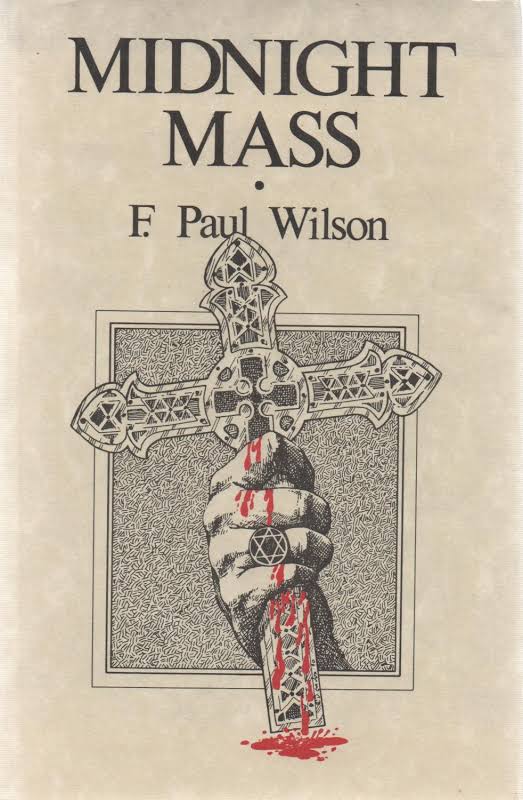
"Midnight Mass" (1990) by F. Paul Wilson

Readers unfamiliar with the novella "Midnight Mass" (1990) and the novel Midnight Mass (2004) may prefer to read these notes only after reading the stories.


A priest and a rabbi walk into a church together.


     For a moment he was disoriented, like someone peering out the window of a city apartment and seeing the rolling hills of a Kansas farm. This could not be the interior of St Anthony's.

     In the flickering light of hundreds of sacramental candles he saw that the walls were bare, stripped of all their ornaments, of the plaques for the stations of the cross; the dark wood along the wall was scarred and gouged wherever there had been anything remotely resembling a cross. The floor too was mostly bare, the pews ripped from their neat rows and hacked to pieces, their splintered remains piled high at the rear under the choir balcony.

     And the giant crucifix that had dominated the space behind the altar – only a portion of it remained. The cross-pieces on each side had been sawed off and so now an armless, life-size Christ hung upside down against the rear wall of the sanctuary.

     Joe took in all that in a flash, then his attention was drawn to the unholy congregation that peopled St Anthony's this night. The collaborators – the Vichy humans, as Zev called them – made up the periphery of the group. They looked like normal, everyday people but each was wearing a crescent moon earring.

     But the others, the group gathered in the sanctuary – Joe felt his hackles rise at the sight of them. They surrounded the altar in a tight knot. Their pale, bestial faces, bereft of the slightest trace of human warmth, compassion, or decency, were turned upward. His gorge rose when he saw the object of their rapt attention.

     A naked teenage boy – his hands tied behind his back, was suspended over the altar by his ankles. He was sobbing and choking, his eyes wide and vacant with shock, his mind all but gone. The skin had been flayed from his forehead – apparently the Vichy had found an expedient solution to the cross tattoo – and blood ran in a slow stream down his abdomen and chest from his freshly truncated genitals. And beside him, standing atop the altar, a bloody-mouthed creature dressed in a long cassock. Joe recognized the thin shoulders, the graying hair trailing from the balding crown, but was shocked at the crimson vulpine grin he flashed to the things clustered below him.

     "Now," said the creature in a lightly accented voice Joe had heard hundreds of times from St Anthony's pulpit.

     Father Alberto Palmeri.

     And from the group a hand reached up with a straight razor and drew it across the boy's throat. As the blood flowed down over his face, those below squeezed and struggled forward like hatchling vultures to catch the falling drops and scarlet trickles in their open mouths.

     Joe fell away from the window and vomited. He felt Zev grab his arm and lead him away. He was vaguely aware of crossing the street and heading toward the ruined legal office.


• • •


Stories about humanity "under the fang" don't come much bloodier, more sanctimonious, and populated with more caricatues than F. Paul Wilson's 1990 novella "Midnight Mass."


Father Joseph Cahill, a handsome and winning young priest, has been framed-up as a pedophile and exiled from his parish before the action begins. He is found in the basement Morton's Liquors and recalled to life by an old theological sparring partner, Rabbi Zev Wolpin. Zev is a Jackie Mason Jew stereotype from central casting. For Wilson he only exists to maneuver Fadda Joe into inspiring a mass fightback against the vampire occupation.


Wilson later shaped this novella and other material into the 2004 paste-up novel Midnight Mass. That novel, with alternating situations for a variety of characters as they converge and unite to fight the vampires, is very good.


So, all proportions guarded, is "Midnight Mass." I have read enough Wilson to know his use of caricature for rabbis and whiskey priests and colorful parishioners is not aimed maliciously. It's mass market fiction, and of a very high order.


Jay

16 July 2022

_____

The Mammoth Book of Vampires ([1992] 2004 edition) edited by Stephen Jones


Sunday, May 12, 2019

Nightworld by F. Paul Wilson (1992)


….The stars do look kind of sparse up there, Bill thought.


"It's almost as if the planet's been moved to a different part of the universe."


"Cosmic, man," Joe said, eyes widening. "Maybe it has."


"No," Bill said. "That would be too logical an explanation, and easier to accept than what we're going through."


"Magnetic north's changed too," Joe said. "Compasses have been pointing anywhere they damn well please for the past couple days."


The stars do look kind of sparse up there, Bill thought.


Like Bloch's Strange Eons, Wilson's Nightworld gives us the plight of characters caught in a global disaster as an ancient power manifests again in physical form. Some forms are human, some are not. As with many an F. Paul Wilson novel, those not ready for battle get their noses rubbed right in it.

The trouble begins when the sun starts rising late and setting too soon. Then come the bottomless sinkholes. Then come the things out of the sinkholes.

....Then came another sound, a heavy, chitonous slithering from the impenetrable darkness beyond his feet. As it grew louder, Hank began to whimper in fear. He began to thrash in the water, struggling desperately to pull free but the pincers in his arms and legs tightened their grip, digging deeper into his already bleeding flesh.


And then in the growing shaft of light from the rising moon he saw it. A millipede like all the rest, but so much larger. Its head was the size of Hank's torso, its body a good two feet across, half-filling the drain pipe.


Hank screamed as understanding exploded within him. These other, smaller horrors were workers or drones of some sort; they'd captured him and were holding him here for their queen! He renewed his struggles, ignoring the tearing pain in his limbs. He had to get free!


But he couldn't. Sliding over the bodies of her obedient subjects the queen crawled between Hank's squirming legs until she held her head poised over his chest, staring at him with her huge, black, multifaceted eyes. As Hank watched in mute horror, a drill-like proboscis extruded from between her huge mandibles. Slowly, she raised her head and angled it down over Hank's abdomen. Hank found his voice and screamed again as she plunged the proboscis deep into his abdomen.


Nightworld is the conclusion of a series of novels called The Adversary Cycle.

I have not read the other novels, but Nightworld does backfill enough plot points to flesh-out character motivations. I have read a number of Wilson's Repairman Jack vigilante novels, where the author always enjoys having his cake and eating it, too. In Nightworld - where Repairman Jack does play a subsidiary role - there is some real physical and moral self-sacrifice.

Nightworld also gives us a scale of "cosmic" (as opposed to merely eschatological) menace. On a private jet on a night flight to Hawaii:

....Jack held on to his seats arm rests and knew if he looked down at his hands he'd see two sets of white knuckles.


"We'll be okay," Frank said.


"Good. A much better choice of three words."


"Be cool, Jack. Some weird air currents out of nowhere, that's all."


The grayness lightened as abruptly as it had darkened. Jack began to breath easier. He was leaning against his window, staring out into the unrelieved grayness, when the plane passed through a brief break in the vog. His throat closed and his hands renewed their chokehold on his armrests. Directly below the wings he saw a broad flat surface, smooth and black as new asphalt, spanning off in all directions until it disappeared into the gray. He was about to shout to Frank that they were going to crash when he saw the eye: Far off to his right, perhaps a quarter-mile away, cathedral-sized, huge and yellow with a slit pupil, it sat embedded in the black surface, staring back at him like a lab tech eying a microbe.


Jack slammed back in his seat, gasping for breath.


Nightworld doesn't take its apocalypse all the way, like Strange Eons or Koontz's superb The Taking. But that's not an authorial failure: Wilson gives us an averted religious calamity with good thwarting evil in combat.

However, after a couple of hundred pages where good guys are sent on a scavenger hunt for elements to build their armaments, the final battle is at best perfunctory.

"But even the trying counts for something," as one character says.


Jay
12 May 2019