Biological incident.
That was the first of it. How the government tried to explain. A biological incident, at some kind of secret—up until then—testing center in North Dakota. That was six years ago. The biological incident was worse than they’d let on. They had created something from their stew of gene manipulation and bacteriological tampering that had sent their ten test subjects out into the world with a vengeance. The ten had multiplied into twenty, the twenty to forty, the forty to eighty, and on and on. They had the wrath of Hell in their blood, a contamination that made AIDS look like a common cold. The germ boys had learned how to create—by accident, yes—weapons that walked on two legs. What foreign power were we going to unleash that taint upon? No matter; it had come home to live.
Biological incident.
Kyle shifted the suitcase again. Call them what they are, he thought. They craved blood like addicts used to crave heroin and crack. They wrapped themselves up and hid in closets and basements and any hole they could winnow into. Their skin burst and oozed and they split apart at the seams like old suits in the sunlight. Call them what they are, damn it.
They were everywhere now. They had everything. The television networks, the corporations, the advertising agencies, the publishing houses, the banks, the law. Everything. Once in a while a pirate station broke in on the cable, human beings pleading for others not to give up hope. Hope. There it was again, the cosmic joke. Those bastards were as bad as fundamentalist preachers; their role models were Jim Bakker and Jerry Falwell, seen through a dark glass. They wanted to convert everybody on earth, make them see the “truth,” and if you didn’t choose to join the fold they battered you in like a weak door and chewed the faith into you.
It wasn’t just America. It was everywhere: Canada, the Soviet Union, Japan, Germany, Norway, Africa, England, South America, and Spain. Everywhere. The contamination—the “faith”—knew no racial nor national boundaries. It was another cosmic joke, with a hideous twist: The world was moving toward a true brotherhood.
Kyle watched his shadow loom before him, its darkness merging with Allie’s. If a man couldn’t take a vacation in the sun with his family, he thought, then what the hell good was living?
--"The Miracle Mile"
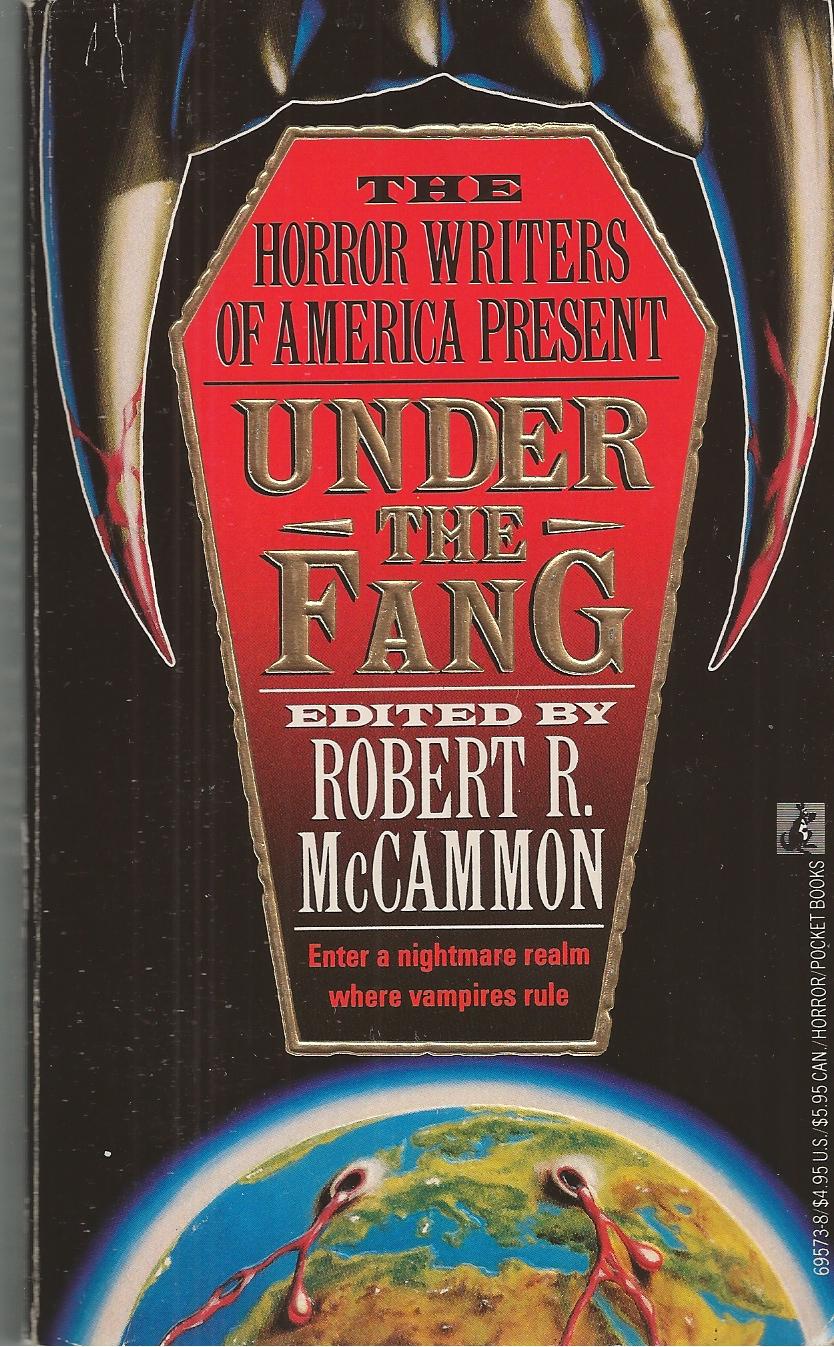
Under the Fang edited by Robert R. McCammon
(Pocket Books, 1991)
What happens when a thirty year old anthology you loved is out of print? When it has no ebook edition? When second-hand hardcovers are prohibitively expensive and paperbacks spread spores?
If you're me, you go hunting the stories in other anthologies and collections, triangulated with some clicking in the ISFDB.
Most of the stories in Under the Fang never went further than that anthology. Most of the author names on the title page strike no chord. But I did find six of the seventeen stories here at home.
* * *
My memory of Under the Fang was that its authors were better focused on the theme and mise en scène than those invited to publish in Skipp and Spector's 1991 Book of the Dead.
[N.B. That both Under the Fang and Book of the Dead were published in 1991 (end of the cold war, "end of history" and all that) is worth noting.]
The Miracle Mile by Robert R. McCammon
(Best New Horror, 1992)
McCammon edited Under The Fang, and his story, which leads the anthology, does not disappoint. He lays out the geography of the disaster, the scope of its human toll, and the dead-end of survivalist fantasies as a solution. All that's left for the family it depicts is remembrance and a stoical embrace of family suicide (or murder-suicide) as finale. McCammon handles this poignant material without surrendering to bathos or cynicism. It is a fine piece of work.
....He took the thermos and went into the bathroom, where there was a sink and a shower stall and a tub with a sliding door of smoked plastic. He pulled the blind up and opened the small window in there too, and then he turned on the sink’s tap and waited for the rusty water to clear before he refilled the thermos.
Something moved, there in the bathroom. Something moved with a long, slow, and agonized stretching sound.
Kyle looked at the smoked plastic door for a moment, a pulse beating in his skull, and then he reached out and slid it open.
It was lying in the tub. Like a fat cocoon, it was swaddled in bed sheets and tacky beach towels covered with busty cartoon bathing beauties and studs swigging beer. It was impossible to determine where the head and feet were, the arms bound to its sides and the hands hidden. The thing in its shroud of sheets and towels trembled, a hideous involuntary reaction of nerves and muscles, and Kyle thought, It smells me.
“Kill it.”
He looked back at Allie, who stood in the doorway behind him with the baby in her arms. Her face was emotionless, her eyes vacant as a dreamer’s. “Kill it, Kyle,” she said. “Please kill it.”
Dancing Nitely by Nancy A. Collins
(Hopedale Press, 2012)
"Dancing Nitely" is a small-compass slice-of-life evening of hip, on-the-town vampires. Mavrides, whose own "conversion" took place in the 1960s, disdains the bumptious nouveau types who swarm Club Vlad. "Today’s new breed of vampire didn’t have to worry about waking up with a stake piercing their thorax," he thinks. It's a clever story, one deeply embedded in the mores of a non-human social order where citizens take their right to rule as beyond question.
Red Eve by Al Sarrantonio
(Toybox, 1999)
Sarrantonio gives us a far future holiday banquet populated by jaded vampire nobility. In a glass house in a glass city floating above a radioactive earth, these sybarites give Poe's Prospero and his guests a run for their money. Like most stories with a cast of feasting decadents, it is about tables being turned and history being avenged.
“Now!” LaFortina said, lifting himself unsteadily to his feet with the unsteady help of his neighbors. He spoke in a blur. “Give us your finest lesson—now!”
“Hurrah!” came a slurred chorus behind him. Others tried to rise from their cushions, hampered by drunkenness and gluttony.
“As you wish.”
Eidolan's fingers fluttered, and the hologram moon overhead brightened to almost painful intensity. It was brown and white, artistically cratered; not the gray, pale, distant, bomb-blasted circle they knew, outshone by some of the stars, night-silent, dead. This moon tugged at them, at their eyes, their hearts—made rhythms in their blood.
“This,” said Eidolan, “is my lesson.” Her voice was the voice of this moon, pulling at them, making them hers. For a moment the moon blinked out, leaving them with a gasping view of the red balloons still playing out through the clear-glass walls from the other palaces surrounding them—a black-night sky waltzing with rising balloons.
The moon blinked back on; the ceiling, the night, disappeared. “This,” Eidolan said in a gentle hush, “is my story—”
LaFortina pushed himself up, pointed a finger at Eidolan, at the moon. “Your finest,” he insisted. “You promised!” Swaying slightly, he turned his finger downward, pointed through the crystal table, the glass floor, to the roiling, dark, sickly yellow clouds that hid the Earth. “This year you promised your best—better than this moon! We're tired of the same old Red Eve lessons! We're sick of the Vampire Wars, of dead Earth below, poison gas, proton bombs, stakes through hearts, screaming men! We're tired of bogeymen with fangs, reflectionless images, children hung like beef for living blood, the battles for the moon—it doesn't entertain us! We're bored with the thousand-year-old histories, the slaughter in Asia, the Night of a Thousand Impalements, the building of the Crystal Sphere, the Deadly Climb to Life, the story of the Last Stake! It's old! And tired! Children's stories, for a children's holiday! We're tired of this tedium and we want better! We want—your finest lesson!”
We Are Dead Together by Charles de Lint
(The Very Best of Charles de Lint, 2014)
Let it be recounted in the swato—the stories of my people that chronicle our history and keep it alive—that while Kata Petalo was first and foremost a fool, she meant well. I truly believed there was a road I could walk between the world of the Rom and the shilmullo.
We have always been an adaptable people. We’d already lived side-by-side with the Gaje for ten times a hundred years, a part of their society, and yet apart from it. The undead were just another kind of non-Gypsy; why shouldn’t we be able to to coexist with them as well?
I knew now. I had always known. We didn’t call them the shilmullo—the cold dead—simply for the touch of their pale flesh, cold as marble. Their hearts were cold, too—cold and black as the hoarfrost that rimmed the hedges by which my ancestors had camped in gentler times.
I had always known, but I had chosen to forget. I had let the chance for survival seduce me.
A minor-key revenge tale, very brief.
Special by Richard Laymon
(Fiends, 1997)
Another patented Laymon misogynist survivalist daydream, complete with militia, hierarchy, treachery, and a double-entry bordello. It's a love story.
Prodigal Sun by Thomas F. Monteleone
(Fearful Symmetries, 2004)
This is a clever, smoothly executed story about a vampire scientist who has discovered a cure for sunlight, and has successfully experimented on himself and survived. But there is a side-effect.
* * *
Free online material
"The Miracle Mile" story by Robert R. McCammon
https://www.robertmccammon.com/fiction/miracle.html
McCammon's original Under the Fang prospectus:
https://www.robertmccammon.com/fiction/fang.html
Jay
8 April 2020