Subscribe to my Substack

Showing posts with label Brian Lumley. Show all posts

Sunday, January 9, 2022

The Caller of the Black by Brian Lumley (Arkham House, 1971)

The early horrible


The Caller of the Black by Brian Lumley (Arkham House, 1971) contains stories that commit all kinds of sins to sound and sense. It's a tyro work, and clearly a gamble for any publisher. Still, Derleth's support for Lumley looks prescient today: the author has produced many stories and some novels of real merit, and many more that gave their readers hours of pleasure and escape.


A Thing About Cars! 


"A Thing About Cars!" [Emphasis in original] begins with a gut-buster of a first sentence, which is also the first paragraph:


     Despite all government planning—the rapid constriction of multiple road systems spanning the length and breadth of the country, population transplants of the human spill-over from the cities to the previously thinly-peopled regions, and the conversion of many areas of wasteland into vast farming concerns—the traveller in England will somewhere, sooner or later, still stumble across the quiet backwater surviving modernity, defying time and sometimes, when the setting is just right, radiating an aura out of tune with the day and age which, as if in resentment of the slow but ever approaching encroachment of Man's machineries, might in certain perspective appear ominous and even frightening.


It's a story about a brother searching for a brother. The narrator, just discharged from the military, returns to the UK, hunting his "unfortunate brother Arnold." Arnold has lost his wife and son in separate car accidents, and has isolated himself in the rural wilds after a breakdown.


     There are places like this in the Severn Valley—Goatswood and Temphill spring unpleasantly to mind—and others in the North and North-East, like Harden on the coast and Tharpe-Nettleford on the North Yorkshire border; but between a certain triangle of ancient but updated towns in the Midlands, there exists an area of some hundred square miles simply abounding with tiny villages of hoary antiquity exuding an ancient nastiness, and I cannot think back on my experience in that region without shuddering abominably and knowing again the terror I knew then.


Lumley does a good job on the menacing atmosphere of rural isolation. And when brother meets brother, Lumley does the one thing few novice horror writers know how to do: he stops the story at the perfect moment.


* * *


The Cyprus Shell (1968)


A dinner guest writes a letter of apology to his host after fleeing the table during the seafood course.


     Two years ago in Cyprus something happened that put an end to my appetite for that sort of thing. But before I go on let me ask you to do something. Get out your Bible and look up Leviticus 11; 10/11. No, I have not become a religious maniac. It's just that since that occurrence of two years ago I have taken a deep interest, a morbid interest I hasten to add, in this subject and all connected with it.

      If, after reading my story, you should find your curiosity tickled, there are numerous books on the subject that you might like to look up—though I doubt whether you'll find many of them at your local library. Anyway, here is a list of four such books: Gantley's Hydrophinnae, Gaston Le Fe's Dwellers in the Depths, the German Unter-Zee Kulten, and the monstrous Cthaat Aquadingen by an unknown author. All contain tidbits of an almost equally nauseating nature to the tale that I must relate in order to excuse myself.


This is a transmigration of souls tale, but instead of an earthly protagonist exchanging places with a fantastic warrior hero, a snorkeling corporal trades places with a Murex.


    10 And all that have not fins and scales in the seas, and in the rivers, of all that move in the waters, and of any living thing which is in the waters, they shall be an abomination unto you:

     11 They shall be even an abomination unto you; ye shall not eat of their flesh, but ye shall have their carcases in abomination.

                --Leviticus 11:10-11


* * *


Billy's Oak


Red-bathrobed Titus Crow takes time out from fiddling with De Maringy's clock to aid our narrator, who wants to look at a copy of "Cthaat Aquadingen, an almost legendary collection of spells and incantations purported to relate, among other things, to the raising of certain water-elementals...."


     "The, er, binding…" he muttered. "It's forever sweating—which is rather surprising, you'll agree, considering its donor has been dead for at least four hundred years!"

     "Its donor!" I exclaimed, glancing in morbid fascination at the book. "You don't mean to say that it's bound in…?"

     "I'm afraid so! At least, that copy is."

     "My God!…Are there many copies then?" I asked.

     "Only three that I know of—and one of the other two is here in London. I take it they wouldn't let you see it?"

     "You're very shrewd, Mr. Crow, and perfectly correct. No, I wasn't allowed to see the copy at the British Museum."


All of which is simply misdirection and prelude to a supernatural anecdote about Billy's Oak itself. Lumley builds-up saturating layers of genre clichรฉ with control and sense of proportion before the nicely modest denouement.


* * *

The Writer in the Garret


Our narrator is hungry, practically homeless: a career writing fiction has been a failure. Walking the city streets at night, he sees another man throwing pages in a trash bin. He discovers the man is throwing away a manuscript.


     He did not seem adverse to my questions and I learned that he, just as I had done, was trying to write a long novel. Between chapters he "dabbled" with short pieces, the like of which I had found in the bin, but was not satisfied with them and never completed them to that basic degree of neatness or polish which is the natural right of any respectable publisher. No, he told me, he had never even tried to get his work published—what was the point when it was so hopelessly puerile? He would wait until he had written something really good and worthwhile and only then would he try! By this time he was obviously eager to get back to work so I detained him no longer. As he opened the door for me he thrust a half-dozen more such manuscripts into my hand, begging me to dispose of them also in the bin on my way out.


So begins a regular schedule of late night visits by the narrator to that bin. He types the discarded manuscripts and easily sells the result. Eventually a novel joins the short stories.


A year later, a nighttime visit finds no manuscripts in the bin. The narrator climbs to the writers room, but is intercepted by the landlord:


     "Visitin', sir?" he seemed surprised. "Well, strikes me as yer've come ter the wrong place if yer was wantin' ter visit 'im! Yer'd best be lookin' in Taylor's Field, up the road a way. Yer'11 know 'is grave easy enough. Fresh buried, 'e is!

     "No more'n a day or so ago, it 'appened. About ten in the mornin'—after the post 'ad delivered 'im a book! Let out such a scream, 'e did, an' fell down the stairs like a bag o' sticks. Broke 'is neck like it was a rotten twig—but 'e was 'alf dead anyway! Thin as a rake an' coughin' blood. 'Ere, not int'rested in the room, then?"

     Half crazy with self-loathing, shock and horror—submerged in a sudden ocean of that alien awareness—I was already half-way down the stairs, fleeing to the cleanliness of the night.

     Yet even as I hurried out through the door, ghoul that I was, out of long accustomed habit I turned towards the bin. The weird sensation of an unknown observer was almost a tangible thing as I promised myself that this (of necessity, now), would be the last time.

     Furtively glancing up and down the narrow street, I lifted the heavy, iron lid and plunged my hand into the bin's mephitic throat. Instantly my fingers grasped crackling paper and I started to withdraw my prize. But the manuscript was caught on something and would not budge. I tugged harder and then, not wanting to tear the paper, thrust both hands into the black interior of that evil container and hauled at what seemed to be a heavy bundle of wet rags beneath the manuscript. Suddenly the entire contents of the bin shifted and with a grunt of triumph I hoisted strongly upwards until…

     It was in those brief, shrieking seconds, as I struggled at the bin, that the horrible, impossible truth dawned on me. The muddy, dragging footprints on the recently rain-clean cobbles… The smell rising from the bin—which was not the normal odour of refuse—smote at my tortured nostrils… The small clots of earth scattered around that hellish container suddenly stood out as clear as boulders to my seared vision… My God! Sufficient to disturb the very dead…


This climax of "The Writer in the Garret" echoes a similar moment in another story of curse and theft, "The Treasure of Abbot Thomas" by M. R. James:


     "Well, I felt to the right, and my fingers touched something curved, that felt—yes—more or less like leather. Dampish it was, and evidently part of a heavy, full thing. There was nothing, I must say, to alarm one. I grew bolder, and putting both hands in as well as I could, I pulled it to me, and it came. It was heavy, but moved more easily than I expected. As I pulled it toward the entrance, my left elbow knocked over and extinguished the candle. I got the thing fairly in front of the mouth and began drawing it out.

     "Just then Brown gave a sharp ejaculation and ran quickly up the steps with the lantern. He will tell you why in a moment.

     "Startled as I was, I looked around after him, and saw him stand for a minute at the top and then walk away a few yards. Then I heard him call softly, 'All right, sir,' and went on pulling out the great bag, in complete darkness. It hung for an instant on the edge of the hole, then slipped forward on to my chest, and put its arms around my neck." 


Lumley's narrator will apparently not have Mr. Somerton's opportunity to put back what has been stolen.  


The theme of ghoulish literary theft is protean indeed, particularly in relation to Lumley. Is he consciously or unconsciously commenting upon his own aesthetic procedures as a Derleth epigone? Or is he instead oblivious to the statement he is sending out? Does this account for the scarcity of republication of "The Writer in the Garret"?


* * *


The Caller of the Black


"The Caller of the Black" opens with this paragraph of prose, because apparently Lumley wants his narrator Titus Crow to be taken for a pretentious ass:


     One night, not so long ago, I was disturbed, during the study of some of the ancient books it is my pleasure to own, by a knock at the solid doors of my abode, Blowne House. Perhaps it would convey a more correct impression to say that the assault upon my door was more a frenzied hammering than a knock. I knew instinctively from that moment that something out of the ordinary was to come—nor did this premonition let me down....


The strength, authority, and excellence of "Casting the Runes" is reinforced by every subsequent story I read about confrontations with black magicians seeking vengeance on their critics. 


Lumley's "caller" is the nefarious James Gedney. ("The Black" itself is a smothering fall of black snowflakes.) Titus Crow, seeking vengeance for two murdered men who tried to quit Gedney's cult, remorselessly turns the tables on this antagonist. 


....He could not take in what had happened, for it had all been too fast for him. His victim was snatched from the snare and he could not believe his eyes. But believe he had to as the first black flakes began to fall upon him! The shadows darkened under his suddenly comprehending eyes and his aspect turned an awful grey as I spoke these words from the safety of the shower:


"Let him who calls The Black,

Be aware of the danger

His victim may be protectedby the spell of running water

And turn the called-up darkness

Against the very caller…"   


    Nor did this alone satisfy me. I wanted Gedney to remember me in whichever hell he was bound for; and so, after repeating that warning of the elder Ptetholites, I said:

    "Good evening, Mr. Gedney—and goodbye…"

    Cruel? Ah! You may call me cruel—but had not Gedney planned the same fate for me? And how many others, along with Symonds and Chambers, had died from the incredible sorceries of this fiend?

    He had started to scream. Taken by surprise, he was almost completely covered by the stuff before he could move but now, as the horrible truth sank in, he tried to make it across the room to the shower. It was his only possible means of salvation and he stumbled clumsily round the table towards me. But if Gedney was a fiend so, in my own right, was I—and I had taken precautions. In the shower recess I had previously placed a windowpole, and snatching it up I now put it to use fending off the shrilly shrieking object before me.

    As more of "The Black," the evil blood of Yibb-Tstll, settled on him, Gedney began the frantic brushing motions which I remembered so well, all the while babbling and striving to fight his way past my window.... By now the stuff was thick on him, inches deep, a dull, black mantle which covered him from head to toe. Only one eye and his screaming mouth remained visible and his outline was rapidly becoming the bloated duplicate of that hideous shadow I had seen on the night of Chambers' death.

    It was now literally snowing black death in my room and the end had to follow quickly. Gedney's bulging eye and screaming, frothing mouth seemed to sink into the ever thickening blackness and the noises he was making were instantly shut off. For a few seconds he did a monstrous, shuffling dance of agony, and unable to bear the sight any longer I used the pole to push him off his feet....


Stirring stuff. But give me the tense ten minutes in the first-class carriage where Karswell's fate is sealed. Perhaps Lumley made a deal with a devil: popularity, but debased aesthetics.


* * *


The Mirror of Nitocris


Narrator Henri-Laurent de Marigny tells us all about a singular confluence among his occult bric-a-brac. At an auction of explorer Bannister Brown-Farley's estate, he buys the man's diary and a mirror Brown-Farley brought home from Egypt.


From the diary, de Marigny learns the dangerous properties of the mirror. Happily, among his collection he has Baron Kant's silver pistol, against which the mirror is not impervious.


This kind of connect-the-dots fiction probably looks appealing and "doable" to those satisfied to try Derleth-style hodgepodging. But like new adventures for Mina Harker or Poirot , it is no pleasure to read.


* * *


The Night Sea-Maid Went Down


I previously wrote about "Sea-Maid" here.


* * *

The Thing from the Blasted Heath (1971)


....I doubt if anyone could have named that shrub for it was the child of strange radiation, not of this world, and therefore unknown to man. Its leaves were awful, hybrid things—thick, flacid and white like a sick child's hands—and its slender trunk and branches were terribly twisted and strangely veined. It was in such a poor state when I planted it in my garden that I did not think it would live. Unfortunately I was wrong; it soon began its luxuriant growth and Old Cartwright often used to warily prod it with his cane when he came visiting.


....I thought that in ridding myself of the remainder of my collection I might also kill the memory of that which once stood in my garden. I was wrong.

    It makes no difference that I have given away my conches from the islands of Polynesia and have shattered into fragments the skull I dug from beneath the ground where once stood a Roman ruin. Letting my Dionaea Muscipulas die from lack of their singular nourishment has not helped me at all! My devil-drums and death-masks from Africa now rest beneath glass in Wharby Museum along with the sacrificial gown from Mua-Aphos. My collection of ten nightmare paintings by Pickman, Chandler Davies and Clark Ashton Smith now belong to an avid American collector, to whom I have also sold my complete set of Poe's works. I have melted down my Iceland meteorite and parted forever with the horribly inscribed silver figurine from India. The silvery fragments of unknown crystal from dead G'harne rest untended in their box and I have sold in auction all my books of Earth's elder madness.

    Yes, that which I once boasted of as being the finest collection of morbid and macabre curiosities outside of the British Museum is no more; yet still I am unable to sleep. There is something—some fear that keeps me awake—which has caused me of late to chain myself to the bed when I lie down.

    You see, I know that my doctor's assurance that it is "all in my mind" is at fault, and I know that if ever I wake up in the garden again it will mean permanent insanity—or worse!


* * *

An Item of Supporting Evidence (1970)


This is a nicely articulated conversation piece. The writer of short stories Titus Crow gets to intellectually slap-down his critic, the illustrator Chandler Davies. Crow is casually arrogant and imperviousness to criticism


Crow begins his first-person tale of besting Davies with relish:


    It was the contents of a letter from Chandler Davies, the weird-artist, commenting upon the negative effect which my short story Yegg-ha's Realm had had on him, which determined me to invite him round to Blowne House. Not that I grieved to any great extent over Mr. Davies' adverse comments—you can never please everyone—but I definitely disagreed with his expounded argument. He had had it that Mythological-Fantasy was 'out'; that the Cthulhu Mythos' fabled lands and creatures and Cimmeria's scintillating citadels and dark demons should have been allowed to die a sad but certain death along with their respective originators, and that constant culling from those tales—the brain children of my own, not to mention many another author's, literary progenitors—was weakening the impact of the original works. Nor, apparently, had my story—admittedly a Lovecraftian piece; set during the time of Rome's rule over England and involving the worship of an "outside God"—irritated him in this respect alone. What seemed to have annoyed Mr. Davies especially was the fact that I had portrayed "so thoroughly unbelievable a God" as existing in such a well-known period of England's history that even an average student of our country's antiquities could hardly miss the obvious impossibility of my tale....


* * *


Dylath—Leen (1971)


A man has recurring dreams of love and adventure in a fantastical land. The heartbreaking brevity of the protagonist's physical and emotional visits to that world achieve real resonance.


....It became as one of those nightmares (which indeed it was) where you run and run through vast vats of subconscious molasses, totally unable to increase the distance between yourself and your ethereal pursuer; the only difference being, dream or none, that I knew for a certainty I was running for my life!


* * *


De Marigny's Clock (1971)


Thieves outsmart themselves, despite the earnest warnings of householder Titus Crow. It's a very entertaining story that rises above most in this collection. (I was reminded of housebreakers who sometimes visited Lord Peter Wimsey in the small hours.)


* * *


In the Vaults Beneath


A lengthy mythos pastiche novella written in non-hysterical voice. It concludes with a wonderfully macabre punchline.


* * *


The Pearl (1971)


A gruesome "you can't go home again" pendant.


Jay

9 January 2022


Friday, June 19, 2020

A tale from the Innsmouth diaspora: "The Taint" by Brian Lumley (2005)

"He is asleep now," Piers said, "and the taint sleeps with him."


Simon Raven

Doctors Wear Scarlet (1960)


"The Taint" by Brian Lumley (2005)

From: The Taint and Other Novellas


"The Taint" is a masterpiece of aftermath and belatedness. In my opinion it surpasses "The Viaduct" and "The Picnickers" as Lumley's most accomplished shorter work. There are no eye-popping space adventures, and thankfully no first-person narrators. The fate of earth or humanity is not at stake, just a half dozen people Lumley teaches us to care about.


The story takes  place in a village on the UK's southwest coast. Previously something happened there, and those who remain live with it, acknowledged consciously  or not.


Newly arrived retiree Dr. James Jamieson has moved from the U.S. The story begins on his patio overlooking the beach as he entertains new friends. These include John and Doreen Tremain, a talkative couple useful for both relaying local gossip and as red herrings. Jilly White, recently widowed, is also a guest, ever watchful of her teenage daughter Anne.


Jamieson will also shortly meet Geoff, ward of the Fosters, a beleaguered fishing family. Geoff is ostracized by locals because he is a genetic misfire with pronounced  Innsmouth characteristics. Before the story's end he will succumb to the call of the ocean, but die because his gills are malformed.


Dr. Jamieson becomes a close confidant of Jilly. She has no car, so persuades Jamieson to doctor her and prescribe for her anxieties. She is also desperate to talk with him about her late husband George White, who hailed from Innsmouth.


Lumley handles the third-person in this story beautifully. Through the slow accretion of facts via dialogue, Jilly learns about Innsmouth from Jamieson. (We find out that Jamieson spent some time in Innsmouth, though he is initially misleading about this fact.)


...."During my time at my practice in Innsmouth, I saw some strange sad cases. Many locals are inbred, to such an extent that their blood is tainted. I would very much like to be able to put that some other way, but no other way says it so succinctly. And the 'Innsmouth look'—a name given to the very weird, almost alien appearance of some of the town's inhabitants—is the principal symptom of that taint.

    "However, among the many myths and legends I've heard about that place and those with 'the look,' some of the more fanciful have it the other way round; they insist that it wasn't so much inbreeding that caused the taint as miscegenation…the mixed breeding between the town's old-time sea captains and the women of certain South Sea island tribes with which they often traded during their voyages. And what's more, the same legends have it that it wasn't only the native women with whom these degenerate old sea dogs associated, but…but I think it's best to leave that be for now, for tittle-tattle of that nature can so easily descend into sheer fantasy.

    "Very well, but whatever the origin or source of the town's problems—the real source, that is—it's still possible that it may at least have some connection with those old sea-traders and the things they brought back with them from their ventures. Certainly some of them married and brought home native women—which in this day and age mightn't cause much of a stir, but in the mid-19th century was very much frowned upon—and in their turn these women must surely have brought some of their personal belongings and customs with them: a few native gewgaws, some items of clothing, their 'cuisine,' of course…possibly even something of their, er, religions? Or perhaps 'religion' is too strong a word for what we should more properlyaccept as primitive native beliefs.

    "In any case, that's as far back as I was able to trace the blood taint—if such it is,—but as for the 'Innsmouth look' itself, and the horrible way it manifested itself in the town's inhabitants…well, I think the best way to describe that is as a disease; yes, and perhaps more than one disease at that.

    "As to the form or forms this affliction takes," (now Jamieson began to lie, or at least to step aside from the truth,) "well, if I didn't know any better, I might say that there's a fairly representative example or specimen, as it were, right here in our own backyard: that poor unfortunate youth who lives with the Fosters, Anne's friend, young Geoff. Of course, I don't know of any connection—and can't see how there could possibly be one—but that youth would seem to have something much akin to the Innsmouth stigma, if not the selfsame affliction. Just take a look at his condition:

    "The unwholesome scaliness of the skin, far worse than any mere ichthyosis; the strange, shambling gait; the eyes, larger than normal and increasingly difficult to close; the speech—where such exists at all—or the guttural gruntings that pass for speech; and those gross anomalies or distortions of facial arrangement giving rise to fishy or froggy looks…and all of these features present in young Geoff. Why, John Tremain tells me that the youth reminds him of nothing so much as a stranded fish! And if somehow there is something of the Innsmouth taint in him…well then, is it any wonder that such dreadful fantasies came into being in the first place? I think not…"

    Pausing, the old man stared hard at Jilly. During his discourse she had turned very pale, sunk down into her chair, and gripped its arms with white-knuckled hands. And for the first time he noticed grey in her hair, at the temples. She had not, however, given way to those twitches and jerks normally associated with her nervous condition, and all of her attention was still rapt upon him....


***


George White, it turns out, brought treasure and sacred books from Innsmouth when he moved to the UK. Jamieson, far from being a disinterested retiree, has come to reclaim Innsmouth's stolen patrimony.


At story's end, he explains all this to Jilly's daughter Anne, daughter of George White.


"....I swear to you—whatever you tell me—it will be safe with me. I think you must know that by now."

    The old man nodded and gently disengaged himself. "I think I can do that, yes. That is, as long as you're not going to be frightened by it, and provided you won't run away…like your father."

    "He was very afraid, wasn't he?" she said. "But I'll never understand why he stole the books and the Innsmouth jewellery. If he hadn't taken them, maybe they'd have just let him go."

    "I think that perhaps he planned to sell those books," the old man answered. "In order to support himself, naturally. For of course he would have known that they were very rare and valuable. But after he fled Innsmouth, changed his name, got back a little self-confidence and started to think clearly, he must also have realized that wherever the books surfaced they would be a sure link—a clue, a pointer—to his whereabouts. And so he kept them."

    "And yet he sold the jewellery." She frowned.

    "Because gold is different than books." Jamieson smiled. "It becomes very personal; the people who buy jewellery wear it, of course, but they also guard it very closely and they don't keep it on library shelves or places where others might wonder about it. Also, your father was careful not to spread it too thickly. Some here, some there; never too much in any one place. Perhaps at one time he'd reasoned that just like the books he shouldn't sell the jewellery—but then came the time when he had to."

    "Yet the people of the Esoteric Order weren't any too careful with it," she said, questioningly.

    "Because they consider Innsmouth their town and safe," Jamieson answered. "And also because their members rarely betray a trust. Which in turn is because there are penalties for any who do."

    "Penalties?"

    "There are laws, Anne. Doesn't every society have laws?"

    Her huge eyes studied his, and Jamieson felt the trust they conveyed…a mutual trust, passing in both directions. And he said, "So is there anything else I should tell you right now?"

    "A great many things," Anne answered, musingly. "It's just that I'm not quite sure how to ask about them. I have to think things through." But in the next moment she was alert again:

    "You say my father changed his name?"

    "Oh yes, as part of the merry chase he's led us—led me—all these years. But the jewellery did in the end let him down. All winter long, when I've been out and about, I've been buying it back in the towns around. I have most of it now. As for your father's name: actually, he wasn't a White but a Waite, from a long line—a very, very long line—of Innsmouth Waites. One of his ancestors, and mine, sailed with Obed Marsh on the Polynesian trade routes. But as for myself…well, chronologically I'm a lot closer to those old seafarers than poor George was."

    She blinked, shook her head in bewilderment; the first time the old man had seen her caught unawares, which made him smile. And: "You're a Waite, too?" she said. "But…Jamieson?"

    "Well, actually it's Jamie's son." He corrected her. "Jamie Waite's son, out of old Innsmouth. Have I shocked you? Is it so awful to discover that the kinship you've felt is real?"

    And after the briefest pause, while once again she studied his face: "No," she answered, and shook her head. "I think I've probably guessed it—some of it—all along. And Geoff, poor Geoff…Why, it would also make you kin to him, and I think he knew it, too! It was in his eyes when he looked at you."

    "Geoff?" The old man's face fell and he gave a sad shake of his head. "What a pity. But he was a hopeless case who couldn't ever have developed fully. His gills were rudimentary, useless, unformed, atrophied. Atavisms, throwbacks in bloodlines that we hoped had been successfully conditioned out, still occur occasionally. That poor boy was in one such 'state,' trapped between his ancestral heritage and his—or his father's—scientifically engineered or altered genes. And instead of cojoining, the two facets fought."

    "A throwback," she said, softly. "What a horrible description!"

    And the old man shrugged, sighed, and said, "Yes. Yet what else can we call him, the way Geoff was, and the way he looked? But one day, my dear, our ambassadors—our agents—will walk among people and look no different from them, and be completely accepted by them. Until eventually we Deep Ones will be the one race, the true amphibious race which nature always intended. We were the first…why, we came from the sea, the cradle of life itself! Given time, and the land and sea both shall be ours."

    "Ambassadors…" Anne repeated him, letting it all sink in. "But in actual fact agents. Spies and fifth columnists."

    "Our advance guard." He nodded. "And who knows—you may be one of them? Indeed, that's my intention."

    She stroked her throat, looked suddenly alarmed. "But Geoff and me, we were of an age, of a blood. And if his—his gills? —those flaps were gills? But…" Again she stroked her throat, searchingly now. Until he caught at her hand.

    "Yours are on the inside, like mine. A genetic modification which reproduced itself perfectly in you, just as in me. That's why your father's desertion was so disappointing to us, and one of the reasons why I had to track him down: to see how he would spawn, and if he'd spawn true. In your case he did. In Geoff's, he didn't."

    "My gills?" Yet again she stroked her throat, and then remembered something. "Ah! My laryngitis! When my throat hurt last December, and you examined me! Two or three aspirins a day was your advice to my mother, and I should gargle four or five times daily with a spoonful of salt dissolved in warm water."

    "You wouldn't let anyone else see you." The old man reminded her. "And why was that, I wonder? Why me?"

    "Because I didn't want any other doctor looking at me," she replied. "I didn't want anyone else examining me. Just you."

    "Kinship," he said. "And you made the right choice. But you needn't worry. Your gills—at present the merest of pink slits at the base of your windpipe—are as perfect as in any foetal or infant land-born Deep One. And they'll stay that way for…oh, a long time—as long or even longer than mine have stayed that way, and will until I'm ready—when they'll wear through. For a month or so then they'll feel tender as their development progresses, with fleshy canals like empty veins that will carry air to your land lungs. At which time you'll be as much at home in the sea as you are now on dry land. And that will be wonderful, my dear!"

    "You want me to…to come with you? To be a…a…?"

    "But you already are! There's a certain faint but distinct odour about you, Anne. Yes, and I have it, too, and so did your half-brother. But you can dilute it with pills we've developed, and then dispel it utterly with a dab of special cologne."

    A much longer silence, and again she took his bare forearms in her hands, stroking down from the elbow. His skin felt quite smooth in that direction. But when she stroked upwards from the wrist…

    "Yes," she said, "I suppose I am. My skin is like yours…the scales don't show. They're fine and pink and golden. But if I'm to come with you, what of my mother? You still haven't told me what's wrong with her."

    And now, finally, after all these truths, the old man must tell a lie. He must, because the truth was one she'd never accept—or rather she would—and all faith gone. But there had been no other way. And so:

    "Your mother," the old man hung his head, averted his gaze, started again. "Your mother, your own dear Jilly…I'm afraid she won't last much longer." That much at least was the truth.

    But Anne's hand had flown to her mouth, and so he hurriedly continued. "She has CJD, Anne—Creutzfeldt-Jacob disease—the so-called mad cow disease, at a very advanced stage." (That was another truth, but not the whole truth.)

    Anne's mouth had fallen open. "Does she know?"

    "But how can I tell her? And how can you? She may never be herself again. And if or when she were herself, she would only worry about what will become of you. And there's no way we can tell her about…well, you know what I mean. But Anne, don't look at me like that, for there's nothing that can be done for her. There's no known cure, no hospital can help her. I wanted her to have her time here, with you. And of course I'm here to help in the final stages. That specialist from St. Austell, he agrees with me."

    Finally the girl found her voice. "Then your pills were of no use to her."

    "A placebo." Now Jamieson lied. "They were sugar pills, to give her some relief by making her think I was helping her."

    No, not so…and no help for Jilly, who would never have let her daughter go; whose daughter never would have gone while her mother lived. And those pills filled with synthetic prions—rogue proteins indistinguishable from the human form of the insidious bovine disease, developed in a laboratory in shadowy old Innsmouth—eating away at Jilly's brain even now, faster and faster.

    Anne's hand fell from her face. "How long?"

    He shook his head. "Not long. After witnessing what happened the other day, not long at all. Days, maybe? No more than a month at best. But we shall be here, you and I. And Anne, we can make up for what she'll miss. Your years, like mine…oh, you shall have years without number!"

    "It's true, then?" Anne looked at him, and Jamieson looked back but saw no sign of tears in her eyes, which was perfectly normal. "It's true that we go on—that our lives go on—for a long time? But not everlasting, surely?"

    He shook his head. "Not everlasting, no—though it sometimes feels that way! I often lose count of my years. But I am your ancestor, yes...."


"The Taint" has more secrets to surrender to the careful reader. Jamieson is pivotal to these, as well. This is a tale that rewards rereading.


Jay

19 June 2020


Thursday, June 18, 2020

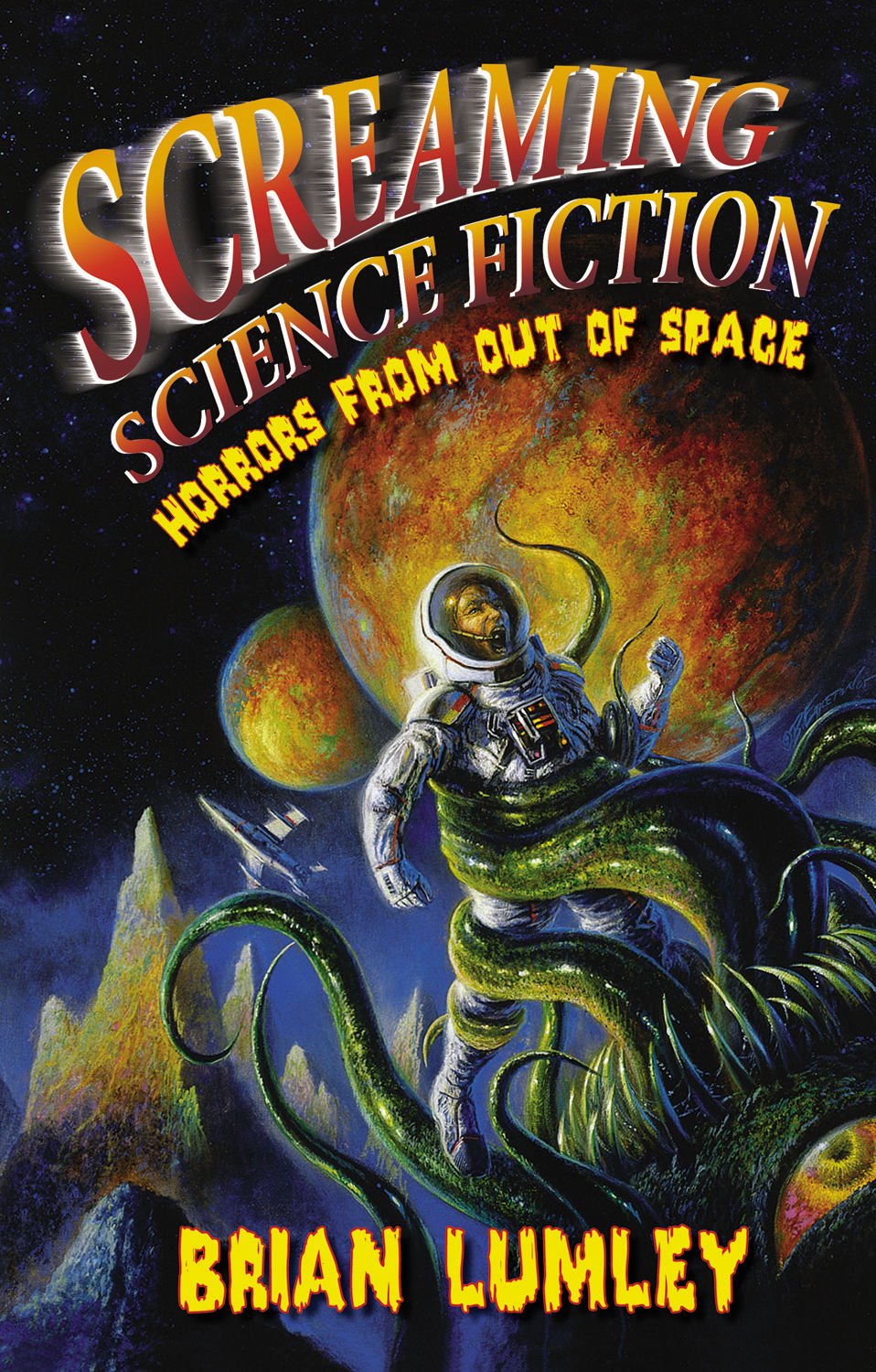
Funny sort of thing: Brian Lumley's Screaming Science Fiction

Screaming Science Fiction (2006)

by Brian Lumley


Snarker's Son (1980) 

No Way Home (1975)


These are two of Lumley's strongest stories. Don't let them get lost in the fireworks glare of his more popular tales. I'm a sucker for protagonists who slide inadvertently into other realities and only realize their predicament too late.


"Snarker's Son," the more modest of the two, will also recall King's "Crouch End." "No Way Home" is a wrong-turn masterpiece with a droll and wonderfully gruesome ending.


In his The Darkening Garden A Short Lexicon of Horror, Clute discusses tales in which horror protagonists (as opposed to fantasy protagonists) slip inadvertently:


....what is defined as Portal in Fantasy does not exist in Horror: so the term Cloaca is applied here to semblances of Portal when such are uncovered. If entering a Portal can be likened to swimming with the tide as upon a quest, then entering a Cloaca can be likened to swimming upstream like a gaffed fish: HOOKED . The Cloaca is a Parody of the Portal: an extremely bad joke (such being common in tales of Horror) about the true nature of the world. The term is visceral, it allows a strong inference of deep unpleasantness ahead....


Lumley's humour and aplomb are put to good use in these two stories.


***


The Man Who Felt Pain (1989)


A poignant existential SF horror story.


...."Ray," Durant looked straight into my eyes, "your brother is convinced he's going to die—of other people's pain. He says he's given it plenty of thought and knows there's no way of stopping it. And he says that since it's coming, he'd prefer it came here on Earth than out there. Going out into space would only delay it anyway, he says. So you're his last chance. Possibly he's already too far gone physically for the job, in which case you'll not only have to talk him into accepting it, but also get him back up on his feet one last time. You did it before, between you, so maybe you can do it again. That's the whole thing, and that's why I sent for you…."


***


The Strange Years (1982)


An apocalyptic look at (probably) the end of humanity. Lumley is fully engaged and on a small compass, where he can work to his strengths. And make your flesh creep!


     "Ma Nature strikes back. Get rid of the human vermin. They're lousing up your planet! And maybe that's what gave Her the idea. If fire and flood and disease and disaster and war couldn't do the trick, well, what else could She do? They advise you to fight fire with fire, so why not vermin with vermin?"


***


The Man Who Saw No Spiders (1978)


Mirthful, modest and ingenious tale about alien conquest of earth. It's a brief, well-told stinger and Lumley pulls it off beautifully.


***


Deja Viewer (2005)

Feasibility Study (2006)


There's compelling Lumley.  Then there's mythos Lumley. And lastly there's jocular, jargony, trite and tiresome Lumley, as in these two stories. Being glib is just not good enough.


[When compared with a tale like Shea's "Polyphemus," Lumley's failings with "Deja Viewer," "Feasibility Study" and "Gaddy's Gloves" are even more starkly outlined.]


***


Gaddy's Gloves (1991)


Prognosticating about lifestyles of future videogame pros, and of the games themselves, is an auto-humiliation device for writers who think they have the skills to write SF. 


Nothing dates quicker than today's hot take on tomorrow's hobbies. Lumley's mixing of this with small time conmen and alien worlds (it's all water!) leave "Gaddy's Gloves" stuck in fanfiction mode, along with nearly all his off-earth SF.


***


Big "C" (1990)


The story's voice is like a friend rattling off a mythos tale at machine gun tempo in their own rough and ready way. Craft ain't in it.


People used to call cancer "the big c." The Big C in Lumley's tale is an astronaut's sentient, growing cancer. It is surgically removed  and quickly takes command of a US space flight base.


Jay

18 June 2020