Subscribe to my Substack

Wednesday, October 12, 2022

My Steve Duffy Itinerary (Thus Far)

Steve Duffy (b. 1963) is a powerful and versatile master of the short story and novella forms. He excels in rich evocations of different historical periods. His novella "The Clay Party" is a matchless depiction of North American horror set during the nineteenth century westward expansion, in which settlers race to conquer before being conquered, all sides red in tooth and claw.


Below are my blog posts about several of Duffy's stories I have been fortunate enough to read:


The Night Comes On


Two stories: The Lion's Den & The Ice Beneath Us


No Passage Landward


The Clay Party


Certain Death for a Known Person


The Rag-and-Bone Men


The Marginals


X for Demetrious


The Vanishing Hitchhiker


Tragic Life Stories


Jay

12 October 2022


Saturday, October 8, 2022

An uncanny valley in the Rue Morgue?

Readers unfamiliar with "The Murders in the Rue Morgue" may prefer to read these notes only after reading the story


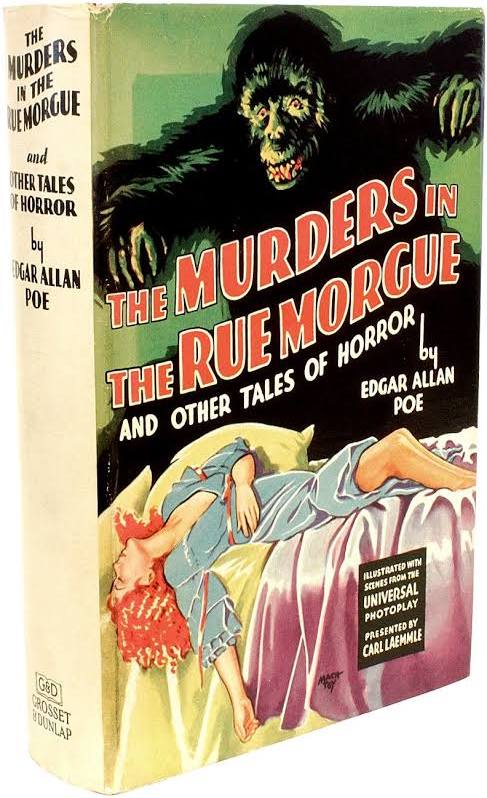
Illustrators of Poe's 1841 story "The Murders in the Rue Morgue" usually take as their subject the Ourang-Outang's rampage through the locked rooms shared by Madame L’Espanaye and her adult daughter. Readers of the story know the appalling carnage that results.


Beardsley gives the scene a stately, processional balance:


Harry Clarke's black and white illustration gives the Ourang-Outang a physicality, a density of muscular suggestion, far from Beardsley's hieratic schema:


Berni Wrightson, on entirely another level above Beardsley and Clark, gives us something akin to Jack Asher's saturated Eastmancolor pallet:


*   *   *


For me the truly uncanny moment comes before the Ourang-Outang's escape from his owner, the French merchant seaman later lured by Dupin into telling his side of the murders:


     What he stated was, in substance, this. He had lately made a voyage to the Indian Archipelago. A party, of which he formed one, landed at Borneo, and passed into the interior on an excursion of pleasure. Himself and a companion had captured the Ourang-Outang. This companion dying, the animal fell into his own exclusive possession. After great trouble, occasioned by the intractable ferocity of his captive during the home voyage, he at length succeeded in lodging it safely at his own residence in Paris, where, not to attract toward himself the unpleasant curiosity of his neighbors, he kept it carefully secluded, until such time as it should recover from a wound in the foot, received from a splinter on board ship. His ultimate design was to sell it.

     Returning home from some sailors’ frolic the night, or rather in the morning of the murder, he found the beast occupying his own bed-room, into which it had broken from a closet adjoining, where it had been, as was thought, securely confined. Razor in hand, and fully lathered, it was sitting before a looking-glass, attempting the operation of shaving, in which it had no doubt previously watched its master through the key-hole of the closet. Terrified at the sight of so dangerous a weapon in the possession of an animal so ferocious, and so well able to use it, the man, for some moments, was at a loss what to do. He had been accustomed, however, to quiet the creature, even in its fiercest moods, by the use of a whip, and to this he now resorted. Upon sight of it, the Ourang-Outang sprang at once through the door of the chamber, down the stairs, and thence, through a window, unfortunately open, into the street.


It's owner has observed the Ourang-Outang in an unguarded moment of performance, aping an everyday human activity it previously observed: "Razor in hand, and fully lathered, it was sitting before a looking-glass, attempting the operation of shaving, in which it had no doubt previously watched its master through the key-hole of the closet."


The sailor tells Dupin and the narrator he tried to catch and restrain the Ourang-Outang at that moment because its handling of the razor was a danger.


Or was the danger, and the alarm felt by the sailor, in witnessing uncanny play of the beast at the vanity mirror, cheeks already lathered? Later that night at Madame L’Espanaye's residence, the Ourang-Outang will play dual human parrts: criminal marauder and visiting lover/suitor. 


Clearly, the beast has studied, internalized, and is ready to play the male adult human role. It's activity is certainly comprehensible: in Dupin's insight the murders are akin to an anarchic and irrational crime passionnel.


It's too bad we have no illustrations of the Ourang-Outang preparing for his shave, an inadvertent prelude to his night on the town.


Jay

8 October 2022


Tuesday, October 4, 2022

Fear? He wrote the book

Where No Fear Was: A Book About Fear by Arthur Christopher Benson (1914) can be read here.


*   *   *


As front matter for his 1914 study Where No Fear Was: A Book About Fear, A. C. Benson selected this minatory passage from part two of Pilgrim's Progress:


"Thus they went on till they came to about the middle of the Valley, and then Christiana said, 'Methinks I see something yonder on the road before us, a thing of such a shape such as I have not seen.' Then said Joseph, 'Mother, what is it?' 'An ugly thing, Child, an ugly thing,' said she. 'But, Mother, what is it like?' said he. ''Tis like I cannot tell what,' said she. And now it was but a little way off. Then said she, 'It is nigh.'"


This reminded me of another instance of something fearful coming on, in the 1924 short story "A Neighbor's Landmark" by M. R. James:


     At the top [of the manuscript page] was written a motto from Scott's Glenfinlas, which seemed to me well-chosen:


Where walks, they say, the shrieking ghost.


     Then there were notes of his talk with Mitchell's mother, from which I extract only this much: "I asked her if she never thought she saw anything to account for the sounds she heard. She told me, no more than once, on the darkest evening she ever came through the Wood: and then she seemed forced to look behind her as the rustling came in the bushes, and she thought she saw something all in tatters with the two arms held out in front of it coming on very fast, and at that she ran for the stile, and tore her gown all to finders getting over it."


(James was skilled at depicting threats physically approaching his protagonists from a distance, often over open country).


Benson gives another example in the "coming on" mode at the end of Chapter I:


[....] There is an episode in that strange and beautiful book Phantastes, by George Macdonald, which comes often to my mind. The boy is wandering in the enchanted forest, and he is told to avoid the house where the Daughter of the Ogre lives. His morose young guide shows him where the paths divide, and he takes the one indicated to him with a sense of misgiving. 

      A little while before he had been deceived by the Alder-maiden, and had given her his love in error. This has taken some of the old joy out of his heart, but he has made his escape from her, and thinks he has learned his lesson. 

      But he comes at last to the long low house in the clearing; he finds within it an ancient woman reading out of an old volume; he enters, he examines the room in which she sits, and yielding to curiosity, he opens the door of the great cupboard in the corner, in spite of a muttered warning. He thinks, on first opening it, that it is just a dark cupboard; but he sees with a shock of surprise that he is looking into a long dark passage, which leads out, far away from where he stands, into the starlit night. Then a figure, which seems to have been running from a long distance, turns the corner, and comes speeding down towards him. He has not time to close the door, but stands aside to let it pass; it passes, and slips behind him; and soon he sees that it is a shadow of himself, which has fallen on the floor at his feet. He asks what has happened, and then the old woman says that he has found his shadow, a thing which happens to many people; and then for the first time she raises her head and looks at him, and he sees that her mouth is full of long white teeth; he knows where he is at last, and stumbles out, with the dark shadow at his heels, which is to haunt him so miserably for many a sad day....


Benson uses these literary examples to underscore his statement in Chapter I: "How impossible it is ever to learn anything by being told it!"


*   *   *


For many of us the strongest fear is fear of the known, not the unknown. Where No Fear Was is not about the pleasing terror of old houses or lonely tarns or open country, but debilitating and demoralizing social anxieties. 


In armoring ourselves against these fears, Benson endorses a sense of proportion and probity as central when facing all turns in life, whether the turns at first seem positive or negative. He also praises the hard-won skill of looking at fearful situations (fearful to many of us, often innocuous to others) as opportunities to find out how much we might still accomplish.


*   *   *


He has some funny stories about life's little lessons in humility, and how he has learned to appreciate them.


[....] I had to pay a visit of business to a remote house in the country. A good-natured friend descanted upon the excitement it would be to the household to entertain a living author, and how eagerly my utterances would be listened to. I was received not only without respect but with obvious boredom. In the course of the afternoon I discovered that I was supposed to be a solicitor's clerk, but when a little later it transpired what my real occupations were, I was not displeased to find that no member of the party had ever heard of my existence, or was aware that I had ever published a book, and when I was questioned as to what I had written, no one had ever come across anything that I had printed, until at last I soared into some transient distinction by the discovery that my brother was the author of Dodo.

     I cannot help feeling that there is something gently humorous about this good-humoured indication that the whole civilised world is not engaged in the pursuit of literature, and that one's claims to consideration depend upon one's social merits. I do honestly think that Providence was here deliberately poking fun at me, and showing me that a habit of presenting one's opinions broadcast to the world does not necessarily mean that the world is much aware either of oneself or of one's opinions....


*   *   *


As someone who has carried his share of  maiming fears and anxieties through life, I appreciate Benson's boldness and honesty in Where No Fear Was. Yet I cannot help but think: To achieve such a confident tone, ACB must have written this when he was having a very bright day. I have some days like that, too, when fears appear in manageable and realistic proportions. But sufferers know those days are fleeting.


*   *   *


Below are a few excerpts I found worth underlining. 


I.    THE SHADOW 


[....] interrogate the memory as to what have been the most real, vivid, and intense things that have befallen us by the way. We may try to separate the momentous from the trivial, and the important from the unimportant; to discern where and how and when we might have acted differently; to see and to say what has really mattered, what has made a deep mark on our spirit; what has hampered or wounded or maimed us. Because one of the strangest things about life seems to be our incapacity to decide beforehand, or even at the time, where the real and fruitful joys, and where the dark dangers and distresses lie. The things that at certain times filled all one's mind, kindled hope and aim, seemed so infinitely desirable, so necessary to happiness, have faded, many of them, into the lightest and most worthless of husks and phantoms, like the withered flowers that we find sometimes shut in the pages of our old books, and cannot even remember of what glowing and emotional moment they were the record!


[....] long afterwards perhaps, when he has made a mistake and is suffering for it, he sees that it was THAT of which they spoke, and wonders that they could not have explained it better.


[....] We cannot recognise the dark tower, to which in the story Childe Roland came, by any description. We must go there ourselves; and not till we feel the teeth of the trap biting into us, do we see that it was exactly in such a place that we had been warned that it would be laid.


XII.    TENNYSON, RUSKIN, CARLYLE 


[....] The widespread delusion of the English educated classes, that they are interested in art, was of Ruskin's making.


XV.    INSTINCTIVE FEAR 


[....] Our instinctive fears, such as our fear of darkness and solitude, and our suspicion of strangers, seem to date from a time when such conditions were really dangerous, though they are so no longer.


[....] The whole of civilisation is a combat between these two forces, a struggle between the rational and the instinctive parts of the mind.


[....] What then is our practical way of escape from the dominion of these shadows? Not, I am sure, in any resolute attempt to combat them by rational weapons; the rational argument, the common-sense consolation, only touches the rational part of the mind; we have got to get behind and below that, we have got somehow to fight instinct by instinct, and quell the terror in its proper home.


[....] our only chance is to turn tail altogether, and try to set some other dominant instinct at work; while we remember, we shall continue to suffer; our best chance lies in forgetting, and we can only do that by calling some other dominant emotion into play.


[....] the peculiarly paralysing effect of these baser emotions [:] As Victor Hugo once said, in a fine apophthegm, "Despair yawns." Fear and anxiety bring with them a particular kind of physical fatigue which makes us listless and inert.


[....] When I was myself a sufferer from long nervous depression, and had to face a social gathering, I used out of very shame, and partly I think out of a sense of courtesy due to others, to galvanise myself into a sort of horrid merriment. The dark tide flowed on beneath in its sore and aching channels. It was common enough then for some sympathetic friend to say, "You seemed better to-night—you were quite yourself; that is what you want; if you would only make the effort and go out more into society, you would soon forget your troubles.


[....] I am sure that in my long affliction I never suffered more than after occasions when I was betrayed by excitement into argument or lively talk, and the worst spasms of melancholy that I ever endured were the direct and immediate results of such efforts.


[....] to put the mind in easier postures, to avoid excess and strain, to live more in company, to do something different. Human beings are happiest in monotony and settled ways of life; but these also develop their own poisons, like sameness of diet, however wholesome it may be.


XVII.    SIMPLICITY 


[....] The real simplicity is a sense of being at home and at ease in any company and mode of living, and a quiet equanimity of spirit which cannot be content to waste time over the arrangements of life. Sufficient food and exercise and sleep may be postulated; but these are all to be in the background, and the real occupations of life are to be work and interests and talk and ideas and natural relations with others.


XVIII.    AFFECTION 


[....] It is strange that it should be so, but there is some psychological law at the back of it; and it is certainly true in my experience that the men who have been most eagerly sought in friendship have not as a rule been the most open-hearted and expansive natures.


XIX.    SIN 


[....] There is no joy in the world so great as the joy of finding ourselves stronger than we know....


[....] Hell is rather what we start from, and out of which we have to find our way, than the waste-paper basket of life, the last receptacle for our shattered purposes.


XX.    SERENITY


[....] the imaginative nature which lives tremulously in delight will be most apt to portend sadness in hours of happiness, and in sorrow to anticipate the continuance of sorrow. That is an inevitable effect of temperament; but we must not give way helplessly to temperament, or allow ourselves to drift wherever the mind bears us. Just as the skilled sailor can tack up against the wind, and use ingenuity to compel a contrary breeze to bring him to the haven of his desire, so we must be wise in trimming our sails to the force of circumstance; while there is an eager delight in making adverse conditions help us to realise our hopes.


[....] if we look fairly at life, at our own life, at other lives, we see that pleasure and contentment, even if we hardly realised that it was contentment at the time, have largely predominated over pain and unhappiness; a man must be very rueful and melancholy before he will deliberately say that life has not been worth living....


[....] the pleasures of activity and health, the sharp joys of love and friendship, these are surely very great and marvellous experiences....


[....] Men and women do not make pilgrimages to the graves and houses of eminent jurists and bankers, political economists or statisticians: these have done their work, and have had their reward. Even the monuments of statesmen and conquerors have little power to touch the imagination, unless some love for humanity, some desire to uplift and benefit the race, have entered into their schemes and policies. No, it is rather the soil which covers the bones of dreamers and visionaries that is sacred yet, prophets and poets, artists and musicians, those who have seen through life to beauty, and have lived and suffered that they might inspire and tranquillise human hearts.


[....] the hours we spend in fear, in sending the mind in weariness along the desolate track, are merely wasted, for we can alter nothing so. We use life best when we live it eagerly, exulting in its fulness and its significance, casting ourselves into strong relations with others, drinking in beauty, making high music in our hearts. There is an abundance of awe in the experiences through which we pass, awe at the greatness of the vision, at the vastness of the design, as it embraces and enfolds our weakness. But we are inside it all, an integral and indestructible part of it; and the shadow of fear falls when we doubt this, when we dread being overlooked or disregarded....


*   *   *


Three years ago I wrote this post about ACB's strange and supernatural stories. What, this week, could be more exciting than finding the same author wrote a study about fear?


Where No Fear Was: A Book About Fear did not turn out to be the royal road to understanding what motivates a man like Benson to write horror. But it is an impressive example of the depths of human sympathy that a writer achieved and was gracious enough to share with his readers. 


More than just the "brother of the author of Dodo," ACB was a consequential educator, scholar, and artist.


Jay

4 October 2022


Monday, October 3, 2022

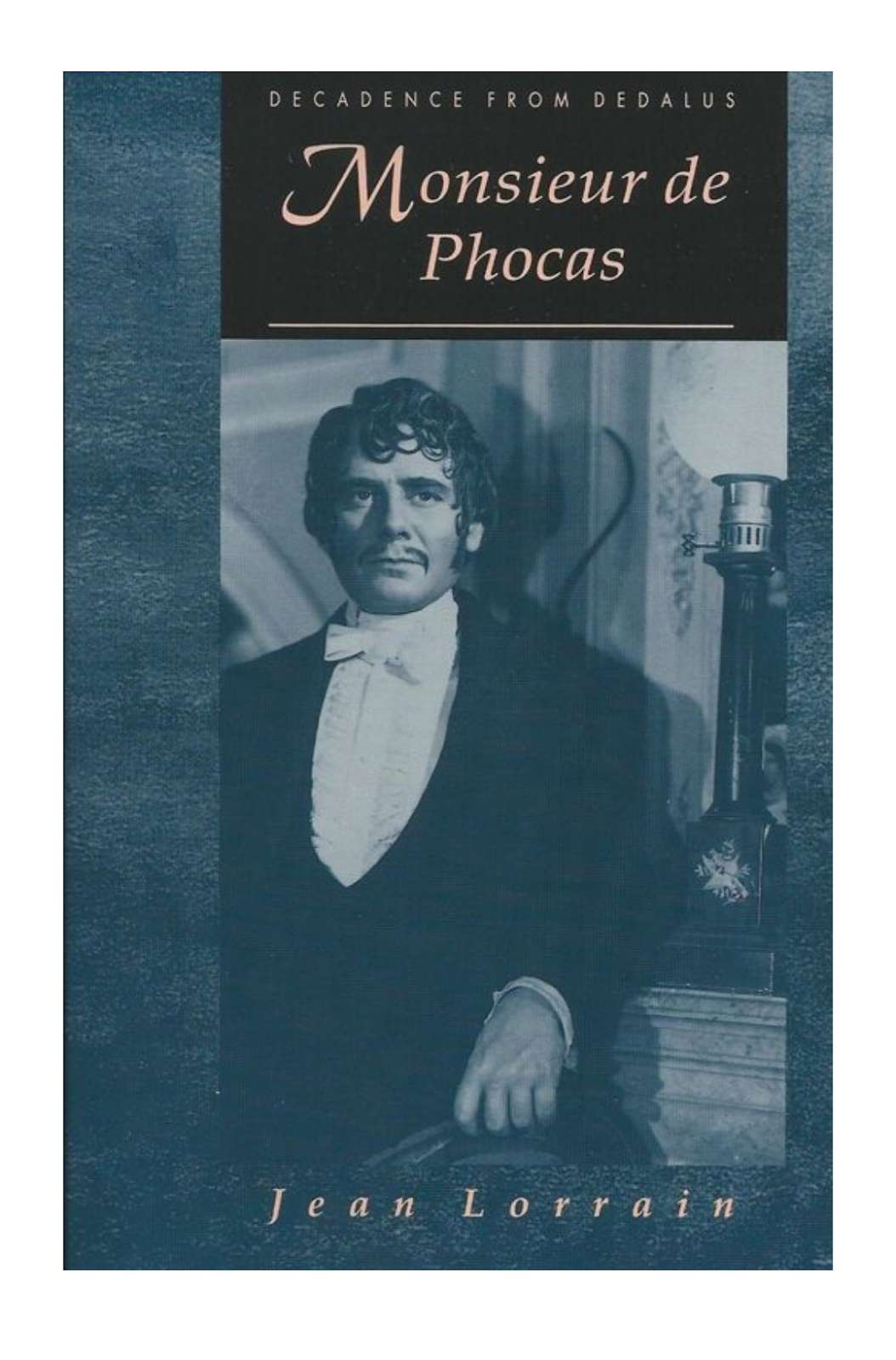
Monsieur de Phocas (1901) by Jean Lorrain

         The palpitations of life have always filled me with a strange destructive rage. Now there have been two occasions when I was surprised by the idea of murder in association with love. 

     Might there be a second self lurking within me?


*   *   *


Readers unfamiliar with Monsieur de Phocas may prefer to read these notes only after reading the story.


Monsieur de Phocas (1901) by Jean Lorrain


*   *   *


From the Introduction: The life and Career of Jean Lorrain by Francis Amery:


     [....] It cannot have come as a surprise to Amable Duval when his son finally announced that he was giving up the law in favour of a literary career; he agreed readily enough to provide a modest allowance, on condition that Paul used a pseudonym. Paul and his mother leafed through a directory in search of something suitable, and were delighted with their choice. In 1880 Jean Lorrain set himself up in Montmartre, eager to launch himself into the Bohemian life.

    This was the Montmartre of Toulouse-Lautrec, a world of cheap furnished rooms in which impoverished members of the literary avant-garde rubbed shoulders with cheap prostitutes and formed enthusiastic cliques in cafes. The café in which Jean Lorrain elected to spend most of his days was the Chat Noir. Paul Verlaine was known to drop in occasionally – and was later to launch the fad for 'Decadence' with a poem in Le Chat Noir, the periodical founded by the regulars – but the hard core of the group were then in the habit of describing themselves as 'Hydropathes' and 'Zutistes'. They included Jean Moréas and Jean Richepin. The Hydropathes were literary Satanists, great admirers of the historian Jean Michelet, whose curiously rhapsodic book La Sorcière (1862; tr. as Satanism and Witchcraft) had hailed the witches burned in days of yore as heroic and virtuous antagonists of a tyrannical church. They were enthusiastic apologists for the Devil, and conscientiously re-worked the mythology of witches' sabbats and black masses. Many of the poems Lorrain wrote under this influence are reprinted in Sang des dieux (1882) and La Forêt bleue.

    Sang des dieux, Lorrain's first book, had a frontispiece by Gustave Moreau. Lorrain met Moreau in 1880, and immediately became a devout admirer of his work. The two did not become friends – Moreau became a virtual recluse in his later years – but Lorrain visited the artist's studio in the Rue La Rochefoucauld, which was left to the state as a museum when Moreau died in 1898. Moreau's work revealed to Lorrain a whole world-view: a gorgeous symbolically-transfigured vision of a world dominated by lust and luxury (concepts which seem to be more closely related in French than in English, in the words luxure and luxe), where eroticism is inextricably linked with cruelty and death, placed in fabulously gaudy settings: a 'Sublime Sodom', as Lorrain's biographer Philippe Jullian put it. The hallucinatory world of Moreau's art is dominated by femmes fatales — Salomé, Helen of Troy, the Sirens – who are all, in some sense, incarnations of the same eternal person. In Flaubert's La Tentation de Saint Antoine (1874; tr. as The Temptations of St Anthony) — another favourite of the Hydropathes – the archetype of which all these other females are avatars is called Ennoïa; she features in person, of course, in Moreau's own versions of the saint's torments. In many different guises – including Astarté, the name of one of the many pagan deities demonised by the monotheistic followers of Jehovah – Ennoïa was to play a central role in Jean Lorrain's personal mythos, although 'she' had an understandable tendency to become androgynous or frankly masculine….


*   *   *


Monsieur de Phocas is a brief, disintegrating thriller that comes around aesthetically to bite its own tail. The narrator's diary recounts his daily struggle to escape the poisons sickening his soul, class, and city. Paris here is not a century's capital but a disease vector.


Monsieur de Phocas begins with de Phocas (formerly the self-indulgent, dead-end Duc de Fréneuse) imposing himself on the first-person narrator of the book's opening chapters.


     'You see that I know my authors. Now, no one has suffered more than myself from the morbid attraction of these jewels; and, sick unto death – seeing that I am being carried away by their translucent glaucous poison – it is you in whom I now wish to confide, monsieur: you, who have understood their sumptuous and dangerous magic well enough to communicate to others its thrill and its malaise.

     'You alone can understand me. You alone can indulgently recognise the affinity which attracted me to you. The Duc de Fréneuse was merely an eccentric, monsieur; for all others save yourself, Monsieur de Phocas would be a madman. I mentioned just now the name of the city of Ys and the Demon which caused that city to be engulfed: the Demon of Lust, which seduced the daughter of the king. Such curses have the power to extend across the centuries. I tell you that this Demon is within me. A veritable Demon tortures and haunts me, and has done ever since my adolescence. Who knows – perhaps it was already in me when I was merely a child? Even though I may seem to you to be deluded, monsieur, I have suffered for many years the effects of a certain blue and green something.

     'Whether it is the gleam of a gem or a gaze that I lust after – worse, that I am bewitched by – I am possessed by a certain glaucous transparence. It is like a hunger in me. I search for this gleam – in vain! – in the irises of eyes and the transparency of gemstones, but no human eye possesses it. Occasionally, I have detected it in the empty orbit of a statue's eye or beneath the painted eyelids of a portrait, but it has only been a decoy: the brightness is always extinguished, having scarcely been glimpsed.


Naturally, A Manuscript


De Phocas, preparing to flee to the Orient and its fabled powers of regeneration, leaves his diary manuscript with the narrator. When it begins, we are plunged into the masque of de Fréneuse as he becomes De Phocas. A gossip says about him:


     That pallor of decay; the twitching of his bony hands, more Japanese than chrysanthemums; the arabesque profile; that vampiric emaciation – has all of that never given you cause to reflect? In spite of his supple body and his callow face Fréneuse is a hundred thousand years old. That man has lived before, in ancient times, under the reigns of Heliogabalus, Alexander IV and the last of the Valois. What am I saying? That man is Henri III himself....


De Phocas's diary of the 1890s begins as it will end,  filled with horror at what the Duc de Fréneuse sees in all aspects of everyday life:


8 April 1891

     The obscenity of nostrils and mouths; the ignominious cupidity of smiles and women encountered in the street; the shifty baseness on every side, as of hyenas and wild beasts ready to bite: tradesmen in their shops and strollers on their pavements. How long must I suffer this? I have suffered it before, as a child, when, descending by chance to the servant's quarters, I overheard in astonishment their vile gossip, tearing up my own kind with their lovely teeth.

     This hostility to the entire race, this muted detestation of lynxes in human form, I must have rediscovered it later while at school. I had a repugnance and horror for all base instincts, but am I not myself instinctively violent and lewd, murderous and sensual? Am I any different, in essence, from the members of the riotous and murderous mob of a hundred years ago, who hurled the town sergeants into the Seine and cried, 'String up the aristos!' just as they shout 'Down with the army!' or 'Death to the Jews!' today?


*   *   *


     April 98.

     Masks! I see them everywhere. That dreadful vision of the other night – the deserted town with its masked corpses in every doorway; that nightmare product of morphine and ether – has taken up residence within me. I see masks in the street, I see them on stage in the theatre, I find yet more of them in the boxes. They are on the balcony and in the orchestra-pit. Everywhere I go I am surrounded by masks. The attendants to whom I give my overcoat are masked; masks crowd around me in the foyer as everyone leaves, and the coachman who drives me home has the same cardboard grimace fixed upon his face!

     It is truly too much to bear: to feel that one is alone and at the mercy of all those enigmatic and deceptive faces, alone amid all the mocking laughs and the threats embodied in those masks. I have tried to persuade myself that I am dreaming, and that I am the victim of a hallucination, but all the powdered and painted faces of women, all the rouged lips and kohl-blackened eyelids … all of that has created around me an atmosphere of trance and mortal agony. Cosmetics: there is the root cause of my illness!

     But I am happy, now, when there are only masks! Sometimes, I detect the cadavers beneath, and remember that beneath the masks there is a host of spectres.

     The other evening, in that café-cabaret in the Rue de la Fontaine, where I had run aground with Tramsel and Jocard, who had taken me there to see that supposedly-fashionable singer … how could they fail to see that she was nothing but a corpse?

     Yes, beneath the sumptuous and heavy ballgown, which swaddled her and held her upright like a sentry-box of pink velvet trimmed and embroidered with gold – a coffin befitting the queen of Spain – there was a corpse! But the others, amused by her wan voice and her emaciated frame, found her quaint – more than that, quite 'droll'…

     Droll! that drab, soft and inconsistent epithet that everyone uses nowadays! The woman had, to be sure, a tiny carven head, and a kind of macabre prettiness within the furry heap of her opera-cloak. They studied her minutely, interested by the romance of her story: a petite bourgeoise thrown into the high life following the fad which had caught her up – and neither of them, nor anyone else besides in the whole of that room, had perceived what was immediately evident to my eyes. Placed flat on the white satin of her dress, the two hands of that singer were the two hands of a skeleton: two sets of knuckle-bones gloved in white suede. They might have been drawn by Albrecht Dürer: the ten fingers of an evil dead woman, fitted at the ends of the two overlong and excessively thin arms of a mannequin …


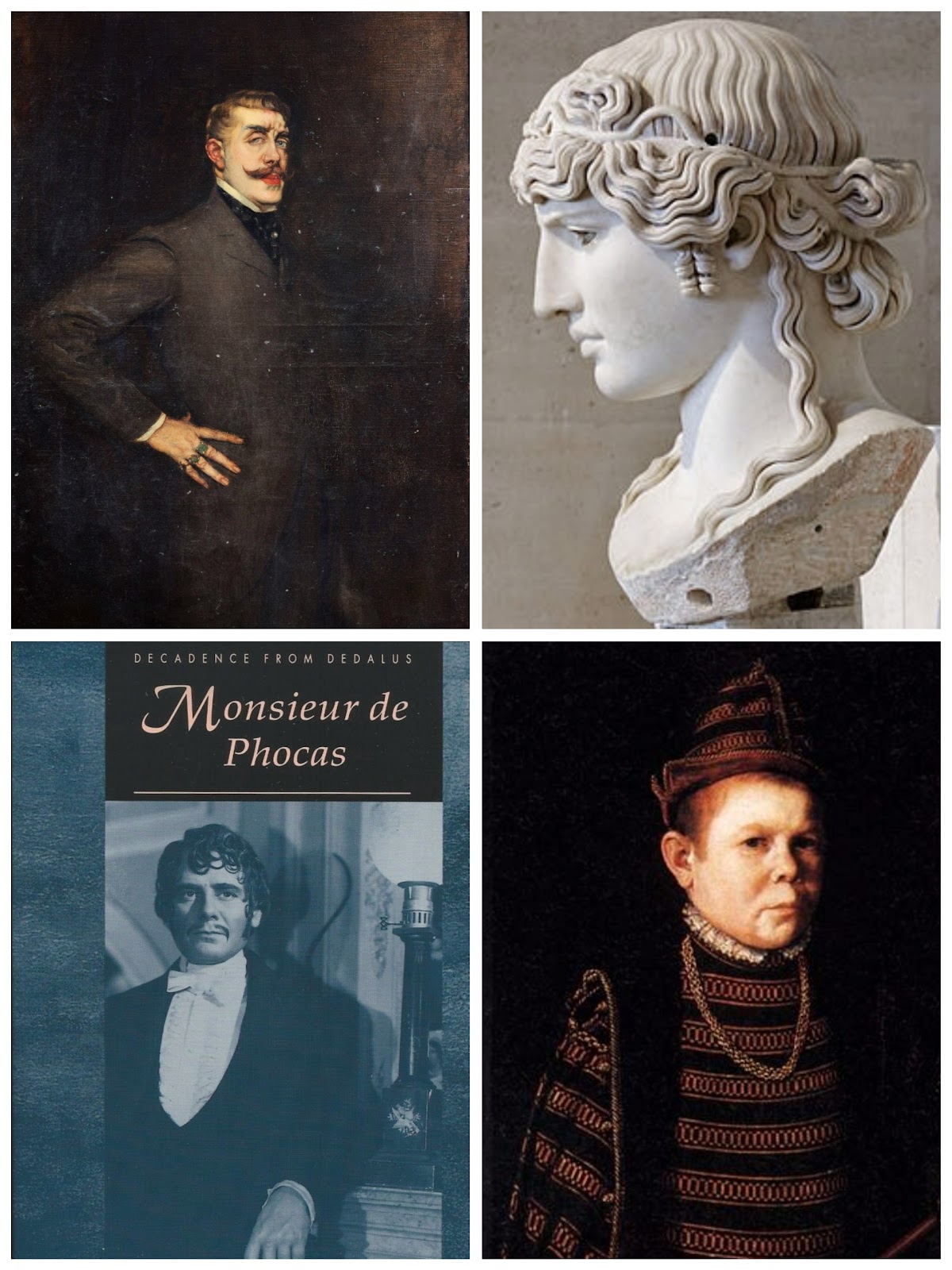
Before too many chapters the Duc de Fréneuse/Monsieur de Phocas  has left behind the classical beauty of a marble Antinous in the Louvre and come into the orbit of a living avatar of "Antonio Moro's portrait of the Duc D'Albe's famous dwarf": the disgraced and banished English painter Claudius Ethal.


Ethal is infamous for a studio where guests and sitters are unknowingly exposed to hallucinogenic drugs that destroy their morals before taking their lives. He is notorious for depicting in oils the Baroness Desrodes as a frog. 


'What did she expect?' Ethal said. 'It is her own physique which is the root of the problem. She defies portraiture and demands caricature.'


Claudius Ethal presents himself to Duc de Fréneuse/Monsieur de Phocas as a saviour and liberator, ready to combat the Duc's maladies. In practice, he is more akin to Old Scratch or Tyler Durden. The remainder of Monsieur de Phocas inflicts one nightmare ordeal after another on the diarist: it is a remorseless version of Saki's "unrest cure."


*   *   *


I share oddly weird fiction blogger NancyO's thoughts on the book:


There is just so very much to say about this dark, dark novel that like Ethal's bizarre hold on Phocas, will certainly cast a spell on its reader.  It is one of those books that refuses to let go, one that gets down deep into the psyche, making me wonder at several points where this story was taking me and sort of being afraid to move on because it was getting very deep into Phocas' head, which trust me, is a very scary place to be.   Once again I fail to do this book justice -- it is another one that absolutely must be experienced on one's own. And I loved it. Very much recommended, but certainly not for everyone -- it is not an easy read on many levels.


Not easy, but fascinating, funny, and over too soon.


Jay

30 September 2022