Subscribe to my Substack

Showing posts with label Steve Duffy. Show all posts

Wednesday, October 12, 2022

My Steve Duffy Itinerary (Thus Far)

Steve Duffy (b. 1963) is a powerful and versatile master of the short story and novella forms. He excels in rich evocations of different historical periods. His novella "The Clay Party" is a matchless depiction of North American horror set during the nineteenth century westward expansion, in which settlers race to conquer before being conquered, all sides red in tooth and claw.


Below are my blog posts about several of Duffy's stories I have been fortunate enough to read:


The Night Comes On


Two stories: The Lion's Den & The Ice Beneath Us


No Passage Landward


The Clay Party


Certain Death for a Known Person


The Rag-and-Bone Men


The Marginals


X for Demetrious


The Vanishing Hitchhiker


Tragic Life Stories


Jay

12 October 2022


Sunday, March 20, 2022

My review of Supernatural Tales 49

I have purchased more issues of Supernatural Tales than I have read. Each issue has at least one story by an author I enjoy, and the ebook price is always right. Issue 49 is the first issue of ST I have read cover to cover. 


*   *   *


"The Woofle Dust" by Steve Duffy is a wonderful evocation of UK end-of-the-pier entertainment in late August 1939. Regular readers will not be surprised at Duffy's skill here. In stories as varied in setting and historical period as "The Vanishing Hitchhiker," "The Oram County Whoosit," and "The Clay Party," Duffy has displayed superb skill in the short story and novella modes.


"The Woofle Dust" is a trap for the unwary, both the reader and the story's protagonist. It has a sunset mood: the shadow of impending imperialist war skews each human act and interaction.


*   *   *


Hardy's sublime story "The Withered Arm" came to mind repeatedly as I read "Godless" by Sam Dawson. It has a historically indeterminate rural village setting, and Dawson does a skilful job conveying a pre-industrial era.


By any means necessary, protagonist Ruth Darnell works to ensure her son, hung for murder, ends up buried in consecrated ground. Dawson is at his best in the story when delineating this struggle: a woman against men and against a man's world.


*   *   *


"All Talk" by Rosalie Parker is a carefully observed timeslip story. The narrator tells us about her employee Gregory, a successful young family man who, for a  while, lives two lives in two different years. Ultimately, one life must win over the other, and one does.


Est enim magnum chaos.


*   *   *


"Another One To Love Them" by David Buchan


She wondered where they had learnt the game that they were playing. It certainly couldn't have come from their aunt. The woman had seemed too self-absorbed to teach something like that to the children, something that was....


Gwendolyn shepherds three siblings around a stately home, once the site of a terrible crime. The children, working class and normally unruly, surprise her by seeming to rise to the occasion.


In the end they are happy to sit on the lawn, playing together with something that "had the texture and colour of aged leather, and what might have been strands of hair that sprouted from one edge."


*   *   *


"Candler's Ceremony" by Sam Hicks describes urban disorientation in the early Covid period: empty streets, few and different faces. 


"I wanted, hoping all this would only happen once, to go somewhere where I could really see the change," our narrator says. So he heads to London's City, and wandering the emptiness meets Candler. Is Candler simply another person unmoored by the pandemic's dissolution of routine? Or an altogether different order of guide?


This is the first Sam Hicks story I have read; its brevity lends an almost molecular weight to each sentence. The sense of "last things and last people" is palpable.


*   *   *


"Not That Kind of Place" by James Everington starts out as a search for two runaway daughters. It ends atomization into contingency and uncertainty, conveyed with the confusions and unreason of dream. 


Stories that refuse to make conventional sense, or tell their stories in a conventional way, have always challenged me. (And by challenged, I mean annoyed). When a writer gets it right in this game, the case for their method is irrefutable. Everington's story falls short, but the world he builds is initially compelling.


*   *   *


James Machin's use in "Cave Canem'' of skewed perspectives and intentional lacunae recall de la Mare and Aickman here, but also the queerly suggestive landscapes of Buchan and Ramsey Campbell. Repressed motivations and apparently arbitrary clueing are in play, but action is sharply grounded for all the strange-making procedures afoot.

In a way, the story's skewed assignments and god-building are objective correlatives for the protagonist Mark's developmental prosopagnosia.


These rhetorical wire-modelings aside, "Cave Canem" is a compelling story about the risk of calling up that which cannot be put down again. 


*   *   *


"Four Vignettes" by Jane Jakeman is a bravura collection of short-short stories. They display real skill at deftly renewing different historical periods and horror clichรฉs.


*   *   *

Jay

19 March 2022


Saturday, November 30, 2019

X for Demetrious (2011) by Steve Duffy

"X for Demetrious" (2011) by Steve Duffy is the story of Eastern European immigrant Demetrious Myiciura, his life and death. It is also a riff on ways in which fear of vampires robs victims of life and sanity as surely as vampiric activity itself.

Duffy spares no punches in portraying Myiciura's mental and physical disintegration:

....The bottles and jars he arranges around the room, the cloudy piss mixed with salt for the virtue in it. The last time his bowels moved, he took the shriveled sordes and crushed them up with garlic, for the windowsill. See, here: this is Myiciura, and he is protected, yes, he knows wherein lies true magic and real influence. Baseness raised to power and made sound. Oupire, tread not in this house.

....He held the candle high above the cot, saying, "Papa, it's morning, how are you." His father's eyes—black as raisins in the kneaded dough of his face—followed the light. "Papa," Demetrious said, "papa," and then he saw it, the fear deep down in those staring eyes. Incomprehensible, never before seen or dreamed of, yet now overmastering. How long had his father been lying there in the dark while the rest of the family slept, struggling with a terror that could not be held in check?

In this instant Demetrious learned a great lesson: that there is dread at the heart of all things, that fear comes to all men at the end and reclaims them for its own. Birthed in blood and chaos, we struggle a little while till inexorably we are undone, and horror waits panting at both ends of existence. He opened his mouth, wanting to ask his father what he saw in the wavering candle flame, but the words would not come. Instead he watched, fascinated and aghast at the same time, while the old man took one ragged sucking breath, and then another. He waited a long time for the next breath to come, and somewhere in that everlasting interval, he realized that his father was dead.

....In the course of the war, nearly all the Jewish vampires disappeared, rounded up at dawn, when their powers were waning, and taken away by the soldiers. Myiciura watched in bleak satisfaction from his window as the trucks drove away in the thick mist of morning, leaving behind empty houses, suitcases scattered on the cobblestones, a vivid splash of lifeblood up against a wall. Taken to where? "Up the chimney," everyone said, then changed the subject, as if they feared being overheard. Again, this made sense to Myiciura: fire, you see, father of true iron, the sacred principle behind it all. The rushing force of God's breath drawn through the furnace, to rid the world of all contagion. For a while, Myiciura slept more easily….

But history seems in the end to be on the side of the vampires, and Myiciura dies in a rented room, in a nest of his own fear and filth.


Available in:


Jay
30 November 2019


The Marginals (2013) by Steve Duffy

"The Marginals" (2013) by Steve Duffy

"You off, then? Aren't you going to give me-laddo the talk or anything?"

"Talk?" Barry was halfway out of the back door before the car had come to a full halt. He had to stoop to Howard's wound-down window to reply. "What 'talk' is that, then? You mean tell him about the job, what he's signed up for? Tell him what goes on, like? Where's the point in that? You tell him now, he'd laugh in your face. Even when he's done it, he won't understand it. Look at me. I've done it the best part of six months and I still don't understand fuck all, I don't. I can tell him that if you'd like." He thrust his head into the passenger window, causing Howard to recoil slightly. "Get that, did you, mate? Fuck, all. There you go, consider yourself up to speed."

It's Howard's first day, and his orientation is sketchy at best.

Some of the material in the handbook binder sheds light, but seems to raise more questions than it answers.

LEARN TO RECOGNIZE THEM

You WILL have come across them, even if you didn't realize it at the time.

In the motorway services, for example, at off-peak hours of the daytime, or through the lonely stretches of the night. In the cafeterias, the Happy Chefs and Costa Coffees. They're drawn inescapably to places like these: the margins, the places in between. They can pass for businessmen, commercial travelers, middle management, representatives. Cups of tea grow cold on the table in front of them as they sit, hands folded, apart from everyone. Other customers come and go while they remain—if you stayed long enough, you would notice it, you'd have to.

You will never see them arriving, nor will you see them leave. Their eyes will never meet your own.

....Once you learn to recognize them, try this exercise: look very closely at the people around you in the Underground carriage or the bus. The law of averages is adamant on this point.

....In their ones and twos they came and went, though never while Howard was looking, it seemed. He'd developed a kind of anxiety compulsion about checking both windows, front and rear: there was something going on, he felt sure, along the course of the stream, but the banks were just too high for him to be able to make it out. Perhaps it was nothing more than a black post, uncovered by the tide. A black post, that's all. But every time he turned away, satisfied or otherwise, from the tidewater creek, it seemed that through the other window there were one or two more of the men, or one or two fewer, over by the trailer.

Where they came from, why they gathered there, what they were doing . . . Howard could work none of it out. The notion they were coming out of (or going back into) the trailer had occurred to him as the most likely explanation for the first part of it, and he spent several hours trying to catch them in the act. By lunchtime he was only half convinced this might really be the explanation. But even if so, what did it actually explain?

....These are different. Nobody grieves for them. The majority are not even missed.

....What these unfortunates have in common, it seems safest to say, is the experience of lessening. The drip-drip-drip of psychic diminution. The attenuation of the psyche. Call it what you will. They are drained, one and all, at the most profound and fundamental level. Months, maybe years of unremitting reduction . . . till the day, long after they'd become oblivious to the whole process, on which they reached the tipping-point and passed over, unnoticed, unmourned. A day on which they did not go home.

....inhospitable thresholds they're forever on the verge of crossing....

....Some, the newly translated perhaps, are drawn to certain houses in the night. While the occupants are asleep they move in close, position themselves outside the unlit curtained windows and press their faces to the panes, as if—though it's pointless to ascribe to them any motives we would recognize—some memory of refuge, of belonging might move in them still. Why these houses? Why these feelings? Who can say? We could assume the houses evoke in them something like nostalgia; probably we'd be wrong. All we really know is that there they are, leaning in against the glass, resigned, unwearied, still and noiseless in their vigils.

Duffy is here merely sketching the strange interstitial and liminal zones of social abstraction that have come to be called Aickmanesque. It is populated by strangers, outsiders we only see by chance from the corner of the eye. 


Available in:

Jay
30 November 2019


Horror and the Holocaust: The Rag-and-Bone Men (1999) by Steve Duffy

"The Rag-and-Bone Men" (1999) by Steve Duffy skates the thin ice of good taste.

Genre writers from Rod Serling to Stephen King have written about comeuppance visited upon perpetrators of Judeocide; somehow the topic still seems taboo, especially for a genre whose strengths are aesthetic, not political perspicacity or bourgeois liberal rectitude.

Protagonist Jonathan Glatzy, displaced person from Lithuania, UK school caretaker, is a Nazi-era war criminal; alone at the school campus over holiday break, he finds his past deeds closing in.

....Last night came an intruder. Around one in the morning I heard a sound from downstairs, as someone might have left ajar a door, and the wind caught it. I was not asleep, but sitting up by the window in the dark, and I took my heavy torch—unlit, I do not need it to know my way—and checked the premises. There was a back door open in the kitchens, that I had thought was shut, and there was snow blown in by the doorway, but nothing further inside. I locked the door and bolted it, and walked the empty corridors, but there was no one. Perhaps it would be best to tell the police, but this I do not wish to do—not while there are such people nearby, in the woods.

This is the first time such things have bothered me, here. Before, when I lived in East Ham, there was a synagogue and burial ground nearby, and I was obliged to be cautious. I grew a beard, and that helped, but after coming here I shaved it off. Twenty years have passed; still one never knows. I feared as much when first began my wandering. Against memory one must always remain vigilant.

The rest of the day I spent in my room up in the attic, going out only to make my customary tour of the grounds. There were footsteps in the snow on the yard; during the night someone walked all around the outside of the school, pausing at the windows where the tracks are close and crowded. In my job it is not allowed to keep a dog; and yet a dog would give me protection. I am reminded of the dogs we kept in the Schwarze Korps: wolfhounds, and the snow would gather on their coats, and their panting breath would fog in the winter air as they barked and leaped and plunged on their leashes. And cordite and blood and rough tobacco, and the burning of brandy in the throat on a cold day, and after the gunshots and the screaming the great stillness of the Northern forests . . . what good is it to remember?

....Beyond Christmas carols and brash pop songs I could find no music, but at the very end of the dial there seemed to be a play for voices. The reception was poor, and I could make out nothing distinctly, but after a while I was obliged to turn it off. I thought I heard the voice from that man in the snug, the Hรคftling, the rag-and-bone man: I thought he said, Padernice, though that was of course impossible.

Padernice, the impossible village. A rumor we created for good reason: it made them feel more comfortable, thinking they were being taken to a new town, a new ghetto, whose rules they could be sure of learning before long. A place in which they might hope to shelter from the storm; somewhere the furious withering wind might pass them by. Perhaps the guards would be kind, the rations more generous, perhaps there would be stoves in the barracks, and a synagogue. Is it so cruel, to give hope where none in truth exists? At any rate, it made our task, the task of the Einsatzgruppen, easier. Because I spoke their language, I would say to them, in Yiddish, Do not be afraid, nothing bad will happen to you. You are being taken to Padernice, sonderbehandlung, special treatment. Soon you will arrive at Padernice. And then the short ride out into the forest, and the pits.

Padernice was our invention. In all the Eastern lands, clear out to the chertรก osรฉdlosti, the Russian Pale of Settlement, such a place never existed. So how could the rag-and-bone man claim that he came from Padernice? He mumbled; his voice was indistinct; but I have replayed the scenario a thousand times in my mind, and I am more and more certain that was what he said, though nothing else about him is certain any more. I must analyse the situation, and think logically. Logically. From his tattoo, he was not of those we took into the forest with Einsatzgruppe B. The tattoo he could only have been given on arrival at the camps. Was it Birkenau, or Belzec, or Treblinka? Kulmhof was the closest; perhaps from Kulmhof; but there they did not tattoo . . . I was at Kulmhof only a few months, so perhaps I am safe. But it is useless to conjecture. I await the night with mounting apprehension; sleep is impossible.

Cheล‚mno, known as Kulmhof, and the castle on the banks of the Narew; Treblinka in the forest, hard by Malkinia Junction on the Bug. Upstream, Sobibor; Belzec also. South, Oล›wiฤ™cim of the tall birch trees in the farmlands of the Vistula. Hundreds more; but remember these, by the rivers of Poland, strung along the black spiderweb of the railway tracks. Remember these citadels of horror and despair, these ghost towns; remember these capitals of night and fog.

....At the rear of the building, the side that faces the woods, there is a small gymnasium and a changing-room. Here if anywhere the sounds seemed to be congregated, but when I entered there was nothing, and again I was forced to ask myself what manner of thing it is that pursues me, and then eludes me at the last. Will it come to me, or must I seek it out? The faintest glimmer of light came through the small high windows, moonlight on snowfall; in the depth of the shadows I saw a coat hanging from a peg, and for a second I thought it—why cannot I say it, even to myself?

....They stood in amongst the trees, the dull stripes of their uniforms indistinguishable from the patterns of branches against the snow, from the iron railings that afford me no defense. What did the publican call them: rag-and-bone men? Rags and bones, but he could not have seen their eyes, that watched me from out of the shadows, from out of the past. Twenty years ago, and it seemed like yesterday, as if I never escaped, never left the forests of the East with my stolen identity, my dead man's papers. Since two, three days, I have not eaten, and I was dizzy—I almost slipped, the mouth of a pit, an abyss, a freezing wind . . .

....what I fear is not exposure, or a show trial in Jerusalem at the hands of the Zionist hangmen. What I now fear, I can hardly name. That which comes out of the forest does not always have a name. My grandmother knew the names of many things, but there were those of whom even she would not speak. She put salt on the window-sills as protection, and I too have done this. If I had garlic, this too would be a protection; I try to imagine the taste of garlic in my mouth, but I can taste only blood.

Steve Duffy's modest narrative compass in "The Rag-and-Bone Men" rescues it from callousness and bad taste. He is writing about a monster's aftermath, not the emotional afterlife of his victims. 


Available in:

Jay
30 November 2019


Strange menace: Certain Death for a Known Person (2009) by Steve Duffy

"Certain Death for a Known Person" 
(2009) by Steve Duffy is supernatural horror in small social compass. The ambitious historical scope of "The Vanishing Hitchhiker" and "The Clay Party" is set-aside.

(That Duffy is  a skilled practitioner of prose fiction in both the UK and U.S. vernacular is one of the strengths of the genre today.)

The narrator of "Certain Death" recounts a holiday visit to the Headley family at their home, High Thornhays. He experiences an uncanny interaction one night while sleeping-off a drinking binge:

....It was night outside, but the fire in the grate was still in, banked down to a glowing bed of embers. That helped me realize where I was; that and the starlight, reflected off the snow outside and streaming through the still uncurtained windows. The room was dark but not inky black. You could make out shapes, and even a measure of detail; you could probably have found a book, but you wouldn't have been able to read it, not without turning on a light.

I wanted no light. I wanted only about another twelve hours or so of sleep, and the soothing hand of a beautiful woman on my brow, and possibly a cup of tea, if there was one going. I was thinking in an aimless way about getting back off again, when I realized I wasn't alone in the room.

Someone was sitting in one of the armchairs over by the windows. I could see a head, silhouetted against the gleam of the snowfields outside, but no features, none of the detail; the firelight was too low for that. I must have caught my breath in surprise, or grunted or something, because the figure raised a hand in silent acknowledgement.

Who was it? I assumed it was somebody else sleeping over for the night, one of the neighbors who'd maybe had one over the eight. Had I been introduced? Well, that was anyone's guess. I yawned and said, "All right?"

"Fine, thank you. Nice of you to ask." A man. I didn't recognise the voice—no, that's not it, exactly. I thought I did; I just couldn't put a name to it. He spoke a cultured RP English with just the slightest edge; that cool sardonic humor that comes with the assumption of unbounded and perpetual pre-eminence. The sort of voice that built the Empire, and left half the world wishing we'd stayed at home instead.

"What time is it?" I would have told him how I was, but he hadn't asked.

The other—the guest—shifted a little in his seat and glanced over his shoulder through the window. I still couldn't see his face, but I thought I saw a glint of something red as he turned his head. He may have been wearing glasses, and they may have caught the firelight. "It's very late. Or very early still, depending on which way you look at it."

Well, that was helpful. "Have you got a watch on?"

"I don't have any use for watches," admitted the guest, politely amused at the notion. "I'm always on time, you see, wherever I arrive." And modest with it. Clearly, a prince among men.

"No? Well, doesn't matter." I was quite prepared to leave it at that. I was very, very tired, remember, and a bit drunk still, I dare say; not in the mood for late-night conversation. I was settling back on the sofa, when the guest spoke again.

"Nice party." Not inflected one way or the other; an open-ended statement, or a polite enquiry.

"Yeah. Yeah, it was great." Had I said anything? Had I done anything? Spilled my drink over him? Come on to his wife? I couldn't remember.

"All the young people enjoying themselves." Again without discernible inflection. A pause, then: "You were certainly having a ball."

Oh Christ. I had done something. What?

"Talking to Emily, I mean." Friendly on the surface; but no further. Underneath that? You wouldn't want to look.

"They're great . . . all the girls." I so didn't want to be having this conversation. "Really nice family. Nice people."

"Yes, but Emily is your favorite, isn't she?"

Oh, no way. No way had I made it that obvious. "I wouldn't say—"

"That's because you think this is an ordinary conversation."

Could there be anything more calculated to make you throw your brakes on? In the end I just didn't know what else to say. "Isn't it?"

"No,' said the guest, so categorically that it seemed to leave no space for an answer. After a little while, during which time I'd almost decided that the whole thing was actually just an extremely weird dream, he resumed. "No, it isn't. Encounters such as this, they don't happen every day, you see, Mike."

That sounded ominous. Was it a sex thing? You heard about these posh people. Aloud I said, "Encounter?"

"Rendezvous. Rencontre. Whatever." He waved a hand, as if granting me the freedom to fill in the synonym of my choice. "You see, my role here tonight—my purpose—was primarily to observe. Nothing more for now. And then when I saw that we were both observing the same thing . . . Well, it seemed only polite to consult, so to speak. One aficionado to another."

Sometimes when he spoke there was the slightest pause before the noun, as if there were other names for everything—secret names some of them—and he had to be careful which names he used. Careful, because his choice would determine how much he might reveal of his true intent—of his true nature, maybe.

"What do you mean?" It was hypnotic, the dance of the language, but treacherous as well. A snake will dance and weave before it strikes.

The guest sighed, and leaned forwards. Clasping his hands, he rested the point of his chin on the extended tips of his index fingers. Still his face was indistinguishable in the dark. "The matter of Emily," he said, and a shudder passed through the room, passed all the way through me. I swear it did.

"Little Emily." Savoring the words. "So special—but you saw that straight away, didn't you? I noticed you noticing. Such a lovely girl. So . . . vivacious."

I wanted to stop him right there, before he went any further. Our parents' generation had a phrase—it sounds absurdly dated now, but it expressed exactly what I felt—I don't like the tone of your voice. But he was speaking still:

"Vivacious. I wonder, is that exactly the word I was looking for—I mean, in terms of its etymology? Ah, though, I was forgetting: I doubt that sort of thing is covered in college any more. Lively, tenacious of life; long lived." He tutted, like a Sunday painter who'd selected the wrong color. "What do you think?"

"I know what vivacious means," I said sullenly. I wished I knew the word that would get him to piss off, though politely.

"But is it appropriate to the matter at hand? Is it apposite? Is it correct?" With that last word, a hard flinty quality came into his speech: the k sounds practically knapped sparks off the edges of the air.

"Eh? What are you getting at?" For the first time since my arrival at High Thornhays I was on the defensive. Old habits born of inadequacy coming to the fore: truculence, sullenness . . . and just the beginnings of fear. The man with no face there in the armchair: I was already afraid of him. Not nearly as afraid as I ought to have been, not yet. But soon; very soon.

Already I had that sick black-hole sensation of sliding towards something awful, the kind of feeling we associate only with bad dreams, because we're conditioned to believe that such things never happen in real life. Then why do they seem so familiar in our dreams? And why did I feel as though I knew this man, when I'd never to the best of my recollection met him? Why could I already sense what he was going to say, when I asked him "What do you mean?"

"I mean, she looks healthy enough," began the guest; and there it was. It was that odd dreamy foreknowledge of his answer that made me panic, as much as what he said. "She looks healthy enough, I grant you that. But how could you know, just from looking? How could you possibly be sure?" He spread his hands wide. "How could you know what's inside?" The word fell very heavily in the darkened room. Absurd as it sounds, I was already thinking, Yes, exactly, how can you know?

"I mean, what about leukemia?" said the guest, pronouncing that tricky first syllable to a nicety. "Hyperplasic transformation of leucopoietic tissue. Half of all cancers in teenage children. Or meningitis: presents as a headache and irritability. Well." He tittered. "Irritability, in teenagers? How could you even guess, until it was far too late? So many forms; so many causes. Viruses, fungi, bacteria, carcinomas . . . " A languid flourish of his hand, sketching out a process of infinite regression.

"Carcinomas? What do you mean?" There was a tremor in my voice I didn't like. "Nobody's got cancer."

"Ah, well, cancer." He might have been describing an old bad penny of a friend, a mischievous rouรฉ impossible to dislike. "I suppose there's always that moment, isn't there, when the first cell divides in a slightly different way? And you don't know it, but inside you something is already changing—the traitor cell, the Judas tissue? And it starts like that—at the snap of a finger." A dry clicking of cold bones.

"Cancer. Limbs of the crab. And there are so many places it can hide. Have you ever stopped to consider this? The body is infinitely tolerant in this respect, Mike, infinitely welcoming. All the major organs, of course—but the big toe? The humble hallux, this-little-piggy-went-to-market? Cancer in your big toe? Look it up in the textbooks. And while you're there, try cancer of the rectum. Cancer of the womb. Cancer of the tongue—even cancer of the eyeball. Imagine that, Mike!"

How could I not? I wonder: did he know that anything to do with eyes terrified me, ever since that playground fight when I'd nearly lost the sight in my right eye? I think he probably did. I don't think there was much he didn't know. He wanted me terrified, you see. He wanted me to panic. And there was no stopping him, he was off again.

"Or the neurodegenerative diseases! It's a list as long as your arm, all the Herr Doktors jostling for immortality in the medical texts. Sandhoff, Spielmeyer, Kreutzfeld-Jakob, Pelizaeus-Merzbacher, Schilder and Pick. Body dementia. Corticobasal degeneration. Spinocerebellar ataxia. All of it lying in wait as you grow old, and you never know. Neurons deteriorating, connections broken all across the cortex, until all of a sudden you're sitting in the day ward in incontinence pants, crying because you've dropped your sippy-cup. It could happen to anyone. To Emily, even—why not?"

The menacing encounter fades. As the years pass, the narrator is able to overcome the emotional trauma.

Until the day, on a bus on the way to meet his wife for her obstetrics appointment, the black portentous wave of that voice rises again to swamp him.


Available in:


Jay
30 November 2019
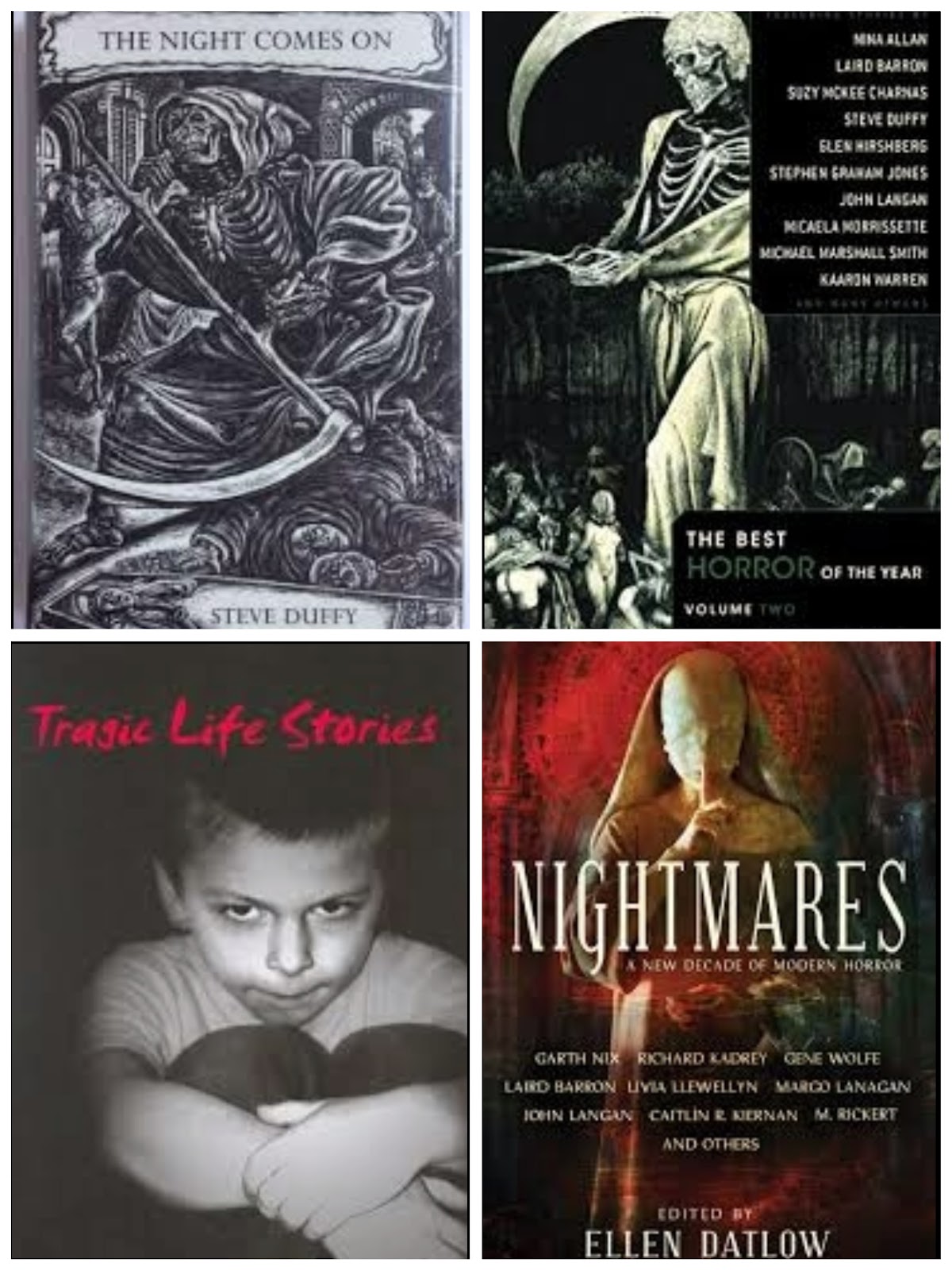


Frontier horror thesis: The Clay Party (2008) by Steve Duffy

"The Clay Party" (2008) by Steve Duffy is a masterful matter-of-North-America story. It is an audacious work of great aesthetic confidence and historical imagination.

Duffy weaves the story out of newspaper articles from the Sacramento Citizen-Journal and a private diary of John Buell. The Clay Party is a wagon train of settlers bound for Northern California. Their tyro leader, Jefferson Clay, claims knowledge of a short-cut that will save the party hundreds of miles.

Things do not go as planned.

....August 17th: A wilderness of canyons. Impassable except by much labour. Entire days wasted in backing out of dead-ends and searching for another route. We are falling behind, and the seasons will not wait. Mr Clay delivered the harshest of rebukes to Cagie Bowden for suggesting we turn back to Fort Jim Bridger and the northern trail. (And yet it is only what some of the others are saying.) Too late now in any case.

....trackless wastes along the Wasatch....

September 20th: No slackening in our progress, no rest for any man; but we are slow, we are devilish slow. Without the oxen and the wagons we lost out on the salt pans our progress is impeded mightily, and much effort is expended in the securing of provisions. Clay now wholly removed from the rest of the party; like a general he rides alone at the head of the column, seeing nothing but the far horizon while all around him his troops suffer, close to mutiny. Around our wagons each night, the howling of wolves.

As the prospect of not reaching the mountain passes before they are closed by snow becomes a certainty, Clay's party fractures.

....October 3rd: A catastrophe. The thing I most feared has come to pass. Last night Cagie Bowden led a deputation of the men to Clay's wagon and demanded he produce the note. Clay refused, and upon Bowden pressing him, drew a pistol and shot him through the chest. Instantly Clay was seized by the men, while aid was summoned for the stricken Bowden; alas, too late. Within a very little time he expired.

I was for burying him, then abandoning Clay in the wilderness and pressing on. Hiderick would have none of it, calling instead for frontier justice and a summary settling of accounts. His hotter temper won the day. Hiderick caused Clay's wagon to be tipped over on its side, and then hanged him from the shafts. It was a barbarous thing to watch as he strangled to death at the end of a short rope. Are we no better than beasts now? Have our hardships brought us to such an extremity of animal passion? Back in the wagon, I threw myself to the floor in a perfect storm of emotion; Elizabeth tried to comfort me, but I could take no solace even from her sweet voice. I have failed her—we have all failed, all of us men who stood by and let vanity and stupidity lead us into this hell on earth. Now on top of it all we are murderers. The mark of Cain lies upon us.

....October 23rd: In the night, a great alarm: Indians, howling down from the hills, attacking our wagons. Four wagons lost before we knew it—nine men dead in the onslaught. They have slaughtered half of the oxen too, the brutes. As they vanished back into the hills, we heard them laughing—a terrible and callous sound. I hear it now as I write, and it may be that it shall follow me to my grave: the mocking of savages in this savage land. Savages, I say? At least they do not kill their own as we have done.

John Buell's voice is one of almost Calvinist fatality and resignation. The tone is amplified in the diary's addenda written by his wife, Elizabeth.

....November 10th: Snow all through the night. Trail impassable—neither man nor beast can battle through the drifts. Exhausted, hope gone. Wind mounting to a howling frenzy, mercury falling, sky as black as lead. We have failed. The winter is upon us and we are lost in the high passes. God help us.

After Clay's death, his lieutenant and leader of the party's vigilante faction, Hiderick, takes over.

The horror of settlement is visited upon the settlers.

....The hunger swallows all things. Whole days will pass, and we think of nothing save food, how it would be to fill our bellies to repletion. There is a narcotic in it; it lulls one into a dangerous inactivity, a dull vacant torpor. I have seen this look settle upon a score of people; in each case the end came very nigh after. Daily I look for it in myself. I must be strong, for my angel's sake.

The provisions ran out before the end of November: the last of the oxen were slaughtered and eaten by then, and the mules too. One of the children was the first to die, Sarah Doerr's little Emily; soon after her, Missy Shorstein, and her father the next day. Our sorrow was great—we had no way of knowing that all too soon death would become a familiar thing with us. It is hard to mourn, when horror is piled upon horror and the bodies are beyond counting or remembrance; but it is necessary. It is the most human of emotions, and we must remain human, even in this uttermost remove of hell.

....Now I must be brave, and record the facts of the matter without flinching. Hiderick said that the rescue party were doomed to failure, and would undoubtedly die in the mountain passes; we should not rely on them for assistance. I could have struck him—that he could thus impugn my husband, and his brave allies, when he had not the courage to do aught save cower in his cabin! But I must tell it aright, and not let myself be sidetracked.

Hiderick said that we were doomed, and should not make it through to the spring, save for one chance. He said that we were surrounded by fresh meat, if we had only the brains to see it, and the nerve to do something about it; he said he was a butcher by trade, and would show us what he meant. If I live another fifty years I shall not forget what he did next.

He went to the door of the big cabin and flung it wide open. The snow rose up in drifts all around, parted only where a path had been cleared between the cabins. All around were the graves of those who had already succumbed to the hunger and the cold; maybe nine or ten by that time. We could not dig them in the ground, for that lay ten feet beneath the snowdrifts, and was frozen hard as iron. Instead we lay them wrapped in blankets in the snow, where the cold would preserve them till the spring.

Hiderick pointed to the nearest of the graves—little Missy Shorstein's. "There's your meat," he said, in his thick guttural voice. "Like it or not, it's the only vittles you'll get this side of the thaw."

Human-made horrors start to erase a boundary with and intermingle with the supernatural.


Available in:


Jay
30 November 2019



Monday, November 18, 2019

Two stories by Steve Duffy

"The Lion's Den" by Steve Duffy
From: The Best Horror of the Year: Volume Two edited by Ellen Datlow (2010 by Night Shade Books) 

....Inevitably, you see, a zoo will attract certain types of people, over and above its core visitor group. These range from the mostly harmless—the lonely and inadequate, the homeless, the community-care brigade—through to the more problematic types, the obsessives, the neurotics, and in extreme instances the dangerously, even suicidally unhinged. With the former, our job consists mostly of moving them on at closing time, rousing them if they try to sleep in the dark musty tunnels of the nocturama or the vivarium, making sure they don't present a nuisance to the staff or to other zoo users. With the latter, it can be very different....

"The Lion's Den" begins as a story about a UK zoo crisis: a teenage boy enters the lion enclosure, strips off his clothes, and begins to harangue the big cats in an unknown language. This opening set-piece is well-executed. Duffy's audacity and skill are much in evidence. Then events take a very strange turn, and then another; as weeks go by the crisis becomes generalized throughout the facility. 

"....Over the last three months, our animals here have demonstrated profound behavioural alterations, across all species, across all hierarchical relationships. Now, we either assume this change is a non-volitional response to external stimuli—that is, they used to behave this way, and now they behave that way, because there's something in the water, or they all had the same sort of brainstorm, or whatever—or else . . . "
     "Or else?"
     Manoj looked as if he was chewing a wasp. "Or else what we're seeing here is a volitional behaviour shift."
      "You mean—they decided to do it?"
      "They chose, yes. That would be the other alternative." I could see Manoj liked this option even less. "According to that scenario, what we're seeing here would be interpreted as possibly the first recorded instance of altruistic co-operation across species towards a common, mutually desirable goal—though what that might be, I have no idea. How could I? Now that sort of conceptualisation would require a level of self-awareness . . . " He broke off, lost in his own thoughts.


"The Lions Den" is robustly speculative. It gives us a setting and a team of characters we rarely see. And its implications are terrifying.

***


"The Ice Beneath Us" by Steve Duffy
( 2017: Night Shade Books) 

"The Ice Beneath Us" is one of Duffy's Americana tales: horror stories richly imbued with echoes of historic traumas braided into U.S. history. (Other stories in the sequence: "The Clay Party," "The Oram County Whoosit," "The Vanishing Hitchhiker").

Bob and Claude, retired from Boeing, are ice fishing on Bent Iron Lake, near the Snoqualmie National Forest. They share a secret flowing from an encounter they had the year before. When a Native American named Jimbo paid them a visit.

....Maybe when the wolf put on Grandmamma's clothes as a disguise to trick Red Riding Hood, they kind of had the same look about them.
     "I been hunting," he said, and his smile was like an axe split in his face. "Messy work, you know?"
     "What do you hunt up here?" I asked him.
      He laughed. It was not a pleasant sound. "Can't you guess?" he asked. "Your buddy there, I think he knows. Why don't you ask him?"

The raw coldness of the setting is beautifully married to the tale's folk content.


Jay
18 November 2019