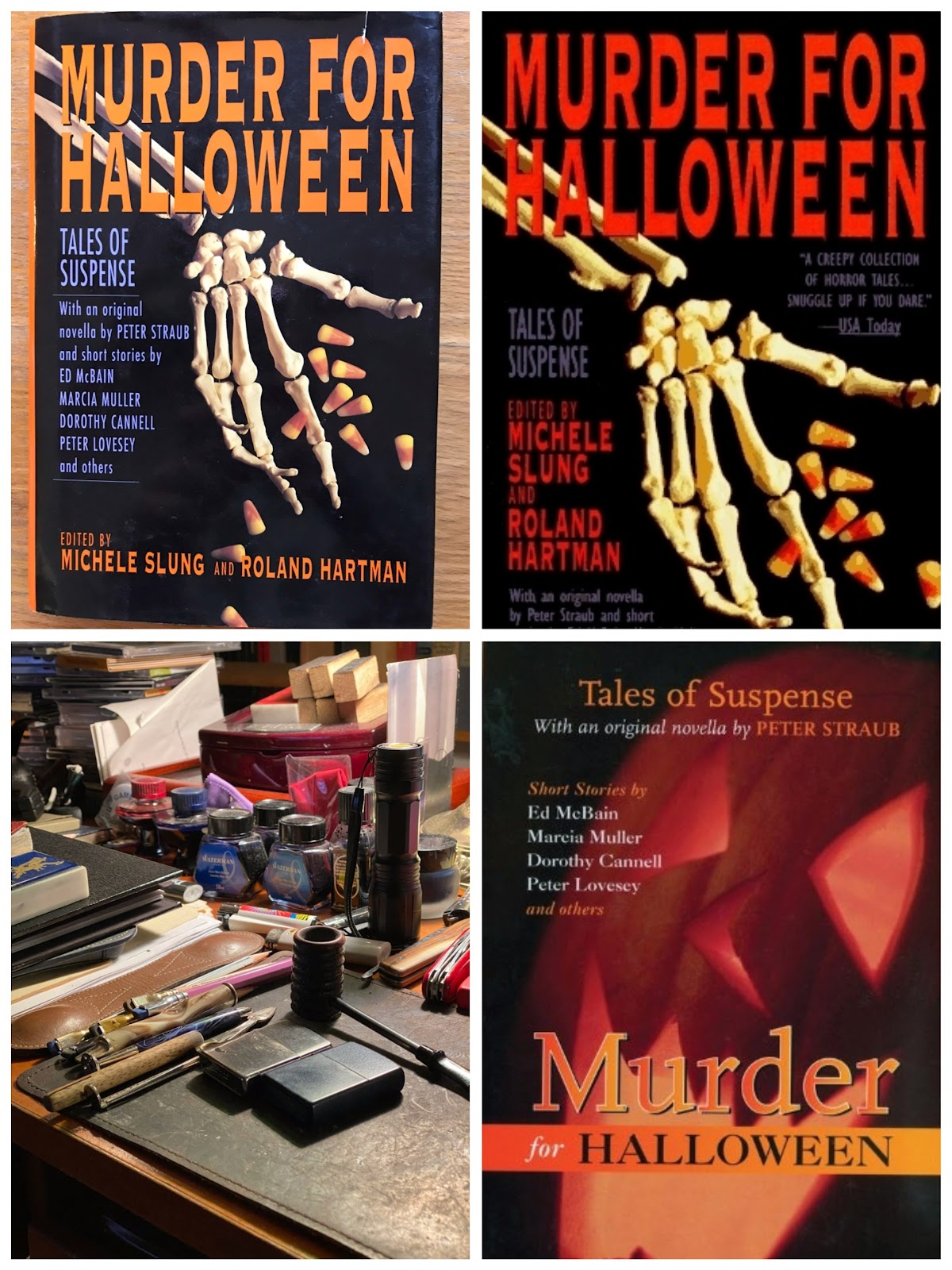
Some stories are narrated by the dead. Of these, some are banal and others are sharply heartbreaking.
Reward yourself as a reader with the experience....
Full:

The October Country by Ray Bradbury (1955)
Something Wicked This Way Comes by Ray Bradbury (1962)
The Halloween Tree (1972)
Jay
5 October 2022
Readers unfamiliar with "Porkpie Hat" may prefer to read these notes only after reading the story.
A disturbance in the texture of reality: "Pork Pie Hat" (1994) by Peter Straub
....we isolate the dire facts of being alive by relegating them to a remote compartment of our minds.
....To keep our minds unreflective of a world of horrors, we distract them with a world of trifling or momentous trash.
– Thomas Ligotti, The Conspiracy Against the Human Race (2010)
* * *
The truth is hard to live with. Straub was concerned with men and women trying to figure out a puzzle, a mystery, a tragedy of some kind, even if some of them would not be able to reconcile it with their waking life.
Straub took delight in partial views, skewed perspectives, unreliable recollections. His witnesses fought for equipoise within a tangle of partial information, groping to understand what they may have witnessed.
[....]Hat had lived forty-nine years as a black man in America, and I'd spent all of my twenty-one years in white suburbs. He was an immensely talented musician, a man who virtually thought in music, and I can't even hum in tune. That I expected to understand anything at all about him staggers me now. Back then, I didn't know anything about grief, and Hat wore grief about him daily, like a cloak. Now that I am the age he was then, I see that most of what is called information is interpretation, and interpretation is always partial.
* * *
"Porkpie Hat" (1994) is one of the most accomplished pieces of short fiction produced by a US horror writer in the 1990s. It approaches both historical and family trauma (and failed recovery therefrom) with bold and challenging choices of point of view.
Straub was always accomplished at defamiliarization: estranging protagonists (and readers). His fictions usually have knotty crimes at their core, and many traps to thwart his investigators.
Solving "the case" can become discoraging in a story of typical Straubian length, say 600 to 700 pages. Happily, this is not the case with "Porkpie Hat," a modest novella of under 100 pages.
Jazz saxophonist Hat, interviewed by the unnamed narrator, has a profound self-interest in telling his story wrong: to keep shielding himself from its full implications after half a century. He spends his days drinking and sleepwalking through the last chapter of his life, cocooned in an almost cosmic sorrow. He only comes alive when performing.
Ultimately, we will learn Hat found out about adult realities much too soon: as an eleven year old in depression-era Jim Crow Mississippi.
* * *
What appeared to be a long slide from joyous Mastery to outright exhaustion can be seen in another way altogether.
[....] Hat had lived forty-nine years as a black man in America, and I'd spent all of my twenty-one years in white suburbs. He was an immensely talented musician, a man who virtually thought in music, and I can't even hum in tune. That I expected to understand anything at all about him staggers me now. Back then, I didn't know anything about grief, and Hat wore grief about him daily, like a cloak. Now that I am the age he was then, I see that most of what is called information is interpretation, and interpretation is always partial.
"Porkpie Hat" is a story about why a grown man stays home every Halloween night as neighborhood kids run wild. Hat's antipathy to the date stems from a horrific night he and a childhood friend spent in The Backs.
[....] "No matter where you live, there are places you're not supposed to go," he said, still gazing up. "And sooner or later, you're gonna wind up there." He smiled at me again. "Where we lived, the place you weren't supposed to go was called The Backs. Out of town, stuck in the woods off one little path. In Darktown, we had all kinds from preachers on down. We had washerwomen and blacksmiths and carpenters, and we had some no-good thieving trash, too, like Eddie Grimes, that man who came back from being dead. In The Backs, they started with trash like Eddie Grimes, and went down from there. Sometimes, our people went out there to buy a jug, and sometimes they went there to get a woman, but they never talked about it. The Backs was rough. What they had was rough. " He rolled his eyes at me and said, "That witch-lady I told you about, she lived in The Backs." He snickered. "Man, they were a mean bunch of people. They'd cut you, you looked at 'em bad. But one thing funny about the place, white and colored lived there just the same—it was integrated. Backs people were so evil, color didn't make no difference to them. They hated everybody anyhow, on principle." Hat pointed his glass at me, tilted his head, and narrowed his eyes. "At least, that was what everybody said. So this particular Halloween, Dee Sparks says to me after we finish with Darktown, we ought to head out to The Backs and see what the place is really like. Maybe we can have some fun.
The Backs on Halloween night turns out for Dee and Hat to be a hellish borderland. Reanimated thug Eddie Grimes will be the least insidious threat they face. Facts and implications flowing from that Halloween, the truth about what happened (as opposed to the story Hat will tell the narrator about what happened) will take our narrator years to unravel.
* * *
A deep irreversible sadness
"Porkpie Hat" is ripe with peripeteias for Hat and the narrator.
In fact, Hat seems to have infected the narrator with some of his own affectless ennui. The young man who moved from Illinois to NYC to attend Columbia when "Porkpie Hat" began was on the road to an academic career. He apparently ends up married with children and working as a Chicagoland corporate drone who feels the pinch of paying $35 for a hardcover biography of Grant Kilbert. He also reveals he rarely listens anymore to jazz.
* * *
The narrator's ultimate success in assembling the real story of that Halloween night, and what it revealed about Hat's life and career, leaves the careful reader with a story of stunning emotional power. Art, whether jazz or literature, may ultimately be nothing more significant than an attempt to use "trifling or momentous trash" to distract us from "a world of horror."
Jay
18 September 2022
October1888.
In a London suburb straight out of Machenland, peculiar neighbors prepare. Some prepare to open the way for a reign of Lovecraftian beastliness upon earth. Others prepare to keep the way closed by any means necessary.
Perhaps humanity's savior is Jack [the Ripper]: a haunted man, cursed to outlive the eons. Some say he is Cain. His blade is inscribed with words of power.
Jack's opposite number among the closers is Jill. An old crone of a witch; or is she one of the newer, subtler variety?
Dracula and Rasputin are also on hand. As is a dodgy vicar (is there another kind?)
Investigating this mileu is a Great Detective and his limping chum. The detective disguises himself as a lady, but a Sherlock by any other name smells as sweet.
Dracula and Dr. Frankenstein are there: but as what? Openers, closers, or red herrings?
Sound like we're in Anno Dracula (1992) territory? Zelazny is not the pulp Victoriana epicure Kim Newman is. But A Night in the Lonesome October has something Anno Dracula does not: a contagious atmosphere of ghoulish drollery and delight.
A Night in the Lonesome October is narrated not in third person, and not by a human protagonist. Each opener and closer has an animal familiar. Jack has Snuff, a big and brilliant dog skilled in tracking and higher Witch-House maths.
Jill has Graymalk, a cat of wit and cunning. Others have bats, rats, owls, birds of prey.
The chapters count down to a rare October 31 full moon. But on the way openers and closers and their familiars work together as much as against one-another. This graveyard scene, for instance, is practically a hymn to solidarity:
....Jack wanted to visit a cemetery for a few final ingredients. He decided upon a distant, isolated one we had been to once before. He went on horseback, bearing a spade and bull's-eye lantern, and I trotted along beside.
He tethered his horse amid some trees outside the graveyard, and we went in on foot. It was, of course, a very dark night. But with the aid of the lantern we quickly located an appropriately secluded plot of recent turning. Jack set to work immediately, and I went about my watching.
It was a pleasantly mild evening for October, with a few bats flitting by, bright stars overhead. I heard footsteps in the distance, but they were not headed in our direction and I saw no cause for alarm. I patrolled our small area in an almost leisurely fashion. After a time, something very large passed overhead, descending. It did not land nearby, however, nor make any movement to approach us. A bit later, something equally large passed—again, descending, though in a different area than the first, and, again, making no overtures toward us—and I remained alert but voiced no warning. I heard horses on the trail a little after that, sounds of dismounting, more footsteps. Later, a wagon creaked to a halt, and I heard its brake being set. The sounds of a few whispered voices reached me then, from various distant areas. I began to feel uncomfortable at all this activity. I patrolled farther afield; and, listening closely, I began hearing the sounds of spades from many directions.
"I remember you," came a faintly familiar voice. "You're a watchdog, like me, with big teeth."
It was the graveyard dog, making his rounds.
"'Evening," I said. "Yes, I recall. Seems to be a lot of activity all of a sudden."
"Too much," he replied. "I'm not sure I care to give the alarm. Might get mobbed. After all, everybody here is dead, so who cares? They won't complain. The older I get the more conservative I feel. I'm just not much into heavy action these days. I do wish everybody'd fill up their holes neatly, though, afterwards. Maybe you could pass the word along?"
"I don't know," I said. "I don't know who all's out there. It's not like a trade union, you know, with operating rules and policies. We usually just get the work done as efficiently as possible and get the hell out."
"Well, it would be nice if you cleaned up after yourselves. Less trouble for me."
"I'm afraid I can only speak for the master, but he's usually quite neat in these matters. Maybe you'd better approach a few of the others yourself."
"I'm inclined to let it go by," he said. "Too bad."
We strolled around a bit together then. Later, a voice very like MacCab's called out from down the hill, "Damn! I need a left femur and this one ain't got one!"
"Left femur, you say?" came an ancient croaking voice from nearby, which could have been Owen's. "I've one right here I ain't usin'. Have you a liver, though? That's my need."
"Easily done!" came the reply. "Bide a moment. There! Trade?"
"You have it! Catch!"
Something flashed through the air to rattle farther down the hill, followed by scurrying sounds.
"Fair enough! Here's yer liver!"
There came a splap from higher up and a muttered "Got it!"
"Hey!" came a lady's voice then, from off to the left. "While you're about it, have you a skull?"
"Indeed I do!" said the second man. "What'll you give?"
"What do you need?"
"Fingerbones!"
"Done! I'll tie 'em together with a piece of twine!"
"Here's your skull!"
"Got it! Yours'll be along shortly!"
"Has anyone the broken vertebrae of a hanged man?" came a deep masculine voice with a Hungarian accent, from somewhere far to the right.
There followed a minute's silence. Then, "I've some mashed ones here! Dunno how they got that way, though!"
"Perhaps they'll do. Send them along, please!"
Something white and rattling flashed through the starlit air.
"Yes. I can work with these. What'll you have for them?"
"They're on the house! I'm done! 'Night!"
There followed the sounds of rapidly retreating footfalls.
"See?" the old dog said. "He didn't fill it in."
"I'm sorry."
"I'll be up kicking dirt all night."
"Afraid I can't help you. I've got my own job to see to."
"Eyeballs, anyone?" came a call.
"Over here," said someone with a Russian accent. "One of them, please."
"I'll have the other," came an aristocratic voice from the opposite direction.
"Either of you got a couple of floating ribs, or a pair of kidneys?"
"Down here, on the kidneys!" came a new voice. "And I'm in need of a patella!"
"What's that?"
"Knee bone!"
"Oh? No problem. . . ."
On the way out, we passed a white-bearded, frail-looking man, half-adoze, leaning on a spade near the gate. Casual inspection would have had one believe him a sexton, out for a bit of night air, but his scent was that of the Great Detective, hardly drowsing. Someone had obviously spoken too publicly.
Jack muffled himself and we slunk by, shadows amid shadows.
Thus was all our work quickly concluded to everyone's satisfaction, save for the tired hound. Such times are rare, such times are fleeting, but always bright when caught, measured, hung, and later regarded in times of adversity, there in the kinder halls of memory, against the flapping of the flames.
* * *
A Night in the Lonesome October is a lovely paeon to Universal Monsters and the thought-world of Stoker and Conan Doyle, braided drollery courtesy of a Wodehouse.
Jay
9 October 2018