Subscribe to my Substack

Tuesday, May 14, 2019

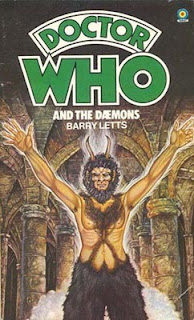
They couldn't be hoof marks: Doctor Who and the Daemons by Barry Letts (1975).


....'You beg so prettily, my dear. But you see, I am so near to attaining one of my greatest ambitions: power to control, to rule, an entire planet—this planet, Earth. Nothing and nobody can be allowed to stand in my way.'

'You're mad.. ' she breathed....


A barrow called the Devil's Hump  is being excavated in the picturesque village of Devil's End (which has a local pub called The Cloven Hoof.) The excavation will climax on live TV on May 1, as village Morris dancers and all the trimmings are rolled out for the holiday.

The local vicar, Mr. Magister, thinks concerns about supernatural and malevolent forces are absurd. Miss Hawthorne, local wise woman, suspects differently.

The Doctor Who TV episode "The Demons" was first aired in 1971. Co-scripter Barry Letts' novelization appeared in 1975.

To viewers and readers of my generation, this was the golden age of Doctor Who.  (No Moffat-Gatiss mind-screws back then.)

"The Demons," like the Fang Rock, Weng-Chiang, and Martian pyramid episodes,  checks many boxes in the weird "matter of Britain." "The Demons" includes: ancient barrows, 'white' witches, altered or unusual maypole traditions, Beltane, Quatermassian boffins, and archeological digs that reveal "we are all Martians." Well, not Martians per se, but the product of fiddling by alien Prometheans.

Notes of Nigel Kneale, Grant Allen, and Eleanor Scott are struck, as well as Dennis Wheatley.

The Doctor lays it all out here:


…..Sitting round the rickety old oak table in the little back room of 'The Cloven Hoof' Jo, Mike and Sergeant Benton were tucking into a traditional 'Ploughman's Lunch'—
large slabs of cheese, crusty new bread with farm butter and crunchy pickled onions; all washed down with pints of draught cider or strong ale. Miss Hawthorne had graciously accepted one small apple, stating it as her considered opinion that too much eating in the middle of the day led to sluggish vibrations in the afternoon.

'Do come and eat something, Doctor,' called Jo.

But the Doctor was too far away to think of food.

Surrounded by piles of books of every shape, size and age, he was hunting here and there through them, making notes and leaving slips of paper as book marks.

'Well, well, well! The Grimoire of Pope Honorius!' The Doctor had seized an ancient leatherbound volume with great excitement. 'A copy I never knew existed...'

'You have the pick of the finest collection of occult material in the country there, Doctor,' said Miss Hawthorne proudly, 'though why you wanted me to bring it, I can't think.'

'I hope that will become clear. Apart from anything else, I'm being pestered for an explanation. These books will help me to provide it.'

Miss Hawthorne looked puzzled. 'But Doctor, there is only one possible explanation: this is the supernatural at work.'

The Doctor looked up from his notes. 'Nonsense!' he said.

Benton thoughtfully chomped on a pickled onion.

'What about that thing that got me? That was real enough.'

The Doctor had returned to his books. 'There's nothing more real than a force-field, Sergeant,' he said, marking a large coloured picture of a goat, 'even a psionic force-field.'

Miss Hawthorne bristled. To have her cherished beliefs challenged! It was unthinkable. 'You're being deliberately obtuse, Doctor. We are dealing with the supernatural, I tell you. The Occult! Magic!'

The Doctor shook his head. 'Science,' he said.

'Magic!'

' Science, Miss Hawthorne.'

Mike Yates finished off his beer. 'Really,' he said, 'what does it matter? There's no point in getting all hot under the collar about words. The important thing is to find a way to stop it, whatever it is.'

'How can you stop it without knowing what it is?' said Jo indignantly, leaping to the Doctor's defence as usual.

'Well done, Jo,' said the Doctor, getting up, 'you're being logical at last.'

'Oh, am I? Thanks,' said Jo, doubtfully.

'We'll turn you into a scientist yet. Now then. If you've all finished perhaps we could clear a space.'

One end of the table was quickly cleared of the remains of the meal and the Doctor was able to spread out a number of books. 'Right,' he said, 'here we go,' and he opened the first book. 'Who's that?'

'It's an Egyptian god, isn't it?' said Jo.

'Top of the class. The God Khnum—one of their gods with horns.' He opened the next book. 'A Hindu Demon—with horns.' Another. And another. 'The Ancient Greek god Pan—with horns. A bust of Jupiter—with horns. A statue of Moses—yes, even he's got horns. The Minotaur—the bull-headed monster of Crete. Our old friend the Horned Beast—the Devil with the head of a goat...'

The Doctor went on opening book after book, until the table was filled with pictures of horned beings.

Miss Hawthorne was not impressed. 'You could go on all day and all night showing us pretty pictures,' she said tartly. 'It proves nothing. Horns have been a symbol of power ever since... Oh, ever since...'

'Even since man began,' agreed the Doctor. 'Look.' He showed them yet another picture—a photograph of a prehistoric cave-painting which seemed to show a group of witch doctors dancing, all with horns upon their brows.

'But has it ever struck you to ask yourself why?' the Doctor continued. 'Creatures like that have been seen over and again throughout the history of man, and man has over turned them into myths—into gods or devils.' He gestured towards the pictures. 'But they're neither. They are creatures from another world...'

Even Miss Hawthorne was silenced.

'You mean,' said Benton slowly, 'like the Axons, and the Nestenes—and the Cybermen?'

'Precisely,' said the Doctor, 'but far, far older and immeasurably more dangerous.'

'Charming,' murmured Mike Yates.

'Are you suggesting that these creatures came to Earth in spaceships?' said Miss Hawthorne, regaining her composure.

'I am,' he replied. 'They're Dæmons* from the planet Damos; and that's a long long way from Earth.'

'Sixty thousand light years,' put in Jo, wisely.

'That's right. The other side of the Milky Way; and they first came to Earth nearly one hundred thousand years ago...'

'But why? I mean, why should they want to?' asked Benton.

So the Doctor went on to tell them something of the history of these alien beings, the Dæmons, or Demons. He told of their evolution and the development of their culture over long aeons even before life began on Earth. When the first land creatures were crawling out of our oceans, the Dæmons already had a fully developed civilisation with a sophisticated science and technology. By the time man

* pronounced deemons.

appeared, the Dæmons had been space travellers for many centuries and had established a tradition of scientific exploration and experiment through-out the Galaxy. They arrived on Earth just in time to help homo sapiens kick out Neanderthal Man and they have been appearing on and off over since, merely observing most of the time but occasionally giving history a push in the right direction...

'There you are,' said Miss Hawthorne, triumphantly,

'that proves you're talking nonsense. This.. thing that Professor Horner loosed on the world is evil. You said so yourself. And now you tell us that they have been helping mankind for a thousand centuries!'

'Yes,' said Jo, 'and you say they're from another planet.

Then what's all this jazz about witchcraft and covens and all?'

'A very good point, Miss Grant,' put in Miss Hawthorne.

'But don't you see,' explained the Doctor, 'all the magical traditions are just the remnants of the Dæmons'

advanced science. And that's what the Master is using!'

'Mm...' Miss Hawthorne was unconvinced. 'And how do you know all this anyway?'

'Yes, Doctor,' said Mike, 'you didn't seem to know what was going on at first.'

'I learned it at school,' said the Doctor grumpily,

'chapter thirteen of the Galactic History. Unfortunately, I forgot it all.' He stood up and started to clear away the books.

'You must have gone to a very odd school—and you must have very peculiar memory,' said Miss Hawthorne.

'That, madam, is my misfortune; said the Doctor acidly, for she had touched on a sore point. 'In any case, it's all in these books of yours, if you know how to read them properly.'

'Then these creatures are linked with the Black Arts,'

she said. 'They are evil.'

'Amoral would be a better word, perhaps,' the Doctor replied 'They help Earth, but on their own terms. It's a scientific experiment to them. We're just a cageful of laboratory rats.'

'Then what's the Master up to?' asked Mike.

'He's established a link with the Dæmon from the barrow. What frightens me is the choice—domination by the Master or total destruction.'

Jo, who had been stacking the books in a neat pile, looked up aghast. 'You mean this Dæmon could destroy the Earth?'

'What does any scientist do with an experiment that fails? He throws it in the rubbish bin. And you must admit that mankind doesn't look a very successful species at the moment.'

'But Doctor... you're talking about the end of the world!'

The Doctor looked at her very seriously. 'Yes, Jo,' he said, 'I am.'

Jay
14 May 2019


Sunday, May 12, 2019

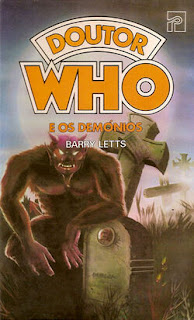
Nightworld by F. Paul Wilson (1992)


….The stars do look kind of sparse up there, Bill thought.


"It's almost as if the planet's been moved to a different part of the universe."


"Cosmic, man," Joe said, eyes widening. "Maybe it has."


"No," Bill said. "That would be too logical an explanation, and easier to accept than what we're going through."


"Magnetic north's changed too," Joe said. "Compasses have been pointing anywhere they damn well please for the past couple days."


The stars do look kind of sparse up there, Bill thought.


Like Bloch's Strange Eons, Wilson's Nightworld gives us the plight of characters caught in a global disaster as an ancient power manifests again in physical form. Some forms are human, some are not. As with many an F. Paul Wilson novel, those not ready for battle get their noses rubbed right in it.

The trouble begins when the sun starts rising late and setting too soon. Then come the bottomless sinkholes. Then come the things out of the sinkholes.

....Then came another sound, a heavy, chitonous slithering from the impenetrable darkness beyond his feet. As it grew louder, Hank began to whimper in fear. He began to thrash in the water, struggling desperately to pull free but the pincers in his arms and legs tightened their grip, digging deeper into his already bleeding flesh.


And then in the growing shaft of light from the rising moon he saw it. A millipede like all the rest, but so much larger. Its head was the size of Hank's torso, its body a good two feet across, half-filling the drain pipe.


Hank screamed as understanding exploded within him. These other, smaller horrors were workers or drones of some sort; they'd captured him and were holding him here for their queen! He renewed his struggles, ignoring the tearing pain in his limbs. He had to get free!


But he couldn't. Sliding over the bodies of her obedient subjects the queen crawled between Hank's squirming legs until she held her head poised over his chest, staring at him with her huge, black, multifaceted eyes. As Hank watched in mute horror, a drill-like proboscis extruded from between her huge mandibles. Slowly, she raised her head and angled it down over Hank's abdomen. Hank found his voice and screamed again as she plunged the proboscis deep into his abdomen.


Nightworld is the conclusion of a series of novels called The Adversary Cycle.

I have not read the other novels, but Nightworld does backfill enough plot points to flesh-out character motivations. I have read a number of Wilson's Repairman Jack vigilante novels, where the author always enjoys having his cake and eating it, too. In Nightworld - where Repairman Jack does play a subsidiary role - there is some real physical and moral self-sacrifice.

Nightworld also gives us a scale of "cosmic" (as opposed to merely eschatological) menace. On a private jet on a night flight to Hawaii:

....Jack held on to his seats arm rests and knew if he looked down at his hands he'd see two sets of white knuckles.


"We'll be okay," Frank said.


"Good. A much better choice of three words."


"Be cool, Jack. Some weird air currents out of nowhere, that's all."


The grayness lightened as abruptly as it had darkened. Jack began to breath easier. He was leaning against his window, staring out into the unrelieved grayness, when the plane passed through a brief break in the vog. His throat closed and his hands renewed their chokehold on his armrests. Directly below the wings he saw a broad flat surface, smooth and black as new asphalt, spanning off in all directions until it disappeared into the gray. He was about to shout to Frank that they were going to crash when he saw the eye: Far off to his right, perhaps a quarter-mile away, cathedral-sized, huge and yellow with a slit pupil, it sat embedded in the black surface, staring back at him like a lab tech eying a microbe.


Jack slammed back in his seat, gasping for breath.


Nightworld doesn't take its apocalypse all the way, like Strange Eons or Koontz's superb The Taking. But that's not an authorial failure: Wilson gives us an averted religious calamity with good thwarting evil in combat.

However, after a couple of hundred pages where good guys are sent on a scavenger hunt for elements to build their armaments, the final battle is at best perfunctory.

"But even the trying counts for something," as one character says.


Jay
12 May 2019


Better never than late: Mrs. Carteret Receives, And Other Stories by L.P. Hartley (1971).


Uncanny-flecked, strange, and beguiling, the stories in Mrs. Carteret Receives And Other Stories are a pleasure for the reader. Hartley is a strong and skilled writer. His craft is well-displayed in this collection.


Social calamities, embarrassments, gaffes, bad dreams, and misunderstandings are all here tinged with something unusual. And beneath it all, the knowing Hartley Cheshire Cat smile.

Notes and excerpts:

Mrs Carteret Receives • (1971)
Another immaculate Venice story from Hartley. It's no "Podolo," but there's charm, characterization, and growing menace.

Fall in at the Double • (1970)
A haunting begins the day the owner of the house narrowly escapes the same fate that doomed a previous tenant. As always with Hartley, faultless tone and distance.

Paradise Paddock • (1971)
....One thing that he couldn't find a suitable place for was a turquoise-coloured beetle—obviously meant to be Egyptian for it had a cartouche on its back, but too large, he thought, to be a real scarab. He had bought it at an antique shop for a few shillings.
    A friend, who had travelled much in the Near East, took a different view.
    'One never knows,' he said. 'I don't like the look of it and I should get rid of it, if I were you.'

Roman Charity • (1971)
The most shocking, strange, and disturbing tale in the whole collection. Words cannot begin...

Pains and Pleasures • (1971)
Trouble with the domestic help. And worse, good help being hard to find, the risk of losing it. Blackly funny.

Please Do Not Touch • (1971)
....But though he hadn't much minded the first burglary—indeed he was in bed and asleep when it happened and didn't know about it until the morning—he did mind the second, with its violence and its sequel of nervous shock, not to mention the loss of objects that he treasured; and like the hero of Poe's story, 'The Cask of Amontillado', he vowed revenge.

Home Sweet Home • (1971)
You can't go home again. Your old house has been turned into a home for disturbed children.

The Shadow on the Wall • (1969)
....A house is a hungry beast, and the more its appetite can be kept at bay the better.


Jay
12 May 2019


Saturday, May 11, 2019

"Negotium Perambulans" by E.F. Benson

You can't go home again 


   “I stick to work and whisky. God! I’ve learned to paint since I saw you, and drink too for that matter. I live in the quarry-house, you know, and it’s a powerful thirsty place. Come and have a look at my things if you’re passing. Staying with your aunt, are you? I could do a wonderful portrait of her. Interesting face; she knows a lot. People who live at Polearn get to know a lot, though I don’t take much stock in that sort of knowledge myself.”
     I do not know when I have been at once so repelled and interested. Behind the mere grossness of his face there lurked something which, while it appalled, yet fascinated me. His thick lisping speech had the same quality. And his paintings, what would they be like? . . .
     “I was just going home,” I said. “I’ll gladly come in, if you’ll allow me.”
     He took me through the untended and overgrown garden into the house which I had never yet entered. A great grey cat was sunning itself in the window, and an old woman was laying lunch in a corner of the cool hall into which the door opened. It was built of stone, and the carved mouldings let into the walls, the fragments of gargoyles and sculptured images, bore testimony to the truth of its having been built out of the demolished church. In one corner was an oblong and carved wooden table littered with a painter’s apparatus and stacks of canvases leaned against the walls.
     He jerked his thumb towards a head of an angel that was built into the mantelpiece and giggled.
     “Quite a sanctified air,” he said, “so we tone it down for the purposes of ordinary life by a different sort of art. Have a drink? No? Well, turn over some of my pictures while I put myself to rights.”
     He was justified in his own estimate of his skill: he could paint (and apparently he could paint anything), but never have I seen pictures so inexplicably hellish. There were exquisite studies of trees, and you knew that something lurked in the flickering shadows. There was a drawing of his cat sunning itself in the window, even as I had just now seen it, and yet it was no cat but some beast of awful malignity. There was a boy stretched naked on the sands, not human, but some evil thing which had come out of the sea. Above all there were pictures of his garden overgrown and jungle-like, and you knew that in the bushes were presences ready to spring out on you . . .
     “Well, do you like my style?” he said as he came up, glass in hand. (The tumbler of spirits that he held had not been diluted.) “I try to paint the essence of what I see, not the mere husk and skin of it, but its nature, where it comes from and what gave it birth. There’s much in common between a cat and a fuchsia-bush if you look at them closely enough. Everything came out of the slime of the pit, and it’s all going back there. I should like to do a picture of you some day. I’d hold the mirror up to Nature, as that old lunatic said.”
     After this first meeting I saw him occasionally throughout the months of that wonderful summer. Often he kept to his house and to his painting for days together, and then perhaps some evening I would find him lounging on the pier, always alone, and every time we met thus the repulsion and interest grew, for every time he seemed to have gone farther along a path of secret knowledge towards some evil shrine where complete initiation awaited him . . . And then suddenly the end came.
I had met him thus one evening on the cliffs while the October sunset still burned in the sky, but over it with amazing rapidity there spread from the west a great blackness of cloud such as I have never seen for denseness. The light was sucked from the sky, the dusk fell in ever thicker layers. He suddenly became conscious of this.
     “I must get back as quick as I can,” he said. “It will be dark in a few minutes, and my servant is out. The lamps will not be lit.”
     He stepped out with extraordinary briskness for one who shambled and could scarcely lift his feet, and soon broke out into a stumbling run. In the gathering darkness I could see that his face was moist with the dew of some unspoken terror.
“You must come with me,” he panted, “for so we shall get the lights burning the sooner. I cannot do without light.”
     I had to exert myself to the full to keep up with him, for terror winged him, and even so I fell behind, so that when I came to the garden gate, he was already half-way up the path to the house.
I saw him enter, leaving the door wide, and found him fumbling with matches. But his hand so trembled that he could not transfer the light to the wick of the lamp . . . “But what’s the hurry about?” I asked.
     Suddenly his eyes focused themselves on the open door behind me, and he jumped from his seat beside the table which had once been the altar of God, with a gasp and a scream.
     “No, no!” he cried. “Keep it off! . . . ”
     I turned and saw what he had seen. The Thing had entered and now was swiftly sliding across the floor towards him, like some gigantic caterpillar. A stale phosphorescent light came from it, for though the dusk had grown to blackness outside, I could see it quite distinctly in the awful light of its own presence. From it too there came an odour of corruption and decay, as from slime that has long lain below water. It seemed to have no head, but on the front of it was an orifice of puckered skin which opened and shut and slavered at the edges. It was hairless, and slug-like in shape and in texture. As it advanced its fore-part reared itself from the ground, like a snake about to strike, and it fastened on him . . .
     At that sight, and with the yells of his agony in my ears, the panic which had struck me relaxed into a hopeless courage, and with palsied, impotent hands I tried to lay hold of the Thing.
     But I could not: though something material was there, it was impossible to grasp it; my hands sunk in it as in thick mud. It was like wrestling with a nightmare.
     I think that but a few seconds elapsed before all was over. The screams of the wretched man sank to moans and mutterings as the Thing fell on him: he panted once or twice and was still. For a moment longer there came gurglings and sucking noises, and then it slid out even as it had entered. I lit the lamp which he had fumbled with, and there on the floor he lay, no more than a rind of skin in loose folds over projecting bones....


https://ebooks.adelaide.edu.au/b/benson/ef/negotium-perambulans/


Thursday, May 2, 2019

Trump inferno: Fires of Eden by Dan Simmons (1994).

I first gave up on the paperback edition of Fires of Eden in August 1995. (Thanks to habits formed under decades of undiagnosed autism, I have probably given up on more novels in my life than I have completed).

But powerful images and scenes from Fires of Eden stuck with me, particularly a legion of night-marching spirits filing through the wilds of Hawaii. Similar to the staying power of scenes of devouring lampreys in Simmons' Summer of Night or the vampiric stomach siphons of Romanian orphans in Children of the Night.

Like trend-setting 1970s horror novels, early Simmons gives us third person, multiple character perspectives and action in alternating chapter subsections. He keeps the ball rolling without an excess of gore or - most mercifully - melodrama.

Fires of Eden alternates between the present day and 1866.

In the present, New York City real estate tycoon and all-round egomaniac Byron Trumbo is trying to sell his Mauna Pele Resort to a Japanese billionaire before bankruptcy destroys his reputation. Mauna Pele is in the crosshairs of not one but two erupting volcanoes.  Trumbo juggles this with the imminent arrival on the Big Island of an ex-wife, a girlfriend, and a mistress. A perfect storm.

Eleanor Perry and Cordie Stumpf are also present day protagonists. Both are guests at the Mauna Pele Resort. Eleanor is a college history instructor revisiting sites mentioned in the 1866 diary of her Aunt Kidder. Cordie, among many other things, is a widow and retired business woman learning to live with implications of resurgent cancer.

The 1866 chapters of Fires of Eden are excerpts from the acerbic Aunt Kidder's diary. She is on a tour of Hawaii with an assortment of missionaries, do-gooders, and journalist Samuel Clemens. Fireworks between her and the future Mark Twain begin cute and do not relent.

In both periods the gate to Milu, the Hawaiian underworld, has opened, disgorging black dogs, shark men, and a very nasty hog. It's hell on the tourists.

The character Byron Trumbo is clearly Donald Trump. In 1994 this was probably funny, when Trump was a New York Clinton Democrat with a rich and famous lifestyle. In 2019 it is hilarious. I wonder what Simmons thinks today? He gives his Trumbo center stage and let's the character march to victory over every obstacle, financial and supernatural.

At the climax Trumbo and Cordie beard the Milu monsters in their underworld den:

"Byron," said the hog, "so nice of you to drop in." Its snout thrust in Cordie's direction. "Is this an offering to me?"

Trumbo glanced at Cordie and then back at the pig. "Sure," he said.

The hog made a sound in its massive throat. "I'll eat it in a moment. First, we have business to do."

Trumbo waited.

"I see you helped yourself to Sunny's soul," said Kamapua'a.

Trumbo shrugged. "It seemed to be self-serve."

The growling from the monster hog's belly might have been a chuckle. "Fine, fine," it said. "But there is still a price."

"My soul?" said the billionaire.

"Fuck your soul," said the hog. "I'm talking a trade."

"What kind of trade?" asked Trumbo. "You want the money?"

The hog grunted. "The miserable kahuna summoned us to destroy you," it said. "But we had no intention of doing so. It is Pele whom I wish to destroy. You and I are alike, Byron. We were born to dominate. Born to subdue…women…the land. I understand your urge to bulldoze and rape. I understand it well. I don't want your money."

Trumbo nodded thoughtfully for a moment. "I still don't see what we'd be trading," he said at last.

Kamapua'a showed his grin. His eight eyes were bright. "We trade places for a while, Byron my friend. I become you. You become me."

Trumbo's face remained expressionless. "Let me get this straight…the deal you're offering me is that we trade places? That you get my body and I get yours?"

The hog nodded.

"You get to be a handsome billionaire with homes and women on three continents," continued Byron Trumbo, "and I get to spend a couple of decades as a giant, smelly pig living in a cave in Hawaii. Is that the deal?"

Kamapua'a's grin remained in place. "That's the deal, Byron."

Trumbo nodded. "And why the hell should I be interested in a deal like that?"

"First," grunted the pig in the voice that seemed to come from his belly, "you will be allowed to live. I will not devour your guts and bones. Second, I guarantee you that in my fifteen or twenty years in your body, I will enlarge your financial empire to a scale never before seen on this planet. You came down here as a man on the skids…desperately trying to shore up your tumbling empire by selling this miserable hotel for a few hundred million dollars. When you return to your body, you will own the world, Byron Trumbo. And that is not a figure of speech."

"I'll end up owning the world if I stay in my own body," said Trumbo.

The hog grunted. "Thirdly," he continued as if Byron had not spoken, "while you are King of the Underworld, you will have unlimited power over the ghosts and demons in this world. You will have power over the elements above, commanding the lightning, the tide, and the great tsunamis. You will taste power the likes of which you currently cannot dream of."

Trumbo rubbed his cheek. "Will I have all the powers you have now?"

Kamapua'a shook his great, bristled head. "I am not a fool, Byron. If you assumed all of my powers, you could cancel our deal anytime you wished and establish yourself as king of the world above. No, I will need the majority of my powers while in your body, using them to make you rich and famous beyond your wildest dreams. But I assure you that being Kamapua'a, lord of the Underworld and of all he surveys, will be the high point of your life. And—as I say—when you return to your mortal form, you will inherit the riches and powers I have amassed for you."

"What if you decide to stay human forever?" asked Trumbo. "No, no, no," grumbled the hog. "Your mortal form is acceptable, but it is mortal. I have no wish to die. I am a god."

"That's another point," said Trumbo. "My body will be old if you sublet it for two decades…almost sixty."

The hog's teeth gleamed slick in the dim light. "At the height of your powers, Byron. I will treat your mortal form with greater care than you do now. It will be fit, tuned to a fighting edge…after all, I would be disappointed if you wasted the empire I will earn for you. And you should be reminded that your brief stint as a god will prepare you for greater things than any mortal has ever achieved on the earth above."

"So that's it?" said Trumbo. "That's the deal?"

"That's the deal," said Kamapua'a. "If you say no, you die here and now and your soul will rot down here forever. If you say yes, you gain illimitable power and wealth and taste the magnificence of being a god. What do you say, Byron Trumbo?"

Trumbo seemed lost in thought for a long moment. When he looked up, his face showed resolve. "Well," he said, "since you put it that way, I say fuck you."

Cordie would not have imagined that a hog's face could show amazement. This one did.

"Fuck you and the sow you rode in on," said Trumbo for good measure.

The giant pig actually bellowed, its roar echoing from the lava tube ceiling. "Why have you cast all away to deny me, mortal?" Byron Trumbo shrugged. "I was never that fond of bacon," he said.

Jay
2 May 2019