Subscribe to my Substack

Showing posts with label E.F. Benson. Show all posts

Friday, November 1, 2019

Watchers, listeners, overlookers: Ghostland by Edward Parnell (2019).

Just finished Ghostland by Parnell. A very powerful book. A personal tour of landscapes featured in UK supernatural fiction and TV. A very personal and deeply poignant memoir of family loss, as well. 

Every chapter touches on some aspect of M.R. James' life and art. Other chapters discuss intelligently:
Blackwood, Machen, the Bensons, Aickman, Rolt, Alan Garner.

Films discussed: The Wicker Man, Quatermass, Dead of Night, Thunder Rock, Night of the Demon.
Among many others.

Copiously illustrated with Parnell's own photos of the landscapes.

Recommended.

Jay
1 November 2019


Friday, September 13, 2019

Arthur Christopher Benson: A sudden access of dread


....nothing that he could see would be so fearful as that which was unseen....
--The Red Camp


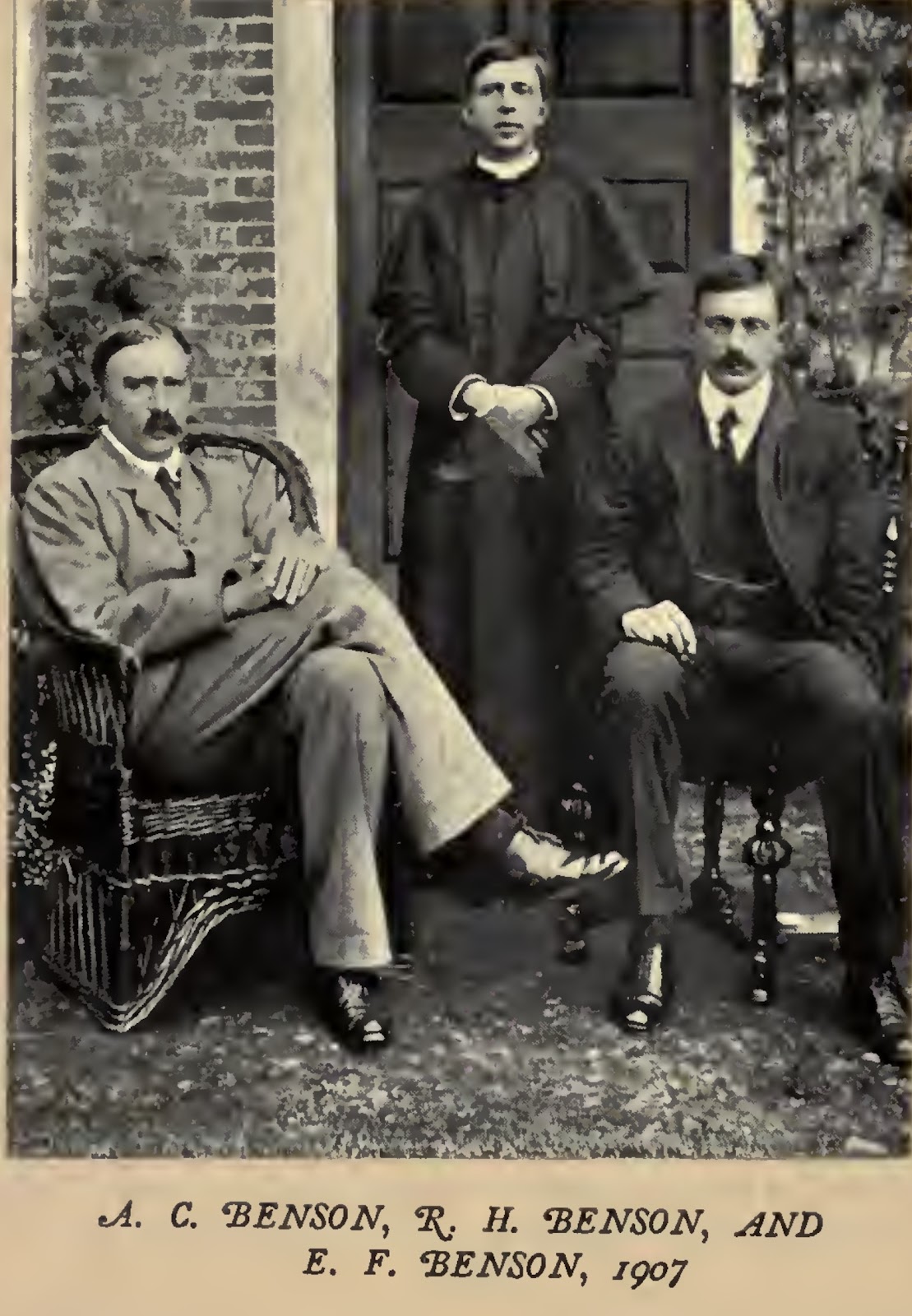
Arthur Christopher Benson (1862-1925) was the eldest of the three Benson brothers, sons of an Archbishop of Canterbury.  They made signal contributions as academic (A.C), cleric (R.H.) and writer (E.F.). All left books, including peerless and varied collections of supernatural fiction. Each took some inspiration from M.R. James, the genre's master prose stylist. Each wrote psychological and antiquarian tales, but also pieces we would today call folk horror. 

Not sure why I am so tardy in reading E.F. Benson's two brothers. ACB's stories, sampled this week in my new favorite anthology, The Big Book Of The Masters Of Horror, Weird And Supernatural Short Stories, are the opposite of E.F.'s: Arthur's protagonists rise to the challenge of vastation and fearlessly and consciously attend their respective appointments in Samarra. None have any curiosity about spiritualism or archaeology or winter sports. In fact, ACB's stories do not take place in the modern world at all. At best estimate, I would say the stories noted below take place before the Reformation. "The Temple of Death," seems to unfold before about 500 A.D., perhaps earlier.

As a point of personal taste, my favorite story is "The Red Camp." The reader will note some interesting contrasts to "A Warning to the Curious." In it, cash-poor and debt-ridden landowner uses a cursed hidden treasure to save the soul of its spectral guardian from earthly bondage.

I've been an atheist and a Marxist for almost four decades, and have never had much curiosity about Christianity or religion. I think some readers in our genre bring their own personal hang-ups about religion to it, which might be an obstacle to appreciating the depth of feeling and technical excellence of ACB's stories. If you think believers are fools, it can lead to a degree of aesthetic tone-deafness. Or perhaps I've recently read (and enjoyed!) too many essay collections by S.T. Joshi?


The Closed Window 

....the two young men drew near to the closed window; the shutters were tightly barred, and across the panels was scrawled in red, in an uncertain hand, the words CLAUDIT ET NEMO APERIT, which Mark explained was the Latin for the text, He shutteth and none openeth. And then Mark said that the story went that it was ill for the man that opened the window, and that shut it should remain for him.
     
One who has looked into the Unknown finds it hard to believe again in the outward shows of life....


The Gray Cat 

....Roderick had a strange dream; it seemed to him that he wandered over bare hillsides, and came at last to the pool; the peak rose sharp and clear, and the water was very black and still; while he gazed upon it, it seemed to be troubled; the water began to spin round and round, and bubbling waves rose and broke on the surface. Suddenly a hand emerged from the water, and then a head, bright and unwetted, as though the water had no power to touch it. Roderick saw that it was a man of youthful aspect and commanding mien; he waded out to the shore and stood for a moment looking round him; then he beckoned Roderick to approach, looking at him kindly, and spoke to him gently, saying that he had waited for him long. They walked together to the crag, and then, in some way that Roderick could not clearly see, the man opened a door into the mountain, and Roderick saw a glimmering passage within. The air came out laden with a rich and heavy fragrance, and there was a faint sound of distant music in the hill. The man turned and looked upon Roderick as though inviting him to enter; but Roderick shook his head and refused, saying that he was not ready; at which the man stepped inside with a smile, half of pity, and the door was shut.


The Hill of Trouble 

....he stepped back, and though he had a feeling that it would be wiser not to go, he put it aside and went boldly into the circle of stones. He stood there for a moment, and then feeling very weary, sate down on the turf, leaning his back against a stone; then came upon him a great drowsiness. He was haunted by a sense that it was not well to sleep there, and that the dreaming mind was an ill defence against the powers of the air — yet he put the thought aside with a certain shame and fell asleep.


Out of the Sea 

...."Come," said Father Thomas, turning upon him, "you speak thus of a thing, as you might speak of a dog — what is it like?" "Nay," said Henry, "I know not; I can never see it clearly; it is like a speck in the eye — it is never there when you look upon it — it glides away very secretly; it is most like a goat, I think. It seems to be horned, and hairy; but I have seen its eyes, and they were yellow, like a flame."


The Red Camp 

....The Holy Church hath power indeed over the spirits of evil, the devils that enter into men. But I have not heard that she hath power over the spirits of the dead, and least of all over those that lived and died outside the fold. It seems to me, though I but grope in darkness, that these poor spirits grudge the treasure that they fought and died for to the hands of a man who hath not fought for it.


The Slype House 

….Between the candlesticks and behind the skull was an old and dark picture, at which he gazed for a time, holding his taper on high. The picture represented a man fleeing in a kind of furious haste from a wood, his hands spread wide, and his eyes staring out of the picture; behind him everywhere was the wood, above which was a star in the sky — and out of the wood leaned a strange pale horned thing, very dim. The horror in the man's face was skilfully painted, and Anthony felt a shudder pass through his veins. He knew not what the picture meant; it had been given to him by the old Italian, who had smiled a wicked smile when he gave it, and told him that it had a very great virtue. When Anthony had asked him of the subject of the picture, the old Italian had said, "Oh, it is as appears; he hath been where he ought not, and he hath seen somewhat he doth not like." When Anthony would fain have known more, and especially what the thing was that leaned out of the wood, the old Italian had smiled cruelly and said, "Know you not? Well, you will know some day when you have seen him;" and never a word more would he say.


The Temple of Death

....After the meal the man asked him to tell him something of the new faith, and Paullinus very willingly told him as simply as he could of the Way of Christ.

The man listened with a sort of gloomy attention. "So it is this," he said at last, "which is taking hold of the world! well, it is pretty enough — a good faith for such as live in ease and security, for women and children in fair houses; but it suits not with these forests. The god who made these great lonely woods, and who dwells in them, is very different," — he rose and made a strange obeisance as he talked. "He loves death and darkness, and the cries of strong and furious beasts. There is little peace here, for all that the woods are still — and as for love, it is of a brutish sort. Nay, stranger, the gods of these lands are very different; and they demand very different sacrifices. They delight in sharp woes and agonies, in grinding pains, in dripping blood and death-sweats and cries of despair. If these woods were all cut down, and the land ploughed up, and peaceful folk lived here in quiet fields and farms, then perhaps your simple, easy-going God might come and dwell with them — but now, if he came, he would flee in terror."


I would be remiss if I did not acknowledge Matt Cowan's blog post about Arthur Christopher Benson 
at Horror Delve here.


Jay
13 September 2019


Monday, September 9, 2019

Robert Hugh Benson: Specters and grace


Father Robert Hugh Benson (1871-1914) wrote much, but cannot escape the shadow of a better writer, his brother E.F.

Well, perhaps not better, but certainly more single-minded and accomplished in his artistry.

R.H.'s stories have their own aesthetic authority, and they are masterful in their modest sacerdotal seriousness.


"Consolatrix Afflictorum"
A young boy gets a visit from the spirit of his recently deceased mother.

....One night I was lying half dozing against my mother's breast, my head against her heart, and not, as I usually lay, with my head on her shoulder. As I lay there it seemed to me as if I heard a strange sound like the noise of the sea in a shell, but more melodious. It is difficult to describe it, but it was like the murmuring of a far-off crowd, overlaid with musical pulsations. I nestled closer to her and listened; and then I could distinguish, I thought, innumerable ripples of church bells pealing, as if from another world. Then I listened more intently to the other sound; there were words, but I could not distinguish them. Again and again a voice seemed to rise above the others, but I could hear no intelligible words. The voices cried in every sort of tone — passion, content, despair, monotony. And then as I listened I fell asleep. As I look back now, I have no doubt what voices those were that I heard....

Over the Gateway
An excellent example of what I refer to as Machenean perichoresis.

...."Did I ever tell you," he asked, "about what I saw out there in the garden? It looks ordinary enough now: yet I saw there what I suppose I shall never see again on this side of death, or at least not until I am in the very gate of death itself."

....Now I do not know how to explain myself, but I was conscious that across this material world of light and color there cut a plane of the spiritual world, and that where the planes crossed I could look through and see what was beyond. It was like smoke cutting across a sunbeam. Each made the other visible.

The Traveler
Superb antiquarian tale.

....I know this is a great platitude, but I never can look at a piece of old furniture without a curious thrill at a thing that has been so much saturated with human emotion....

....The church stood only a few steps away, for the garden and churchyard adjoined one another. As I went down carrying the lantern that Parker had lighted for me, I remember hearing far away to the south, beyond the village, the beat of a horse's hoofs. The horse seemed to be in a gallop, but presently the noise died away behind a ridge. 

The Watcher
The first story I read by RHB. Several decades ago it brought tears to my eyes. Sublime.

....the ready tears of old age.


The Blood-Eagle
Antiquarian, Machenean, sui generis.

...."Then we heard a scuffling in front of us and a grunting, and some big creature came hurrying down the path. As it passed us I looked, almost terrified out of my mind, and saw that it was a huge pig; but the thing that held me breathless and sick was that there ran nearly the whole length of its back a deep wound, from which the blood dripped. The creature, grunting heavily, tore down the path towards the cottage, and presently the sound of it died away. As I leaned against Jack, I could feel his arm trembling as it held the tree.

"'Oh!' he said in a moment, 'we must get out of this. Which way, which way?'

"But I had been still listening, and held him quiet.

"'Wait,' I said, 'there is something else.'

"Out of the wood in front of us there came a panting, and the soft sounds of hobbling steps along the path. We crouched lower and watched. Presently the figure of a bent old man came in sight, making his way quickly along the path. He seemed startled and out of breath. His mouth was moving, and he was talking to himself in a low voice in a complaining tone, but his eyes searched the wood from side to side.

"As he came quite close to us, as we lay hardly daring to breathe, I saw one of his hands that hung in front of him, opening and shutting; and that it was stained with what looked black in the moonlight. He did not see us, as by now we were hidden by a great bramble bush, and he passed on down the path; and then all was silent again....


Jay
9 September 2019


Friday, July 26, 2019

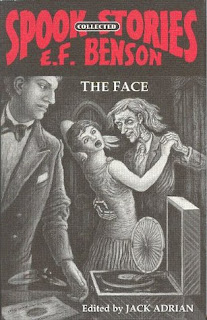
Not my idea of a peaceful night: "The Face" by E.F. Benson


July 24 was the 152nd anniversary of E.F. Benson's birth.

On Facebook that day Ramsey Campbell singled-out Benson's "The Face" for particular praise.

A praiseworthy story of incredible uncanny power it is. If one were looking for a "missing link" between M.R. James and Robert Aickman, "The Face" would be an outstanding candidate. It's "gone in the night" climax will also strike a chord with Campbell readers.

Excerpt:


....The gallery was crowded when she got there; there were friends among the sightseers, and the inspection of the pictures was diversified by cheerful conversation. There were two or three fine Raeburns, a couple of Sir Joshuas, but the gems, so she gathered, were three Vandycks that hung in a small room by themselves. Presently she strolled in there, looking at her catalogue. The first of them, she saw, was a portrait of Sir Roger Wyburn. Still chatting to her friend she raised her eye and saw it….

Her heart hammered in her throat, and then seemed to stand still altogether. A qualm, as of some mental sickness of the soul overcame her, for there in front of her was he who would soon come for her. There was the reddish hair, the projecting ears, the greedy eyes set close together, and the mouth smiling on one side, and on the other gathered up into the sneering menace that she knew so well. It might have been her own nightmare rather than a living model which had sat to the painter for that face.

"Ah, what a portrait, and what a brute!" said her companion. "Look, Hester, isn't that marvellous?"

She recovered herself with an effort. To give way to this ever-mastering dread would have been to allow nightmare to invade her waking life, and there, for sure, madness lay. She forced herself to look at it again, but there were the steady and eager eyes regarding her; she could almost fancy the mouth began to move. All round her the crowd bustled and chattered, but to her own sense she was alone there with Roger Wyburn.

And yet, so she reasoned with herself, this picture of him—for it was he and no other—should have reassured her. Roger Wyburn, to have been painted by Vandyck, must have been dead near on two hundred years; how could he be a menace to her? Had she seen that portrait by some chance as a child; had it made some dreadful impression on her, since overscored by other memories, but still alive in the mysterious subconsciousness, which flows eternally, like some dark underground river, beneath the surface of human life? Psychologists taught that these early impressions fester or poison the mind like some hidden abscess. That might account for this dread of one, nameless no longer, who waited for her.

That night down at Rye there came again to her the prefatory dream, followed by the nightmare, and clinging to her husband as the terror began to subside, she told him what she had resolved to keep to herself. Just to tell it brought a measure of comfort, for it was so outrageously fantastic, and his robust common sense upheld her. But when on their return to London there was a recurrence of these visions, he made short work of her demur and took her straight to her doctor.

"Tell him all, darling," he said. "Unless you promise to do that, I will. I can't have you worried like this. It's all nonsense, you know, and doctors are wonderful people for curing nonsense."

She turned to him.

"Dick, you're frightened," she said quietly.

He laughed.

"I'm nothing of the kind," he said, "but I don't like being awakened by your screaming. Not my idea of a peaceful night. Here we are."


"The Face" by E.F. Benson


Jay

26 July 2019


Saturday, May 11, 2019

"Negotium Perambulans" by E.F. Benson

You can't go home again 


   “I stick to work and whisky. God! I’ve learned to paint since I saw you, and drink too for that matter. I live in the quarry-house, you know, and it’s a powerful thirsty place. Come and have a look at my things if you’re passing. Staying with your aunt, are you? I could do a wonderful portrait of her. Interesting face; she knows a lot. People who live at Polearn get to know a lot, though I don’t take much stock in that sort of knowledge myself.”
     I do not know when I have been at once so repelled and interested. Behind the mere grossness of his face there lurked something which, while it appalled, yet fascinated me. His thick lisping speech had the same quality. And his paintings, what would they be like? . . .
     “I was just going home,” I said. “I’ll gladly come in, if you’ll allow me.”
     He took me through the untended and overgrown garden into the house which I had never yet entered. A great grey cat was sunning itself in the window, and an old woman was laying lunch in a corner of the cool hall into which the door opened. It was built of stone, and the carved mouldings let into the walls, the fragments of gargoyles and sculptured images, bore testimony to the truth of its having been built out of the demolished church. In one corner was an oblong and carved wooden table littered with a painter’s apparatus and stacks of canvases leaned against the walls.
     He jerked his thumb towards a head of an angel that was built into the mantelpiece and giggled.
     “Quite a sanctified air,” he said, “so we tone it down for the purposes of ordinary life by a different sort of art. Have a drink? No? Well, turn over some of my pictures while I put myself to rights.”
     He was justified in his own estimate of his skill: he could paint (and apparently he could paint anything), but never have I seen pictures so inexplicably hellish. There were exquisite studies of trees, and you knew that something lurked in the flickering shadows. There was a drawing of his cat sunning itself in the window, even as I had just now seen it, and yet it was no cat but some beast of awful malignity. There was a boy stretched naked on the sands, not human, but some evil thing which had come out of the sea. Above all there were pictures of his garden overgrown and jungle-like, and you knew that in the bushes were presences ready to spring out on you . . .
     “Well, do you like my style?” he said as he came up, glass in hand. (The tumbler of spirits that he held had not been diluted.) “I try to paint the essence of what I see, not the mere husk and skin of it, but its nature, where it comes from and what gave it birth. There’s much in common between a cat and a fuchsia-bush if you look at them closely enough. Everything came out of the slime of the pit, and it’s all going back there. I should like to do a picture of you some day. I’d hold the mirror up to Nature, as that old lunatic said.”
     After this first meeting I saw him occasionally throughout the months of that wonderful summer. Often he kept to his house and to his painting for days together, and then perhaps some evening I would find him lounging on the pier, always alone, and every time we met thus the repulsion and interest grew, for every time he seemed to have gone farther along a path of secret knowledge towards some evil shrine where complete initiation awaited him . . . And then suddenly the end came.
I had met him thus one evening on the cliffs while the October sunset still burned in the sky, but over it with amazing rapidity there spread from the west a great blackness of cloud such as I have never seen for denseness. The light was sucked from the sky, the dusk fell in ever thicker layers. He suddenly became conscious of this.
     “I must get back as quick as I can,” he said. “It will be dark in a few minutes, and my servant is out. The lamps will not be lit.”
     He stepped out with extraordinary briskness for one who shambled and could scarcely lift his feet, and soon broke out into a stumbling run. In the gathering darkness I could see that his face was moist with the dew of some unspoken terror.
“You must come with me,” he panted, “for so we shall get the lights burning the sooner. I cannot do without light.”
     I had to exert myself to the full to keep up with him, for terror winged him, and even so I fell behind, so that when I came to the garden gate, he was already half-way up the path to the house.
I saw him enter, leaving the door wide, and found him fumbling with matches. But his hand so trembled that he could not transfer the light to the wick of the lamp . . . “But what’s the hurry about?” I asked.
     Suddenly his eyes focused themselves on the open door behind me, and he jumped from his seat beside the table which had once been the altar of God, with a gasp and a scream.
     “No, no!” he cried. “Keep it off! . . . ”
     I turned and saw what he had seen. The Thing had entered and now was swiftly sliding across the floor towards him, like some gigantic caterpillar. A stale phosphorescent light came from it, for though the dusk had grown to blackness outside, I could see it quite distinctly in the awful light of its own presence. From it too there came an odour of corruption and decay, as from slime that has long lain below water. It seemed to have no head, but on the front of it was an orifice of puckered skin which opened and shut and slavered at the edges. It was hairless, and slug-like in shape and in texture. As it advanced its fore-part reared itself from the ground, like a snake about to strike, and it fastened on him . . .
     At that sight, and with the yells of his agony in my ears, the panic which had struck me relaxed into a hopeless courage, and with palsied, impotent hands I tried to lay hold of the Thing.
     But I could not: though something material was there, it was impossible to grasp it; my hands sunk in it as in thick mud. It was like wrestling with a nightmare.
     I think that but a few seconds elapsed before all was over. The screams of the wretched man sank to moans and mutterings as the Thing fell on him: he panted once or twice and was still. For a moment longer there came gurglings and sucking noises, and then it slid out even as it had entered. I lit the lamp which he had fumbled with, and there on the floor he lay, no more than a rind of skin in loose folds over projecting bones....


https://ebooks.adelaide.edu.au/b/benson/ef/negotium-perambulans/


Monday, September 24, 2018

Face of fear: The House with the Brick-Kiln by E. F. Benson

....there came a crisp step on the gravel, a rattle at the front-door, and Jack came in.

“Good sport,” he said, “you gave up too soon.”

And he went straight to the table above which hung the picture of the man at the brick-kiln, and looked at it. Then there was silence; and eventually I spoke, for I wanted to know one thing.

“Seen anybody?” I asked.

“Yes. Why do you ask?”

“Because I have also; the man in that picture.”

Jack came and sat down near me.

“It’s a ghost, you know,” he said. “He came down to the river about dusk and stood near me for an hour. At first I thought he was real — was real, and I warned him that he had better stand further off if he didn’t want to be hooked. And then it struck me he wasn’t real, and I cast, well, right through him, and about seven he walked up towards the house.”

“Were you frightened?”

“No. It was so tremendously interesting. So you saw him here too. Whereabouts?”

“Just outside. I think he is in the house now.”

Jack looked round.

“Did you see him come in?” he asked.

“No, but I felt him. There’s another queer thing too; the chimney of the brick-kiln is smoking.”

Jack looked out of the window. It was nearly dark, but the wreathing smoke could just be seen.

“So it is,” he said, “fat, greasy smoke. I think I’ll go up and see what’s on. Come too?”

“I think not,” I said.

“Are you frightened? It isn’t worth while. Besides, it is so tremendously interesting.”

Jack came back from his little expedition still interested. He had found nothing stirring at the kiln, but though it was then nearly dark the interior was faintly luminous, and against the black of the sky he could see a wisp of thick white smoke floating northwards. But for the rest of the evening we neither heard nor saw anything of abnormal import, and the next day ran a course of undisturbed hours. Then suddenly a hellish activity was manifested.

That night, while I was undressing for bed, I heard a bell ring furiously, and I thought I heard a shout also. I guessed where the ring came from, since Franklyn and his wife had long ago gone to bed, and went straight to Jack’s room. But as I tapped at the door I heard his voice from inside calling loud to me. “Take care,” it said, “he’s close to the door....”


"The House with the Brick-Kiln" 

E. F. Benson

https://ebooks.adelaide.edu.au/b/benson/ef/house-with-the-brick-kiln/