Subscribe to my Substack

Showing posts with label Andrew Caldecott. Show all posts

Tuesday, August 23, 2022

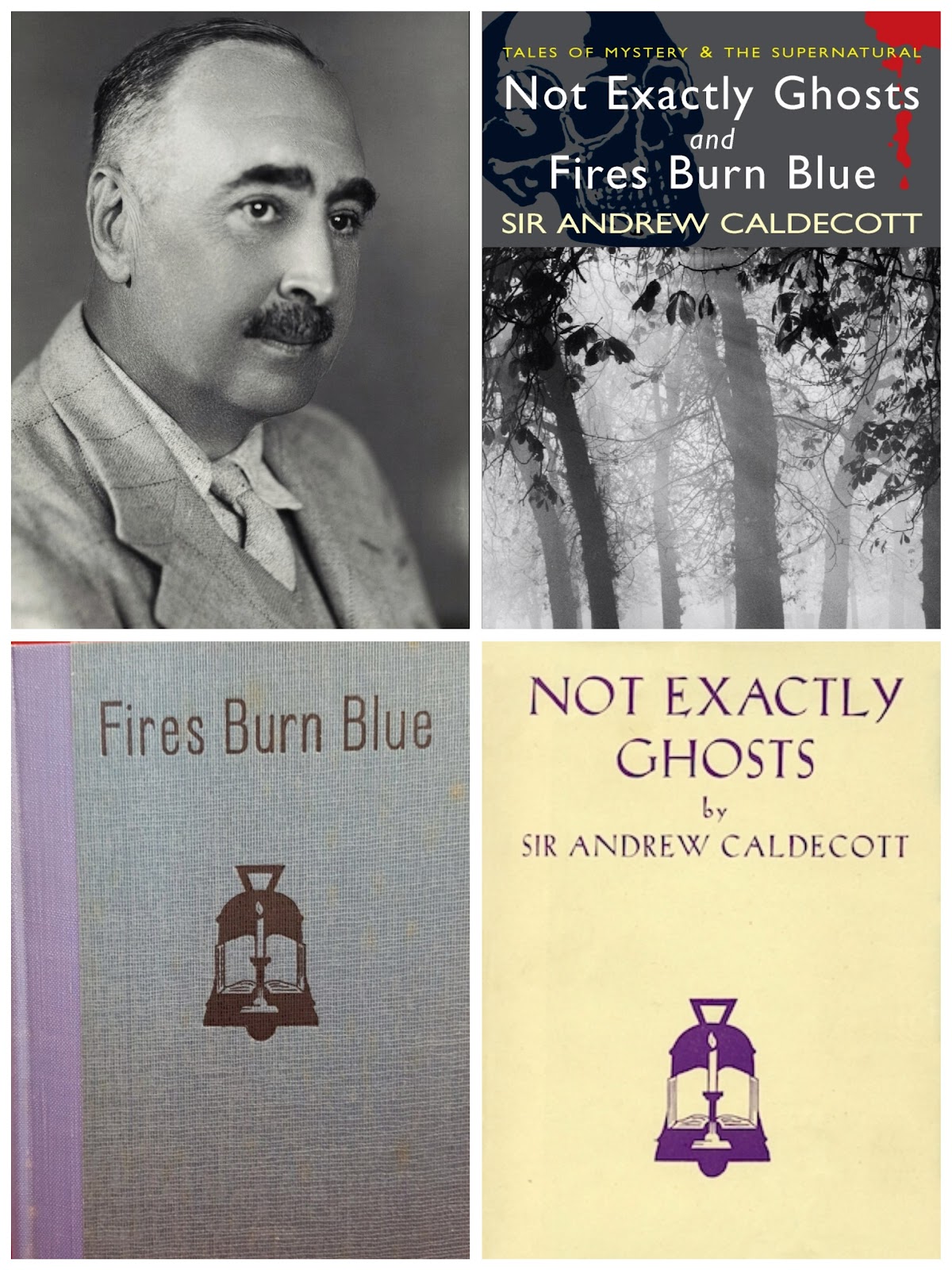
Fires Burn Blue (1948) by Andrew Caldecott

Readers unfamiliar with Fires Burn Blue may prefer to read these notes only after reading the collection.


Fires Burn Blue (1948) by Andrew Caldecott


An Exchange of Notes 

     Mrs Letitia Parlington, a "rather managing woman" reminiscent of certain characters in E. F. Benson's Tilling novels, saves the Telmington Philharmonic Club's performance of Sir Cuthbert Kewbridge' Poem for Chorus and Orchestra, Northern Lights


Cheap and Nasty 

'....You did a fine stroke of business, Kitty, in getting the stove so cheap; and this house too. We couldn't have found a nicer one at double the price. Now lie down and go to sleep again, darling, and don't keep your ears waiting for noises, or you'll begin imagining them.'


Grey Brothers 

     A team is sent into a dangerous zone of the Kongean jungle to bring out a man who has declared himself its king. The area is avoided by Kongeans themselves, as it is home to man-hunting spiders.


Quintet 

     A small party sat up in the parlour of Brindlestone Manor to see in the new year. There were five of them, three men and two women. The stillness of a windless frosty night and the warm glow of a log fire made them sleepy; yet it was only a quarter past ten. 

     'I vote we each tell a ghost story to keep ourselves awake,' said the youngest of the men. 'I want to practise my shorthand and I'll try jotting them down.'


Authorship Disputed 

     Vampiric plagiarism or incipient insanity?


Final Touches 

     'What reason is there for the feud?' 

     'Oh! each of the two families seems to have laid the other under a curse. No Perrandale will take the bridle-path to Knapton after nightfall, and no Farribal that footway to the north of the village green. They're frightened of being "touched", they say.'


What's in a Name? 

     "What's in a Name?" is a magnificent short story. Young and privileged, Ronald Austin Transome embraces the nickname Rat that others give him. His pet white rat Snattajin assumes a totemic role in his young life. At boarding school, the victories and punishments seem to find an echo in Snattajin's own life back home. The line between love for an animal and something more occult blurs when Rat is stricken with a dangerous fever during an outbreak of measles at his school.

      Caldecott's slingshot ending is robustly droll and celebratory:


....It is pleasant to be able to close this record with a coda in the major key. The Rat did great credit to St Olave's, winning a scholarship at Winchingham where he ended by being head of the school and captain of cricket. His career at Selham College, Oxbridge, was little less distinguished, though he just missed getting his blue. After considerable success at the Bar he was appointed Chief Justice of a prosperous colony, where he now is. Mr Transome, now an octogenarian, is fond of repeating that 'all this comes of his having been brought up in a thoroughly happy home; no coddling or making too much of him.'

     The Chief Justice's interests are wide. He is known to have read a paper before a Colonial Philosophical Society on 'Some survivals of a belief in Lycanthropy'. His white bull-terrier's name is 'Snattajin'. The history of the first Snattajin used to interest his contemporaries at Winchingham and Oxbridge, also many friends of his later life. That is why it is here offered to a wider public. Names (except that of Snattajin himself) have of course been altered or disguised, but the text of the narrative was sent to the Chief Justice's private secretary for any alterations or amendments that His Honour might consider desirable in the interest of truth or accuracy. His Honour made none, but endorsed the manuscript with the one word: 'Ratified'.


Under the Mistletoe 

     A story of murder in Kongea's white colinial milieu, imbricated with local superstition and nightime sightings of figures at windows of lonely bungalows.


His Name was Legion 

     A droll village story: the impact of a local scandal sheet whose contents are reportedly written by Spirits. Caldecott catches the local politics and personalities beautifully, and ends with a sharp crescendo.


Tall Tales but True 

     Caldecott recounts two stories given to him as true. Both are brief and pleasing in their oddness. The first is about a "phantasm of the living," the second about a house, or its resident couple, who are a nexus for uncanny events only determined to be uncanny "afterward."


A Book Entry 

     "A Book Entry" is one of the most effective Kongea colonial stories. It begins as a story of apparently whimsical signatures in a visitor's book, and of sleep-talking and sleep-walking. It ends, however, with a nicely managed and chilling line of revelation. 


Seeds of Remembrance 

     The flowers are helping Mabelson more than me. They make me remember his appearance too well. I had forgotten till now that he said to me 'Someday, Brayne, you will regret this…'

     I shall have to give up smelling the flowers. They focus my attention only on Mabelson, and he has left no successors or representatives…

     Mabelson keeps breaking in on me, even without the flowers. I seem to see and hear him in the room with me: a silly, senile illusion. Despite him I am completing all other settlements….


Seated One Day at the Organ 

     The strongest supernatural story in the collection, "Seated One Day at the Organ" recounts a vision foretelling death; it is seen by Fulstowe, the Scarminster abbey organist. Canon Glenside is dismissive. At first.


*   *   *


My notes on Caldecott's Not Exactly Ghosts (1946) can be found here.


Readers looking for the antiquarianism and rhetorical cunning of M. R. James should not expect to find it in Caldecott.


Not Exactly Ghosts and the 1948 collection Fires Burn Blue are modest and worth reading. Several stories in each collection achieve the level of a pleasing terror. Stories of blood, anger, jealousy and abuse of power recall stronger tales by Wakefield and Metcalfe; Maugham's colonial tragicomedies are not far away. Caldecott is a modest writer, and his prose is clear and unaffected. 


Jay

23 August 2022


Monday, August 22, 2022

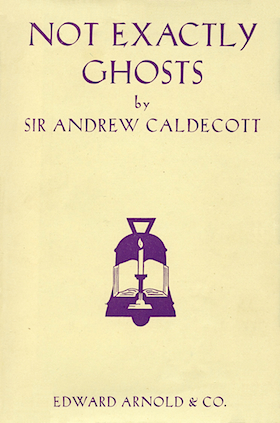
Not Exactly Ghosts (1946) by Andrew Caldecott


Readers unfamiliar with Not Exactly Ghosts may prefer to read these notes only after reading the collection.


     'But,' her husband remonstrated, 'you know that I don't believe in ghosts.'

     'No, but your aunt Cecilia does; and she is such a clever woman. By the way, she called in this morning and left you a book to look at.'

     'A book?'

     'Yes, the collected ghost stories of M. R. James.'

     'But the stupid old dear knows that I have them all in the original editions.'

     'So she said: but she wants you to read the author's epilogue to the collection which, she says, is most entertaining. It's entitled "Stories I have tried to write". She said that she'd side-lined a passage that might interest you. The book's on that table by you. No, not that: the one with the black cover.'

     Dreyton picked it up, found the marked passage and read it aloud.

     'There may be possibilities too in the Christmas cracker if the right people pull it and if the motto which they find inside has the right message on it. They will probably leave the party early, pleading indisposition; but very likely a previous engagement of long standing would be the more truthful excuse.'

     'There is certainly,' Dreyton commented, 'some resemblance between James's idea and our recent experience. But he could have made a perfectly good yarn out of that theme without introducing ghosts.'

     His wife's mood at that moment was for compromise rather than controversy.

     'Well, darling,' she temporised, 'perhaps not exactly ghosts.'


"Christmas Re-union"


*   *   *


Not Exactly Ghosts (1946) 

by Andrew Caldecott (1884-1951)


A Room in a Rectory 

     Said room is traditionally locked and left unused until the new vicar picks it for his sermon room. And what sermons they are!


MY DEAR SMITH

     I am so sorry you could not come for the New Year. There is little news to tell you, except that our worthy (?) incumbent intrigues me more and more. He is, believe me, surely and not slowly converting this countryside to a pseudo-mediaeval demonolatry. Those sermons I told you about in my last letter were in the nature of direct approaches to Manichaeism. Last Sunday he succeeded in being even more corruptive by prompting an undesirable reference to the Old Testament. You may remember that under a bequest of old Miss Hardham every seat in St Botolph's is provided with a copy of the Bible and Apocrypha. They are seldom opened, but there was an audible turning of leaves when Tylethorpe, preaching on the prodigal son, remarked that those of us who remembered the twenty-eighth chapter of the first book of Samuel, and especially the twenty-fourth verse, would realise that the return of the prodigal was not the only return associated in Holy Writ with a slaughter of the fatted calf. The result of this reference was of course that every one of his listeners, from old Bugles down to the newest joined choirboy, was quickly reading how the witch of Endor brought up the shade of Samuel from the grave. This continual harping upon the sinister and occult cannot be good for anybody and, if I mistake not, Tylethorpe himself begins to show nervous strain. For instance, he keeps turning to look behind him in an unpleasantly odd and furtive fashion and has taken to preaching not from the front of the pulpit but with his back to the wall at its side; just as though he feared that somebody might look or lean over his shoulder. This attitude so impressed me on Sunday that I found myself half expecting to see him suddenly propelled forward by some invisible and unwelcome agency! But enough of this nonsense. Do try to get down for a week-end soon. They have put on a good afternoon train leaving town at 4.23, if you cannot manage the 12.57.

     Yours sincerely,

     A. GRIBDEN


Branch Line to Benceston 

    The branch line was never completed, but a rider experiences it as an alternate reality, echoing his travails in the real world.


     'What are you going to do about your stairs?' he asked me.

     'Nothing,' I replied, 'and you?'

     'I'm having a fire escape put in from the box room next to my bedroom.'

     'That'll cost you something!'

     'Oh! not much. All one needs is a trap-door and a length of rope.... 


Sonata in D Minor 

     During a recording session, the blood feud between two brothers, violinist and pianist, explodes into murder. The record retains some of that homicidal energy.


[....] Whether the fault lay with player or instrument, the tone was indescribably horrible: it reminded Morcambe somehow of an animal moaning in pain, or was it rage? The piano, on the other hand, was being played exquisitely and, by contrast, made the violin all the more intolerable. Morcambe, indeed, rose from his chair to turn the radiophone off, but checked himself as he called to mind that this was an experiment and this his first reaction that he must remember to describe to Tullivant. As he moved towards the fire the tone of the violin grew even more shrill and strident, and fiercer in its apparent enmity to the piano. Catching a sudden glimpse of his reflection in the mirror above the mantelpiece, Morcambe did not like what he saw and turned angrily round. Sonata indeed! Vendetta for violin and piano, that was what he was listening to. The violinist had now reached that pizzicato passage in the first movement, in which his brutal plucking of the strings moved Morcambe to fury. With a pounce at the grate he seized the small poker from its tripod and brandished it towards the radiophone. No: there would be no relief in smashing that inanimate machine. The music clamoured for violence to flesh and blood! In a nervous frenzy he sprang towards the door, and then as suddenly recoiled. That swine, Tullivant, in his dirty cunning had, he remembered, bolted it...


Autoepitaphy 

     An antique desk dictates macabre self-obituaries to those seated at it.


The Pump in Thorp's Spinney 

     Nightmares inspired by obsession and coincidence plague a man from childhood. 


Whiffs of the Sea 

[....] He had thought the drawing and colouring good, as did I, and had bought it on its own merits at a sale for two pounds. He had subsequently developed a dislike for it and would let me have it for that sum. 'Nonsense,' I replied, 'you would die of remorse when you tot up your accounts! I'll give you three guineas for it. In my opinion it's good.'

     I was confirmed in this opinion when I saw the picture hanging in my rooms at Stanners Court, and Hollingdon, who dropped in for tea, congratulated me on the buy. 'It's got quite as much atmosphere in it,' he said, 'in spite of its accuracy of detail, as any of our modern impressionist stuff. The scene is almost unpleasantly alive.'


In Due Course 

     An uncle expected to live too long, a neighbor lady conducting dodgy seances, and pollarded elms by a river bank that seem to shield stick-thin figures all make for long days in the life of a nephew tired of waiting to ("in due course") inherit.


Light in the Darkness 

     Shades of Wells' "Pollock and the Porroh Man" in this story that starts in Kongea before sending its protagonist home.

     Martin Lorimer, administrator of an education college, angers everyone by trying to debunk as fraud a glowing religious shrine in a local cave. His actions cause political scandal and he is sent home; his physical change exceeds the political consequences.


Decastroland 

     Another story set out east in Kongea. A visiting painter is needled into contempt for a local artist by Miss Cavilege, art instructor at the local college. Like Miss Scettall in "In Due Course," her unconscious witchcraft creates a dangerous atmosphere.


A Victim of Medusa 

     A brief story about a man whose life interest was jellyfish, and who discovered - sadly - a book describing their use in scrying.


Fits of the Blues 

     A man in the gem trade interferes with a local religious ceremony while visiting Kongea. Nemesis zaps him once he returns home. A longer story, coldly wrought.


Christmas Re-union

     A jolly ghost story of Christmas: a dodgy uncle at a family house party gets unwelcome news, and is sped on his departure by "a visitor from down under."


*   *   *


In his guide to supernatural fiction, Bleiler refers to Andrew Caldecott's collection as "ghost stories and whimsies." Droll or whimsical some may be, but they all advance by the negative side: the cold black humor of reversed fortunes and biters bit. The stories are free of pathos and lugubrious sentiment. If the reader is looking for tales almost as good as Saki's, Not Exactly Ghosts will serve.


Jay

22 August 2022