Subscribe to my Substack

Showing posts with label Michael Shea. Show all posts

Wednesday, June 19, 2019

Shadows over Frisco: Stories by Michael Shea


Shea's Bay Area Cthulhu stories have several strengths: mastery of language, scene-building, and high skill with prose.  Most neo-Cthulhu stories coming out today never rise above the level of fan fiction, but Shea is a stylist first, and the braiding of his Bay Area world with that of the Old Ones is at a very high aesthetic level.  No occult detectives, no scholars seeking after the outre, no armed vigilantes or private dicks, just working people and people too old to work who find a fierce desire within themselves to defend their community when the shadows gather.


Notes and excerpts below.


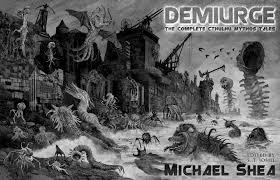
DEMIURGE: The Complete Cthulhu Mythos Tales of Michael Shea

Edited by S. T. Joshi

2017 Dark Regions Press


INTRODUCTION

....Michael Shea was anything but a pastichist; even when he was writing in novels or tales that avowedly imitated the work of others, his own dynamic originality kept bursting through—and the result is a series of works that, while drawing inspiration from prior texts, are infused with the distinctive vision of their creator.

....he quickly decided that he needed to draw upon his own Californian roots to generate tales that truly evoked the realistic topography—human, social, cultural, historical—of Lovecraft's best narratives.

....Shea, eschewing simple-minded moral condemnation, finds in these exiles from polite society a brooding determination to persevere in the face of poverty, crime and social condemnation that is strangely ennobling.

....Shea sensed that the cosmic and the human were not mutually exclusive. In such scintillating tales as "Copping Squid," "Dagoniad," and "Tsathoggua" he slyly leads the reader to the perception of unthinkable cosmic terror by means of characters whose all-too-human flaws make them the reader's eyes and ears as the awesome revelation slowly dawns.

....Shea both drew inspiration from H. P. Lovecraft and also transmuted Lovecraft's conceptions into his own by the alchemy of his imagination.

....he evolved into a genuine disciple whose vibrant originality and sensitivity Lovecraft would have recognized and admired.


FAT FACE

"Fat Face" bakes in the heat of Los Angeles dawns and dusks, of urban neighborhoods of coffee shops and old hotels, of superseded side streets of once pleasant residences left behind long ago. Its characters have fallen off the bottom rung of class society, and live an atomized lumpen existence, self-sedating and kidding themselves they have a future or any life plans worth thinking about. Bukowski has nothing on Shea with this milieu.

    ....She dreamed of a city like Hollywood, but the city's walls and pavements were half alive, and they could feel premonitions of something that was drawing near them. All the walls and streets of the city waited in a cold-sweat fear under a blackly overcast sky. She herself, Patti grasped, was the heart and mind of the city. She lay in its midst, and its vast, cold fear was hers. She lay, and somehow she knew the things that were drawing near her giant body. She knew their provenance in huge, blind voids where stood walls older than the present face of Earth; she knew their long cunning toll to reach her own cringing frontiers. Giant worms they were, or jellyfish, or merely huge clots of boiling substance. They entered her deserted streets, gliding convergingly. She lay like carrion that lives and knows the maggots' assault on it. She lay in her central citadel, herself the morsel they sped toward, piping their lust from foul, corrosive jaws.


NEMO ME IMPUNE LACESSIT

This is an astonishing and masterful story.  It far exceeds Bloch's Poe ventriloquism, and employs it beautifully in a tale of revenge worthy of a Montresor scion. Our narrator carries out an ingenious act of revenge against his former wife and her retinue, with the help of a shoggoth, from "roses" from Yuggoth, some "hounds" and various other tarantulaic and boiling entities ready to partake of  a bounteous May Eve.


THE PRESENTATION

A shadow over Frisco (and shadows are plentiful in Shea's Frisco) in the form of a new tech company wows the bohemian milieu. The avatar of Cthulhu comes in form of a business "master of the world" named Chip Shugrue; he has deep pockets and a generous checkbook. Shea gives us a big social canvas of characters, for each of whom Chip's money (and his portal project) become end-all and be-all.

    The presentation itself is the devil's own Ted Talk.

    ....And that was when, as one, they felt the sudden presence of the Entrepreneur, the Holder of this Account into whose bottomless wealth they'd just disgorged their holdings. The Holder of the Account hung just below them in the black gulf.

    They felt him as an immense subjacent gravitational mass. They felt the tug of a leviathan hanging just under the keel of their collective consciousness.

    And his sudden presence gave them all a wonderful moment of childhood. It was that Daddy feeling—that the grand, glorious, but frighteningly vast muchness and suchness of the world was mediated for your little self. That Daddy's greater, loving mass hovered between you and the immensity, a loving canopy of concern, a big ally in the bigness of it all....


THE POOL

Daryl is a social dropout working as a laborer on a crew digging holes for swimming pools in Marin County.

    ....What had these glacial horrors to do with him? It was as if, with ghostly fanfare, the Beyond had delivered its message to the wrong man on the wrong world.


THE RECRUITER

Chester is an old widower approaching the end.  He lives in a transient hotel in Frisco, a recurring location for Shea and artfully evoked. Chester gets a life-saving cash windfall, then learns what he must do to earn the pay.

    ....Galvanized, he sits up to swing his legs off the bed—and discovers a terror that dwarfs what he's already feeling: his body has not stirred. Violently, he again exerts his will … and his frame lies untouched by it, calm as sleep.


THE BATTERY

A non-Bay Area story, rare for this collection.  "The Battery: takes place on an isolated strip of coast in South Florida. One of Shea's great subjects is people confronting the unspeakable and reaching out in solidarity for allies.  His heroes are rarely intellectuals or scholarly, but in this story a couple are.

    ....Do you two realize that we have occupied our post of vigilance, wherever in the world it took us, for more than thirty years? And generations before us have done likewise, but to us it has been given to discharge our trust and confront the apocalypse. And at the same time it has been given us, near the end of our watch, which is the end of our lives, to find our successors, and to meet at last our dearest friends."


COPPING SQUID

It is easy to understand why "Copping Squid" has gained a reputation as one of Shea's best stories.  Like many of the best, it is a San Francisco Bay-area story, and takes us into the hills east of Richmond. What Shea's protagonist finds there, and what he comes away with, may not be beyond human ken, but they are things beyond reason.

    ....And the knell of that voice awoke winds in the night, and the winds buffeted Ricky as though he hung in the night sky within the eye, and Ricky knew. He knew this being into whose view he'd come! Knew this monster was the king of a vast migration of titans across the eons of the countless Space-Times! Over the gale-swept universe they moved, these Great Old Ones. Across the cracked continents they trawled, they plundered! Worlds were the pastures that they grazed, and the broken bodies of whole races were the pavement that they trod!


DAGONIAD

"dagoniad" details the opening guns in the battle to defnd the bay area from the Old One in the Bay. The heroes are the owne4r of a hole-in-the-wall bookstore and a young prostitute: both are women. It's a graphic and rousing story.

    "You know what we should do? We should defy him."

    "Dagon." Dee said it dully, not quite asking.

    "Dagon. Look at this thing! What good could meekness do us against its master? I say fuck him! What right does he have to our world? To our lives?"


TSATHOGGUA

"Tsathoggua" is the culminating Bay Area story.  It sees the founding of the "fellowship of the ring" of individuals who have survived previous encounters with Old Ones and their minions, have had enough, and are ready to join together to draw a line.  These are not elite and learned academics, nor students, or "seekers after the outre." They are seasoned working class people living a precarious economic existence in San Francisco, but who view it as their town.


MOMMA DURTT

A man makes his own god by accumulating illegally dumped toxic waste in an abandoned mineshaft near Richmond, California.  Shea is a master dramatizing each character through suggestive initial bits of plot before the main course. He has the skill and the confidence to switch through multiple characters, giving his short stories and novellas the breadth and scope of novel.

    ...."You gotta meet my Auntie some day," Alex said, scanning that view. "She's like half Miwok or something. Anyway she told me this mountain Chip's mine is in was like a Spirit Place—like where you go to fast and have visions? Go to like, face your demons and stuff."

    "Spirits! Rad. I wish there was something cool like that about it. That would be something, but I think what these guys are doing up here is just plain old creepy and criminal."

    "Yeah, but we don't really know that, not for sure. Anyway, we're definitely good and late now. Maybe he's just gonna fire us. When Chip said get back on time, he put a lot into it."


Jay

19 June 2019


C:\Users\john.rothermel\AppData\Local\Microsoft\Windows\INetCache\Content.MSO\66FC06DD.tmp

Friday, June 14, 2019

7 Short Stories by Michael Shea: Reading notes


That Frog!

This story is executed with the elan of an S.J. Perelman. The jocose understatement, the unreliability of the narrator, and all the hidden ghastliness of the joke, are unchallengeable. Our perfectly sane and reasonable protagonist never sees the punch line: he is the monster. And a very thorough one; like the narrator of "The Horla," who forgot to get his servants out of the house before he burned it to the ground.


Grunt-12 Test Drive

A tale of time travel, car salesmanship, and sibling rivalry paced to outstrip the Keystone Kops.


Fill It With Regular

Kaleidoscopic and masterful alien invasion story with an Emmerich-scale scope and cast.  Superior to Kevin J. Anderstons 2000 novel Ill Wind.

    ....Gasoline and some municipal supplies of natural gas were thought to be its initial vector, at least in California and others of the heaviest-hit states. The mechanisms of its continuing diffusion were no mystery. The fungus's omniperipheral advance, by mycelial branching, was incredibly rapid in itself, of course, through any food matrix. But with the combustion of that matrix, the mycelium it contained underwent a fusion and a heat-triggered concentration of genetic material, and resolved itself into a gust of exceedingly small and numerous spores. Hence the roadways were only the first of many zones that those first vectors had seeded, since most of a tail pipe's tillage went aloft to haunt the troposphere. There was the real scope of this thing, and it made Ken shiver slightly, imagining that global microsnow, that sooty seed like a gauze-fine, wide-flung shroud settling right now — softly, softly — down upon them all. What could anybody do but drive out to business as usual through this awesome newness that had been laid upon the world?


Delivery

A reproductive rights dystopia told in the language of dream fever, giving us the tip of a poisoned alp that rides just below the surface.

    ....The doctor's fingers were wedged in the os now, gripping the hair plug. Briefly, Lupe's womb seemed to recoil, to be at tug-of-war with him, and then it surrendered with a peristaltic shudder, and the slick mass of their second-born was uprooted — the crooked black legs, bunched like bananas below the bristly abdominal bulb, plucked free. The doctor carried it to the troopers' cart.

    One of them opened the glass box's trap, and the doctor eased it through. It poured off his cupped palms and scuttled around its bright, warm crib, pedipalps caressing the glass, so brisk and fully expert in its life's first moments.


For Every Tatter in Its Mortal Dress

An atypical and abstract fantasy along the lines of Borges or Kafka, in which one stranger's self-imposed suffering inflicts itself on another.


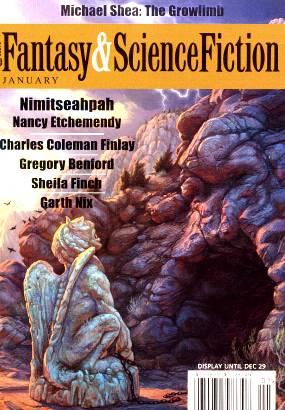
The Growlimb

A man makes his own god and calls it forth in Northern California wine country. A faultless tale, unerringly executed.

    .....All living things were dangerous miracles. Each tree brimmed with majesty as it wore the light, and the wind moved through it, but anything that lived could blow up in your face. And if you did win your own immortality, then you must live it in the web of these mortal lives, and you must endure all of their deaths, death after death after death. And if the beauty of it all – fields farms trees skies suns stars – was almost unendurable now, must not immortality itself kill you if you did attain it? Kill you with all that excruciating beauty?


Momma Durtt

A man makes his own god by accumulating illegally dumped toxic waste in an abandoned mineshaft near Richmond, California.  Shea is a master dramatizing each character through suggestive initial bits of activity before the main course. He has the skill and the confidence to switch through multiple characters, giving his short stories and novellas the breadth and heft of novel.

    ...."You gotta meet my Auntie some day," Alex said, scanning that view. "She's like half Miwok or something. Anyway she told me this mountain Chip's mine is in was like a Spirit Place—like where you go to fast and have visions? Go to like, face your demons and stuff."

    "Spirits! Rad. I wish there was something cool like that about it. That would be something, but I think what these guys are doing up here is just plain old creepy and criminal."

    "Yeah, but we don't really know that, not for sure. Anyway, we're definitely good and late now. Maybe he's just gonna fire us. When Chip said get back on time, he put a lot into it."


Jay

14 June 2019


Wednesday, June 12, 2019

Michael Shea: An initial encounter with the short fiction

1987: Arkham House


POLYPHEMUS
Was Shea considered New Wave?  Perhaps he came later. My ignorance of science fiction is almost complete, but "Polyphemus" strikes me as a compelling example of Hard SF flowing not from math or engineering, but from the biological sciences.  It is a skilled work of world-building, as well, where th society's back-story must be inferred by careful ready and is not handled with an info-dump. It is also a first-rate problem-solving adventure/frontier story.

THE ANGEL OF DEATH
Here is a perfectly and aesthetically satisfyingly fiction. Shea's style, his own but on a par in craft and authority with Flaubert and Conrad, is deployed in a masterful depiction of the meeting between an an alien conducting a field study and a Son of Sam-type serial killer. Pacing and scene-building are carefully executed, the protagonists modstly rounded.

UNCLE TUGGS
An uproarious piece of supernatural revenge slapstick, recounting one of those days when nothing goes right and we wonder whose side the gods are really on.  Here they are on the side of the wronged, though the laborer through whom they act probably has a different opinion now.

THE PEARLS OF THE VAMPIRE QUEEN
Swords and sorcery told deftly with gusto.
    ....She knelt beside him, and her face was taut, refined by a tension of icy love, made younger before our eyes by her passionate anticipation. She lowered her face—worshipfully, kissing—to the muscled juncture of his neck and shoulder. And then there was a crisp, liquid sound of horrible distinctness, her hands clutched his shoulders, and the King's body rose and convulsed upon the stone with the raw, coiling power of a speared eel.

THE HORROR ON THE #33
Shea is at his best when he conveys the economic dead-end choices thrust upon the marginalized who have fallen off the bottom rung of the ladder. It doesn't take much else to illuminate the horror of such a trap.
    ....A person without experience of the wino perspective could easily miss the peculiar dismalness of Knavle's position. He and his caste inhabit the waste corners of the world and have therefore the least power to hide of any class of men. Only a man who possesses things has any power to rearrange his life, to avoid or defend; as for the resolutely destitute, they are already clinging to crannies and last possibilities. There are only so many places to sleep for free, or to get a morning's work distributing supermarket advertisers, and to these places Knavle had to go.

THE EXTRA
"The Extra" is a slangy, impressionistic story of an atomized market future where individual barbarians combat corporate barbarians in the context of going to work.  Each is looking out for number one; there previous little gentility and even smaller space for sentiment.

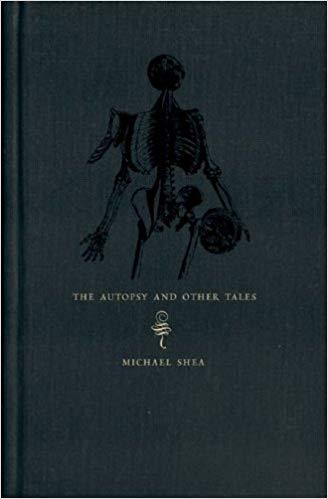
THE AUTOPSY
Doctor Winters, our pathologist, carries a fellow traveler in his body: the cancer that will kill him.  Joe Allen, a footloose laborer killed in a mine explosion, hosts a different kind of traveler in his body. Shea makes of this conflict a masterpiece of speculative horror, a tale whose canonical status has been acknowledged for several decades now. Shea's surgical brevity in handling such a rich situation is admirable.
    ....the doctor had glimpses of the racial history that underlay the aliens' predatory present. Glimpses of a dispassionate, inquiring breed so advanced in the analysis of its own mental fabric that, through scientific commitment and genetic self-sculpting, it had come to embody its own model of perfected consciousness. It had grown streamlined to permit its entry of other beings and its direct acquisition of their experiential worlds. All strictest scholarship at first, until their matured in the disembodied scholars their long-germinal and now blazing, jealous hatred for all 'lesser' minds rooted and clothed in the soil and sunlight of solid particular worlds. The parasite spoke of the 'cerebral music,' the 'symphonies of agonised paradox' that were its invasion's chief plunder. The doctor felt the truth behind this grandiloquence: the parasite's actual harvest from the systematic violation of encoffined personalities was the experience of a barren supremacy of means over lives more primitive, perhaps, but vastly wealthier in the vividness and passionate concern with which life for them was imbued.


Jay
12 June 2019


Thursday, February 8, 2018

The Color Out of Time by Michael Shea (1984)

The Color Out of Time by Michael Shea (1984).

A modest novel-length pendant to Lovecraft's supreme "The Colour Out of Space" (1927).

All the sins of Lovecraft pastiche by Lovecraft's epigones are on display. An alien  force that in "The Colour Out of Space" was completely indifferent to mankind and earth becomes for Shea an occasion for good versus evil combat. Can plucky humans thwart the alien menace?

Some human monsters have walk-on roles, as they did in J.G. Ballard's early apocalypse novels. Other horrific anatomic consequences foreshadow the rural body-horror of Stephen King's Dreamcatcher.

Reading this novel may sound like a chore. But Shea played a large role in the literature of Lovecraftismo in the post-1970 period. It is of historical interest for completists to check it off their lists.

Jay
8 February 2018


Tuesday, September 5, 2017

Copping Squid by Michael Shea

....See the ice-cold, spinecrawlin, hair-stirrin truth?

....And he beheld a dizzying mosaic of lights flashing to life within the mighty pupil. A grand midnight vision crystallized: the whole of San Francisco Bay lay within the black orb, bordered by the whole bright oroboros of coastal lights . . . 

* * *

He and Andre gazed on the vista, on the Bridges' glittering spines transecting it, all their lengths corpuscled with fleeing lights red and white. The two men gazed on the panorama and it drank their minds. Rooted, they inhabited its grandeur, even as it began a subtle distortion. The vista seemed tugged awry, torqued toward the very center of the giant's pupil. And within that grand, slow distortion, Ricky saw strange movements. Across the Bay Bridge, near its eastern end, the cargo cranes of West Oakland—tracked monsters, each on four mighty legs—raised and bowed their cabled booms in a dinosaurian salute—obeisance, or acclaim . . . while to their left, the giant tanks on Benecia's tarry hills, and the Richmond tanks too in the west, began a ponderous rotation on their bases, a slow spin like planets obeying the pupil's gathering vortex.

....He knew this being into whose view he'd come! Knew this monster was the King of a vast migration of titans across the eons of the countless Space-Times! Over the gale-swept universe they moved, these Great Old Ones. Across the cracked continents they trawled, they plundered! Worlds were the pastures that they grazed, and the broken bodies of whole races were the pavement that they trod!

Michael Shea, "Copping Squid" short story.

Wednesday, March 1, 2017

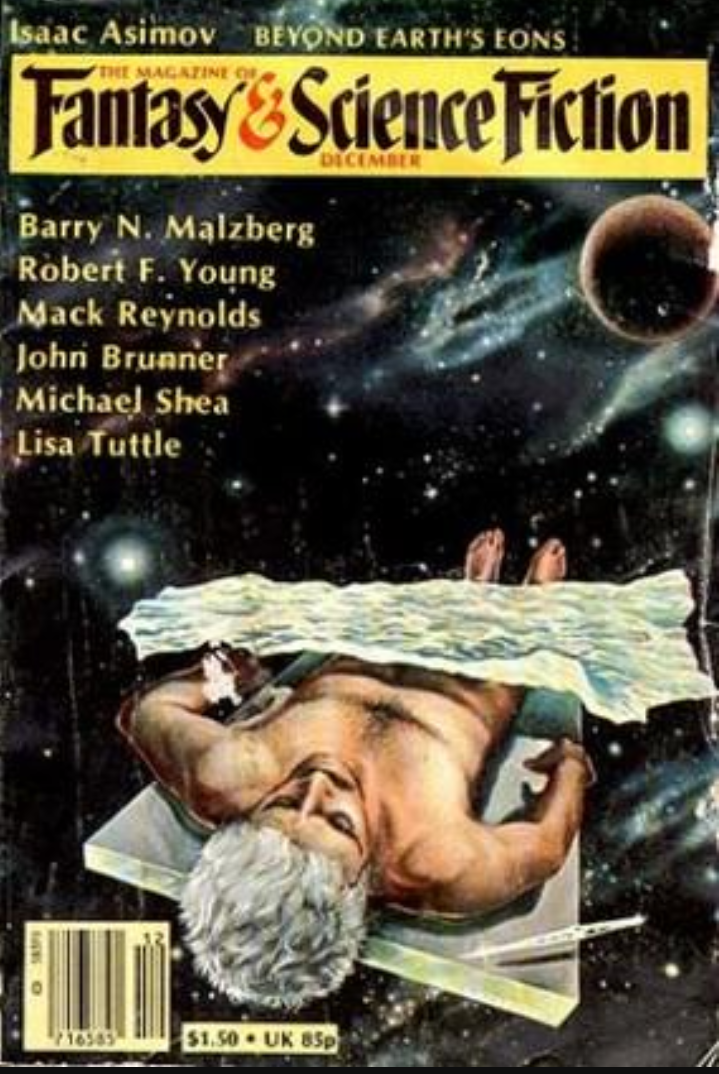
Ruined choirs of the body: Michael Shea's story The Autopsy

Michael Shea's 1980 novella "The Autopsy" is available here.


Audio artist Morgan Scorpion has a very good reading of the story available here.


Shea's story is intimate, with only a couple of characters. Still, it recalls Campbell's "Who Goes There?" and Heinlein's The Puppet Masters. Shea's alien also contains echoes of sociopathic sybarites like Hannibal Lecter: a genius who dines on the manipulation and immiseration of lesser beings.


The story begins with a meeting between a pathologist named Winters and a sheriff named Craven. Craven tells his friend the doctor about odd events leading up to an underground mine explosion. To me this interaction is as interesting as the battle of wits contained in the second half of the story.


Dr. Winters arrives in the mountain mining town of Bailey in the middle of the night.


….He entered the courthouse by a side door. His heels knocked on the linoleum corridor. A door at the end of it, on which was lettered NATE CRAVEN, COUNTY SHERIFF, opened well before he reached it, and his friend stepped out to meet him.


"Dammit, Carl, you're still so thin they could use you for a whip. Gimme that. You're in too good a shape already. You don't need the exercise."


The case hung weightless from the sheriff's hand, imparting no tilt at all to his bull shoulders. Despite his implied self-derogation, he was only moderately paunched for a man his age and size. He had a rough-hewn face, and the bulk of brow, nose, and jaw made his greenish eyes look small until one engaged them and felt the snap and penetration of their intelligence. In the office he half filled two cups from a coffee urn and topped off both with bourbon from a bottle in his desk. When they had finished these, they had finished trading news of mutual friends. The sheriff mixed another round and sipped from his, in a silence clearly prefatory to the work at hand.


"They talk about rough justice," he said. "I've sure seen it now. One of those … patients of yours that you'll be working on? He was a killer. Christ, 'killer' doesn't half say it. A killer's the least of what he was. The blast killing him, that was the justice part. Those other nine, they were the rough. And it just galls the hell out of me, Carl! If that kiss-ass boss of yours has his way, the rough won't even stop with their being dead! There won't even be any compensation for their survivors! Tell me – has he broke his back yet? I mean, touching his toes for Fordham Mutual?"


"You refer, I take it, to the estimable Coroner Waddleton of Fordham County." Dr. Winters paused to sip his drink. With a delicate flaring of his nostrils he communicated all the disgust, contempt, and amusement he had felt in his four years as pathologist in Waddleton's office. The sheriff laughed.


"Clear pictures seldom emerge from anything the coroner says," the doctor continued. "He took your name in vain. Vigorously and repeatedly. These expressions formed his opening remarks. He then developed the theme of our office's responsibility to the letter of the law, and of the workmen's compensation law in particular. Death benefits accrue only to the dependants of decedents whose deaths arise out of the course of their employment, not merely in the course of it. Victims of a maniacal assault, though they die on the job, are by no means necessarily compensable under the law. We then contemplated the tragic injustice of an insurance company – any insurance company – having to pay benefits to unentitled persons, solely through the laxity and incompetence of investigating officers. Your name came up again, and Coroner Waddleton subjected it to further abuse. Fordham Mutual, campaign contributor or not, is certainly a major insurance company and is therefore entitled to the same fair treatment that all such companies deserve."


Craven uttered a bark of wrathful mirth and spat expertly into his wastebasket. "Ah, the impartial public servant! What's seven widows and sixteen dependant children, next to Fordham Mutual?" He drained his cup and sighed. "I'll tell you what, Carl. We've been five days digging those men out and the last two days sifting half that mountain for explosive traces, with those insurance investigators hanging on our elbows, and the most they could say was that there was 'strong presumptive evidence' of a bomb. Well, I don't budge for that because I don't have to. Waddleton can shove his 'extraordinary circumstances.' If you don't find anything in those bodies, then that's all the autopsy there is to it, and they get buried right here where their families want 'em."


The doctor was smiling at his friend. He finished his cup and spoke with his previous wry detachment, as if the sheriff had not interrupted his narrative.


"The honourable coroner then spoke with remarkable volubility on the subject of Autopsy Consent forms and the malicious subversion of private citizens by vested officers of the law. He had, as it happened, a sheaf of such forms on his desk, all signed, all with a rider clause typed in above the signatures. A cogent paragraph. It had, among its other qualities, the property of turning the coroner's face purple when he read it aloud. He read it aloud to me three times. It appeared that the survivors' consent was contingent on two conditions: that the autopsy be performed in locum mortis, that is to say in Bailey, and that only if the coroner's pathologist found concrete evidence of homicide should the decedents be subject either to removal from Bailey or to further necropsy. It was well written. I remember wondering who wrote it."


The sheriff nodded musingly. He took Dr. Winters's empty cup, set it by his own, filled both two-thirds with bourbon, and added a splash of coffee to the doctor's. The two friends exchanged a level stare, rather like poker players in the clinch. The sheriff regarded his cup, sipped from it.


"In locum mortis. What-all does that mean exactly?"


"In the place of death."


"Oh. Freshen that up for you?"


"I've just started it, thank you."


Both men laughed, paused, and laughed again, some might have said immoderately.


"He all but told me that I had to find something to compel a second autopsy," the doctor said at length. "He would have sold his soul – or taken out a second mortgage on it – for a mobile X-ray unit. He's right, of course. If those bodies have trapped any bomb fragments, that would be the surest and quickest way of finding them. It still amazes me your Dr. Parsons could let his X-ray go unfixed for so long."


"He sets bones, stitches wounds, writes prescriptions, and sends anything tricky down the mountain. Just barely manages that. Drunks don't get much done."


"He's gotten that bad?"


"He hangs on and no more. Waddleton was right there, not deputising him pathologist. I doubt he could find a cannonball in a dead rat. I wouldn't say it where it could hurt him, as long as he's still managing, but everyone here knows it. His patients sort of look after him half the time. But Waddleton would have sent you, no matter who was here. Nothing but his best for party contributors like Fordham Mutual."


The doctor looked at his hands and shrugged. "So. There's a killer in the batch. Was there a bomb?"


Slowly the sheriff planted his elbows on the desk and pressed his hands against his temples, as if the question had raised a turbulence of memories. For the first time the doctor – half hearkening throughout to the never-quite-muted stirrings of the death within him – saw his friend's exhaustion: the tremor of hand, the bruised look under the eyes.


"When I've told you what we have, I guess you'll end up assuming what I do about it. But I think assuming is as far as any of us will get with this one. It's one of those nightmare specials, Carl. The ones no one ever does get to the bottom of.


"All right, then. About two months ago, we had a man disappear – Ronald Hanley. Mine worker, rock-steady, family man. He didn't come home one night, and we never found a trace of him. OK, that happens sometimes. About a week later, the lady that ran the laundromat, Sharon Starker, she disappeared, no trace. We got edgy then. I made an announcement on the local radio about a possible weirdo at large, spelled out special precautions everybody should take. We put both our squad cars on the night beat, and by day we set to work knocking on every door in town collecting alibis for the two times of disappearance.


"No good. Maybe you're fooled by this uniform and think I'm a law officer, protector of the people, and all that? A natural mistake. A lot of people were fooled. In less than seven weeks, six people vanished, just like that. Me and my deputies might as well have stayed in bed round the clock, for all the good we did." The sheriff drained his cup.


"Anyway, at last we got lucky. Don't get me wrong now. We didn't go all hog-wild and actually prevent a crime or anything. But we did find a body – except it wasn't the body of any of the seven people that had disappeared. We'd taken to combing the woods nearest town, with temporary deputies from the miners to help. Well, one of those boys was out there with us last week. It was hot – like it's been for a while now – and it was real quiet. He heard this buzzing noise and looked around for it, and he saw a bee-swarm up in the crotch of a tree. Except he was smart enough to know that that's not usual around here – beehives. So it wasn't bees. It was bluebottle flies, a goddamned big cloud of them, all over a bundle that was wrapped in a tarp."


The sheriff studied his knuckles. He had, in his eventful life, occasionally met men literate enough to understand his last name and rash enough to be openly amused by it, and the knuckles – scarred knobs – were eloquent of his reactions. He looked back into his old friend's eyes.


"We got that thing down and unwrapped it. Billy Lee Davis, one of my deputies, he was in Vietnam, been near some bad, bad things and held on. Billy Lee blew his lunch all over the ground when we unwrapped that thing. It was a man. Some of a man. We knew he'd stood six-two because all the bones were there, and he'd probably weighed between two fifteen and two twenty-five, but he folded up no bigger than a bag-size laundry package. Still had his face, both shoulders, and the left arm, but all the rest was clean. It wasn't animal work. It was knife work, all the edges neat as butcher cuts. Except butchered meat, even when you drain it all you can, will bleed a good deal afterwards, and there wasn't one goddamned drop of blood on the tarp, nor in that meat. It was just as pale as fish meat."


Deep in his body's centre, the doctor's cancer touched him. Not a ravening attack – it sank one fang of pain, questioningly, into new untasted flesh, probing the scope for its appetite there. He disguised his tremor with a shake of the head.


"A cache, then."


The sheriff nodded. "Like you might keep a pot roast in the icebox for making lunches. I took some pictures of his face, then we put him back and erased our traces. Two of the miners I'd deputised did a lot of hunting, were woods-smart. So I left them on the first watch. We worked out positions and cover for them, and drove back.


"We got right on tracing him, sent out descriptions to every town within a hundred miles. He was no one I'd ever seen in Bailey, nor anyone else either, it began to look like, after we'd combed the town all day with the photos. Then, out of the blue, Billy Lee Davis smacks himself on the forehead and says, 'Sheriff, I seen this man somewhere in town, and not long ago!'


"He'd been shook all day since throwing up, and then all of a sudden he just snapped to. Was dead sure. Except he couldn't remember where or when. We went over and over it, and he tried and tried. It got to where I wanted to grab him by the ankles and hang him upside down and shake him till it dropped out of him. But it was no damn use. Just after dark we went back to that tree – we'd worked out a place to hide the cars and a route to it through the woods. When we were close, we walkie-talkied the men we'd left for an all-clear to come up. No answer at all. And when we got there, all that was left of our trap was the tree. No body, no tarp, no Special Assistant Deputies. Nothing."


This time Dr. Winters poured the coffee and bourbon. "Too much coffee," the sheriff muttered, but drank anyway. "Part of me wanted to chew nails and break necks. And part of me was scared shitless. When we got back, I got on the radio station again and made an emergency broadcast and then had the man at the station rebroadcast it every hour. Told everyone to do everything in groups of three, to stay together at night in threes at least, to go out little as possible, keep armed and keep checking up on each other. It had such a damn-fool sound to it, but just pairing-up was no protection if half of one of those pairs was the killer. I sent our corpse's picture out statewide, I deputised more men and put them out on the streets to beef up the night patrol.


"It was the next morning that things broke. The sheriff of Rakehell called – he's over in the next county. He said our corpse looked a lot like a man named Abel Dougherty, a mill-hand with Con Wood over there. I left Billy Lee in charge and drove right out.


"This Dougherty had a cripple older sister he always checked back to by phone whenever he left town for long, a habit no one knew about, probably embarrassed him. Sheriff Peck there only found out about it when the woman called him, said her brother'd been four days gone for vacation and not rung her once. He'd hardly had her report for an hour when he got the picture I sent out, and recognised it. And I hadn't been in his office more than ten minutes when Billy Lee called me there. He'd remembered.


"When he'd seen Dougherty was the Sunday night three days before we found him. Where he'd seen him was the Trucker's Tavern outside the north end of town. The man had made a stir by being jolly drunk and latching onto a miner who was drinking there, man named Joe Allen, who'd started at the mine about two months back. Dougherty kept telling him that he wasn't Joe Allen, but Dougherty's old buddy named Sykes that had worked with him at Con Wood for a coon's age, and what the hell kind of joke was this, come have a beer old buddy and tell me why you took off so sudden and what the hell you been doing with yourself.


"Allen took it laughing. Dougherty'd clap him on the shoulder, Allen'd clap him right back and make every kind of joke about it, say, 'Give this man another beer, I'm standing in for a long-lost friend of his.' Dougherty was so big and loud and stubborn, Billy Lee was worried about a fight starting, and he wasn't the only one worried. But this Joe Allen was a natural good ol' boy, handled it perfect. We'd checked him out weeks back along with everyone else, and he was real popular with the other miners. Finally Dougherty swore he was going to take him on to another bar to help celebrate the vacation Dougherty was starting out on. Joe Allen got up grinning, said goddamn it, he couldn't accommodate Dougherty by being this fellow Sykes, but he could sure as hell have a glass with any serious drinking man that was treating. He went out with him, and gave everyone a wink as he left, to the general satisfaction of the audience."


Craven paused. Dr. Winters met his eyes and knew his thought, two images: the jolly wink that roused the room to laughter, and the thing in the tarp aboil with bright blue flies.


"It was plain enough for me," the sheriff said. "I told Billy Lee to search Allen's room at the Skettles' boarding-house and then go straight to the mine and take him. We could fine-polish things once we had him. Since I was already in Rakehell, I saw to some of the loose ends before I started back. I went with Sheriff Peck down to Con Wood, and we found a picture of Eddie Sykes in the personnel file. I'd seen Joe Allen often enough, and it was his picture in that file.


"We found out Sykes had lived alone, was an on-again, off-again worker, private in his comings and goings, and hadn't been around for a while. But one of the sawyers there could be pretty sure of when Sykes left Rakehell because he'd gone to Sykes's cabin the morning after a big meteor shower they had out there about nine weeks back, since some thought the shower might have reached the ground, and not far from Sykes's side of the mountain. He wasn't in that morning, and the sawyer hadn't seen him since.


"After all those weeks, it was sewed up just like that. Within another hour I was almost back in Bailey, had the pedal to the metal, and was barely three miles out of town, when it all blew to shit. I heard it blow, I was that close to collaring him. I tell you, Carl, I felt … like a bullet. I was going to rip through this Sykes, this goddamned cannibal monster …


"We had to reconstruct what happened. Billy Lee got impatient and went after him alone, but luckily he radioed Travis – my other deputy – first. Travis was on the mountain dragnetting around that tree for clues, but he happened to be near his car when Billy Lee called him. He said he'd just been through Allen's room and had got something really odd. It was a sphere, half again as big as a basketball, heavy, made of something that wasn't metal or glass but was a little like both. He could half-see into it, and it looked to be full of some kind of circuitry and components. He hadn't found anything else unusual. He was going to take this thing along with him, and go after Allen now. He told Travis to get up to the mine for backup. He'd be there first and should already have Allen by the time Travis arrived.


"Tierney, the shift boss up there, had an assistant that told us the rest. Billy Lee parked behind the offices where the men in the yard wouldn't see the car. He went upstairs to arrange the arrest with Tierney. They got half a dozen men together. Just as they came out of the building, they saw Allen take off running from the squad car. He had the sphere under his arm.


"The whole compound's fenced in, and Tierney'd already phoned to have all the gates shut. Allen zigged and zagged some, but caught on quick to the trap. The sphere slowed him, but he still had a good lead. He hesitated a minute and then ran straight for the main shaft. A cage was just going down with a crew, and he risked every bone in him jumping down after it, but he got safe on top. By the time they got to the switches, the cage was down to the second level, and Allen and the crew had got out. Tierney got it back up. Billy Lee ordered the rest back to get weapons and follow, and him and Tierney rode the cage right back down. And about two minutes later half the goddamned mine blew up."


The sheriff stopped as if cut off, his lips parted to say more, his eyes registering for perhaps the hundredth time his amazement that there was no more, that the weeks of death and mystification ended here, with this split-second recapitulation: more death, more answerless dark, sealing all.


"Nate."


"What."


"Wrap it up and go to bed. I don't need your help. You're dead on your feet."


"I'm not on my feet. And I'm coming along."


"Give me a picture of the victims' position relative to the blast. I'm going to work, and you're going to bed."


The sheriff shook his head absently. "They're mining in shrinkage stopes. The adits – levels – branch off lateral from the vertical shaft. From one level they hollow out overhand up to the one above. Scoop out big chambers and let most of the broken rock stay inside so they can stand on the heaps to cut the ceiling higher. They leave sections of support wall between stopes, and those men were buried several stopes in from the shaft. The cave-in killed them. The mountain just folded them up in their own hill of tailings. No kind of fragments reached them. I'm dead sure. The only ones they found were of some standard charges that the main blast set off, and those didn't even get close. The big one blew out where the adit joined the shaft, right where, and right when, Billy Lee and Tierney got out of the cage. And there is nothing left there, Carl. No sphere, no cage, no Tierney, no Billy Lee Davis. Just rock blown fine as flour."


Dr. Winters nodded and, after a moment, stood up.


"Come on, Nate. I've got to get started. I'll be lucky to have even a few of them done before morning. Drop me off and go to sleep, till then at least. You'll still be there to witness most of the work."


The sheriff rose, took up the doctor's suitcase, and led him out of the office without a word, concession in his silence.


The patrol car was behind the building. The doctor saw a crueller beauty in the stars than he had an hour before. They got in, and Craven swung them out onto the empty street. The doctor opened the window and hearkened, but the motor's surge drowned out the river sound. Before the thrust of their headlights, ranks of old-fashioned parking meters sprouted shadows tall across the sidewalks, shadows that shrank and were cut down by the lights' passage. The sheriff said:


"All those extra dead. For nothing! Not even to … feed him! If it was a bomb, and he made it, he'd know how powerful it was. He wouldn't try some stupid escape stunt with it. And how did he even know that globe was there? We worked it out that Allen was just ending a shift, but he wasn't even up out of the ground before Billy Lee'd parked out of sight from the shaft."


"Let it rest, Nate. I want to hear more, but after you've slept. I know you. All the photos will be there, and the report complete, all the evidence neatly boxed and carefully described. When I've looked things over, I'll know exactly how to proceed by myself."


***