Subscribe to my Substack

Showing posts with label Michael Crichton. Show all posts

Wednesday, June 24, 2020

Re-reading The Lost World by Michael Crichton (1995)

"You know, there is such a thing as accurate and inaccurate. Irrespective of whatever your feelings are."


The Lost World by Michael Crichton

(1995, Alfred A. Knopf)


The Lost World is Crichton's forceful, take-no-prisoners statement of scientific unknowability about nature and existence, the way behavior determines adaptation and evolution, and the foolhardiness of attempting to understand diverse threads making up that study of studys: extinction.


At the end of the novel, Critchton points young Kelly Curtis toward the wisdom of his two practical blue collar scientists, Sarah Harding and Jack Thorne. Even their creator ultimately gives short shrift to injury-prone Ian Malcolm and arrogant Richard Levine.


"....the point," [Sarah Harding] said, "is that I doubt this island will be able to tell you very much about extinction."

    Malcolm stared back at the dark cliffs for a moment, and then began to speak. "Maybe that's the way it should be," he said. "Because extinction has always been a great mystery. It's happened five major times on this planet, and not always because of an asteroid. Everyone's interested in the Cretaceous die-out that killed the dinosaurs, but there were die-outs at the end of the Jurassic and the Triassic as well. They were severe, but they were nothing compared to the Permian extinction, which killed ninety percent of all life on the planet, on the seas and on the land. No one knows why that catastrophe happened. But I wonder if we are the cause of the next one."

    "How is that?" Kelly said.

    "Human beings are so destructive," Malcolm said. "I sometimes think we're a kind of plague, that will scrub the earth clean. We destroy things so well that I sometimes think, maybe that's our function. Maybe every few eons, some animal comes along that kills off the rest of the world, clears the decks, and lets evolution proceed to its next phase."

    Kelly shook her head. She turned away from Malcolm and moved up the boat, to sit alongside Thorne.

    "Are you listening to all that?" Thorne said. "I wouldn't take any of it too seriously. It's just theories. Human beings can't help making them, but the fact is that theories are just fantasies. And they change. When America was a new country, people believed in something called phlogiston. You know what that is? No? Well, it doesn't matter, because it wasn't real anyway. They also believed that four humors controlled behavior. And they believed that the earth was only a few thousand years old. Now we believe the earth is four billion years old, and we believe in photons and electrons, and we think human behavior is controlled by things like ego and self-esteem. We think those beliefs are more scientific and better."

    "Aren't they?"

    Thorne shrugged. "They're still just fantasies. They're not real. Have you ever seen a self-esteem? Can you bring me one on a plate? How about a photon? Can you bring me one of those?"

    Kelly shook her head. "No, but . . ."

    "And you never will, because those things don't exist. No matter how seriously people take them," Thorne said. "A hundred years from now, people will look back at us and laugh. They'll say, 'You know what people used to believe? They believed in photons and electrons. Can you imagine anything so silly?' They'll have a good laugh, because by then there will be newer and better fantasies." Thorne shook his head. "And meanwhile, you feel the way the boat moves? That's the sea. That's real. You smell the salt in the air? You feel the sunlight on your skin? That's all real. You see all of us together? That's real. Life is wonderful. It's a gift to be alive, to see the sun and breathe the air. And there isn't really anything else. Now look at that compass, and tell me where south is. I want to go to Puerto Cortรฉs. It's time for us all to go home."


***


Crichton's novels, like screenplays, can be beautifully bisected at the 50% mark to determine the plot's swerve under the weight of accumulated aesthetic choices and actions. [I also noticed this recently when reading Brooks' Devolution. Brooks strikes me as a novelist who has studied Crichton to great profit.]


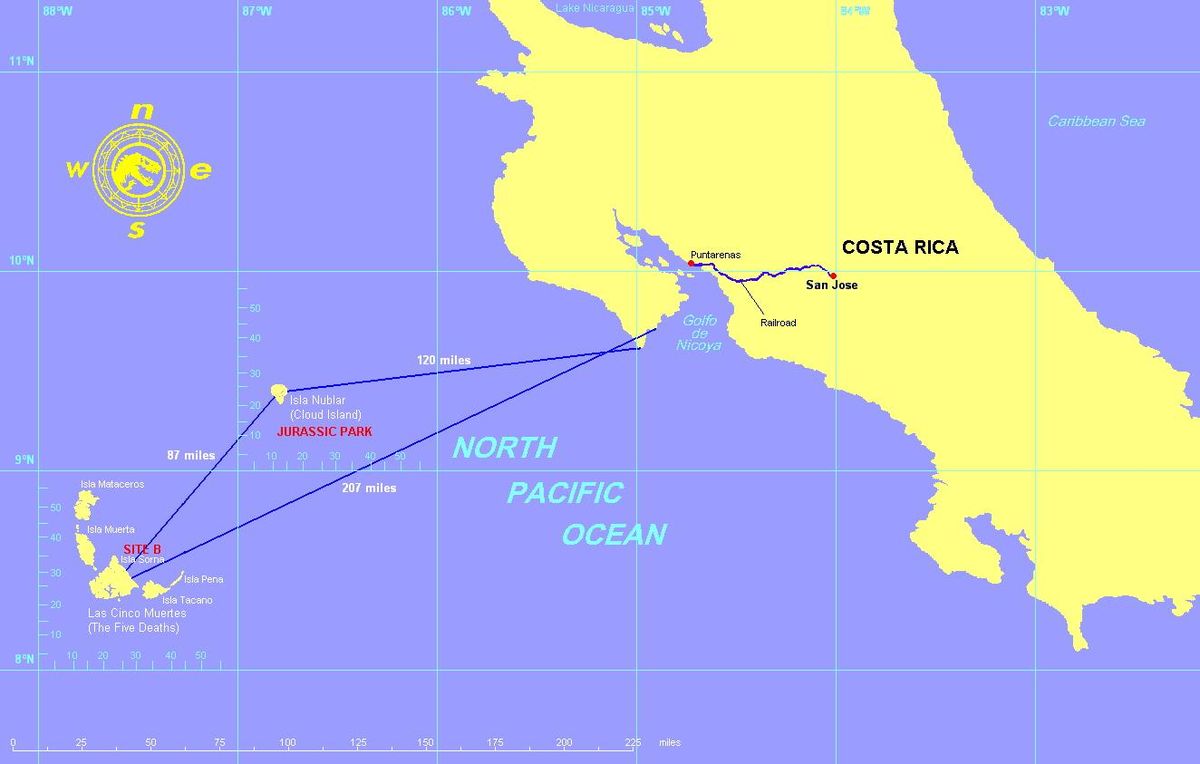
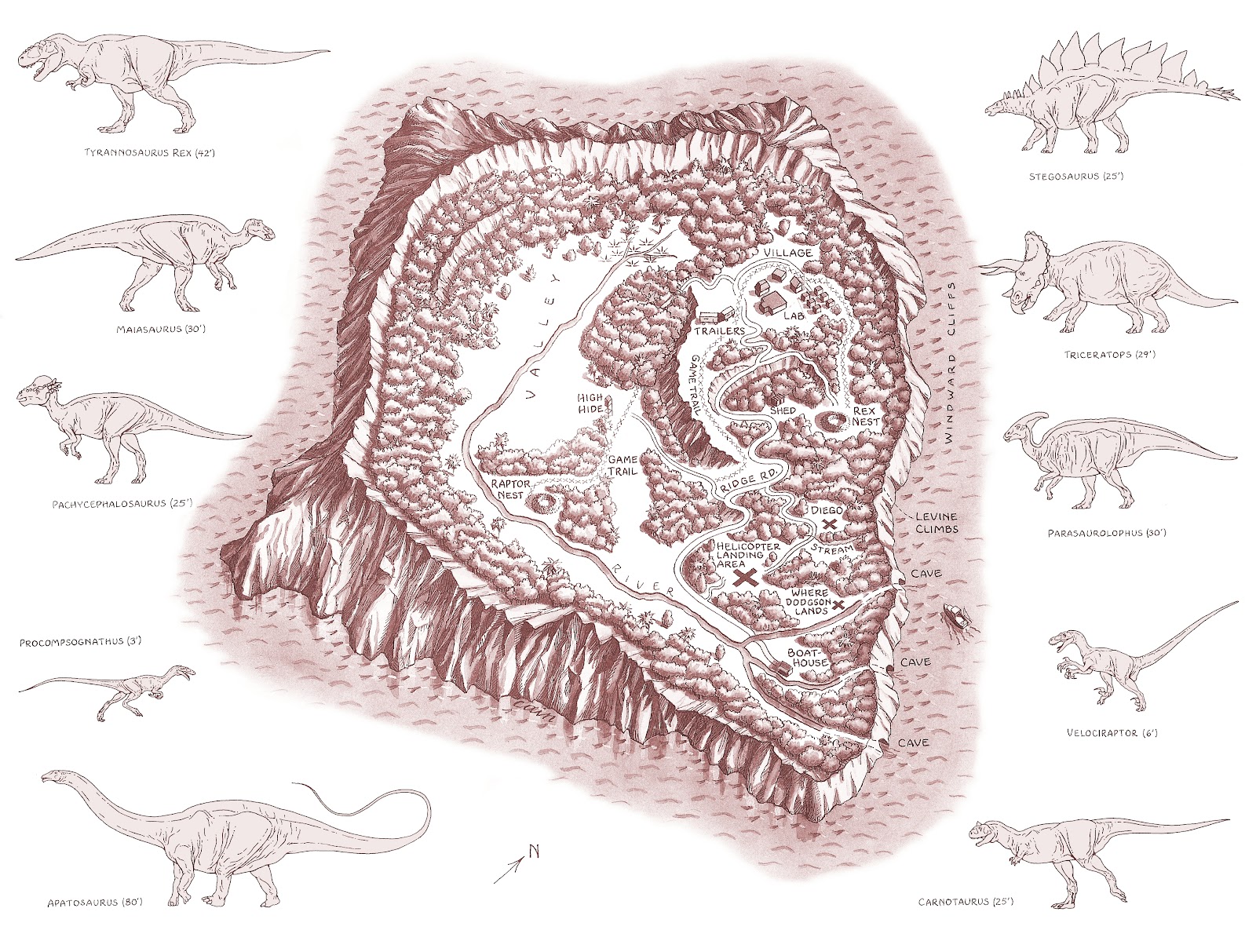
At the halfway mark of The Lost World, our team has set up their camp on Isla Sorna and has recovered Richard Levine.


     "This is going extremely well," Levine said, rubbing his hands together. "Far beyond my expectations, I must say. I couldn't be more pleased."

     He was standing in the high hide with Thorne, Eddie, Malcolm, and the kids, looking down on the valley floor below. Everyone was sweating inside the little observation hut; the midday air was still and hot. Around them, the grassy meadow was deserted; most of the dinosaurs had moved beneath the trees, into the cool of the shade....


However, the arrival of the nefarious Dodgson is coming up quickly, as is the nick-of-time arrival of Sarah Harding.


Once the new setting and new character configurations dig in, and Isla Sorna starts to hint at the true scale of its horrors, Malcolm is still only equipped to theorize. No wonder Crichton moves so swiftly to break more of his bones and leave the derring-do to those who can do it.


....Harding said, "It was bound to happen, Ian. You know you can't expect to observe the animals without changing anything. It's a scientific impossibility."

    "Of course it is," Malcolm said. "That's the greatest single scientific discovery of the twentieth century. You can't study anything without changing it."

    Since Galileo, scientists had adopted the view that they were objective observers of the natural world. That was implicit in every aspect of their behavior, even the way they wrote scientific papers, saying things like "It was observed . . ." As if nobody had observed it. For three hundred years, that impersonal quality was the hallmark of science. Science was objective, and the observer had no influence on the results he or she described.

    This objectivity made science different from the humanities, or from religion—fields where the observer's point of view was integral, where the observer was inextricably mixed up in the results observed.

    But in the twentieth century, that difference had vanished. Scientific objectivity was gone, even at the most fundamental levels. Physicists now knew you couldn't even measure a single subatomic particle without affecting it totally. If you stuck your instruments in to measure a particle's position, you changed its velocity. If you measured its velocity, you changed its position. That basic truth became the Heisenberg uncertainty principle: that whatever you studied you also changed. In the end, it became clear that all scientists were participants in a participatory universe which did not allow anyone to be a mere observer. 

    "I know objectivity is impossible," Malcolm said impatiently. "I'm not concerned about that."

    "Then what are you concerned about?"

    "I'm concerned about the Gambler's Ruin," Malcolm said, staring at the monitor.


    Gambler's Ruin was a notorious and much-debated statistical phenomenon that had major consequences both for evolution, and for everyday life. "Let's say you're a gambler," he said. "And you're playing a coin-toss game. Every time the coin comes up heads, you win a dollar. Every time it comes up tails, you lose a dollar."

    "Okay . . ."

    "What happens over time?"

    Harding shrugged. "The chances of getting either heads or tails is even. So maybe you win, maybe you lose. But in the end, you'll come out at zero."

    "Unfortunately, you don't," Malcolm said. "If you gamble long enough, you'll always lose—the gambler is always ruined. That's why casinos stay in business. But the question is, what happens over time? What happens in the period before the gambler is finally ruined?"

    "Okay," she said. "What happens?"

    "If you chart the gambler's fortunes over time, what you find is the gambler wins for a period, or loses for a period. In other words, everything in the world goes in streaks. It's a real phenomenon, and you see it everywhere: in weather, in river flooding, in baseball, in heart rhythms, in stock markets. Once things go bad, they tend to stay bad. Like the old folk saying that bad things come in threes. Complexity theory tells us the folk wisdom is right. Bad things cluster. Things go to hell together. That's the real world."

    "So what are you saying? That things are going to hell now?"

    "They could be, thanks to Dodgson," Malcolm said, frowning at the monitor....


***


Both Jurassic Park and The Lost World have their problems as SF thrillers. I suspect that is why their film adaptations have been such an unsatisfactory treatment of the plot materials.  [The most egregious example of this is the transformation of John Hammond from a deadly dangerous pragmatist into a sugary blob with a twinkling eye.]


The novel The Lost World faces up to unpleasant questions and seems to revel in their dire ramifications with more ardor than Jurassic Park.  It is much more Moreau's kind of island than Disney's, or Spielberg's.


Jay

24 June 2020


Tuesday, June 23, 2020

Where the cross is made: Grave Descend by Michael Crichton writing as John Lange (1970)

....Walking back to his bike, he lit a cigarette and tried to put things together. Something wrong? Christ, nothing was right. He ticked off the points in his mind:

     Wayne. If he was really a marine insurance investigator, he was either very inexperienced, or very dumb.

     The charts. The position of the ship had been marked by a cross. Normally a presumed site was located by a broad circle, as much as a quarter of a mile in diameter. Never a cross—never so exactly.


Grave Descend by Michael Crichton writing as John Lange (1970)


Grave Descend is a brief thriller (under forty thousand words) about a motorcycle-riding scuba-diving pro hired to dive on a sunken yacht called The Grave Descend. There are untrustworthy employers, untrustworthy dames, and one local Jamaican as sidekick.


....She meant that Yeoman was deep enough that McGregor would not hit him rolling off. A man with a hundred-pound tank, ten pounds of weight, and his own body mass sank a good distance in the water.

     McGregor nodded, winked at Sylvie through his mask, gripped the glass so that it would not be pulled off as he entered the water, and fell back. His tanks broke the water, and he was down, in a silver swirl of bubbles. He took a breath, the sound of the air and the clicking regulator loud in the water.

     He began to descend. Directly facing him was the stern of the boat, riding in the water. Looking forward, he could see the bow and the anchor line. Yeoman came up; he made a signal with his hands, a flexing of his fist, to indicate he was getting the guns. McGregor waited, hanging quietly at twenty feet, while Yeoman broke surface, his body mirrored from beneath, decapitated, his head above.

     McGregor looked down, to the blue beneath him. The Grave Descend was directly below, just outside the wall of the far reef, which plunged sharply down from near the surface to almost a hundred feet. The ship lay partly on its side, just as he had seen from the air. No bubbles trailed up from it now.

     He looked carefully. A small school of barracuda swam past, and there were jacks, majors, and other tiny fish that moved almost immediately into any wreck, but no sharks.

     Not yet.

     Yeoman came back, clutching two guns in his hand. He gave one to McGregor, handling it carefully. He pointed to the handle, to indicate that the safety was on. McGregor nodded, and pointed down at the wreck.

     They upended, and kicked downward. Though the surface water was warm, as they went down it became colder. McGregor was glad for the wet-suit. He gripped the handle of the gun, feeling the balance.

     His depth-gauge showed sixty-two feet as they reached the stern of the Grave Descend. As always, whenever he came upon a wreck underwater, he was struck by the size of it. A boat which appeared only moderately large on the surface was huge underwater, when you could see all of it, and were free to swim around it. Yeoman went around, kicking easily, his arms at his sides. McGregor followed him, and they disappeared into the shadows beneath the curve of the stern. The propellers, five feet across, large bronze and polished, were directly ahead. Yeoman checked the shafts while McGregor checked the undersurface of the stern.

     It was only a few minutes before he saw the gaping hole, somewhat forward from the stern. It was a large, neat hole which looked as if it had been punched out from within; the metal was torn outward. McGregor ran his fingers lightly over the jagged edge, knowing that human skin in water was fragile; he did not want a cut.

     The hole was four feet across. He was easily able to wriggle in, his metal tanks clanging once against the edge. It was dark inside; he flicked on his underwater flashlight and swung the yellow beam around.

     The engine room. To the left and right, large twin diesels faced him. He turned the light to the walls of the room, looking for damage, pitting, blacking, the signs of an explosion …

     There were none, of course. This explosion had been carefully prepared. Its force was directed almost entirely outward, through the hull.

     Yeoman appeared at his side, and gestured to indicate that the propellers were all right. McGregor signaled that they should begin looking further; Yeoman nodded. From the engine room, they swam forward and squeezed through a door, going down a carpeted hallway. The rooms opening off the hall were simple; plain metal bunk-beds, lightweight metal dressers. These were the crew's quarters. At the end of the hall there was a narrow stairs. They kicked up, gliding past the rungs, and came onto the deck. The staterooms were here, and the guest quarters. The walls and doors were polished mahogany.

     McGregor, remembering the plan of the ship, moved forward to the main stateroom, opened the door, and went inside. His air burbled up, struck the ceiling, and ran trickling along the roof to the open window, where it climbed to the surface.

     He swung the torch around the room. It was elegant, a fitting room for the rest of the yacht. He looked for the sculpture.

     He didn't see it.

     He looked again, the torch beam sweeping across the floor, in case it had fallen.

     There was no chrome sculpture.

     Peculiar.

     He kicked over to the aft wall, opened a cabinet, and found the safe. It was not large, but firmly bolted down. He gave a tug, then felt beneath the cabinet to the large bolts.

     Yeoman came over, and signaled he was going up to the bridge. McGregor nodded and followed. They moved down the deck passage, Yeoman floating above the carpeted floor as he kicked smoothly ahead.

     They came out on the stern deck, and clicked off their torches, then swam up to the bridge. They examined the charts and maps which remained on the shelf.

     It was then that McGregor heard it.

     For a moment, he could not be sure. He signaled to Yeoman to stop breathing for a moment. The two men hung silent in the water, and listened.

     There was a low but distinct humming sound.

     Yeoman gestured with his hands to indicate he thought it was a surface boat far off. McGregor shook his head: outboards didn't sound that way. They were sharper, more a buzzing sound. This was a hum, and it was coming from below.

     From the boat.

     He kicked down, reentered the deck passage, and slipped forward. Every so often he paused, holding his breath, and waited until the trickling of his bubbles on the roof had died.

     Then he would hear the humming sound, fix it, and move toward it.

     Yeoman, understanding, had remained on the aft deck. The fewer people inside, where their air would make noise, the better.

     McGregor found himself moving to the narrow galley, and still further toward the bow, into a forward storage room of some sort. It was very dark; the flashlight cut a narrow pale beam in the water.

     The humming was loud in this room, very loud. He swung the beam around. There were life preservers, floating up against the ceiling; there were oars, canned food, tarps, supplies in a jumble in the room.

     And the humming.

     He frowned as he moved the beam. He saw something reflect back, and swam closer.

     It was a metal box, elaborately sealed and waterproofed, attached to the deck, humming softly. From it, two wires ran off. He followed them forward and came to an amorphous packet, wrapped in several layers of plastic.

     McGregor stared. He knew what it was: tetralon, the latest underwater explosive. There were at least fifty pounds of it here. And the small humming box was a radio-controlled detonator.

     His first thought was that it was originally intended to explode with the stern charges, thus sinking the ship. But then he had another thought about its purpose. He swam back to Yeoman, and signaled him to surface.


Grave Descend is peppered with quotations from Dr. Samuel Johnson. The only one Crichton leaves out is: "No man but a blockhead ever wrote except for money."


Jay

23 June 2020


Rereading Jurassic Park by Michael Crichton (1990)

The SF Encyclopedia, in its Crichton entry, laments: "....the world at the end of his tales, though shaken, tends to be the same world as before." 


How can it not be? It is certainly not for Crichton to posit an alternative to the carnage of 21st century capitalism and its scientific ramifications. Crichton's modest method is simply to pull out a dramaturgical horse shoe nail in today's reality and imagine (calculate, postulate) the cascade of consequences.


Every 20th century imperialist war, when ended, left a world seething with combustible inter-imperialist strife that prepared the next war. Crichton holds up a mirror, not a prescription pad.


***


….Hammond came into the room and said, "How is he?"

         "He's holding," Harding said. "A bit delirious."

         "I am nothing of the sort," Malcolm said. "I am utterly clear." They listened to the radio. "It sounds like a war out there."

         "The raptors got out," Hammond said.

         "Did they," Malcolm said, breathing shallowly. "How could that possibly happen?"

         "It was a system screwup. Arnold didn't realize that the auxiliary power was on, and the fences cut out."

         "Did they."

         "Go to hell, you supercilious bastard-"

         "If I remember," Malcolm said, "I predicted fence integrity would fail."

         Hammond sighed, and sat down heavily. "Damn it all," he said, shaking his head. "It must surely not have escaped your notice that at heart what we are attempting here is an extremely simple idea. My colleagues and I determined, several years ago, that it was possible to clone the DNA of an extinct animal, and to grow it. That seemed to us a wonderful idea, it was a kind of time travel-the only time travel in the world. Bring them back alive, so to speak. And since it was so exciting, and since it was possible to do it, we decided to go forward. We got this island, and we proceeded. It was all very simple."

         "Simple?" Malcolm said. Somehow he found the energy to sit up in the bed. "Simple? You're a bigger fool than I thought you were. And I thought you were a very substantial fool."

         Ellie said, "Dr. Malcolm," and tried to ease him back down. But Malcolm would have none of it. He pointed toward the radio, the shouts and the cries.

         "What is that, going on out there?" he said. "That's your simple idea. Simple. You create new life forms, about which you know nothing at all. Your Dr. Wu does not even know the names of the things he is creating. He cannot be bothered with such details as what the thing is called, let alone what it is. You create many of them in a very short time, you never learn anything about them, yet you expect them to do your bidding, because you made them and you therefore think you own them; you forget that they are alive, they have an intelligence of their own, and they may not do your bidding, and you forget how little you know about them, how incompetent you are to do the things that you so frivolously call simple.... Dear God . . ."

         He sank back, coughing.

         "You know what's wrong with scientific power?" Malcolm said. "It's a form of inherited wealth. And you know what assholes congenitally rich people are. It never fails."

         Hammond said, "What is he talking about?"

         Harding made a sign, indicating delirium. Malcolm cocked his eye.

         "I will tell you what I am talking about," he said. "Most kinds of power require a substantial sacrifice by whoever wants the power. There is an apprenticeship, a discipline lasting many years. Whatever kind of power you want. President of the company. Black belt in karate. Spiritual guru. Whatever it is you seek, you have to put in the time, the practice, the effort. You must give up a lot to get it. It has to be very important to you. And once you have attained it, it is your power. It can't be given away: it resides in you. It is literally the result of your discipline.

         "Now, what is interesting about this process is that, by the time someone has acquired the ability to kill with his bare hands, he has also matured to the point where he won't use it unwisely. So that kind of power has a built-in control. The discipline of getting the power changes you so that you won't abuse it.

         "But scientific power is like inherited wealth: attained without discipline. You read what others have done, and you take the next step. You can do it very young. You can make progress very fast. There is no discipline lasting many decades. There is no mastery: old scientists are ignored. There is no humility before nature. There is only a get-rich-quick, make-a-name-for-yourself-fast philosophy. Cheat, lie, falsify-it doesn't matter. Not to you, or to your colleagues. No one will criticize you. No one has any standards. They are all trying to do the same thing: to do something big, and do it fast.

         "And because you can stand on the shoulders of giants, you can accomplish something quickly. You don't even know exactly what you have done, but already you have reported it, patented it, and sold it. And the buyer will have even less discipline than you. The buyer simply purchases the power, like any commodity. The buyer doesn't even conceive that any discipline might be necessary."

         Hammond said, "Do you know what he is talking about?"

         Ellie nodded.

         "I haven't a clue," Hammond said.

         "I'll make it simple," Malcolm said. "A karate master does not kill people with his bare hands. He does not lose his temper and kill his wife. The person who kills is the person who has no discipline, no restraint, and who has purchased his power in the form of a Saturday night special. And that is the kind of power that science fosters, and permits. And that is why you think that to build a place like this is simple."

         "It was simple," Hammond insisted.

         "Then why did it go wrong?"


Jay

23 June 2020


Sunday, April 7, 2019

State of Fear by Michael Crichton


State of Fear
Michael Crichton
2004

State of Fear has many typical Michael Crichton elements: Time restriction. Characters out of their depth. Conspiracy. High-level incompetence.

In it, Crichton presents us with NGO climate experts preparing terrorist attacks using high-technology to show that dangerous climate change is occurring today, not 100 years from now.

Motivation? Anxious for contributions from those crazed by such attacks, the baddies dream of donation plenty.

Crichton is particularly strong on bourgeois liberals attracted to environmental catastrophism:

....Ted Bradley looked out the window. "Isn't it beautiful?" he said. "Truly unspoiled paradise. This is what is vanishing in our world."

Seated opposite him, Kenner said nothing. He, too, was staring out the window.

"Don't you think the problem," Bradley said, "is that we have lost contact with nature?"

"No," Kenner said. "I think the problem is I don't see many roads."

"Don't you think," Bradley said, "that's because it's the white man, not the natives, who wants to conquer nature, to beat it into submission?"

"No, I don't think that."

"I do," Bradley said. "I find that people who live closer to the earth, in their villages, surrounded by nature, that those people have a natural ecological sense and a feeling for the fitness of it all."

"Spent a lot of time in villages, Ted?" Kenner said.

"As a matter of fact, yes. I shot a picture in Zimbabwe and another one in Botswana. I know what I am talking about."

"Uh-huh. You stayed in villages all that time?"

"No, I stayed in hotels. I had to, for insurance. But I had a lot of experiences in villages. There is no question that village life is best and ecologically soundest. Frankly, I think everyone in the world should live that way. And certainly, we should not be encouraging village people to industrialize. That's the problem."

"I see. So you want to stay in a hotel, but you want everybody else to stay in a village."

"No, you're not hearing—"

"Where do you live now, Ted?" Kenner said.

"Sherman Oaks."

"Is that a village?"

"No. Well, it's a sort of a village, I suppose you could say…But I have to be in LA for my work," Bradley said. "I don't have a choice."

"Ted, have you ever stayed in a Third-World village? Even for one night?"

Bradley shifted in his seat. "As I said before, I spent a lot of time in the villages while we were shooting. I know what I'm talking about."

"If village life is so great, why do you think people want to leave?"

"They shouldn't leave. That's my point."

"You know better than they do?" Kenner said.

Bradley paused, then blurted: "Well, frankly, if you must know, yes. I do know better. I have the benefit of education and broader experience. And I know firsthand the dangers of industrial society and how it is making the whole world sick. So, yes, I think I do know what is best for them. Certainly I know what is ecologically best for the planet."

"I have a problem," Kenner said, "with other people deciding what is in my best interest when they don't live where I do, when they don't know the local conditions or the local problems I face, when they don't even live in the same country as I do, but they still feel—in some far-off Western city, at a desk in some glass skyscraper in Brussels or Berlin or New York—they still feel that they know the solution to all my problems and how I should live my life. I have a problem with that."

"What's your problem?" Bradley said. "I mean, look: You don't seriously believe everybody on the planet should do whatever they want, do you? That would be terrible. These people need help and guidance."

"And you're the one to give it? To 'these people?'"

"Okay, so it's not politically correct to talk this way. But do you want all these people to have the same horrific, wasteful living standard that we do in America and, to a lesser extent, Europe?"

"I don't see you giving it up."

"No," Ted said, "but I conserve where I can. I recycle. I support a carbon-neutral lifestyle. The point is, if all these other people industrialize, it will add a terrible, terrible burden of global pollution to the planet. That should not happen."

"I got mine, but you can't have yours?"

"It's a question of facing realities," Bradley said.

"Your realities. Not theirs."


_____________

Jay
7April 2019