Subscribe to my Substack

Showing posts with label John Blackburn. Show all posts

Tuesday, May 31, 2022

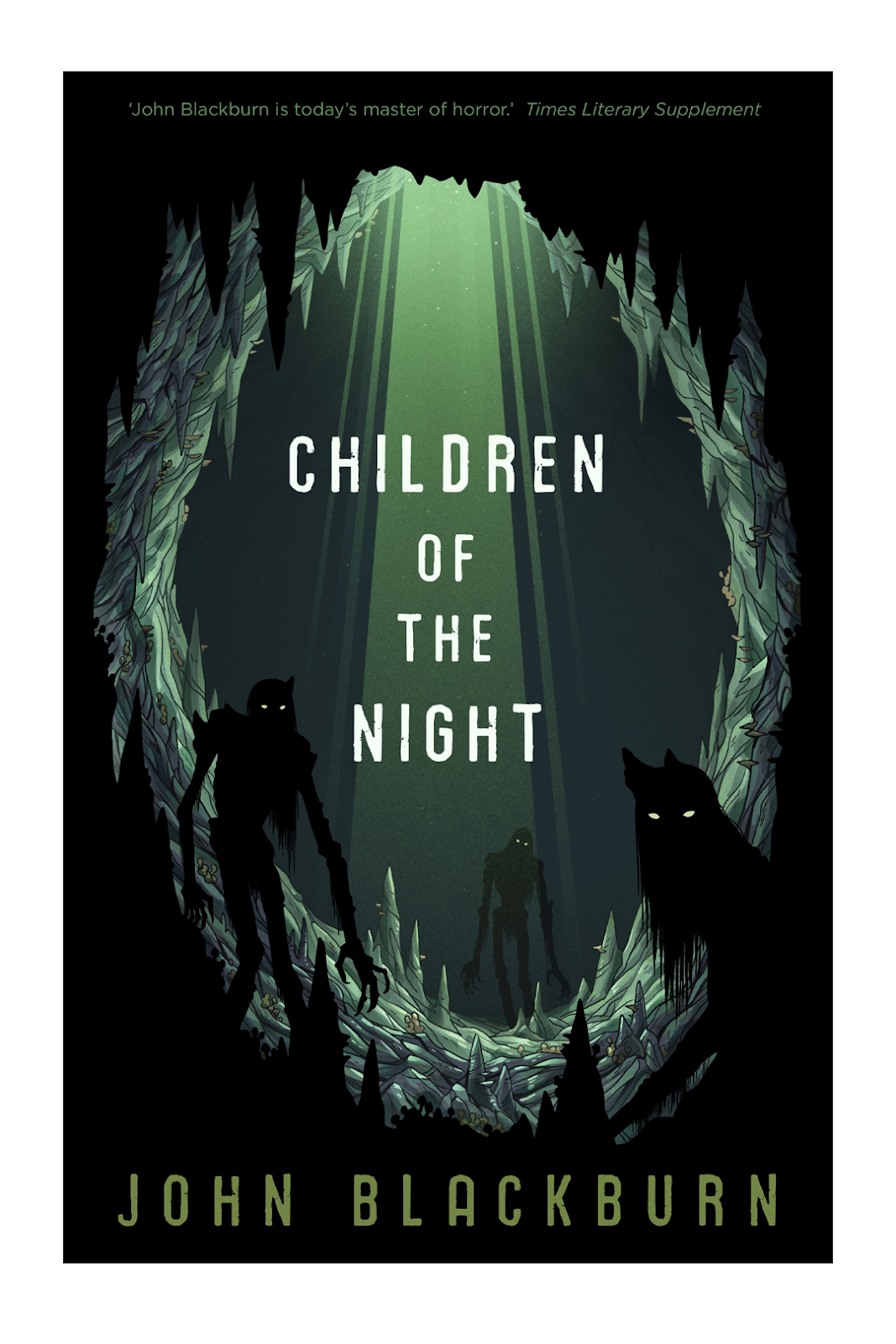
[Book Review] Children of the Night by John Blackburn

My 2014 edition of Children of the Night by John Blackburn (originally from Jonathan Cape in 1966) was published by Valancourt Books. Valancourt has reissued seventeen of Blackburn's thrillers over the last decade. This helps bring back into focus the actual outlines of UK literary horror production and reception: between 1940 and 1970, horror readers were not simply biding their time waiting for the Ramsey Campbells and James Herberts to hatch. 


*   *   *


Children of the Night is a heady and highly concentrated mix of cursed village, taboo moorland, sudden murderous madness, secret cults, and forsaken tin mines in a charming postage stamp of land in the northeast UK called Dunstonholme.


Blackburn's heroes (of the professional medical-military-colonial petty bourgeois meritocracy type) must butt heads literally with occult (hidden) forces in the area. Ultimately, they will also have to take on local potentates of church and state power: only the local doctor Tom Allen and professional adventurer Moldon Mott are smart enough to solve the mystery and try saving the day.


Shocked by early, sudden, and inexplicable violence and death in his locality, Dr. Allen learns the best source of facts about Dunstonholme lore is vicar David Ainger.


[....]It was pretty late. [Tom Allen] had arranged to meet Mary at seven-fifteen, and the church clock showed almost that now, though the sun was still high in the sky. Only a few more days to midsummer. The heather wasn't out, of course, but some trick of light gave the near-by hills a deep purple tinge which contrasted beautifully with the pale green of the sea. Tom glanced through the railings as he passed the church. There were some interesting monuments in the churchyard, all of them somehow connected with the sea, which often brought visitors to the village at week-ends. A shattered spar in a stone shrine: TO THE CREW OF THE BRIG, THREE BROTHERS, WHO PERISHED DURING THE GREAT GALE, DECEMBER 1843 . . . A cross with an anchor chain twined around it: IN MEMORY OF LIEUTENANT JOHN SPRAGGE, WHO DIED OF WOUNDS OFF CAPE SAINT VINCENT . . . A very old cross with the Latin inscription worn away, but he had been told that it once read: TO THE MURDERED VILLAGERS OF DUNSTONHOLME, JUNE 1300 – GOD WILL REPAY. He was almost at the end of the railings, when a tall gaunt figure wearing a clerical collar came out of the lych-gate and blocked his way.

     'Ah, there you are, Dr. Allen. I was hoping to catch you. I rather wanted to have a word with you about poor Joe Bates.'

     'Of course, Padre, but wouldn't tomorrow do? I am in a bit of a hurry.' About half the village called the Reverend David Ainger 'father', and the rest 'vicar', but Tom used the military compromise. 'I'm meeting Mary at the Crown, you see and . . .' Behind them the clock struck the quarter.

     'Oh, I'll not keep you long, my boy, and I'm sure the clientele of the Crown won't let your pretty wife be lonely. It really is important to me that we have a chat.'

     'All right, Padre, if you promise it won't be long.' Ainger had a long sallow face which looked as though it had been roughly modelled out of plasticine, but one of the most appealing smiles Tom had ever known. Added to that was an aura which he could only describe as 'goodness'. An impersonal charm that made one want to fit in with his wishes, however irksome they might be. He nodded and followed him across to the vicarage, and into the little gloomy library he called his den.

     'Do sit down, Doctor. Oh, excuse me.' The room was littered with books and papers and Ainger removed two heavy volumes from a chair.

     'That's better.' He leaned against the fire-place and pulled out his pipe, not lighting it, but fiddling with the bowl.

     'I've been to the police station, but they wouldn't let me see Bates, though I did have a few words with Constable Rutter. What I want to ask you is this: do you personally consider that Joe is a lunatic, a cunning murderer, or a person who really did have some sort of supernatural experience?'

     'Isn't that a bit of an unfair question, Padre?' Tom tried to settle himself more comfortably in his chair. A loose spring was digging sharply into his thigh. 'After all, I'm just a country G.P., not a detective, a psychiatrist, or a priest. All I can say is what I told the sergeant they sent over from Welcott.'

     'And could you repeat that to me, Dr. Allen?' As though suddenly remembering his duties as host, Ainger crossed to a cupboard and poured out two glasses of thick brown liquid. 'I really have a good reason for wanting to know.'

     'Of course, I can. There was very little to it. Thank you.' The sherry was sweet and cloying, but Tom sipped at it and told Ainger exactly what he had said to Fenwick. Bates suffered from a weakness of the aorta which could have caused a black-out under severe strain; he had a feeble mentality which, coupled with guilt, might have attributed an act of anger to some divine intervention. Ainger obviously knew all about the way that Bates had been treated over the years by his employer.

     As he talked, Tom studied the room. Ainger had been a celebrated mountaineer in his time, and the walls were covered by photographs of roped figures balanced on precipices, or crawling up arĂȘtes and dank gullies. A tough old boy, and apparently quite a scholar too. Though he was no theologian himself, he could see that these books were the real thing. Most of the major Greeks bound in leather, Aquinas, Augustine in the Bretain edition, Von Hugel wedged against Spinoza, and not a trace of the popular works which usually take pride of place in Anglican libraries.

     The next case appeared to be devoted to a wide range of subjects, and some of them disturbed him slightly. Among The Golden Bough, Patterns of Culture, and other standard books on anthropology were dotted: Marshall's Cult of the Werewolf, Weber's Devil in Western Europe, and a number of medical books. In the top shelf he could see Winter & Reynard's Teratology . . . A Study of Monstrous Birth. Its coloured illustrations had given him several sleepless nights when he was a student.

     'Thank you, Doctor.' Ainger put down his glass with a sharp click as he finished speaking. 'You preserve a completely open mind, in fact. Colonel Keith provoked Joe Bates just once too often and in the wrong place. He died because Joe was either mentally or physically ill, and that's all there is to it. You haven't thought that his death might be connected with certain other events which have happened in this village?'

     'Sorry, but I'm not with you, Padre.' The grandfather clock in the corner showed the half hour. As a doctor's wife, Mary was used to waiting, but this was their day off. 'What other events do you mean?'

     'With the salvage ship, perhaps. No, please bear with me a little longer, my boy.' Ainger took a newspaper from his table. 'By all accounts, her master was a most reliable man, yet he suddenly appeared to go mad and charged out to sea through thick fog, destroying himself, his crew, and the crew of that unfortunate tanker which happened to be in his way.

     'And today, Joe Bates goes mad too. He'd worked for Keith for years and he must have taken him up Boxer's Hill a hundred times. Why should he suddenly have this stroke or black-out, or whatever it was, and tell a story about feeling that he was being buried alive?

     'You've known Joe for some time, Dr. Allen. Do you think he is capable of making it all up?'

     'No, and I said so to Sergeant Fenwick.' Tom frowned. 'At the same time, the mind plays queer tricks on one now and again, and he might have imagined it.

     'But I can't see any possible connection between him and the Dalecrest. Nobody can even guess what happened to her till there has been a full inquiry, and even then . . .' He broke off and shrugged his shoulders.

     'Quite right. I don't think we'll know even after the inquiry. Not unless they find survivors, and that appears unlikely now.' Ainger crossed to the window and stared out at the bay, with the sunlight glinting on his spectacles.

     'But there have been a lot of unexplained tragedies in this district over the centuries, haven't there? What really happened to the Children of Paul? Why should a group of normally peaceful people suddenly turn into vicious murderers?'

     'I haven't the slightest idea, Padre. After all, it happened several hundred years ago.' Tom struggled to conceal his irritation. He was fond of Ainger, but the old boy really did appear to be getting very strange.

     The Children of Paul were members of a religious cult led by a monk named Paul of Ely. Like many other medieval sects, they believed themselves to be contaminated by the rest of humanity, and decided to withdraw from the world. The story went that they arrived in Dunstonholme in 1300 on their way to one of the Feyne Islands where they hoped to found their community. Being refused transport by the Franklin, they killed the villagers and the small garrison of the castle, and set out in stolen boats which promptly capsized and drowned all of them. There was some factual evidence, Tom supposed, but most of it was just legend, like Arthur, and Robin Hood, and Gog-Magog.

     'Yes, six hundred and sixty-six years ago, almost to a day, but there have been more recent events as well.' Ainger's voice droned on against the tick of the clock. 'Do you know why we have no railway here? They started a line from Welcott, but it was never finished. When they got as far as the moors, the navvies refused to work on the cutting.

     'Then there was the lead mine up near Salter's Gate. Lord Mayne financed it to ease local unemployment in 1880, but it closed down after only a few weeks, because nobody would work there. They said there was a curse on the place.'

     'I thought the shaft was supposed to be unsafe because of loose rock.' How old was Ainger, Tom wondered? At least seventy-five, and his mind appeared to be running down fast. There were no relatives either. They'd have to see about finding him a living-in housekeeper if he got any worse.

     'Yes, that was the official reason they gave for the closure, but no local people believed it. There are more things though; so many more.' Ainger turned from the window and stared at a tarnished silver crucifix on the far wall. Behind his glasses, the eyes didn't look as though they were focusing correctly.

     'The night the American ship was bombed, for instance. That terrible business at Pounder's Hole. You probably think I'm mad, Doctor, and in a way I hope you are right. But, I honestly believe that all these events are connected, and there is something hellish surrounding this village. A dreadful danger which is going to break out very soon.'


*   *   *


In leanness and tone Children of the Night has much in common with early post-WW2 thrillers by Maclean and Bagley. Blackburn's strength in Children of the Night is dramatizing thriller crises in wild and dangerous landscapes whose history of ancient menace coexists with the modern world.


Jay

28 May 2022
Friday, May 20, 2022

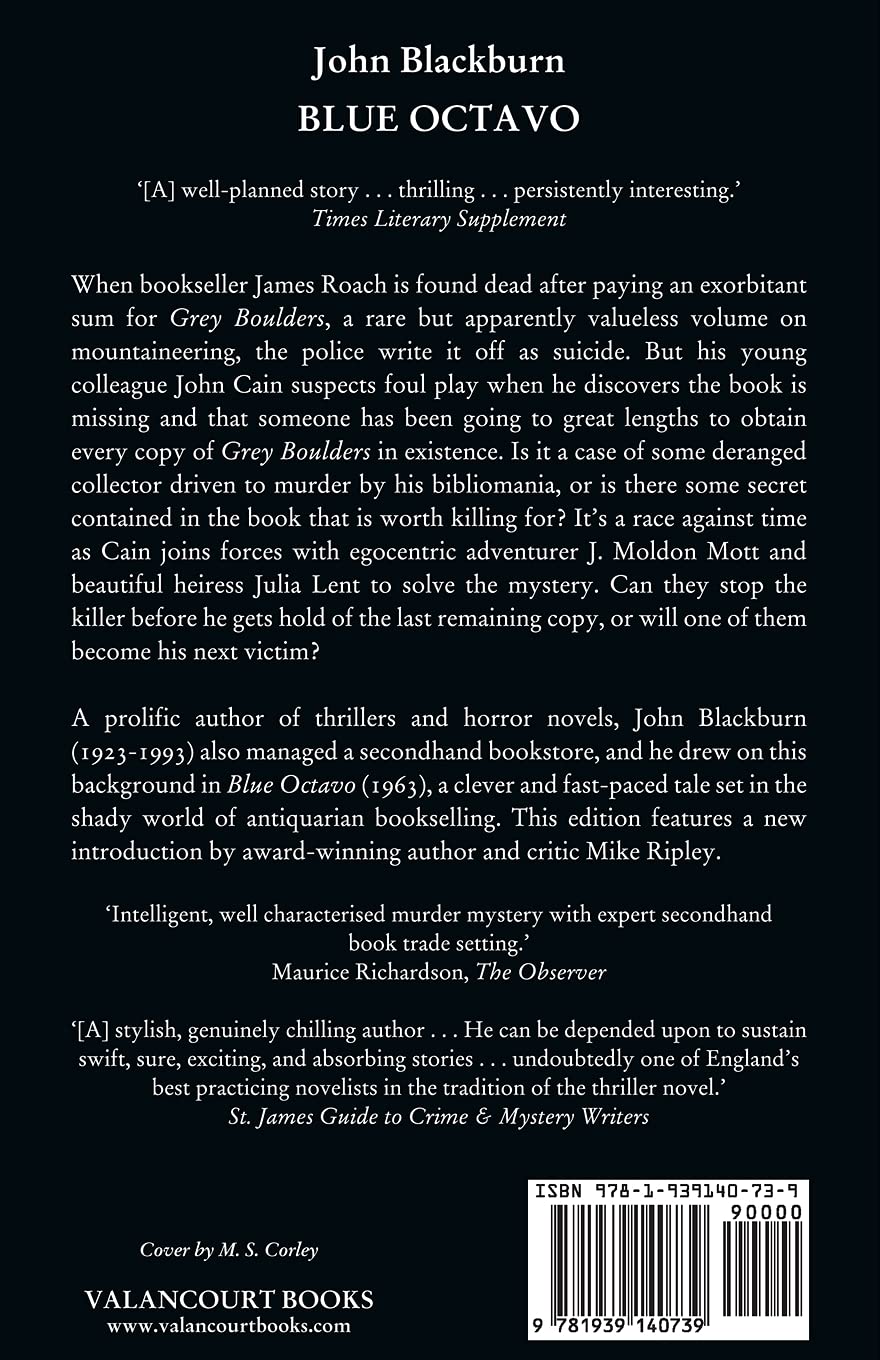
[Book Rreview] Blue Octavo (1963) by John Blackburn

    The memory of Mr Reade's voice on the phone ran through his head like a gramophone record – 'Oh, we know that those sort of things happen in the public or free libraries, Mr Cain, but not in the Metropolitan. All our members are so carefully screened, you see; three references, a degree from a reputable university, and proof of financial status, before one is even allowed to join. As I said to my assistant, "these things may take place in the British Museum Reading Room or even the London Library, but never in the Metro­politan."

     'And it was the way the book had been treated that was so horrible, Mr Cain. This wasn't just the work of a thief removing plates to make up an imperfect copy of his own. It had been slashed and torn as though a maniac had done it, as though somebody bore the book a personal grudge.'

     'A maniac!' John whispered the word aloud, for that was the most probable explanation, it seemed. Somebody who felt he had a secret hidden in the book would merely have removed the incriminating pages. A hard-working maniac too. An old dealer had been killed for the book, a millionaire had been robbed of it, and a very swagger library had had its copy mutilated. He was beginning to picture the kind of mind that was at work. Somebody who hoarded the books, but didn't want anybody else to have them; an efficient somebody, though. The Metropolitan was a reference, not a lending, library, and no one was allowed to take a book from the premises. It would have been very hard to steal that copy, but quite simple to deface it. He began to feel a deep dread at the thought of that crazed but efficient mind.


Blue Octavo (1963) by John Blackburn

(Valancourt Books, 2013)


Blue Octavo is an intensely focused thriller, dry and British, the kind of novel Hitchcock might have optioned when he was at a loose end.


*   *   *


Blackburn was beautifully suited to write thrillers: his characters come alive and action finds its target despite all aesthetic economies. Blue Octavo has a clear who-done-it plot with a trio of winning and oddball amateurs out to crack the case.


A bookseller, a library staffer, and a dodgy vicar are among the killer's victims. Book dealer John Cain, adventurer J. Moldon Mott, and debutante industrial heiress Julia Lent unite to unravel the killer's apparent motivation: collecting every known copy of a rare 1909 mountaineering book: The Grey Boulders – An account of British Mountaineering between the years 1840 and 1910.


....They sat in the office behind his [Cain's] shop, hedged in on every side with piles of unsorted books and unframed prints. Though officially the shop itself was closed, through the glass partition he could see one industrious browser still browsing. He was an old, though not very valued customer, and could be trusted to let himself out.

     'Yes, I suppose one could call it neat, in an unpleasant, crazy way.' Mott had obviously noticed Julia's smile and was put out by it.

     'We've got a very rum bird on our hands, it seems. When he can buy or steal he does so, when that's impossible he destroys. An efficient blighter, too; he must have got hold of most of the edition by now. But the way, did you know that there were only seventy-six in existence – not a hundred as originally advertised?

     'No, well, don't let me teach you your business, but it's a fact. Twenty-four were destroyed in a fire just after binding. Allowing for a normal loss through time, what Roach bought, and what we know to have been destroyed, there can't be many copies about now. My guess is that if we don't get our hands on one of them, we're sunk. Only that book can tell us the kind of man we're up against, and we've got to get hold of a copy – we've got to. I suppose you've had no luck at all, old boy?'

     'No, not a smell of the damned book.' John remembered his fruitless hours on the telephone, and the replies which had always been the same. There just didn't seem to be a copy anywhere. 'No, sorry, Cain, but I haven't seen one for years. Why don't you try Francis Edwards?' 'Can't help, old boy. Think I sold a copy some time back, but I can't remember who to. James Thin in Edinburgh might have one.' 'No, sir, we haven't one in stock at the moment. Perhaps the Museum Bookshop in Kendal might help. They carry a very large stock on sporting subjects.'

     Yes, always the same: 'Sorry', and advice to try somebody else. 'Try Quaritch, and Maggs, and Commin in Bournemouth, and Hill in Newcastle, and Kerr in Lancashire.' Try anybody you damn well liked, but it didn't do any good. John dreaded the thought of his next phone bill.

     'I see. Then we'll just have to hope that our friend panics and shows his hand by attacking you, old boy. Ah, but you've got business to attend to, it seems.' Mott broke off as a knock sounded on the door and the browser came into the office.

     'Ah, good evening, Mr Cain.' The man came slowly towards John and he wheezed and creaked like an old gate. He weighed about twenty stone with a great sagging paunch slung in front of him, and grey, mutton-chop whiskers gave him a marked resemblance to the late Emperor Franz Josef of Austria. There was a book in his hand, and he held it out as though it were a rather nasty object and probably laden with germs.

     'Sorry to bother you so late, but I found this, and wondered if it is your price-marking. Seems terribly high, you know; thirty shillings!'

     'Let me see, Major Allan.' John glanced forward at the book.

     'Yes, Ford Madox Ford's Queen who flew. I don't think thirty bob is too much. It's a first edition and quite scarce.'

     'Yes, yes, but the condition it's in, Mr Cain.' Franz Josef's face looked slightly injured, as though John were an old friend who had let him down badly.

     'The spine and covers are rubbed, and there's quite a lot of foxing on the endpapers. Foyle's had one the other day in much better condition for only twenty-five.'

     'All right, twenty-five it is then, Major.' Normally John would have used the obvious retort, 'Why didn't you buy Foyle's copy?' and held out for the full amount, but now he just wanted to get rid of the man. He watched him lay the money on the desk and wheeze away, well satisfied with a bargain.

     'Humph, big business indeed, old man!' Mott stared scornfully at the money, and then grinned across at Julia. 'Do you manage to make a living out of this dump?'

     'Yes, thank you, I make a living.' John suddenly realized that he had rarely disliked a human being as much as he disliked Mott.


*   *   *


My interest in Blackburn's fiction has focused on titles that braid elements of thriller and horror. Bury Him Darkly (1969) is probably the finest Blackburn novel I have read along these lines. The Scent of New-Mown Hay (1958), reissued by Valancourt Books in 2013, is an excellent techno-thriller with bows to affect and body horror. Blow This House Down (1970) is a more topical thriller, and also looks forward to the 1970s urban disaster trend in publishing and film.


Blue Octavo is free of blood and gore. Its puzzle premise owes more to Dickson Carr and Ellery Queen than to Grand Guignol or Ian Fleming. Indeed, it's almost cozy.


Scholar Mike Ripley, who wrote Kiss Kiss, Bang Bang (2017), nicely sums up Blackburn's strengths in his introduction to the Valancourt edition:


    Most of Blackburn's novels were short – Blue Octavo clocks in at little more than 50,000 words, which is a refreshing change from many of today's overblown thrillers – and all characterised by short scenes, pithy dialogue and rapid action to enhance the pace of the storytelling. The characters in them are described in stark outlines, yet cleverly enough to make them all believable and though Blue Octavo may have only 50,000 words, you would be hard pressed to find a wasted one.


Jay

19 May 2022


Thursday, November 8, 2018

Bury Him Darkly (1969) by John Blackburn


Bury Him Darkly (1969) by John Blackburn is a UK thriller with strong horror and science fiction elements driving its plot forward.

The buried man, buried in the 18th century after a late-flowering burst artistic and sexual fecundity, is Sir Martin Railstone. Commonly believed to be a devil-worshiper, he is the object of present-day reverence by a powerful UK magnate and an echelon of civil servants. They conspire and demand the opening of his tomb, which they think is crammed with intellectual and aesthetic treasures.

But this cult is facing a deadline. The government will soon flood the valley where Railstone's estate is situated, as well as the nearby cathedral housing his crypt.

Blackburn builds this countdown intensity as Railstone's worshippers and opponents are each thwarted, then allowed steps forward, by virtue of chicanery, double-cross, and bureaucratic maneuvering.

The scope and consequence of what the searchers uncover is truly staggering, and Blackburn's bravura confidence in handling this in under 200 pages is a delight.

The novel recalled to me the SF social crisis films and TV produced in the UK when London's place in the sun dissolved: Quatermass, Doctor Who in the Pertwee/Baker years, "The Day the Earth Caught Fire," "Doomwatch."

A Simon Raven cultist can only smile at this scene, in which a clergyman attempts to open Railstone's tomb, which is graced with a large penis carved into the lid of the sarcophagus:

....'Dr Norseman, stop it. Please come away from the slab.' The feeling of impending danger had become intolerable and Mary couldn't control herself. 'There is something behind that stone. I can sense it: something horrible!'

'Naturally there is. That is one of the reasons why we are here. But there's no need to be neurotic. Just take the torch and hold it steady, there's a good girl.

'Yes, excellent.' He inserted the flat end of the blade into the gap and bore down on the handle. The metal creaked against the flagstones, gained a fulcrum, and the slab started to move. The first guardian struck.

John was adjusting his camera at the time and he never saw how it happened, though the crash of metal, Mary's screams and the Dean's sudden bellow of agony brought his face up with a jerk. What he saw then would remain with him for the rest of his life, and later made him remember that an earlier, pre-Christian version of the Grail story described it, not as a cup, but as a spear which dripped with blood. A long bronze shaft held Norseman suspended against the bars of the cage, and the tip of the proud, rampant phallus protruded from between his shoulder blades....

Jay
7 November 2018