Subscribe to my Substack

Showing posts with label H. G. Wells. Show all posts

Monday, August 1, 2022

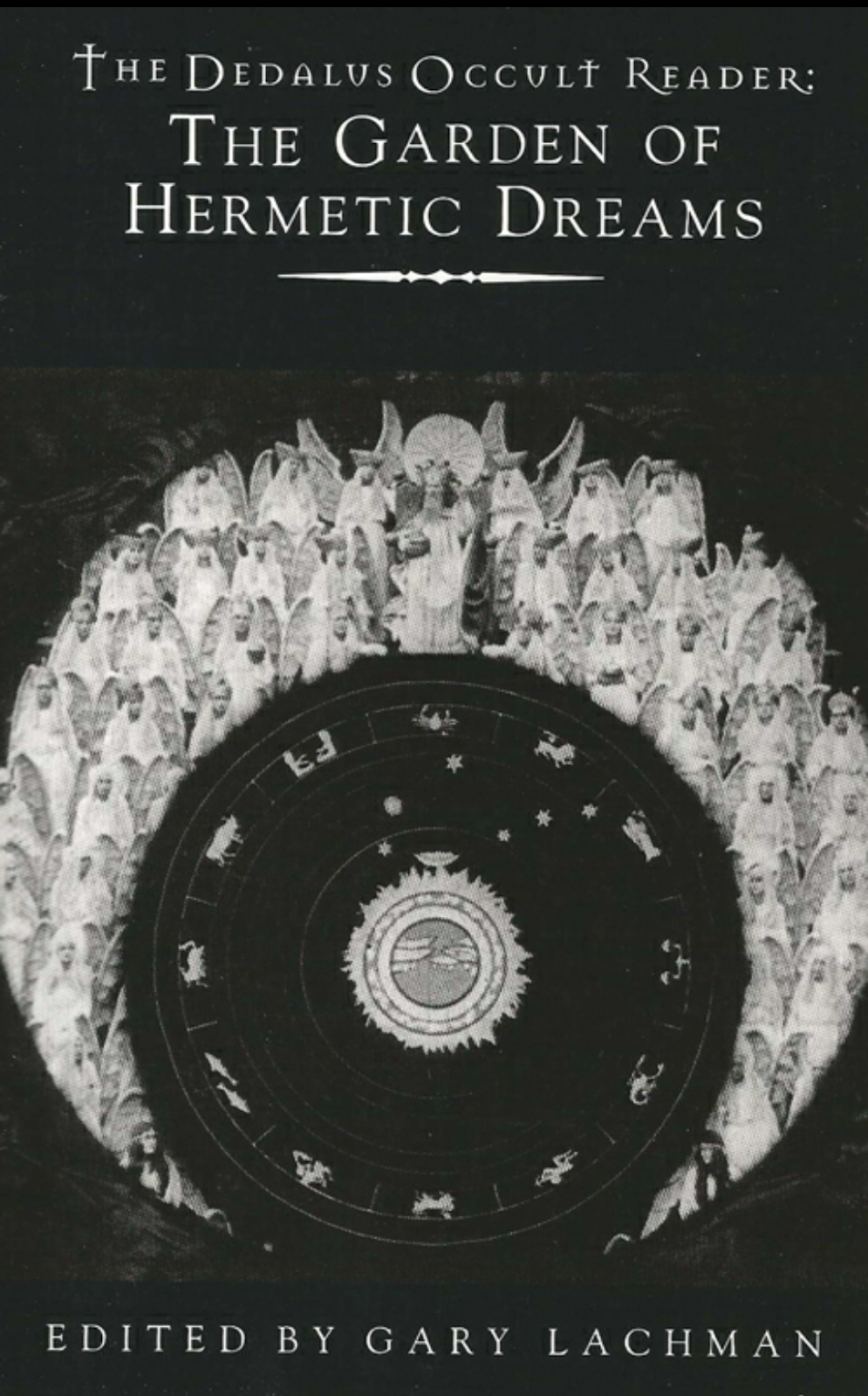
Reading notes: Introduction to The Dedalus Occult Reader: The Garden of Hermetic Dreams by Gary Lachman (2004)

Below are some underlinings from the introduction to The Dedalus Occult Reader: The Garden of Hermetic Dreams by Gary Lachman (2004).

Introduction

[....] Human consciousness seems to be programmed with a fundamental dissatisfaction with the world as given, with the 'facts' of life. We are not content with the 'triviality of everydayness', as the philosopher Heidegger put it.

[....] human beings feel an instinctive yearning for some kind of 'beyond', for something more, a reluctance to fully abandon some form of belief in magic which, ultimately, means a belief in human freedom. One form this resistance to complete explanation has taken is occultism.


[....] these and other beliefs are attractive because they elude the obsessive urge for explanation.

[....] not solely a testament to weak minds and wishful thinking.


[....] popular occultism is a raw, unsophisticated expression of a deep, universal need.

[....] The hunger for something more that dubious gurus exploit is a valid hunger; what is unfortunate is that many lack discrimination, and satisfy their spiritual appetite with the equivalent of junk food.


[....] Along with the occultism of fortune-tellers and love potions, there is a more demanding form, a tradition of occult thought of which the popular variant is only a recent offshoot. This more sophisticated form of occultism is at bottom a literary tradition, a genre and a canon of works. Like the potential for transcendence inherent in language itself – its ability to speak 'otherwise' and 'change' reality – sophisticated occultism is about the power of words, the efficacy of language and writing….

[....] Kabbalah, on which nearly all of modern occultism is based, is fundamentally about the magical powers of letters.

[....] it was after Newton unveiled the clockwork universe, set in motion by a Deus Abscondus, that the occult lost its status. The laws of inertia required only a single push; after that the heavens rained angels, spirits, celestial powers, until today what is left is a vast but meaningless space, brought into existence by sheer chance, and tenanted by blind balls of rock or gas, on one of which reside the accidental arrangement of atoms we call the human race.


[....] It was precisely the emphasis on human strength, will and purpose as opposed to that of the gods, that led to the rise of the great magicians.

[....] the new scientific world-view didn't win over everyone. A sensitive minority was troubled by its rise, and by the loss o. meaning its growing success ensured. The dogma and authority of the church had been undercut, but the cost was high. Mankind was free, but, as was becoming increasingly clear, the universe itself was pointless.

[....] It was at this point – the late eighteenth century – that occultism as we know it began.

[....] the key fact for occultism as we know it, is that it is an alternative to scientific thought. The occult was abandoned by the architects of the Age of Reason, but it was not forgotten, and in the years that followed, it became a kind of reservoir of rejected knowledge, available to the artists, poets, writers, philosophers and musicians who were dissatisfied with the new, Newtonian dispensation.


[....] the majority of writings collected here are not by authors generally considered supernatural or occult.

[....] An anthology of occult writings by occultists might be interesting, but it wouldn't tell us anything we didn't know. My aim in bringing together these disparate works is to show that far from the marginal phenomenon we generally think it is, occultism had a powerful impact on much of mainstream western culture….

[....] What we know as the New Age is in many ways a kind of domesticated occultism. Alternative health stores, yoga centres, head shops and metaphysical bookshops appear on many high streets; what was one time radical and hard to find is now blended in with corner shops and newsagents. Likewise, much of the threatening aspect of occultism has found a home in Goth, death rock and other forms of pop music. In many ways, occultism today is but one of a variety of alternative life styles and sub-cultures….


[The occult offers] freedom and meaning, lacking in more conventional modes of thought.

[....] 'extraverted' occultism…. retreated from the outer world after the collapse of the Revolution into the Terror. The new world that the political forms of occultism hoped to create was now sought for within. Romantic occultism was about the exploration of the psyche, the voyage into the vast recesses of 'inner space'.


[....] Goethe, with one foot in the classical world, was strong enough to survive the buffetings of the unconscious, as well as the inevitable let down of being returned to the dull, prosaic world, after a brief tenure in ecstasy. Others, however, were not so resistant. Of the Romantic occultists offered here – E. T. A. Hoffmann, Balzac, Villiers de l'Isle Adam, Edward Bulwer-Lytton and Gérard de Nerval – four died young, casualties of their attempts to actualize their 'godhood'; one, Nerval, by his own hand, after repeated interments in asylums.

[....] This need to 'go beyond'– the family motto of Villiers – led to a fascination with what today is called 'transgression', examples of which are found in the Satanic occultism of J.K. Huysmans and Valery Briusov, two writers firmly associated with the decadent and Symbolist schools of literature. In many ways, the history of literary occultism is the history of Symbolism, for it is with Swedenborg's doctrine of symbolic correspondence – encapsulated in Baudelaire's seminal poem "Correspondences"– that the literary search for a 'higher world' begins its paradoxical descent into decadence and the fin de siècle….

[....] the early Romantics tried to bridge the gap between the two – the challenge most effectively portrayed in Hoffmann's "The Golden Flower Pot"– later epigone opted for a complete rejection of the everyday in favour of the strange and, ultimately, unwholesome.

[Decadent fin de siècle]: hallucinatory states of consciousness and a paralyzing sense of impending doom….

[....] With philosophers like Nietzsche and Henri Bergson, writers like Bernard Shaw, and occultists like Madame Blavatsky, the figures making up what we might call the 'positive' fin de siècle looked forward to the near future, when the gap between this world and the higher one would be bridged. The selections from H.G. Wells, Algernon Blackwood and Lord Dunsany all deal with this theme. Wells, a proponent of science, was in no way an occultist, but the scientific ideas he treated were often the same ones as many occultists were exploring; a good example of this is Algernon Blackwood's "A Victim of Higher Space."

[....] 'scientific' fin de siècle ('higher space', advanced races, the superman)....


[....] typically English approach to the occult: level-headed, sceptical but sympathetic, and less prone to the excesses of their continental counterparts.

[Types of fin de siècle fiction included in The Dedalus Occult Reader: The Garden of Hermetic Dreams]: oriental, initiatory, 'psychotic', decadent…


[....] by the late eighteenth century, occultism had formed into a more or less coherent philosophy, with a canon of recurring themes and ideas.

[....] The central theme of occult literature is the contrast between 'this' world and the 'other'.


[....] The reader, caught up in Hoffmann's glittering tale, is initiated into the problem and must decide whether the realms of poetry and magic – those rare moments of affirmation and meaning – are 'real', or merely entertaining diversions from the proper and dreary business of getting on in life….

Sunday, February 20, 2022

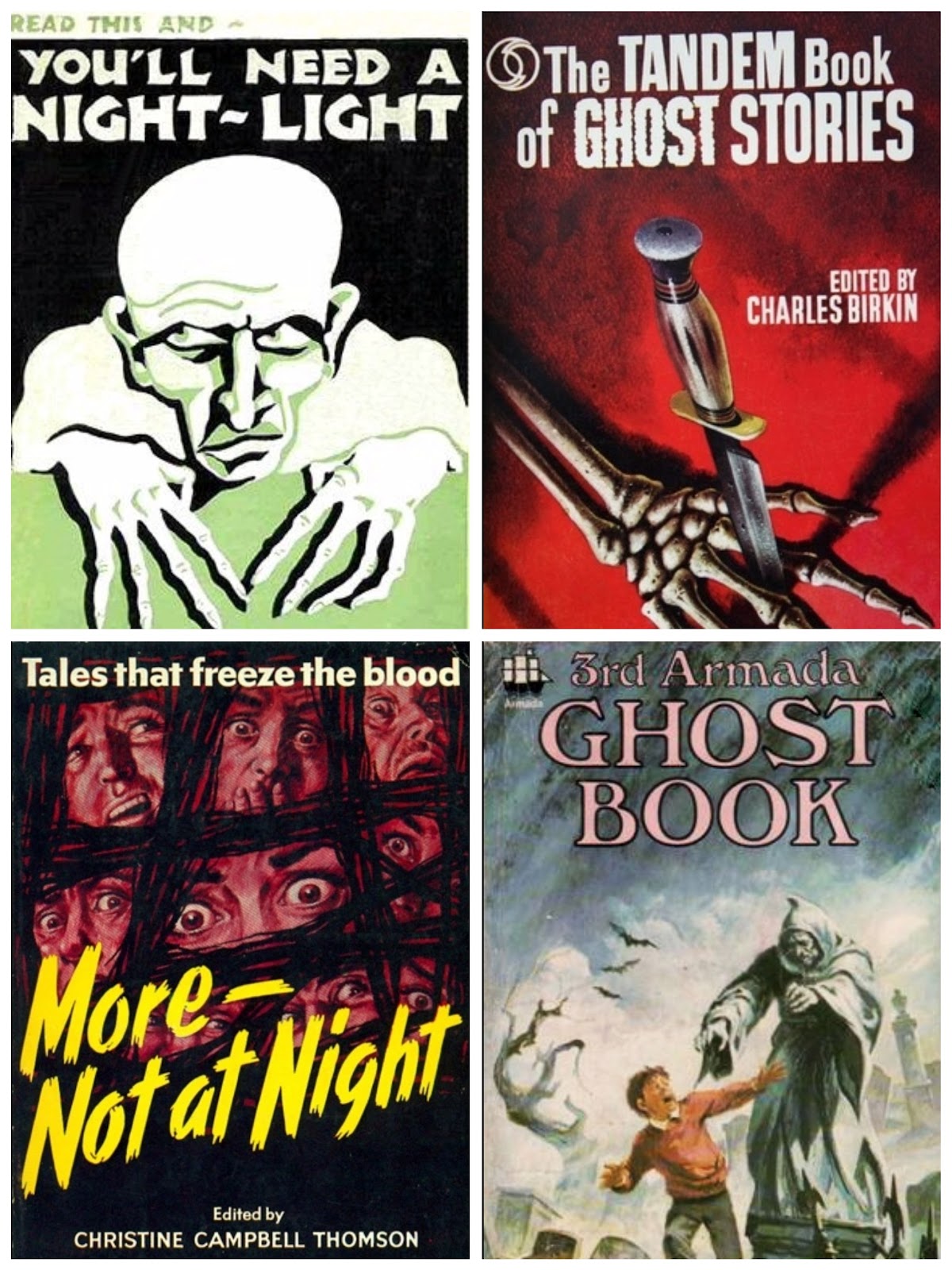
"Out of the Earth" (1925) by Flavia Richardson

"Out of the Earth" (1925) by Flavia Richardson [Christine Campbell Thomson] can be heard here, read by Jim Moon. The story also appeared in the April 1927 issue of Weird Tales, which can be viewed here.


It is not a story I was aware of before Mr. Moon posted it. The story begins with a promising situation and arresting atmosphere. (Alas, recent binges of "A History of Ancient Britain" and "Time Team" have left me a little too superficially knowledgeable about tumuli and barrows to suspend disbelief to the extent "Out of the Earth" requires.)


* * *

As a title, "Out of the Earth" has been used by half a dozen writers.


Like Clute's use of APPOINTMENT IN SAMARRA, ATTEMPTED RESCUE, and ANSWERED PRAYER, Out of the Earth could certainly serve as a term of art for a type of horror story.


Flavia Richardson's "Out of the Earth" bears a slight resemblance to "Man-Size in Marble" by E. Nesbit: A young husband and wife, hungry to live on their own terms with limited income, move to the country. But there the similarities end. 


The Wayre's encounter is with a prehistoric supernatural entity, not a hidden degenerate race spurred to action by modern human war-making, as in Machen's "Out of the Earth" and "The Croquet Player" by H. G. Wells.


G. W. Thomas discusses "Out of the Earth" here.


Jay

20 February 2022


Tuesday, May 4, 2021

The War in the Air by H. G. Wells (1908)

Today The War in the Air by H. G. Wells (1908) is marketed as "Steampunk." Alas, assemblers of Steampunk are apparently interested in rifling it (and other scientific romances) for their generic cargo cult, so the comedy and politics of Wells' novel  remain largely undiscussed. That's too bad, as the novel overflows with energy and novelty, its style both sharp and graceful, redolent of its origins in the Long Fin de Siècle.


In H.G. Wells: Another Kind of Life (2010) Michael Sherborne does a fine job summing up the novel's many strengths: 


....Wells probably put a lot more thought and care into New Worlds for Old than his scientific romance The War in the Air, published in October 1908, which he knocked out in four months and regarded as a potboiler. The book owes something to the science fiction of George Griffiths, acknowledged in the text by a reference to his Outlaws of the Air.Wells was exasperated when Beatrice Webb told him she preferred The War in the Air to Tono-Bungay, but her judgement is defensible. The scientific romances were Wells's most distinctive contribution to literature, and this was the best one since The First Men in the Moon, if not The War of the Worlds. It also succeeded in incorporating comedy, political concerns and foresight, making it one of the most quintessentially Wellsian of his books.

     Its protagonist is a cycle dealer and sometime beach entertainer named Bert Smallways, who is accidentally carried from Britain to Germany in a hot-air balloon. Mistaken for an aviation pioneer whose flying machine constitutes a leap forward in the arms race, he is taken to the USA by an invading German airship fleet. Wells manages to give a much more spirited and humorous account of America here than he had done in The Future in America. When the Chinese and Japanese intervene in the conflict, industrial civilization is incinerated by world war. Hardened by his experiences, Bert takes his revenge on militarism by shooting the German leader at Niagara Falls, then makes his way back to his sweetheart in Britain and lives as a vigilante leader in the ruins where, decades after the Great Exhibition marked the triumph of globalization, its collapse is symbolized by the splintered pinnacles of the Crystal Palace.

     The combination of omniscient narrator and globally mobile hero enables Wells to connect the general and the particular exceptionally effectively, with the movement between overview and involvement synchronized with Bert's ascents and descents. Argument and adventure are neatly dovetailed, showing that the persistence of rival nation states in an era of advanced technology is likely to lead to mass destruction, world war and even the breakdown of civilization. In contrast to New Worlds for Old, The War in the Air has probably gained in power in the hundred years since it was written, many of Wells's prophecies having proved remarkably accurate.


The novel begins with a couple of chapters devoted to coincidences and misadventures of Bert Smallways, a man oblivious to war frenzy in the popular press around him. After an accidental balloon ride takes him from England's south coast to Germany, the fate of Bert and civilization become inextricable.


They were rising in the air smoothly and quietly, and moving slowly to the throb of the engine athwart the aeronautic park. Down below it stretched, dimly geometrical in the darkness, picked out at regular intervals by glow-worm spangles of light. One black gap in the long line of grey, round-backed airships marked the position from which the Vaterland had come. Beside it a second monster now rose softly, released from its bonds and cables into the air. Then, taking a beautifully exact distance, a third ascended, and then a fourth.

     "Too late, Mr. Butteridge!" the young man remarked. "We're off! I daresay it is a bit of a shock to you, but there you are! The Prince said you'd have to come."

     "Look 'ere," said Bert. "I really am dazed. What's this thing? Where are we going?"

     "This, Mr. Butteridge," said the young man, taking pains to be explicit, "is an airship. It's the flagship of Prince Karl Albert. This is the German air-fleet, and it is going over to America, to give that spirited people 'what for.' The only thing we were at all uneasy about was your invention. And here you are!"

     "But!—you a German?" asked Bert.

     "Lieutenant Kurt. Luft-lieutenant Kurt, at your service."

     "But you speak English!"

     "Mother was English—went to school in England. Afterwards, Rhodes scholar. German none the less for that. Detailed for the present, Mr. Butteridge, to look after you. You're shaken by your fall. It's all right, really. They're going to buy your machine and everything. You sit down, and take it quite calmly. You'll soon get the hang of the position."


Such droll interludes soon fade away.


In this manner the massacre of New York began. She was the first of the great cities of the Scientific Age to suffer by the enormous powers and grotesque limitations of aerial warfare. She was wrecked as in the previous century endless barbaric cities had been bombarded, because she was at once too strong to be occupied and too undisciplined and proud to surrender in order to escape destruction. Given the circumstances, the thing had to be done. It was impossible for the Prince to desist, and own himself defeated, and it was impossible to subdue the city except by largely destroying it. The catastrophe was the logical outcome of the situation, created by the application of science to warfare. It was unavoidable that great cities should be destroyed. In spite of his intense exasperation with his dilemma, the Prince sought to be moderate even in massacre. He tried to give a memorable lesson with the minimum waste of life and the minimum expenditure of explosives. For that night he proposed only the wrecking of Broadway. He directed the air-fleet to move in column over the route of this thoroughfare, dropping bombs, the Vaterland leading. And so our Bert Smallways became a participant in one of the most cold-blooded slaughters in the world's history, in which men who were neither excited nor, except for the remotest chance of a bullet, in any danger, poured death and destruction upon homes and crowds below.

     He clung to the frame of the porthole as the airship tossed and swayed, and stared down through the light rain that now drove before the wind, into the twilight streets, watching people running out of the houses, watching buildings collapse and fires begin. As the airships sailed along they smashed up the city as a child will shatter its cities of brick and card. Below, they left ruins and blazing conflagrations and heaped and scattered dead; men, women, and children mixed together as though they had been no more than Moors, or Zulus, or Chinese. Lower New York was soon a furnace of crimson flames, from which there was no escape. Cars, railways, ferries, all had ceased, and never a light lit the way of the distracted fugitives in that dusky confusion but the light of burning. He had glimpses of what it must mean to be down there—glimpses. And it came to him suddenly as an incredible discovery, that such disasters were not only possible now in this strange, gigantic, foreign New York, but also in London—in Bun Hill! that the little island in the silver seas was at the end of its immunity, that nowhere in the world any more was there a place left where a Smallways might lift his head proudly and vote for war and a spirited foreign policy, and go secure from such horrible things.


Wells cannot imagine the kind of mass radicalization in wartime that enabled the soldiers of the Triple Alliance to end World War One. The Zimmerwald Left does not appear in his crystal ball. And so his air war leads to a complete collapse of modern life: modern states atomize and half a millenia's progress is overthrown.


It's a powerful novel, free of the unrelieved programmatic banalities that ruin The Shape of Things to Come


Sooner Bert Smallways than Phillip Raven!


Jay

4 May 2021


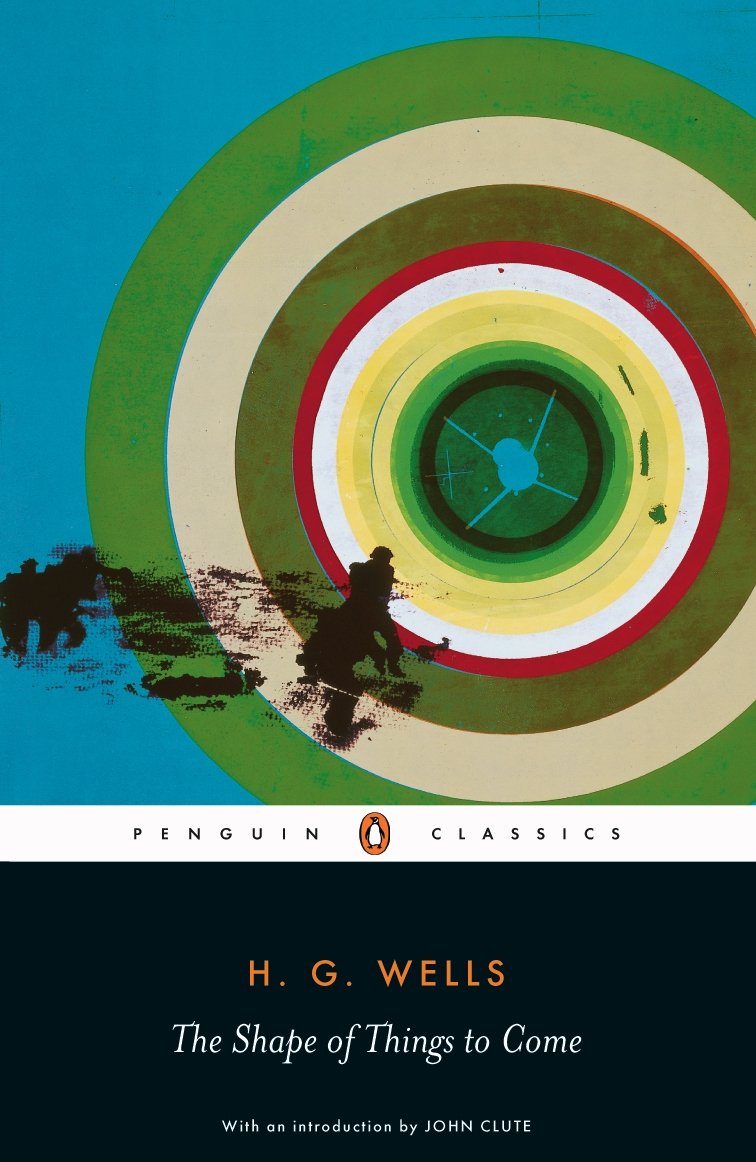
The Shape of Things to Come (1933) by H. G. Wells

...."es lasst sich nicht lesen"—it does not permit itself to be read. 

-- Edgar A. Poe, "The Man of the Crowd" 


The Shape of Things to Come (1933) is a novel I last tried to read in high school. Its opening chapters defeated me. Forty years later, I am trying again. 


Wells's politics, petty bourgeois liberal reformism mixed with the kind of "socialism" Marx obituaried in The Poverty of Philosophy and Engels systematically demolished in Anti-Duhring, infuriates in its complacent and parochial ignorance. His main criticism of Marx is that he provided no plan for rule by socialist governments of the future.


In The Shape of Things to Come he writes:


Marx seems never to have distinguished clearly between restrictive and productive possessions, which nowadays we recognize as a difference of fundamental importance. Exploitation for profit and strangulation for dominance, the radical son and the conservative father, were all one to him. And his proposals for expropriating the profit-seeking 'capitalist' were of the vaguest; he betrayed no conception whatever of the real psychology of economic activities, and he had no sense of the intricate organization of motives needed if the coarse incentive of profit was to be superseded. Indeed, he had no practical capacity at all, and one is not surprised to learn that for his own part he never earned a living. He claimed all the privileges of a prophet and all the laxity and indolence of a genius, and he never even completed his great book.

     It was the far abler and finer-minded Lenin (1870 – 1924, in power in Russia after 1917), rather than Marx, who gave a practical organization to the revolutionary forces of communism and made the Communist Party for a time, until Stalin overtook it, the most vital creative force in the world. The essential intellectual difference between these two men is explained very clearly by Max Eastman (1895 – 1980), whose compact and scholarly Marx and Lenin[13] is still quite readable by the contemporary student. In his time Lenin had to pose as the disciple and exponent of Marx; it was only later that criticism revealed the subtle brilliance of his effort to wrest a practical common sense out of the time-worn doctrines of the older prophet.

     Another nineteenth-century writer, with perhaps a clearer realization of the strangulating effect of restrictive property as distinguished from the stimulating effect of exploitation, was Henry George (1839 – 1897), an American printer who rose to great popularity as a writer upon economic questions. He saw the life of mankind limited and dwarfed by the continual rise in rents. His naive remedy was to tax the landowner, as Marx's naive remedy was to expropriate the capitalist, and just as Marx never gave his disciples the ghost of an idea for a competent administration of the expropriated economic plant and resources of the world, so Henry George never indicated how, in the world of implacable individualism he advocated, the taxing authority was to find a use for its ever-increasing tax receipts.


I admit it is unfair to pick a political argument with a work of fiction. But the early chapters of The Shape of Things to Come clearly permit no air between Wells the pamphleteer and the novel's narrator.


Did Wells realize the "novels of ideas" put him in a position of unmatched aesthetic banality? That compared with the grace and economy of earlier work, which wore it's world government polemic lightly, a novel like The Shape of Things to Come is too drearily authoritarian to provoke more from the reader than capitulation?


Jay

4 May 2021


Thursday, February 25, 2021

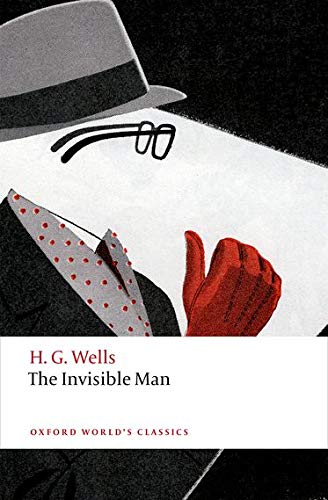
Comedy of terror in The Invisible Man: A Grotesque Romance by H. G. Wells (1897)

I just read the novel The Invisible Man: A Grotesque Romance (1897) for the first time on Monday. 


Maria Parrino, in The Gothic Encyclopedia, defines the grotesque thusly: "The grotesque deals with distorted or unnatural forms set in an extravagant arrangement aiming at a disturbing comic effect."


Unnatural and extravagant certainly typify the early science fiction stories and novels Wells produced in the Yellow Nineties. And The Invisible Man is first and foremost filled with disturbingly comic instances and scenes.


At first these are at the expense of Iping locals who have to contend with inexplicable chaos after the arrival of a mysterious stranger. This is particularly the case with the Halls, whose Coach and Horses inn becomes the stranger's bolt-hole.


Beyond these comic opening chapters, the reader might expect a growing sympathy for the stranger's predicament. But Griffin, the stranger, is at the mercy of his own limited ingenuity from the moment he decides, before the novel begins, to use his invisibility for personal profit. 


Make no mistake: Griffin is a real villain. (And an albino villain, another "first" for Wells. This is an aspect of the novel I was unaware of and have never seen mooted in film and TV adaptations).


From Matthew Beaumont's introduction to the Oxford World's Classics paperback:


....A physicist and former chemist, Griffin is no more than 'a shabby, poverty-struck, hemmed-in demonstrator, teaching fools in a provincial college' (p. 83) when he first apprehends that it might be possible to make the 'whole fabric' of his body (p. 82), including in the end his blood, completely colourless and transparent. As he himself points out, he is 'almost an albino', 'with a pink and white face and red eyes', and this lack of skin pigmentation makes it easier for him to decolourize his tissues (p. 71): ' "… I could be Invisible," I said, suddenly realising what it meant to be an albino with such knowledge' (p. 82). In addition, his albinism reinforces his embattled sense of being a social outsider. In the nineteenth century, after all, albinos were exhibited at carnivals and fairs, and classed among degenerates. Because of his albinism the Invisible Man is already cut off from his kind.

     Sick of confronting a sense of personal, professional, and social impotence, Griffin is driven, in his dream of making himself invisible, by what Friedrich Nietzsche, exactly a decade before the publication of The Invisible Man, identified as ressentiment  —  the vindictively resentful attitude fostered in the individual as a result of the negation of the self that, as opposed to the 'noble morality' of 'the masters', is characteristic of 'slave morality'.1 In this respect, his psychological condition anticipates that of the eponymous character of Wells's later novel The History of Mr Polly (1910), who hates 'the whole scheme of life', which he regards as 'at once excessive and inadequate of him', and who consequently falls, each day, 'into a violent rage and hatred against the outer world'.2 But Griffin is far more malicious than Mr Polly. He is sociopathic. At one point, in order to fund his research, he steals from his own father, who then kills himself because he is secretly in debt.

     Frustrated in his ambitions, Griffin 'find[s] compensation in an imaginary revenge', to frame it in terms of Nietzsche's formulation — his dream of becoming an invisible Übermensch.3 After discovering 'a general principle of pigments and refraction', Griffin devotes himself to his obsessive scientific labours in the laboratory he has surreptitiously set up in a cheap apartment in central London; and devises an elaborate method that makes it possible, 'without changing any other property of matter', as he puts it in his retrospective narrative, 'to lower the refractive index of a substance, solid or liquid, to that of air — so far as all practical purposes are concerned' (p. 80).4 'Wounded by the world', the Invisible Man thus sets out to dominate it through his command of experimental science, and so to make himself one of the 'masters of the world'.5

     Once he has performed the painful metamorphosis that follows his secretive experiments, Griffin gives full expression to his contempt for 'the common conventions of humanity' and the 'common people' who embody them (p. 104). Inspired by his ressentiment, the Invisible Man's vengeful and destructive actions, which culminate in his announcement that he will initiate a Reign of Terror, ensure that he quickly becomes universally feared. He announces 'the Epoch of the Invisible Man', and rumours of his terroristic campaign fan out across the nation (p. 119). The police, in response to the Invisible Man's attempt to implement this terroristic dream, instate 'a stringent state of siege' across an area of several hundred square miles surrounding the place in the countryside to which he has fled (p. 116). But this is too late for one man 'of inoffensive habits and appearance' whom Griffin beats to death, in 'a murderous frenzy', with an iron rod (p. 116): 'He stopped this quiet man, going quietly home to his midday meal, attacked him, beat down his feeble defences, broke his arm, felled him, and smashed his head to a jelly' (p. 116). This is not the 'judicious slaying' Griffin boasted of making when he insisted on establishing his Reign of Terror; it is a 'wanton killing' (p. 110). If he is sociopathic, he is almost psychopathic too. Even the insane moral code to which this monomaniac had hitherto adhered has collapsed.

     Finally, in fulfilment of the function of an ancient scapegoat, the Invisible Man is hunted down and brutally killed in what amounts to a sacrificial ritual performed by the community. 'As if by irresistible gravitation towards the unpleasant,' explained one of Wells's most appreciative contemporaries, the campaigning journalist W. T. Stead, when he came to recapitulate its remorseless plot, 'the invisible man passes through a series of disastrous experiences, until finally he goes mad and is beaten to death as the only way of putting an end to a homicidal maniac with the abnormal gift of invisibility.'6


On the run, Griffin goes to ground at a house in the village of Port Burdock occupied - coincidentally -  by old schoolmate Kemp.


After all the toing-and-froing forced on Griffin, he thinks this reunion is pure serendipity. An invisible man, driven by a profound sense of ressentiment, who dreams of becoming a secret terrorizer of people on a grand scale, must have a safe house for loot and clothes, a place to hide during days of rain and snow and smog. 


Poor old Kemp, snug in a nice little house with a belvedere, carefully tending his own professional scientific ambitions, loses no time alerting authorities. He keeps Griffin talking until they arrive:


      'What I want, Kemp, is a goal-keeper, a helper, and a hiding-place; an arrangement whereby I can sleep and eat and rest in peace and unsuspected. I must have a confederate. With a confederate, with food and rest, a thousand things are possible.

     'Hitherto I have gone on vague lines. We have to consider all that invisibility means; all that it does not mean. It means little advantage for eavesdropping and so forth — one makes sounds. It's of little help — a little help, perhaps — in housebreaking and so forth. Once you've caught me you could easily imprison me. But on the other hand I am hard to catch. This invisibility, in fact, is only good in two cases. It's useful in getting away; it's useful in approaching. It's particularly useful, therefore, in killing. I can walk round a man, whatever weapon he has, choose my point, strike as I like, dodge as I like, escape as I like.'

     Kemp's hand went to his moustache. Was that a movement downstairs?

     'And it is killing we must do, Kemp.'

     'It is killing we must do,' repeated Kemp. 'I'm listening to your plan, Griffin; but I'm not agreeing, mind. Why killing?'

     'Not wanton killing, but a judicious slaying. The point is: They know there is an Invisible Man — as well as we know there is an Invisible Man — and that Invisible Man, Kemp, must now establish a Reign of Terror. Yes; no doubt it's startling, but I mean it. A Reign of Terror. He must take some town, like your Burdock, and terrify and dominate it. He must issue his orders. He can do that in a thousand ways — scraps of paper thrust under doors would suffice. And all who disobey his orders he must kill, and kill all who would defend them.'

     'Humph!' said Kemp, no longer listening to Griffin, but to the sound of his front door opening and closing.

     'It seems to me, Griffin,' he said, to cover his wandering attention, 'that your confederate would be in a difficult position?'

     'No one would know he was a confederate,' said the Invisible Man eagerly….


Griffin is a monster without the pathos of Jekyll; he suffers under no metabolic compulsions, like a vampire. He is not even a mad scientist, his scientific discovery as science is beside the point. Invisibility simply and ironically displays the real Griffin: thief, absconder, megalomaniac.


Jay

25 February 2021