Subscribe to my Substack

Showing posts with label Geoffrey Household. Show all posts

Saturday, January 6, 2018

Unfinished review: The Sending by Geoffrey Household

The Sending by Geoffrey Household. 1980

________

The Sending is a beguiling and strange novel. It overlaps two of my reading passions: the thriller and supernatural fiction. And it is written by one of my favorite writers, Geoffrey Household.

Household's style is spare and perfectly modulated here, as it is in dozens of works. He knows his strengths, and avoids pitfalls which entice and wreck more arrogant craftsmen.

A different hunter/hunted

I first read Rogue Male at a particularly touch time in my life, November 1992. Its authorial sanity and confidence were a tonic, if not a remedy itself.

Since then, I have read every Household paperback I could find. Even when hunting through Half Price Books stores from Leon Trotsky and James P. Cannon, I always checked under H in the fiction and mystery sections. Some times I struck gold: Watcher in the Shadows, A Rough Shoot, Dance of the Dwarves.

Household deals with skilled and resourceful men under extremes of outside pressure in these novels. (Only when rereading Rogue Male did i realize the breadth of knowledge he also offered about interior pressure.)

The inheritor returns

The polecat Meg

All of them witches

The devil explains the role of the Robin


Jay

6 January 2018


Sunday, December 3, 2017

Devil Dance: The Sending by Geoffrey Household


The Sending by Geoffrey Household.
1980

Household's protagonist Alfgif Hollaston has returned to his rural, ancestral home after a career in the Indian Army. He discovers he is the descendant of local Wise Men going back hundreds of years. He inherits the familiar of a recently murdered friend: a polecat named Meg.


_______________
From Chapter 9

IT WAS MEG WHO roused me when I was half asleep in my chair, my mind wandering through the far forest with tiger brother, disembodied by his dance of worship. Meg was scrabbling at the door trying to get out. I opened it for her and followed her to the front door. When I threw it wide and let in the night, I heard what she had heard.

I could not tell whether it was played on a pipe or on the single string of hunting man. It was a reminder of all the joy we have lost, and thus of infinite melancholy, yet it had the sweetness of bird song—if a bird could have the voice of an animal. The symphony, to which one listens dreaming and reasoning simultaneously, must be the highest product of the human mind, yet a shepherd pipe in the stillness of night or the freshness of dawn is the music which comes nearest to communion with all creation.

Meg looped down past the still sheep under the oaks. They did not notice us, their heads turned towards the woodland which sheltered the piper, or itself piped. She was moving fast and was out of sight in the darkness when she crossed the stream, but I knew that our destinations were the same; even the stems of flowers would have bent towards this song of earth, if it had not been night and petals closed. By both of us the singing was received as a summons. She would have felt no fear at all, only gladness in answering. I felt both, the fear being more in the nature of reverence than the terror transmitted by Leyalรก.

Often in life we answer a summons. The receptors of saint and shaman are aware of it, though eyes and ears are unaffected. But this was different. I clearly heard with ears, and knew that once we were under the trees I should also see. That was where fear came in. The legend of Pan and panic of course passed through my mind and was rejected as too simple, too contrived. What I was hearing was the truth behind the myth, whether expressed by man or by my valley itself.

As I entered the trees and began to plunge uphill, the descant of creature or instrument became fainter, not louder, and I guessed where it came from: a small, open glade left by a spreading beech which had fallen and been cut up for firewood. When I reached it I saw Julian Molay sitting on the stump with Meg on his shoulder. All sense of the supernatural vanished. I asked him how on earth he did it.

‘Answer me how on earth you heard it and I will tell you how I did it.’

‘That was how you took Meg away from the vet?’

‘Of course.’

‘And trained her to do all the damage possible!’

‘A small part of all the damage possible. I expected you to kill her.’

‘How could I?’

‘Because in your anger you are without pity. You abused love in order to take revenge.’
I knew exactly what he meant. I denied fiercely that any so-called magic was concerned in the slaughter of Odolaga’s black shepherd and his sheep, except perhaps in the hypnosis of that stage property, the eagle owl.

‘I used the skill of the hunter,’ I told him, ‘not the skill of the shaman.’

‘Yet from somewhere you have the gift.’

Molay was standing up now, his deep eyes condemning me. He was impressive as a judge handing out a sentence, but neither ex-Colonel Hollaston nor the painter of the Holy Well were in a mood to be impressed.
I said that I had no power at all beyond the concentration of the master craftsman: a prayer as he had called it. I had seen what could be effected through the trance and dancing of the shaman, and by trial and error I had found out a little of the use of the familiar: of the good which I might do by communion with Meg and of the evil which was done to me, and life around me, by Odolaga and his training of Leyalรก.
‘What you feel in me is the same as you felt in Freeman, to whom you released Meg’ I added. ‘It is a gift from my ancestors and not of my making. My grandfather had it. My great-great-grandfather had it, and we all were named Alfgif.’

‘I thought your name was Alfred,’ he said.
‘Alfred means Wise as an Elf. Alfgif is Gift of the Elf.’

‘What has that to do with it?’

‘I am told the elf is my valley. See it in any shape you like! I have never wished it to appear to me. But I too was taught to sing in silence.’

I must assume that I was possessed. Having no better spell, I used the incantation of tiger brother to call a spirit of the ancestors. I had closed my eyes as I rocked to and fro in the trance, so that I could neither see Molay nor any result, but on and on I chanted until I felt the Presence. When I opened my eyes and stood still except for shaking, Meg had left his shoulder and had begun to dance.

‘And now what shape did you give it?’ I asked.

‘I saw it in the shape you gave it.’

‘And what was that?’

‘Gentle and laughing and of the earth, Alfgif.’

It was the first time he had used my name. He asked me to tell him exactly what had happened on the slopes of Aquelarre. I gave him the story, from the first sight of Izar Odolaga to the making of the bow and the stampede of the terrified sheep. I fear there must have been some pride in my voice besides regret.

‘You said my Columns of the Sun was an invincible prayer,’ I reminded him, ‘and asked if I did not know it. I did not, but I found it was. So it is true that I had no more reason to fear Odolaga. His sending had failed. You must know by now what that was.’

He answered that he did know, that Odolaga in his desolation had confessed all to him.

‘Very well! And then the woman I love fell ill. Her soul was captured, as a shaman would say. Was it surprising that I believed it was another of Odolaga’s telepathic tricks and that I set out to warn him that my powers could be as dangerous as his?’
‘You were wrong to blame him.’

‘I know. It was you who first made me see that I myself could be responsible and now I am sure I was. All the same I think justice has been done—if one can set the beauty of my Holy Well against the beauty of his dear familiar.’

Molay lay back on his elbows in that unspoken courtroom of the glade and gestured to me to sit on the stump. He said that at least my motive had been more generous than Odolaga’s, that I had acted from love and he only from fear for himself.

‘So now you shall be the judge. Ask whatever questions you like!’

‘Did Odolaga kill Paddy for you?’

‘He did.’

‘So you are the devil!’

‘In the sense of anguished clergy long ago, yes, I am.’

‘Is there no other devil within the Purpose?’

‘I doubt it. But if evil were personified, it would be the antithesis of love. Have you forgotten the cough of the tiger which maddened sixty sheep? Man does not need a devil. He does well enough by himself.’
I said that I found it hard to imagine him as that ancestral Horned God, when we were talking face to face and sharing the same faith.

‘I dress my mind and not my body in the innocence of the horns and tail. I do not believe that my blood or my semen will fertilise a field, but it may be that I myself can still fertilise mankind. If I cannot, if my powers fail through age, then before I infect my people with my weakness it is right to kill me and choose a successor. He is already chosen, but he is still too young for the fullness of wisdom. Nothing mysterious there, my Alfgif! Even in politics a party may decide on its future leader before he is quite fit to lead. Therefore I must live longer and one of us had to die in my place. Paddy chose to do so. I did not wish to accept his sacrifice, but as Grand Master it is my duty.’

I could not see the point of either of them being killed, and asked him to explain if he could.

‘What is the point of a soldier’s death?’ he asked.

‘His society expects it of him.’

‘Yes. You have answered your own question. And now I will put one to you. Would you die for the sake of the Christian faith?’

‘Probably.’

‘Yet you have little respect for the Church and its creed.’

‘Or for its rites.’

‘There you are wrong, for rites are a shadow of the truth. I summoned you to me by what is remembered as the harp of Orpheus. You called up a Presence as mischievous and sweet as Meg by a rite far older. You had faith that you heard. I had faith that I saw. Reality? We are fools to ask what is reality, when all we touch and see and are is empty space and energy. Within the Purpose there are rites named of earth and rites named of heaven, all intermingled in all religions and culminating in that purest and simplest of rites: the Communion of the Christian with the Purpose.’

‘For you, then, what is the Purpose?’ I asked.

‘How often there is more beauty in living things than needed for survival! Consider the peacock’s tail and the feathers of the Bird of Paradise! To attract a mate and be recognised, we are told, but that could be achieved by a fraction of the display. Consider the majestic antlers of the stag! A magnificence and nothing but a handicap. The colours of the butterfly—they have a use but not to that extent of glory. Consider the Columns of the Sun and your late Holy Well! What use to your survival or the survival of the race are those? They have only one conceivable value, and that is to the observer. What the Purpose is we cannot know, but observation must be within it. Observe this garden of the earth and understand that when you cease to observe and to love, you exist no more!’

‘Then death is the end.’

‘You miss my meaning, Alfgif. I know nothing of death except that we should not whine for immortality. Take joy in the gift of life! If the object of my life is finished with my death, I rejoice that I have been able to serve. If it is not finished, I rejoice that there is still a use for me.’

He said that was enough of preaching and remained silent. The scent of the earth was stronger than I had ever known it. Meg ran between us, caressing his face with her whiskers and then returning to my feet. I asked him to tell me about Paddy.

‘Paddy was a healer of the animals. A Robin. His coven was formed of all his friends, though few were conscious of it. He was simpler and more saintly and quicker than I. He would have seen that you could never have abused your gift as I believed you had. He said you had the makings of a leader.’

‘A shaman?’

‘A Robin. I like that happy, English name. The healer. The provider of joy.’

‘And of sendings to the innocent,’ I added, remembering Odolaga.

‘Forgive him! He acted from foolish fear, and you would not blame the beast which charges when it cannot run. And now for this girl of yours, my strange, chaste sorcerer! It seems you can copy the attack of the carnivore but not the tempest of its mating.’

‘How do you know?’

‘Only a monk could have so much passion and remain celibate. Were you never married?’

‘For two weeks.’

‘What happened?’

She died in my arms.’

‘I see. Guilt, But that was not beyond psychiatrists’

‘I’ll have none of them. I am what I am and know more than they.’

‘But your tiger brother—couldn’t he cure you?’

‘No. He said that a white larva had made its home in my wretched organ and could not conjure it to leave.’

‘I think you would not let him, Alfgif. You believed in your guilt and clung to it. But now will you let me? I can make you as a Robin of old days, whose maidens would hang wreathes of poppies on the symbol of fertility. Will you be ashamed to dance naked with me?’

I might have been, but those gentle, piercing eyes would not release mine. And there was I naked while he, stripped to the waist only, like tiger brother, raised his arms in a hieratic gesture as if he were throwing over his shoulders the skin and tail of the God.

He began to beat the ground with his feet, always circling round me face to face, and I kept time with him. What ritual I was treading out I could not know, though there were memories of the forest and memories of the eager hunting dance which I had performed for my dinner, but never for myself.

‘Your horns are spread between sky and sky, my Alfgif. You have driven away your rivals and the herd of does awaits you. As a bird dances for its mate, so must you. Tell him, Valley, to dance for grandson Alfgif! Tell him, Meg, to dance with you! As we dance, so must you.’

There was much more, but that is what I remember. He circled me, chanting, and each time he passed a young plant of broom he plucked a green twig from it like a browsing goat. In the trance of beating feet, I was aware only of his hands and eyes; nor was I conscious of the erection, being so long forgotten, until he flung the wreath that he had been twisting as if it were a quoit over a peg.

He told me to dress and have no fear.
‘Mate after mate is yours if you wish, and if you wish only for one she will never leave you. What is her name? I will call her.’

‘Rita. But she cannot receive. She would not hear you.’

‘Better so, Alfgif! In you she will find the future and in her you will find the past. Go now, and tomorrow be with her!’

‘Shall I see you again?’

‘As a passing friend it may be, with the simplicity of Paddy.’

I asked him if he really lived on the Syrian shore, as Paddy had told me.

‘Often enough, because that is where all religions meet and all traditions remain. Among my ancestors were reigning devils, or Grand Masters if you wish: Jacques de Molay, Master of the Temple, burnt for heresy; Plantagenets reverenced by Christian and Pagan alike, and true to both. It may well be that you and I are not the first of our two families who have met and prayed together.’

‘Can I drive you anywhere?’ I asked, the question sounding absurdly out of time and place. ‘How are you going?’

‘As I came, Alfgif.’

He shook hands, blessed me and was gone, vanishing with the skill of tiger brother and with only the rustle of his footsteps to show that he was most certainly passing through the trees and not above them.
***
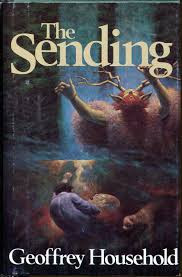
Witch Trial: The Sending by Geoffrey Household


The Sending by Geoffrey Household.
1980

Household's protagonist Alfgif Hollaston has returned to his rural, ancestral home after a career in the Indian Army. He discovers he is the descendant of local Wise Men going back hundreds of years. He inherits the familiar of a recently murdered friend: a polecat named Meg.

Here he lunches with the enticing Somerville don Eita, who vacations in a cottage near his home.


….I asked [Rita] to lunch after Meg and I had celebrated by stealing out in the late twilight to catch a dish of crayfish, to which Meg, regardless of the season, had added an unsuspecting mallard grabbed with a leap as it rose from the rushes. The invitation seems to have happily surprised her, and when I showed her my Columns of the Sun there were tears on her cheeks. She did not examine it closely, so I think her emotion was due more to my eyes and bearing. Ginny, who is fascinated by my drawings but can’t abide them funny pictures, was also inclined to be tearful. It appears that I am like a botched work of art, cherished because it has been over the mantelpiece for so long.
            After lunch we sat in the garden and Rita again pressed on me her theory that the depression from which I had suffered could be a backlash from the sort of powers I was using. I denied that I had any more powers than the rest of us. I merely knew they existed because I had been on terms of close friendship with a shaman.
            ‘The difference between you and the rest of us is that you appear to have them,’ she said.
            I told her that nobody could seriously believe anything of the sort. She then announced, merry and mocking, her hands setting the scene for me, that she would have another small brandy and put me on trial in 1664 acting as prosecuting counsel within the beliefs of the time. I reproduce it as best I can:
            ‘Prisoner at the bar, you are charged on suspicion of the felony of witchcraft to the Great Offence of God’s Law, Hurt and Damage of the King’s Subjects and to the Infamy and Disquietness of the Realm. Upon the first charge of bewitching Master William Hutchins’ bullocks how say you now to His Lordship and this jury? Guilty or Not Guilty?’
            ‘Guilty, your worships, but not with intent.’
            ‘So now to the second charge, sirrah, of possessing an imp in the likeness of a polecat which you did nourish with your blood. How say you?’
            ‘I never did.’
            ‘Call Mistress Rita Vernon.… Mistress Vernon, tell us whether upon the fourteenth June last you did not witness this abomination!’
            ‘I did indeed witness it, good sirs.’
            ‘Damn it, Rita! Just because I once let Meg lick up the blood where she had scratched me with her claws!’
            ‘Silence in Court! Guilty or Not Guilty?’
            ‘Well, on a technicality…’
            ‘The third charge is that you, Hollaston, did receive visits from the Devil and swore to be his servant. Dare you say you are not guilty?’
            ‘If counsel is referring to Robin’s chasuble of animal skin and tail, or to his appearance as the Man in Black when dressed as any other priest for visiting his parishioners, I deny having received any such visits and know nothing of the organisation and practice of the religion. I confess to have been visited by an incorporeal devil, but against my will.’
            ‘Most damnable! And there is yet a fourth charge which he cannot answer, for examination showeth that he beareth upon his upper arm the mark by which the devil claimed him as his own. How now, Hollaston? What say you to his Lordship?’
            ‘My Lord, I have indeed been initiated by a mark, but see no more harm in it than circumcision or scarring of the face. I confess to the formality of an exchange of blood with the local representative of the Divine. His conception of sin, my Lord, was much the same as yours, plus a few extras. The scar upon my upper arm is permanent because herb juice was rubbed into the cut to keep it suppurating. And how the hell did you know, Rita?’
            ‘Because Ginny told me. Silence in Court! Not only does the prisoner confess to abominable practices, but would persuade us that they resemble those of Holy Church. Let him to be taken out and hanged by the neck until he is dead!’
            Well, it must be fun to be alive to past and present, and a beautiful woman with it. But now she took the wrappings off the parcel.
            ‘Will you admit, Alfgif, that you could be taken for a sorcerer?’
            ‘Not unless you would call Paddy Gadsden a sorcerer, which he certainly wasn’t.’
            ‘Your von Pluwig thought he was.’
            I said that was putting it far too romantically. Paddy’s receptors interacting with nature were more sensitive than mine, but that did not make him a sorcerer. And who in the world, apart from a few of the more superstitious, could possibly think that I was?
            ‘Somebody who in fact can use the powers you only experiment with. Somebody like your tiger brother brought up to date, so that your horrible sending wasn’t a freak like Gargary’s rabbit warren but a quite deliberate attempt on you.’
            I had to agree that at least it was possible, since I was not invulnerable like sceptical urban man, but receptive as a tribesman whom the witch doctor can influence to die.
            ‘I have no enemies so far as I know.’
            ‘Then find him, her or it,’ she said.
            Absurd! Am I blacklisted because I haven’t joined the union? A joke when I put it that way. Yet tiger brother did not approve of competition. He would not admit that he had anything to do with accidents, but they happened—just as to that harmless chap boring me with his chatter about abstract art. Concentrated venom could at least distract his thoughts to the point of tripping over himself. And is there any more deadly method of distraction than to make the mind consume itself, obsessed with terror?
            What alarms me in the witch trials is that the judges—one can’t answer for the juries—were able men experienced in distinguishing truth from falsehood and misrepresentation. Acquittals, light sentences and pardons were frequent. Accusations plainly deriving from malice or superstitious illiterates were thrown out. So what is one to make of the death sentences?
            Leave out Satan and his imps, and the evidence is as straightforward as in any police court, clear, factual and obeying the rules such as they were. Wincanton witches were guilty of using a baptised image for cursing; witches of East Anglia used the familiar. Both could also heal, but not much is recorded about that. In any case, healing by means of incantations was considered no less a crime than cursing….

The Robin: The Sending by Geoffrey Household

From Chapter 4
The Sending by Geoffrey Household.
1980

Household's protagonist Alfgif Hollaston has returned to his rural, ancestral home after a career in the Indian Army. He discovers he is the descendant of local Wise Men going back hundreds of years. He inherits the familiar of a recently murdered friend: a polecat named Meg.


....I HAVE GREAT DIFFICULTY in reading. When I open a book I cannot concentrate; too often I must look round to see what is waiting for me behind my chair. But I did my best, in spite of interruptions, to follow the record of the trial of the Wincanton witches, especially after discovering that they confessed to being instructed and comforted by a Man in Black to whom they gave the name of Robin.
            The prosecution was founded on sound legal evidence of the facts, but the court never attempted to identify Robin. Of course it did not. It assumed that he was the Devil, who could hardly be put in the dock. The witches did not deny it (loyalty or genuine belief?) and sometimes called him Satan.
            They sound like some isolated and fading little tribe whose shamans have been killed or civilised, who cannot recover the rites, let alone their meaning, and flutter around like lost hens.
            All that is left of the Robin, the chief of the coven, the beast-man, the incarnation of the Purpose and its joy, is my grandfather’s uncanny eye at an auction of livestock together with my great-great-grandfather’s power of healing. This gene which activates the human receptors and skips a generation—what is it up to now? Well, somehow, it was detected in me through my beliefs or my words by the saintly Paddy and by my blood brother. An anthropologist or administrator or explorer would not be capable of sensing the aspects of truth behind the antics of a shaman; a hereditary Robin would be.
            Apparently I am a witch—a freelance witch, one might say, with few powers and only the vaguest training in the theology of animism, but possibly with the makings of a Robin. I see that in scribbling my speculations some days ago I came to the tentative conclusion that action at a distance is powered by the dance and self-hypnosis. The latter, I suppose, in more evolved religions is the ecstasy of prayer. That is beyond my reach. I have difficulty in importuning the Purpose. Since I believe in the holiness of the senses, any ecstasy of mine would be praise not prayer: the Te Deum not the Miserere. A Robin may come steaming from the Pit, horned and clawed as the prosecution believed, but can still praise the Purpose.
            This written confession of faith has momentarily lifted the Fear. Praise even in adversity like poor old Job? What else has lifted it? The approach of the vixen and my own identity with her, with the oaks and the radiance of moonlight. That was in fact a passing moment of the mystic vision which, I suspect, is the resting state of animals from the butterfly to the tiger, easily to be entered by primitive man and only with long and deep meditation by the civilised.
            The Wincanton trials are short of hints and tips on the use of the tame familiar. Our local witches do not seem to have had any. They used animals much as the Roman augurs, setting the scene, calling on the god and foretelling the future by the first beast or bird which turned up. I have watched tiger brother go through a similar ceremony to predict the success or failure of a hunt when he could have done it on his own without any fortune-telling at all—just as Paddy, according to George, could pick winners.
            Meg and her like become very important in other trials outside Somerset. The familiar may be supplied by the Robin or bought or just found and tamed. It might occasionally be used for healing but far more often for cursing and petty stuff at that: bewitching the next door neighbour’s pig, stealing some much needed butter, hastening the end of some farmer down the road who was obviously dying of natural causes. All self-advertisement. If an old woman with an eccentric taste in pets could make her district thoroughly afraid of her, she was sure in her utter poverty of gifts and respect. My tiger brother was sometimes no better. His power to send and receive telepathically was beyond doubt, but he was not above hocus pocus if he didn’t get his proper share of what food was going.

            I wish he had used a familiar; but since he believed that he could send his soul to commune with beasts in the wild he had no need of one at home. In spite of all this reading I am still unable to answer Rita’s question: what is the importance of Meg?

King's Blood: The Sending by Geoffrey Household

Excerpt from The Sending by Geoffrey Household. 1980


'....You know the anthropologists' theory of the king who must die for the people?' she asked.

            'Yes. And I've spotted remnants of the belief here and there in India.'

            'And did you know that was why William Rufus was killed?'

            I did not, having only learned the school book verdict that he was a 'bad' king. She explained to me how historians had been puzzled by all the abuse poured on him by monastic chroniclers, when the rest of the evidence showed that he was brave, just, chivalrous and accepted with love by the English, who hated his father, the Conqueror. Why did the common people follow his bier from the New Forest to Winchester? Why was it said that all the way his blood dripped to the earth? And why when Walter Tyrell hesitated to shoot, did he cry: 'Draw, draw your bow for the Devil's sake and let fly your arrow, or you will be sorry for it!' And why was his death expected and foretold all over Europe?

            'He was the King and Grand Master, the grandson of Robert the Devil. That's the explanation. Churchmen knew him for what he was and were appalled by his contempt for them; but the mass of the Saxons, who were as much pagan as Christian, adored him for living for them and dying for their land. This isn't a lecture, Alfgif, so I'll just give you Rufus. There's a good case too for Henry II as Grand Master and a better one for Gilles de Rais who was Joan of Arc's commander in the field.'

            I presumed that she knew her stuff and I saw the implications, but I said I could not for a moment believe that the gentle Paddy was the secret shaman of Western Europe.

            'Ah, but the Grand Master did not have to die. If he could find a willing victim to die in his place he had another seven years.'

            'You're suggesting that the rite still exists in the Europe of today?'

            'There must be more people than you, Alfgif, who share the vision that all living creatures are one within what you call the Purpose. Their myths and forms of worship may be as odd as tiger brother's. And that's no odder than some of those American sects. I told you I couldn't really believe it but the evidence keeps piling up. And you must admit that your Paddy was a Man in Black.'

            'He had no coven.'

            'Of course he hadn't. A village coven would be an absurdity in these days when one can fly to Paris in the time that it took to ride from Penminster to Wincanton. So couldn't a coven now be international? Remember all the strangers and foreigners who came to his funeral!'

            That I had explained by his reputation among horsemen, but it had always puzzled me. So did the fact that a saddler in a little country town had executors of international standing. And if Rita was right, where did I come in? That I did come in somewhere was certain.

            'Why do you think he gave me Meg?'

            'Because he saw you were a kindred spirit, just as your tiger brother did. And perhaps because it was a mark of honour and good for Meg and perhaps because you are loved. Will you start a coven, my Robin, and dance with me on our downs in moonlight?'