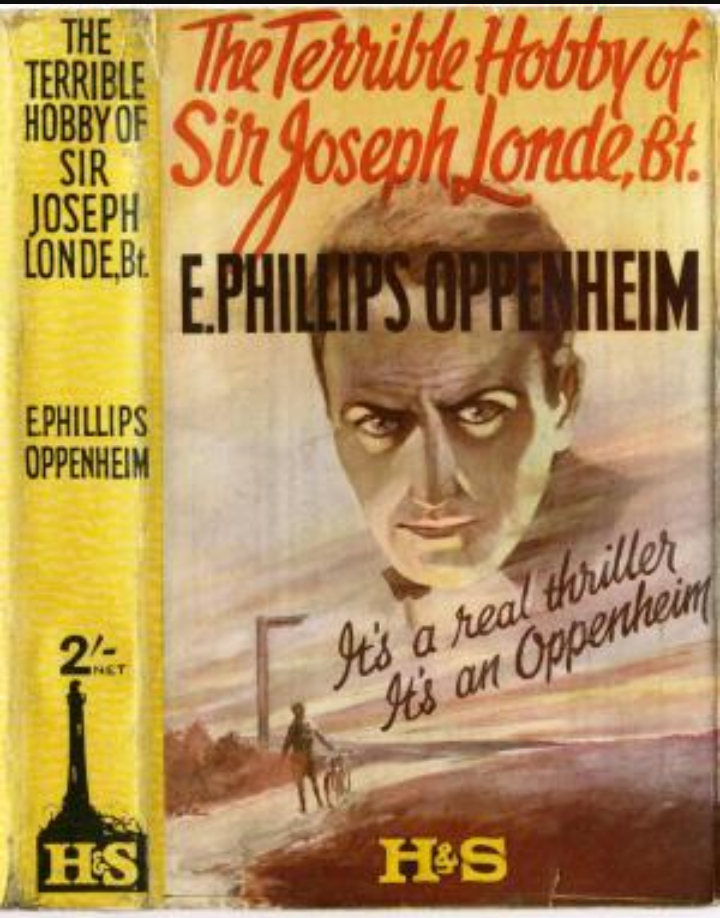
by E. Phillips Oppenheim
*
After a week of reacquainting myself with Hemingway's short stories, a book by E. Phillips Oppenheim comes almost as a relief.
Hemingway demands to be read at full attention in a straight-back wooden chair with hard seat and no armrests. His style requires the reader do the heavy narrative lifting; this is an incredible exciting process, but exhausting. Unless taken in small doses, everything by Hemingway quickly begins to sound the same.
I have not read Oppenheim before. The Terrible Hobby of Sir Joseph Londe, Bart. was probably not the beginning a real connoisseur would suggest. But even if I never read another Oppenheim book, I'm glad I read this one, which I thoroughly enjoyed.
Londe was originally written as a series of interconnected stories, published in magazines in 1923-24. Various online sources give year of book publication as 1927.
Oppenheim seems not to have recast the stories as a novel, as Christie did with The Big Four. So the chapters are episodic, and the reader should not force the pace. I found one chapter in the morning, and another on lunch break at work, worked very well.
Londe is not a mystery novel. There are some crimes and investigations and solutions along the way. But the real atmosphere is one of menace and suspense, and fundamentally of adventurous dread. At first we think we are rooting for the amateur sleuths, Daniel Rocke and Ann Lancaster. They are both wet as haddocks, but Oppenheim throws in some nice bickering to break things up.
After a few chapters we begin to think we should root for Londe and his equally mad wife Judith. Londe himself wants to be cured of his madness, convinced then he will be able to achieve scientific greatness. He thinks insanity has also robbed him of his soul. Judith, on the other hand, insists that madness has done wonders for her hair and skin, making her look and feel like a young pagan. She mesmerizes young men and bathes in their adulation.
Oppenheim gives us plenty of scrapes and escapes and some nicely outre touches. Later chapters in Monte Carlo are particularly strong.
Below are a few long excerpts that capture the weird poetry of Londe's character and behaviour.
_____
...."You see, my wife here and I—she wasn't my wife then—were right up to the line in France and Belgium for many, many months. I lived with a knife in my hand, and she with bandages. Night and day we were there. If I sought a moment's sleep, I was awakened by the screaming—and they came and fetched me. We were short of anaesthetics. We were short of everything. Blood—you never saw anything like it! We lived in it, and, somehow or other, a drop of it got into my brain. I went to a physician. I knew it was there because I could see it with the X-rays. He told me that nothing would cure me but to find another brain of the same formation as mine, but a natural colour, and remove a small portion of it to take the place of the discoloured part of my own. I dare say it was good advice, but I couldn't find another brain that hadn't got a similar smudge of red in it. I tried several subjects, as you know. The third was too selfish. People misunderstood us, so we had to go away. Then there came the question of this exchange of hair. My wife was afraid that you would be like these cowardly men and make difficulties about it. Directly I saw you, though, I knew there was no fear of that."
The Terrible Hobby of Sir Joseph Londe, Bart.
http://gutenberg.net.au/ebooks12/1202251h.html
___
From chapter 7:
LONDE threw the copy of the Times which he had been reading across to his wife, and stood upon the hearthrug of the somewhat Victorian-looking drawing-room, scowling. They had settled down for a few months in a remote corner of Surrey.
"Read that, Judith," he invited.
She stretched out a lazy hand, drew the paper towards her, and read the paragraph aloud.
"1,000 reward will be paid for any information as to the present whereabouts of Sir Joseph Londe, Bart., late of Melbourne, Australia, Surgeon-Major in His Majesty's Forces. Apply Box 117, Offices of this Journal."
Judith looked up and laughed with the pleased interest of a child.
"Why, that must mean you, Joseph," she exclaimed. "Somebody seems to want you very badly."
He glanced at her with an evil light in his brilliant eyes—eyes which seemed during the last few months to have narrowed and to have receded in his head.
"Somebody wants me," he repeated bitterly. "I know who it is, of course. It is that archlunatic in this world of lunatics, Daniel Rocke. I know what he wants, too. He wants to hang me."
"How ridiculous!" she murmured. "Are people ever hanged nowadays?"
"You have not much intelligence, Judith," he went on, dropping his voice a little, although they were alone in the room; "but you know what has happened, of course—the war has sent every living human creature mad. I could see it coming. I foretold it in the Lancet and all the medical papers. I even warned them in an article I sent to the Fortnightly, which they never published. I felt it coming like the end of the world. It is a horrible thing, Judith, to be the only sane person amongst all the hundreds of millions in the universe."
"What about me?" she asked, with an empty laugh.
"You are mad, of course," he answered scornfully, "but that does not matter. You are beautiful and that's all that counts with you. It is your very insanity which keeps your skin as soft as a baby's, your forehead unwrinkled, which gives you the strength never to tire. But think of the horror of the situation for me. I have the brain of a million scientists in one. I am solving every day in my mind problems which have baffled the world for generations, and yet, at any moment, I am liable to be arrested by lunatic detectives, tried by a lunatic judge and twelve lunatic jurymen, and hanged by a lunatic hangman. All this because I am the only sane person in the world!"
She smiled reassuringly. She was lying on a couch by the window, her hands clasped behind her head.
"Don't think of it, dear," she begged. "You are too clever, far too clever for them. Think how they try to catch us sometimes and how we always move on when we choose. A world of lunatics have no chance against a sane man hke you."
He nodded, assentingly, but still with gloom.
"That is true," he admitted, "but mad people are sometimes very cunning. Not mad people like you," he continued, after a moment's pause. "You are just silly—soft, the country folk call it. But a man like Griggs! I have been watching Griggs lately. I have come to the conclusion that he is no longer trustworthy."
"What a pity!" she murmured. "He has been so useful and we must have somebody."
"I am afraid," Londe observed, with a peculiar smile, "that his days of utility are over. I have made a most interesting experiment upon him. I was obliged to do it as a matter of self-preservation, but I am afraid it means that he will be of little use to us in the future."
"Poor Griggs!" she sighed. "What have you done?"
"I have closed up the other cells in his mind," Londe confided. "He is now not only mad, but a hopeless imbecile. It was quite an interesting experiment."
She clapped her hands.
"What fun!" she exclaimed. "I must see him at once."
"You will be very interested," Londe assured her. "I flatter myself that there is no one living who could have done with that man what I have done."....
The Terrible Hobby of Sir Joseph Londe, Bart.
http://gutenberg.net.au/ebooks12/1202251h.html#ch07
__
….It was, in its way, a wonderful dinner, served by a typical French butler, and cooked by his wife. Londe was an excellent host, Judith a seductive hostess. Brookes expanded with the wine and the glamour of his surroundings. He told them both his story. After the war, he had gone back to Ceylon, to find his small estate in a parlous condition. Then the price of rubber, of which half his planting consisted, had fallen to nothing. In despair, after two years of unsuccessful toiling, he had closed down the estate, collected all the money he could, which amounted only to about nine hundred pounds, and come to England, for a holiday first and then to make a fresh start. That nine hundred pounds he had lost at the tables that afternoon. Judith was a little scornful. Londe only smiled. The young man drank more wine.
"I must make money somehow," he declared. "I can't think why I can't win at the tables like you do. Everything you back seems to turn up."
Londe's smile became more evident.
"There is a reason for that," he remarked.
"What do you mean?" Brookes demanded eagerly. "Do you play on a system?"
Londe shook his head. Judith laughed.
"We need no system," the former confided. "We win always because neither my wife nor I are perfectly sane. A mad person, as you know, will win at any game of chance."
"I beg your pardon," the young man ventured, a little bewildered.
"I mean exactly what T said," Londe continued, with dignity. "You, yourself, know something of our activities during the war. We did twice as much work as any other surgeon and nurse. In the end, a small portion of my brain became affected. My wife, curiously enough, developed sympathetic symptoms."
"God bless my soul!" the young man gasped.
"There is nothing so extraordinary in the matter," Londe proceeded stiffly. "A small spot in my brain became discoloured; it became, in fact, red instead of of ordinary grey, which, you may be aware, is the colour of a normal person's brain. An operation was indicated. All that I needed was a small atom of healthy matter to be annexed to mine, in a manner known only to me. Now, I'm going to tell you something that I have never told any other living person. I advertised for a subject. Shall I tell you the result?"
"Yes, yes, certainly."
"I was incarcerated in a lunatic asylum—my wife and I—for over a year."
Brookes was past speech. He lifted his glass. He gazed at the speaker, half-fearfully, yet with a terrible curiosity.
"When they let me out," Londe continued, "I tried again to find a subject, only this time I knew better than to advertise. I investigated the brains of several persons who happened to come my way, but in each case I found a small red discolouration just in the same position as my own. For the present, therefore, I have abandoned the attempt. My efforts seem to have created an absurd prejudice against me on the part of the police and other troublesome people, and, to tell you the truth, I have lost faith, to some extent, in my own theory of exchange. Besides, my wife and I find a certain compensation in our present state."
"You really believe that you are both a little mad still, then?" Brookes faltered.
"Without a doubt," his host assented. "I am perfectly aware that both my wife and I, in different and varying degrees, lack an absolutely sane poise towards life. But what does that matter? See!"
He rose to his feet, and drew on one side the blinds which concealed the window. From outside a stone balcony looked down upon gardens, glorious in the full moonlight, and sloping to the still Mediterranean. There were cypress trees, like black frescoes against the deep blue background, orange trees, bending with their load of fruit, a few olive trees, a grove of firs, a mass of flowering shrubs, oleanders, a bed of Freesias, whose disturbing perfume crept into the room. From below came the haunting sound of the soft lapping of the waves upon the shore.
"We can appreciate beauty," Londe pointed out, "just as you can. We have gifts—cunning, I suppose you would call the chief one—which enable us to match our wits against most people's. We have lost the rack of nerves—look at my wife, she is more beautiful and younger now than during or before the war. All that we lack, the scientists would say, is soul—and who on earth is not the better for being without a soul?"
Londe dropped the curtain and turned back into the room. His wife's hand rested on the young man's arm. He felt the pressure of her fingers, and his brain reeled with the wonder of it. He was, after all, quite an ordinary person.
"I shall go to my salon," she murmured, moving towards the door. "Please come soon."
Brookes resumed his place at the table and sipped the old brandy which his host had produced. He was still in a state of feverish bewilderment. Londe, in his way, seemed also excited. His eyes were bright, his lips tense.
"I have a proposition to make to you, Mr. Brookes," he announced. "Do you care to hear it?"
"Rather," the young man agreed, a little recklessly. "If there's any money at the end of it, it will be all the more welcome."
"There will be all the money you can use at the end of it," Londe promised. "Briefly, the situation is this. You know, of your own experience, that I am a great surgeon."
"I have heard it said that you are the greatest surgeon in the world," was the emphatic assent.
"It is possibly true," Londe acquiesced. "I am also a great scientist. I have invented a new anaesthetic, which has marvellous properties. I have a tube in my pocket now. I could take the strength from your limbs with a single whiff, whilst leaving your brain normal. Or I have another one, with which I could entirely reverse the process. Would you like me to experiment?"
"No! For God's sake, no!" the young man interrupted.
Londe smiled tolerantly.
"Just as you like, of course. Now, I have made another discovery which I am anxious to try," he continued, leaning back in his chair, and lighting a cigarette. "I still believe that I shall be able some day to regain my sanity by my principle of brain transfusion, but my last discovery is this. I can make you insane like me. I could give you a draught to-night, and you would awake to-morrow, to all appearances, exactly the same person, but you yourself would be conscious of the change. You would be lighter-hearted, gayer, happier, and, in some things—such as gambling, for instance—your success would be extraordinary. You would be free, too, from the thraldom of soul."
"But I should be mad," the young man muttered.
Londe shrugged his shoulders.
"Are you so happy, as you are, and is your future so assured?" he asked. "Give yourself over to me for experiment, and to-morrow you can make a million francs at the tables, and a million more whenever you choose."
Brookes looked around him, dazed but already shaking with excitement.
"This isn't some sort of an Arabian Nights, is it?" he asked, with a clumsy laugh.
"I am making a perfectly practical proposition to you," his host assured him.
"What do I have to do about it?"
"You submit to a slight injection before you leave this house," Londe explained, "and you take a draught which I shall prepare for you."
The young man rose from his seat and walked to the window. His heart was pounding. Somehow or other, although he had affected incredulity, he felt a curious conviction that this amazing offer was a perfectly genuine one. Suddenly he swung round.
"I consent," he announced. "I might as well. There is nothing else left for me."
Londe accepted his decision as a matter of course.
"I shall now go to prepare the drug," he declared. "It takes careful mixing. When you have offered yourself for my experiment, I shall give you ten of these mille notes to start with. Afterwards, your future is in your own hands. Do me the favour to entertain my wife for a quarter of an hour. You will find her in the salon across the hall."
The young man, in a state now of fierce excitement, hastened to obey his host. He was an unambitious youth, who, save for that brief period of the war, had lived, for the most part, a quiet life in middle-class surroundings. He had certainly never been brought into social contact with any woman so lovely and engaging as Judith. Her very presence intoxicated him. He felt himself trembling as he heard his host's retreating footsteps, and he himself turned the handle of the door of the salon. Judith was half sitting, half reclining, upon the sofa as he entered. The flash of her white arm, as she motioned him to a seat by her side, maddened him. She wore a wonderful, blue brocaded gown, fastened round her waist by a silken girdle, seductively unrestraining. She saw his confusion and laughed at him. He leaned towards her, but she held him away.
"Silly boy," she murmured. "You lose your head so easily, and now you have lost all your money."
"I shall make more, a great deal more," he declared passionately. "Do you know that you are the most beautiful thing on earth?"
"Foolish!" she mocked. "There, you may hold my hand. I like you very much, but—"
"I love you," he broke in. "I adore you, Judith. Come back to Ceylon with me."
She laughed outright.
"And what about my husband?" she asked. "And what should we live on? I am a very extravagant woman."
"I can make money," he assured her. "To win you I shall do it."
"I like you. I have affection to give," she told him; "but I warn you that I am a pagan. I will love you a little when you give me a present like this."
She held up her arm, from which drooped a strange bracelet, a thin band of platinum and a single rose-tinted pearl.
"I will do it," he promised. "One kiss, Judith, one kiss."
She leaned towards him, then suddenly drew back with a warning gesture. The door had opened noiselessly. Londe stood upon the threshold. His face was imperturbable. He appeared not to notice his guest's embarrassment. He simply stood there.
"I have a liqueur I am anxious for you to try, Mr. Brookes," he said. "Afterwards, perhaps my wife will give us some music."
The young man hesitated. For a single moment a queer divination of evil seemed to oppress him. A black gulf yawned at his feet—on the other side of it Londe, impenetrable, yet menacing. He had an impulse to fly from the house. Then he heard Judith's whisper, low and caressing, carrying with it the spice of promise.
"Go with him now, and return."
He moved towards the door, crossed the white stone-flagged hall, and followed his host into the dining room. An old dust-covered brandy bottle stood upon the table and two Napoleon glasses. Londe served the liqueurs with meticulous care.
"Eighteen eighteen." he murmured. "Gold and sunshine. The best things in life."
Brookes drained the contents of his glass. He felt a delicious sense of fragrant warmth steal through his veins. The touch of the brandy upon his palate was like velvet. Londe drew another bottle from behind a bowl of roses, poured out a wineglassful into a fresh glass, and passed it over.
"Now I want you to try that," he invited.
His guest did not hesitate. He raised the glass to his lips and drained its contents. It was tasteless, yet somehow suggestive, of marvellous and unexpected potency. He saw Londe's face, sinister but triumphant, and then a hundred faces. A mist and a roar. Afterwards nothing.
The morning was full of surprises to Brookes. He woke with an unusual sense of buoyancy, to find himself in his hotel bedroom, the sound of his bath water running, and the valet moving about the room, laying out his clothes. He sat up in bed.
"Hullo!" he exclaimed. "How the devil did I get here?"
The man smiled a little knowingly.
"Monsieur is in his own room," he observed.
"But I don't remember coming home last night," Brookes confessed.
"Monsieur arrived home soon after one o'clock," the man confided. "He was accompanied by an older gentleman who had the kindness to give me a twenty-franc note. Monsieur had, without doubt, been dining well," he added.
Brookes felt absolutely no more curiosity about the events of the night before. He sprang out of bed, whistling lightly to himself. From the moment he stepped into his bath he was conscious of a new light-heartedness which he seemed to accept as a matter of course. He shouted for his breakfast, which he devoured eagerly, dressed with interest, and strolled out afterwards on to the terrace, full of an exhilaration such as he had not experienced for years, a childlike delight in his surroundings which took no account of his recent despair. He talked to all his neighbours in the famous bar where he took his morning cocktail, and made several new acquaintances, strolled across to the Casino, played without anxiety, and with a new sense of certainty, and before lunch, which he shared with some of his new friends, had won a trifle over forty milles. Four o'clock found him at the Sporting Club, engaged in an eager search for Judith. He played for a short time with a curious loss of all sense of excitement, won a pocketful of plaques and notes, but left the tables directly Londe and Judith entered. He hurried to them with all the eagerness of a schoolboy. They both looked at him curiously.
"Winning?" Londe enquired.
Brookes nodded indifferently—he who had played, with beads of perspiration on his forehead, only yesterday, watching every stake as though it had been a matter of life or death.
"Yes, I've won," he admitted. "What about some tea, Sister Judith? Let's find a corner in the bar, or shall we go somewhere and dance?"
His eyes sought hers eagerly, devouringly. She was gracious, but with a certain restraint in her manner, which he was at first too happy to appreciate.
"I've come to play," she told him. "We'll have some tea first, though, if you like."
Londe strolled off and the young man eagerly carried Judith away to a corner table in the bar. He had lost all his nervous incoherence of the night before. He plunged at once into superlatives. He made open and unabashed love to her. He was eager, impetuous, almost compelling. She, on her part, was all the time gracious. She at no time rebuked him, but he felt, somehow or other, conscious of a barrier which had not been there on the preceding day. He refused to accept the possibility of its existence, however. He laughed to scorn the idea of failure.
"You are an ardent lover to-day," she murmured, "but I have come to see you play. Remember, you must win."
He suffered himself to be led, reluctantly, into the rooms. At seven o'clock he had won half a million francs.
"You must dine with me, both of you," he insisted.
Londe accepted eagerly. Judith seemed a little bored at the prospect.
"I shall have to go home and dress," she said. "However, I suppose—"
"Nine o'clock at the Hotel de Paris," Brookes interrupted. "I shall have a little surprise for you."
The dinner was a banquet—wine, food, flowers, thanks to the genius of the maitre d'httel, were all the most perfect of their sort. Brookes was an eager host, almost handsome in his light-hearted gaiety, with a new colour in his cheeks, a freshness which made him seem years younger, a constant stream of conversation, a complete lack of background. Londe, immensely interested, was an appreciative guest. Judith, on the other hand, occasionally showed signs of a wandering attention. Several times she smiled across the room at a table where a young Frenchman, an acquaintance from the Club, was dining alone. Once Brookes intercepted her glance, and broke off in the middle of a sentence. The stem of the wineglass which he was holding snapped in his fingers, a look of black fury darkened his face. Londe watched him with the delighted interest of the scientific investigator. Judith laughed at him.
"He's such a dear," she murmured, "the Vicomte d'Aix. He's all alone, too. Why don't you ask him to have coffee with us?"
"I don't want to," Brookes answered sullenly. "I don't like him."
Judith made a little grimace.
"Very well then, let's go," she suggested, rising to her feet at the same moment as the Vicomte. "We'll have our coffee at the Club. You men needn't hurry unless you like. The Vicomte will take me."
Brookes seized the menu and tore it in half. Londe watched his distorted face with a pleased and understanding interest.
"A capricious person, my wife, I am afraid," he sighed. "She is scarcely sufficiently grateful for our delightful dinner. May I suggest that we try a glass of eighteen eighteen brandy? We can compare it with what I gave you last night."
"Damn last night, and you, and your wife!" was the insolent reply.
Londe only laughed.
The young man's, opportunity was long in coming. He had won many thousands of francs and drank many liqueur brandies before he found Judith temporarily alone. He drew her into the bar.
"I am not sure that I want to come in here again," she complained, a little peevishly. "I want to play."
"Presently," he said. "I have something for you."
She settled down with an air of resignation.
"Do you know that I have won six hundred thousand francs," he confided.
She nodded.
"Well?"
He drew a little packet from his pocket, opened the grey morocco case, and the glitter of diamonds flashed out into the room. She leaned forward negligently and made a little grimace.
"Diamonds!" she exclaimed disparagingly. "I hate them. Whatever made you spend your money on jewels set in such a ridiculous fashion?"
He shut up the case with a snap. His expression for a moment was almost terrible.
"I bought them for you," he declared fiercely. "I won my money for you. I have become as you and your husband are for your sake."
She looked at him disdainfully.
"You're a fool," she exclaimed. "You might have had a chance before. You have none now."
"What do you mean?" he gasped. "I did it for your sake."
"Idiot!" she scoffed.
"I only half believed what your husband told me," he went on, "but I know now that it's the truth. I feel the difference every moment. I have a mind without a background, a brain, feeling, passion—all without a soul. It was for you."
She laughed at him contemptuously.
"You should have known better," she told him. "Your only attraction to me was—that you were on the other side of the border. You were sane. Now you are just like us. You do not interest me. Run away, please, and take your diamonds. The Vicomte is coming and I want to talk to him."
Brookes rose to his feet and walked out of the place, hatless, and without a word to the servant whom he passed. He crossed the road, descended a little way and sprang on to the top of the wall. For a moment he stood there, poised—a horrible sight. Then he dived downwards into space.
____
….brought you here because of a curious idea I had," Sir Francis confided, after the ceremony was over and the melancholy little procession had departed. "I think I told you that amongst my few accomplishments is a knowledge of Spanish. I've been very interested during the last week in hearing the gossip of some of these peasants. They say that the devil has been walking in the cemetery. There have been curious footprints and disturbances around the graves. The people here are very superstitious and I was really surprised to see a funeral taking place at all."
Ann shivered a little. It was Daniel who asked the question.
"You think that Londe—"
"I suspect something of the sort," Sir Francis admitted. "One can't pretend to follow the workings of such a brain as his, but one can easily imagine that his craving to use the knife is insatiable. A cemetery close at hand would always be a temptation."
"Horrible!" Ann exclaimed.
"We draw near to the end," Sir Francis said solemnly. "To-morrow I expect the warrant."
But to-morrow brought nothing except a storm from the sea, a grey mistral which sent them shivering indoors, to enjoy the luxury of a wood fire, and kept them there most of the day. In the afternoon came a telegram which Worton tore open eagerly. He passed it over with an air of satisfaction.
"The warrant is granted," he announced. "It will be here to-morrow night."
Even then the sense of restlessness pursued them. A little before dusk they donned mackintoshes and walked out along the sea road to watch the waves break against the quay. At the last bend they came face to face with Judith! They stopped short. So did she. She was wearing a seaman's mackintosh and south-wester and the rain was dripping from her, but in those few startled seconds the three of them had but the one thought—the amazing beauty of this woman. She carried herself with the grace and freedom of a young goddess, her skin was peachlike in its clearness. She showed not the slightest sign of embarrassment or fear. She looked at no one but Sir Francis, and her eyes glowed as she laughed into his face.
"Have you come for me at last?" she asked. "I expected you long ago. I am ready."
Sir Francis could find no coherent words, but she scarcely waited to listen. She came close to him. Her voice was lowered almost to a whisper, but the music of it remained and the soft invitation of her presence.
"Something has happened to Joseph," she confided. "All day long he sits and mutters. There are terrible things in his eyes. He seems to be surrounded by invisible people whom he is always trying to push away. Sometimes he looks at me as though he hated me. Shall I tell you what I think is coming to him?"
"Tell me," Worton invited.
"I think that he is going sane," she declared. "It is too terrible. I cannot stay with him any longer. The sunshine here warms my heart, makes me feel young and happy, and he is like a frozen statue of horror. I'm glad that you have come at last.—Listen! What's that?"
She broke off in sudden fear. A murmur of voices drifted up to them from the beach. They moved to the side of the road. Below, on the sands, close to the edge of the sea, a group of people were standing round an object that had just been washed ashore.
A man, almost black, from his mixed race and generations of the baking sun, was gesticulating fiercely. He had a black beard, a mass of black hair, a skin withered and scorched—a remnant of his Moorish ancestry. To all appearance he was on the defensive, and there was evil threatening him—evil in the faces and shouting of the little crowd by which he was surrounded. Foremost amongst them was the widow of two days before, a shaking monument of ever-growing fury, her eyes burning fires, her flesh quivering. She seemed to gather the newcomers into her declamation as she swung backwards and forwards an empty sack.
"Listen, all of you, and tell me what it may mean," she cried. "Here was Jose, husband of mine, father of my boys, buried yesterday. Dead he was, as you all know, of the fever that eats out the heart. Buried he was, as you all saw. And now, behold his corpse washed in from the sea, and his head—Mother of Christ! his dear head!"
"What have I to do with this?" cried Pedro, the man with the black skin of a Moor. "It is the devil who took him from his grave, none other."
"You lie, you foul son of a swine!" the woman shouted, suddenly brandishing the sack in one hand and a knife in the other. "He was washed ashore with this sack tied to him, in which there have been stones, and it is your sack, Pedro—yours, you robber of graves, you mutilator of the dead!"
She sprang at him, her knife a line of glittering fire. Pedro fell on his knees.
"I will tell the truth!" he screamed.
The woman paused. Perhaps, even at the height of her passion, curiosity prevailed. Pedro pointed to the body.
"It is the Seqor at the villa by the sea," he declared. "He gives a thousand pesetas for a dead body, out of which the life has only just gone. It is for the science. See, he comes. Spare your anger, Marguerita, widow of Jose. It is a hard world and, for a thousand pesetas—why, Jose himself would have murdered his friend for that!"
The woman seemed tongue-tied. There was a mutter from one or two in the crowd, but no one spoke. Towards them, across the sands, came Londe, quiet, composed, ignorant apparently of what had happened.—Ann found herself shaking in every limb. This must be the end, she told herself. There could be no escape. Her hand touched Daniel's arm and found it tense and hard. In his right hand he was gripping an automatic pistol. Sir Francis had detached himself a little and the light of the hunter was keen in his eyes. So Londe came on to his final end—not death at the hands of Daniel or Worton, men of their word and pledged to kill—but at the hand of the least of his victims. About half a dozen paces from the outskirts of the group, he paused. He probably did not for a moment doubt his ability to quell the tumult, even after Pedro had betrayed him, but he suddenly saw Ann, with Daniel by her side, and Worton in the background. Afterwards they all shared a peculiar conviction with regard to the moments which followed. They saw a sudden gleam of light in Londe's eyes, a terrible self-revealing fire of remorse. The whole expression of his face changed—its strength, the brute strength of lunacy, failed. They all believed that in those few seconds he was sane, that the curtain of his distorted vision was momentarily raised. If this were indeed so he must have welcomed death. The woman sprang at him with a lightness and force which were amazing. In a flash they saw the thread of steel descending, heard one long drawn-out cry—and that was the end. But, while they stood there paralysed—the woman made sure.