Subscribe to my Substack

Showing posts with label Donald E. Westlake. Show all posts

Sunday, March 28, 2021

Richard Stark's formula: The Mourner (1963)

WHEN the guy with asthma finally came in from the fire escape, Parker rabbit-punched him and took his gun away. The asthmatic hit the carpet, but there'd been another one out there, and he landed on Parker's back like a duffel bag with arms. Parker fell turning, so that the duffel bag would be on the bottom, but it didn't quite work out that way. They landed sideways, jokingly, and the gun skittered away into the darkness....


I read the first three Richard Stark novels about master thief Parker two decades ago. Then I got diverted onto the main road of Donald E. Westlake's novels about Dortmunder. Then, as they say, way led unto way.


This morning before work I finished The Mourner (1963), the fourth novel about Parker.

The thief is perhaps slightly sentimental in this tale. For instance, after being betrayed by a partner, he hangs around a crime scene to ensure both quick medical treatment for himself, then bargaining for significant treatment for his gut-shot comrade, Handy McKay. I can't help thinking The Man with the Getaway Face would have walked away and let Handy take his own chances.

The Parker novels are all organized on the same strict outline and time table, like Von Schleiffen's war plans.

Part One starts off in the middle of complications with a tough and violent action scene. Then we go back and forth a few chapters, catching up to that opening jaw-dropper.

Part Two gives us the heist in several chapters, ending with the double cross.

Part Three in a Parker heist novel is always told from the point of view of a character out to thwart Parker. Usually the guy who thought he could get away with stabbing him in the back. (In The Mourner this is Inspector Menlo, part of the secret police of a small Carpathian Stalinist republic. Once Menlo has his hands on the stolen statue of a Medieval mourner, he puts a bullett each in Parker and McKay. Too bad he used a .22 Derringer.)

Part Four: we are back with Parker. We follow him from the moment of double-cross until the end of the book.

Stark/Westlake's best scenes take us from a big picture to a small one.

Here Parker and McKay break into Menlo's house (early in the story when they are still partners):


….ON THAT block was a row of two-family houses, built before the war. The one they wanted was on the corner. What the Outfit used it for normally they didn't know, but right now Menlo was living in the downstairs flat, and the upstairs flat, according to Ambridge, was empty.

They'd stopped off on the way to get rid of the truck and pick up their own car, where Handy had left it earlier in the evening. The car was a Pontiac, two years old. It was hot, but not on the East coast, and the papers on it were a good imitation of the real thing.

Handy was driving, and a block from the address he took his foot off the accelerator. The car slowed. There were tail-lights ahead. A car was double-parked in front of the house they wanted, lights on and motor running.

"Go on past," Parker said. "Then around the block."

Parker looked the car over on the way by. It was a black Continental. The man at the wheel wore a chauffeur's cap and was reading the Star.The car carried New York plates, and they started DPL. Diplomat. Beyond the car was the house, the ground floor all lit up, the upper story dark.

It was almost three o'clock in the morning. The Continental out front with diplomat plates at three in the morning wasn't a good sign. Parker said, "Hurry around the block. Park on the cross street."

"I'm ahead of you," Handy answered. "What did that guy say Manlo was? A defector?"

"Yeah."

They left the Pontiac half a block from Bradley, on the side street that flanked the house they wanted. This way they could get to the back door without tipping the chauffeur in the Continental.

There was a white picket fence separating the back yard from the sidewalk, with a white picket gate. The gate opened with no trouble and no squeaking, and they went across the slate walk to the stoop and up on to the back porch. The kitchen door stood wide open, and the storm door was closed but not locked. The kitchen was empty, but casting bright, wide swatches of light out through the window and doorway.

Handy's touch with doors was the lightest. The storm door never made a sound. They stood on linoleum with a black-and-white diamond design, and listened. The refrigerator hummed, and on a different note the circular fluorescent light in the ceiling also hummed. The rest of the house was silent. Bright and silent.

An open door to the right led to the bedroom, but with no bed in it. The ceiling light was on two seventy-five-watt-bulbs unshielded and in the glare the bedroom was a bleak cubicle full of unmarked cardboard cartons, stacked along the walls. The Venetian blinds were down across both windows.

A hall led off the kitchen. Midway along it was a brace of doorways facing each other. The one on the left opened on to the bathroom, gleaming with white tile and white porcelain and white enamel, with a brightly burning white fluorescent tube over the mirror above the sink. The doorway on the right led to another bedroom, this one containing a bed. This too was garishly lit, and looked like a whore's crib. A double bed dominated the room, covered by a cheap tan spread, and without pillows. A scarred dresser stood on the opposite wall, and the bed was flanked on one side by a black kitchen chair and on the other by a small wooden table containing nothing but a chipped ashtray.

At the end of the hall was a dining-room, lit by a rococo ceiling fixture of rose-tinted-glass. The cream-and-tan wallpaper was a faded pattern of ivy and Grecian columns. Centred beneath the light was a poker table, round and covered with green felt, with eight wells around the outer edge for the player's money and drinks. Eight chairs crouched around the table, on a faded Oriental rug. There was no other furniture in the room.

The third bedroom, off the dining-room, was apparently the one Menlo was using, for there was clothing draped on the chair, hairbrush and cuff-links and other things on the dresser, and an expensive-looking alarm clock on the night table.

A wide archway led from dining-room to living-room, which was furnished in an old-fashioned way, in dark colours and heavy overstuffed furniture.

Every light in the house was on, and the Continental still waited out front, though all the rooms were empty.

Handy caught Parker's eye, and pointed at the floor. Parker nodded. Still moving cautiously and silently, they went back to the kitchen. The first door they tried opened on to the pantry, but the second showed cellar stairs angling away to the left. Light came up from below, and the sound of someone talking, softly and conversationally. And there was another sound, a steady scraping and chuffing, slow and rhythmic.

Handy already had the.380 out. Parker unlimbered the Terrier, and led the way down. The stairs angled sharply to the left, and then went straight down the rest of the way, towards the rear wall of the house, so that most of the basement was behind Parker as he came down. He came halfway, then crouching on the stairs, ducked his head under the banister and looked back at the rest of the cellar.

Three hundred-watt bulbs were spaced along under the I-beam that ran down the middle of the ceiling. All were unshielded, and all were lit, throwing the dirt-floored cellar in stark, almost shadowless, relief. An old coal furnace hulked on one side, with its squat oil converter crouched in front of it. Several barrels of trash were standing alongside two deep metal sinks.

Down at the other end, the fat man was digging his own grave....

___


Jay

9 April 2018


Ever-decreasing circles: The Jugger by Richard Stark (1965)

Joe Sheer from Omaha, retired but long a sort of world wide web server relaying messages between North American heisters, is facing trouble in his old age in the town of Sagamore, Nebraska.


Parker,

You got to excuse an old man. I need help. You know I never in my life pushed for anybody to get me out of any trouble, but I'm getting old and rusty and scared. If you want to tell me to go to hell that's okay, but if you got the time and inclination I could use a hand up here. I don't promise you any profit out of it at all. In fact I don't see how you could break even on travel expenses unless I pay for them, and I will. If you got a woman, bring her along and I'll pay for her too. A young hardcase like you could take care of this problem of mine with no sweat, and sit around and drink beer a while afterwards. This isn't trouble I would have thought twice about ten years ago, but now is another story. Anyway, if you're coming, just come, and if you're not then don't and I won't hold it against you. Whatever you do for God sake don't call me on the telephone.

Joe


The source of Joe's trouble is Sagamore, Nebraska's murderous and dumb police chief, Abner L. Younger. Well, Younger is stupid, but lethal to those he thinks are not already in his control. (He's no Lou Ford.)

Younger thinks Sheer buried over a million from a lifetime of heists at his Sagamore property. It never occurs to Younger that men like Sheer could run through loot, survive hand-to-mouth, and end up with nothing.

Parker takes an interest in all this because he thinks he needs to suss-out his own exposure. Did Sheer give Younger the names and aliases of old comrades?

The Jugger (1965) by Richard Stark is not on a par with the first three novels about Parker. As with The Mourner (1963), Parker seems like the old self-contained shark, but comradely proclivities keep pushing to the surface. I suspect by the fourth and fifth book in the series, Stark/Westlake could see the corner he painted himself into with the character.

In the end, taking care of Younger creates enough ripples to completely unravel Parker's legal civilian credentials under the name Charles Willis.

Back to the drawing board.


Jay
10 April 2018


Gutted: The Handle by Richard Stark (1966).

The Handle by Richard Stark (1966).


The bad news first: Grofield is back as Parker's first choice for a team to gut the gambling island of Cockaigne, 60 miles south of Galveston.

Grofield is a clever cluck who comes and goes like a virus through the Parker novels. He seems like an escapee from a lightweight caper penned by Donald E. Westlake or Lawrence Block. An actor who supports his theatrical career by cold-blooded and murderous crime? Yock, yock, yock.

Still, a Stark heist plot can overcome most such failings.

The owner if the casino on Cockaigne is - and I am not making this up - Baron Wolfgang von Altstein. He has sold the Soviets and the Cubans on the idea that he is building an intelligence network, but he's actually a Sturmabteilung alumnist in it for himself.

Both the U.S. government and the outfit want Baron von Altstein and his operation stopped. (Shades of Operation Mongoose).The outfit hires Parker to do it. The U.S. government goes along, hoping to double cross Parker when the heist is over.

This is very far from a midwest armored car hijacking.

Seems like we're in James Bond la-la-land. Gert Frobe is playing von Altstein, Ken Adam did the casino design, and Peter Hunt is editing.

Poor Salsa. Too good a man to be thrown away like this.

Jay
12 April 2018


Monday, October 26, 2020

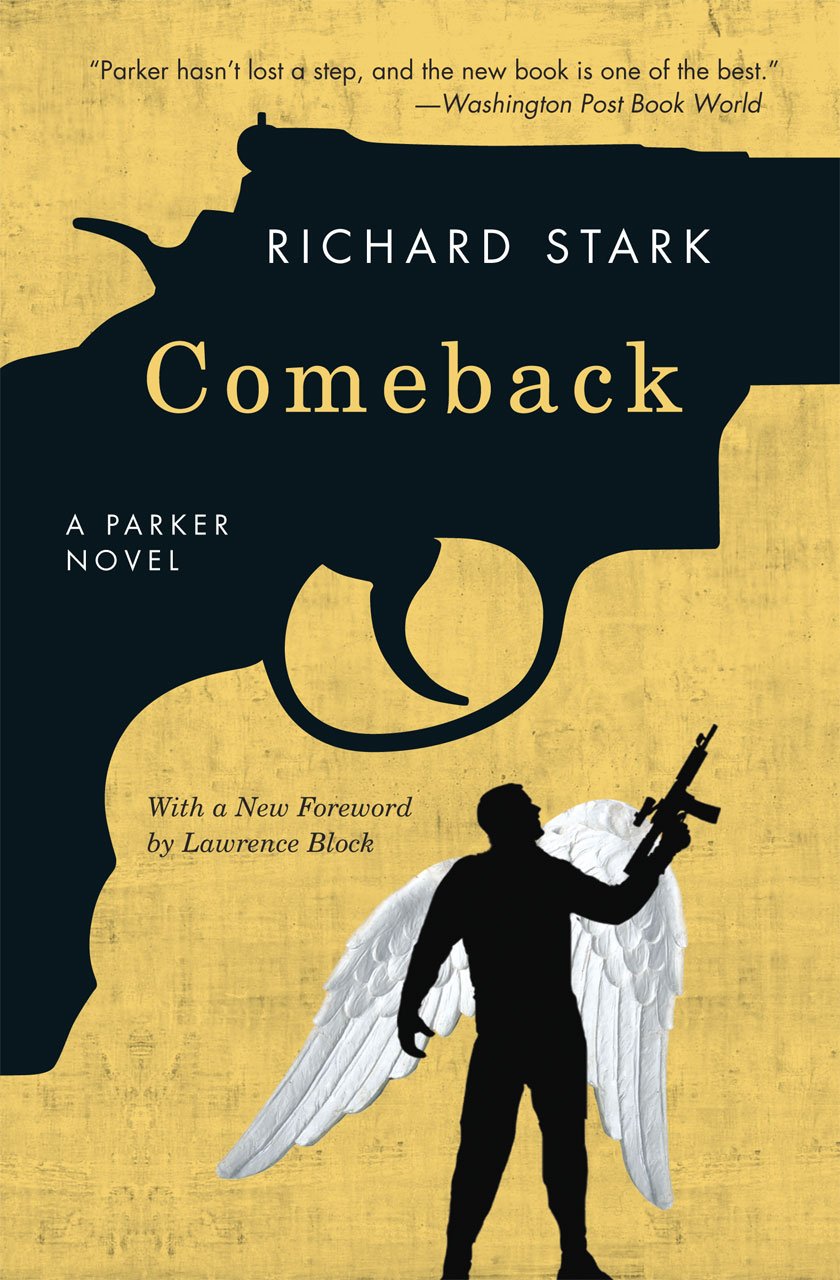
Comeback by Richard Stark (1997)

Richard Stark wrote Parker heist novels (perhaps better 

described as Parker-gets-back-his-share-of-the-

heist) from 1960 to 1974. 


The heists were varied nicely: armored cars, islands used as casinos, whole mountain towns with cash payrolls. The first four novels have one overarching storyline of Parker sweating and wrecking the outfit until it cries uncle.


Stark brought Parker back in 1997 with Comeback. Quite a comeback it is.


*   *   *


Where do you find a mountain of cash in the age of internet banking?


....Parker and George Liss had never worked together, though they'd come close. Twice, they'd met on other guys' deals that hadn't panned out. He had no real opinion about George Liss, except he thought he probably wouldn't want to count on him if things turned sour.

     The money situation at the moment was all right, but not perfect. There was cash here and there, stowed away. He could wait for something that smelled good. Even in a world of electronic cash transfers and credit cards and money floating in cyberspace, there were still heists out there, waiting to be collected.

     When the phone rang the second time, Parker was in the enclosed porch that faced the lawn and the lake and the boathouse, standing there, looking out. The day was overcast, and looked colder than it was. He picked up the phone on the third ring and said, "George?"

     "I've got something." The voice slurred a little, making a furry sound in the phone lines.

     Parker waited. George Liss could have a lot of things, including a need to turn someone else over to the law to take his place.

     Liss said, "It's a little different, but it's profitable."

     They were all different, and they were all supposed to be profitable, or you wouldn't do it. Parker waited.

     Liss said, "You still there?"

     "Yes."

     "We could get together someplace, talk it over."

     "Maybe."

     "You want to know who else is aboard." And again Liss waited for Parker to say something, but again Parker had nothing to say, so finally Liss said, "Ed Mackey."

     That was different. Ed Mackey was somebody Parker did know and had worked with. Ed Mackey was solid. Parker said, "Who else?"

     "It only takes three."

     Even better. The fewer the people, the fewer the complications, and the more the profit. Parker said, "Where and when?"

     They came together first in the parking lot of a lobster restaurant on Route 1 just south of Auburn, Maine, a place where a couple of rental cars from Boston's Logan Airport wouldn't look out of place. Parker left his Impala and crisscrossed through the parked cars to the Century Regal where Ed Mackey, blunt and taciturn, sat at the wheel with his girlfriend Brenda beside him and George Liss in the back seat. Parker joined Liss, a tall, narrow, black-haired man with a long chin, who nodded at him and smiled with the side of his mouth where the nerves and muscles still worked, and said, "Have a good flight?"

     This wasn't a sensible question. Parker said, "Tell me about it."

     "It's a stadium," Ed Mackey said, half-turning in the front seat, knees pointed at Brenda as he looked back at Parker. "Usual stadium security. Twenty thousand civilians inside."

     Parker shook his head. "All you walk out with," he said, "is credit card receipts."

     "Not this one," Liss said, and the left side of his face smiled more broadly. A sharpened spoon handle had laid open the right side, in a prison in Wyoming, eleven years ago. A plastic surgeon had made the scars disappear, but nothing could make that side of his face move again, ever. Around civilians, Liss usually tried to keep himself turned partially away, showing only the profile that worked, but among fellow mechanics he didn't worry about it. With the slight slurring that made his words always sound just a little odd, he said, "This one is all cash. Paid at the door."

     "They call it love offerings," Mackey said, deadpan.

     Parker tried to read Mackey's face. "Love offerings? What kind of stadium is this?"

     Liss explained, "The stadium's the usual. The attraction's a guy named William Archibald. A TV preacher, you know those guys? Evangelists."

     "I thought they were all in jail," Parker said.

     'The woods are full of them," Liss said, and Mackey added, "Mostly the back woods."

     Parker said, "He's preaching at this stadium, is that it?"

     "To make a movie," Mackey said, "and show it on the TV later."

     "The people walking in," Liss said, moving his hands around in the space between himself and Parker, "they put down a twenty-dollar love offering, every one of them. No exceptions. Twenty thousand people."

     Brenda spoke for the first time: "Four hundred thousand dollars," she said in her husky voice, rolling her full lips around the words.

     "Brenda does my math for me," Mackey said.

     "Plus," Liss said, "they got these barrels up front by the stage, you get inspired along the way, you want to help the preacher spread the word on the TV, you can go up and toss whatever money you want in the barrel."

     "On TV," Mackey said. "On the big screen up behind the preacher. I seen it work, Parker, it's like hypnotizing. These people love to see themselves on that big screen, walking right up there, tossing their cash in the old barrel. Then a month later, they're at home, TV on, there they are again. Live the moment twice. The day you gave the rent money to God."

     "We figure," Liss said, "that doubles the take."

     Brenda opened her mouth, but before she could say anything Mackey pointed at her and said, "Brenda. He can work it out."

     Parker said, "There's going to be more than the usual security, if it's all cash."

     "Archibald has his own people," Liss agreed.

     "But we got a guy on the inside. That's what made it start to happen."

     "Not one of us," Parker said.

     "Not for a minute," Mackey said.

     "He works for the preacher," Liss said. "And now he's mad at him."

     "Greedy? Wants a bigger slice?"

     "Just the reverse," Liss said, and half his face laughed. "Ol' Tom got religion."

     'Just tell it to me," Parker said.

     Mackey patted the top of the seatback, as though calming a horse. "It's a good story, Parker," he said. "Wait for it."

     People had to tell their stories their own way, with all the pointless extras. "Go ahead," Parker said, and sat back to wait it out.

     Liss said, "I had twenty-nine months' parole last time I got out. It was easier, just hang around and do it, then have a paper out on me the rest of my life. This guy Archibald, one of his scams is, his people volunteer to give this counseling to ex-cons. It's all crap and everybody knows it, it's just to find new suckers, and to get some kinda tax break."

     "A cash business," Parker said. "He's doing okay with taxes anyway."

     "Oh, you know he is. But William Archibald, he's one of those guys, the more you give him to drink, the thirstier he gets. So I drew this guy

     Tom Carmody to be my counselor, once a week he'd come around the place I was living, and then when he'd fill out the sheet, that meant I didn't have to go in to the parole office. A good deal for everybody. And after the first few weeks, we pretty much come clean with each other, and after that we'd just watch basketball on the tube or something, or have a beer around the corner. I mean, he knew what I was and no problem, and I knew what scam he was on, so we just got on with life. Except sometimes he'd go on crusades, and—"

     Parker said, "Crusades?"

     "When Archibald takes his show on the road," Liss explained. "Rents a hall, a movie house, a stadium, someplace big, does his act three, four times, brings in a couple mil, takes it all home again. Tom was one of the staff guys he brought along on these things, so then I'd get some gung ho trainee from the office instead, and I'd have to be real serious and rehabilitated and grateful as hell to Jesus and all this shit, and then when Tom came back we'd laugh about it. Only, then, about the last six months—yeah, two years we're dealing bullshit and we both knew it, and then the last six months he began to change it all around. Not trying to reform me or nothing. It was Archibald he got agitated about."

     Brenda spoke again, this time drily: "He noticed Mister Archibald was insincere."

     "He got hung up on the money," Liss said. "How Archibald takes all the suckers for all this money, and it doesn't go anywhere good. I dunno, Parker, it wasn't the scam that got ol' Tom riled up, it still isn't. It's what happens with the money after Archibald trims the rubes. He'd talk about all the good that money could do, you know, feed the homeless and house the hungry and all this, and then he wanted to know was there any way I knew that he could get a bunch of that cash. Not for himself, you see, but to do good works with it."


Jay

26 October 2020


Thursday, April 12, 2018

The gang plays detective: The Seventh by Richard Stark (1966)

….Somebody had taken one of the crossed swords from the wall and jammed it through her chest and through the padded headboard of the bed and into the plasterboard of the wall. She was stuck there like a scarecrow put away for the winter.

The guy who did it had a hell of an arm. Either that, or he'd brought a sledge along to hammer it the rest of the way after the first thrust.


The Seventh by Richard Stark (1966)


I've read the first seven Parker heist thrillers by Westlake/Stark, and the final eight. The Seventh is my favorite, and I'm in awe of its energy and drive. In this novel the author has pulled himself out of a tight corner: one of the string of bad guys doing the robbery does not have to be Parker's main enemy. The potboiling arbitrariness of coincidence can be allowed to provide a worthy nemesis.

In The Seventh, Parker and six other guys are hiding-out various places in a largish (perhaps midwestern) town after robbing a local college stadium on the day of the big game. One night Parker steps out of his apartment for ten minutes to get beer and cigarettes, and finds when he returns that the woman he was shacking up with has been murdered with an ornamental rapier.

To add injury to insult, whoever done it took the boodle from the stadium job, which the gang entrusted to Parker until they had a chance to split it seven ways and leave town.

Parker brings the gang back together. He convinces them that working together they can get their money back.

....Negli was sitting in the room's one chair, a foam-rubber and wrought-iron affair. He was as dapper as ever, dressed to the nines, busy unwrapping one of his long cigars. He said, 'You know better than this, Parker. It isn't time for us to contact each other. What if you brought the law here?'

'I didn't bring the law.'

Negli shrugged. 'Still,' he said, 'this had better be worth it.'

Parker studied him sourly. Negli had the little man's courage, the knowledge he could get away with things a bigger man would be called on in a minute. It gave him a nasty disposition, and made Parker itch to tromp him.

Feccio was the other half of the team, the apologizer.

'Parker knows what he's doing,' he said. 'If he's here, he's got a good reason.'

'Good enough,' Parker said. 'I was hijacked. The money's gone.'

Feccio just stared. Negli looked up from his cigar, and paused, and said, 'Stole it from you, Parker?' He said it like he didn't believe it.

Parker went over and picked him up and threw him into the corner. When Negli rolled over with his hand going inside his coat, Parker put his right hand in his topcoat pocket.

Feccio said, 'Cut it! Bob, don't you move!'

Negli stayed where he was, half up from the floor, right hand still inside the coat.

Feccio said, 'Parker, you know Bob's way. He didn't mean it like it sounded.'

Parker said, 'Let Negli talk.'

Negli said, 'I believe you, Parker. You had the dough and you let somebody glom it from you. I believe it.'

Feccio walked over in front of Negli and said, 'Cut it out, Bob, or I'll take care of you myself.'

'The hell, Arnie. What does he want, a medal? We put a lot of work in and he comes around and says he lost the money, somebody took it from him.'

'Let's listen to him, what do you say?'

Negli got to his feet, and brushed himself off. 'I'll listen to anybody,' he said.

Feccio turned to Parker. 'We start all over,' he said. 'You just tell the story and we'll listen.'

Parker told them the story. Feccio listened and Negli stood around trying to look insulting. Parker had control of himself now, and he ignored Negli. The little bastard wasn't worth the sweat.

When he was done, Feccio said, 'I like the outsider. Somebody wanted your girl dead and he found the cash by accident.'

Negli said, 'I haven't said word one to anybody outside the group about what we were doing. Neither has Arnie. What about you, talking to the girl? Or Dan and his bimbo?'

Parker shook his head. 'Neither one of us told our women anything to worry about.'

'Yours knew you had all that cash, didn't she?'

'She never left the apartment from the time I brought the suitcases in. She wasn't out of my sight for three days, not until I went out last night.'

Feccio said, 'All right, never mind that now. What do you want from us, that's the question.'

'If we work together, we can get our cash back.'

Feccio nodded. 'If we work together,' he said, 'and if we're lucky. And if the law doesn't get him first.'

'They'll be looking for me,' Parker said. 'They won't think about anybody else when I'm so handy.'

Negli said, 'That makes you a liability, doesn't it, Parker?'

Before Parker could say anything, Feccio said, 'Bob, keep your mouth shut. We don't have time to put up with you now.'

Parker said, 'Do you know where any of the others are holed up?'

'I know where Shelly is,' Feccio said. 'I think he knows where to find Clinger and Rudd.'

Negli said, 'What we ought to do, Arnie, we ought to clear out of here. That dough's gone.'

Parker said, 'Maybe not.'

Negli shook his head. 'You're a dreamer. If I had that cash, I'd be a thousand miles from here by now.'

'You're a pro. You wouldn't have hung around last night to ambush me.'

Feccio said, 'This is wasting time. Bob and I'll go talk to Shelly. You want us all to meet someplace?'

'At Dan's. I'll get there as soon as I can.'

'Fine.'

Parker went to the door, then looked back at Negli. 'You don't have to waste time with the rest of us,' he said. 'You want to take off, go ahead. We'll find something to do with your cut.'

Negli made a crooked grin around his cigar. 'Forget it, Parker,' he said. 'I own a seventh of that pie. As long as there's one chance left at it, I'll stick around.'

Parker said, 'That's what I thought.'


What makes The Seventh so unusual is the seeming randomness of the mystery the gang has to solve. They dig in to the murdered woman's past male associates. Parker, in a tight little scene, gets the notes from the police detective on the case.

Part Three of the novel gives Westlake/Stark the chance to break out of of the professional heister milieu and go into the mind of a character we'd typically find in a Robert Bloch novel from the 1950s. He's a homicidal nut, though he'd be the last person to realize it.

His inadvertent actions and ego let him advance where professionals would never tread.  At one point, Westlake/Stark hauls back on his narrative to send us this sling-shot about the guy: "....having made the mistake that would kill him."

We have to keep going after a line like that.

The other members of Parker's crew are beautifully realized. Each is given their minute to shine. I came away particularly fond of Little Bob and Arnie Feccio, a double act, and poor Abe Clinger:

....Abe Clinger was a businessman, not a crook. It was his nature to be a businessman, and only the force of circumstances had him temporarily playing the part of a crook, a temporary condition that had lasted now about twelve years.

Television was to blame. Television was a blot and a rotten thing, ruining the eyes of young America, an insidious monster in living rooms all across the nation, showing sex and sadism, people smoking and holding glasses full of beer, destroying the livelihood of honest businessmen trying to make an honest dollar even with the minimum wage going all the time up up up and taxes getting worse every year. Even with government intervention and payments for workmen's compensation and social security and all the rest of it, it might have been barely possible to keep an honest man's head above water, except for the rotten box, television.

Abe Clinger had owned a movie theater. But a movie, theater, the real thing, with a kiddie matinee on Saturday with twelve cartoons and a Western and a chapter, and beautiful dinnerware given away to the ladies on Wednesday evening, and always a double feature plus cartoon plus newsreel plus coming attractions, changed twice a week on Wednesday and Sunday. A nice friendly neighborhood theater that was like an institution almost, like the branch of the public library or the post office substation, a part of the neighborhood.

Until television.

Then, to make matters worse, when he burned the theater down for the insurance he did several things wrong and he got caught. His wife of twenty-six years, when she learned he'd borrowed to the hilt on his life insurance and was also letting it lapse because he was going to jail, divorced him. His two sons looked at him with disgust and reproach, said, 'Pop', in long-suffering voices, and went away to change their names.

But in jail he met a couple of people who made a new life possible for him, and when he got out on parole after spending the minimum time behind bars he was pretty sure he would never be bankrupt again. There was always work in the armed robbery line for a man who looked like a businessman or a bookkeeper or a general manager or whatever in the office type the job might require. Carrying guns always made him nervous nevertheless, and he was yet to fire one of them, but he understood it was necessary in this trade, like being a Democrat in his previous occupation. Still, the new line of work had its advantages, like no employees and no overhead and no long hours, and his blonde was a hell of an improvement over the former Mrs Clinger, and generally speaking he had no complaints....


You can tell Westlake/Stark enjoys having a large cast to narrate. In part three of any Parker novel we nearly always break away from following Parker. In part three of The Seventh we follow the killer, but we also follow the other six heisters as they go about their detective work to find the guy who took their money.

Not all will make it to their seventh of the one hundred thirty-four thousand dollars.


As one detective on the robbery case exclaims to another: "This one's a lulu!"


Jay
12 April 2018